Article
On the Cis
→
→
→
→
→
Trans
Isomerization of the Square-Planar [Pt(Cl)(SnCl
3)(PH
3)
2] Compound:
Ab
Initio
Gas Phase Reaction Mechanism and Solvent Effects Using Continuum Models
Willian R. Rochaa and Wagner B. de Almeidaa,b,*
a
Departamento de Química, ICEx, Universidade Federal de Minas Gerais, 31270-901, Belo Horizonte, MG, Brazil
b
Departamento de Química, ICE, Universidade Federal de Juiz de Fora, Campus Universitário, Martelos, 36.036-330, Juiz de Fora, MG, Brazil
A isomerização cis → trans do composto quadrático plano d8 [Pt(Cl)(SnCl3)(PH3)2] foi
investigada utilizando-se o nível ab initio de cálculo MP4(SDQ)//MP2. As estruturas otimizadas, localizadas na superfície de energia potencial em fase gasosa, indicam que esta reação se processa através de um estado de transição quase-tetraédrico. A influência dos efeitos eletrônicos dos ligantes no mecanismo da reação foi investigada utilizando-se o método de Análise de Decomposição de Carga (CDA), o qual forneceu suporte para a compreensão do forte efeito trans do ligante SnCl3. O efeito devido ao solvente na energia de reação em fase gasosa foi avaliado utilizando-se os
modelos contínuos SCRF e IPCM. Em ambos os casos um aumento na barreira de energia para o processo foi observado, sendo que a estabilidade termodinâmica dos isômeros cis e trans foi alterada pela solvatação.
The cis → trans isomerization of the d8 square planar [Pt(Cl)(SnCl3)(PH3)2] compound was
investigated at the MP4(SDQ)//MP2 level of theory. The optimized structures located on the gas-phase potential energy surface indicate that this reaction proceeds through a quasi-tetrahedral transition state. The influence of electronic effects of the ligands on the reaction mechanism was investigated with the Charge Decomposition Analysis (CDA) method, which gave support to understand the strong trans effect of the SnCl3 ligand. The solvent effect on the gas phase energy
reaction was evaluated using the SCRF and IPCM continuum models. In both cases, an increase on the energy barrier for the process was observed and, the thermodynamical stability of the cis and trans isomers was changed upon solvation.
Keywords: isomerization, square-planar [Pt(Cl)(SnCl3)(PH3)2], ab initio, solvent effects
Introduction
The square planar geometry is quite common amongst compounds of transition elements having d8 configuration, for example Rh(I), Ir(I), Pd(II), Pt(II) and Au(III). These 16-electron complexes can act as precursors, intermediates or products in several catalytic processes, where they can par-ticipate in associative elementary steps (in which they are readily converted into a 18-electrons compound) or in asso-ciative reactions, in which they can act as a 14-electrons species1-3. The existence of cis → trans isomerism in square planar d8 complexes is well known. The isomerization mecha-nism of compounds involving platinum group metals is of
particular interest due to their catalytic properties and to the fact that some isomers of this group show antitumor activity4. For example the cis isomer of cisplatin, [Pt(Cl)2(NH3)2], is a very active antitumor agent but, the trans isomer is inactive4a. On the other hand, the Pd analog of cisplatin, [Pd(Cl)2(NH3)2], is inactive4b. Some questions be-come apparent such as (i) how does the geometric arrange-ments affect the reactivity? (ii) what is the influence of the ligands and solvent on the relative stability of these isomers and on the isomerization mechanism?
Since the early 50’s several studies have appeared, try-ing to rationalize the factors which affect the relative stabil-ity of the isomers, as well as the reaction mechanism, for compounds of the MX2L2 type (where M=Pd(II), Pt(II); X=halide ion and L is a phosphine ligand). Indeed several interesting general rules about the solvent effects, electronic
effects of the phosphine and the electronegativity of the halides were obtained5-7. Most of these studies were carried out for compounds where the Pt-X bond is of the same na-ture. The situation becomes more challenging in compounds of the M(PR3)2XY type where the Pt-X and Pt-Y bonds are dissimilar, as in the process exemplified in Scheme 1. Com-pounds with the general formulation [Pt(Cl)(SnCl3)(PR3)2], possessing the Pt-Sn bond, have been shown to be highly active and selective in hydroformylation of olefins8. These compounds are formed in situ when SnCl2 reacts with cis-[Pt(Cl)2(PR3)2] through an insertion mechanism.
of the stationary points located on the Potential Energy Surface (PES) for the gas phase cis→trans isomerization reaction of the [Pt(Cl)(SnCl3)(PH3)2] heterobimetallic com-pound, as well as to study the nature of the Pt-ligand bonds. The second goal of this work is to evaluate the solvent effects on the gas phase PES for this reaction.
Recently much theoretical effort has been directed to the development of new methodologies to better understand reactive processes in solution. These methods can be clas-sified according to the form they treat explicitly the solute-solvent interactions, such as Molecular Mechanics force fields (MM)15, Empirical Valence Bond method (EVB)16 and the whole variation of hybrid Quantum Mechanics/ Molecular Mechanics potentials (QM/MM)17. The other models are based on an implicit approach, which treats the solvent as a dielectric continuum medium in which the sol-ute molecule is surrounded by a cavity, such as the Self Consistent Reaction Field method (SCRF)18, the Polariz-able Continuum Model (PCM)19, the Isodensity Polariz-able Continuum Model (IPCM)20 and the Generalized Con-ductor-like Screening Model (GCOSMO)21. The implicit and explicit approaches to treat the solute-solvent interactions have been successfully applied to understand the role of the solvent in some relevant organic reactions22. Despite some progress, the study of solvent effects on reactions involving transition metal compounds remains a challenge. Since many of these compounds are active catalytic spe-cies in homogeneous catalysis, which occurs in solution, these methodologies have to be extended to this kind of reactions. The explicit treatment of the solute-solvent in-teraction when the solute molecule is an organometallic compound is a hard task because of the intermolecular po-tential parametrization. To the best of our knowledge, the only study reported so far for such kind of reactions is due to Morokuma and co-workers23, who used the Honda-Kitaura potential24 to investigate the ligand substitution reaction [Pt(NH3)3(H2O)]2+ + Cl- → [Pt(NH3)3Cl]+ + H2O in solution. Based on the arguments presented in this sec-tion, this work can be viewed as an attempt to extend the continuum solvent approaches to study organometallic re-actions in solution, as well as to test the applicability of these models to such reactions.
Method of Calculation
Full geometry optimizations were performed at the sec-ond-order Møller-Plesset perturbation (MP2) level of theory, without any symmetry constraint, using the LANL2DZ ef-fective core potential (ECP) and valence double-x basis set of Hay and Wadt25 for the Pt and Sn atoms. For the P and Cl atoms, the split-valence basis set 6-31G(d)26, which
R3P Pt
Cl
PR3
SnCl3 Cl Pt
PR3
PR3
SnCl3
cis trans
Scheme 1
The 31P and 195Pt Nuclear Magnetic Resonance (NMR) characterization of the complexes that are formed in solu-tion when SnCl2 reacts with cis-[Pt(Cl)2(PR3)2] was
stud-ied by Pregosin and Sze9. The reaction scheme proposed by these authors is shown in Scheme 2. These authors found that the insertion of SnCl2 into the Pt-Cl bond in
cis-[Pt(Cl)2(PR3)2] is followed by rapid isomerization.
R3P Pt
Cl
PR3
Cl Cl Pt
PR3
PR3
SnCl3
R3P Pt
Cl
PR3
SnCl3
cis trans
+ SnCl2
CH2Cl2
cis
Scheme 2
The electronic effects of the phosphine and SnCl3- ligands on the thermodynamic stability of the isomers in the gas phase, as well as the insertion mechanism, were recently investigated theoretically by our group10. The application of this Pt-Sn catalytic system on the first step of the hydroformylation re-action was also investigated theoretically11.
includes a set of five d polarization functions, was used. For the spectator hydrogen atoms, we used a smaller split-valence 3-21G26 basis set. The valence basis set for the tin atom was augmented with a set of five d polarization func-tions, with an exponential coefficient of 0.18027. All the stationary points located on the gas phase potential en-ergy surface for the cis-[Pt(Cl)(SnCl3)(PH3)2] →
trans-[Pt(Cl)(SnCl3)(PH3)2] isomerization reaction (see Figure 1) were characterized as minima or transition state through harmonic vibrational frequency calculations. The calculated harmonic frequencies were also used to compute the en-tropy contribution to the energy variation. To obtain better energetic results, we carried out single-point calculations at the fourth-order Møller-Plesset perturbation level of theory (MP4) with single, double and quadruple excitations MP4(SDQ) on the MP2 optimized geometries, denominated MP4(SDQ)//MP2, using the same basis set.
The nature of the Metal-Ligand (M-L) bonds was in-vestigated through the Charge Decomposition Analysis (CDA) of Frenking and co-workers28, in which a Linear Combination of Fragment Orbitals (LCFO) is performed and the charge donation, charge backdonation and repulsive polarization between the molecular fragments are obtained. The CDA method has been shown to be a very suitable method to investigate the nature of M-L interactions29.
The solvent effects on the reaction energetics were evalu-ated using the thermodynamic cycle shown in Scheme 3, where the indices g, sol and solv stand for gas phase, solution and solvation, respectively.
( ) ( ) ( ) ( )
[
]
∆ ∆ ∆ ∆ G G E E sol sol solv solv 0 0 0 0TS Trans TS Trans
Trans TS → = → + − (2) ( ) ( ) ( ) ( )
[
∆∆ ∆ ∆]
G G E E sol sol solv solv 0 0 0 0Cis Trans Cis Trans
Trans Cis
→ = → +
− (3)
where DE0solv(N) is the solvation energy of the species N, obtained by the difference between the energy of the
Pt Sn Cl P1 P2 Cl Cl Cl
HH H
H H H 2.394 2.261 86.7 101.5 79.7 92.1 2.362 1.412 Sn Cl P1 P2 Pt Cl Cl Cl H H H H H 2.495 2.440 2.322 1.410 H
r(Pt-P1) = 2.385, r(Pt-P2) = 2.297; w(P1-Pt-P2) = 138.0; w(P1-Pt-Sn) = 93.0; w(P1-Pt-Cl) = 100.1; w(P2-Pt-Cl) = 121.2 w(P2-Pt-Sn) = 90.5; w(Cl-Pt-Sn) = 95.9
Cis(g) TS(g) Trans(g)
Cis(sol) TS(sol) Trans(sol)
∆G0solv(TS)
∆G0solv(Cis) ∆G
0 solv(Trans)
∆G0sol(Cis-TS) ∆G0sol(TS-Trans)
∆G0(g)(Cis-TS) ∆G0(g)(TS-Trans)
Scheme 3
What Scheme 3 tells us is that, in order to follow the reac-tion path in solureac-tion, we need to perform vibrareac-tional frequency calculations at every point on the gas phase PES necessary for the calculation of the free energy of solvation of each species, that is, of course, a difficult task. What we did was to assume that the gas phase PES has the same profile of the PES in solution so, Scheme 3 can be written as follows:
( ) ( ) ( ) ( )
[
∆∆ ∆ ∆]
G G E E sol sol solv solv 0 0 0 0Cis Trans Cis Trans
TS Cis
→ = → +
− (1)
C i s
TS Pt Cl P1 P2 Sn Cl Cl Cl H HH H H H 2.439 2.323 2.316 2.523 86.5 86.4 90.9 96.2 2.333 1.407 Trans
Figure 1. MP2 Optimized structural parameters for the
cis-[Pt(Cl)(SnCl3)(PH3)2] (Cis) isomer, Transition State (TS) and the
trans-[Pt(Cl)(SnCl3)(PH3)2] (Trans) isomer. Bond lengths are in
species N in gas phase and in solution. As formulated, we only add the difference in solvation energy of the involved species to the gas phase free energy. We can use even classical expressions to estimate the solvation energy of the species involved30.
Two continuum methods were used to evaluate the sol-vation energy of the Cis, TS and Trans species [∆E0solv(Cis), ∆E0solv(TS) and ∆E0solv(Trans)]. These methods have in common the fact that the solute molecule is treated as a charge distribution embedded in a polariz-able and continuum dielectric (solvent), characterized by a dielectric constant e. The solvation energy is described as a function of the interaction between the solute charge distribution (ρ) and the induced charges on the dielectric (solvent) (σ) (eq. 4). The solute-solvent interaction is re-duced to the determination of the electric potential (Φσ) generated by the charge distribution s, which is a conse-quence of the solvent polarization by the solute (eq. 4).
Vint= ∫ρΦ τd σ
τ (4)
The two continuum models used in this work differ in the way that the electrostatic potential Fsis obtained.
The first method used was the SCRF (Self Consistent Reaction Field)18, in which a homogeneous solute charge distribution is assumed and so, the cavity defined for the solute is symmetric (spherical in this case). In this situa-tion, the electric potential inside this cavity can be expressed as a multipolar expansion (eq. 5) and the solvation energy is given by Esolv=Vint/2.
(
)(
)(
)(
)
Φ(r) k k k 1 M k k 2 1=0 k 1 M l l k e r r e al 1 l
l 1 1
rr
a P cos
= − + ∑ + − + + ∑ ∑ = ∞ = ε
ε θ (5)
The first term on this multipolar expansion(l = 0) leads to the Born equation18e:
E q a l 2 = = − − 0 int 1 2 1 1 ε (6)
in which q is the solute net charge. If neutral molecules are considered, as in the present study, the next term which contributes to the solute-solvent interaction energy is l = 1, which gives the Onsager equation18f:
( ) El= = −
1 2 3 -1 +1 int 1 2 2 2 ε ε µ α (7)
where ε is the solvent dielectric constant, µ is the solute dipole moment and a is the cavity radius which is occupied by the solute molecule. So, the solute charge distribution is represented by a single-center multipolar expansion,
truncated at the dipolar term. As can be seen from equa-tions 5-7, the SCRF model is strongly dependent on the cavity radius assumed for the solute molecule. In this study, the spherical cavity radius for the solute was obtained tak-ing half the maximum distance between non-bonded atoms and adding half the van der Waals radii of the atoms which form this maximum distance. Using this approach, we obtained a cavity radius a0 of 4.472 Å for the Cis isomer, 4.099 Å for the Trans isomer and 4.196 Å for TS.
The other method used to study the solvent effects was the IPCM (Isodensity Polarizable Continuum Model)20, which uses a more realistic molecular-shape cavity, derived from the solute electron density. This method overcomes two main deficiencies of the SCRF approach: the assump-tion of a uniform charge distribuassump-tion and the symmetric shape of the cavity. In the IPCM method, s is given by eq. 8.
(
)
σ ∂ ∂ ρ σ = − + − − ε πε 1 4 Φ Φ n (8)where Φρ- designates the contribution from the solute charge distribution to the potential and Φσ- is the contri-bution due to the induced charge districontri-bution on the di-electric. The determination of the electrostatic potential Φσ (eq. 9) is carried out self-consistently.
Φσ( )r =∫∑σr s−(s)d s2 (9)
In all IPCM calculations an isodensity value of 0.001 elec-trons Å-3 was used. The SCRF and IPCM calculations were carried out in CH2Cl2 (e = 9.080) at the MP2 level of theory. The reason to choose this solvent is that the cis-[Pt(Cl)(SnCl3) (PH3)2], trans-[Pt(Cl)(SnCl3)(PH3)2] isomerization was
experi-mentally observed in dichloromethane9, so some compari-sons can be made. As CH2Cl2 is a non-coordinating solvent, consequently no specific solute-solvent interaction can be expected. The system investigated here seems to be good to test the adequacy of continuum solvent approaches to orga-nometallic reactions. All the calculations reported here were performed using the GAUSSIAN-94 package31.
Results and Discussion
Equilibrium structures, vibrational spectra, electronic effects of the ligands and relative energies in gas phase
Geometries
The MP2 optimized structural parameters obtained for the reactants cis-[Pt(Cl)(SnCl3)(PH3)2], (Cis), Transition State (TS), and the product trans-[Pt(Cl)(SnCl3)(PH3)2], (Trans)
obtained are in good agreement with experimental findings. For example, the optimized angles around the platinum metal, for the Cis and Trans isomers are a little distorted from the expected optimal value of 90° for a d8 square planar com-pound. The calculated Pt-P bond distances are in agreement with the experimentally observed values of 2.284 Å and 2.303 Å in [Pt(CH3)2(PCH3Ph2)2]32 and trans-[Pt(H)(SnCl3) (PPh3)2]8e, respectively. The Pt-Sn bond lengths of 2.561 Å in Cis and 2.523 Å in Trans are also in good accordance with the experimental Pt-Sn lengths of 2.634 Å in trans-[Pt(SnCl3)
(COPh)(PEt3)2]33, 2.601 Å in trans-[Pt(H)(SnCl3)(PPh3)2]8e and 2.600 Å in trans-[Pt(H)(SnCl3)(PCy3)2]34. The Sn-Cl
bond distances of 2.362 and 2.333 Å in compounds Cis and Trans agree with the experimental values of 2.283-2.367 Å found in the trans-[Pt(H)(SnCl3)(PPh3)2]8e complex. The structural parameters obtained for the transition state, TS, indicate that it is a quasi-tetrahedral species, arising from an intramolecular rearrangement, which can be viewed as a pseudorotation of the Cl-Pt-P1 angle in Cis, in which the Cl atom stays trans to the SnCl3 group and the phosphines trans to each other. The Pt-P1 bond length of 2.385 Å is shortened from its original value of 2.413 Å in the Cis isomer, and the Pt-Cl bond a little stretched.
In organometallic chemistry the structural parameters are a very rich source of information, from where some elec-tronic effects of the ligands can be qualitatively analyzed, such as the ability of some ligands to labilyze the bond trans to it, the so called trans influence. For example, the Pt-P bond distance trans to the SnCl3 group in the Cis isomer (2.413 Å) is greater than the Pt-P bond in the Trans isomer (2.320 Å), indicating that the SnCl3 group weakens the Pt-P bond trans to it. The Pt-Pt-Cl bond in Cis (2.394 Å) trans to the PH3 ligand is shorter than is the Pt-Cl bond length in Trans (2.439 Å) , also indicating the trans influence of the SnCl3 group. The Pt-Sn bond length of 2.495 Å in TS is shorter than the values found for the Cis (2.561 Å) and Trans (2.523 Å) isomers. This can be qualitatively explained by the fact that in TS the SnCl3 group does not have any ligand directly bonded trans to it and so, it can make a more effective interaction with the platinum atom. What these structural parameters tell us is that the SnCl3- ligand is a stronger trans director than the PH3 ligand and this ex-plains qualitatively why the isomerization takes place. These
facts will be discussed quantitatively later.
Vibrational spectra
The calculated vibrational frequencies for the Pt-Cl, Pt-Sn, Pt-P and Sn-Cl bonds are shown in Table 1. The values quoted in Table 1 are in good agreement with ex-perimental values obtained for similar compounds35. As can be seen from Table 1, the trans effect of the SnCl3 group is reflected in the vibrational spectra for the Cis and Trans isomers. The stretching frequency ν(Pt-P) for the PH3 trans to SnCl3 (259 cm-1) in the Cis isomer is shifted 114 cm-1 to the low frequency region, compared with the ν(Pt-P) for the Pt-P bond cis to SnCl3. It is inter-esting to note that the ν(Sn-Cl) and ν(Pt-Cl) appear in the same region of the spectra which makes difficult its ex-perimental attribution35. The calculated frequencies show that the most important vibrational frequencies are present in the low frequency region of the infrared (I.R) spectrum, which makes difficult the experimental identification of the Cis and Trans isomers by infrared spectroscopy. The transition state TS has one negative eigenvalue of 80 cm -1 and the normal mode associated with this frequency is shown in Figure 2. We have re-optimized the geometry of the TS structure as a minimum energy point on the PES in an attempt to verify if it optimizes to one of the isomers or to a probable intermediate. We found that the initial struc-ture is already a stationary point on the PES and when harmonic frequency analysis is performed we found one small imaginary frequency characterizing a first-order TS
Table 1. Main vibrational stretching frequencies for the [Pt(Cl)(SnCl3)(PH3)2] compound *.
Isomer ν(Pt-Cl) ν(Pt-P) ν(Pt-Sn) ν(Sn-Cl)
Calc. Expt. Calc. Expt. Calc. Expt. Calc. Expt.
Cis 334 328c 259a 442e 201 184-230g 345 408,
373b 427e 396h
Trans 312 206d 313c 415f 206 367
*All values in cm-1. aPt-P bond trans to SnCl
3, bPt-P bond cis to SnCl3. cin compound cis-[Pt(Cl)2(NH3)2]35, din compound trans-[Pt(Cl)2(NH3)2]35. ein compound cis-[Pt(Cl)
2(PEt3)2]35, fin compound trans-[Pt(Cl)2(PEt3)2]35, gref. 35, hin compound SnCl435.
structure, in spite of being on a flat region of the PES.
Electronic effects of the ligands
The nature of the M-L interactions was analyzed through the Charge Decomposition Analysis, CDA28, using the MP2 wavefunction. The results are shown in Table 2. There are several interesting points to be addressed here. First, as can be seen from Table 2, in all combinations analyzed, the magnitude of the charge donation from the PH3 fragment to the platinum fragment, [Pt(Cl)(SnCl3)(PH3)], is greater than is the backdonation term, which indicates that the PH3 fragment is a poor π-acceptor ligand. The compari-sons of the extent of backdonated charges of the two PH3 ligands in the cis-[Pt(Cl)(SnCl3)(PH3)2], (Cis isomer) can give some ideas, indirectly, about the amount of backdona-tion of the SnCl3 ligand. For example, the extent of backdo-nation from the PH3 fragment trans to the SnCl3 group in the Cis isomer (0.075 e) is lower than backdonation from the PH3 fragment cis to SnCl3 (0.202 e). This indicates that the SnCl3 fragment is withdrawing electron density from the platinum atom, which in turn, reduces the electron density available for donating to the PH3 group. So, The PH3 is competing unevenly with the SnCl3 group to withdraw elec-tron density from the platinum and this explains quantita-tively why the isomerization does occur. In fact, the back-donation from the platinum fragment, [Pt(Cl)(SnCl3)(PH3)], to the PH3 fragment trans to another PH3 ligand in the Trans isomer (0.139 e), gives support to this assertion.
A quantitative measurement of the trans effect of the SnCl3 group can be seen through the M-L interaction en-ergy quoted in Table 2. As can be seen, the Pt-P bond enen-ergy evaluated for the PH3 fragment cis to SnCl3 in the Cis isomer (50.9 kcal mol-1) is 26.3 kcal mol-1 higher than the Pt-P bond energy calculated for the PH3 fragment trans to SnCl3 (24.6 kcal mol-1) in this same isomer. That is, the SnCl3 ligand can weaken the Pt-P bond trans to it by ca. 26 kcal mol-1.
Relative energies
The relative energies obtained for the gas phase PES are quoted in Table 3 and the relative thermodynamic properties
are shown in Table 4. As can be seen from Table 3, the activa-tion energy, DE#, for the Cis→Trans isomerization is 26.9 kcal mol-1 and, the Trans isomer is ca. 7.0 kcal mol-1 more stable than the Cis one in gas phase. Table 3 also shows that there is no significant change in energy when the elec-tron correlation level is augmented up to fourth order of perturbation theory. The thermodynamic properties, evalu-ated at room temperature, shown in Table 4 give the follow-ing activation parameters for the gas phase Cis→Trans isomerization reaction: ∆S# = 2.0 cal K-1 mol-1, ∆H# = 26.7 kcal mol-1 and ∆G# = 26.1 kcal/mol. The reaction proceeds with ∆GCis→Trans of -7.7 kcal mol-1, ∆H Cis→Trans of -7.0 kcal mol-1 and ∆S Cis→Trans of 2.8 cal K-1 mol-1. From these data, it seems that the enthalpy changes will favor the Trans isomer much more than the entropy changes. This energetic Table 2. Total amount of charge donation, charge backdonation and bond energy obtained by the CDA method, using the MP2 wavefunction.
Interaction
Fragment Σ Donation Σ Backdonation energy
(kcal mol-1)
A B
PH3a Pt(Cl)(SnCl3)(PH3) 0.577 e 0.202 e 50.9
PH3b Pt(Cl)(SnCl3)(PH3) 0.565 e 0.075 e 24.6
PH3c Pt(Cl)(SnCl3)(PH3) 0.603 e 0.139 e 44.5
aPH
3 cis to SnCl3 in the cis-[Pt(Cl)(SnCl3)(PH3)2], Cis, isomer. bPH3 trans to SnCl3 in the cis-[Pt(Cl)(SnCl3)(PH3)2], Cis, isomer. cPH3 trans to
another PH3 group in the Trans isomer. o1cal = 4.18J.
Table 3. Relative energies (in kcal mol-1)* for the three stationary
points located on the gas phase PES for the isomerization reaction.
Cisa TS Trans
∆EM P 2 0 27.8 -6.9
∆MP2 + ZPE 0 26.9 -6.9
∆EMP4(SDQ)b 0 27.7 -7.0
aTotal energies for the Cis isomer are E
MP2=-2645.528958 a.u, Zero
Point Energy (ZPE)=0.063639 a.u, EMP4(SDQ)=-2645.618237 a.u. bSingle-point energy calculation on the MP2 optimized structures
(see text). *1cal=4.18J
Table 4. Zero point energies (ZPE), relative entropies (∆S), relative energies (∆E), relative enthalpies (∆H) and relative free-energy in gas phase for the Cis, Trans and TS structures* (T=298K)
Cis TS Trans
ZPE 39.9 39.1 40.0
∆S 0 2.0 2.8
∆H 0 26.7 -6.8
∆EMP2 0 27.7 -6.9
∆G a 0 26.1 -7.7
*All values are in kcal mol-1, except for the ∆S where cal K-1 mol-1 is
used. (1cal=4.18J) aEvaluated including electronic contribution and
thermal correction at 298K.
favoring of the Trans isomer in gas phase may be due to internal bond energy changes in the Trans isomer.
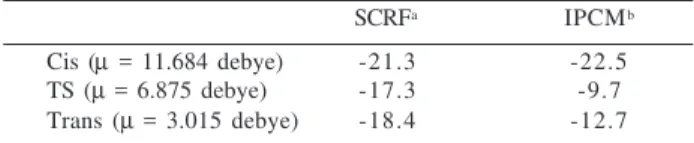
The solvation energy of Cis, TS and Trans are shown in Table 5. As can be seen, the SCRF results lead to higher stabilization energies in solution compared with the IPCM results. This can be explained by the fact that in the SCRF approach the solute-solvent interaction is modeled as a di-pole-dipole interaction and so, this method has a marked dependence on the solute dipole moment (a quadratic de-pendence, µ2), as can be seen in eq. 7. The SCRF results agree with the expected trend in solvation energy, where the species having higher dipole moment will be more stabilized in solution. That is, the Cis isomer (µ = 11.684 debye) is more stabilized than Trans (µ = 3.015 debye) and TS (µ = 6.875 debye). The IPCM gave different stabilization energies in solution, where the Trans isomer is more stabilized than TS. This is because in the IPCM model we do not assume a homogeneous solute charge distribution as in the SCRF method. The more proper atomic charge distribution in IPCM may give atomic charge polarization effects, which give rise to deviations from what would be expected if only the solute total dipole moment is considered. Thus, a species with the smallest overall dipole moment may still have the largest solvent stabilization energy, as in this case. Of course, this different solvent stabilization energies obtained by these two methods, will be reflected on the relative stability of the Cis and Trans isomer in solution, ∆G0sol (Cis→Trans), as can be seen in the relative free energy in solution, shown in Table 6. In the SCRF model the Trans isomer is 4.8 kcal mol -1 more stable than the Cis isomer. The IPCM model gave a reverse stability order, where the Cis isomer is 2.1 kcal mol-1 more stable than Trans. These IPCM results are in accor-dance with the experimental studies of Redfield and Nelson6. These authors evaluated the cis→trans relative stability of [Pd(Cl)2{PPh(CH3)2}2]in eleven different solvents and found that the cis isomer was more stable in all solvents analyzed. The assumption of a homogeneous charge distri-bution, the symmetric form to the cavity and the marked dependence on the solute dipole moment appear to make the SCRF approach more inconsistent than the IPCM. The sen-sitivity of the SCRF to the cavity radius (with a dependence of a0-3) is another problem. Different procedures to estimate a0 can lead to different results. In fact, we have some results showing that in order to reproduce the IPCM results, we have to use explicitly some solvent molecules in the SCRF treatment, an approach called Super-Molecule + SCRF (SM +SCRF)36. The two methods agree only on the free energy of activation in solution, where we have an increase, com-pared with the gas phase results, in both methods (30.1 kcal mol-1 in the SCRF approach and 38.9 kcal mol-1 in IPCM).
Assuming that the IPCM is our best solution result, we have two factors competing with each other: the strong trans effect of the SnCl3 ligand, which avoids placing the
Table 5. Solvation energy of Cis, Ts and Trans obtained by the SCRF and IPCM methods*.
SCRFa IPCMb
Cis (µ = 11.684 debye) -21.3 -22.5 TS (µ = 6.875 debye) -17.3 -9.7 Trans (µ = 3.015 debye) -18.4 -12.7 * All values in kcal mol-1 (1cal=4.18J); a Cavity radius a
0 of 4.472Å
for Cis, 4.099 Å for Trans and 4.196 Å for TS; b Isodensity of
0.001e
Table 6. Relative free energies in solution*
SCRF IPCM
DG0#sol (Cis→TS) 30.1 38.9
DG0sol (Cis→Trans) -4.8 2.1
* all values in kcal mol-1 (1cal=4.18J)
PH3 ligand trans to it and determines more stabilization of the trans-[Pt(Cl)(SnCl3)(PH3)2] isomer in gas phase, and the high dipole moment of the Cis isomer which makes it more stable in solution.
As was said before, several mechanisms can explain the cis→trans isomerization reaction in square planar com-pounds12. Most of these mechanisms are solvent assisted. The activation free energy found in this work for the Cis→Trans isomerization of [Pt(Cl)(SnCl3)(PH3)2], without the assistance of specific interactions of the solvent, seems to be high in gas phase (∆G# = 26.1 kcal mol-1) and in solution (∆G#SCRF = 30.1 kcal mol-1, ∆G#IPCM = 38.9 kcal mol-1) to explain this isomerization process. Combining the strong trans influence of the SnCl3 ligand, as was shown in this work, and the ability of the Pt-Sn bond to stabilize penta-coordinated intermediates11, another route for this isomerization reaction could be the displacement of the PH3 ligand trans to SnCl3 by a solvent molecule, which catalyze the isomerization of another molecule (see Scheme 4)
Scheme 4
Despite the fact that CH2Cl2 is a weakly coordinating solvent, the ability of such kind of solvents to displace strongly coordinated ligands from the transition metal can not be ruled out. For example, the loss of a PPh3 from Wilkinson’s catalyst, [RhCl(PPh3)3]37, is a crucial step in the catalytic cycle. Another example where this autocata-lytic pathway takes place is in the isomerization of [PtCl2(CO)L]38, which proceeds spontaneously in several solvents of the weakly coordinating type.
As can be seen, this is the challenge of treating solvent
cis-[Pt(Cl)(SnCl3)(PH3)2] [Pt(Cl)(SnCl3)(S)(PH3)]+ PH3
cis-[Pt(Cl)(SnCl3)(PH3)2] trans-[Pt(Cl)(SnCl3)(S)(PH3)]
Solvent
effects in organonometallic reactions, that is, even weakly coordinating solvents can affect drastically the reaction pathway and in fact, all sort of specific interactions (coor-dination of the solvent, interactions with coordinated ligands through hydrogen bond etc.) must be taken into account and so, the continuum approaches can not explain these phenomena.
Conclusions
In this work we investigated the energetic and reaction mechanism for the gas-phase cis→trans isomerization re-action of [Pt(Cl)(SnCl3)(PH3)2], at the MP4(SDQ)//MP2 level of theory. The solvent effects on the reaction ener-getic were evaluated using the Self Consistent Reaction Field (SCRF) approach and the Isodensity Polarizable Con-tinuum Model (IPCM). All the stationary points located on the gas-phase potential energy surface were fully optimized. The transition state (TS) structure obtained indicates that this reaction may proceed through a pseudorotation mecha-nism, leading to a quasi-tetrahedral structure for TS. The activation free energy obtained for the gas-phase reaction was 26.1 kcal mol-1. No significant change in energy was observed when the correlation level is increased up to fourth order. The electronic effects of the ligands on the isomer-ization reaction were evaluated through the analysis of the MP2 wavefunction with the aid of the Charge Decomposi-tion Analysis (CDA) method. This analysis indicates that SnCl3 is a strong trans director capable of weakening the Pt-P bond trans to it by 26.3 kcal mol-1. The CDA results gave explanation about why this isomerization does occur. The solvent effects on the energetic of the gas phase reaction were evaluated using the SCRF and IPCM con-tinuum approaches. In both cases an increase in the free energy of activation was observed (DG# = 30.1 kcal mol-1 using the SCRF approach and DG# = 38.9 kcal mol-1 with the IPCM method). The IPCM results gave an inverse ther-modynamic stability order, compared to the gas phase sta-bility, which can be attributed to charge polarization effects on the stabilization of the Trans isomer. Combining the strong trans influence of the SnCl3 ligand and the ability of the Pt-Sn to stabilize the penta-coordinated geometry, we proposed an autocatalytic mechanism for this reaction, which is solvent assisted. Based on the results presented here and on the facts that even weakly coordinating sol-vents can significantly change the reaction pathway through specific interactions, we believe that other treat-ments, taking into account all these interactions, are neces-sary to study organometallic reactions in solution. Our group is currently engaged in developing new tools for studying these reactions in solution. Despite the fact that
the solvent dynamics was not explicitly included in the present study, work is in progress aiming to model the dy-namic effects.
We are interested in understanding the substitution and isomerization reactions of square planar compounds, and other results will be available in future publications.
Acknowledgements
The authors would like to thank CNPq (Conselho Nacional de Desenvolvimento Científico e Tecnológico) for support. We would like to thank Dr. Hélio F. Dos Santos for useful discussions. This work was partially supported by PADCT (Programa de Apoio ao Desenvolvimento Científico e Tecnológico, Proc. No. 620241/95.0) from the Science and Technology Ministry (MCT) of Brazil and FAPEMIG (Fundação de Amparo à Pesquisa no Estado de Minas Gerais). W.B. De Almeida would like to thank the Pró-Reitoria de Pós-Graduação e Pesquisa (PROPP), Universidade Fed-eral de Juiz de Fora, for a Visiting Professor Fellowship.
References
1. Tolman, C. A. Chem. Soc. Rev. 1972, 1, 337.
2. Braterman, P. S.; Cross, R. J. Chem. Soc. Rev. 1973, 2, 271.
3. Basolo, F.; Pearson, G. Mechanism of Inorganic
Reactions, 2nd edn., Wiley: New York, 1967.
4. (a) Farrel, N. Transition Metal Complexes as Drug and
Chemotherapeutic Agents, Kluwer Academic,
Dordrecht, 1989. (b) Gill, D. S. Platinum Coordination
Complexes in Cancer Chemotherapy; Martinus Nijhoff:
Boston, 1984. (c) Fricker, S. P. Metal Compounds in
Cancer Therapy, Chapmann&Hall: London, 1994.
5. (a) Chatt, J.; Wilkins, R. G. J. Chem. Soc. 1952, 273.
(b) Chatt, J.; Wilkins, R. G. J. Chem. Soc. 1952, 4300.
(c) Chatt, J.; Wilkins, R. G. J. Chem. Soc. 1953, 70. (d)
Chatt, J.; Wilkins, R. G. J. Chem. Soc. 1956, 525.
6. Redfield, D. A.; Nelson, J. H. Inorg. Chem. 1973, 12, 15.
7. (a) Verstuyft, A. N.; Nelson, J. H. Inorg. Chem. 1975,
14, 1501. (b) Louw, W. J. Inorg. Chem. 1977, 16, 2147.
8. (a) Scrivanti, A.; Berton, A.; Toniolo, L.; Bottteghi, C.
J. Organomet. Chem. 1986, 314, 369. (b) Parrinelo, G.;
Stille, J. K. J. Am. Chem. Soc. 1987, 109, 7122. (c)
Kóllar, L.; Consiglio, G.; Pino, P. J. Organomet. Chem. 1987, 330, 305. (d) Kóllar, L.; Bagos, J.; Tóth, I.; Heil,
B. J. Organomet. Chem. 1988, 350, 277. (e) Gómez,
M.; Muller, G.; Sainz, D.; Sales, J. Organometallics 1991, 10, 4036. (f) Holt, M. S.; Wilson, W. L.; Nelson,
9. Pregosin, P. S.; Sze, S. N. Helv. Chim. Acta 1978, 61, 1848.
10. Rocha, W. R.; De Almeida, W. B. Int. J. Quantum Chem. 1997, 65, 643.
11. Rocha, W. R.; De Almeida, W. B. Organometallics 1998, 17, 1961.
12. Anderson, G. K.; Cross, R. J. Chem. Soc. Rev. 1980, 9, 185.
13. Berry, R. S. J. Chem. Phys. 1960, 32, 933.
14. (a) Ozawa, F.; Ito, T.; Nakamura, Y.; Yamamoto, A. Bull. Chem. Soc. Jpn. 1981, 54, 1868. (b) Paonessa, R. S.;
Trogler, W. C. J. Am. Chem. Soc. 1982, 104, 3529.
15. Jorgensen, W. L. Acc. Chem. Res. 1989, 22, 184.
16. Aqvist, J.; Warshel, A. Chem. Rev. 1993, 93, 2523.
17. (a) Field, M. J.; Bash, P. A.; Karplus, M. J. Comp. Chem. 1990, 11, 700. (b) Singh, U. C.; Kollman, P. A. J. Comp. Chem. 1986, 7, 718. (c) Gao, J. in Reviews in
Computational Chemistry, Lipkowitz, K. B.; Boyd, D.
B., Eds., VCH: New York, 1996, 7, 119.
18. (a) Rivail, J. L.; Terryn, B.; Ruiz-Lopez, M. F. J. Mol.
Struct.: Theochem1985, 120, 387. (c) Tapia O. in
Molecular Interactions; Orville-Thomas, W. J., Ed.,
Wiley: New York, 1982, vol. 3, chapter 2. (d) Wong, M. W.; Frisch, M. J.; Wiberg, K. B. J. Am. Chem. Soc. 1991, 113, 4776. (e) Born, M. Z. Phys. 1920, 1, 45. (f)
Onsager, L. J. Am. Chem. Soc. 1936, 58, 1486.
19. Miertus, S.; Scrocco, E.; Tomasi, J. Chem. Phys. 1981, 55, 117.
20. Foresman, J. B.; Keith, T. A.; Wiberg, K. B.; Snoonian, J.; Frish, M. J. J. Phys. Chem.1996, 100, 16098.
21. Truong, T. N.; Nguyen, U. N.; Stefanovich, E. V. Int. J. Quantum Chem. 1996, 60, 1615.
22. (a) Duffy, E. M.; Severance, D. L.; Jorgensen, W. L. J. Am. Chem. Soc. 1991, 114, 7535. (b) Straub, J. E.;
Borkovel, M.; Berne, J. B. J. Chem. Phys. 1988, 89,
4833. (c) Truong, T. N.; Truong, T. T.; Stefanovich, E. V. J. Chem. Phys. 1997, 107, 1881. (d) Chandraskar, J.;
Smith, S. F.; Jorgensen, W. L. J. Am. Chem. Soc. 1984, 106, 3049. (e) Gao, J.; Xia, X. J. Am. Chem. Soc. 1993, 115, 9667. (f) Warshel, A. J. Phys. Chem. 1982, 86,
2218. (g) Barder, J. S.; Chandler, D. Chem. Phys. Lett. 1989, 157, 501. (h) Pérez, V.; Liuch, J.; Bertrán, L. J. Comp. Chem. 1992, 13, 1057. (i) Blake, J. F.; Jorgensen,
W. L. J. Am. Chem. Soc. 1991, 113, 7430.
23. Muguruma, C.; Koga, N.; Kitaura, K.; Morokuma, K.
J. Chem. Phys. 1995, 103, 9274.
24. Honda, K.; Kitaura, K. Chem. Phys. Lett. 1987, 140, 53.
25. Hay, P. J.; Wadt, W. R. J. Chem. Phys. 1985, 82, 270.
26. Hehre, W. J.; Ditchfield, R.; Pople, J. A. J. Chem. Phys. 1972, 56, 2257.
27. Höllwarth, A.; Böhme, M.; Dapprich, S.; Ehlers, A.; Gobbi, A.; Jonas,V.; Köhler, K. F.; Stegmann, R.; Veldkamp, A.; Frenking,G. Chem. Phys. Lett. 1993, 208, 237.
28. Dapprich, S.; Frenking, G. J. Phys. Chem. 1995, 99, 9352.
29. (a) Antes, I.; Frenking, G. Organometallics1995, 14,
4263. (b) Dapprich, S.; Frenking, G.; Angew, Chem. 1995, 107, 383. Angew. Chem. Int. Ed. Engl. 1995, 34, 354. (c) Frenking, G.; Pidum,U. J. Chem. Soc., Dalton Trans., 1997, 1653.
30. De Almeida, W. B.; Dos Santos, H. F.; Rocha, W. R.; Zerner, M. C. J. Chem. Soc., Dalton Trans. 1998, 15, 2531.
31. GAUSSIAN 94 (revision A.1). Frisch, M. J.; Trucks,
G. W.; Schlegel, H. B.; Gill, P. M. W.; Johnson, B. G.; Robb, M. A.; Cheeseman, J. R.; Keith, T. A.; Peterson, G. A.; Montgomery, J. A.; Raghavachari, K.; Al-Lahan, M. A.; Zakrzewski, V. G.; Ortiz, J. V.; Foresman, J. B.; Cioslowski, J.; Stefanov, B. B.; Nanayakkara, A.; Challacombe, M.; Peng, C. Y.; Ayala, P. Y.; Chen, W.; Wong, M. W.; Andres J. L.; Replogle, E. S.; Gomperts, R.; Martin, R. L.; Fox, D. J.; Binkley, J. S.; Defrees, D. J.; Baker, J.; Stewart, J. P.; Head-Gordon, M.; Gonzalez, C.; Pople, J.A. Gaussian, Inc., Pittsburgh, PA, 1995. 32. Wisner, J. M.; Bartchak, T. J.; Ibers, J. A.; Low, J. J.;
Goddard III, W. A. J. Am. Chem. Soc. 1986, 108, 347.
33. Albinati, A.; Gunten, U. N.; Pregosin, P. S.; Ruegg, H. J. J. Organomet. Chem. 1985, 295, 239.
34. Del Pra, A.; Forsellini, E.; Bomberi, G.; Michelin, R. A.; Ros, A. J. Chem. Soc., Dalton Trans. 1979,1862.
35. Nakamoto, K. Infrared and Raman Spectra of
Inorganic and Coordination Compounds, 4th ed.,
Wiley: New York, 1986.
36. Dos Santos, H. F.; O’Malley, P. J.; De Almeida, W. B.
Theor. Chem. Acc. 1998, 99, 301.
37. Tolmann, C. A.; Meakin, P. Z.; Lindwer, D. L.; Jesson, J. P. J. Am. Chem. Soc. 1974, 96, 2762.
38. Anderson, G. K.; Cross, R. J. Inorg. Chim. Acta, 1979, 38, L21.
![Figure 1. MP2 Optimized structural parameters for the cis- cis-[Pt(Cl)(SnCl 3 )(PH 3 ) 2 ] (Cis) isomer, Transition State (TS) and the trans-[Pt(Cl)(SnCl 3 )(PH 3 ) 2 ] (Trans) isomer](https://thumb-eu.123doks.com/thumbv2/123dok_br/18988574.459788/3.892.500.716.137.833/figure-optimized-structural-parameters-isomer-transition-state-trans.webp)