LiLT volume 14, issue 5 August 2016
Modality annotation for Portuguese: from
manual annotation to automatic labeling
Am´alia Mendes1, Iris Hendrickx1,2, Luciana ´Avila1,5, Paulo Quaresma3,4, Teresa Gonc¸alves3 and Jo˜ao Sequeira3, 1Center for Linguistics, University of Lisbon, Portugal
2 Center for Language Studies/Center for Language and Speech Technology, Radboud University, Nijmegen, The Netherlands 3Department of Informatics, University of ´Evora, Portugal
4L2F – Spoken Language Systems Laboratory, INESC-ID, Portugal 5Universidade Federal de Vi¸cosa, Brazil
Abstract
We investigate modality in Portuguese and we combine a linguistic perspective with an application-oriented perspective on modality. We design an annotation scheme reflecting theoretical linguistic concepts and apply this schema to a small corpus sample to show how the scheme deals with real world language usage. We present two schemas for Por-tuguese, one for spoken Brazilian Portuguese and one for written Euro-pean Portuguese. Furthermore, we use the annotated data not only to study the linguistic phenomena of modality, but also to train a practical text mining tool to detect modality in text automatically. The modal-ity tagger uses a machine learning classifier trained on automatically extracted features from a syntactic parser. As we only have a small an-notated sample available, the tagger was evaluated on 11 modal verbs that are frequent in our corpus and that denote more than one modal meaning. Finally, we discuss several valuable insights into the complex-ity of the semantic concept of modalcomplex-ity that derive from the process of manual annotation of the corpus and from the analysis of the results of the automatic labeling: ambiguity and the semantic and syntactic
properties typically associated to one modal meaning in context, and also the interaction of modality with negation and focus. The knowl-edge gained from the manual annotation task leads us to propose a new unified scheme for modality that applies to the two Portuguese varieties and covers both written and spoken data.
1
Introduction
There has been a growing interest in text mining applications that can automatically detect opinions, facts and sentiments in texts. Many of the current opinion or sentiment mining applications use a crude divi-sion between negative, neutral and positive sentiments. Modality, de-fined from a linguistic perspective as the speaker’s attitude towards the proposition in the text (Palmer, 1986) offers a theoretical framework to make more fine-grained distinctions between different attitudes. For example, one can detect whether the speaker expresses his or someone else’s commitment, hope, belief or knowledge about a certain proposi-tion.
In this paper we aim to combine a linguistic perspective with a practical and application-oriented perspective on modality. On the one hand we design an annotation scheme reflecting theoretical linguistic concepts and apply this schema to corpus data to fit with real world language usage. On the other hand we use the annotated data not only to study the linguistic phenomena of modality, but to train a practical text mining tool to detect modality in text automatically.
The concept of modality is related to factivity, evidentiality, hedg-ing, and is consequently grounded on notions of subjectivity and atti-tude. The study of modality relates to the question of how subjective language use is. How many of our utterances and sentences are modal-ized? How is subjectivity and attitude grammaticalized in the sentence through modal markers? Are certain genres more prone to subjectivity? And how successful can we be in dealing with modality in automatic processing systems?
These questions depart from a purely formal approach to language and move into a cognitively grounded discourse perspective. While cer-tain linguistic aspects such as morphology, lexicography and syntax have been addressed in interdisciplinary studies combining theoretical and computational approaches that have produced a body of available resources, other aspects such as semantics and discourse are still lack-ing the same level of attention. Although modality has been intensively explored from a theoretical linguistic perspective, there are few theo-retical studies relying on corpus data and no concerted effort to create
a resource covering this topic.
In this paper we aim to contribute to filling this gap and provide an annotation schema for modality based on linguistic theory but firmly grounded by applying and revising the schema based on corpus anno-tation. This schema is also evaluated from a computational perspective as we use the annotated data to train an automatic modality tagger intended to be part of a Text Mining application. Moreover, many of the existing efforts in this domain are applied to written texts, while we discuss here the annotation of both written and spoken data. Further-more, while most work on human and automatic annotation of modality is focused on English, we provide feedback on another global language, Portuguese, and address language diversity by covering two national varieties of Portuguese (Brazilian and European).
Corpus annotation does not solely provide the basis for text mining applications, but sheds new light on linguistic issues. Indeed, we believe that corpus annotation triggers research questions left untouched when exclusively assessing constructed samples and allow to redefine cate-gories after assessing the contexts. First, the specific task of labeling each modal marker in context challenges the usual theoretical perspec-tives that center on specific lexical items, mainly semi-auxiliary verbs, and leads us to reflect on the diversity of modal markers, providing the necessary data for an approach at the crossroad with typological linguis-tics. Second, this has implications over the modal types traditionally described in linguistics. It is necessary to address the complexity of cor-pus data and keep a balance between achieving accuracy and preventing the proliferation of labels. This inevitably requires an investigation of the role played by modal marker’s ambiguity. Third, the analysis of corpus data will also provide empirical insights into theoretical issues to modality: modal logic (Kratzer, 2013) and discourse-focused modal-ity (Bybee and Fleischman, 2013); propositional modalmodal-ity and event modality (Palmer, 2001). Finally, embedding the annotation in actual corpus data reveals the interaction of modal markers with systems such as negation and focus, which falls outside modality but may affect the modal interpretation.
Computationally, the automatic identification and interpretation of modalized statements is a prime concern in a large number of applica-tions, especially with the recent attention to opinion mining and social networks. As the vast amount of digitally available data keeps growing, so does the demand to automatically extract relevant information. We see a clear trend in information extraction applications to go beyond the extraction of pure facts, to focus on personal opinions in sentiment analysis and opinion mining, and to distinguish between factual and
probable information (Saur´ı et al., 2006), to detect uncertainty, specu-lation and negation, especially in biomedical text mining (Baker et al., 2010, Matsuyoshi et al., 2010, Szarvas et al., 2008). Modality detection is therefore also clearly linked to the current trend in NLP on sentiment analysis and opinion mining.
We will report on the two modality annotation schemes designed for Portuguese, each addressing a specific national variety and a specific text type. The European Portuguese (EP) scheme was envisaged as genre independent and tested on written data, while the Brazilian Por-tuguese (BP) scheme was designed for spontaneous speech, and modal-ity is taken as the evaluation or the point of view of a conceptualizer towards the locutory material in a given utterance in a communicative act. Both schemes cover different grammatical categories that convey modal values, such as adjectives, adverbs, nouns and verbs which we will denote as modal trigger in the rest of this paper. The EP scheme has been manually applied to a small written sample of 160K tokens (Hen-drickx et al., 2012a) while the BP scheme was manually applied to a spoken sample of the CORAL-BRASIL spoken corpus ( ´Avila, 2014).
The EP annotated sample was used as the basis for the development of a software tool that can automatically detect modal triggers and their scope in text. Such automatic tool has many practical applications in the area of automatic document understanding or information extrac-tion. The first experiment has been to automatically label a subset of 11 highly frequent and ambiguous modal verbs. For instance, the Por-tuguese verb poder is highly ambiguous and can express multiple modal meanings: “to be possible”, “to be able” or “to give permission”. This polysemy increases the level of difficulty of the automatic annotation task. To create the modality tagger, we first automatically assign lem-mas, POS and syntactic tags, we then automatically identify modal triggers and apply a machine learning approach to attribute a modal value to the triggers, comparing the results with our gold (manually annotated) labeling.
Constructing an automatic modality tagger requires a data set with labeled examples to train and evaluate the tagger. As we are currently in need of a suitable data set, one of the goals of the current experiments is to develop an automatic modality tagger on a small manually labeled sample that can later be applied (semi-automatically) to generate a larger data set.
Our paper first discusses related work on modality, its annotation and automatic labeling in section 2. The two schemes are presented in section 3. The automatic labeling tool trained over the EP corpus is presented in section 4. In section 5 we discuss several valuable insights
into the complexity of the semantic concept of modality that the process of manual annotation of the corpus, its linguistic exploration and the analysis of the results of the automatic labeling have provided us. In the last two sections we discuss the next steps that we aim to take such as using a unified approach to modality annotation presented in section 6 and we conclude in section 7.
2
Related work
Modality is traditionally grounded in epistemic modality, which is con-cerned with the truth-value of the proposition: whether the proposition is considered by the speaker (or another entity) as certain, uncertain, possible, probable etc. In languages with no modality-exclusive mor-phological system, such as English or Portuguese, research has mainly focused on semi-auxiliary modal verbs, e.g., can, may, must. For in-stance one can have different perspectives on the proposition (Ana buy a house), such as: Ana may buy a house, Ana must buy a house, Ana can buy a house. Other modal types besides epistemic modality have been proposed that reflect some degree of subjectivity towards the proposi-tion (or towards the event). Although terminologies vary considerably, the concepts at hand are relatively constant: they include notions of obligation and permission, of capacity and necessity, of evidentiality (what is the source of information), wish and evaluation. This broader scope of modal types is reflected in the growing attention to a large set of linguistic categories that may convey modal values, such as tense af-fixes, mood, auxiliary verbs, main verbs, adjectives, adverbs and multi-word expressions. In fact, several lexical items conveying modality may occur in the same context, and, furthermore, many of these items are ambiguous between one or more modal values. The complexity of the phenomenon does not undermine its importance in language to con-vey attitudinal information, such as belief, uncertainty, factuality and evidentiality.
Most of the research on modality has been based on constructed examples, although the importance of looking at modal items in context is increasingly acknowledged, on a par with a clear trend in Corpus Linguistics and Natural Language Processing (NLP) to go beyond the part-of-speech (POS) and syntactic levels and to include semantics, pragmatics and supra-sentential information.
This interest gave rise to some proposals for the annotation of modal-ity in corpora, mainly for the English language. The annotation schemes covering modality differ greatly in their objectives and in the nature of the concepts that are labeled (Nissim et al., 2013). According to
Nissim and Pietandrea (2015),
computationally, the automatic identification and interpretation of modalized statements is a prime concern in a large number of applica-tions, especially with the recent attention to opinion mining and social networks (pp. vii)
but
the computational linguistics community is still far from having devel-oped working, shared standards for converting modality-related issues into annotation categories. (pp. vii)
Modality may be one aspect of the semantic information encoded in the properties of events (cf. (Baker et al., 2010, Matsuyoshi et al., 2010, Nirenburg and McShane, 2008, Song et al., 2015, Szarvas et al., 2008)) or it can be the core of the scheme. For instance Rubinstein et al. (2013) use a restricted notion of modality and establish conditions for an expression to be considered modal, such as the requirement for a propositional argument. In other cases, modal values are included in annotation schemes that cover both factuality and modality, as in the work of Saur´ı et al. (2006) that distinguish between factual and prob-able information, while Lee et al. (2015) specifically address factuality, rated on a scale of -3 (certainly did not happen) to 3 (certainly did).
Different annotation schemes also diverge in what textual elements they annotate: the modal value may be attributed globally to the sen-tence/event or it can be encoded on specific lexical items. The ap-plied nature of these studies leads to detailed description of the tex-tual elements involved in the expression of modality and the roles they have: most schemes identify a modal trigger, the subject of the modal-ity (source) and the elements in the scope of the modal trigger (tar-get/scope/focus).
The availability of large sets of data annotated with modality pro-vides important insights on the interaction between modality and other linguistic systems, such as negation (Morante and Sporleder, 2012) and focus (Mendes et al., 2013, Moreira, 2005). Another application of these data sets are experiments in the automatic annotation of modal values for information extraction and data mining. In BioNLP, Miwa et al. (2012) annotated pre-recognized events with the epistemic value “level of certainty” and attain F-measures of 74,9 for “low confidence” and 66,5 for “high but not complete confidence”. The factuality-oriented scheme presented by Saur´ı et al. (2006) has been applied in an exper-iment of automatic identification of events and their modal features in text, and attains 97.04 accuracy with the EviTA tool. A specific task for detecting uncertainty through the use of hedging clues was
organized at CoNLL2010 (Farkas et al., 2010). Contrary to these ap-proaches, Baker et al. (2010) include both trigger and target in their experiments, and attain 86% precision with a structure-based tagger over 249 modality-tagged sentences from the English side of the NIST 09 MTEval training sentences. The approach of Diab et al. (2009) covers modality but is essentially geared towards the identification of belief. Contrary to our own approach, the authors do not take into considera-tion the polysemy of the auxiliary verbs and only encode the epistemic value, although they do report that the verbs may be deontic in some contexts. This experiment has been extended to other modality val-ues (ability, effort, intention, success and want) (Prabhakaran et al., 2012). The work of Ruppenhofer and Rehbein (2012) focuses on En-glish modal verbs. The five EnEn-glish modal verbs (can/could, may/might, must, ought, shall/should) were first identified in texts and their modal values were predicted by training a maximum entropy classifier on fea-tures extracted from the training set. The classifier achieved an im-provement of the most frequent sense baseline for all verbs but must, and accuracy numbers between 68.7 and 93.5. Our experiments pre-sented in Section 4 are closely related to this type of automatic modal verb labeling. This brief overview of related work has shown the di-versity of objectives, annotation choices and evaluation metrics, which makes it difficult to compare results.
3
Annotation schemes
We present two separate modality annotation schemes for Portuguese. Although they apply to different varieties of Portuguese, the general structure of the schemes is very similar. For instance, the range of phenomena that are not considered as modality, and are not annotated, is almost equivalent in both schemes:
.
Although tense contributes to modality and interacts with the modal values in the sentences, it is not annotated. The schemes do not tag the past tense (although it provides certainty about the realization of an event), nor future (possibility) nor conditional tense1..
Declarative clauses with no modal triggers convey an assertion and may have an epistemic reading of belief (and even factual-ity) (Palmer, 1986), but both schemes consider the declarative sen-tence type as non-modal or as representing the unmarked level of modality (John Lyons, 1977, Oliveira, 1988).1Note however that the conjunction introducing the conditional clause is
.
The Evidential modal type, i.e., contexts where the source provides some kind of evidence for his belief (for instance: I believe it is a good movie, based on the reviews), are also not annotated as a separate value, and instead are marked as epistemic belief..
Aspectual verbs as continuar a ‘continue to’, passar a ‘change to’, acabar de ‘stop’ signal the continuation of a state or event or a change of state, and are not annotated..
We only annotate events, not entities. This proved especially impor-tant with the modal value evaluation, since many cases of evaluation have scope over entities.3.1 Annotation scheme for written European Portuguese The annotation scheme components comprise the trigger (which is the lexical clue conveying the modal value), its target, the source of the event mention (speaker or writer) and the source of the modality. The source of the event mention and the source of the modality are in many cases the same entity: the speaker/writer produces a discourse/text unit where he/she states his/her belief or doubt or the possibility that some-thing may happen. However, they may also be different entities when the text presents the views of someone else than its producer. The annotation was performed over each trigger, and not over the global interpretation of the sentence. The trigger receives an attribute modal value, while both trigger and target are marked for polarity. This fea-ture describes the positive or negative polarity of the trigger and not the polarity of full sentences. A trigger may be marked with negative polarity by a negation adverb, or the negative polarity can be expressed morphologically by an affix (improbable) or by the lexical verbal form itself (proibir ‘forbid’).
The choice of the size of the components to be annotated is a chal-lenge. To achieve some level of consistency, we were inspired by the “min-max strategy” presented by Farkas et al. (2010). The trigger is annotated as the smallest possible unit (for example only the head noun in a noun phrase), while the target is annotated maximally and include all relevant parts. Adverbial adjuncts are included only when they are structurally inside the scope of the target, in order to avoid a prolif-eration of discontinuous targets. It is nevertheless difficult to establish exactly what is to be considered relevant and annotators still differ in this regard. For the sources, we annotate full noun phrases or verbs. In fact, as Portuguese is a null-subject language, the source of the modal-ity is frequently not expressed explicitly in the sentence. In these cases we decided to tag the main verb that carries inflectional information pointing to the subject, or the clitic in cases of intrinsically
pronomi-nal verbs such as arriscamo-nos (verb-clitic) ‘we risk’ as source of the modality. We refer to annotation guidelines (Hendrickx et al., 2012b) for more details.
Modal verbs may have more than one meaning and it is sometimes difficult to distinguish between those modal values, even when the an-notator takes into consideration a larger context. To address this issue, the scheme includes an Ambiguity field, where the annotators can write down secondary meanings when present in a specific context. The an-notator chooses the most salient meaning as the main modal value. In general such ambiguity is caused by the intrinsic ambiguity of the modal trigger that has multiple meanings. In some rare cases, both options are equally salient, and the annotator has to choose randomly. We dis-cuss ambiguity in more detail in section 5. The annotation scheme was further enriched with Focus information to address the interaction be-tween exclusive adverbs and modal triggers (Mendes et al., 2013). The scheme is similar to the representation of modality (Nirenburg and Mc-Shane, 2008) used in OntoSem (McShane et al., 2005), a text processing environment that produces formal text meaning representations.
Our scheme covers a total of 13 modal values: epistemic and its sub-values (knowledge, belief, doubt, possibility and interrogative), deontic and values (obligation, permission), participant-internal and sub-values (capacity, necessity), volition, evaluation, effort and success. The typology follows closely linguistic proposals such as Palmer (1986). The inclusion of participant-internal values follows directly from the typol-ogy of van der Auwera and Plungian (1998) (these values match what is called dynamic modality in other typologies (Palmer, 1986)). How-ever, contrary to van der Auwera and Plungian (1998), the scheme doesn’t consider participant-external modality as an independent type, but rather as a sub type of deontic modality2. Other values, such as ef-fort and success, are inspired in other annotation schemes for modality (Baker et al., 2010).
We applied this scheme to a corpus of 160K extracted from the EP written sub-part of the Reference Corpus of Contemporary Portuguese (CRPC) (G´en´ereux et al., 2012), excluding however documents from Politics and Law to avoid formal language usage. A list of 50 pre-selected modal verbs were used as selection criteria to randomly gather 50 sentences per modal verb. However, the annotation of modality cov-ers all modal elements present in the sentences, including nouns, ad-verbs and adjectives. One of the implications of the corpus selection method is that the frequencies found in the sample are by no means
representative for the total CRPC corpus or for Portuguese in general. Nevertheless, we feel that the results provide an indication of what type of elements play a role and provide valuable insights in how modality is expressed in Portuguese.
The editor used for this task is the MMAX2 annotation software tool (M¨uller and Strube, 2006) which is platform-independent, written in java and freely downloadable from http://mmax2.sourceforge.net/. MMAX2 offers a visual interface to annotate sentences by mark-ing textual strmark-ings and creatmark-ing links between the marked elements. MMAX2 allows to mark non-contiguous elements and produces stand-off XML annotation. The elements of the annotation consist of mark-ables (namely the trigger, target, source of modality and source of event) that are linked to the same modal event. We present a screen-shot of modal annotation in the MMAX2 editor in Figure 1. The trigger is marked in yellow, and each component of the set is linked to the trigger (source of the event, source of the modality, target).
FIGURE1 Screen-shot of MMAX2 annotation tool. (Eng: According to the high-school director, it were the girls’ parents themselves who demanded
the creation of a special class.)
The annotation was done by one annotator and all difficult cases were discussed with a second annotator and included in the guidelines. The scheme underwent several adaptations during the annotation pro-cess, to answer specific cases, to achieve consistency and also to revise the list of modal values according to the data. For example, the modal value commissive (Palmer, 1986) had few occurrences and its contexts were later included in the modal value deontic obligation.
A study to measure the inter-annotator agreement (IAA) for the task of modality annotation was conducted over a small subset of our data by targeting two specific features of our scheme: trigger identification and modal value attribution. Our goal was to obtain some insight into the complexity of the task and the feasibility of the annotation scheme. Two linguists each annotated 50 sentences. We computed IAA using the kappa-statistic (Cohen, 1960) for each field in the annotation. For the Trigger the kappa value was .65 and for the accompanying Modal value a kappa of .85 was obtained, similar to the reported IAA for English (Matsuyoshi et al., 2010).
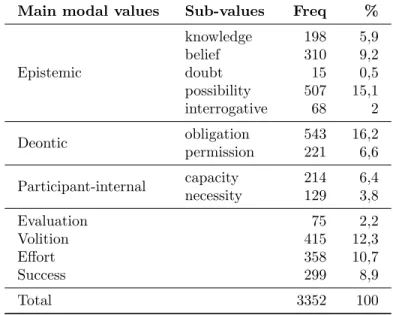
We annotated 3183 lexical triggers in the 160K corpus. We present the list of values and sub-values in table 1, together with their frequency in our golden set. The annotation has been revised in several occasions and the numbers are updated in comparison to those presented in Hen-drickx et al. (2012a) and the manual annotation guidelines reflect these updates (Hendrickx et al., 2012b).
Main modal values Sub-values Freq %
Epistemic knowledge 198 5,9 belief 310 9,2 doubt 15 0,5 possibility 507 15,1 interrogative 68 2 Deontic obligation 543 16,2 permission 221 6,6 Participant-internal capacity 214 6,4 necessity 129 3,8 Evaluation 75 2,2 Volition 415 12,3 Effort 358 10,7 Success 299 8,9 Total 3352 100
TABLE1 Modal values and frequencies in the EP corpus
Epistemic modality and deontic modality, the core values of most linguistic typologies, are indeed the most frequent values, followed by volition. The triggers are mostly verbs as can be expected by our se-lection method. We also encountered several nominal triggers such as tentativa ‘attempt’ or ambi¸c˜ao ‘ambition’ and adjectives that were part of a verbal phrase such as d´ıficil ‘difficult’, necess´ario ‘necessary’, and poss´ıvel ‘possible’. We only encountered 5 different adverbial triggers that always co-occur with another verbal trigger and have the specific function of strengthening this verbal trigger. The source of the event mention is lexically marked in only 6% of the modal events and it usually corresponds to the speaker or writer. When the source of the modality is not lexically marked, it refers to the speaker or writer and so, the two sources refer to the same entity.
There are 3183 triggers in our annotated corpus, but a total of 3352 modal values attributed, due to ambiguous cases. Sometimes the
anno-tators decided that multiple readings of the same sentence were plau-sible, and this was separately denoted.
We provide in (1) and (2) examples of modal uses of the verb de-ver ‘must/ may’. In (1), dede-ver has an epistemic reading, stating that the proposition is probable (the adverb provavelmente ‘probably’ is also a modal trigger), while in (2), it has a deontic obligation reading. In (2) we also provide the total description of the components of the sen-tence annotation. There is no overt source of the modality (in these cases a verb form with inflection marks of the subject is tagged as the source). Cases marked as ambiguous are illustrated in (3): the context is ambiguous between a deontic obligation reading and an epistemic possibility reading (the new phases of the metro network should be vs. will probably be). The annotator selects what he considers to be the primary value and marks the ambiguity in the Ambiguity component.
(1) E que dever´a provavelmente ganhar, a julgar pelo acolhi-mento que o seu programa recebe.
‘And that shall probably win, judging by the reception that his program receives.’
(2) Procurei informa¸c˜ao sobre o que deveria fazer para reservar uma mesa para outro espect´aculo.
‘[I] looked for information about what [I] should do to make a reservation to another show.’
Trigger: deveria
Modal value: deontic obligation Polarity: positive
Target: fazer para reservar uma mesa para outro espect´aculo Source of the modality: procurei
Source of the event: writer Ambiguity: none
(3) E que, depois de tantos ”passos de gigante”, criou-se a nat-´ ural expectativa de ver quais ser˜ao as novas fases da rede do metro lisboeta - que julgamos deverem ser, por um lado, de consolida¸c˜ao ( ...) e, por outro, de expans˜ao (...).
‘It’s just that, after so many ”giants steps”, there is a nat-ural expectation about which will be the new phases of the metro network in Lisbon - which we believe should be / will probably be, on the one hand, consolidation and, in the other hand, expansion.’
Trigger: deverem
Modal value: Epistemic possibility Polarity: positive
Target: ser, por um lado, de consolida¸c˜ao ( ...) e, por outro, de expans˜ao (...)
Source of the modality: julgamos Source of the event: writer Ambiguity: Deontic obligation
3.2 Annotation scheme for spoken Brazilian Portuguese While the modal scheme for EP has been designed and applied to writ-ten texts, the modal scheme for BP is designed for spontaneous speech, which according to Cresti and Scarano (1998), is governed by an illocu-tionary principle not found in written texts, as well as specific informa-tional articulations. It is more theory oriented: modality is understood in enunciative terms (Bally, 1932), that is, it is a semantic category applied to a conceptualizer’s linguistic production, which qualifies and relativises the uttered locutive material in terms of degree of certainty, possibility, necessity, capability, and volition. The scheme follows the Language Into Act Theory (Cresti, 2000), which takes the utterance as its reference unit, and considers the scope of the modality to be the information unit (Tucci, 2008), whose locutory material does not necessarily express a proposition.
The scheme was applied to the Brazilian Portuguese spontaneous speech corpus C-ORAL-BRASIL I (Raso and Mello, 2012). This corpus follows the same architecture as the European Romance spontaneous speech corpus C-ORAL-ROM (Cresti and Moneglia, 2005), whereby di-aphasic variation is privileged in order for a large diversity of illocutions and informational structuring to be documented. C-ORAL-BRASIL I comprises 200 texts of approximately 1,500 words each, proportionally distributed into dialogues, conversations and monologues. The corpus follows the CHILDES-CLAN3 transcription format to which prosodic 3CHILDES - Child Language Data Exchange System, at:
annotation is added, marking tone unit and utterance boundaries. The entire corpus is speech to text aligned with the WinPitch software (Mar-tin, 2004).
In this particular study an annotated sample from the C-ORAL-BRASIL I was analyzed. It covers 20 texts, totaling 31,318 words, 5,484 utterances and 9,825 tone units. Firstly, the identification and classifica-tion of modal markers was undertaken by three annotators working in-dependently; the codification was then qualitatively validated through group discussions involving the research group coordinator and her stu-dents. The search for modal markers was performed manually, through qualitative transcription examination, supported by the WinPitch text-to-audio aligned files and their concomitant examination through the software interface that allows speech signal listening as well as tran-scription and prosodic parameter visualization. The data were orga-nized in a table containing the modal markers, the tone unit in which they occur, the type of information unit they are inserted in, the file they belong to, and any qualitative information deemed relevant.
The BP scheme (based on the latest revision of the guidelines in ´
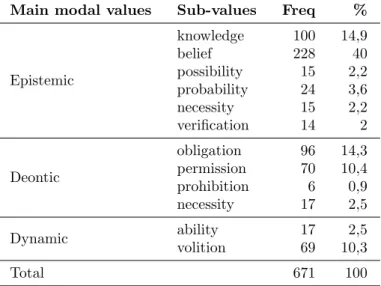
Avila (2014)) uses a three-category scheme of epistemic, deontic and dynamic modality, inspired by Palmer (1986). Epistemic modality car-ries seven sub-values: knowledge, belief, possibility, probability, neces-sity (the conceptualizer presents what is said as a necesneces-sity, based on previous knowledge (s´o pode ser doido ‘he can only be crazy, he has to be crazy’)) and verification (the conceptualizer regards a state of affair as uncertain (olha a´ı se nu tem ningu´em ‘check over there if there is no one’)). Deontic modality encompasses four sub-values: obligation, permission, prohibition and necessity (the conceptualizer expresses his or someone else’s needs). Finally, dynamic modality comprises the sub-values ability and volition/intention. In the sample, we found 1,088 modal markers (lexical and grammatical, excluded the conditional con-structions) and from these we tagged 781 lexical triggers. The distribu-tion of modal values and sub-values in the sub-corpus is presented in table 2.
Both schemes agree in not marking mood and tense. Nor do these schemes address factuality or a larger category of subjectivity and emo-tion. Due to their work on speech, ´Avila and Melo (2013) and ´Avila (2014) also distinguish modality, which is marked lexically and gram-matically, from the pragmatic categories of illocution and attitude, which are carried by prosodic cues. As the three categories are often confused in their definition in the linguistic studies tradition, Mello
Main modal values Sub-values Freq % Epistemic knowledge 100 14,9 belief 228 40 possibility 15 2,2 probability 24 3,6 necessity 15 2,2 verification 14 2 Deontic obligation 96 14,3 permission 70 10,4 prohibition 6 0,9 necessity 17 2,5 Dynamic ability 17 2,5 volition 69 10,3 Total 671 100
TABLE2 Modal values and frequencies in the BP spoken corpus and Raso (2011), through experimental investigation and observation of empirical data, suggest that modality is restricted to the semantic domain, although interrelated and projected into the pragmatic one. The same illocution can be modalized in different ways and performed with different attitudes, without affecting the illocutionary level.
The EP and BP schemes share the same components: the Trigger is the lexical item that carries modality; the Source of the modality is the conceptualizer, i.e., the individual whose perspective and view point is being reported (this might be the speaker, the addressee, or another entity in the discourse); Source of the event mention is the producer of the text or the speaker; the Target is the expression in the scope of the trigger. The BP scheme also considers a Target-dependent component to encompass the cases in which the target, in a given utterance, is not explicit, but it can be recoverable in the referential chain of the text. The two different types of sources are marked up to capture cases where the conceptualizer of the modality is not the producer of the text or speech.
In spoken data, the target is in the scope of an information unit (IU) which may assume different functions: Comment (expresses the illocutionary force of the utterance), Topic (specifies the locus of appli-cation of the illocutionary force of the Comment), Parenthetical (ex-presses metalinguistic integration of the utterance) or Locutive Intro-ducer (signals pragmatic suspension of the hic et nunc and introduces a
meta-illocution). The BP scheme takes into account, for the annotation of the trigger and the target, the information unit in which they oc-cur: Comment (COM), Topic (TOP), Parenthetical (PAR) or Locutive Introducer (INT). Example (4), taken from ´Avila and Melo (2013), illustrates the differences in terms of target delimitation (for an ex-planation of the transcription symbols, see the authors’ paper). The utterance in (4) comprises three different tone units, and the target of the trigger tem que ‘has to/must’, in the second unit, is restringir tamb´em. It leaves out the direct object of the verb isso because it is outside this information unit (defined prosodically). The same sequence in the EP scheme would take as target restringir tamb´em isso.
(4) ´e / [a ¡gente] [tem que]¿ ¡[restringir tamb´em] / isso¿ // Yeah / we have to restrict too / this //
The modal cues in both schemes are not restricted to modal aux-iliaries, but rather take into consideration a large set of cues, such as propositional verbs, adverbs, adjectives, periphrastic forms and condi-tionals, and also nouns and interrogative clauses, in EP.
From a preliminary analysis of the two corpora, there are some differ-ences in the set of lexical modal triggers. For instance, a very frequent epistemic trigger in BP is n˜ao tem como, illustrated in (5), which would translate in EP as n˜ao ´e poss´ıvel and in English as it is not possible. There are also less modal adverbs in the corpus of BP than in the EP corpus, and BP favours verbal triggers (97,3%). The two corpora provide data for a future contrastive study of the categories of modal triggers used by both varieties of Portuguese.
(5) porque eu nunca confundo letras com ¡inform´atica¿ / n˜ao tem nem como //
because I never confuse letters and informatics / it’s not possible //
4
Automatic labeling
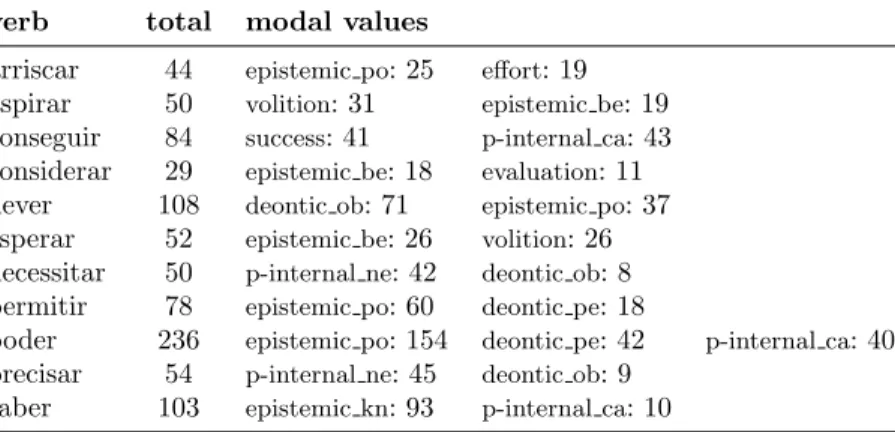
The EP corpus of 160K has been the source of data to train an auto-matic tagger for modality. Many of the verbs in the data set, such as the high frequent modal verbs querer ‘to want’ and tentar ‘to try’, only have one modal value and for those, assigning the correct modal value becomes a trivial task. We focus instead on modal verbs with multiple modal meanings that each occur at least 5 times in the small annotated corpus sample. Only a handful of verbs met this criteria, giving us a
verb total modal values
arriscar 44 epistemic po: 25 effort: 19 aspirar 50 volition: 31 epistemic be: 19 conseguir 84 success: 41 p-internal ca: 43 considerar 29 epistemic be: 18 evaluation: 11 dever 108 deontic ob: 71 epistemic po: 37 esperar 52 epistemic be: 26 volition: 26 necessitar 50 p-internal ne: 42 deontic ob: 8 permitir 78 epistemic po: 60 deontic pe: 18
poder 236 epistemic po: 154 deontic pe: 42 p-internal ca: 40 precisar 54 p-internal ne: 45 deontic ob: 9
saber 103 epistemic kn: 93 p-internal ca: 10
TABLE3 Corpus characterization: number of sentences per modal value list of 11 verbs to work with.
Table 3 shows the 11 verbs and their distribution between the dif-ferent main modal values (we use abbreviations in the table, for full modal values labels see Table 1). We see that all different modal val-ues of the data set are covered but most verbs only have two different modal values resulting in a sparse matrix. Two of the verbs (poder and dever) are polysemous verbs that can be used as a semi-auxiliary verb with modal meaning or as a main verb without a modal meaning. We give in (6) an example of a non-modal use of dever.
(6) O clube est´a em d´ıvida para comigo e o presidente ainda por cima virou-se contra mim a culpar-me de que eu ´e que devia dinheiro ao clube.
‘The club is indebted to me and what is more the president turned against me blaming me that I was the one owing money to the club.’
The labeling is done in several steps. First, the dataset is pre-processed with a syntactic parser and the parser output is used to detect the modal triggers. Then, a machine learning approach is used to label each modal trigger with the appropriate modal value in context. The PALAVRAS parser (Bick, 1999) was used for the syntactic anal-ysis. It distinguishes between modal and non-modal uses of the verbs poder and dever by labeling the former as auxiliary verbs. By exploiting the parser’s predictions, we were able to detect the modal usage of the two verbs with an F-score of 98%.
Most machine learning algorithms use the vector space model to rep-resent the input data. Using this approach, each sentence is transformed into a set of features that can be boolean, nominal or real valued. Here we use the output of PALAVRAS to build those features: we include information from the trigger itself, from the syntactic tree path and from the trigger’s context. We also evaluated two simpler systems, a bag-of-words representation of the sentences and a baseline classifier that always chooses the most common modal value. The next subsec-tion describes in detail the informasubsec-tion extracted from the syntactic tree and how it was represented.
The SVM (Support Vector Machine) algorithm (Vapnik, 1998) was chosen to label the modal value of each verb. Several initial exper-iments were conducted with a bag-of-words representation and with different degrees of the polynomial kernel (n ∈ {1, 2, 3}) and values of the C parameter (C ∈ {0.0001, 0.001, 0.01, 0.1, 1, 10, 100, 1000, 10000}). Those experiments enabled us to choose the linear kernel (n = 1) with C = 1.
Different sets of attributes extracted from the parse tree were eval-uated and compared to the bag-of-words approach. For the evaluation we used a 5-fold stratified cross-validation procedure (repeated twice) and computed weighted (macro-)average precision, recall and F1 per-formance measures. A paired T-test with 95% of significance was ap-plied to analyze the differences to the results of bag-of-words approach. No statistical tests were done over the baseline experiment. These ma-chine learning experiments were conducted using Weka framework (Hall et al., 2009).
4.1 Feature extraction
The feature representation for the machine learning experiments is in-spired by the work of Ruppenhofer and Rehbein (2012). Their approach includes three specific sets of attributes, namely:
.
from the trigger;.
from the path of the trigger to the root of the syntactic parse tree;.
from the context of the trigger.Using the PALAVRAS parser, attributes from the trigger, context and path including all possible information given by the parser output were extracted.
We used the following information:
.
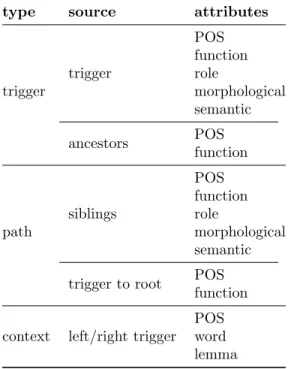
trigger: besides the trigger itself, information about the ancestral nodes (parent, grandparent and great grandparent) was included;type source attributes trigger trigger POS function role morphological semantic ancestors POS function path siblings POS function role morphological semantic trigger to root POS
function
context left/right trigger POS word lemma
TABLE4 Attributes extracted from trigger, path and context
.
path: besides collecting information about the trigger to the root, information about its left and right nodes was also included;.
context: using different size windows, information about the previ-ous and following words was included.These attributes are summarized in Table 4. For each trigger word the POS tag, function, morphological and semantic information, and the role (if it exists) were extracted. These tags have the following organization (more detailed information can be found in Bick (2000)):
.
12 POS tags (e.g. nouns, proper nouns, verbs, adverbs, adjectives, pronouns);.
39 function tags (e.g. subject, accusative, dative, prepositional, ad-verbial);.
7 morphological tags (gender, number, case, person, tense, mood, finiteness);.
171 semantic tags organized in a class taxonomy (e.g. animated hu-man, animated non-huhu-man, animated non-human non-moving, topo-logical, actions and events, time field); and.
45 semantic role labels divided into clause-level (e.g. agent, patient, topic), attributive, spatial, temporal, and adverbial.For the ancestral nodes (parent, grandparent and great-grandparent) the POS tag and function information was extracted. All attributes are binary representing the presence or absence of that specific value attached to the trigger.
The following information taken from the syntactic parse tree’s path was extracted: POS tags and functions from the nodes of the path from the trigger to the root and the POS tags, functions, morphological and semantic information, and the role (if exists) of the path of sibling nodes (left and right ones). Counts over each possible value were calculated representing this information as numerical attributes.
The surrounding context of each trigger was also considered defin-ing a size window equal to five words (with the trigger word in the middle) and information about the POS tags, words and lemmas was extracted into a set of numerical attributes (representing counts over each possible value).
The number of attributes extracted varies from verb to verb: the minimum number is the set of 552 attributes for the bag-of-words ap-proach of the verb considerar and the maximum number is the set of 9770 attributes related to the context of the verb poder.
4.2 Experiments and discussion of results
In order to evaluate the discrimination power of each set of attributes, eight experiments were done: bag-of-words, trigger, path, context, trig-ger+path, trigger+context, path+context and trigger+path+context. Tables 5 and 6 present their precision, and F1 values, respectively; values statistically different (better or worse) from the corresponding bag-of-words experiment are boldfaced.
The results show that the experiments improved the baseline ap-proach for all 11 modal verbs (see tables 5 and 6). Improvements of more than 30 points were obtained for the verbs arriscar, aspirar and conseguir, of around 20 points for the verbs considerar, esperar and per-mitir and less than 10 points for the verbs dever and saber. The values for the verb poder are lower, but this verb has three modal meanings while the other verbs have two. The improvement is also lower for ne-cessitar and precisar, but the baseline already achieves high values in these cases, despite very different distributions in terms of frequency of modal value (see table 3).
For the bag-of-words approach, precision values ranging from 0.402 (considerar) to 0.815 (saber) were obtained; for recall the range was
base bow tg pth ct tg+pth tg+ct pth+ct all arriscar .323 .638 .686 .771 .757 .719 .750 .833 .804 aspirar .384 .741 .853 .795 .694 .778 .756 .778 .779 conseguir .262 .540 .583 .595 .678 .592 .672 .714 .684 considerar .385 .402 .489 .526 .611 .582 .536 .650 .660 dever .432 .700 .662 .568 .626 .636 .692 .611 .602 esperar .250 .745 .610 .527 .595 .545 .619 .477 .577 necessitar .706 .708 .723 .735 .732 .709 .701 .690 .698 permitir .592 .593 .666 .754 .785 .702 .786 .812 .811 poder .426 .530 .486 .529 .522 .544 .520 .484 .536 precisar .694 .698 .700 .669 .757 .700 .788 .736 .736 saber .815 .815 .906 .833 .861 .881 .903 .843 .917
TABLE5 Results: precision values
between 0.530 (conseguir) and 0.903 (saber); for the F1 measure values between 0.472 (conseguir) and 0.857 (saber) were achieved.
base bow tg pth ct tg+pth tg+ct pth+ct all
arriscar .412 .605 .660 .712 .736 .658 .708 .794 .758 aspirar .475 .693 .823 .759 .694 .770 .730 .763 .757 conseguir .347 .552 .554 .581 .670 .563 .640 .689 .650 considerar .475 .472 .470 .510 .611 .543 .489 .634 .618 dever .522 .668 .644 .566 .617 .609 .685 .610 .597 esperar .333 .712 .599 .513 .568 .537 .596 .473 .562 necessitar .767 .768 .746 .724 .775 .718 .742 .699 .728 permitir .669 .670 .672 .742 .782 .683 .775 .807 .794 poder .515 .540 .520 .535 .537 .548 .538 .510 .550 precisar .758 .760 .716 .697 .787 .721 .799 .763 .770 saber .857 .857 .895 .849 .884 .889 .914 .872 .923
TABLE6 Results: F1 values
From Table 5 it is possible to observe that most experiments present no statistical difference to the bag-of-words approach. Nevertheless, when using information extracted from PALAVRAS, an improvement on precision was obtained for the verbs permitir and saber. For permitir better results were obtained using path (0.754), context (0.785), trig-ger+context (0.786), path+context (0.812) and all (0.811) features; for saber better results were obtained with trigger (0.906) and all (0.917) attributes. On the other hand, the verb esperar presents worse results when compared to the bag-of-words for path (0.527) experiments.
For recall values, less statistical differences were obtained; only the verb poder had different results when compared to the bag-of-words approach (0.650) and they were worse (trigger+path attributes
pre-sented a recall of 0.574 and path+context attributes achieved a recall of 0.551).
Based on Table 6, one can state that using information from the parse tree, improvements on F1 measure were possible for 2 verbs: permitir with the path+context setting (0.807) (see section 5) and saber with all attributes (0.923).
A follow-up of our experiments will take into consideration ambigu-ous cases and a new evaluation of the tagging system will be made. Although the 11 verbs were chosen for their polysemy and the ambigu-ous contexts had been manually tagged with a secondary modal value (in the Ambiguity Attribute of the Trigger component) this information was not taken into consideration in these experiments.
Consider, for instance, the modal verb dever. There are 108 modal occurrences of this verb in the corpus, 37 annotated as epistemic possi-bility and 71 as deontic obligation. In 16 cases of epistemic possipossi-bility, the automatic system labeled the context as obligation, while in 17 cases of deontic obligation the system considered the value to be pos-sibility. This leads to a much higher F-measure for the deontic value (0.755) than for the epistemic value (0.521).
However, 5 cases manually tagged as epistemic and automatically labeled as deontic are in fact annotated as ambiguous in the corpus. One such case is example (3), above, where the system predicted only the first reading (epistemic possibility) and ignored the Ambiguity with deontic obligation.
5
Corpus annotation as a source of linguistic insight
on modality
The manual annotation of the corpus, its linguistic exploration and the analysis of the results of the automatic labeling have provided valu-able insight into the complexity of the semantic concept of modality, its intrinsic ambiguity, the interaction between embedded modal trig-gers and embedded sources, and the interaction between modality and other systems such as negation. The information gathered during the annotation itself and the error analysis of the tagger provided feedback to improve our modality scheme and is part of the motivation for the presentation of a unifying proposal in section 6. We discuss some as-pects where our experiments have proven to shed some light on the concept of modality and its annotation.
(i) Interaction between modal triggers, negation and focus
espe-cially difficult to label with a modal value, even for human annotators. One such example is reproduced in (7): the trigger deveriam ‘should’ is preceded by the negation adverb and is followed by another trigger possibilitado ‘made possible/enable’. The linguistic context of the trig-ger is misleading: although there is a negation marker, this operator doesn’t have scope over deveriam but instead over its target (it should (not be possible to...)).
(7) De qualquer forma, depois de falhar a comunica¸c˜ao entre controladores e pilotos, os equipamentos electr´onicos n˜ao de-veriam igualmente ter possibilitado que se chegasse a um ponto em que um dos avi˜oes tivesse que fazer uma descida t˜ao abrupta como a que fez o avi˜ao da TAP.
‘Anyway, after the communication between controllers and pilots failed, the electronic equipment should not have let things get to a point where one of the planes took such an abrupt descent such as TAP airplane did.’
Example sentences (8) and (9) show two embedded triggers that both have negative polarity values. In sentence (8), the deontic verb poder ‘should’ has negative polarity and the embedded trigger conceder ‘to concede’ is preceded by the aspectual expression deixar de ‘to cease’ that carries intrinsic negative polarity. The double negation (should not cease to concede) is equivalent to a global positive polarity (should concede). In (9), the first trigger conveys an epistemic value and a neg-ative polarity (n˜ao julgo ‘[I] don’t believe’), while its target contains a second trigger that lexically expresses negative polarity (imprescind´ıvel ‘indispensable’) and denotes a deontic obligation value. The overall in-terpretation of the sentence is that the source believes that something is dispensable. In both cases, our annotation treats each trigger in-dependently and does not express the overall positive polarity of the clause. The modal interpretation of an embedded trigger may also be affected by the preceding trigger. In sentence (10), the trigger pode ‘can’ influences the degree of certainty of the modal value evaluation of the second trigger dif´ıcil ‘difficult’.
(8) N˜ao se pode, ali´as, deixar de conceder cabimento `a for-mula¸c˜ao (...).
‘We shouldn’t, in fact, cease to concede authorisation to the drafting (...).
(9) N˜ao julgo imprescind´ıvel que se encontre desde j´a, a correr, o novo rosto.
‘I don’t think that it is indispensable that we find right now, immediately, the new face’.
(10) Se o aluno se perde, pode ser dif´ıcil voltar a apanhar. ‘If the student is lost, it can be difficult for him to catch up again’.
Despite the challenge posed by these contexts, we believe that it is important to individually mark each element of the sentence that con-tributes to the modal values to be able to understand how each provides input to the overall semantic interpretation. The global interpretation of the sentence does not only depend on the modal information but is determined by an interplay of information at different levels including focus and negation. Investigating these interactions at the global sen-tence level is beyond the scope of this current work but promises to be a fascinating future research direction.
The annotation of corpus data also points to the fact that exclusive particles, such as s´o ‘only’, may affect and alter the modal meaning of the sentence. For instance, in contexts where the verb poder has an epis-temic reading, adding the exclusive can restrict the set of possibilities to the possibility presented in the sentence, as illustrated in (11).
(11) Isto s´o pode ter sido um acidente. ‘This can only have been an accident’
In (11), by restricting the set of possible situations to one (x and only x), the adverb leads to an overall reading of the sentence that expresses epistemic necessity. This does not hold, however, in all such contexts: the interpretation requires that the target of the modal trigger is a state or a past event, and that the exclusive particle has scope over the full target of the modal trigger. Compare, for instance, the modal readings of the corpus sentence (12) and the slightly adapted version in (13). In (12), the exclusive has scope over the temporal adjunct and denotes a condition over a possibility, while in (13) it has scope over the full target and the overall reading is one of epistemic necessity.
(12) Ora, a Sr.a Deputada MFL s´o pode ter raz˜ao quando acertar nalguma previs˜ao.
‘Well, the member of parliament MFL may only be right when at least one of her forecasts turns out correct.’ (13) Ora, a Sr.a Deputada MFL s´o pode ter raz˜ao.
‘Well, the member of parliament MFL can only / must be right.’
The exclusive particle can also mark the possibility as weaker than expected. Exclusives can downtone an alternative, by underlining the fact that this proposition “is not the strongest that in principle might have been the case”, a function called Mirative (Beaver, 2008). In (14), the combination of the exclusive with the deontic marker doesn’t ex-press one obligation among a set of possibilities, but rather states that the alternative is much easier than one would expect.
(14) Para participar s´o tem de contactar a organiza¸c˜ao atrav´es dos telefones 96... ou 91...
‘To participate, you only have to contact the organization through the phone numbers. . . ’
These meaning interactions are extremely challenging for any an-notation scheme and these contexts tested the limits of what could be represented in our current schema. To represent and compute the mean-ing of such sentences, negation and focus (and any other element that affects modality) could either: (i) be integrated in the modality scheme, an approach that we follow partly by marking the polarity of trigger and target, and also by proposing to deal with exclusive particles as another modal marker in the modal set (Mendes et al., 2013); (ii) be the topic of separate layers of annotation with their own annotation scheme; (iii) be included as features of a global annotation scheme that would take the event as the tagging unit, instead of individual triggers.
(ii) The attributes Path and Context
The discussion of the experiments with different sets of attributes in section 4 pointed out that the system achieved statistically significant improvement over the bag-of-words approach with the path+context settings. By running an attribute ranker (using information gain), we were able to single out the most informative attributes for path:
.
presence of an Accusative node between the root and the verb node.
the left brother node receives the semantic role Theme.
presence of an infinitive clause in the path: either from the root to the verb or as the right brother node.
the left brother node is a Dative object with the function Beneficiary For context, the more important attributes occur in the left tree (we single out the ones that complement the information in path):.
the lemma lei ‘law’ occurs in the left context.
the dative clitic lhe ‘to him/her’ occurs in the left contextThe combination of these attributes express certain properties that seem to favour one modal value over another. For instance, the presence of an Accusative node of the type infinitival clause favours an epistemic reading, as illustrated in (15). There are 77 contexts with an Accusative infinitival clause with the verb permitir: 4 of these contexts have a deontic reading (about a quarter of the total number of deontic contexts with permitir), while 37 have an epistemic reading (about half of the frequency of epistemic contexts with this verb). Moreover, many of the examples of epistemic possibility reading with permitir, such as (16), are associated to constructions where the left brother node is a Dative object: the 10 cases of Dative occurring in pre-verbal position are all instances of epistemic possibility.
(15) Mas estes primeiros dias j´a permitem tirar conclus˜oes. ‘But these first days already make it possible to draw con-clusions.’
(16) Agora, embora n˜ao seja capaz de pintar porque n˜ao tenho t´ecnica para o fazer, descobri que o computador me permite transformar as minhas imagens de tal maneira que ficam a parecer autˆenticas pinturas.
‘Now, although I’m not capable of painting because I don’t have the technique to do so, I discovered that the computer allows me to transform my images in such a way that they end up looking like authentic paintings.’
A non-explicit subject in the left brother node is, on the contrary, associated to a deontic reading of permitir. In fact, all deontic contexts of this verb occur in subordinated clauses (mostly relative clauses, as illustrated in (17)) or coordinated clauses. The presence of the lemma lei ‘law’ in the left context, specifically in subject position of permitir, is a clear indication of a deontic obligation reading (there are 5 occur-rences of a subject containing the lemma lei, where 4 are deontic), as in (18). In fact, this annotation is in accordance to the fact that deontic
necessity derives from some source or cause which may be a person, institution or more or less explicitly formulated body of moral or legal principles (John Lyons, 1977, pp. 824)
(17) S˜ao contratos em condi¸c˜oes suis generis, que permitem prazos de pagamentos de oito e mais anos (...).
‘These are special contracts, that allow payment deadlines of eight years and more (...).’
(18) E acrescenta que n˜ao existe nenhuma lei que permita `a Por-tugal Telecom cortar o servi¸co telef´onico por os utentes n˜ao pagarem, por exemplo, as chamadas de valor acrescentado, tipo telefonemas er´oticos, etc.
‘And [he/she] adds that there is no law that allows Portugal Telecom to cut the phone service when users don’t pay, for instance, value added calls, such as erotic phone calls.’ The role played by some of these attributes in the labeling of permitir is quite unexpected and was uncovered by the analysis of the results of the system. This was the case, for instance, of the attributes “no explicit subject” and “Dative brother node in left context”.
(iii) Ambiguity
Our experiment focused on attributing the correct modal value to modal triggers that may denote more than one modality type. In most cases, the context provides information for disambiguation and a single value was attributed by our human annotators. The goal is for the system to also decide, based on the context, which modal value applies to the sentence. As we mentioned in section 3.1, the context might not provide enough information for manual disambiguation and the human annotators labeled these cases as ambiguous. In future experiments, we will take these cases into consideration and the outcome of the automatic labeling should be able to mark these sentences with two potential modal meanings.
Ambiguity has typically no formal correlate in the nature and span of the components Trigger and Target of our annotation. For instance, in example (19), permitir has, on the one hand, an epistemic possibility reading, in the interpretation that the climate makes it possible for trees to grow. On the other hand, it expresses deontic permission if we consider that the climate is a necessary condition for the growth of the trees. In both cases, the subject NP as condi¸c˜oes clim´aticas will be marked as the source (of possibility or necessity) and the object will be the target.
(19) As condi¸c˜oes clim´aticas permitem o desenvolvimento de ´
arvores como abetos, pinheiros e outras plantas resinosas (con´ıferas).
‘The climatic conditions permit the growth of trees such as spruce, pine and other coniferous plants (conifers)’.
However, there might be a formal counterpart to semantic ambiguity. It is the case of contexts that are ambiguous between deontic obliga-tion and participant-internal necessity with verbs dever and ter de, and epistemic possibility and participant-internal capacity with verb poder. In (20), two interpretations - and therefore two annotations - are pos-sible. The epistemic possibility reading might be paraphrased as it is possible that [he is an excellent candidate], so that the target of the modal trigger is the whole proposition and includes the subject of the sentence Ele@ser um excelente candidato4. The source of the modal-ity will then be the speaker/writer. The internal capacmodal-ity reading can be paraphrased as he has the capacity to be an excellent candidate: the source of the capacity is the subject and the target is the verbal phrase. Currently the scheme has no way of capturing these structural ambigu-ities and only one structure, representing what the annotator considers to be the most salient meaning in the context, is expressed, although semantic ambiguity is marked in the Ambiguity attribute of the trigger. Accordingly, we expect our system to be able, in future experiments, to label these contexts with two possible modal meanings.
(20) Ele pode ser um excelente candidato. ‘He might be an excellent candidate’ Modal value: epistemic possibility
Target: Ele@ser um excelente candidato Source of the event mention: sp/wr Source of the modality: sp/wr Modal value: participant-internal capacity
Target: ser um excelente candidato Source of the event mention: sp/wr Source of the modality: Ele
The ambiguous modal triggers that we have discussed so far can de-note two or more individual modal meanings and, in most cases, the context provides the necessary information to select the appropriate meaning (see Kratzer (1991) and Coates (1983) for different concepts of
4Note that the discontinuity of the target is marked here with the symbol @, but
the polysemy vs. indeterminacy of modal verbs). In these cases, only one reading is available at a time and the interpretations belong to different modal categories (e.g. epistemic vs. deontic) (Coates, 1983). However, the verb conseguir ‘to succeed’ seems to behave differently in that the capacity reading and the success reading are not non-compatible dis-crete meanings, but rather intertwined aspects of the semantics of the verb. In fact, in most contexts of the verb, the value success is asso-ciated with an internal capacity of the subject. This type of semantic indeterminacy is related to the concept of gradience in the work of Coates (1983) and would differ from cases of pure ambiguity.
This is particularly important to assess, first, the relations that ex-ist between the modal values included in the scheme to address any possible overlap in the case of some lexical triggers (not always fore-seeable when establishing which modal values to include), and second the performance of the annotation tool. Cases of gradience, where two or more values are simultaneously present in a single context, although one might be more salient than the other, will be especially difficult to tag by a manual annotator (the choice might be more prone to context influence, such as perfective tenses leaning to the success reading due to their association to factuality).
6
Future work: An unified scheme for Portuguese and
its application
The proliferation of annotation schemes for modality is inevitable and the result of specific objectives of the different teams working on the topic. However, some attempt of standardization would be of inter-est to the field, making contrastive studies an attainable goal. In the case of the EP and BP schemes, the objectives are quite similar and the properties of both varieties do not differ in the components of the schemes, although the list of lexical triggers might be variety-specific to a certain extent. The preparation of a unified proposal is also an op-portunity to refine both schemes according to our experience and the knowledge acquired during the manual and automatic labeling.
As mentioned in section 3, the set of components is practically iden-tical in each scheme. The differences arise essentially in the list of modal values, the Target dependent component and the trigger and target at-tributes. Let us start with the mismatches in modal values. Table 7 presents a comparison of the modal values that are considered in the EP and the BP modal schemes: equivalent modal values (or sub-values) are presented in the same row, regardless of their designation. Both schemes are organized in terms of main and secondary modal values.
Most of the modal values are included in both schemes: epistemic possi-bility, epistemic knowledge, epistemic belief, deontic obligation, deontic permission, capacity/ability, volition. There are some mismatches: the contexts tagged with the sub-value epistemic necessity in BP seem to be close to the value deontic obligation in EP (we mark these cases between // in Table 7); the deontic prohibition value in BP is most probably annotated as a deontic permission with negative polarity in EP; and participant-internal necessity in EP is covered by deontic ne-cessity in BP. Two sub-values have no equivalent: epistemic probability only occurs in BP and epistemic interrogative only occurs in EP. Be-sides those sub-values, three main values in the EP scheme are absent in BP: evaluation, effort and success. There is however a partial equiv-alence for Success: when success is related to an internal capacity (e.g. verb conseguir ‘achieve’) it is tagged as dynamic ability in BP.
EP modal scheme BP modal scheme
Epistemic Epistemic Possibility Possibility Probability /Deontic/ Necessity Knowledge Knowledge Belief Belief Doubt Verification Interrogative Deontic Deontic Obligation Obligation Permission Permission
/Deontic perm., neg. polarity/ Prohibition /Internal necessity/ Necessity Participant internal Dynamic
Necessity /Deontic necessity/
Capacity Ability
Volition Volition/Intention
Evaluation
Effort /Dynamic ability/
Success /Dynamic ability/
TABLE7 Comparison of modal values in the EP and BP schemes We present our proposal for a unifying set of categories in Table 8. Although the percentage of occurrence of the epistemic probabil-ity value is relatively low in the BP corpus, this value is nevertheless
important in the modality typology and quite easily distinguishable from epistemic possibility. These two subvalues of epistemic modality are covered by the pairs of lexical items poder/dever ‘might/should’, poss´ıvel/prov´avel ‘possible/probable’, possibilidade/probabilidade ‘pos-sibility/probability’. Consequently, we keep this value in the final set. The uncertainty meaning conveyed by the epistemic verification value (BP) is in fact covered by the more general epistemic possibility value. The same is valid for epistemic doubt (EP), which translates into an epistemic possibility value with negative polarity (I doubt that this will happen = maybe it is not possible that this will happen). Direct interrogative sentences are syntactically marked as such and their an-notation as modal instances in the EP scheme involved marking the entire sentence as trigger and target, what seems unnecessary. Indirect interrogative sentences express a possibility value that can be captured as such in the scheme. Necessity is a concept that required further re-vision in both schemes: the EP scheme doesn’t capture contexts where necessity is the result of circumstances (Circumstantial modality or participant-external modality). In spite of the difficulty in establishing whether a necessity is external or instead is an obligation established by the entities involved in the state of affairs, it is important to make the distinction in the clear-cut cases. With this in mind, we keep the value deontic necessity (´e necess´ario que ‘it is necessary that’). We also keep the dynamic value (BP) instead of the participant-internal one (EP). However, we enlarge the sub-values of the dynamic category, so as to include several categories related to the expression of a subjective attitude of the subject. It is the case of necessity, ability and volition. Since effort and success are types associated to the dynamic ability sub-value, we decided to leave them out. Finally, we keep the category evaluation as crucial for studies of belief and opinion, and we would like to study this category in more detail in the future.
In the Target component, the difference between the two schemes lies in the type of segment which is tagged in the corpus: a syntactic phrase or any locutory material in the scope of an information unit. We think that the functions of the information units should be the subject of a separate layer of annotation: the information structure. The Target dependent component should be addressed in the co-reference level of annotation. Therefore, we keep the single Target component in the unified scheme. In Table 8, we presented a unified annotation scheme with a list of components, the attributes of the trigger and the list of modal values that is applicable to both spoken and written, European and Brazilian, Portuguese.