Contents lists available atScienceDirect
Computers in Industry
journal homepage:www.elsevier.com/locate/compind
IDARTS
–
Towards intelligent data analysis and real-time supervision for
industry 4.0
Ricardo Silva Peres
a,b,⁎, Andre Dionisio Rocha
a,b, Paulo Leitao
c,d, Jose Barata
a,baUNINOVA - Centre of Technology and Systems (CTS), FCT Campus, Monte de Caparica, 2829-516, Caparica, Portugal
bFaculdade de Ciências e Tecnologia, Universidade Nova de Lisboa, Departamento de Engenharia Electrotécnica, Monte de Caparica, 2829-516, Caparica, Portugal cPolytechnic Institute of Bragança, Campus Sta Apolónia, Apartado 1134, 5301-857, Bragança, Portugal
dLIACC -Artificial Intelligence and Computer Science Laboratory, R. Campo Alegre 102, 4169-007, Porto, Portugal
A R T I C L E I N F O
Keywords:
Predictive manufacturing systems Cyber-physical systems Industry 4.0 Multi- agent systems Data analytics
A B S T R A C T
The manufacturing industry represents a data rich environment, in which larger and larger volumes of data are constantly being generated by its processes. However, only a relatively small portion of it is actually taken advantage of by manufacturers. As such, the proposed Intelligent Data Analysis and Real-Time Supervision (IDARTS) framework presents the guidelines for the implementation of scalable,flexible and pluggable data analysis and real-time supervision systems for manufacturing environments. IDARTS is aligned with the current Industry 4.0 trend, being aimed at allowing manufacturers to translate their data into a business advantage through the integration of a Cyber-Physical System at the edge with cloud computing. It combines distributed data acquisition, machine learning and run-time reasoning to assist infields such as predictive maintenance and quality control, reducing the impact of disruptive events in production.
1. Introduction
With the advancements in the Information and Communication Technology field and the exponentially increasing volumes of data being generated every day, a new set of possibilities has been presented to improve the efficiency and the characteristics of production pro-cesses. Adding to this is the transformation from a saturated seller’s market into a customer-driven one, with its growing demand for highly customized products accompanied by decreasing product lifecycles and smaller lot sizes, pushing companies towards a paradigm shift in order to leverage their data to attain a business advantage in such a compe-titive and dynamic market [1].
As such, the currently ongoing 4th industrial revolution, usually referred to as Industry 4.0 in Europe [2–4] and Industrial Internet in the US [5], aims to introduce and take advantage of the interconnected world along the entire value chain, allowing the sharing and processing of the data available in all of the its actors to generate relevant knowledge and optimize the overall process. The adoption of the In-dustry 4.0 paradigm encompasses the following three characteristics [6]:
•
○“Horizontal integration across the entire value network”: By
integrating the overall value chain it is possible to optimize it beginning with the suppliers, materials, logistics, etc. In this sense, all of the value chain’s actors must be connected and co-ordinated among each other based on their individual require-ments, creating a very dynamic ecosystem.
○“End-to-end engineering across the entire product life-cycle”: The integration and digitalization across all phases of the pro-duct’s life-cycle is crucial to ensure that data can be collected, stored and processed to generate new knowledge from the pro-duct’s inception to its end of life. This knowledge can be parti-cularly relevant for the product’s improvement, not only re-garding its production, but also the for instance its design or material suppliers.
○“Vertical integration and networked manufacturing systems”: At the shop-floor, the integration among the different components and actors (such as resources, humans and Manufacturing Execution Systems) should be done through a Cyber-Physical System (CPS). This system will allow not only the internal in-tegration and optimization but also a harmonized and smooth integration with the two previously presented functionalities. With the vertical integration emerges the concept of Smart Factory (SF). According to [7] these factories must have some characteristics
https://doi.org/10.1016/j.compind.2018.07.004
Received 30 October 2017; Received in revised form 5 June 2018; Accepted 10 July 2018 ⁎
Corresponding author at: UNINOVA - Centre of Technology and Systems (CTS), FCT Campus, Monte de Caparica, 2829-516, Caparica, Portugal.
E-mail addresses:[email protected](R.S. Peres),[email protected](A. Dionisio Rocha),[email protected](P. Leitao),[email protected](J. Barata).
0166-3615/ © 2018 Elsevier B.V. All rights reserved.
including among others the capacity to deal with mass customization [4],flexibility [8] and new maintenance strategies [9]. However, one of the main characteristics is the ability to generate new and relevant knowledge based on data processing [10]. As previously stated, SFs are implemented and deployed via CPS. The concept of Cyber-Physical Production System (CPPS) [11] merges the functionalities and benefits of CPS applied to the industrial context. The main objective in a CPPS is to create an abstraction layer where each of the shop-floor’s actors is represented by a cyber entity, as shown inFig. 1.
The communication between the heterogeneous components is now made at the cyber level, allowing a smooth and effective integration of all the components and actors avoiding the usual problems related to vendors’ specifications and standards. In [12] the authors present a comparison between today’s factories and the now emerging Industry 4.0 based SFs, implemented through CPPS. With all the resources in-tegrated, sharing information and their behaviours among each other, the shop-floor can adapt and organize in runtime to optimize at dif-ferent levels (production, maintenance, energy consumption, etc). Moreover, with the advances in the Industrial Internet of Things (IIoT) and the increasingly large number of sensors and other data sources available on the shop-floor, the amount of extracted data is growing and the traditional algorithms are no longer able to process these vo-lumes of data. Hence, the big data analysisfield is becoming more and more important in several areas as a way to tackle this challenge [13]. This is often coupled with the usage of Machine Learning (ML), allowing manufacturers to obtain insights regarding their factory which would have been otherwise missed. ML can be defined as a system’s capacity to improve its performance on a given task or set of tasks over time based on previous results [14]. Therefore, ML algorithms can be used to predict a system’s behaviour and/or improve its overall per-formance, enabling the development of tools capable of analysing data and perceive what are the underlying trends and correlations. Thus, ML-based approaches can be used to predict abnormal events (failures, degradation, energy consumption, etc), generate warnings and advise the system and/or the operator regarding which course of action to take, assisting in diagnosis and maintenance tasks [15].
In line with this, the work detailed in the coming sections aims to provide an integration of this real-time and historical analysis with self-improvement mechanisms under a single framework for Predictive Manufacturing Systems (PMS), along with an initial implementation of its core functionalities. It is structured as follows: Section2presents a summary of related work that can be found in current literature per-taining to CPPS-based PMS. Section3introduces the proposed frame-work and formalizes some core concepts, requirements and function-alities. Section4details the initial implementation of the framework and the integration of its modules. Afterwards, Section5describes the
denominators including the employment of CPPS for virtualization, ML models for data analysis (e.g. early fault detection, quality control), decentralization and self-adjustment. However, the discussions are often on the conceptual or architectural level, with a lack of deployable implementations or results.
Regardless, the growing importance of PMS in the current in-formation age is evident from its multitude of research venues. In [19], the authors survey several articles pertaining to the applications of PMS and propose to group them into four main applicationfields, namely system control [20], quality control [21], fault diagnosis [22], and predictive maintenance [23]. Other recent examples include an archi-tecture for predictive maintenance as a service based on the cloud computing paradigm [24], the prediction of power consumption levels in machining processes through big data analytics [25] and a dis-tributed multi-agent oriented framework for failure prediction from real-time sensor data [26].
Some frameworks for the application of predictive analytics in manufacturing environments have also been proposed. In [23], a CPPS-based framework for intelligent predictive maintenance is presented, using mostly the processing and feature extraction of real-time signal information as enablers of fault diagnosis and prognosis. Zhiqiang Ge [27] presents a distributed framework for the prediction and diagnosis of key performance indices in plant-wide industrial processes. One key aspect is the division of the entire process into several smaller blocks, later enabling data to be extracted more efficiently whilst greatly re-ducing its dimensionality. A fog computing-based framework for data-driven machine health and process monitoring in CPPS is introduced in [28], highlighting the importance of scalable, high-performance ap-proaches and the usage of cloud-based machine learning algorithms for predictive analytics. Zhong et. al [29]. introduce a big data analytics framework for radio-frequency identification-enabled shop-floor logis-tics, which presents a considerable challenge in terms of complexity not only due to the large amount of assets involved, but also the intrinsic dynamic logic of the logistics domain.
into account, so that they can be easily migrated and applied to wide array of manufacturing scenarios and domains. These are the main differentiating characteristics of the framework proposed in this article, which will be detailed in Section3.
3. The IDARTS framework
In this section, an overview of the proposed Intelligent Data Analysis and Real-Time Supervision (IDARTS) framework is provided along with its main design goals, requirements and a thorough de-scription of each of its individual structural elements.
IDARTS targets not only the acquisition of data at different granu-larity levels, but also the realization of context-aware data analysis and evaluation based on both real-time and historical data. This analysis outputs predictive data, which in this context can be defined as prob-able future values or states forecasted based on models representing a given process, with prediction referring to the act of making statements about data that is yet to be observed [31]. Predictive data can then be used to trigger the system's self-adjustment mechanisms (e.g. re-configuration) or alert operators in the shop-floor, thus assisting in returning a deviating or unstable manufacturing system to normal op-eration conditions, before critical breakdown events occur.
To this end, IDARTS’foundations lay on top of three core principles, namely:
•
The Integration of the Physical and Software Elements –Through the application of a CPPS, IDARTS’real-time computation module should be capable of extracting data from the shop-floor and reason on it in order to assess possible deviations, acting accord-ingly. This should assist in preventing the propagation of anomalies downstream and returning the system to its normal operation con-ditions, either via self-adjustment mechanisms or alerts to trigger human intervention.
•
Seamless Data Exchange between Heterogeneous Components–The employment of a common data representation and exchange format in crucial to ensure the interoperability of the heterogeneous components comprising an IDARTS-based platform.
•
Knowledge Management and Data Analytics – Despite theexponential growth in the volume and velocity at which data is generated in manufacturing environments (e.g. embedded sensors), a large portion of it remains untapped. IDARTS’approach aims to translate this data into a business advantage by employing advanced data analysis and knowledge management methods on semantically enriched data acquired by the CPPS. The generated knowledge can be then used to improve the CPPS’reasoning system and the real-time analysis, hence further mitigating the occurrence of breakdown events during production. The approach encompasses the combi-nation of real-time and historical data throughout the entire pro-duction, allowing the adaptation of the analysis and monitoring algorithms after deployment for a truly adaptable andflexible ap-proach to predictive manufacturing.
Additionally, a number of non-functional requirements are imposed by the framework’s design. First and foremost, it should be generic enough to be applicable to various different scenarios, being open so as to not depend on the existence of a single communication protocol or standard on the shop-floor, hence facilitating its industrial integration and adoption. Moreover, it needs to beflexible, capable of adapting to changes to the process or its assets in runtime, for instance in terms of pluggability, changes to the Key Performance Indicators (KPI) to be analysed or to improvements in the analysis process.
Another point to take into account is the aspect of scalability. To ensure that the approach is applicable to varied scenarios, it needs to be capable of scaling according to the requirements of the use case at hand, which might also translate in an increase in its complexity. These include for instance the number of assets to be virtualized in the shop-floor, as well as the volume, velocity and variety of data to be extracted and analysed. This reinforces a critical point, which is the need to connect, harmonize and transform heterogeneous data received from different sources [32].
Hence, to tackle these challenges, a layered, modular design ap-proach is suggested. An overview of the resulting IDARTS framework can be seen inFig. 2.
shop-floor level, playing the role of the centrepiece that glues the dif-ferent constituents of the framework together, integrating both pro-duction and quality control processes.
The Plant Topology data should be an integral part of the system’s data model, representing its existing resources, their organizational structure and other relevant information such as connection interfaces and existing data sources. Through it, the CPPS can be instantiated in a way that is capable of virtualizing each of the system’s elements and initiate the data acquisition process. This System Virtualization creates a logical one-to-one relationship between each element of the shop-floor and its cyber representation, enabling a non-invasive application of the framework’s capabilities. It also represents a way to break down the system into smaller, more manageable building blocks and thus reducing the complexity of the problem.
This data acquisition process is responsible for feeding new in-coming data from the shop-floor not only to the reasoning module, but also to the RDA component and to an historical data store to be used by the Knowledge Management layer. To do so, this system needs to be both flexible and adaptable in order to deal with unforeseen dis-turbances at the shop-floor level in a robust and efficient manner.
Also, the communication with the shop-floor needs to be specified in a generic way, thus allowing the consideration of different require-ments from potentially heterogeneous use cases. For instance, a specific case might present time constraints in the order of weeks or days, while another might require data to be collected and analysed in near real-time, allowing only the consideration of relatively small delays in the communication and processing and therefore requiring different ap-proaches.
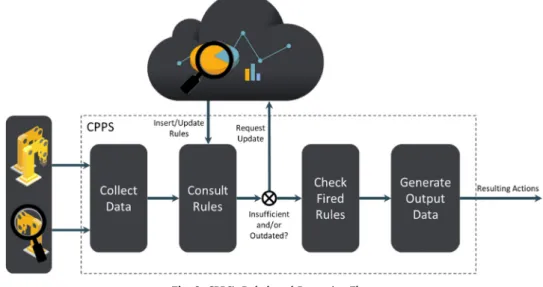
Finally, the CPPS is also responsible for the local processing of the collected data. This is done in two stages, thefirst of which deals with the pre-processing of raw shop-floor data and generation of more complex knowledge. The other refers to being capable of reasoning and following through with rule-based decision-making processes, pro-viding an earlier identification of faults, potential deviations or other critical events. The basis of this behaviour is depicted inFig. 3, in which the arrows indicate the general dataflow throughout the process.
These rules are contained in a Dynamic Rule Store, and should be modelled using the system’s common data representation format. The store can be updated dynamically during runtime by the Knowledge Management layer, if either as a result of the data analysis performed on the historical data it is found that certain changes are required to improve overall quality control, or if the CPPS requests an update from Knowledge Management due to having insufficient or outdated rules. 3.2. Real-time data analysis component
Concerning the runtime domain, the RDA Component encompasses the elements necessary to perform the analysis of relevant production-related data during the system’s execution.
3.3. Knowledge management component
Contrastingly, the Knowledge Management Component operates outside of the constraints imposed by the real-time execution and monitoring of the production system. It consists in combination of a Historical Data Store and 3 processing modules, namely Data Analytics, Semantic Contextualization and Adaptation.
Each of these modules is responsible for a different step of the knowledge management pipeline. While the Data Analytics component refers to the actual data analysis process, Semantic Contextualization deals with capturing domain-expert knowledge and enriching the re-sults with meaningful, easily understandable context. This is extremely important because it assists not only human operators, but also the CPPS in interpreting the analysis results. Lastly, the Adaptation com-ponent handles the management and refinement of the decision-making rules and runtime analysis processes.
While the analysis performed at runtime focuses solely on the constantly incoming streams of raw data, the one done at the higher-level additionally takes into account historical data, not only raw but also the more complex knowledge generated by the CPPS. This makes it possible to generate new knowledge from correlations and patterns that might be harder or impossible to discover in the RDA alone. This can then be used to update the rules that govern the CPPS’reasoning me-chanisms or models used in the RDA, either periodically or on request, therefore improving the overall quality of the manufacturing processes. 4. Implementation
An initial implementation was developed focusing on the integra-tion of the IDARTS’core elements. The main goal at this stage is to showcase an initial implementation of the data acquisition and pre-processing CPPS, the real-time pre-processing module and its integration with a Knowledge Management tool, as well as all the dataflow in between and its required interfaces. Each of these elements is described in the following subsections.
4.1. MAS-based cyber-physical production system
As mentioned in Section 3, the CPPS needs to be capable of ex-tracting data from the shop-floor during execution in a flexible and robust manner. To this end, a Multi-Agent System (MAS) was im-plemented using the Java Agent DEvelopment framework (JADE) [33] based on the monitoring approach developed in [34], previously vali-dated in an automotive industry cell under the FP7 PRIME project [35]. JADE provides a robust infrastructure which supports the agents’core behavioural logic and communication, as well a wide array of auxiliary tools to further facilitate the development process.
conveyors, sensors) and subsystems (e.g. cells, workstations), taking care of the acquisition of their respective data as well as its pre-pro-cessing, preparing it to be further analysed by the other framework modules. The adoption of MAS technology confers additionalflexibility and robustness to the CPPS, allowing it to quickly adapt to changes in the shop-floor as imposed by the framework’s requirements. The MAS’ support for pluggability, combined with the framework’s modular de-sign, allow for the components it abstracts to be plugged/unplugged in runtime without requiring additional reprogramming effort in the overall system. An overview of the MAS architecture is provided in Fig. 4.
The Component Monitoring Agent (CMA) presents a one-to-one relation with a component on the shop-floor (e.g. clamp, robot), being the sole responsible for extracting and pre-processing the data from the resource it is abstracting, as explained in [35]. This extraction can be event-based (i.e. triggered by the low-level, for instance an on-change
event from an OPC-UA server) or time-based, with the agent periodi-cally polling the corresponding asset in a cyclic behaviour.
Similarly, the Subsystem Monitoring Agent (SMA) fulfils a com-parable role, albeit on a higher- level of abstraction. However, not only does the SMA extract raw data from its associated subsystem (set of components and/or other subsystems) but it also receives the data computed by other components or lower-level subsystems associated to it. As such, due to its broader view of the system, it is able to generate more complex knowledge that would have remained untapped other-wise. This is an example of the data fusion performed by the CPPS, through which different data sources are combined to generate new meaningful and useful data. The agents' interactions are FIPA com-pliant, following the FIPA Request protocol [36].
Although the aforementioned monitoring approach employed an additional type of agent to handle the output of data, in this context this could result in a bottleneck when scaling the number of deployed Fig. 3.CPPS's Rule-based Reasoning Flow.
agents can interface with their physical shop- floor counterparts through different protocols without requiring additional programming effort on the agents’side, thus greatly reducing deployment effort.
4.2. Real-time data analysis
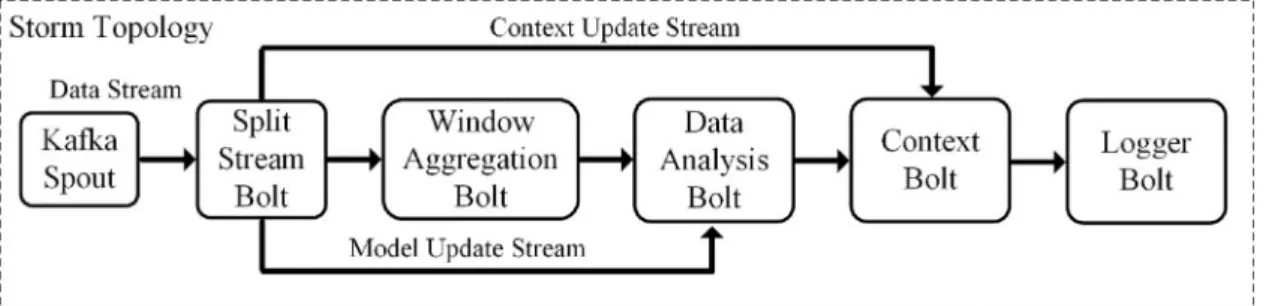
The implementation of the RDA module was split into two compo-nents, namely a data message queue based on Apache Kafka, and a stream processing network developed in Apache Storm. This develop-ment approach builds on the work and guidelines laid out in [26] with the instantiation of the Kafka broker and the implementation of the Storm topology. The representation of the data analysis topology can be seen onFig. 5.
Upon collecting or generating new data, the CPPS publishes it to Kafka, which acts as a reliable, highly-scalable, high-throughput real time data broker. This broker handles all the communications between the distributed modules of the IDARTS framework, enabling the seamless exchange of data between them. Once data has been published to a Kafka topic, it can be easily consumed by the Storm topology via a Kafka Spout. In Apache Storm, spouts represent data stream sources, typically reading tuples from external sources and emitting them into the topology.
The topology’s actual processing is performed by its bolts, each containing its own specific logic. The proposed topology is multi-layered, with each bolt performing a specific task on the incoming tu-ples, as it can be seen in the pipeline represented inFig. 5.
First and foremost, tuples arefiltered by the Split Stream bolt ac-cording to their respective topic of origin, as they can be related to either data or updates to the running system (the latter is further ad-dressed in Subsection4.3. Tuples are then aggregated in window slots of a given size and emitted to the Data Analysis Bolt (DAB), enabling a sliding window approach.
The DAB is responsible for the actual processing task, using ML models to generate predictions for the shop-floor resources based on the incoming real-time data (e.g. likelihood of failure within a certain number of cycles). These models can vary from resource to resource,
4.3. Knowledge management tool
For this initial implementation, the Knowledge Management tool focuses on empowering the RDA with additional flexibility, by pro-viding the means to adapt the way data analysis is performed in time, without requiring any stoppages or re-redeployment of the run-ning system. This process occurs in two distinct stages.
Firstly, ML models are implemented in Python using the Scikit-Learn library [38]. The models are created offline, trained using his-torical data and then serialized into PMML. This constitutes the appli-cation-specific stage of the solution, however, the usage of PMML en-sures that developers are not restrained to using Python-based models, as long as they can be serialized to the adopted format.
Afterwards, the resulting model description is then loaded by a Java-based application, which also allows the user to input additional model information such as the model ID, the resource or resources it is related to, and its context. This context can be used to capture domain knowledge and enriching model outputs with their meaning in the physical world, allowing the CPPS to autonomously interpret the results of the RDA later on.
All this information is then serialized and pushed to a dedicated Kafka topic to be consumed by the running Storm topology. Once there, the Split Stream bolt takes care of dividing the message into the updates to be processed by the Data Analysis Bolt and the Context Bolt, thus effectively adapting the runtime system without required any addi-tional effort or time.
5. Testing and validation
This section details the steps taken during the testing and validation of the initial implementation described in Section 4. The tests were conducted with the goal of validating the main three non- functional requirements identified in the specification of the framework, namely scalability,flexibility and pluggability.
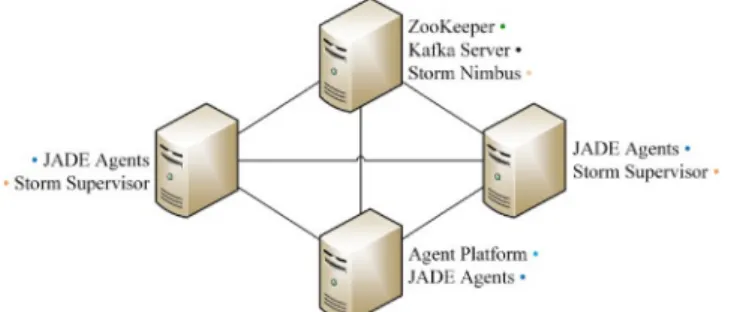
The testing environment consisted in the four-node cluster shown in Fig. 6, consisting on four machines running Core i7-4770 processors
with 12GB of memory each.
One machine was dedicated to running Zookeeper (a dependency of both Kafka and Storm), the Kafka server and Storm Nimbus, which is responsible for assigning tasks and monitoring other nodes. Two others act as Storm supervisor nodes. These are the nodes that host and govern several worker processes to complete the tasks previously assigned by the Nimbus node. Finally, the remaining machines were allocated to the hosting of the agents running in each test (evenly divided between each of the three machines). The testing configuration consisted in two main dataflows, as illustrated inFig. 7.
Regarding the CPPS, the agents were instantiated with a dummy hardware communication interface, which for each agent simulated the generation of data from its respective emulated resource. This was achieved by developing a small Java graphical application which en-abled the user to plug and unplug virtual resources that, once plugged, generated a new random value between 100 and 200 every 100 ms. Additionally, every time a new value was generated the resource had a three percent chance to enter failure mode, which forced it to generate data of increasingly larger values in small increments for 30 cycles.
The actual shop-floor dataflow is depicted with a solid line inFig. 7. For each resource a CMA was deployed, collecting all its data and publishing it to a Kafka topic (1). This topic was consumed by the Kafka Spout in the Storm topology (2) in order to enable the processing of the emulated shop-floor data. Once this process was concluded, the result was once more published to Kafka (3) and made available to be con-sumed by the CPPS one more (4).
For the scalability tests, three different deployment configurations were used, each doubling the number of resources/agents deployed in the previous one and running for 30 min. A summary of the data
collected during these runs can be seen inTable 1.
The metrics observed inTable 1are capacity and execution latency, extracted using Storm’s UI daemon. The former is referent to the pro-cessing capacity of the bolts deployed in the Storm topology. The closer the value is to“1.0”, the closer the bolt is to be running as fast as it can. This is useful to verify if the parallelism of the topology needs to be adjusted. The latter refers to how long each tuple takes on average (in milliseconds) to be executed by the respective bolt. The Logger Bolt was excluded because during testing it was only quickly logging the model updates, thus its metrics were very close to zero and not relevant for comparison. An additional metric that was extracted was the complete topology latency, meaning the time it takes each tuple, on average, to be fully processed and acknowledged by the entire topology. Its values were 11.452 ms, 13.441 ms and 16.222 ms, for 75, 150 and 300 agents respectively. These results will be discussed in Section6.
On the other hand, the second dataflow, represented by the dashed line, pertains to the Knowledge Management updates used to demon-strate theflexibility of the initial implementation regarding the analysis process. The data generated by the virtual resources was used to train two different ML models beforehand, more specifically K-Means Clustering and Logistic Regression classifiers. An example of the output from the latter can be seen inFig. 8.
As it can be observed, the model outputs the probability of failure within a given number of cycles. For testing purposes, the training data was labelled based on a 5-cycle period, and it was considered that a probability above 60% would result in a model classification of“1”as a representation of impending resource failure.
Upon deployment, every agent is initialized being associated with the aforementioned model, passing this information to the Storm to-pology via Kafka. During runtime, this configuration was then changed by the Knowledge Management tool, individually shifting certain re-sources to the clustering model instead. As shown inFig. 7, this process is initiated once the user hasfinished introducing all the information pertaining to the new model in the Java application. The serialized update is published to a Kafka topic (1), being then consumed by the Kafka Spout and emitted into the Storm topology (2). Internally, it is then split into the model and context updates, and sent to the respective bolts. The latency associated with these updates was measured over 100 iterations, consisting in the average timespan in milliseconds between the user publishing the update to Kafka, and each bolt completely up-dating its internal execution process accordingly.
Finally, the pluggability was tested using the deployment tool mentioned in the beginning of this section. For this purpose, time-stamps were extracted from two specific moments for both the plugging and unplugging of resources/agents. Once when pressing the button to launch/remove a
new resource, mimicking the detection of a new/removed shop-floor asset by the Deployment Agent, and then again when the re-spective agent is deployed and ready to start publishing data, or when it Fig. 6.IDARTS Testing 4-Node Cluster.
Fig. 7.Data Flow for the Test Case (Solid line: Data, Dashed line: Model Updates).
Table 1
Apache Storm Topology Metrics.
# Agents Bolt Capacity Execution Latency
(ms)
is removed from the agent platform. The results are summarized in Table 2, representing the average latency measured when unplugging and plugging randomly chosen agents 100 times during execution, one at a time, with arbitrary intervals in between each action and with a varying number of active agents for each run.
6. Discussion of results
The tests described in Section5aimed to verify the three main non-functional requirements described in the IDARTS specification, namely scalability,flexibility and pluggability.
Regarding thefirst set of tests pertaining to the scalability of the solution, the implementation was deployed on a four-node cluster and tested with varying data throughput rates. This rate started at around 750, then 1500, andfinally 3000 data points per second, corresponding to 75, 150 and 300 virtual resources/agents, respectively. The com-parison of the results for the RDA module can be seen inFig. 9.
As it can be observed, even with 300 concurrent resources/agents each tuple was spending slightly less than 0.2 ms at most per bolt. The average capacity of each bolt increases significantly for the last set of the test, but is still considerably less than“1.0”meaning that the bolts are not being forced to run faster than they can, which would result in unwanted queueing and delays. Regardless, once the capacity reaches higher values as the system scales further, this issue can be tackled by increasing the parallelism of the topology.
Regarding the knowledge managementflow, the latency associated with each update to the running system was also measured under dif-ferent throughput rates. The goal was to verify the impact that in-creasing volumes of data could have in the system’s capacity to adapt the RDA process.
The results for the average update latency can be visualized in Fig. 10, along with a comparison with the overall complete latency for the tuples pertaining to the shop-floor data stream.
The latency associated with the knowledge management updates is shown to increase as the system scales, albeit very slightly. These results show that not only is the Knowledge Management tool capable of adapting the RDA during execution, but also that the system’s scale has very little impact in the performance of this updates. As far as the complete latency for the data stream is concerned, the overall impact of the system’s scale is also relatively small in comparison. This is con-sidering that while the scale doubles for each run, the latency only increases by a factor of around 1.174 and 1.217 between each of them. This can be attributed not only to the increase in the processing time, but also in the increased network load and respective associated delays. Lastly, for the pluggability tests the latency was measured between the moment a new/removed resource is detected and the instant the agent is fully initialized/removed from the platform. The comparison of the results is illustrated inFig. 11.
It is interesting to note the difference between the results for un-plugging and un-plugging events. Atfirst glance, it might seem that the results suggest the agent platform simply takes a lot longer to handle the deployment of new agents. However, this difference lies mainly in the monitoring agent’s ramp-up time, since the measurement is taken only after it has fully completed its setup process, which includes in-itializing its data collection and output communication libraries. Table 2
CPPS Pluggability Test Results.
# Agents Plug Latency (ms) Unplug Latency (ms)
75 248.889 3.556
150 252.000 5.050
300 249.560 11.300
7. Conclusion and future work
A generic framework was proposed, focused on the aspects of data analysis and real-time supervision of manufacturing systems. Being aligned with the Industry 4.0 vision, the framework aims to take ad-vantage of the ongoing data explosion, presenting a scalable andfl ex-ible solution for predictive manufacturing, being as little invasive as possible. Its efficacy is however dependent on the availability, volume and quality of the data from the underlying production system.
The main contributions of the framework are thus:
•
Capacity to support a plug-and-produce paradigm in the context of predictive manufacturing through dynamic system virtualization via a MAS-based CPPS, coping with changes and disturbances at the shop-floor;•
Integration of real-time and historical data at both the component and system levels, enabling the adaptation of the real-time analysis and rule-based supervision algorithms after deployment;•
Support for context-aware self-adjustment coupled with human-machine interaction, allowing the system to either adjust its op-eration parameters through self-reconfiguration, or suggest correc-tive actions to an operator in order to return to normal production conditions and product quality.The initial implementation of the IDARTS framework focused on the integration of the CPPS data acquisition, the RDA module, as well as a prototype knowledge management application to adapt the runtime analysis during execution. The solution was deployed in a four-node cluster and tested in order to validate three main non-functional re-quirements, namely scalability,flexibility and pluggability.
From these tests it was possible to observe that the solution was scalable and capable of adapting to the changes in production, be it in terms of the shop-floor layout or capturing domain knowledge to adapt the data analysis being performed in runtime, without requiring addi-tional programming effort, stoppages or re-deployment.
Finally, future work shall also include the implementation and in-tegration of the CPPS’runtime decision module, as well as the updates to the decision-making rules that govern it.
References
[1] M. Brettel, N. Friederichsen, M. Keller, M. Rosenberg, How virtualization, decen-tralization and network building change the manufacturing landscape: an industry 4.0 perspective, Int. J. Inf. Commun. Eng. 8 (1) (2014) 37–44.
[2] Deloitte, Industry 4.0–challenges and Solutions for the Digital Transformation and Use of Exponential Technologies, (2014).
[3] A. Gilchrist, Introducing industry 4.0, Industry 4.0, Apress, 2016, pp. 195–215. [4] H. Kagermann, J. Helbig, A. Hellinger, W. Wahlster, Recommendations for
im-plementing the strategic initiative INDUSTRIE 4.0: securing the future of German manufacturing industry; Final report of the industrie 4.0 working group, Forschungsunion, Technical Report, (2013).
[5] I.I. Consortium, Industrial internet reference architecture, Industrial Internet Consortium, Technical Report, (2015).
[6] T. Stock, G. Seliger, Opportunities of sustainable manufacturing in industry 4.0,
Procedia CIRP 40 (January) (2016) 536–541.
[7] F. Shrouf, J. Ordieres, G. Miragliotta, Smart factories in industry 4.0: a review of the concept and of energy management approached in production based on the internet of things paradigm, 2014 IEEE International Conference on Industrial Engineering and Engineering Management, (2014), pp. 697–701.
[8] D. Zuehlke, SmartFactory—towards a factory-of-things, Annu. Rev. Control 34 (April (1)) (2010) 129–138.
[9] R.K. Mobley, An Introduction to Predictive Maintenance, 2nd editio, Elsevier, 2002. [10] J. Lee, E. Lapira, B. Bagheri, H. Kao, Recent advances and trends in predictive
manufacturing systems in big data environment, Manuf. Lett. 1 (1) (2013) 38–41. [11] L. Ribeiro, Cyber-physical production systems’design challenges, 2017 IEEE 26th International Symposium on Industrial Electronics (ISIE), (2017), pp. 1189–1194. [12] J. Lee, B. Bagheri, H.A. Kao, A Cyber-Physical Systems architecture for Industry
4.0-based manufacturing systems, Manuf. Lett. 3 (December) (2015) 18–23. [13] R.F. Babiceanu, R. Seker, Big Data and virtualization for manufacturing
cyber-physical systems: a survey of the current status and future outlook, Comput. Ind. 81 (2016) 128–137.
[14] A. Patcha, J.M. Park, An overview of anomaly detection techniques: existing solu-tions and latest technological trends,”, Comput. Networks 51 (12) (2007) 3448–3470.
[15] A. Marvuglia, A. Messineo, Monitoring of wind farms’power curves using machine learning techniques, Appl. Energy 98 (October (Supplement C)) (2012) 574–583. [16] J. Lee, B. Bagheri, H.-A. Kao, Recent advances and trends of cyber-physical systems
and Big data analytics in industrial informatics, Int. Conf. Ind. Informatics 2014, November 2015, 2014.
[17] L.C. Siafara, H.A. Kholerdi, A. Bratukhin, N. Taherinejad, A. Wendt, SAMBA : a self-aware health monitoring architecture for distributed industrial systems, Industrial Electronics Society, IECON 2017-43rd Annual Conference of the IEEE, (2017), pp. 3512–3517.
[18] A. Canito, M. Fernandes, I. Pra, An architecture for proactive maintenance in the machinery industry, 8th International Symposium on Ambient Intelligence (ISAml 2017) 615 (2017) ISAmI.
[19] D. Lechevalier, A. Narayanan, S. Rachuri, Towards a domain-specific framework for predictive analytics in manufacturing, Proc. - 2014 IEEE Int. Conf. Big Data, IEEE Big Data 2014, February 2015, 2015, pp. 987–995.
[20] J. Li, J. Shi, Knowledge discovery from observational data for process control using causal Bayesian networks, IIE Trans. 39 (6) (2007) 681–690.
[21] Y.K. Penya, P.G. Bringas, A. Zabala, Advanced fault prediction in high-precision foundry production, IEEE Int. Conf. Ind. Informatics, (2008), pp. 1672–1677. [22] A. Chan, K.R. McNaught, Using Bayesian networks to improve fault diagnosis
during manufacturing tests of mobile telephone infrastructure, J. Oper. Res. Soc. 59 (4) (2008) 423–430.
[23] K. Wang, Intelligent Predictive Maintenance (IPdM) system–Industry 4.0 scenario, WIT Trans. Eng. Sci. 113 (2016) 259–268.
[24] L.S. Terrissa, S. Meraghni, Z. Bouzidi, N. Zerhouni, A New approach of PHM as a service in Cloud computing, 2016 4th IEEE Int. Colloq. Inf. Sci. Technol. (CiSt). Proc. (2016), pp. 610–614.
[25] S.-J. Shin, J. Woo, S. Rachuri, Predictive analytics model for power consumption in manufacturing, Procedia CIRP 15 (2014) 153–158.
[26] R.S. Peres, A. Rocha, A. Coelho, J. Barata, A highlyflexible, distributed data ana-lysis framework for industry 4.0 manufacturing systems, in: T. Borangiu, D. Trentesaux, A. Thomas, P. Leitão, J. Barata (Eds.), Service Orientation in Holonic and Multi-Agent Manufacturing. SOHOMA 2017, March, Springer, Cham, 2017, pp. 373–381.
[27] Z. Ge, Distributed predictive modeling framework for prediction and diagnosis of key performance index in plant-wide processes, J. Process Control 65 (2018) 107–117.
[28] D. Wu, et al., A fog computing-based framework for process monitoring and prognosis in cyber-manufacturing, Int. J. Ind. Manuf. Syst. Eng. 43 (2017) 25–34. [29] R.Y. Zhong, C. Xu, C. Chen, G.Q. Huang, Big data analytics for physical
internet-based intelligent manufacturing shopfloors, Int. J. Prod. Res. 55 (9) (2017) 2610–2621.
[30] J. Lee, H.A. Kao, S. Yang, Service innovation and smart analytics for Industry 4.0 and big data environment, Procedia CIRP 16 (2014) 3–8.
[31] O. Kanjanatarakul, T. Denœux, S. Sriboonchitta, Prediction of future observations using belief functions: a likelihood-based approach, Int. J. Approx. Reason. 72 (2016) 71–94.
[32] A. Gandomi, M. Haider, Beyond the hype: big data concepts, methods, and analy-tics, Int. J. Inf. Manage. 35 (2) (2015) 137–144.
[33] F. Bellifemine, G. Caire, D. Greenwood, Developing Multi-agent Systems With JADE, (2007).
[34] A.D. Rocha, R. Peres, J. Barata, An agent based monitoring architecture for plug and produce based manufacturing systems, Industrial Informatics (INDIN), 2015 IEEE 13th International Conference, (2015), pp. 1318–1323.
[35] A.D. Rocha, R.S. Peres, L. Flores, J. Barata, A multiagent based knowledge extrac-tion framework to support plug and produce capabilities in manufacturing mon-itoring systems, ISMA 2015 - 10th Int. Symp. Mechatronics Its Appl. (2016). [36] FIPA, FIPA Request Interaction Protocol Specification, [Online] Available (2002)
http://www.fipa.org/specs/fipa00026/SC00026H.pdf.
[37] A. Guazzelli, M. Zeller, W. Lin, G. Williams, PMML: an open standard for sharing models, R J. 1 (1) (2009) 60–65.
[38] F. Pedregosa, et al., Scikit-learn: Machine Learning in Python, J. Mach. Learn. Res. 12 (2012) 2825–2830.