Profile of hospitalizations due to
otorhinolaryngologic morbidity
requiring surgical treatment. Brazil,
2003
Summary
Mariana de Carvalho Leal Gouveia1, Fábio José Delgado Lessa2, Mirella Bezerra Rodrigues3, Silvio da Silva Caldas Neto4
1 Ph.D. in Science (Otorhinolaryngology), FMUSP, Deputy Professor, Department of Surgery, UFPE. 2 Ph.D. studies in Nutrition under course, UFPE. Assistant Professor, Department of Surgery - UFPE.
3 Master studies in Public Health under course, Centro de Pesquisa Aggeu Magalhães - Fundação Oswaldo Cruz (CPqAM/Fio Cruz), Speech and Language Therapist. 4 Full Professor, Joint Professor of Otorhinolaryngology, Federal University of Pernambuco - UFPE.
Centro de Pesquisas Aggeu Magalhães - Fundação Oswaldo Cruz (CPqAM / FIOCRUZ). Address correspondence to: Mariana de Carvalho Leal - R. Paes Cabral 584 B Cordeiro Recife PE 50630-170
Tel. (55 81) 9996-5530 - Fax: (55 81) 3416-1634 - E-mail: [email protected] The present article was submitted through SGP on June 8, 2005 and approved on September 23, 2005.
A
im: To analyze the profile of the surgical procedures related to otorhinolaryngology in Brazil in the year 2003. Study Design: This was an observational, descriptive, cross-sectional study.Methods: We analyzed 80,030 surgical procedures performed in 27 Brazilian States during the period from January to December 2003. The data were obtained from the Hospital Information System of the Ministry of Health. The inclusion factor was a surgical procedure in otorhinolaryngology (ORL). All files were processed with the TABWIN software. Results: In 2003, 80,030 ORL-related surgical procedures were performed in Brazil. The Southeast region had the largest number of procedures (53.08%), followed by the South and Northeast regions (19.6% and 15.6%, respectively). Regarding the group of procedures, surgeries of the pharynx represented 45% of ORL procedures. Procedures of high complexity were more numerous in the ear surgery group. Regarding the distribution of the type of attending institution, the highest concentration of surgical procedures occurred in philanthropic hospitals, followed by state and university public hospitals. The table adopted by SUS for payment of ORL surgical procedures has not been updated for the procedures currently performed, with the consequent inappropriate notification of some types of surgery. Conclusion: Knowledge about the profile of surgical hospitalizations related to ORL permits the identification of the peculiarities of the different regions that can help health-managing authorities to make decisions in order to guarantee the principles recommended by SUS regarding access to health services.
Key words: epidemiology, surgical procedures, otorrhinolarin-gology.
ORIGINAL ARTICLE Rev Bras Otorrinolaringol.
INTRODUCTION
Otorhinolaryngology (ENT) is a clinical surgical specialty that has grown a lot in Brazil for the past years. However, public healthcare for this specialty has presented major disproportions in different regions of Brazil.
The small number of centers that train specialists in Otorhinolaryngology in some regions, such as the North and Northeast regions and the main concentration in the Southeast region makes it one of the main determining factors for the uneven distribution of services, together with financial factors, considering that it is a specialty that requires high cost equipment.
The Brazilian Constitution of 1988 has incorporated changes to the role of the government and deeply changed the legal-institutional framework of the public healthcare service, creating new relations between the different governmental levels, new roles to players in the area and has given rise to the Universal Healthcare System (SUS - Sistema Único de Saúde)1.
According to the Ministry of Health, the doctrine of SUS includes the following factors: universality, based on assurance of healthcare to any and all citizens, equity, ensuring actions and services of all levels according to the complexity required in each case, and integrity ensuring that citizens have access to health promotion, protection and rehabilitation actions, creating a system capable of providing integral healthcare 2. Medical services, therefore, should be organized so as to ensure compliance with these principles.
The repercussions of pathologies related with Otorhinolaryngologists can be recognized in many dif-ferent areas, such as occupational health, such as voice professionals and work-related laryngopathies 3, which may lead to inability to work in the role and consequent transfer of function. Another important aspect is hearing impairment: it is estimated that in the Brazilian population 1.5%, that is, about 2,250,000 inhabitants have hearing loss, ranked third among all impairments in the country 4.
So that we can develop actions and intervention strategies directed to medical care improvement it is neces-sary to have epidemiological profile of the affections and interventions and regional distribution.
The Health Information System (SIS) performs a fundamental role in Epidemiology in Health Care, aiming at making the diagnosis of healthcare status and assess-ment of public policy impact 5.
The Hospital Information System SUS (SIH/SUS) comprises an administrative database. Despite the fact that the main purpose of the system was hospitalization compensation sponsored by SUS, it has enabled the gen-eration of important information related to morbidity such as the description of care and resources used, despite the limitations 6, 7. By means of studies carried out in such
systems, we have considered the use of this database that may represent an important advance in the assessment actions and quality improvement of healthcare 5.
In ENT, this type of studies is scarce, and it is neces-sary to get to know better the profile of hospital procedure in ENT in Brazil and their implications concerning better planning and distribution of such actions.
Taking these considerations into account, we in-tended to study and analyze the hospitalization profile by ENT morbidity with surgical treatment in Brazil in 2003, characterizing ENT surgical procedures according to state, number of procedures by hospital, complexity, nature of hospital, age, gender and identification of mean length of stay for surgical procedures, specifying the value of profes-sional, hospital and diagnostic support services.
MATERIAL AND METHOD
We analyzed 80,030 surgical procedures within a total of 1,779 SUS-associated hospitals that have surgical hospitalization in ENT in 27 states of Brazil, within January and December 2003.
It was an observation descriptive cross-section study.
The studied surgical procedures were analyzed by group of procedures related with ENT, divided by anatomi-cal region (ear, pharynx, larynx, nose).
The other analyzed variables were: region, state, complexity (high and medium complexity), month of competence (previous month of submission of bill, which is normally the discharge month), type of provider (legal nature of provider classified as federal, state, municipal, non-profitable and university), mean value of hospital serv-ices (SH), professional servserv-ices (SP), complementary tests for diagnosis and therapy (SADT), for the bills paid.
The analyzed data were collected from the files of hospital production RDUFAAMM.DBC in the period from January to December 2003, kept by the Hospital Informa-tion System, Ministry of Health. The inclusion factor was ENT surgical procedure. All files were processed by the software TABWIN developed by the Department of Infor-mation Technology, Ministry of Health.
Given that they were data available on the Internet and without identification and because they were ag-gregated by Healthcare center and municipalities, there was no need for Informed Consent Term and approval of the Ethics Committee, and the source where they were collected from was: Sistema de Informação Hospitalar /Ministério da Saúde.
RESULTS
the country and the respective states.
The distribution of the surgical procedures accord-ing to complexity is shown in Table 3. We can see that only 1.56% (n= 1,249) of the procedures performed in 2003 were of high complexity. Table 4 presents a classification of hospitals according to provider by region.
Surgeries were performed 55.18% (n= 44,163) of the times in male patients and 44.81% (n= 35,867) in female patients (Table 5). The distribution of surgical procedures by age range is shown in Table 6.
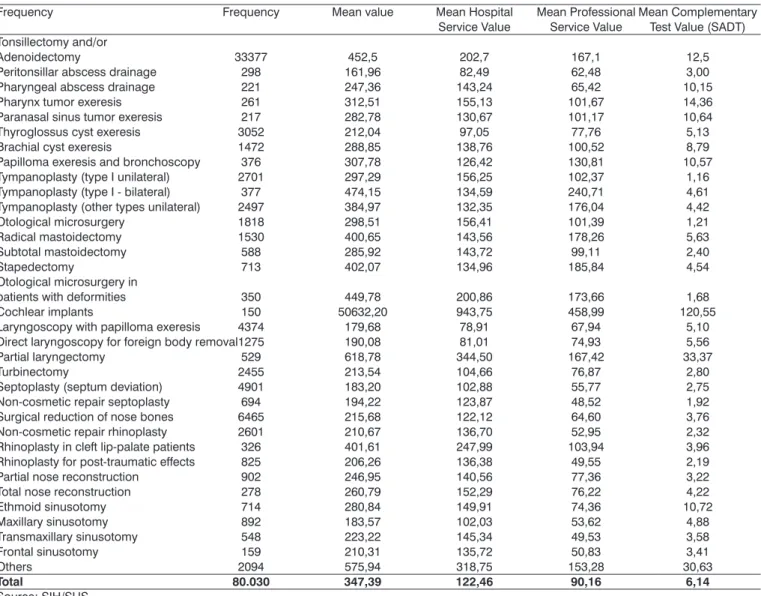
Values referring to cost with hospitalization, hos-pital services, professional service (including the whole team: surgeon, assistant surgeon and anesthesiologist), and complementary diagnostic and therapeutic services are shown in Table 7.
DISCUSSION
Social-economic differences that exist in Brazil are clearly reflected in many aspects, which also apply to medical care. According to the obtained results, the South-east region is the one that performs the most procedures (53.08%), followed by the South and Northeast regions, with 19.6% and 15.6%, respectively. As to states, Sao Paulo concentrates 35% of procedures in Brazil, followed by Minas Gerais with 9.9%. The North region is the region that has the smallest number of surgical procedures in the country. In the Northeast, the state of Bahia presented 4.6% of procedures, followed by Ceara and Pernambuco with 2.9 and 2.4, respectively. In our opinion, this distribution is a result of the fact that the Southeast region, especially the city of Sao Paulo, in addition to being highly populated 8, it is the largest medical center in the country, concentrat-ing many hospitals and medical centers. However, such data show the uneven distribution of ENT medical care in the different regions of the country, probably a reflex of the uneven economic heterogeneous distribution and development among the regions.
When we analyze it by group of procedure (Table 2), pharyngeal surgeries represent 45% of ENT procedures, which is owed to the influence of tonsillectomy and ad-enoidectomy, which are the most frequent ENT surgeries in Brazil and also in the USA 9. In all regions, this is the group of procedures most frequently performed. It is
im-Table 1. Distribution of surgical procedures in Otorhinolaryngology by region and state. Brazil, 2003.
Region and state N %
North Region 3745 4,68
Rondônia 208 0,26
Acre 386 0,48
Amazonas 326 0,41
Roraima 37 0,05
Pará 2317 2,90
Amapá 55 0,07
Tocantins 416 0,52
Northeast Region 12768 15,95
Maranhão 407 0,51
Piauí 588 0,73
Ceará 2329 2,91
Rio Grande do North 1250 1,56
Paraíba 1302 1,63
Pernambuco 1917 2,40
Alagoas 603 0,75
Sergipe 720 0,90
Bahia 3652 4,56
Southeast Region 42476 53,08
Minas Gerais 7901 9,87
Espírito Santo 1759 2,20
Rio de Janeiro 4148 5,18
Sao Paulo 28668 35,82
South Region 15676 19,59
Paraná 7704 9,63
Santa Catarina 2652 3,31
Rio Grande do Sul 5320 6,65
Center West Region 5365 6,70
Mato Grosso do Sul 450 0,56
Mato Grosso 804 1,00
Goiás 2743 3,43
Distrito Federal 1368 1,71
Total 80.030 100,00
Source: SIH/SUS
Table 2. Distribution of surgical procedures in Otorhinolaryngology by region. Brazil, 2003.
Procedure group North Northeast Southeast South Center West Total
N % N % N % N % N %
Ear surgery 306 8,2 1559 12,2 6652 15,7 1977 12,6 703 13,1 11197
Nose surgery 1045 27,9 4121 32,3 11870 27,9 3837 24,5 1523 28,4 22396
Pharynx surgery 1844 49,2 4553 35,7 19032 44,8 8089 51,6 2600 48,5 36118
Larynx surgery 550 14,7 2535 19,9 4922 11,6 1773 11,3 539 10,0 10319
Total 3745 100,0 12768 100,0 42476 100,0 15676 100,0 5365 100,0 80.030
Source: SIH/SUS
portant to point out the fact that ear surgeries represent 8% of procedures in the North and over 12% in the other regions, up to 15.7% in the Southeast, which include high complexity surgeries whose surgical material is not necessarily available in SUS centers in other states, which results in some patients being referred to outside treatment, sometimes in other regions of the country, generating higher costs for the resolution of the case.
classi-fied by SUS into high and medium complexity. Medium complexity comprises a set of actions and ambulatory and hospital services that aim at dealing with the main health-care problems of the population, whose clinical practice demands the availability of specialized professionals and the use of diagnostic and therapeutic technological sup-port, which does not justify its provision in other cities of the country. High complexity, in turn, is high technology, high quality and high cost services. In Table 3 we can see
the distribution of these ENT surgical procedures accord-ing to complexity.
High complexity ENT procedures comprise cochlear implant and surgeries in patients with craniofacial deformi-ties (pharynx, nose and ear) that are part of SIPAC (High Complexity Procedure Information System). The group of ear surgery comprises most of these procedures, maybe because of the presence of cochlear implant, which has been expanding in Brazil. In 2003, out of 640 high
com-Table 3. Distribution of surgical procedures in Otorhinolaryngology by procedure complexity. Brazil, 2003.
Procedure group High Complexity Medium Complexity Total
N % N %
Ear surgery 640 5,71 10557 9,28 11197
Nose surgery 577 2,57 21819 97,43 22396
Pharynx surgery 32 0,08 36086 99,92 36522
Larynx surgery 0 0 10319 100 10319
Total 1249 1,56 78781 98,44 80.030
Source: SIH/SUS
Table 4. Distribution of surgical procedures in Otorhinolaryngology by type of provider and region. Brazil, 2003.
Region and state North Northeast Southeast South Center West Total
Hired 1113 2150 2866 2049 676 8854
Federal 81 570 1465 981 650 3747
State 581 2407 9291 1718 707 14704
Municipal 254 641 3201 791 337 5224
Non-profitable 1581 4247 19227 6543 1679 33277
University 135 2753 6426 3594 1316 14224
Total 3745 12768 42476 15676 5365 80.030
Source: SIH/SUS
Table 5. Distribution of procedures in Otorhinolaryngology by gender. Brazil, 2003.
Procedure group Male % Female % Total
Ear surgery 5200 48,56 5507 51,44 10707
Nose surgery 13609 60,0 8787 40,0 22396
Pharynx surgery 19243 52,56 17365 47,43 36608
Larynx surgery 6111 59,22 4208 40,77 10319
Total 44163 55,18 35867 44,81 80.030
Fonte: SIH/SUS
Table 6. Distribution of procedures in Otorhinolaryngology by age range. Brazil, 2003.
Procedure group ≤ 4 years 5-9y 10-19y 20-39y 40-59y ≥ 60 y Total
Ear surgery 762 1502 2880 3858 1865 330 11197
Nose surgery 278 614 5268 11419 3758 1059 22396
Pharynx surgery 9403 15692 7004 3001 778 240 36118
Larynx surgery 1267 1230 1140 1766 2946 1970 10319
Total 11710 19038 16292 20044 9347 3599 80.030
plexity procedures, 150 were cochlear implants (SIH/SUS, 2004). It is a procedure that started to be performed by SUS in 1993 and up to 2003 three states (Rio Grande do Norte, Rio Grande do Sul and Sao Paulo) had performed the procedure, reflecting the need to be expanded to other centers to provide the universal action proposed by SUS, so that the whole population can have access to healthcare services for integral healthcare provision.
As to distribution of ENT procedures according to type of provider, we observed that there is higher concen-tration of surgical procedures performed in non-profitable
hospitals, followed by state and university centers (Table 4). We also observed that contracted hospitals (private SUS-related hospitals) amounted to only 11% of these procedures performed in the country. The North region presented higher productivity of this type of provider compared to the others, with 29% surgical procedures, and the Southeast region is the one that has fewer surgeries performed in contracted hospitals (6.74%). Our opinion is that owing to the fact that the fees paid for ENT procedures are low compared to other surgical procedures performed by other specialties, in the private sector, SUS-related
enti-Table 7. Description of mean value of hospitalization, hospital services, professional and complementary tests by ENT surgical procedure. Brazil, 2003.
Frequency Frequency Mean value Mean Hospital Mean Professional Mean Complementary
Service Value Service Value Test Value (SADT) Tonsillectomy and/or
Adenoidectomy 33377 452,5 202,7 167,1 12,5
Peritonsillar abscess drainage 298 161,96 82,49 62,48 3,00
Pharyngeal abscess drainage 221 247,36 143,24 65,42 10,15
Pharynx tumor exeresis 261 312,51 155,13 101,67 14,36
Paranasal sinus tumor exeresis 217 282,78 130,67 101,17 10,64
Thyroglossus cyst exeresis 3052 212,04 97,05 77,76 5,13
Brachial cyst exeresis 1472 288,85 138,76 100,52 8,79
Papilloma exeresis and bronchoscopy 376 307,78 126,42 130,81 10,57
Tympanoplasty (type I unilateral) 2701 297,29 156,25 102,37 1,16
Tympanoplasty (type I - bilateral) 377 474,15 134,59 240,71 4,61
Tympanoplasty (other types unilateral) 2497 384,97 132,35 176,04 4,42
Otological microsurgery 1818 298,51 156,41 101,39 1,21
Radical mastoidectomy 1530 400,65 143,56 178,26 5,63
Subtotal mastoidectomy 588 285,92 143,72 99,11 2,40
Stapedectomy 713 402,07 134,96 185,84 4,54
Otological microsurgery in
patients with deformities 350 449,78 200,86 173,66 1,68
Cochlear implants 150 50632,20 943,75 458,99 120,55
Laryngoscopy with papilloma exeresis 4374 179,68 78,91 67,94 5,10
Direct laryngoscopy for foreign body removal 1275 190,08 81,01 74,93 5,56
Partial laryngectomy 529 618,78 344,50 167,42 33,37
Turbinectomy 2455 213,54 104,66 76,87 2,80
Septoplasty (septum deviation) 4901 183,20 102,88 55,77 2,75
Non-cosmetic repair septoplasty 694 194,22 123,87 48,52 1,92
Surgical reduction of nose bones 6465 215,68 122,12 64,60 3,76
Non-cosmetic repair rhinoplasty 2601 210,67 136,70 52,95 2,32
Rhinoplasty in cleft lip-palate patients 326 401,61 247,99 103,94 3,96
Rhinoplasty for post-traumatic effects 825 206,26 136,38 49,55 2,19
Partial nose reconstruction 902 246,95 140,56 77,36 3,22
Total nose reconstruction 278 260,79 152,29 76,22 4,22
Ethmoid sinusotomy 714 280,84 149,91 74,36 10,72
Maxillary sinusotomy 892 183,57 102,03 53,62 4,88
Transmaxillary sinusotomy 548 223,22 145,34 49,53 3,58
Frontal sinusotomy 159 210,31 135,72 50,83 3,41
Others 2094 575,94 318,75 153,28 30,63
Total 80.030 347,39 122,46 90,16 6,14
Source: SIH/SUS
ties do not feel encouraged to perform these procedures and, at the same time, high complexity procedures that are well compensated have high level of requirements, hindering the accreditation of this type of provider.
The low production of federal hospitals is justified by the small number of this type of hospital per state. We have to take into account the fact that university hospitals, differently from other type of providers, do not intend to have high yield, because they have their activities directed to teaching and research.
As to analysis and distribution by gender (Table 5), we detected slight predominance of male gender in ENT procedures in general. We observed similar distribution concerning gender in all procedure groups, which was expected given that we analyze many types of surgery in the same group. Knowing that most surgical pathologies in ENT do not have different distribution concerning gender, except for few such as otosclerosis, which is more frequent in women 10, and larynx cancer, which is more frequent in male subjects 11.
As to age range distribution (Table 6), pharynx surgeries, especially tonsillectomy with and without ad-enoidectomy, were more frequent in school-age children (5-9 years) and pre-school age children (≤ 4 years), which was already expected, given that the lymphoid tissue reaches maximum growth between the age of 4 and 10 years, period of maximum clinical manifestation leading to surgical procedure 12. Ear surgeries were more frequent in young adult age, which was already expected given that most surgical pathologies in this group result from chronic inflammatory processes of slow progression. Laryngeal surgeries were more prevalent in adults (40 to 59 years) and the elderly (≥ 60 years). In this group, we can include pathologies such as laryngeal neoplasm that affects the population with mean age of 58 years, according to the national study carried out by Steffen and Corrêa (1994)10, and laryngeal benign pathologies, especially those result-ing from speech trauma that may be related to some spe-cific professional activities more prevalent in older stages of life, reaching the economically active population.
We observed that some procedures shown in Table 7 described as laryngectomy, nose reconstruction, rhino-plasty may be performed also by professionals of related areas such as head and neck surgeon and plastic surgeon. This difficulty to select more restrictively procedures per-formed by Otorhinolaryngologists is owed to the fact that SIH does not identify which professional performed the procedure, even though there is a procedure table that includes the description of which professionals are trained to perform each procedure. We decided to select by group of procedure (ear, nose, pharynx and larynx) because they are areas of competence of Otorhinolaryngology, because there is no selection by performing professional, even though we are aware that some of the procedures could
have been performed by some other specialist.
We can also observe that in the surgical procedure table in force some procedures that have been recently implemented as a result of surgical and technological advance have not been included yet, such as the case of nasal endoscopic surgeries applied specially in the surgical approaches of sinusal surgeries, which is well recognized as a safe technique that has more benefits to the patients than the conventional technique 13. This type of surgery demands higher expenses for its execution because of surgical material used and videoendoscopic equipment, and as we could observe there is no differentiation in terms of payment for endoscopic or conventional procedures, which may lead to situations in which the hospitals that do not have other source of income can not purchase such special type of material. The procedures that are paid higher mean values are high complexity procedures such as cochlear implant and craniofacial deformity surgeries, which involve high cost materials, but the price increase of expensive materials is not necessarily followed by increase in fees paid by SUS.
Considering such factors, in addition to lack of at-tention when filling out the forms that generate notification of information sources by professionals that perform the procedures, which may imply inappropriate information, we should be very careful when analyzing data generated from such instruments.
CONCLUSION
The obtained data show uneven distribution con-cerning ENT surgical care in the regions and states of Brazil. The most relevant aspects were:
• More than 50% of ENT surgical procedures are performed in the Southeast region.
• High complexity procedures represent only 1.56% of surgical procedures in ENT, which is the group that generates the higher number of these procedures is ear surgery, contributing to such data the cochlear implant surgery, but it is still less available in Brazil than its demand.
• Non-profitable hospitals were the ones that per-formed the most such surgical procedures, and there was little participation of private (hired) sector as a result of low fees paid for such procedures.
• The surgical procedure fee table adopted by SUS is not updated to include the most current procedures, leading to inappropriate notification of some types of surgeries.
REFERENCES
1. Andrade SM.de et al. Bases da Saúde Coletiva. Rio de Janeiro: Uel; 2001.
2. BRASIL, Ministério da Saúde, Secretaria Nacional de Assistência à Saúde. ABC do SUS. Doutrinas e Princípios. Brasília, 1990.
3. Consenso Nacional sobre voz profissional. Rev Bras Otorrinolaringol 2004 (Supl) 70(6): 68p.
4. ASHA-American Speech and Hearing Association. Available at: http:// www.entreamigos.com.br/textos/defaud/infdefaud.htm. Accessed on: 26 jan. 2004.
5. Lessa FJD, Mendes ACG, Farias DA et al. Novas metodologias para vigilância Epidemiológica: Uso do Sistema de Informação Hospitalar - SIH/SUS. Informe Epidemiológico de SUS 2000; 9 (Supl.1): 3-27. 6. Campos MR, Martins M, Noronha JC, Travassos C. Proposta de
Inte-gração de Dados do Sistema de Informações Hospitalares do Sistema Único de Saúde (SIH/SUS) para Pesquisa. Informe Epidemiológico de SUS 2000; 9 (1): 51-8.
7. Portela MC, Scheramm JMA, Pepe VLE et al. Algoritmo para a com-posição de dados por internação a partir do sistema de informações hospitalares do sistema único de saúde (SIH/SUS) - Composição de dados por internação a partir do SIH /SUS. Cad Saúde Publ 1997; 13 (1): 771-4.
8. IBGE, 1996. Available at: http://www.ibge.gov.br/home/estatistica/ populacao/contagem/brcont96.shtm Accessed on: 08/11/2004 9. Rutkow IM. Ear, nose and Throat operations in the United states,
1979-1984. Arch Otolaryngol Head and Neck Surg 1986; 112: 873. 10. Hungria H. Otosclerose - tratamento cirúrgico. In: Hungria H.
Otor-rinolaringologia. 8°ed. Rio de Janeiro: Guanabara Koogan; 2000. p. 507-22.
11. Steffen N, Corrêa MZl. Câncer de Laringe. In: Da Costa SS, Cruz OLM, Oliveira JAA. Otorrinolaringologia - Princípios e Prática. Porto Alegre: Artes Médicas; 1994. p.168-80.
12. Richtsmeier WJ, Shikhani AH. The physiology and immunology of the pharyngeal lymphoid tissue. Otolaringol Clin North Am 1987; 20:219.