ISSN 0104-6632 Printed in Brazil
www.abeq.org.br/bjche
Vol. 33, No. 01, pp. 105 - 114, January - March, 2016 dx.doi.org/10.1590/0104-6632.20160331s20140078
*To whom correspondence should be addressed
Brazilian Journal
of Chemical
Engineering
LEACHING OF COARSE CALICHE ORE.
EXPERIMENT AND MODELLING
S. Valdez
1, J. I. Ordóñez
1*, L. A. Cisternas
1,3and L. Moreno
1,21
Department of Chemical and Mineral Process Engineering, Universidad de Antofagasta, Chile. E-mail: [email protected]
2
Department of Chemical Engineering and Technology, Royal Institute of Technology, Sweden. 3
Centro de Investigación Científico y Tecnológico para la Minería, Chile.
(Submitted: September 25, 2014 ; Revised: March 11, 2015 ; Accepted: March 15, 2015)
Abstract - Heap leaching of caliche ores is frequently performed with run-of-mine (ROM) material, which includes rocks of very different sizes; however, most of the experimental data are obtained using small particles. To contribute to the understanding of caliche leaching, an experiment using coarse particles was carried out. The recoveries obtained from this experiment were compared with those observed in the leaching of fine particles and, as expected, a larger volume of leachant was required for leaching coarse particles to reach the same recovery. For the highly soluble species nitrate, the recovery was modelled using a previously developed model, obtaining good agreement without any fitting by using only the mass transfer coefficient obtained, by fitting, from fine particle leaching data in previous works. Physical properties such as permeability and capillarity were determined, showing that capillary forces are large, but that the permeability is very small, implying that flow through caliche particles should be very small.
Keywords: Nitrate; Physical properties; Column leaching; Particle size effect; Phenomenological model.
INTRODUCTION
Caliche is a mineral composed of a high propor-tion of water-soluble species that is naturally found in northern Chile, in the regions of Tarapacá and Antofagasta. The most important products obtained from this mineral are nitrates and iodine. Natural nitrates (also named Saltpetre) are used for the manu-facture of fertilizers and as industrial salts, while iodine is employed in medical and technological ap-plications (Gálvez et al., 2012; Valencia et al., 2008; Ericksen, 1983). Chile is the world's largest producer of iodine and natural nitrates (USGS, 2013).
The recovery of metals and non-metals from min-erals using aqueous solutions has been carried out since ancient times, both vat and heap leaching being the most used techniques. In general, the leaching consists of the dissolution of solids or part of them
by adding a leaching solution, which is subsequently conducted to a separation process (De Andrade Lima, 2004). In the case of the production of iodine and nitrates from caliche, depending on the grade and granulometry of the ore, the leaching process takes place in vats or heaps. The heap leaching has gained great importance due to the decreasing ore grades and the increment of processing costs (Ghorbani et al., 2011). Caliche heaps are frequently constructed by accumulation of 600 to 900 thousand tons of ROM caliche, which means that a wide spectrum of particle sizes composes the heaps.
salts (SQM, 2013; Wheeler, 2010).
For metallic minerals, such as copper ores, the leaching is governed by chemical reactions (Bouffard and Dixon, 2001; Bennett et al., 2012), whereas the leaching in caliche is determined by dissolution of the soluble species, which is governed by concentra-tion differences. Another important difference with metallic minerals is that caliche has a high fraction of soluble minerals formed by different species that are dissolved simultaneously at different rates, which makes the modelling of caliche heap leaching a com-plex task (Gálvez et al., 2012). The high fraction of soluble species causes a gradual decrease in the size of the particles and, therefore, a diminution of the heap height.
Many factors affect the performance of heap leaching, such as the macro hydrodynamics of the heap, compaction, channelling, changing permeabil-ity and the particle size, among others. The last one has an important effect on the leaching since the magnitude of the radius has a direct relation with the resistance to mass transfer within the solid matrix and with the surface area of contact between leachant and solid (Ghorbani et al., 2011). In previous works (Ordóñez et al., 2013; Ordóñez et al., 2014), column leaching experiments on a pilot scale using fine mate-rial were performed and a phenomenological model based on mass balance was fitted with acceptable accuracy for the dissolution of the highly soluble species. In the present study, coarser particles were leached, in order to get empirical information some-what closer to industrial conditions, where the parti-cles can reach up to several decimetres. Moreover, the phenomenological model was tested in a new column experiment, using the same mass transfer coefficient, , obtained by fitting in an experiment with small sized particles.
One of the possible causes for poor performance of heap leaching could be the inadequate understand-ing of the mineralogy and the physical properties related to it. Therefore, experiments were also done to characterize the material physically, such as per-meability and capillary suction tests.
METHODOLOGY
Caliche and Solutions
The particles of caliche used in the column ex-periment and in the physical characterization tests were obtained from Northern Chile. The soluble frac-tion of the mineral was chemically analysed and its
composition is shown in Table 1. Nitrate was deter-mined by molecular absorption spectroscopy (UV2, Unicam UV/Vis). Sulphate was quantified by gra-vimetry, while sodium, potassium, magnesium and calcium were measured by atomic absorption spec-troscopy (220FS, Varian). Acid-base volumetry was used for boron determination. Chloride and iodine were determined by titration with silver nitrate and so-dium thiosulphate, respectively. For perchlorate analy-sis, a selective ion-electrode was used (Cole Parmer).
Table 1: Composition of soluble species in the caliche. Concentration in wt%.
NO3- IO3- Cl- SO42-ClO4-BO33- K+ Ca2+ Mg2+ Na+ 4.65 0.011 8.45 9.50 0.025 0.09 1.18 0.82 0.62 8.56
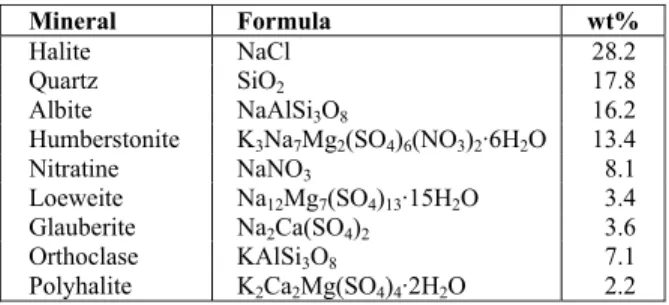
According to mineralogical XRD analysis (Sie-mens D5000 Diffractometer), the most abundant water-soluble species in the caliche ore used is Halite (NaCl), which is the unique source of chloride; meanwhile, nitrate is shared between Humberstonite (K3Na7Mg2(SO4)6(NO3)2·6H2O) and Nitratine (NaNO3),
both very soluble minerals. Sulphate is widely spread in caliche and it is associated with sodium, potas-sium, magnesium and calcium. The insoluble species are present as silicates such as Quartz (SiO2) and
Albite (NaAlSi3O8). The semi-analytical
quantifica-tion by XRD of the species is listed in Table 2.
Table 2: Main mineral composition of caliche de-termined by XRD.
Mineral Formula wt%
Halite NaCl 28.2
Quartz SiO2 17.8
Albite NaAlSi3O8 16.2
Humberstonite K3Na7Mg2(SO4)6(NO3)2·6H2O 13.4
Nitratine NaNO3 8.1
Loeweite Na12Mg7(SO4)13·15H2O 3.4
Glauberite Na2Ca(SO4)2 3.6
Orthoclase KAlSi3O8 7.1
Polyhalite K2Ca2Mg(SO4)4·2H2O 2.2
In the leaching test, rocks with masses ranging from 0.2 to 4.3 kg were placed into the column. For the granulometric characterization, the volume-weighted particle radius was used, which was 6 cm. The mass distribution is presented in Figure 1, where 40% of the total loaded mass is found in the last interval, in which particles with masses larger than 3.2 kg are included.
w te si d co co w le ca fo F in ex F p w g af in
were loaded i ened on one ilicone on th irect liquid olumn wall. olumn was with inert gla eaching expe aliche was ormly distrib
Figure 1: Par n the column xperiments.
Figure 2: Co articles. Two walls are show
The leach ation rate of fter 600 h. ntermittent ir 0 0.1 0.2 0.3 0.4 0.5 0. M as s frac ti o n Brazilia in the colum e side and a he upper par flow betwee The total m 28.5 kg. Th ass particles eriment, the demineralise buted.
rticle mass d n leaching ex
olumn leach o large partic wn.
ing was per f 4 L/h/m2, The leachin rrigation reg
.2 ‐ 1.2 1.2 ‐ 2
Interv
Leach
an Journal of Che mn; some of t attached to t
rt of the peri en the calich mass of calich he void spac (Figure 2). F solution emp ed water, w
istribution of xperiment. C
hing experim cles attached
formed with which was r ng was perfo gime of 8 ho
2.2 2.2 ‐ 3.2
val of masses, kg
hing of Coarse Ca
emical Engineerin them were f the walls us imeter to av he rock and he loaded in ces were fil For the colu ployed to lea which was u
f caliche load olumn leach
ment with la d to the colu
h an initial i reduced to h formed with urs a day fo
> 3.2
aliche Ore. Experi
ng Vol. 33, No. 0 flat-sing void the the lled umn ach uni-ded hing arge umn rri-half an or a tot liq lys dis and lys eri the Ph ter par Th ass the fun che sen the the ma per Fo cal ma tem wi tim rem the (A ker ter the the dif sub a v int wa sam Th the the tai po ho ker
iment and Model
01, pp. 105 - 114 tal period of quid were ta sed. When th smantled and d weighed. sed. The reco ing the total e leachant an
hysical Char Some physi rmined, whic rent density, hey provide sociated with e transport o ndamental to e is a predo ne was used e dissolution The capillar e capillary co ass of absorb r square root or determinin liche rocks aintaining an mperature du th the suctio me; in each m
moved from e vessel acco AENOR, 199 rosene, the rms of water e densities o e apparent fferent sizes bmerged in a very short tim to the calich as calculated
mple by the his density is e rock (open To estimate e rocks were ned kerosen res was rem urs. After th rosene, the
lling
4, January - Marc f 71 days. Du aken every
he leaching d the remain
Samples of overy of eac mass of the nd the mass r
racterization
ical propertie ch included:
c) open por useful inform h the minera of leachant i o understand minantly wa in the measu of caliche. ry suction w oefficient (kc bed liquid pe t of the elaps ng the capil
were put in n immersion uring 5 hour oned liquid w
measuremen the support, ording to the 99). Since obtained va
properties b f kerosene a density ( ) s and previo
a glass beak me to avoid t he pores. The
d by dividi e volume of
apparent sin and closed p e the open p
dried and pu ne at the bot
moved using hat, the calic vacuum pum
ch, 2016 uring this tim
day and ch finalized, th ning rocks w f residues w
h ion is calc e ion that wa remaining in
n of Caliche
es of the min a) capillary rosity and d) mation on th al such as th
in the partic heap leachin ater-soluble m
urements in
was determin ),
c which is er cross-sect
sed time for lary suction n contact w n depth of 3
rs. The mass was determi nt, the sampl , weighed, an e standard U the test i alues were tr by using the r and water. Fo ), rocks of ously weigh er filled with the penetratio e apparent c
ng the mas displaced k nce it include pores).
orosity of th ut in a desicc ttom. The ai g a vacuum che was subm mp was then
1
me, samples hemically an he column w were remove were also an
culated consi as removed b
the residue.
Ores
neral were d suction, b) a ) permeabilit he phenomen he wetting an cle, which a
ng. Since ca mineral, ker order to avo
ed in terms defined as th ional area an liquid uptak n, cube-shape with kerosen
mm at roo s of the rock ined along th le was rapid
nd returned UNE-EN 192
is done wi ransformed ratios betwee or determinin f caliche wi
hed dry we h kerosene f on of kerosen caliche densi
ss of the d kerosene (Vs es the pores
he caliche ( cator that co ir in the inn m pump for
th p sa p ε w k v te sp ch 5 d ra an co sa k a h le h b
he valve wa ressure in th aturated in k orosity was c
sat s k M M ε V ρ
where Msat erosene, Ms olume of sam
Permeabili erial to perm paces. For th he, cubic sam 0 cm2 were c iameter vert ated in vacuu
nd the bottom one and adh ample top h erosene was hose conne eight of the e evel of the ke
Figure 3: L
The variat ose was mea ility accordin
e h r r k ln Kρ g h
as opened to he desiccato kerosene is t
calculated by
s M
is the mass
s the initial mple and ρk
ity (K) is the mit the flow
he study of t mples with c cut. The sam tically drilled um with kero m of the sam hered to acry
ad a hole at introduced in ected to the
experiment f erosene in the
Layout of pe
tion of heigh asured and us ng to the Equ
2 m
Qμ
h πZ
o recover th or. The mass
then determi y Equation (
of the samp mass of the the density e capability o
of fluids th the permeabi cross sectiona mples, with a
d in the cen osene for 24 mples were s ylic plates. T t the centre,
nto the calich plate (Figur from the soli e hose (H) w
rmeability te
ht level of k sed to calcul uation (2) (Bi
he atmosphe s of the calic
ined. The op 1).
ple saturated e solid, Vs
of kerosene. of a porous m hrough its p ility in the c al area of ab hole of 1 cm ntre, were sa 4 hours. The
sealed with s The plate on through wh he sample us re 3). The to id sample to
as about 3.5
est. H=3.5 m
kerosene in late the perm ird et al., 200
eric che pen (1) d in the ma-pore ali-bout m of atu-top sili-the hich sing otal the m. m. the mea-02). (2) wh res dy is t age of cy cub the pro tio scr lut nit tio by the dec (D of the cen ali k (α dr dt con cal dV wh sen tra and dis the (N ple
here re is the sponds to the ynamic visco
the kerosene e height of k
the sample lindrical geo bic shapes, e average ra oach gave th os r / re h, w
MO
The model ribed by Gálv tion of highl trate and iod on. The mode y well-stirred e particles a crease when
According Dokoumetzidi
the particle r e difference
ntration in th ty factor is g (Equation ( )
α and the mi
i s r k C t αρ Performing ncentration o lculated from
wi i V C qA C dthere the acc nted by the le ansported by
d the dissolu ssolution is o e number of
). p
N For a m
ease review G
e external rad e hole radiu
sity of keros e density, hm kerosene and e. As Equati
ometries and a weighted adius was co he best agree which were te
ODEL FUND
that was us vez et al. (20 ly soluble s dine in terms el is 1-D and d reactors in
re spherical the soluble to the Brun is and Mach radius ( )ri w between the he liquid (C given by the (3)). The fra ineral density
Ci
a material b of the specie m Equation (4
1
i i
C C N
cumulation i eft hand side y advection b
ution from t obtained con f particles co more detailed
Gálvez et al.
dius of the sa s,Q is the f sene, g is th
m correspond d Z represe ion (2) is f d the sampl radius defin onsidered for ement for th ested by simu
DAMENTA
sed in this w 012) and def
pecies of ca s of their out d the column series. It is and of equa species are d nner and Tol heras, 2006), with time is p e solubility (
), i
C where th e mass transf
action of so y ( )ρ are als
balance in ea es along the 4). 2 4 p i d N r d
in the reacto e term, is equ
between adj the particles nsidering Equ ontained in t d description
. (2012). Sub
ample, rh co flow, μ is th he gravity, ρ ds to the ave ents the heig formulated f les used hav ned as 90%
r re. This a he different r
ulation.
LS
work was d fines the diss aliche such tlet concentr is represente assumed th al size, whic dissolved.
lloczko mod , the variatio proportional
(Cs) and co he proportio fer coefficien
luble materi so considered
(3
ach reactor, th e heap may b
i dr
dt (4
or " "i , repr ual to the ma acent reacto s. The term uation (3) an the reactor "
of the mode
bsequently, th or-he k ρ er-ght for ve of ap- ra- de- o-as ra-ed hat ch del on to n-nt, ial d. 3) he be 4) re-ass ors of nd " "i
el,
p m (2 ad te pr re w P al p sa sh sa henomenolo mental data, a
2013); by us djustable pa ests were ca
resent work, eference, sim with the leach
RE Physical Cha The calich logical detai erformed in ample. Altho howed an ap amples salin Fi M Brazilia ogical model according to sing column arameter ( )k arried out w
using the sa mulations wer hing experime
ESULTS AND
aracterizatio
he studied co ls on its surf
order to ob ough, the ma pparently hom
e veins were
igure 4: Deta Microcrystalli
Leach
an Journal of Che was validat the work of n leaching ex
was fitted. with small p ame k obtai re carried ou ents with coa
D DISCUSS
on
ontained int face. Longitu
serve the inn ajor part of c mogeneous t e identified, p
(a) ailed view o ine structure.
Table 3 Values c (SD=sta Entity Lowes Highes Avera SD
hing of Coarse Ca
emical Engineerin ed with expe f Ordóñez et xperiments, . However, particles. In ned in the ci ut and compa arser particles
SION
eresting min udinal cuts w ner parts of caliche surfa texture, in so possibly Hal
f the surface . 3: Density correspond andard devia y st value st value ge value
aliche Ore. Experi
ng Vol. 33, No. 0
eri-t al. the the the ited ared s. ner-were the aces ome lite. In 1 m dis the ter Th 2.4 the hea liq me ave 24 kg be spa cor ob hig
e of a caliche
and poros to the statis ation). Density, kg/m3 2102 2468 2309 131
iment and Model
01, pp. 105 - 114 other ones, t mm was obs ssolution pro e surface to e The porosit rmined and t he open por 4% and 16.3 e 14 analyse ap leaching quid retention
easurements, erage value w 68 kg/m3. W /m3 for calic directly com aces and fra rrelation bet served, sinc gh heterogen
e sample. (a)
sity determ stics for 14
Poro % 2. 16. 9. 5. lling
4, January - Marc the presence
erved, which ovoked by a environmenta ty of rocks an the results ar rosity of the %, with an ed samples. T
performance n in the hea , no big diffe was 2309 kg Wheeler (201 che ores; how mpared since actures, whic tween densi e the specim neity in their
(b) Saline veins inations. samples. osity, % 4 3 5 5
ch, 2016 e of microcry
h can arise th a prolonged al moisture ( nd their dens re summariz e caliche ra average valu The open po e are mainly ap. Regardin erences were g/m3, ranging
0) found den wever, these they include ch diminish ity and poro mens of calic composition
s (10X) and (
1
ystals less tha hrough a loc
exposition (Figure 4).
sities were d zed in Table anges betwee
ue of 9.5% f orosities in th y related to th ng the densi e observed; th g from 2102 nsities of 190
When the particles are irrigated, two different re-gions are observed in the rocks: a water-saturated layer in the surface and a material slightly humid in the core of the rocks. This was observed in the labor-atory in the capillarity tests and subsequently con-firmed by the column experiment in the rocks at-tached to the column walls. Apparently the leaching solution flows on the particle surface and no liquid transport takes place through the inner part of the rock. The capillarity of caliche is large (Table 4) but the permeability is very small, about 5*10-17 m2 (Table 5). Therefore, the leaching agent would be transported into the particle by capillary forces, which are large when the material is dry, but they disappear once the material is humid. No water flow is expected through the caliche rocks due to the small permeability of the caliche. The leachant would flow along the surface of the caliche ores and water penetrates the inner part of the particles by capillary suction. From these data, it is possible to conclude that the pores in caliche are very small (large capillarity and small permeability) but they are abundant (no small porosity).
Table 4: Capillary absorption coefficients (kc) of ca-liche specimens. (SD=standard deviation).
Sample C1 C2 C3 C4 C5 C6 C7 C8 C9 Mean SD
kc, kg/m2/h0.5 0.5 1.1 1.5 2.7 3.6 3.7 4.5 6.8 8.7 3.6 2.7 Table 5: Permeability coefficient (K) determined for caliche samples. (SD=standard deviation).
Sample P1 P2 P3 Mean SD
K, m2 7.4*10-18 5.7*10-17 8.1*10-17 4.9*10-17 3.8*10-17
Column Leaching Experiments
Recovery of the ions was determined considering the mass of species extracted during leaching and that remaining in the residues. The composition of the residues is shown in Table 6. For nitrate, perchlo-rate and iodine the final recoveries were the highest, above 90%. On the other hand, the species formed by calcium (Glauberite and Polyhalite) and boron were only partially leached, reaching recoveries of about 50% for these ions (Figure 5).
Table 6: Composition of the remaining soluble species in the residue after leaching. Concentra-tion in wt%
NO3- IO3- Cl- SO42-ClO4-BO33- K+ Ca2+ Mg2+ Na+ 0.35 0.001 1.10 2.80 0.003 0.07 0.19 0.69 0.15 0.86
Significant increments in recovery were achieved up to 600 h, which correspond to 1 m3/t; after that, the extraction changed to slower kinetics due to a reduction by half of the irrigation rate. This is not visualized in Figure 5, since it shows the recovery as a function of the leaching ratio. In this case a small irrigation rate increases the slope of the curve. Ac-cording to the recoveries, the volume of leachant used in the experiment was sufficient because the recoveries of ions were relatively high for the highly water-soluble species and even less soluble ions, such as sulphate, were close to 80%. The use of glass stones may favour the channelling in the column and a part of the leachant may pass directly through the column without being effectively used for leaching.
(a) (b) 0.0
0.2 0.4 0.6 0.8 1.0
0.0 0.5 1.0 1.5 2.0
R
el
a
ti
ve
r
ec
ove
ry
Leaching ratio, m3/t
NO3 Cl Ca
0.0 0.2 0.4 0.6 0.8 1.0
0.0 0.5 1.0 1.5 2.0
R
el
a
ti
ve
r
ec
ove
ry
Leaching ratio, m3/t
Leaching of Coarse Caliche Ore. Experiment and Modelling 111
Brazilian Journal of Chemical Engineering Vol. 33, No. 01, pp. 105 - 114, January - March, 2016 (c)
Figure 5: Recovery curves of ions for large particle column leaching. (a) Nitrate, Chloride and Calcium, (b) Perchlorate, Iodate, Potassium and Sulphate and (c) Sodium, Magnesium and Boron.
The effect of the particle size on recovery was evaluated by comparing the results of coarse leach-ing (CL experiment) with another leachleach-ing experi-ment previously performed by Ordóñez et al. (2013), in which fine particles, less than 1.4 cm of diameter, were used with tap water as leaching agent (FL ex-periment). As shown in Figure 6, the final recoveries of all ions were similar between both experiments. However the increment was slower for the CL ex-periment; i.e., a larger volume of leaching solution is required to reach the same recovery. The particle size is determinant in this result, because larger parti-cles present higher resistance to inner transport that slows the depleting of ions from caliche. The leachant preferably flowed by the periphery of rocks; however, at the end, all particles were completely wetted and with high levels of water saturation. Some of the particles or part of them collapsed dur-ing the leachdur-ing. The ratio of leachant volume over mass loaded for the FL experiment was 2.4 m3/t (in the recovery figures, the x-axes are presented up to 2.0 m3/t because no changes are observed for longer times), while for CL the leaching ratio was close to 2.0 m3/t. The last leaching ratio does not consider the fraction of leachant that flowed freely through the glass stones.
Model Results
The phenomenological model described above was used to simulate data for the coarse leaching experiment. In this simulation the value of the k -parameter, which was previously determined by
fit-ting the leaching of fine particles (Ordóñez et al., 2013), was used. In that work, the model fitting was done in terms of the outlet concentration of the highly soluble species, and the value obtained was 1.99*10-5 m/h. The parameters used in the simulation of the different experiments are listed in Table 7.
Table 7: Parameters used in the simulation of the phenomenological model.
Parameter FL Experiment
CL Experiment
Average particle radius, m 0.007 0.06
Nitrate mass fraction 0.037 0.047
Mass transfer coefficient, m/h 1.99*10-5 1.99*10-5 Solubility concentration, kg/m3 230 230
Water porosity 0.08 0.08
Column base geometry Circular Square
Cross section column area, m2 0.031 0.078
Bed height, m 1.0 0.6
Irrigation rate, m3/m2/h 0.006 0.004/0.002
The simulated recovery for the FL experiment was determined from the simulated outlet concentration obtained using the fitted k parameter. On the other hand, the recovery for the CL experiment was deter-mined from the outlet concentration simulated using the same (k) parameter obtained in the FL experiment.
It is observed that the model captures the re-covery of nitrate for coarse particles. It is appropriate to note the consistency of the model, since no further adjustment was required. This indicates that the k -parameter is only slightly dependent on the operating conditions (Figure 7); but is strongly influenced by the species that is being leached.
0.0 0.2 0.4 0.6 0.8 1.0
0.0 0.5 1.0 1.5 2.0
R
el
a
ti
v
e r
ec
o
ve
ry
Leaching ratio, m3/t
(a) (b)
(c) (d) Figure 6: Comparison of recoveries between column leaching using small and large particles as
a function of leaching ratio (volume of leachant/mass of caliche). (a) Nitrate, (b) iodate, (c) sulphate and (d) chloride. FL: Fine particle leaching and CL: Coarse particle leaching.
Figure 7: Simulation of nitrate recovery from the phenomenological model for fine (FL) and coarse (CL) leaching experiments. Markers are experimental results and lines correspond to simulated data.
0.0 0.2 0.4 0.6 0.8 1.0
0.0 0.5 1.0 1.5 2.0
R
el
ati
ve
r
ec
o
ve
ry
Leaching ratio, m3/t NO3_FL
NO3_CL
0.0 0.2 0.4 0.6 0.8 1.0
0.0 0.5 1.0 1.5 2.0
R
el
a
ti
v
e r
ec
o
v
er
y
Leaching ratio, m3/t IO3_FL
IO3_CL
0.0 0.2 0.4 0.6 0.8 1.0
0.0 0.5 1.0 1.5 2.0
R
el
a
ti
v
e r
ec
o
v
er
y
Leaching ratio, m3/t SO4_FL
SO4_CL
0.0 0.2 0.4 0.6 0.8 1.0
0.0 0.5 1.0 1.5 2.0
R
el
a
ti
v
e r
ec
o
v
er
y
Leaching ratio, m3/t Cl_FL
Cl_CL
0.0 0.2 0.4 0.6 0.8 1.0
0.0 0.5 1.0 1.5 2.0
R
el
a
ti
ve
r
ec
o
ve
ry
Leaching of Coarse Caliche Ore. Experiment and Modelling 113
Brazilian Journal of Chemical Engineering Vol. 33, No. 01, pp. 105 - 114, January - March, 2016 The recovery of nitrate close to 1.0 was rapidly
reached for the FL experiment after only 0.5 m3/t. While, for the CL experiment this value is not reached even after 2.0 m3/t. The experiment with coarse par-ticles was simulated using two flowrates; 0.004 and 0.002 m3/m2/h. Despite this change in the irrigation rate, the trends were well reproduced.
CONCLUSIONS
The contribution of this work is threefold: i) new data of column leaching experiments using coarse caliche ore are supplied, ii) a previously developed model is applied to the leaching of coarse particles with an acceptable level of agreement, and iii) determination of physical properties of caliche mineral is carried out.
The leaching experiment showed that dissolution rates using coarse particles were much slower than the rates observed with finer particles, and three types of ions with different dissolution behaviours were observed. High recoveries are obtained even using large particles if the material is irrigated during longer times.
The results of leaching experiment were simu-lated using the previously developed model for highly soluble species proposed by Gálvez et al. (2012). It was found that the model can be used directly for the representation of the leaching of coarse particles without fitting using the same mass transfer coeffi-cient that was obtained for small particles. A good representation of the recovery for nitrate was ob-tained from the simulation. This shows that the model is adequate to simulate caliche leaching with different particle sizes. In this sense, it was also demonstrated that the conceptual model is a correct approach; i.e., the leaching takes place on the parti-cle surface and advanced into the partiparti-cle when the material in the surface is partially dissolved or has collapsed as was assumed in the model.
In the determination of physical properties, it was found that caliche has a high capillarity because the porous structure is formed by very small pores. This also causes caliche to show a very small permeabil-ity. Therefore, the leaching solution may be sucked into the caliche ore, but water flow through a caliche ore is negligible or not possible. This clearly indi-cates that the leaching takes place on the particle surface and an insignificant part of the leaching oc-curs in the interior.
NOMENCLATURE
A Cross-sectional area of the reactor (m2)
i
C Concentration in the reactor (kg/m3) 1
i
C Concentration in the reactor − 1 (kg/m3) s
C Solubility of ion (kg/m3) g Gravity (m/s2
)
H Total height of permeability test (m)
m
h Average level of kerosene (m) K Permeability coefficient (m2) k Mass transfer coefficient (m/h)
c
k Capillary coefficient (kg/m2/h0.5) sat
M Mass of saturated caliche sample (kg)
s
M Initial mass of the caliche sample (kg)
p
N Number of particles in reactor
Q Flow of kerosene (m3/s) q Irrigation rate (m3
/m2/h) e
r Radius of cylindrical caliche sample (m)
h
r Radius of internal hole (m)
i
r Particle radius in the reactor (m)
s
V Volume of displaced kerosene (m3) wi
V Volume of water in the reactor (m3) t Time (h)
Z Height of caliche sample (m)
Greek Letters
Mass fraction of soluble species in caliche
Open porosity of caliche
Apparent density of mineral (kg/m3) k
Kerosene density (kg/m3)
Dynamic viscosity of kerosene (kg/m/s)
ACKNOWLEDGEMENTS
The authors thank CONICYT and the Regional Government of Antofagasta by their funding through PAI program, Project Anillo ACT 1201.
REFERENCES
AENOR, Asociación Española de Normalización y Certificación, UNE-EN 1925, Natural Stone test Method. Determination of Water Absorption Co-efficient by Capillarity, p. 13 (1999).
Bird R. B., Stewart, W. E., Lightfoot, E. N., Transport Phenomena. Second Ed., John Wiley and Sons, Inc. New Jersey (2002).
Bouffard, S. C., Dixon, D. G., Investigative study into the hydrodynamics of heap leaching pro-cesses. Metallurgical and Material Transactions, B 32B, 763-776 (2001).
De Andrade Lima, L. R. P., A mathematical model for isothermal heap and column leaching. Bra-zilian Journal of Chemical Engineering 21, 435-477 (2004).
Dokoumetzidis, A., Macheras, P., A century of disso-lution research: From Noyes and Whitney to the Biopharmaceutics Classification Systems. Inter-national Journal of Pharmaceutics 321, 1-11 (2006). Ericksen, G. E., The Chilean nitrate deposits.
Ameri-can Scientist, 71, 366-374 (1983).
Gálvez, E. D., Moreno, L., Mellado, M. E., Ordóñez, J. I., Cisternas, L. A., Heap leaching of Caliche minerals: Phenomenological and analytical models – some comparisons. Minerals Engineering, 33, 46- 53 (2012).
Ghorbani, Y., Becker, M., Mainza, A., Franzidis J., Petersen, J., Large particle effects in chemical/ biochemical heap leach processes – a review. Minerals Engineering, 24, 1172-1184 (2011). Ordóñez, J. I., Moreno, L., Gálvez, E. D., Cisternas,
L. A., Seawater leaching of caliche mineral in column experiments. Hydrometallurgy, 139, 79-87 (2013).
Ordóñez, J. I., Moreno, L., Mellado, M. E., Cisternas, L. A., Modeling validation of caliche ore leaching using seawater. International Journal of Mineral Processing, 126, 10-17 (2014).
SQM Webpage, <http://www.sqm.com> (Accessed: August 2013).
USGS, United States Geological Survey Webpage, <http://www.usgs.gov> (Accessed: October 2013). Valencia, J. A., Méndez, D. A., Cueto, J. Y.,
Cister-nas, L. A., Saltpeter extraction and modelling of caliche mineral heap leaching. Hydrometallurgy, 90, 103-114 (2008).