Original article
status questionnaires in a community sample in southern Brazil
O uso da versão computadorizada de questionários de qualidade de vida e de estado de saúde
em uma amostra na região Sul do Brasil
Carlos Zubaran
I, Ivanor Tres
IIUniversidade de Caxias do Sul (UCS), Caxias do Sul, Rio Grande do Sul, Brazil
IMD, PhD. Conjoint associate professor, Department of Psychiatry, Blacktown Hospital, School of Medicine, University of Western Sydney, Australia.
ABSTRACT
CONTEXT AND OBJECTIVE: Computerized data collection is an eficient process and well accepted by patients with different disorders. Although computer-based systems have been used to assess health status and quality of life in various areas of healthcare, there is a lack of studies to investigate the effectiveness of these instruments in Brazil. The aims here were to assess the usability of the Portuguese-language versions of the Personal Health Scale (PHS) and the Multicultural Quality of Life Index (MQLI) in southern Brazil and to determine the correlation between these two questionnaires.
DESIGN AND SETTING: This was a cross-sectional community-based survey in which participants completed computerized versions of these two questionnaires.
METHODS: In a survey conducted in 16 different locations, 458 volunteers completed both questionnaires. Pearson correlation coeficients were generated between the scores of the two questionnaires. The inclusion criteria allowed all volunteers who were able to understand the questions in both questionnaires to participate in the study.
RESULTS: The percentage of proper data collection via the computerized versions of the two questionnaires combined was 97.45%. A signiicant correlation (P < 0.01) between the PHS and the MQLI was observed.
CONCLUSION: The computerized versions of the PHS and MQLI demonstrated eficient data collection patterns during the ield survey trials. Health-related issues were signiicantly corHealth-related with the overall experience of wellbeing and quality of life. The computerized versions of the PHS and MQLI are valid tools for research and clinical use in Brazil.
RESUMO
CONTEXTO E OBJETIVO: A coleta computadorizada de dados é um processo eiciente e bem aceito por pacientes com diferentes enfermidades. Embora os sistemas computadorizados tenham sido usados para avaliar o estado de saúde e a qualidade de vida em várias áreas da assistência de saúde, há falta de estudos que investiguem a eiciência desses instrumentos no Brasil. O objetivo deste estudo foi avaliar a aplicabilidade da versão em Português da Escala de Saúde Pessoal (PHS) e do Índice Multicultural de Qualidade de Vida (MQLI) no Sul do Brasil, bem como determinar a correlação existente entre estes dois questionários.
TIPO DE ESTUDO E LOCAL: Este é um estudo transversal, de base comunitária, no qual participantes completaram versões computadorizadas dos dois questionários.
MÉTODOS: Em um estudo realizado em 16 locais diferentes, 458 voluntários preencheram os dois questionários. Foram gerados coeicientes de correlação de Pearson entre a pontuação de ambos questionários. Os critérios de inclusão permitiram que todos os voluntários capazes de entender as questões de ambos questionários participassem do estudo.
RESULTADOS: O percentual de coleta de dados adequada através da versão computadorizada de ambos os questionários, combinados, foi de 97,45%. Foi observada uma correlação signiicativa (P < 0,01) entre o PHS e o MQLI.
CONCLUSÃO: As versões computadorizadas do PHS e do MQLI demonstraram padrões eicientes de coleta de dados das pesquisas de campo. Questões relacionadas a saúde foram signiicativamente correlacionadas com a experiência global de bem-estar e qualidade de vida. As versões computadorizadas do PHS e do MQLI são instrumentos válidos para a pesquisa e uso clínico no Brasil.
KEY WORDS:
Quality of life. Health status.
Medical informatics applications. Questionnaires.
Brazil.
PALAVRAS-CHAVE: Qualidade de vida. Nível de saúde.
Aplicação de informática médica. Questionários.
Brasil.
INTRODUCTION
he ield of health status and assessment of quality of life measure-ments has been evolving as a formal discipline with structured theo-retical foundations and speciic methodology for more than 30 years.1
During the latter part of the 20th century, patients’ impressions about
their own health and wellbeing became a salient topic of investigation in healthcare.2
Quality of life has been deined as the individual’s perception of his position in life within the context of cultural and value systems, in relation to his objectives, beliefs and expectations.3 Measurement
disease and diferent treatments at the personal level can be measured.4
On the other hand, health status questionnaires not only provide pa-rameters for monitoring the impact of disease activity and the efect of a given therapeutic intervention, but also indicate the need for medical assistance and the degree of disability presented by a given patient. An improvement in health status and quality of life is an important primary outcome in determining the therapeutic beneit.5 Clinicians and
poli-cymakers now agree on the importance of measuring both general and health-related quality of life.6
Lately, on-site computerized tools7 and personal digital assistants
(PDAs)8 have been introduced to the array of resources available for
measuring quality of life and other health-related constructs. Electronic assessment of health status and quality of life provides new opportuni-ties for regular patient monitoring and ready access to relevant informa-tion.9 Diferent electronic devices are now available for health screening
and monitoring purposes, including web-based,10 ixed and interactive
center-based computers10 or mobile handheld devices.11
Computerized data collection is well accepted by patients and time-eicient in clinical settings.12 Electronic collection of information
facili-tates data transfer13 and analysis.14Compliance with assessments
con-ducted via handheld computers can be superior to procedures using a “pen and paper” format.15 Some computer-based assessment systems
fa-cilitate data collection for individuals with mental disorders.16 Although
PDAs have been used successfully to record health status and quality of life in various areas of healthcare,15,17-20 additional studies to investigate
the efectiveness of these instruments in diferent patient populations and regions have been recommended.21
OBJECTIVE
he main objective of this study was to conduct, for the irst time in Brazil, a ield survey using the electronic versions of two questionnaires for speciically evaluating quality of life and health status. Field trials on new investigational tools are an essential requirement for assessing their ease of use, acceptance by the target population, reliability, accuracy and efectiveness. he usability of the computerized versions of the Per-sonal Health Scale (PHS) and the Multicultural Quality of Life Index (MQLI) were investigated in a community sample in southern Brazil. In this study, the authors also examined the correlation between these two questionnaires, as well as the amount of data loss during the surveys.
MATERIAL AND METHODS
Subjects
his study evaluated 470 adults in 16 localities close to the city of Caxias do Sul, which is one of the main urban hubs in Brazil’s southern-most state of Rio Grande do Sul. hese localities were included in a series of community programs that are developed annually by the Universidade de Caxias do Sul (UCS). As part of these community programs, academic staf and students from UCS visit a series of districts and cities on speciic dates with the purpose of providing information and assistance within a
myriad of ields ranging from healthcare to legal matters. hese activities are advertised beforehand via a variety of media campaigns. In the present study, the data collection took place in all localities in conjunction with the three main institutional community programs sponsored by UCS, which are Agita Caxias (“Get Moving, Caxias”), Programa de Ação Co-munitária (“Community Action Program”) and Projeto UCS Saúde e Ci-dadania (“UCS Project on Health and Active Citizenship”).
Potential participants were invited by word-of-mouth to respond to the electronic questionnaire. Participants were attending the com-munity fair and their health statuses were unknown to the interviewer. he criteria for participating in this survey included the ability to under-stand both the aim of the study and the complete content of the ques-tions in both questionnaires. he interviewers positioned themselves at the medical assessment and legal advice stands during the local com-munity fairs. his study was endorsed by the institution’s Research Eth-ics Committee. Before answering the questionnaires, the survey partici-pants signed a brief consent form in which they declared that they vol-untarily agreed with all the procedures implicated in this project.
All the volunteers were native Portuguese-speakers. Illiterate or semi-illiterate volunteers were also included in the research protocol, in a category deined as participants who were able to read but unable to write and/or who had limited knowledge or understanding, especially of technical subjects.
Software development
A computer programmer from the UCS Data Processing Center was contracted to develop the software. he tool used for designing the electronic versions of the questionnaires was the eMbedded Visual Tools 3.0 - 2002 Free Edition for the Windows CE/Mobile platform. In terms of language features, Visual Basic was used. he local data storage was developed on a Pocket Access database manager. A Dell Axim X30 handheld computer was used during the entire study.
Data administration
he study participants completed the questionnaires under mini-mal guidance from the trained examiners, who followed standardized instructional procedures. All the participants were initially instructed about how to complete the questionnaires. he instruction comments were standardized for all volunteers. he instructions were repeated un-til the volunteers conirmed that they had completely understood them. Occasionally, speciic questions not considered in the initial instruction procedure were answered on a one-by-one basis. Special attention was given to illiterate or semi-illiterate volunteers in order to conirm that full understanding was attained.
After an entire session of data gathering had been completed in a given locality, the data stored in the handheld computer was transferred to a mainframe computer in the main research laboratory. he survey data were then converted to Microsoft Excel spreadsheets. Finally, visu-al accuracy checks were performed in order to conirm correct data re-cording. Satisfactory performance was deined as completion of all 20 questions included in both questionnaires. he accepted shortfall levels included instances of diiculty in understanding the questions of the questionnaires.
Instruments
he MQLI is a visual analog scale composed of 10 dimensions, in which each dimension presents integer values from 1 to 10. his ar-rangement is applicable for both “pen and paper” and electronic scale formats. he dimensions include physical and emotional wellbeing, spiritual fulillment, social functioning, community and services sup-port as well as the overall perception of life. he magnitude of the score parallels the intensity or quality of the construct, in that higher scores indicate an elevated perception of quality of life.
he PHS is a 10-item instrument for self-rated assessment of gen-eral health status. It is an ordinal scale that measures the frequency of dimensions numerically from zero to three, based on dis tinct levels of presence and/or frequency of a given phenomenon. he PHS includes questions relating to areas such as sleep, mood, nervousness, fatigue and functional capacity. he score magnitude of each domain parallels the frequency of each correlated dysfunction or symptom, so that the high-er the ovhigh-erall score on the instrument is, the lowhigh-er the phigh-ersonal health status will be.
Versions of the MQLI and the PHS have already been validated in a range of languages.3,22,23 In developing both psychometric tools,
particu-lar attention was paid to multicultural issues.24 he Portuguese versions
of the PHS and the MQLI were adapted to this language and tested in Brazil, and their respective psychometric properties are analyzed in the respective trial studies.22,23
RESULTS
Data collection
Out of the entire sample of 470 volunteers, two (one from each gender) were unable to respond to both questionnaires because of overt cognitive diiculties in understanding the questions. Information from three volunteers was not recorded in the PHS questionnaire due to human failure and electronic problems with the handheld comput-er. hree questions from the MQLI and ive questions from the PHS were “skipped” by the handheld computer and lost during the inter-views. he inal subsamples of completers for the MQLI and the PHS were, respectively, 465 and 460 respondents. he inal collective group of volunteers who responded to all questions from both questionnaires consisted of 458 volunteers: this igure was considered for correlational analyses only. herefore, the combined completion rate for the comput-erized format of both questionnaires was 97.45%.
No refusal to complete either of the questionnaires was observed af-ter the survey participants had signed the consent form. Although not formally recorded, it was noted that many of the volunteers had never answered a computerized questionnaire previously.
Demographic data
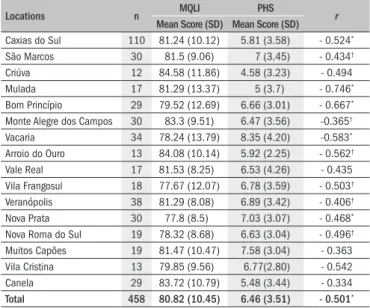
he gender distribution among the whole sample of 470 volun-teers was 262 women (55.7%) and 208 men (44.3%). In the subsam-ple of comsubsam-plete MQLI respondents, 260 were women (55.9%) and 205 were men (44.1%), whereas in the subsample of complete PHS respondents, 256 were women (55.7%) and 204 were men (44.3%). In terms of age, the mean age for the entire sample of 470 volunteers was 37.68 years (standard deviation, SD = 13.07). In the subsample of complete MQLI respondents, the mean age was 37.63 years, where-as in the subsample of complete PHS respondents, the mean age wwhere-as 37.59. In terms of region of origin, the total sample was divided ac-cording to 16 regional locations, including cities and districts, which are all listed in Table 1.
Score variance according to location
he statistical analyses were chosen based on a homogenous para-digm relating to the variance observed within these groups. One-way analysis of variance (Anova) was performed to evaluate the relationship between region of origin or locality and the total MQLI scores, which revealed the following values: F (15, 449) = 0.949, P = 0.509. Similarly, one-way Anova was conducted to evaluate the relationship between lo-cation of origin and the total PHS scores, which revealed a signiicant result: F (15, 444) = 1.821, P = 0.03. A post-hoc analysis was also con-ducted, using the Tukey HSD test for multiple comparisons. his latter analysis revealed a signiicant diference between the PHS scores of sub-samples from two cities: Caxias do Sul and Vacaria.
Locations n Mean Score (SD) Mean Score (SD)MQLI PHS r
Caxias do Sul 110 81.24 (10.12) 5.81 (3.58) - 0.524*
São Marcos 30 81.5 (9.06) 7 (3.45) - 0.434†
Criúva 12 84.58 (11.86) 4.58 (3.23) - 0.494 Mulada 17 81.29 (13.37) 5 (3.7) - 0.746*
Bom Princípio 29 79.52 (12.69) 6.66 (3.01) - 0.667*
Monte Alegre dos Campos 30 83.3 (9.51) 6.47 (3.56) -0.365†
Vacaria 34 78.24 (13.79) 8.35 (4.20) -0.583*
Arroio do Ouro 13 84.08 (10.14) 5.92 (2.25) - 0.562†
Vale Real 17 81.53 (8.25) 6.53 (4.26) - 0.435 Vila Frangosul 18 77.67 (12.07) 6.78 (3.59) - 0.503†
Veranópolis 38 81.29 (8.08) 6.89 (3.42) - 0.406†
Nova Prata 30 77.8 (8.5) 7.03 (3.07) - 0.468*
Nova Roma do Sul 19 78.32 (8.68) 6.63 (3.04) - 0.496†
Muitos Capões 19 81.47 (10.47) 7.58 (3.04) - 0.363 Vila Cristina 13 79.85 (9.56) 6.77(2.80) - 0.542 Canela 29 83.72 (10.79) 5.48 (3.44) - 0.334
Total 458 80.82 (10.45) 6.46 (3.51) - 0.501*
Table 1. Survey participants who answered all the questions of both
questionnaires according to the different locations surveyed and the correlation of quality of life and health status scores
*correlation signiicant at the 0.01 level; †correlation is signiicant at the 0.05 level
he mean MQLI scores and standard deviations of all the volun-teers who also answered all the PHS questions are listed in Table 1
ac-cording to locality.
Pearson product-moment correlation coeficients
Correlation coeicients were computed among the overall scores (the sum of the scores for all ten questions) from the PHS and MQLI of all volunteers who answered all the questions from both questionnaires (n = 458). he statistical analysis yielded a Pearson correlation of - 0.501 with P< 0.01 (two-tailed). he correlation coeicients according to lo-cation of origin for all the volunteers who answered all the questions from both questionnaires are presented in Table 1.
DISCUSSION
A signiicant correlation between the concepts of quality of life and health status, as evaluated by the Portuguese versions of the PHS and MQLI, was observed using the electronic versions of these question-naires. his is consistent with the inding of a correlation between the scores of the PHS and MQLI using the pen-and-paper methodology during the trial studies on both questionnaires.25 his evidence contrasts
with the indings from one of the few studies designed to investigate a possible correlation between health status and quality of life, which re-vealed no overlapping performances between a disease-speciic quality of life questionnaire and a generic health assessment tool (short form, SF-36) for assessing volunteers afected by allergic conditions.26
he current study presents limitations that hinder subsequent inter-pretations regarding the possible role played by socioeconomic factors in explaining both quality of life and health status, since socioeconomic status was not evaluated in this study. Although it is possible to investi-gate socioeconomic status using speciic questionnaires, the aim in the present study was to minimize interviewing time as much as possible, so that volunteers could easily tolerate the interview process. Furthermore, this study did not compare the electronic versions of the questionnaires with their respective “pen and paper” counterparts. he fact that the correlation between the two electronic questionnaires replicates the pre-viously reported correlation between the two “pen and paper” versions of the same instruments, as mentioned above, suggests that consisten-cy has been maintained in the computerized versions of the question-naires.
he strengths of this study include the negligible gender disparity in the sample, along with the size and geographical distribution of the sample, which encompassed several localities in southern Brazil. hese study characteristics provide a considerable demographic representa-tion of a wider sample size. Nonetheless, epidemiological investigarepresenta-tions on both quality of life and health status in southern Brazil are beyond the scope of this study. Such a valid and desirable research undertaking would require an even larger sample size, with analyses of diferent sub-groups as well as a wider distribution of locations.
During the ield trials on the electronic format of the two question-naires, limited loss of data was observed, and this was within the ac-cepted shortfall levels observed in other trials on electronic assessment
tools.12 Electronic data transfer was an advantageous method for data
analysis, since data transmitted electronically can be incorporated di-rectly into a database. Furthermore, the data was easily stored as spread-sheet documents within a commonly used type of software (Microsoft Excel). In fact, the importance of a well-designed computer interface has been highlighted as a crucial factor for successful implementation of computerized patient questionnaires.27
hese computerized questionnaires were easy to use and well ac-cepted, since no refusals to complete the interview were observed af-ter participants had signed the consent form. he data-gathering proc-ess was conducted mostly by a single interviewer and data transfer to a desktop environment was also very eicient. An earlier, similar study demonstrated that, irrespective of previous computer use, most partici-pants reported that the electronic version of the quality of life question-naire was easy to use and understand as well as a quick-to-use tool.19
Computerized questionnaires would facilitate data gathering, record-ing and transfer to a stable databank environment, which consequently minimizes error rates and improves productivity. Future studies should also investigate interviewees’ subjective impressions of the use of com-puterized health-related questionnaires according to diferent categories such as age, gender, educational background and socioeconomic status.
CONCLUSION
he current study demonstrates that the computerized formats of the Portuguese versions of the Multicultural Quality of Life Index and the Personal Health Scale are efective electronic tools for health status monitoring purposes and epidemiological research in Brazil. he com-puterized questionnaires were tested on a community-derived sample of individuals and achieved satisfactory performance. Computerized qual-ity of life and health status questionnaires can be efectively used at a community level and with large samples. Additional studies that in-clude rural areas may be worthwhile to generate a more representative picture of both regional and nationwide health status and quality of life standards.
REFERENCES
1. Assessing health status and quality-of-life instruments: attributes and review criteria. Qual Life Res. 2002;11(3):193-205.
2. von Engelhardt D. Patient vs. disease in medicine: Historical perspectives and contemporary concerns. J Nephrol. 2004;17(4):611-8.
3. Mezzich JE, Ruipérez MA, Pérez C, et al. The Spanish version of the quality of life index: presentation and validation. J Nerv Ment Dis. 2000;188(5):301-5.
4. Thompson DR, Roebuck A. The measurement of health-related quality of life in patients with coronary heart disease. J Cardiovasc Nurs. 2001;16(1):28-33
5. Treasure T. The measurement of health related quality of life. Heart. 1999;81(4):331-2 6. Guyatt GH. A taxonomy of health status instruments. J Rheumatol. 1995;22(6):1188-90. 7. Le PP, Kohane IS, Weeks JC. Using a pen-based computer to collect health-related quality of
life and utilities information. Proc Annu Symp Comput Appl Med Care. 1995:839-43. 8. Kvien TK, Mowinckel P, Heiberg T, et al. Performance of health status measures with a pen
based personal digital assistant. Ann Rheum Dis. 2005;64(10):1480-4.
9. Kvien TK, Uhlig T. Quality of life in rheumatoid arthritis. Scand J Rheumatol. 2005;34(5):333-41. 10. Bush N, Donaldson G, Moinpour C, et al. Development, feasibility and compliance of a
11. Gaertner J, Elsner F, Pollmann-Dahmen K, Radbruch L, Sabatowski R. Electronic pain diary: a randomized crossover study. J Pain Symptom Manage. 2004;28(3):259-67.
12. Wilson AS, Kitas GD, Carruthers DM, et al. Computerized information-gathering in specialist rheumatology clinics: an initial evaluation of an electronic version of the Short Form 36. Rheumatology (Oxford). 2002;41(3):268-73.
13. Drummond HE, Ghosh S, Ferguson A, Brackenridge D, Tiplady B. Electronic quality of life questionnaires: a comparison of pen-based electronic questionnaires with conventional paper in a gastrointestinal study. Qual Life Res. 1995;4(1):21-6.
14. Lane SJ, Heddle NM, Arnold E, Walker I. A review of randomized controlled trials comparing the effectiveness of hand held computers with paper methods for data collection. BMC Med Inform Decis Mak. 2006;6:23.
15. Walker I, Sigouin C, Sek J, et al. Comparing hand-held computers and paper diaries for haemophilia home therapy: a randomized trial. Haemophilia. 2004;10(6):698-704. 16. Vieweg BW, DiFranco B. The use of automated assessment with seriously mentally ill clients.
Behav Healthc Tomorrow. 1995;4(1):37-41.
17. VanDenKerkhof EG, Goldstein DH, Blaine WC, Rimmer MJ. A comparison of paper with electronic patient-completed questionnaires in a preoperative clinic. Anesth Analg. 2005;101(4):1075-80.
18. DeVore PA. A computerized geriatric assessment designed for use in primary care physi-cians’ ofices. Md Med J. 1994;43(3):257-64.
19. Carlson LE, Speca M, Hagen N, Taenzer P. Computerized quality-of-life screening in a cancer pain clinic. J Palliat Care. 2001;17(1):46-52.
20. Taenzer PA, Speca M, Atkinson MJ, et al. Computerized quality-of-life screening in an onco-logy clinic. Cancer Pract. 1997;5(3):168-75.
21. Taenzer P, Bultz BD, Carlson LE, et al. Impact of computerized quality of life screening on physician behaviour and patient satisfaction in lung cancer outpatients. Psychooncology. 2000;9(3):203-13.
22. Zubaran C, Persch K, Tarso D, Ioppi AE, Mezzich J. The Portuguese version of the personal health scale: a validation study in southern Brazil. Clinics (Sao Paulo). 2007;62(4):419-26. 23. Zubaran C, Persch KN, Tarso D, Ioppi AEE, Mezzich JE. Estudo inicial para o desenvolvimento
da versão em português do índice multicultural de qualidade de vida [Initial study for the development of the portuguese version of the multicultural quality of life index]. Arquivos Brasileiros de Psiquiatria, Neurologia e Medicina Legal. 2004;98(3). Available from: http:// www.aperjrio.org.br/publicacoes/revista/2004/estudo.asp. Accessed in 2010 (Nov 4). 24. Guillemin F, Bombardier C, Beaton D. Cross-cultural adaptation of health-related quality of life
measures: literature review and proposed guidelines. J Clin Epidemiol. 1993;46(12):1417-32. 25. Zubaran C, Persch K, Tarso D, Ioppi AE, Mezzich J. The correlation between health status and
quality of life in southern Brazil [A correlação entre estado de saúde e qualidade de vida no sul do Brasil]. Sao Paulo Med J. 2008;126(5):257-61.
26. Terreehorst I, Duivenvoorden HJ, Tempels-Pavlica Z, et al. Comparison of a generic and a rhinitis-speciic quality-of-life (QOL) instrument in patients with house dust mite al-lergy: relationship between the SF-36 and Rhinitis QOL Questionnaire. Clin Exp Allergy. 2004;34(11):1673-7.
27. Lutner RE, Roizen MF, Stocking CB, et al. The automated interview versus the personal interview. Do patient responses to preoperative health questions differ? Anesthesiology. 1991;75(3):394-400.
Acknowledgements: We kindly thank several colleagues in the Universidade de Caxias do Sul (UCS), Brazil, and in the Department of Psychiatry of Northland Health (New Zealand) for their valuable assistance during different phases of this study
Sources of funding: This study was partially funded by grant # 000605-25.00/03-8 from the Department of Science and Technology, State of Rio Grande do Sul and by grant # 200498/00-2 from Conselho Nacional de Desenvolvimento Cientíico e Tecnológico, Brazil
Conlict of interest: None
Date of irst submission: August 17, 2009
Last received: November 23, 2010
Accepted: November 25, 2010
Address for correspondence: Carlos Zubaran, MD, PhD
Department of Psychiatry, Sydney West Area Health Service Blacktown Hospital
PO Box 6010, Australia Tel: (02) 9881-8000