ABSTRACT
http://dx.doi.org/10.1590/1678-775720160286
An
i n v i t r o
ev al u at i o n o f v ar i o u s i r r i g at i o n
t echniques for t he rem oval of double ant ibiot ic
past e from root canal surfaces
Hakan GOKTURK1, Ismail OZKOCAK1)HY]L%8<8.*(%ø=12VPDQ'(0ø52
1- Gaziosmanpasa University, Faculty of Dentistry, Department of Endodontics, Tokat, Turkey. 2- Gaziosmanpasa University, Faculty of Medicine, Department of Biostatistics, Tokat, Turkey.
Corresponding address: Hakan Gokturk - Department of Endodontics - Faculty of Dentistry - Gaziosmanpasa University - 60100 - Tokat - Turkey - Phone: +90-356-212 42 22 - ext-4015 - Fax: +90-356 212 42 25 - e-mail: [email protected]
6XEPLWWHG0D\0RGL¿FDWLRQ-XO\$FFHSWHG$XJXVWst, 2016
O
bj ect ive: The aim of t his st udy was t o invest igat e t he effect iveness of convent ional syringe irrigat ions, passive ult rasonic irrigat ion ( PUI ) , Vibringe, CanalBrush, XP- endo Finisher, and laser- act ivat ed irrigat ion ( LAI ) syst em s in rem oving double ant ibiot ic past e'$3IURPURRWFDQDOV0DWHULDODQG0HWKRGV2QHKXQGUHG¿YHH[WUDFWHGVLQJOHURRWHG
t eet h w er e inst r um ent ed. The r oot s w er e split longit udinally. Thr ee st andar d gr ooves w ere creat ed and covered w it h DAP. The root s w ere dist ribut ed int o seven groups: Group 1, beveled needle irrigat ion; Group 2, double side- vent ed needle irrigat ion; Group 3, CanalBrush; Group 4, XP- endo Finisher; Group 5, Vibringe; Group 6, PUI ; Group 7, LAI . The am ount of rem aining DAP was scored under a st ereom icroscope. Result s: Group 4,
*URXSDQG*URXSUHPRYHGVLJQL¿FDQWO\PRUH'$3WKDQWKHRWKHUSURWRFROVLQWKH FRURQDOUHJLRQ*URXSZDVPRUHHI¿FLHQWLQWKHPLGGOHUHJLRQKRZHYHUQRVLJQL¿FDQW
difference was found bet w een Group 7 and Group 6. No differences w ere found bet w een groups in t he apical region eit her, except for t he com parisons bet ween groups 7 and 2, and groups 2 and 3. Conclusions: None of t he invest igat ed prot ocols w ere able t o com plet ely rem ove t he DAP from t he grooves. The Vibringe and XP- endo Finisher syst em s show ed result s sim ilar t o t hose of convent ional needle irrigat ion.
Ke yw or ds: Endodont ics. Lasers. Sodium hypochlorit e. Therapeut ic irrigat ion. Ult rasonic t herapy.
I N TROD UCTI ON
The m ain goal of r oot canal t r eat m ent is t o enlar ge t he r oot canal sy st em and t o elim inat e and discharge bact eria from it . For t his purpose, num er ous inst r um ent s, ir r igat ion solut ions, and m edicam ent s have been used12. Chem om echanical SUHSDUDWLRQ LV RIWHQ VHOHFWHG DV WKH ¿UVW RSWLRQ
t o achieve t he goal of elim inat ing t he int racanal bact er ial populat ion. Alt hough chem om echanical preparat ion reduces t he bact eria populat ion, none of t he cont em porar y t echniques can com plet ely clean t he root canal syst em16. Therefore, int racanal
m edicam ent s are used t o elim inat e and/ or reduce t he num ber of bact eria from t he canal22.
Calcium hydroxide ( CH) is w idely used as an in t r acan al m ed icam en t b et w een ap p oin t m en t s
t o enhance t he incidence of bact eria free canals. CH has t herapeut ic propert ies, is biocom pat ible, inhibit s ost eoclast ic act ivit y, can dissolve organic t issue, and has regenerat ive propert ies5,28. Despit e WKHVHDGYDQWDJHV&+LVLQVXI¿FLHQWLQFRPSOHWHO\
rem oving bact eria from root canals20.
An t i b i o t i c p a st e s a r e a n o t h e r e x a m p l e o f in t r acan al m ed icam en t . Tr ip le an t ib iot ic p ast e
7$3FRPSRVHGRIFLSURÀR[DFLQPHWURQLGD]ROH
and m inocycline) or double ant ibiot ic past e ( DAP)
FRQWDLQV FLSURÀR[DFLQ DQG PHWURQLGD]ROH DUH
com m only used as int racanal m edicam ent s in cases in w hich CH cannot alleviat e t he sym pt om s9,30.
Pr e v i o u s i n v e s t i g a t i o n s a g r e e t h a t t h e m edicam ent should be com plet ely rem oved from
WKH URRW FDQDO V\VWHP EHIRUH ¿OOLQJ 5HVHDUFKHUV
penet rat ion of sealers or cem ent s int o t he root canal dent in walls, as t hey act as a physical barrier along t he sealer/ dent in int erface1,14. Furt herm ore, clinical
concent rat ions of CH, DAP, and TAP can lead t o a
PRGHUDWHLQÀDPPDWRU\UHDFWLRQLQVXEFXWDQHRXV
t i ssu es1 1 a n d a r e cy t o t o x i c t o h u m a n d en t a l
pulp st em cells19. Thus, t he com plet e rem oval of
m edicam ent s from t he root canal is an im port ant st ep in successful root canal t reat m ent .
The m ost com m only used t echnique for t he r em oval of m edicam ent s is r ecapit ulat ion of t he
URRWFDQDOZLWKDPDVWHUDSLFDO¿OHDWWKHZRUNLQJ
lengt h ( WL) follow ed by copious ir r igat ion w it h et hylenediam inet et raacet ic acid ( EDTA) and sodium h y p och lor it e ( NaOCl)2 4. Pr ev iou s st u d ies h av e
report ed t hat t he passive ult rasonic irrigat ion ( PUI ) and phot on- induced phot oacoust ic st ream ing ( PI PS) t echniques rem oved m ore m edicam ent t han t he convent ional needle irrigat ion syst em2,4,8.
The XP- endo Finisher ( FKG, Dent air e SA, La Chaux- de- Fonds, Swit zerland) is a newly int roduced shape- m em ory NiTi inst rum ent . This inst rum ent ’s
GHVLJQLVVLPLODUWRWKDWRIDQ,62VL]H WDSHU1L7L¿OH$FFRUGLQJWRWKHPDQXIDFWXUHUWKLV ¿OHLPSURYHVLUULJDWLRQVROXWLRQVE\IRFXVLQJWKHP
on t he irregular area of t he root canal syst em ; t his is achieved by providing an expanded reach ( 6 m m
LQGLDPHWHURUIROGRIDQHTXLYDOHQWVL]HG¿OH DQGWKHVH¿OHVGRQRWFXWWKHGHQWLQH10.
Ho w e v e r, i t i s u n k n o w n w h e t h e r XP- e n d o Finisher or CanalBrush can rem ove DAP from t he root canal wall. Therefore, t he aim of t his st udy was
WRLQYHVWLJDWHWKHHI¿FDF\RIFRQYHQWLRQDOV\ULQJH
irrigat ions, CanalBrush, XP- endo Finisher, Vibringe, PUI , and laser- act ivat ed irrigat ion ( LAI ) syst em s
LQ UHPRYLQJ '$3 IURP WKH DUWL¿FLDO VWDQGDUGL]HG
grooves in t he root canal. The null hypot heses were t hat t he rem oval of DAP was not affect ed by t he [ 1] sect ion of root canal ( t hird) or t he [ 2] irrigat ion t echniques.
M ATERI AL AN D M ETH OD S
This st udy was review ed and approved by t he Tokat Clinical Resear ch Et hics Com m it t ee of t he
*D]LRVPDQSDúD8QLYHUVLW\)DFXOW\RI0HGLFLQH
KAEK 225) .
2QH KXQGUHG DQG ¿YH VLQJOHURRWHG VWUDLJKW
h u m an an t er i o r t eet h w er e sel ect ed t h r o u g h buccolingual and m esiodist al radiographs, aft er
FRQ¿UPDWLRQWKDWWKHUHZDVRQHURRWFDQDODQLQWDFW
apex, and no signs of int ernal/ ext ernal resorpt ion. The t eet h w ere short ened using a diam ond disc under wat er cooling, and each t oot h was given a
QRYHOPHDVXUHPHQWRIPP:/XVLQJD.¿OH
( Mani I nc., Tochigi, Japan) . Canals w ere prepared
ZLWK 5HFLSURF URWDU\ ¿OHV 9': *PE+ 0XQLFK
Germ any) and a t orque- cont rolled m ot or ( Silver
Recipr oc; VDW, Munich, Ger m any ) t o a m ast er
DSLFDO¿OHVL]HRI5DW:/'XULQJSUHSDUDWLRQWKH
root canals were irrigat ed wit h 10 m L of 2.5% NaOCl
:KLWHGHQWPHG(UKDQ.LP\Dø]PLU7XUNH\DQG
t hen t hey w ere placed in Eppendorf vials ( Labosel,
øVWDQEXO 7XUNH\ ¿OOHG ZLWK VLOLFRQH LPSUHVVLRQ
m at erial ( Clinical Zet aplus soft ; Zherm ack, Badia Polesine, I t aly) . Aft er t he im pression m at erial was fully set , t he root s w ere grooved w it h a diam ond disk and split longit udinally w it hout dam aging t he inner layer of dent ine around t he canal. A num ber 1S cav it r on t ip ( Acet on, Mer ignac, France) w as
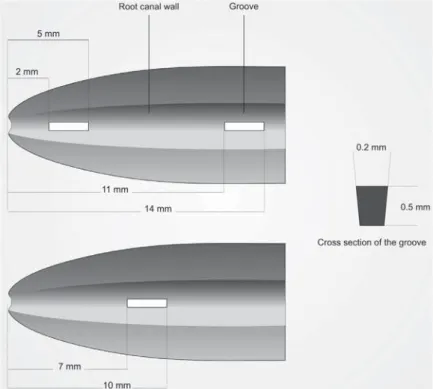
PRGL¿HGWRFUHDWHDUWL¿FLDOVWDQGDUGL]HGJURRYHV
w hich w ere 3 m m in lengt h, 0.5 m m in dept h, and 0.2 m m in w idt h, and w ere locat ed 2–5 m m from t he apex for apical sect ions, 11- 14 m m from t he apex for coronal sect ions, and 7- 10 m m from t he apex in t he opposit e par t of t he m iddle sect ion ( Figure 1) . The phot ographs w ere t aken using a st ereom icroscope ( Zeiss St em i 2000- C; Carl Zeiss Microlm aging, Göt t ingen, Germ any) equipped w it h a digit al cam era ( AxioCam ERc5s, Germ any) at 20X
PDJQL¿FDWLRQ(DFKRIWKHURRWKDOYHVDQGJURRYHV
w ere irrigat ed w it h 5 m L 17% EDTA ( I m icryl Lt d., Konya, Turkey) for 60 sec. and 5 m L 2.5% NaOCl for 60 sec. Then, t he t eet h w ere agit at ed w it h a t oot h brush t o rem ove debris and t he sm ear layer. The root canal was dried w it h paper point s.
Eq u al am o u n t s o f ci p r o f l ox aci n ( Bi o f ar m a,
,VWDQEXO7XUNH\DQGPHWURQLGD]ROHø(8ODJD\
I st anbul, Turkey) w ere m ixed w it h dist illed wat er at a liq u id / p ow d er r at io of 1 : 3 b ased on t h e form ulat ions used in t he st udy by Hoshino, et al.15 (DFK RI WKH JURRYHV ZDV ¿OOHG ZLWK '$3 E\ D PRGL¿HG VSUHDGHU DQG VWHUHRPLFURVFRS\ ZDV XVHG WR FRQ¿UP WKDW WKH JURRYHV ZHUH IXOO\ ¿OOHG ZLWK '$3 7KHQ ZKLOH WDNLQJ FDUH WR DYRLG ZD[ÀRZLQWRWKHURRWFDQDOWKHURRWKDOYHVZHUH
r eassem bled w it h w ax , and all t he r oot s w er e rem ount ed int o Eppendorf vials. Next , t hey w ere
IXOO\¿OOHGZLWK'$3XVLQJD/HQWXORVSLUDOVL]H
The access cavit ies were t em porarily sealed ( Cavit , ESPE GMBH, Seefeld, Germ any) and st ored at 37° C w it h 100% relat ive hum idit y for 2 w eeks. Aft er t his period, specim ens were random ly divided int o seven experim ent al groups ( n= 15) .
For t he rem oval of DAP in all 7 groups, an R40
9':*HUPDQ\¿OHDW:/DQGP/1D2&O
w ere used t o obt ain a space for irrigat ion needles and inst rum ent s.
G1 ( Bev eled Needle) : Th e r oot can als w er e irrigat ed w it h 10 m L 2.5% NaOCl for 2 m in w it h a 27- gauge beveled dent al irrigat ion needle ( Ayset , Adana, Turkey) . The t ip of t he needle was insert ed 1 m m short of t he WL.
dent al, Siauliai, Lit huania) was used ( rat her t han a 27- gauge beveled dent al irrigat ion needle) .
G3 ( CanalBrush) : The root canals were irrigat ed w it h 5 m L 2. 5% NaOCl and t hen br ushed w it h a m edium size CanalBr ush ( Colt ene/ Whaledent Gm bHCo. KG, Langenau, Ger m any ) at 600 r pm
IRUPLQ7KHQWKHURRWFDQDOVXQGHUZHQWD¿QDO ÀXVKZLWKP/1D2&O7KH&DQDO%UXVKZDV
insert ed 1 m m short of t he WL and was m oved around in sm all vert ical m ovem ent s.
G4 ( XP- endo Finisher) : The irrigat ion prot ocol was t he sam e as t hat in G3 w it h t he except ion t hat t he XP- endo Finisher ( FKG, Sw it zerland) was used at 800 rpm w it h 1 Ncm for 1 m in ( rat her t han t he CanalBrush) .
G5 ( Vibringe) : A 10 m L 2.5% NaOCl solut ion w as d eliv er ed an d son ically act iv at ed v ia t h e Vibringe syst em ( Vibringe B. V. Corp, Am st erdam , Net herlands) for 2 m in. The needle t ip was placed 1 m m short of t he WL.
G6 ( PUI ) : Passive ult rasonic irrigat ion ( PUI ) was perform ed using an I rrisafe ult rasonic t ip ( size 25, 0.00 t aper ) ( Act eon, France) , w hich was dr iven by an u lt r ason ic dev ice ( New t r on P5 ; Sat elec, Act eongroup, France) 1 m m short of t he WL. A 10 m L 2.5% NaOCl solut ion cont inuously delivered at
DÀRZUDWHRIDSSUR[LPDWHO\P/V- 1 t hrough
t he unit . I t was act ivat ed at a pow er set t ing of 5 for 1 m in.
G7 ( LAI ) : The irrigat ion prot ocol was t he sam e as t hat in G3 w it h t he except ion t hat an Er: YAG laser ( Kavo Key 3+ , KaVo, Biberach, Ger m any ) w it h a 2940 nm wavelengt h was used for 1 m in w it h endodont ic t ips. The laser param et ers w ere
1 W, 10 Hz, and 100 m J. When t he irrigant in t he root canal dropped or vaporized, t he canal space
ZDV¿OOHGZLWK1D2&O
The t ot al volum e of irrigant for each specim en
ZDVVHWDWP/DQGZDVGHOLYHUHGDWDÀRZUDWHRI
approxim at ely 0.08 m L s- 1 except for G6 ( PUI ) . The
irrigant was delivered int o t he canal wit h a 30- gauge double side- v ent ed needle ( i dent al, Lit huania) except for G1 ( beveled needle) . The root canals w ere dried w it h paper point s, and t he root halves w ere separat ed so t hat digit al phot ographs could be t aken of t he canal walls as described above.
7KHGLJLWDOLPDJHVREWDLQHGDW;PDJQL¿FDWLRQ
w er e cod ed b ef or e ev alu at ion t o en su r e t h at t he evaluat or s w er e blinded t o t heir ident it ies. Th e am ou n t of DAP r em ain in g in t h e g r oov es was evaluat ed by t w o dent ist s using a num er ic evaluat ion scale as described by van der Sluis, et al.32 ( 2007) . The scoring syst em was as follow s:
score 0, t he groove is ent irely em pt y; score 1, DAP is present in less t han 50% of t he groove; score 2, m ore t han 50% of t he groove is covered w it h DAP; and score 3, t he groove is com plet ely covered w it h DAP ( Figure 2) . Before scoring, t he 2 exam iners assessed 30 random ly select ed specim ens t oget her for calibrat ion purposes. I n t he case of discrepant scores, a consensus was reached by discussion.
An aly ses w er e con du ct ed u sin g com m er cial soft ware ( I BM SPSS St at ist ics 19, SPSS I nc., I BM Co., Som ers, New York, USA) . The kappa t est was used t o det erm ine int erexam iner agreem ent . The Kruskal-Wallis and Mann-Whit ney U t est s were used t o com pare t he rem aining DAP scores. Result s were
DQDO\]HGDWFRQ¿GHQFHLQWHUYDOVDQGYDOXHV
of p OHVVWKDQZHUHFRQVLGHUHGVLJQL¿FDQW
RESULTS
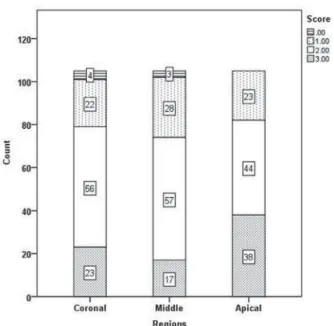
Resu lt s of t h e t w o ex am in er s w er e in good agreem ent ( kappa value= 0.907) . Figure 3 show s t he dist ribut ion of scores according t o t he regions. No irrigat ion prot ocols could com plet ely rem ove all
RIWKH'$3UHPQDQWV6LJQL¿FDQWGLIIHUHQFHVZHUH
found bet w een t oot h r egions in t er m s of past e rem oval, and m ore residues w ere observed in t he apical region ( Figure 3) (p<05) . The Kruskal-Wallis
WHVW UHYHDOHG QR VLJQL¿FDQW GLIIHUHQFHV EHWZHHQ
t he groups for apical, m iddle, and coronal t hirds (p> 05) , except for t he XP- endo Finisher ( G4) and PUI ( G6) (p<05) . The XP- endo Finisher ( G4) , LAI
*DQG38,*UHPRYHGVLJQL¿FDQWO\PRUH'$3 WKDQWKHRWKHUSURWRFROVKRZHYHUQRVLJQL¿FDQW
differences w ere found bet w een t hese groups in t he coronal region (p> 05) ( Figure 4) . LAI ( G7) was
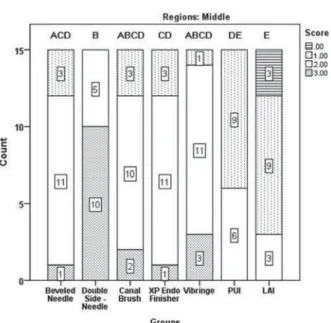
PRUHHI¿FLHQWLQWKHPLGGOHUHJLRQKRZHYHUQR VLJQL¿FDQWGLIIHUHQFHZDVIRXQGEHWZHHQWKH/$,
and PUI groups (p> 05) ( Figure 5) . I t was quit e
GLI¿FXOWWRUHPRYHWKH'$3LQWKHDSLFDOUHJLRQDQG
Figure 2- Images of scores: (A) Score 0; (B) Score 1; (C) Score 2; (D) Score 3
Figure 3- Distribution of scores according to regions
Figure 4- The distribution of scores for double antibiotic paste removal in the coronal third. Different letters denote
no difference was found bet w een groups (p> 05) except for t he com parisons bet w een LAI ( G7) and double side needle ( G2) and bet w een CanalBrush ( G3) and double side needle ( G2) (p< 05) ( Figure 6) .
1RVLJQL¿FDQWGLIIHUHQFHVZHUHIRXQGEHWZHHQWKH
Vibringe syst em ( G5) and t he beveled needle ( G1) or double side needle ( G2) for all segm ent s (p> 05) .
D I SCUSSI ON
To our k now ledge, no st udy hav e com par ed t he effect iveness of needle irrigat ion, t he XP- endo Finisher and CanalBr ush in r em ov ing DAP fr om
sim ulat ed lat eral irregularit ies on root canal walls. Result s of t his st udy indicat e t hat no differ ence was found bet w een t oot h regions in t erm s of past e
UHPRYDO WKHUHIRUH WKH ¿UVW QXOO K\SRWKHVLV LV
accept ed. The rem oval of DAP was not affect ed by t he root canal t hirds. How ever, LAI was superior t o double side- needle irrigat ion in rem oving DAP at all t hirds of t he root , and t herefore, t he second hypot hesis is rej ect ed.
6RPH VWXGLHV VKRZ WKDW &+ LV LQVXI¿FLHQW IRU
t h e elim in at ion of som e sy m p t om s, an d t h u s, an t ibiot ic past es ar e u sed as an alt er n at iv e9 , 3 0
due t o t heir good ant im icrobial and biocom pat ible p r op er t ies1 1 , 1 5 , 3 1. On e of t h e m ost w id ely u sed
ant ibiot ic past es is TAP, w hich consist s of equal p o r t i o n s o f m et r o n i d azo l e, ci p r o f i ox aci n , an d m inocycline. How ever, TAP alw ay s causes t oot h discolorat ion2. I n one st udy, researchers rem oved
m inocycline from t he TAP, and developed DAP, which
FRQVLVWVRIRQO\FLSURÀR[DFLQDQGPHWURQLGD]ROH17.
Alt hough ant ibiot ic past es have been successfully u se d i n e n d o d o n t i c p r o ce d u r e s, t h e y sh o u l d
EH FRPSOHWHO\ UHPRYHG EHIRUH ¿QDO URRW FDQDO
obt urat ion t o avoid t heir negat ive effect s, such as t oot h discolorat ion, cyt ot oxic effect s, and t he prevent ion of sealer or cem ent penet rat ion t o root dent in1,2,19. How ever, it is im possible t o com plet ely
rem ove ant ibiot ic past es from t he root canal using convent ional irrigat ion prot ocol2- 4,6,23.
There are lim it ed dat a about t he effect of t he ir r igat ion pr ot ocol on t he r em oval of DAP fr om t he root canal. Akçay, et al.2 ( 2014) invest igat ed
t he effect iveness of PI PS and an EndoAct ivat or Syst em in rem oving DAP and TAP from root canal irregularit ies in t he coronal and apical part s of a root canal syst em . They report ed t hat PI PS was superior for t he rem oval of DAP and TAP, regardless o f t h e g r o ov e l o cat i o n , w h en co m p ar ed w i t h t he EndoAct ivat or and needle ir r igat ion gr oups. Anot her st udy by Arslan, et al.4 ( 2014) invest igat ed
t h e ef f ect iv en ess of dif f er en t ir r igan t s w it h or w it hout ult rasonic act ivat ion in rem oving TAP from sim ulat ed root canal irregularit ies. They report ed t hat PUI w it h 1% NaOCl w as super ior t o ot her irrigat ion t echniques in rem oving TAP. These result s are sim ilar t o t he result s obt ained in t his st udy.
A pr ev ious st udy by Ber k hoff, et al.6 ( 2014)
com pared positive pressure irrigation, EndoActivator, PUI , and EndoVac from root canal syst em s by t he radiolabeled t echnique; t hey concluded t hat t here was no difference in labeled TAP rem oval am ong groups. These result s are not consist ent w it h t hose
RIRXUVWXG\7KHGLIIHUHQFHVPD\UHÀHFWGLIIHUHQW
variables in t he st udy design, such as ( i) t he used m edicam ent , ( ii) t he irrigat ion solut ion’s volum e, and/ or ( iii) m easurem ent t echnique. I n a previous st udy, it was revealed t hat m inocycline ( a com pound of TAP) binds t o calcium ions via chelat ion t o form
Figure 5- The distribution of scores for double antibiotic paste removal in the middle third. Different letters denote
VLJQL¿FDQWGLIIHUHQFHVEHWZHHQWKHJURXSVS
Figure 6- The distribution of scores for double antibiotic paste removal in the apical third. Different letters denote
an insoluble com plex29. How ever, a m or e r ecent VWXG\UHSRUWHGQRVLJQL¿FDQWGLIIHUHQFHVEHWZHHQ
DAP an d TAP r em ov al f r om ar t if icially cr eat ed grooves2.
I n t h is st u dy, w e u sed a r ot ar y in st r u m en t syst em ( XP- endo Finisher) w it h 2.5% NaOCl as an
LUULJDQWIRUWKHUHPRYDORI'$32XU¿QGLQJVVKRZHG
t hat act ivat ion of irrigant w it h a rot ary inst rum ent
LPSURYHG WKH UHPRYDO RI '$3 IURP WKH DUWL¿FLDO
grooves; however, t his was not st at ist ically different f r om con v en t ion al sy r in g e ir r ig at ion . A st u d y conduct ed by Capar, et al.8 ( 2014) report ed t hat t he
use of t he Self-Adj ust ing File ( SAF) syst em rem oved si g n i f i can t l y m o r e CH f r o m si m u l at ed l at er al irregularit y in t he apical t hird of root canals t han t he convent ional syringe irrigat ion. I n line w it h t he result s of t he aforem ent ioned st udy, Akm an, et al.3 KDYHVKRZQWKDW6$)VLJQL¿FDQWO\LPSURYHG WKHUHPRYDORIP7$3PHWURQLGD]ROHFLSURÀR[DFLQ
and cefaclor) from root canals when com pared wit h convent ional sy r inge ir r igat ion. Unlike r ot ar y or hand inst rum ent s, SAF adapt s channels in t hree dim ensions, and also allow s for copious irrigat ion
GXULQJWKHSURFHGXUHZKLFKLPSURYHVLWVHI¿FLHQF\3.
Sim ilarly, t he superior abilit y of PUI in rem oving int racanal m edicam ent from t he root canals was at t ribut ed t o it s higher velocit y of irrigat ion solut ion
ÀRZ32 and it s fresh irrigant replacem ent propert ies
during t he procedure33.
Can alBr u sh is a h ig h ly f lex ib le en d od on t ic br ush m ade of poly pr opy lene. Accor ding t o t he m anufact urer, it helps clean areas of t he root canal
WKDWFDQQRWEHUHDFKHGE\¿OHV7RRXUNQRZOHGJH
n o st u d y h a s co m p a r ed t h e ef f ect i v en ess o f CanalBr ush on t he r em oval of ant ibiot ic past es.
+RZHYHUDUHFHQWVWXG\UHSRUWHGWKDWQRVLJQL¿FDQW
difference was found bet w een CanalBrush and PUI on t he rem oval of CH from root canal surfaces7.
On t h e ot h er h an d , Gr isch k e, et al.1 3 ( 2 0 1 4 ) LQYHVWLJDWHGWKHHI¿FDF\RIIRXUGLIIHUHQWLUULJDWLRQ
sy st em s i n r em o v i n g r o o t ca n a l sea l er f r o m sim ulat ed irregularit ies on t he root canal wall, and report ed t hat PUI is m ore effect ive t han CanalBrush.
Th e Vib r in g e sy st em ( Vib r in g e B. V. Cor p, Net h er l an d s) i s a d ev i ce t h at p r ov i d es so n i c act ivat ion of irrigat ion solut ions. This device uses
SDWHQWHGVRQLFÀRZWHFKQRORJ\WKDWFDXVHVDFRXVWLF
st r eam in g in t h e r oot can al an d oper at es at a low er frequency ( 2–3 kHz)25. Rodig, et al.25 ( 2010) UHSRUWHGWKDW38,UHPRYHGVLJQL¿FDQWO\PRUHGHEULV
from t he canal irregularit ies t han did t he syringe irrigat ion and Vibringe Syst em . Johnson, et al.18
( 2012) r epor t ed t hat Vibr inge w as not super ior t o side- vent ed needle irrigat ion w hen com paring
GHEULGHPHQWHI¿FDFLHV6LPLODUO\WKLVVWXG\VKRZHG
n o sig n if ican t d if f er en ces b et w een Vib r in g e – beveled needle and Vibringe – double side needle for DAP rem oval for all t he segm ent s. However, few
st udies in t he lit erat ure exam ine t he effect iveness of Vibringe on t he rem oval of m edicam ent s from t he root surface, and t herefore, furt her invest igat ions are needed on t his t opic.
Sahar - Helft , et al.2 7 ( 2 0 1 5 ) inv est igat ed t he HI¿FDF\ RI WKUHH LUULJDWLRQ SURWRFROV SRVLWLYH
pressure irrigat ion, PUI , and LAI ) on sm ear- layer rem oval from hum an t eet h w it h SEM. An Er: YAG laser at a wavelengt h of 2940 nm ( t o 0.5 W, 50 m J, 10 HZ) was used for 60 sec in t he LAI group. They report ed t hat LAI w it h Er: YAG rem oved t he sm ear layer from t he ent ire root canal wall bet t er
WKDQWKHRWKHUWZRWHFKQLTXHV6LPLODU¿QGLQJVZHUH
observed in a previous st udy2. Alt hough t he laser
param et ers in t his st udy are different from t hose
XVHGLQWKHDIRUHPHQWLRQHGVWXGLHVRXU¿QGLQJV
are consist ent w it h t he lit erat ure. We found t hat LAI rem oved m ore DAP from t he root canal surface t han t he ot her t echniques.
Despit e t he fact t hat ant ibiot ic m edicam ent s are com m only used in revascularizat ion and root canal t reat m ent s, t here are no st andardized applicat ion t im es. Er, et al.9 ( 2007) used TAP for int racanal
dressing for up t o 12 weeks in root canal t reat m ent . I n revascularizat ion t reat m ent , t he past es are left in t he canal for different periods ( 1- 11 w eeks)21.
Therefore, fut ure st udies are needed t o t horoughly invest igat e t he applicat ion t im e on t he r em oval capacit y.
Th i s st u d y sh ow ed t h at t h e g r oov e i n t h e apical sect ion gave w orse result s t han t he coronal and m iddle sect ions, regardless of t he irrigat ion prot ocol. These result s are sim ilar t o t hose obt ained by Arslan, et al.4 ( 2014) . I n cont rast , Rodig, et al.26
( 2010) observed superior result s in t he apical t hird,
UDWKHUWKDQLQWKHFRURQDOWKLUG7KHFRQÀLFWVLQWKH
published result s m ay be due t o t he diam et er of apical preparat ion, volum e of irrigant , and irrigat ion prot ocol used bet w een t hese st udies.
Th e design of t h is st u dy h as been u sed by several ot her invest igat ions4,8,13,25,26,32. However, few
st udies are invest igat ing t he rem oval of DAP from
DUWL¿FLDOO\FUHDWHGJURRYHV2. Alt hough t he sim ulat ed
lat eral irregularit ies do not represent t he com plex st ruct ure of a nat ural root canal syst em , t he groove m odel has it s advant ages, w hich include allow ed discrim inat ion bet w een m echanical rem oval of t he
PHGLFDPHQWDQGWKHLQÀXHQFHRIWKHLUULJDQWDORQH
as well as high int raobserver reproducibilit y26. The
m aj or lim it at ion of t his st udy is t he result s obt ained from in vit ro condit ions. Thus, fut ure st udies should
EH FDUULHG RXW WR FRQ¿UP WKH UHVXOWV LQ FOLQLFDO
condit ions.
CON CLUSI ON
None of t he invest igat ed t echniques w ere able
st a n d a r d g r o o v e s. H o w e v e r, l a se r - a ct i v a t e d irrigat ion and PUI m ay be preferred for t he rem oval of DAP. The Vibringe and XP- endo Finisher syst em s gave sim ilar result s t o t hose of convent ional needle irrigat ion.
REFEREN CES
1- Akcay M, Arslan H, Topcuoglu HS, Tuncay O. Effect of calcium hydroxide and double and t riple ant ibiot ic past es on t he bond st rengt h of epoxy resin- based sealer t o root canal dent in. J Endod. 2014; 40( 10) : 1663- 7.
2- Akcay M, Arslan H, Yasa B, Kavrik F, Yasa E. Spect rophot om et ric analysis of crown discolorat ion induced by various ant ibiot ic past es used in revascularizat ion. J Endod. 2014; 40( 6) : 845- 8.
3- Akm an M, Akbulut MB, Aydinbelge HA, Belli S. Com parison of different irrigat ion act ivat ion regim ens and convent ional irrigat ion
WHFKQLTXHVIRUWKHUHPRYDORIPRGL¿HGWULSOHDQWLELRWLFSDVWHIURP
root canals. J Endod. 2015; 41( 5) : 720- 4.
4- Arslan H, Capar I D, Saygili G, Uysal B, Gok T, Ert as H, et al.
(I¿FDF\ RI YDULRXV LUULJDWLRQ SURWRFROV RQ WKH UHPRYDO RI WULSOH
ant ibiot ic past e. I nt Endod J. 2014; 47( 6) : 594- 9.
5- At hanassiadis B, Abbot t PV, Walsh LJ. The use of calcium hydroxide, ant ibiot ics and biocides as ant im icrobial m edicam ent s in endodont ics. Aust Dent J. 2007; 52( 1 Suppl) : S64- 82.
6- Berkhoff JA, Chen PB, Teixeira FB, Diogenes A. Evaluat ion of t riple ant ibiot ic past e rem oval by different irrigat ion procedures. J Endod. 2014; 40( 8) : 1172- 7.
7- Bhuyan AC, Seal M, Pendharkar K. Effect iveness of four different t echniques in r em ov ing int racanal m edicam ent fr om t he r oot canals: an in vit ro st udy. Cont em p Clin Dent . 2015; 6( 3) : 309- 12. 8- Capar I D, Ozcan E, Arslan H, Ert as H, Aydingelge HA. Effect
RI GLIIHUHQW ¿QDO LUULJDWLRQ PHWKRGV RQ WKH UHPRYDO RI FDOFLXP K\GUR[LGHIURPDQDUWL¿FLDOVWDQGDUGL]HGJURRYHLQWKHDSLFDOWKLUG
of root canals. J Endod. 2014; 40( 3) : 451- 4.
(U..XúWDUFL$2]DQ87DúGHPLU71RQVXUJLFDOHQGRGRQWLF
t reat m ent of dens invaginat us in a m andibular prem olar wit h large periradicular lesion: a case report . J Endod. 2007; 33( 3) : 322- 4. 10- FKG sw iss endo. XP- endo Finisher Docum ent at ion [ I nt ernet ] . [ cit ed Ju ly 8 , 2 0 1 6 ] Av ailab le f r om : w w w . f k g . ch / p r od u ct s/
HQGRGRQWLFV¿QDOSUHSDUDWLRQ[SHQGR¿QLVKHU
11- Gom es- Filho JE, Duart e PC, Oliveira CB, Wat anabe S, Lodi CS, Cint ra LT, et al. Tissue react ion t o a t riant ibiot ic past e used for endodont ic t issue self- r egenerat ion of nonv it al im m at ur e perm anent t eet h. J Endod. 2012; 38( 1) : 91- 4.
12- Gorduysus M, Nagas E, Torun OY, Gorduysus O. A com parison of t hree rot ary syst em s and hand inst rum ent at ion t echnique for t he elim inat ion of Ent erococcus faecalis from t he root canal. Aust Endod J. 2011; 37( 3) : 128- 33.
13- Grischke J, Müller- Heine A, Hülsm ann M. The effect of four different irrigat ion syst em s in t he rem oval of a root canal sealer. Clin Oral I nvest ig. 2014; 18( 7) : 1845- 51.
14- Guiot t i FA, Kuga MC, Duart e MA, Sant ’Anna AJ, Faria G. Effect of calcium hy dr ox ide dr essing on push- out bond st r engt h of endodont ic sealers t o root canal dent in. Braz Oral Res. 2014; 28. 15- Hoshino E, Kurihara- Ando N, Sat o I , Uem at su H, Sat o M, Kot a K, et al. I n- vit ro ant ibact erial suscept ibilit y of bact eria t aken from
LQIHFWHGURRWGHQWLQHWRDPL[WXUHRIFLSURÀR[DFLQPHWURQLGD]ROH
and m inocycline. I nt Endod J. 1996; 29( 2) : 125- 30.
16- Hülsm ann M, Pet ers OA, Dum m er PM. Mechanical preparat ion of root canals: shaping goals, t echniques and m eans. Endod Topics. 2005; 10( 1) : 30- 76.
1 7 - I w ay a SI , I k aw a M, Ku b ot a M. Rev ascu lar izat ion of an im m at ure perm anent t oot h w it h apical periodont it is and sinus t ract . Dent Traum at ol. 2001; 17( 4) : 185- 7.
18- Johnson M, Sidow SJ, Looney SW, Lindsey K, Niu LN, Tay FR.
&DQDODQGLVWKPXVGHEULGHPHQWHI¿FDF\XVLQJDVRQLFLUULJDWLRQ
t echnique in a closed- canal syst em . J Endod. 2012; 38( 9) : 1265- 8. 1 9 - Kam ock i K, Nör JE, Bot t in o MC. Den t al p u lp st em cell responses t o novel ant ibiot ic- cont aining scaffolds for regenerat ive endodont ics. I nt Endod J. 2015; 48( 12) : 1147- 56.
2 0 - Kv ist T, Molan d er A, Dah lén G, Reit C. Micr ob iolog ical evaluat ion of one- and t w o- visit endodont ic t reat m ent of t eet h w it h apical periodont it is: a random ized, clinical t rial. J Endod. 2004; 30( 8) : 572- 6.
21- Law AS. Considerat ions for regenerat ion procedures. Pediat r Dent . 2013; 35( 2) : 141- 52.
22- Miller EK, Lee JY, Taw il PZ, Teixeira FB, Vann WF Jr. Em erging t h e r a p i e s f o r t h e m a n a g e m e n t o f t r a u m a t i ze d i m m a t u r e perm anent incisors. Pediat r Dent . 2012; 34( 1) : 66- 9.
23- Ok E, Alt unsoy M, Nur BG, Kalkan A. Effect iveness of different ir r ig at ion solu t ion s on t r ip le an t ib iot ic p ast e r em ov al f r om sim ulat ed im m at ure root canal. Scanning. 2015; 37( 6) : 409- 13. 24- Phillips M, McClanahan S, Bow les W. A t it rat ion m odel for evaluat ing calcium hydr oxide r em oval t echniques. J Appl Oral Sci. 2015; 23( 1) : 94- 100.
25- Rodig T, Bozkurt M, Koniet schke F, Hülsm ann M. Com parison of t he Vibringe syst em wit h syringe and passive ult rasonic irrigat ion in rem oving debris from sim ulat ed root canal irregularit ies. J Endod. 2010; 36( 8) : 1410- 3.
5|GLJ79RJHO6=DSI$+OVPDQQ0(I¿FDF\RIGLIIHUHQW
irrigant s in t he rem oval of calcium hydroxide from root canals. I nt Endod J. 2010; 43( 6) : 519- 27.
27- Sahar- Helft S, Sarp AS, St abholt z A, Gut kin V, Redenski I , St einberg D. Com parison of posit ive- pressure, passive ult rasonic, and laser- act ivat ed irrigat ions on sm ear- layer rem oval from t he root canal surface. Phot om ed Laser Surg. 2015; 33( 3) : 129- 35. 28- Siqueira JF Jr, Magalhães KM, Rôças I N. Bact erial reduct ion in infect ed root canals t reat ed w it h 2.5% NaOCl as an irrigant and calcium hydroxide/ cam phorat ed param onochlorophenol past e as an int racanal dressing. J Endod. 2007; 33( 6) : 667- 72.
29- Tanase S, Tsuchiya H, Yao J, Ohm ot o S, Takagi N, Yoshida S. Reversed- phase ion- pair chrom at ographic analysis of t et racycline ant ibiot ics. Applicat ion t o discolored t eet h. J Chrom at ogr B Biom ed Sci Appl. 1998; 706( 2) : 279- 85.
30- Tanej a S, Kum ar i M. Use of t r iple ant ibiot ic past e in t he t r eat m ent of lar ge per iradicular lesions. J I nvest ig Clin Dent . 2012; 3( 1) : 72- 6.
31- Thibodeau B, Teixeira F, Yam auchi M, Caplan DJ, Trope M. Pulp revascularizat ion of im m at ure dog t eet h w it h apical periodont it is. J Endod. 2007; 33( 6) : 680- 9.
9DQGHU6OXLV/:X0.:HVVHOLQN3&RPSDULVRQRIÀXVKLQJ
m et hods used during passive ult rasonic irrigat ion of t he root canal. Quint essence I nt . 2009; 40( 10) : 875- 9.
33- Van der Sluis LW, Wu MK, Wesselink PR. The evaluat ion of
UHPRYDORIFDOFLXPK\GUR[LGHSDVWHIURPDQDUWL¿FLDOVWDQGDUGL]HG