Validation of the competency profile of the nurses concerning health
care
Validação de perfil de competência do enfermeiro para a atenção à saúde
Juarez Coimbra Ormonde Júnior1, Mara Regina Rosa Ribeiro1, Andreia Correia de Souza Cioffi1, Leonara Raddai Gunther de Campos1, Adriana Freitas de Almeida Finger1
Objective: to validate the content of competence for health care and its performance criteria. Methods: a
cross-sectional, descriptive study using Delphi technique and a five-point Likert scale. The sample (n = 26) was composed by experts from Brazil. In order to calculate the content validity index, a degree of agreement was established in ≥80%. The analysis was performed using simple descriptive statistics. Results: the degree of agreement for the competency was 96.2% and 13 criteria were validated. Conclusion: the contents of the competence for health care and their respective performance criteria were validated by the participants. Favorable agreement demonstrates the recognition of competence as knowledge and actions in health care.
Descriptors: Professional Competence; Health Care (Public Health); Validation Studies.
Objetivo: validar o conteúdo da competência para a atenção à saúde e seus critérios de desempenho. Métodos:
estudo transversal, descritivo e com utilização de técnica Delphi e escala de Likert de cinco pontos. A amostra (n=26) foi composta por experts do Brasil. Para o cálculo doíndice de validade de conteúdo, estabeleceu-se grau de concordância em ≥80%. A análise ocorreu mediante a utilização de estatística descritiva simples. Resultados:
o grau de concordância para a competência elencada foi de 96,2% e 13 critérios foram validados. Conclusão:
o conteúdo da competência para atenção à saúde e seus respectivos critérios de desempenho foram validados pelos participantes. A concordância favorável demonstra o reconhecimento da competência como saberes e fazeres na atenção à saúde.
Introduction
The concept of competence for care does not present common meaning in the scientific literature and maintains its polysemic and multidimensional character, ranging from the broadest conceptions, re-lated to the exercise of the profession, to the more spe-cific, related to the performance of a given task. The conceptual framework adopted here is that compe-tence is related to responsible action, with mobiliza-tion and integramobiliza-tion of multiple knowledge, resources, skills and attitudes in a specific context(1).
Competence is understood as the elemental combination of three components: knowledge, skills and attitudes, as well as those of a social, affective and behavioral character. They can be mobilized together to generate effective, complex and projected action in the future(2).
The concept of competence relates to the no-tion of performance and cannot be confused with it. It is understood as the concrete mobilization of various resources in the execution of the action and depends on individual factors, such as the sensitivity and mo-tivation applied in relation to the collective. The per-formance is visible, measurable and can be used as an evaluation criterion, capable of proving whether the individual is competent or not in the performance of a given task. From the performance evaluation, the com-petence model in training can be operationalized(3).
The insertion of the competency model in the exercise of the profession occurred through the ap-proval of the National Curricular Guidelines for the Nursing Undergraduate Course in 2001. Intended as a significant milestone for the category, they enabled the incorporation of multiple area knowledge techni-cal-instrumental, ethics and politics in the search for the integration among attention, teaching, service and management of the health system(4).
In determining the general and specific com-petencies, the guidelines are used as guiding instru-ments for the elaboration of pedagogical projects of nursing undergraduate courses in the country and es-tablish a new identity for the general nurse.
In the face of this scenario of changes, there were internal movements in nursing graduation at the Federal University of Mato Grosso - Cuiabá campus, which resulted in the proposal of a survey of the Heal-th Human Resources Observatory of Heal-the Pan American Health Organization and the Secretary of Health. The study aimed at building a competency profile based on a broad literature review and using the consensus conference methodology and was prepared and publi-shed in June 2010(5).
The elaboration of the profile considered the work process in nursing, the reality of the undergra-duate course and the local and regional health needs. In its construction, teachers, undergraduate students, managers of the Unified Health System and nurses of the health services participated. The document ex-presses the perspectives of these actors on the trai-ning process based on professional experience, spe-cialized literature and through empirical evidence(5-7).
The profile is composed of four distinct com-petencies: “health care, education, administration/ management and knowledge production” along with performance criteria. Although the document consi-ders the four competences as essential for the training of nurses, we prioritize in this article, the approach to competence for health care and its thirteen per-formance criteria, since it is the core component of nursing care, the core of the profession. In this sense, throughout the text, the term care competence in allu-sion to health care was adopted.
perfor-mance criteria and reflects the actions required to act responsibly and are understood as evidence of profes-sional performance.
Although it was produced locally, it is verified that the profile proposed was not submitted to vali-dation by experts in the area of nursing education. Ex-perts are those professionals with vast theoretical and practical experience in the subject.
Currently, it is observed that there is the need for democratic and participatory processes of social actors directly involved in the formation and elabo-ration of proficiency profiles(8-9). Therefore, in order
to reach an approximation to the intended object of study, the following question emerged: What is the competency profile for the health care required for the training of the general nurse, from the perspecti-ve of experts in nursing education in Brazil? Thus, the objective was to validate the content of competence for health care and its performance criteria.
Methods
It is a descriptive, cross-sectional study using the Delphi method, which allows the collection and synthesis of knowledge produced by groups of pro-fessionals who are experts in the field and who have experience in a particular subject(10).
The research was developed by virtual means. The first step was to insert the existing skills profile into the online questionnaire format and make it available on the SurveyMonkey® platform. The plat-form allowed the sending and receiving of the an-swers by e-mail. The second step was characterized by the identification of experts in nursing education in Brazil and in the third, the questionnaire was sent to the participants.
Nurses with a doctoral degree in nursing or any area of knowledge, with at least two years’ experience
in nursing undergraduate teaching and with relevant scientific production on competencies in national and international journals, were considered experts.
Participants were identified through the Lattes curriculum of the National Council for Scientific and Technological Development, in the “search for curric-ulum” search box, search mode for “subject” with the terms “competence” and “competences”. These filters were used: “nurses”, “doctors” and “Brazilian nation-ality”. Incomplete curricula were excluded. It was pos-sible to elect 94 pospos-sible participants by reading the curricula that met the established inclusion criteria.
In order to identify as many participants as possible, research was carried out on the official pages of the federal universities that offer the undergradu-ate nursing course. A total of 38 contacts of coordina-tors and direccoordina-tors of nursing schools were identified, which indicated two possible participants that met the inclusion criteria. During this stage, pages of outdated courses were found, with incomplete information and non-functional e-mail addresses.
After sending the invitation via e-mail and tele-phone contact with the 96 possible participants, the non-probabilistic final convenience sample consisted of 26 participants (n=26), who accepted to be part of the study. The period for data collection occurred be-tween April and May 2016.
The application of the Delphi method was used containing a questionnaire with closed questions us-ing a Likert scale, in which participants should choose only one item, among: “I totally agree(1), I agree
partial-ly(2), I do not agree or disagree(3), partially disagree(4)
and totally disagree(5).” In this research, the validity
The degree of agreement was obtained in single round Delphi, with no new rounds being performed.
The answers to the competence for health care were analyzed in the light of simple descriptive statis-tics, by means of a table, with calculation of the agree-ment proportions for the various items, with their respective 95.0% confidence intervals (CI 95.0%). The interpretation of the degree of agreement was ob-tained from the analysis of the 95.0% CI greater than 80.0% and the probability of this proportion was not due to chance (p=0.05). The literature has used dif-ferent methods to evaluate the degree of agreement between groups of experts in the validation of ques-tionnaire content; however, the percentage of agree-ment is one of the most used and allows validating the specific item content of the questionnaire(11-12).
The study complied with the formal require-ments contained in the national and international regulatory standards for research involving human beings.
Results
The sample is made up of teachers, mostly fe-male (92.3%), in the age group of 51-60 years (42.3%) and predominantly in the southeastern region (57.7%), followed by the southern region (30.7%), central western (7.7%) and northeastern (3.8%). The time of experience in undergraduate teaching in nur-sing had a higher prevalence in the range of 02 to 12 years (42.3%), followed by 13 to 23 years (23.1%). In addition to teaching at a higher level, 16 participants
also reported that they performed other functions si-multaneously with teaching, coordinating undergra-duate nursing courses (46.2%) and exercising activi-ties in the health care area (15.4%).
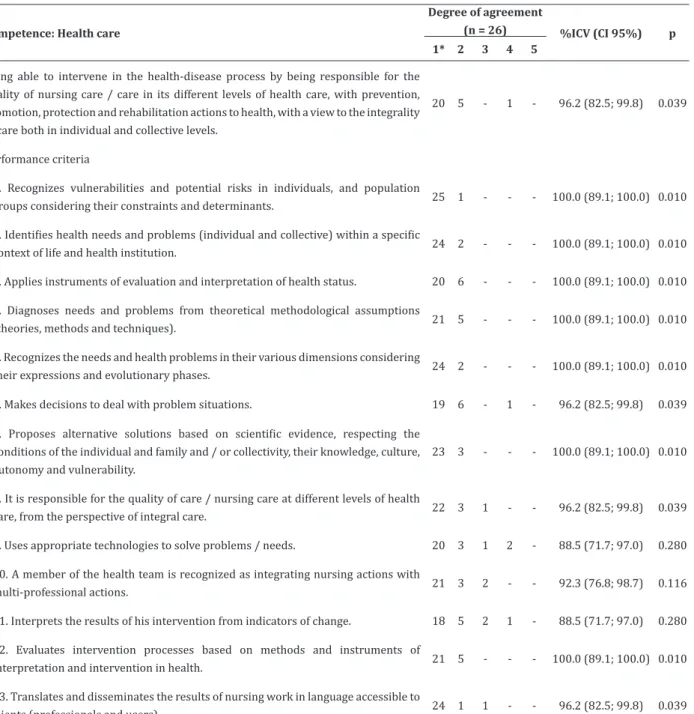
Table 1 presents the data on the degree of agre-ement regarding the competence for health care and the respective performance criteria.
The first component of the profile refers to the text of competence for health care. Among the 26 pos-sible responses for this component, 25 points were obtained for the “totally agree” and “partially agree” answers, being approved with a concordance degree of 96.2% with 95.0% CI (82.5%; 99.8%).
The second component refers to the compe-tency performance criteria described. Among the 338 possible answers, 324 points were obtained for the “totally agree” and “partially agree” items.
Seven performance criteria were obtained with a degree of agreement (CI95.0%) of 100.0% (89.1; 100.0). Criteria 9 and 11 presented the lowest degrees of agreement, of 88.5% CI 95.0% (71.7; 97.0). Criteria 9, 10 and 11 did not present reliability regarding the degree of agreement of 80.0% established. However, it is considered that such criteria are valid, since the degree of agreement of 70.0% is commonly used for validation(12).
Table 1 - Distribution of components related to health care competence and their respective performance
criteria
Competence: Health care
Degree of agreement
(n = 26) %ICV (CI 95%) p 1* 2 3 4 5
Being able to intervene in the health-disease process by being responsible for the quality of nursing care / care in its different levels of health care, with prevention, promotion, protection and rehabilitation actions to health, with a view to the integrality of care both in individual and collective levels.
20 5 - 1 - 96.2 (82.5; 99.8) 0.039
Performance criteria
1. Recognizes vulnerabilities and potential risks in individuals, and population
groups considering their constraints and determinants. 25 1 - - - 100.0 (89.1; 100.0) 0.010
2. Identifies health needs and problems (individual and collective) within a specific
context of life and health institution. 24 2 - - - 100.0 (89.1; 100.0) 0.010
3. Applies instruments of evaluation and interpretation of health status. 20 6 - - - 100.0 (89.1; 100.0) 0.010
4. Diagnoses needs and problems from theoretical methodological assumptions
(theories, methods and techniques). 21 5 - - - 100.0 (89.1; 100.0) 0.010
5. Recognizes the needs and health problems in their various dimensions considering
their expressions and evolutionary phases. 24 2 - - - 100.0 (89.1; 100.0) 0.010
6. Makes decisions to deal with problem situations. 19 6 - 1 - 96.2 (82.5; 99.8) 0.039
7. Proposes alternative solutions based on scientific evidence, respecting the conditions of the individual and family and / or collectivity, their knowledge, culture, autonomy and vulnerability.
23 3 - - - 100.0 (89.1; 100.0) 0.010
8. It is responsible for the quality of care / nursing care at different levels of health
care, from the perspective of integral care. 22 3 1 - - 96.2 (82.5; 99.8) 0.039
9. Uses appropriate technologies to solve problems / needs. 20 3 1 2 - 88.5 (71.7; 97.0) 0.280
10. A member of the health team is recognized as integrating nursing actions with
multi-professional actions. 21 3 2 - - 92.3 (76.8; 98.7) 0.116
11. Interprets the results of his intervention from indicators of change. 18 5 2 1 - 88.5 (71.7; 97.0) 0.280
12. Evaluates intervention processes based on methods and instruments of
interpretation and intervention in health. 21 5 - - - 100.0 (89.1; 100.0) 0.010
13. Translates and disseminates the results of nursing work in language accessible to
clients (professionals and users). 24 1 1 - - 96.2 (82.5; 99.8) 0.039
Discussion
The limitations of the study refer to the design of the cross-sectional method, which makes it impos-sible to establish cause-effect relationships(13).
Regar-ding the Delphi method, the limitations relate to the selection criteria and the low number of participants, as well as the degree of agreement of the established content validity index.
The results provide subsidies to nursing facul-ties when formulating health care competency and what performance is expected from academics. It also points out the limits of the nurses’ performance in this area and contributes as a starting point for the elabo-ration of competency profiles aimed at nursing care delivery.
Competence for nursing care refers to the kno-wledge that can be mobilized and integrated by the students during their formative process to solve blems, deal with varied situations and guide their pro-fessional conduct. It has achieved a high level of agree-ment by the majority of participants and is in line with the pedagogical principles proposed by the national curricular guidelines of undergraduate nursing cour-ses. It has an interface with the Unified Health System in order to focus attention on the prevention, promo-tion, protection and rehabilitation of health based on the principle of integrality. This principle is translated into daily actions that are established between profes-sionals and users through dialogic relations based on the collective reflection of health practices(14).
The development of the described competen-ce takes placompeten-ce throughout the undergraduate course, and it goes from the academic to the professional. It is composed of elements that permeate from formation to the provision of care, constituting multiple know-ledge, skills and attitudes that can be apprehended and developed concomitantly and not in isolation.
based on reflexive practice (action-reflection-action) and with a view to the transformations of reality(3).
Regarding the performance criteria, a degree of agreement of 100.0% was obtained in seven items, exposing the experts’ agreement with the posture for integral care from the perspective of the Unified Heal-th System(15). These items reflect steps in the
systema-tization of nursing care, understood as a tool that ena-bles the operationalization of care plans. In the context of health care, the stages of identification, recognition, diagnosis, operationalization and application of pro-cesses and instruments at the individual and collecti-ve lecollecti-vel are constituticollecti-ve of work in nursing(16).
Although some elements of the described per-formance criteria refer to the field of management, such as decision making (item 6) and teamwork (item 10), it is recognized that nursing care is permeated by different knowledge that intertwine in the reflexive practice(16-17). In this sense, the actions developed
wi-thin the scope of care are constructed from multiple perspectives, which value the interaction and prota-gonism of the subjects involved(18).
The low percentage reported by the partici-pants in the degree of partial agreement may indicate the need for further discussion and reflection on the use of appropriate technologies to solve problems and on the use of the results of interventions from indica-tors of change.
proposed in this study, although validated by the experts, is only the beginning of a process that does not have to reach the state of final product. The competence described is not silent on the new perspectives of postmodernity, since it is not intended to affirm that it is complete and delineated. On the contrary, the awareness that it constitutes an unfinished process must permeate the reflections of those who intend to use it(20).
The competence profile proposed herein re-flects the need for productions that deal with its appli-cability to undergraduate nursing courses. Despite the content validity index of 100.0% in 7 items referring to the performance criteria, it is considered that the reality of health services and the problems faced by the teams are determining factors in the elaboration of proficiency profiles that may reflect teaching aware of the current changes in the labor market.
The originality of the research leads to new stu-dies in this context, where it is expected that the aca-demic community will refute or expand the presented results, contributing to the consolidation of the des-cribed competence.
Conclusion
Competence for health care is recognized by the participants as knowledge and care in health care, however, other studies that address this subject in un-dergraduate nursing and that make revisions of the profile proposed in front of local realities are neces-sary. The competency described and their respective performance criteria were validated by the experts in nursing education in Brazil and the profile provides assertive assertions that can provide subsidies to pe-dagogical projects or even be used in the elaboration of competency profiles that have as core nursing care. The data collected also constitute an instrument for
Collaborations
Ormonde Júnior JC and Ribeiro MRR contribu-ted in the design of the project, analysis and interpre-tation of the data, writing of the article and approval of the final version to be published. Cioffi ACS, Campos LRG and Finger AFA contributed in the analysis and interpretation of the data, article writing and approval of the final version to be published.
References
1. Le Boterf G. Desenvolvendo a competência dos profissionais. Porto Alegre: Artmed; 2003.
2. Camelo SHH, Angerami ELS. Professional com-petence: the building of concepts and strategies developed by health services and implications for nursing. Texto Contexto Enferm. 2013; 22(2):552-60.
3. Perrenoud P. Construir as competências desde a escola. Porto Alegre: Artmed; 2009.
4. Fernandes JD, Rebouças LC. Uma década de Diretrizes Curriculares Nacionais para a Graduação em Enfermagem: avanços e desafios. Rev Bras Enferm. 2013; 66(spe):95-101.
5. Silva MA, Santos NC, Oliveira MG, Pereira WR. Formação de enfermeiros na UFMT: construindo competências. Mato Grosso: Faculdade de Enfermagem, Universidade Federal de Mato Grosso; 2010.
6. Baggio MA, Erdmann, AL. Processando o cuidado “do nós” nas relações/interações estabelecidas por profissionais de enfermagem e de saúde. Cogitare Enferm. 2015; 20(3):573-80.
7. Tonhom SFR, Costa MCG, Hamamoto CG, Francisco AM, Moreira HM, Gomes R. Competency-based training in nursing: limits and possibilities. Rev Esc Enferm USP. 2014; 48(spe2):213-20.
9. Holanda FL, Marra CC, Cunha ICKO. Professional competency profile of nurses working in emergency services. Acta Paul Enferm. 2015; 28(4):308-14.
10. Sinha IP, Smyth RL, Williamson PR. Using the Delphi technique to determine which outcomes to measure in clinical trials: recommendations for the future based on a systematic review of existing studies. PLoS Med [Internet]. 2011 [cited 2016 Aug 13]; 8(1):e1000393. Available from: http:// doi.org/10.1371/journal.pmed.1000393
11. Alexandre NMC, Coluci MZO. Validade de conteúdo nos processos de construção e adaptação de instrumentos de medidas. Ciênc Saúde Coletiva; 2011; 16(7):3061-8.
12. Ribeiro MAS, Vedovato TG, Lopes MHBM, Monteiro MI, Guirardello EB. Validation studies in nursing: integrative review. Rev Rene. 2013; 14(1):218-28. 13. Polit DF, Beck CT. Fundamentos de pesquisa em
enfermagem: avaliação de evidências para a prática de enfermagem. Artmed: Porto Alegre; 2011.
14. Lima MM, Reibnitz KS, Prado M, Kloh D. Comprehensiveness as a pedagogical principle in nursing education. Texto Contexto Enferm. 2013; 22(1):106-13.
15. Ribeiro DKMNR, Maziero ECS, Silveira JTP, Betiolli SE, Mercês NNA. A identidade do cuidado de enfermagem na primeira década do século XXI. Cogitare Enferm. 2013; 18(3):565-72.
16. Soares MI, Resck ZMR, Terra FS, Camelo SHH. Systematization of nursing care: challenges and features to nurses in the care management. Esc Anna Nery. 2015; 19(1):47-53.
17. Santos SB, Tenório EA, Brêda MZ, Mishima SM. The health-disease process and the family health strategy: the user’s perspective. Rev Latino-Am Enfermagem. 2014; 22(6):918-25.
18. Fan JY, Wang YH, Chao LF, Jane SW, Hsu LL. Performance evaluation of nursing students following competency-based education. Nurse Educ Today. 2015; 35(1):97-103.
19. Pires DEP. Transformações necessárias para o avanço da Enfermagem como ciência do cuidar. Rev Bras Enferm. 2013; 66(n.spe):39-44.