The foundry sand waste (FSW) derives from moulds used in the metallurgical industries. The present experimental study was developed to evalu-ate the inluence of the use of FSW on concrete properties. The mixtures were produced with cement CPV-ARI-RS, wevalu-ater reducing admixture, FSW, natural and crushed aggregates. The properties on the fresh state were evaluated by means of low table test and the determination of the incorporated air content. On the hardened state, compressive strength tests were performed. The initial results have shown that the use of FSW leads to an increase in the air content and cracking, caused by expansive reactions. As a result of that, a reduction in the compressive strength has been noticed. In order to deine the origin of the presented trends, a complementary study was developed using FSW with different composi -tions. However, regardless the composition of the FSW, the obtained results presented trends which were similar to the ones previously observed. Finally, considering the materials herein used, the addition of FSW in concrete is considered inadequate since this leads to a decrease not only in the compressive strength, but also in the durability of the material.
Keywords: residues, foundry sand waste, expansive reactions
A areia de fundição residual (AFR) consiste em um resíduo arenoso proveniente dos moldes utilizados no processo de fundição de metais. O presente trabalho foi desenvolvido com o objetivo de avaliar a inluência do uso da AFR nas propriedades concreto. Para tanto, utilizou-se cimento CPV-ARI RS, aditivo plastiicante, AFR e areias ina, média natural e de britagem. As propriedades no estado fresco foram avaliadas através da determinação da consistência e teor de ar incorporado. No estado endurecido avaliou-se a resistência à compressão axial. Os resultados indi -caram que o uso da AFR resulta no aumento do teor de ar incorporado, issuração por reações expansivas e conseqüente redução de resistência. Visando investigar a origem das tendências observadas, realizou-se um estudo complementar empregando AFR de diferentes composições. To -davia, independente da composição utilizada, os resultados indicaram tendência semelhante à observada anteriormente. Por im, considerando os materiais empregados nesta pesquisa, conclui-se que a utilização da AFR em concreto é inadequada, pois prejudica não apenas a resistência mecânica, mas também a durabilidade do material.
Palavras-chave: areia de fundição residual, resíduos, reações expansivas.
Inluence of foundry sand residues on the fresh
and hardened properties of mortars produced with
portland cement
Inluência do emprego de areia de fundição residual
nas propriedades no estado fresco e endurecido de
misturas cimentícias
W. R. L da SILVa a [email protected]
E. TOCHETTO b [email protected]
L. R. PRUdÊNCIO JR. c [email protected]
a. L. OLIVEIRa d [email protected]
a MSc. Civil Engineer, Czech Technical University in Prague – CTU, Faculty of Civil Engineering, [email protected], Thakurova 7, 166 29 Prague 6 Czech Republic.
b Civil Engineer, Justiça Federal do Paraná – JFPR, [email protected], Av. Anita Garibaldi 888, 80540-180 Curitiba/PR Brazil.
c Professor, Universidade Federal de Santa Catarina – UFSC, Departamento de Engenharia Civil, [email protected], Campus Universitário, s/n – Engenharia. Civil, Bloco B, r.114, 88040-970 Florianópolis/SC Brazil.
d Professor, Instituto Federal de Educação – IFSC, Departamento Acadêmico de Construção Civil, [email protected], Rua Mauro Ramos 950, 88020-300 Florianópolis/SC Brazil.
abstract
1. Introduction
The foundry consists of a manufacturing process where a metal or metal alloy, at a liquid state, is poured into a mold containing a cavity shaped and measures corresponding to the part which is to be produced. The sand molding method is the most widely used in metal casting. It is estimated that 85% to 90% of the metal casting industries uses bounded sand molds, which composition is given by a refractory granular material (sand based), water and organic additives and/or bentonite as binders. If bentonite clays are used as bounding materials then the process is known as clay bounded molding system (green sand), otherwise the process is deined as chemically bounded molding system. The chemically bounded molding represents approximately 10% to 15% of the processes used in metal casting. In this process the sand mold components are irstly mixed, and then dried in temperatures which range from 150 to 250 ºC.
One of the problems inherent in the sand molding method is the fact that after a certain number of uses, the sand loses the proper -ties necessary for the manufacturing of other molds, thus creating a signiicant amount of waste.
The production of one ton of cast metal generates approximately one ton of waste [1]. Data from the Brazilian Foundry Association [2] indicates that the production of castings in Brazil exceeded three million tons in 2007. Therefore, it appears that only in 2007, the Brazilian foundry industry generated approximately three mil-lion tons of foundry sand waste.
The Brazilian environmental law requires that the foundry sand waste must be disposed of in landills or incinerated. This require-ment creates a serious environrequire-mental problem, not only due to the high volume of waste produced, but also because the toxic sub-stances found in them, since the sand is contaminated by chemical elements and compounds such as: arsenic, cadmium, lead, phe-nols, mercury, sodium, amongst others [3]. In addition to the envi -ronmental problem, the metal casting industry entrepreneurs are
also concerned about the high cost of management and allocation of the large waste volumes. According to the Brazilian standards [4] the foundry waste sand is generally identiied by the code A016 and classiied as a non-hazardous waste – Class II. However, this classiication may change according to the results obtained from solubility and toxicity analysis of the foundry sand waste.
In this context, companies in the sector have sought alternatives for reusing the waste foundry sand, which would decrease the cost of disposal of waste and also reduce the environmental im-pact. A potential alternative for the reuse of foundry sand waste is to use it in concrete production, given that the aggregates occupy over three-quarters of its volume. The use of foundry waste sand has been studied by various authors, e.g., Khatib & Ellis [5], Naik et al. [6, 7], Siddique et al [8], Tikalsky et al [9], e Kraus et al [10]. Also, Fiore & Zanetti [11] have investigated the use of foundry sand waste in the production of recycled concrete. In other re -searches, e.g., Klinsky [3], Bakis et al. [12] e Javed et al. [13], the use of foundry sand waste in the production of asphalt concrete has been investigated.
Based on the aforementioned, it is noteworthy that in addition to elimi -nating the need for disposal in landills, the use of waste foundry sand in
Table 1 – Aggregates used
in the proposed study
Nomenclature
Description
AM
Medium river bed sand
AF
Fine dune sand
AB
Crushed aggregate
FSW
Foundry sand waste
Table 2 – Foundry sand waste – toxicity (leaching) analysis according to [16]
Parameters
results
FSW
Reference limits
defined by [4]
Detection
limit
Arsenic
(mg/L)
<0.001
1.0
0.001
Barium
(mg/L)
0.061
70.0
0.008
Cadmium
(mg/L)
<0.0001
0.5
0.0001
Lead
(mg/L)
0.003
1.0
0.001
Chrome
(mg/L)
0.027
5.0
0.001
Fluoride
(mg/L)
0.150
150.0
0.05
Mercury
(mg/L)
<0.0001
0.1
0.001
Silver
(mg/L)
<0.0001
5.0
0.0001
Selenium
(mg/L)
<0.001
1.0
0.001
reducing admixture (polyfunctional), density of 1.08 kg/dm³. Besides, three different types of aggregates were used. The description of each aggregate type and their nomenclature are presented in Table 1. Regarding the foundry sand waste (FSW), this corresponds to ine dune sand (AF) collected immediately after the grinding of molds used in metal casting process. In this case, the AF has been mixed with crushed coal (coal-powder), sodium silicate (NaSiO2) and CO2
to obtain the sand molds. After the metal parts production, the sand mold was then milled resulting thus in the FSW.
The results obtained in the used FSW toxicity [16] and solubility analysis [17] are listed in Table 2 and 3, respectively. The toxicity analysis results (see Table 2) have shown that none of the analyzed parameters has crossed the limit speciied in [4], therefore the used FSW was classiied as an non-toxic residue. The solubility analysis results (see Table 3) have shown that the following parameters have concrete would bring an additional beneit for the environment because
it would prevent millions of cubic meters of sand to be taken from caves and rivers. Therefore, this study aims to evaluate the inluence of the use of foundry sand waste on concrete the fresh and hardened.
2. Materials and experimental program
2.1 Materials used in the production of mixtures
Previously to the presentation of the materials used in the present study, it is important to mention that all the experimental tests was carried out in mortar mixtures due to the good correlation that has been obtained in previous studies [14].
In the production of mortar mixtures used throughout this study were used cement CPV ARI RS [15], density of 3.00 kg/dm³, and water
Table 3 – Foundry sand waste – solubility analysis according to [17]
Parameters
results
FSW
Reference limits
defined by [4]
Detection
limit
Aluminum
(mg/L)
0.540
0.200
0.001
Arsenic
(mg/L)
<0.001
0.010
0.001
Barium
(mg/L)
0.019
0.700
0.008
Cadmium
(mg/L)
<0.0001
0.005
0.0001
Lead
(mg/L)
0.001
0.010
0.001
Cyanide
(mg/L)
<0.004
0.070
0.004
Chloride
(mg/kg)
16.3
250.0
0.500
Copper
(mg/L)
0.042
2.000
0.001
Chrome
(mg/L)
0.006
0.050
0.001
Phenol
(mg/L)
<0.01
0.010
0.010
Iron
(mg/L)
2.830
0.300
0.005
Fluoride
(mg/L)
<0.05
1.500
0.200
Manganese
(mg/L)
0.070
0.100
0.003
Mercury
(mg/L)
<0.0001
0.001
0.001
Nitrate
(mg/L)
<0.20
10.0
0.200
Silve
(mg/L)
<0.0001
0.050
0.000
Selenium
(mg/L)
<0.001
0.010
0.001
Sodium
(mg/L)
506.0
200.0
0.005
Sulfate
(mg/L)
15.7
250.0
2.000
Surfactants
(mg/L)
<0.05
0.500
0.050
Zinc
(mg/L)
0.154
5.000
0.001
Humidity
(%)
0.10
-
-
2.2.1 Stage 1
The irst stage aims to evaluate the potential use of foundry sand waste in concrete production. At this stage mortar mixtures with cement CP V ARI RS, polyfunctional water reducing admixtures, and compositions between the aggregates AM, AF and FSW were investigated. The mortar made with the composition between AM and AF was considered as the reference mixture. It is noteworthy that this has unitary mass ratio of 1:3.22:0.66 (cement : aggregate : water). In the other mixtures, AM and AF fractions were volumetrically replaced by FSW in the proportions indicated in Table 5, the mor -tars nomenclatures are also presented in this table. The mor-tars materials content used in the study proposed in stage 1 are listed in Table 6.
exceeded the limits speciied in [4]: Aluminum, Iron and Sodium. Thus, the residue was classiied as Class II A – non-inert.
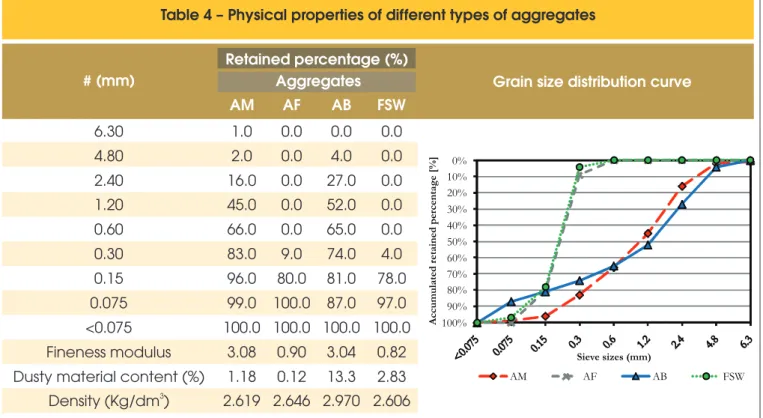
The physical properties of each of the aggregates were determined according to test procedures speciied in [18, 19, 20 and 21] and are presented in Table 4.
2.2 Experimental program
The experimental program applied to evaluate the use of FSW in mortar mixtures was divided in two stages. The irst stage consists of the analysis of mortars produced with compositions between the aggregates AM, AF and FSW. The second stage consists of the analysis of mortars produced with compositions between the aggregates AB, AF and FSW. The details about each one of the mentioned stages are discussed in items 2.2.1 and 2.2.2.
Table 4 – Physical properties of different types of aggregates
# (mm)
Retained percentage (%)
Grain size distribution curve
Aggregates
AM
AF
AB
FSW
6.30
1.0
0.0
0.0
0.0
4.80
2.0
0.0
4.0
0.0
2.40
16.0
0.0
27.0
0.0
1.20
45.0
0.0
52.0
0.0
0.60
66.0
0.0
65.0
0.0
0.30
83.0
9.0
74.0
4.0
0.15
96.0
80.0
81.0
78.0
0.075
99.0
100.0
87.0
97.0
<0.075
100.0
100.0
100.0
100.0
Fineness modulus
3.08
0.90
3.04
0.82
Dusty material content (%)
1.18
0.12
13.3
2.83
3
Density (Kg/dm )
2.619
2.646
2.970
2.606
0% 10% 20% 30% 40% 50% 60% 70% 80% 90% 100%
Sieve sizes (mm)
AM AF AB FSW
Accumulated r
etained percenta
ge [%]
Table 5 – Mortars nomenclature
and volumetric percentages
of aggregates used to produce
the mortars – stage 1
Nomenclature
Aggregates
AM
AF
FSW
Ref
50%
50%
-
A1-1
50%
-
50%
A1-2
35%
-
65%
A1-3
20%
-
80%
Table 6 – Mortar materials content – stage 1
Materials (Kg/m³)
Ref
A1-1
A1-2
A1-3
(1)
Cement
451
451
451
451
AM
722
722
505
289
AF
729
-
-
-
FSW
-
718
934
1149
Water
298
298
298
298
(2)
Admixure
3.2
3.2
3.2
3.2
w/c
0.66
The mortars properties on fresh state were determined based on the evaluation of the incorporated air content and consistency. The incor-porated air content was determined based on the gravimetric method. The consistency was assessed by means of low table tests. In this case the mortar spreading diameter was measured immediately after the mold removal (Flow0) and after applying 10 strokes (Flow10). The testing procedures for determining the incorporated air content and consistency can be found, respectively, in the standards [22, 23]. After performing the abovementioned tests, three specimens with dimension of 5.0 x 10.0 cm (diameter x height) were molded for
each mixture in order to evaluate the compressive strength at 7 days. The used molds are made of PVC.
2.2.2 Stage 2
The stage 2 was developed aiming to evaluate the use of FSW in a composition with ine crushed aggregate for further production of structural concrete with higher compressive strengths.
Aiming to meet the objectives of this stage, mortar mixtures were pro -duced with cement CP V ARI RS, polyfunctional water reducing admix-tures, and aggregates AF, AB and FSW. Table 7 shows the nomencla -ture used for the different aggregate compositions used at this stage. The unitary mass ratio used for the production of mortars in stage 2 was based on the composition used in stage 1, i.e., 1:3.22:0.66. The volumetric replacement of AM by AB was then performed, thus obtaining the unitary mass ratio 1:3.43:0.66 (cement : aggre-gate : water). The mortars materials content used in the study proposed in stage 2 are presented in Table 8.
The tests used to evaluate the mortars properties on fresh and hardened state were identical to those described in stage 1 (see item 2.2.1).
3. Results and discussions
3.1 Results of stage 1
The fresh state tests results obtained for the mortar mixtures pro -duced in stage 1 are presented in Table 9 and Figure 1a.
Table 7 – Mortars nomenclature
and volumetric percentages
of aggregates used to produce
the mortars – stage 2
Nomenclature
Aggregates
AF
AB
FSW
A2-1
50%
50%
-
A2-2
40%
60%
-
A2-3
30%
70%
-
A2-4
-
50%
50%
A2-5
-
60%
40%
A2-6
-
70%
30%
Table 8 – Mortar materials content – stage 2
Materials (Kg/m³)
A2-1
A2-2
A2-3
A2-4
A2-5
A2-6
Cement
451
451
451
451
451
451
AB
819
983
1147
819
983
1147
AF
730
584
438
-
-
-
FSW
-
-
-
719
575
431
Water
298
298
298
298
298
298
(2)
Admixture
3.2
3.2
3.2
3.2
3. 2
3.2
w/c
0.66
(2)
Water reducing admixture – 0.7% in relation to the cement mass.
Table 9 – Fresh and hardened state tests results – stage 1
(3) Potential compressive strength, i.e., highest value out of three specimens.
Nomenclature
(mm)
Flow0
Flow10
(mm)
(kg/m )
Density
3Incorporated air
content (%)
Compressive
(3)strength (MPa)
Ref
277.0
-
2106.0
4.3%
21.4
A1-1
176.0
282.5
1930.0
11.9%
14.8
A1-2
135.5
266.0
2068.0
5.5%
7.7
The results shown in Table 9 and Figure 1a indicate that the addition of FSW resulted in increased levels of incorporated air when com-pared to the mortar Ref. However, it was not observed a clear trend with regard to the relationship between the incorporated air content and the percentage of FSW. Regarding the luidity of the mixtures, it was observed that increasing the replacement level of AF by FSW contributed to the signiicant reduction in the luidity of the mortar. In other words, it can be stated that the use of similar concrete mixtures may require a greater amount of water to achieve a given work-ability. This need leads to an increase of the water/cement ratio and consequently a compressive strength decrease.
The hardened state tests results obtained for the mortar mixtures produced on stage 1 are presented in Table 9 and Figure 1b. The results presented in Table 9 and Figure 1b show that the use of FSW has signiicantly inluenced the mortars compressive strength. The comparison between Ref. and A1-1, which differs only by replacing the AF by FSW, indicates a compressive strength reduction of 31%. This reduction was even greater with increasing FSW content in the mixtures.
Moreover, visual observation of the mortar specimens produced with FSW indicated the presence of expansive reactions which, in turn, led to material structure cracking as shown in Figure 2.
Figure 1 – Stage 1 – mortar tests results: (a) fresh and (b) hardened state
A B
Figure 2 – Visual observation of the expansive reactions that have occurred in the mortars
produced with FSW, e.g., A1-3: (a) mortar mixture expansion; (b) crack opening of
≈
1,0mm
A A
Note that the expansions were determined as higher when levels of FSW in the mixture were increased.
The results presented in Table 9 and Figure 1 indicate that despite the mixtures A1-2 and A1-3 have shown low levels of incorporated air content, their compressive strength is lower than those obtained for A1-1, which has a higher incorporated air content. Thus, it is likely that the expansion caused by the use of FSW contributed in a higher de-gree than the incorporation of air to reduce the compressive strength. To a irst approximation, it is assumed that the effect of excessive expansion may have been caused by the presence of crushed coal (coal-powder), sodium silicate jointly with CO2, or some metallic residue included in the FSW during the casting process.
3.2 Results of stage 2
The fresh state tests results obtained for the mortar mixtures pro -duced in stage 2 are shown in Table 10 and Figure 3a.
The results presented in Table 10 Figure 3a indicate that the use of FSW has contributed to reduce the luidity of the mixtures and increase the amount of incorporated air. Nonetheless, likewise in stage 1, it was not possible to establish a clear trend between the
level of FSW addition and the incorporated air content.
The hardened state tests results obtained for the mortar mixtures produced in stage 2 are presented in Table 10 and Figure 3b. Regarding the compressive strength at 7 days (see Table 10), once more it was observed a loss in strength due to the use of FSW. As observed in stage 1, it appears that increasing the content of FSW in the mixture re -sults in a greater compressive strength reduction. In this case, the mortar produced with the highest level of FSW (A2-4) has shown a decrease of 39% when compared to the mix A2-1, followed by a reduction of 36% for A2-5 in relation to A2-2 and 14% for A2-6 relative to the A2-3.
The results obtained in stages 1 and 2 do not match with those presented by [8] and [9], which evaluated the use of FSW in con -crete production and have found that this use does not result in compressive strength decrease. Similarly, the results presented by [13] indicate that the use of FSW to partially replace the ine ag-gregate is suitable for asphalt concrete. However, when comparing the results herein obtained with those published by [15], a similar trend is observed, i.e., increasing the content of FSW resulted in increased levels of incorporated air and a signiicant compressive strength reduction. The existence of differences between the re -sults obtained in this work to other published re-sults [8, 9, 13] is
Table 10 – Fresh and hardened state tests results – stage 2
Nomenclature
(mm)
Flow0
Flow10
(mm)
(kg/m )
Density
3Incorporated air
content (%)
Compressive
(3)strength (MPa)
A2-1
202.0
300.5
2203.0
4.1%
24.3
A2-2
198.5
299.5
2196.0
5.2%
23.9
A2-3
190.5
288.0
2233.0
4.3%
24.2
A2-4
162.5
280.5
2087.0
8.8%
14.8
A2-5
149.0
265.5
2094.0
9.2%
15.3
A2-6
168.5
280.0
2167.0
6.9%
20.9
Figure 3 – Stage 2 – mortar tests results: (a) fresh and (b) hardened state
likely due to the different FSW chemical composition used in each study. In this case, it is emphasized that the content of the coal-powder in the FSW used by [8] was 5.15%, while the FSW used by [10] was 22%.
As for the expansive reactions, it is noteworthy that the expansion level achieved by the mixtures with crushed aggregates (AB) was not so pronounced as to verify the volume increase in the speci-mens, as noted in stage 1 (Figure 2). Nonetheless, despite the less expressive expansion, it is assumed that the loss in compressive strength observed have occurred due to the same reasons dis -cussed in stage 1.
Based on the results obtained in stages 1 and 2, it has been de-cided to carry out further studies whose goals, methods and results are presented as follows.
4. additional stage
The complementary study stage aims to identify the possible origin of the expansive reactions, and consequent compressive strength reduc-tion, previously observed in the mortars mixtures produced with FSW. To a irst approximation, the expansive reactions and consequent -ly compressive strength reduction observed in stages 1 and 2 are likely to be connected to the presence of the following elements in the FSW: coal-powder, NaSiO2, CO2 or small metal inclusions from the smelting process. Therefore, in this stage, mortars were produced with FSW composed by the following materials: a) AF + NaSiO2 + coal-powder + CO2 – d1=2.652 kg/dm³; b) AF + NaSiO2 + CO2 – d2=2.660 kg/dm³; c) AF + Foumann + coal-powder + CO2
– d3=2.654 kg/dm³.
The abovementioned density valueswere determined based on the recommendations described in [8]. The component called
Fou-mann corresponds to a new binder product that has been tested to substitute NaSiO2.
Note that all FSW types in this study stage were not subjected to metal casting, i.e., the molds for the casting process were pro -duced, but were not used in the casting of metal parts, which ex -cludes the presence of metallic residues in the FSW composition. The ratio between the aggregates used in the mortars production, the mortars nomenclatures, and composition of the used FSW are listed in Table 11. The mortars materials content produced in the complimentary study are presented in Table 12.
The tests applied to evaluate the mortars properties on fresh and hardened state were identical to those described in stage 1 and 2 (see item 2.2.1).
4.1 Analysis of results of the additional stage
The fresh state tests results obtained for the mortar mixtures pro -duced in the complementary stage are presented in Table 13 and Figure 4a.
The results presented in Table 13 and Figure 4a indicate that the performance of the mortar A3-3 was the worst between the tested mortars, both in the low table test and incorporated air content. In regard to the mortar A3-1, although it has shown similar low table test results when compared to the mortar Ref 3, A3-1 presented a higher percentage of incorporated air. The mortar A3-2 had the best result among the mortars produced with FSW (Table 13 and Figure 4a). A3-2 results point to a level of incorporated air which is similar to the one obtained by Ref 3 and also higher luidity. Moreover, although the expansive reaction has occurred in A3-2, it was observed that this mortar has presented the less expressive expansion when compared to the others which were produced with
Table 11 – Mortars nomenclature, FSW composition and volumetric percentages
of aggregates used to produce the mortars – complementary stage
Nomenclature
AM
AF
FSW
FSW components
Ref-2
50%
50%
-
-
A3-1
50%
-
50%
Silicate + Coal-powder + CO
2
A3-2
50%
-
50%
Silicate + CO
2
A3-3
50%
-
50%
Foumann + Coal-powder + CO
2
Tabela 12 – Mortar materials content – complementary stage
Materiais (Kg/m³)
Ref-2
A3-1
A3-2
A3-3
(1)
Cement
466
466
466
466
AM
746
746
746
746
AF
754
-
-
-
FSW
-
755
757
756
Water
275
275
275
275
(2)
Admixture
3.3
3.3
3.3
3.3
FSW. This indicates a considerable contribution of the coal-pow -der in the occurrence of expansive reactions. Nevertheless, since the mixture A3-2 has also shown signs of expansion, it is assumed that the CO2 present in the FSW has also contributed, in a lesser extent, for the occurrence of the expansive reactions.
The hardened state tests results obtained for the mortar mixtures produced on stage 2 are presented in Table 14 and Figure 4b. These results indicate that A3-3 has presented the worst perfor-mance among the tested mortars (48% reduction in compressive strength when compared to Ref 3). The mortars A3-1 and A3-2 had similar results with respect to compressive strength, in this case, a decrease of approximately 15% relative to Ref 3 was noted. Comparing the results of this stage (Table 13 and Figure 4b) with those obtained in stage 1 (Table 9 and Figure 1b), it appears that the compressive strength decrease for mortar produced with FSW in stage 1 is more pronounced than the decrease observed in this stage. Therefore, it is proven that the presence of small metal inclusions in the FSW is a contributing factor to the oc-currence of expansive reactions and consequent compressive strength reduction.
5. Conclusions
The conclusions reached in this work, are presented in the
fol-lowing paragraphs. Note that these conclusions are limited to the herein mentioned materials.
Initially, the results have indicated that the use of FSW has a sig -niicant inluence on the fresh and hardened properties of mortars produced with Portland cement. Moreover, it has been found that this inluence is a function of the FSW composition.
The results have also shown that the presence coal-powder in the FSW has a signiicantly higher effect in the expansive reaction and consequently compressive strength reduction than the presence of NaSiO2 and CO2. If the FSW has metal material traces in its com-position then this effect is even greater.
The tests for the new foundry sand binder, named Foumann, to replace the NaSiO2 has not presented good results. Though its use
has resulted in reduced expansive reactions, the inal compressive strength decrease was considerable.
Based on the presented results, it has been noted that the use of FSW to produce concrete leads to the occurrence of expansive reactions. Such reactions cause cracking in the material structure thus contributing to a substantial compressive strength reduction. Therefore, if adding the expansive effects to the occurrence of cracking and loss of material strength, it can be concluded that the application of mixtures made with FSW becomes risky as to the structural and durability requirements.
However, the indings obtained in this work may not be
general-Table 13 – Fresh and hardened state tests results – complementary stage
Nomenclature
Flow
0
(mm)
Flow
10
(mm)
Density
3
(kg/m )
Incorporated air
content (%)
Compressive
(3)
strength (MPa)
Ref-3
186.5
295.5
2064.0
7.9%
21.1
A3-1
183.0
288.5
1995.0
11.0%
17.8
A3-2
203.5
306.0
2062.0
8.1%
18.6
A3-3
167.5
278.5
1976.0
11.9%
11.0
Figure 4 – Complementary stage - mortar tests results: (a) fresh and (b) hardened state
prove the possibility of using FSW as a partial replacement to ag-gregates in concrete production. Thus, since the FSW composition varies according to the manufacturing process, in all cases it is advisable to carry out preliminary tests in order to verify the effects caused by the use of FSW in the concrete production.
6. acknowledgements
Thanks to CNPq for Prof. Dr. Prudêncio’s research productivity scholarship. Concrete chemical admixtures company Rheoset for providing the water reducing admixture and Steel Company Colina for providing the foundry sand waste used in this research.
7. References
[01] MCINTYRE, S. W. et al. Beneiciation and reuse of foundry sand residuals: a preliminary report.
Transactions of the American Foundry men´s Society, Volume 100, p. 201-208.
[02] ASSOCIAÇÃO BRASILEIRA DE FUNDIÇÃO. Apresenta informações sobre o mercado de fundidos no Brasil. Disponível em:<http://www.abifa.org.br>. Acesso em: 25 Jan. 2010.
[03] KLINSKY, L. M. G.. Proposta de reaproveitamento de areia de fundição em sub-bases e bases de pavimentos lexíveis, através de sua incorporação a solos argilosos. Dissertação. Escola de Engenharia de São Carlos da Universidade de São Paulo, São Paulo, 2008. 215 p..
[04] ASSOCIAÇÃO BRASILEIRA DE NORMAS TÉCNICAS. NBR10004 – Residuos Sólidos - Classiicação. Rio de Janeiro (2004).
[05] KHATIB, J. M., ELLIS, D. J.. Mechanical properties of concrete containing foundry sand. ACI special publication SP-200. American Concrete Institute; 2001. p. 733–48.
[06] NAIK, T. R., KRAUS, R. N., CHUN, Y. M., RAMME, W. B., SINGH, S. S.. Properties of ield manufactured cast-concrete products utilizing recycled materials. Journal of Materials in Civil Engineering, Volume 15, Issue 4, 2003, p. 400-407
[07] NAIK, T. R., KRAUS, R. N., CHUN, Y. M., RAMME, W. B., SIDDIQUE, R.. Precast concrete products using industrial by-products. ACI Materials Journal, Volume 101, Issue 3, 2004, p. 199–206.
[08] SIDDIQUE, R., SCHUTTER, G., NOUMOWE, A.. Effect of used-foundry sand on the mechanical properties of concrete. Construction and Building Materials. Volume 23, Issue 2, 2009, p. 976-980. [09] TIKALSKY P, GAFFNEY M, REGAN R. Properties
of controlled low-strength material containing foundry sand. ACI Materials Journal. Volume 97., Issue 6, 2000, p.698-702.
[10] KRAUS, R. N., NAIK, T. R., RAMME, B. W., KUMAR, R.. Use of foundry silica-dust in manufacturing economical self-consolidating concrete. Construction and Building Materials. Volume 23, Issue 11, 2009, p. 3439-3442.
and recycling in concrete production. American Journal of Environmental Science, Volume 3, Issue 3, 2007, p. 135–142.
[12] BAKIS, R., KOYUNCU, H., DEMIRBAS, A.. An investigation of waste foundry sand in asphalt concrete mixtures. Waste Management Research, Volume 24, Issue 3, 2006, p. 269–274.
[13] JAVED, S., LOVELL, C.W.. Use of waste foundry sand in civil engineering. Transport research record 1486. In: Washington, DC: Transportation Research Board; 1994. p. 109-13.
[14] WEIDMANN, D. F., OLIVEIRA, A. L., SANTOS, J. PRUDÊNCIO JR., L. R.. Comparação da
eiciência dos aditivos plastiicantes e polifuncionais, In: 48o Congresso Brasileiro de Concreto, Rio de
Janeiro, 2006.
[15] ASSOCIAÇÃO BRASILEIRA DE NORMAS TÉCNICAS. NBR5737 – Cimentos Portland resistentes a sulfatos. Rio de Janeiro (1992). [16] ASSOCIAÇÃO BRASILEIRA DE NORMAS
TÉCNICAS. NBR10005 – Procedimento para obtenção de extrato lixiviado de resíduos sólidos. Rio de Janeiro (2004).
[17] ASSOCIAÇÃO BRASILEIRA DE NORMAS TÉCNICAS. NBR10006 – Procedimento para obtenção de extrato solubilizado de resíduos sólidos. Rio de Janeiro (2004).
[18] ASSOCIAÇÃO BRASILEIRA DE NORMAS
TÉCNICAS. NBR 7211 – Agregados para concreto – Especiicação. Rio de Janeiro (2009).
[19] ASSOCIAÇÃO BRASILEIRA DE NORMAS TÉCNICAS. NBR-NM 248 – Agregados – Determinação da composição granulométrica. Rio de Janeiro (2003).
[20] ASSOCIAÇÃO BRASILEIRA DE NORMAS TÉCNICAS. NBR-NM 46 - Agregados - Determinação do material ino que passa através da peneira 75 micrometro, por lavagem. Rio de Janeiro (2003). [21] ASSOCIAÇÃO BRASILEIRA DE NORMAS
TÉCNICAS. NBR-NM 52 - Agregado miúdo - Determinação de massa especíica e massa especíica aparente. Rio de Janeiro (2003). [22] ASSOCIAÇÃO BRASILEIRA DE NORMAS TÉCNICAS. NBR 13278 – Argamassa de
assentamento de paredes e revestimento de paredes e tetos – Determinação da densidade de massa e do teor de ar incorporado. Rio de Janeiro (2003). [23] ASSOCIAÇÃO BRASILEIRA DE NORMAS
![Table 2 – Foundry sand waste – toxicity (leaching) analysis according to [16]](https://thumb-eu.123doks.com/thumbv2/123dok_br/18859692.417705/2.892.70.829.805.1133/table-foundry-sand-waste-toxicity-leaching-analysis-according.webp)
![Table 3 – Foundry sand waste – solubility analysis according to [17]](https://thumb-eu.123doks.com/thumbv2/123dok_br/18859692.417705/3.892.65.825.466.1141/table-foundry-sand-waste-solubility-analysis-according.webp)