BAR, Rio de Janeiro, v. 13, n. 4, art. 2, e160066, Oct./Dec. 2016
http://dx.doi.org/10.1590/1807-7692bar2016160066
Top Human Resources Managers Views on Trade Union Action in
Brazilian Corporations
Antonio Carvalho Neto1 Wilson Aparecido Costa de Amorim2 André Luiz Fischer2
Pontifícia Universidade Católica de Minas Gerais1 Universidade de São Paulo/ Faculdade de Economia, Administração e Contabilidade2
Received 30 June 2016; received in revised form in 27 October 2016; accepted in 2 November 2016; published online 13 December 2016.
Abstract
This article presents the perception of human resource (HR) top managers at strategic level in Brazilian corporations regarding labor union activity. It is a quantitative study about the perception of 354 experienced HR top managers on the unionization of employees, influence of the union on the organization, recognition of the union for labor negotiations and the existence of an advisory committee (workers’ council) within organizations. The theoretical approach addresses both the fields of study on HR and Industrial Relations (IR). The research shows low unionization and management perceptions that unions have little influence on organizations. On the other hand, the HR managers recognize the union influence for collective bargaining purposes and for defining general terms of employment. These contradictions are related to the fact that collective bargaining is mandatory in Brazilian legislation. In general terms of employment, Brazilian legislation is too rigid, prescriptive and detailed. This strong state of regulation reserves to the union an automatic participation in the negotiation process with employers, although this trade union action is somehow inefficient. In this scenario, the perception of HR managers of a relative union influence, although inefficient, is an expected consequence.
Introduction
This article presents an overview about the perception of human resource (HR) managers at the strategic level in Brazilian companies regarding labor union activity within their organizations. It is a very comprehensive study, providing an overview of how HR departments see several important aspects of industrial relations (IR) systems. Data of flexible scheduling and employment contracts are also presented in these enterprises.
This contribution is based on a quantitative study about the perception of 354 experienced HR managers from organizations in all sectors of the Brazilian economy, 79% from the private sector and
mostly large-scale enterprises. These managers’ perceptions on the unionization of employees, influence
of the union on the organization, recognition of the union for labor negotiations and the existence of an advisory committee/workers’ council within organizations are presented and analyzed.
These perceptions are linked to aspects of what can generically be referred to as flexible scheduling and employment contracts at these companies, such as overtime, weekend work, flexible scheduling, reduced work week, work from home, telecommuting and temporary work, considering that often temporary contracts are part of the outsourcing processes.
The existence to a greater or lesser extent of such flexible scheduling and employment contract models, combined with turnover rate, enables a discussion on the degree of influence of the union on the daily lives of workers, given that flexible scheduling and outsourcing have posed enormous challenges for union action and have been met with notorious resistance from the unions, not only in Brazil but also abroad (Amorim, 2015; Camargos & Serrão, 2011; Chaison, 1996; Ferreira, 2016; Guimarães, Hirata, & Sugita, 2009; Weller, 2007).
The turnover rate allows for insight into whether workers are more or less satisfied with general compensation and working conditions, especially in periods of lower unemployment, as was the case until late 2014.
In addition to contributing by discussing HR managers’ perceptions of influence of the union on
major companies in the country, which in and of itself is unprecedented for literature on the field of administration, this article takes an approach that addresses the fields of HR and IR studies in a more juxtaposed manner, in line with U.S. authors on IR (Colvin, Batt, & Katz, 2001; Kaufman, 2002; Kochan, 2000).
The following theoretical framework looks at the Brazilian industrial relations system and how labor unions have reacted to the challenges of this scenario, including flexible scheduling and employment contracts. Specific comparisons to other international IR systems are drawn throughout the theoretical framework.
Union Action in the Brazilian Industrial Relations System
The emergence of an industrial labor market in Brazil began in the first decades of the twentieth century, when the first consumer goods companies set up shop in urban centers like São Paulo and Rio de Janeiro (A. F. Barbosa, 2008). However, it was only from the 1930s onward that an IR system with greater institutional complexity was established in Brazil. During this period, remarkable changes began to take place in Brazilian society, starting with economic policies aimed to development and, as part of these policies, official incentives to promote industrialization. The Brazilian IR system, from the second
half of the 1930s and especially since the 1940s, when the Brazilian Labor Code (Consolidação das Leis
do Trabalho [CLT]) was implemented, has been characterized early on by strong intervention from the state as a regulatory agent of the relations between companies and workers.
Even during the first Vargas government administration (1930-1945), which was dictatorial in nature, core labor legislation began taking shape, outlining the general rules that define aspects such as individual hiring of labor, organization of workers and employers into unions and associations, structuring and financing, collective bargaining, and government participation through Labor Courts and the Ministry of Labor (Amorim, 2015).
Unlike the voluntary nature of the US and British industrial relations systems, the Brazilian system has always been guided by greater government regulation, similar to France and Germany (Bamber, Ryan, & Wailes, 2004; Carvalho, 2001).
Among its key aspects, Brazilian labor legislation guarantees trade unions, federations and
confederations an automatic yearly influx of funds. These funds come from union dues − a deduction
equivalent to one day of work each year from any worker registered at companies. On the employer side, the union structure − trade unions, federations and confederations − is also financed by a contribution proportional to the company’s capital. These dues make Brazilian unions independent on funds from voluntary worker membership. For this reason, many trade unions have little motivation to seek out new members. On the other hand, the guaranteed extension of collective bargaining agreements to non-members prevents many workers from seeking out the union as a representative body. This also happens in other countries, as in France. In the United States, only union members benefit from the gains associated with a collective bargaining agreement (Kaufman, 2002). In short, Brazilian labor laws
discourage both trade unions from pursuing new members and workers’ interest in becoming members.
At the base of the trade union structure – the union itself – there is a monopoly of representation
in terms of territorial coverage. If a city already has a metalworkers’ orbankers’ union, for example, no other union can represent these workers in the same territory.
Another relevant fact is that the Brazilian legislation does not guarantee the right to the workers in order to form a company-wide union, as it is the case in Germany and Sweden. In light of this, the Brazilian IR system is characterized by union action that almost always occurs outside the company. Although there are some major enterprises with worker councils recognized under a collective bargaining agreement, their small number in relation to the total universe of companies only reinforces the general impression that the union organization should take place outside the organization (Carvalho, 2009).
This article does not aim to provide a more detailed history of how this system evolved over the subsequent decades. However, it is clear that labor laws were implemented in Brazil even before the emergence of organized demands from Brazilian workers. Interference from the State has been a
significant factor since the promulgation of the Brazilian Labor Code (Decreto-lei n. 5.452, 1943),
during the populist regimes between 1950 and 1964 and also during the military dictatorship after 1964, by both the executive branch and the labor courts. From late 1970s onward, while the Brazilian economic model entered into a crisis and the military dictatorship saw its gradual decline, the union movement reemerged as a relevant player.
In general, Brazilian IR system does not differ significantly from other Latin and Latin American countries (Visser, 1997) such as Spain and Mexico. Common features are: mandatory union representation; low competition between unions to represent workers; heavy dependence on funds transferred by the federal government and a trend of restrictions on greater freedom of action by union leaders (Lucena & Covarrubias, 2006).
Direct collective bargaining between companies and workers is not legally permitted. In the absence of direct negotiation, bargaining may take place within the Labor Courts, a process in which the judge may rule on terms that govern the hiring of labor at the collective level. Bargaining may only be established by consent between the parties and the definition of this consent is actually quite flexible, expanding to the mere presence of the parties at the labor court hearing (Sarcedo, 2016). Usually, collective bargaining agreements are renewed every year; the main terms relate to wage increase, minimum wage and other professional minimum wage benefits.
Few collective bargaining agreements in Brazil have nationwide implications such as bankers and oil workers. Local agreements tend to prevail (Carvalho, 2001). Collective bargaining that involves different industries is also non-existent. Until at least the late 1980s there was a prevailing statutory-centralized focus in the Brazilian IR system (Pastore & Zylbertstajn, 1988). A strict interpretation of the law was preferred to the detriment of direct negotiations and, secondarily, of negotiations led by trade unions, with little negotiation at the company level. This system is quite different from the U.S. system, characterized by decentralized bargaining, more common at the company level (Kaufman, 2002).
Starting in the mid-1990s, new legal regulations opened opportunities for decentralized bargaining on issues such as profit sharing, compensation and working hours of employees under contract. These regulations brought greater flexibility to Brazilian labor relations and have made company-wide bargaining more common, especially in the manufacturing sector. These negotiations occur primarily under union control and not through worker councils at the company level (Amorim, 2015; Departamento Intersindical de Estatística e Estudos Socioeconômicos [DIEESE], 2001).
After the 1988 Constitution, government restrictions on the establishment of new unions were loosened. Since then, there has been major growth in the number of unions in Brazil, as worker entities due to the breakup of municipal bases and also due to the formation of trade unions for new worker categories. However, this fragmentation has not been accompanied by a corresponding increase in union density, or even the eventual economic industrial reconfiguration. The main reason probably lies in the access to union dues funding by new union leaders, who may be looking to get a piece of the revenue pie (Cardoso, 2014).
The main trade union central in Brazil is the Unified Workers’ Central (Central Única dos
Trabalhadores [CUT]). When it was created in 1983, it congregated the most aligned organizations with the so-called new unionism that emerged in the late 1970s. CUT was able to improve its capacity to mobilize and add new member unions throughout the 1980s, going in the opposite direction of a global setback for the union movement, which faced a crisis in industrialized European countries (Piore, 2011). The union representation crisis would only reach CUT and Brazilian trade unions in the 1990s (Hirata,
2006). Within CUT, most union members are aligned with the Workers’ Party (Partido dos
Trabalhadores [PT]).
In 2008, during the second term of President Lula’s administration, and after finally being
recognized by the law, trade unions centrals also began receiving part of the union dues paid by workers. To be eligible, these unions had to meet a number of criteria for regional and specific industry representation, as well as a minimum share of 7% of all unionized workers.
The prospect of legal recognition for the trade unions centrals and the resulting receipt of union due funds led to creation of new groups that spun off from the two main organizations, CUT and Union
Force (Força Sindical). Currently, CUT accounts for about 30% of Brazilian unions, followed by Força
from the level found in Scandinavian countries and Germany, but similar to countries like Portugal, Spain and even higher than that of France and the USA. Despite all the fluctuations in the Brazilian economy in the 1990s and afterwards, this rate has remained relatively stable (I. J. Rodrigues & Ramalho, 2014).
Looking at the number of strikes or the proportion of agreements that resulted in above-inflation wage increases, in recent years, improves the understanding of the strength of trade unions. Firstly, a high number of collective bargaining agreements continued to be signed each year (Cardoso, 2014). What’s more, the year of 2000 represented a very different scenario from that of the 1990s. With a significant improvement in job market indicators, real increases have become common in Brazilian as a result of collective bargaining agreements.
Likewise, purpose-driven strikes that demand better wages and working conditions, returned as part of the bargaining process between 2003 and 2004. These strikes took place in traditional industries
with more structured internal and external job market and higher levels of unionization – such as bankers
and steel workers – as well as in others closer to the base of the job market pyramid, such as construction
and urban sanitation, industries with traditional low union participation. In other words, when strikes happened, they involved both unionized and non-unionized workers (Amorim, 2015).
In the 2000s, with economic growth and the Lula (PT) administration, the position of trade unions
centrals was strengthened within the country’s overall scenario, as they exerted greater influence on the
federal government due to the presence of several former leaders (mainly from CUT) at various levels of government and as congressmen (Amorim, 2015).
In many tripartite forums such as the National Labor Forum, which promoted nationwide discussions between 2003 and 2005, even in relation to the definition of national public policies aimed at promoting Decent Work (a campaign by International Labor Organization); proposals from unions were barred by employer groups. In other words, even when it has influence within a government, the power of trade unions centrals is not absolute.
Outsourcing is certainly one of the challenges that has had more impact on union representation. Many studies, such as those by Neves (2006), Piccinini, Oltramari and Oliveira (2007) and Ferreira (2016), point out to a decline in stable jobs and an increasing use of outsourced temporary workers. Another challenge is the adoption of flexible scheduling, in many ways that differ from the traditional 40 hours per week standard; this varies from country to country and is still very far from being the dominant pattern, but it is a reality in many industrial relations systems, not only in Brazil but also abroad (Giannikis & Mihail, 2011; Richbell, Brookes, Brewster, & Wood, 2011).
There is one indicator that suggests higher or lower job quality perception at a company, industry or country, which is the turnover rate (Abelson & Baysinger, 1984; Hausknecht & Holwerda, 2013). In Brazil, turnover is among the highest in the world, even when accounting for factors such as industry composition and company size (DIEESE, 2014; Gonzaga, 1998; Orellano & Pazello, 2006). Annual
reports by the Inter-Union Department of Statistics and Socioeconomic Studies (Departamento
Intersindical de Estatística e Estudos Socioeconômicos [DIEESE]) confirm this reality, pointing to a rate of 45.1% in 2001; 43.6% in 2004; 46.8% in 2007; 52.5% in 2008; 49.4% in 2009; 53.8% in 2010 and 64% in 2012 (Chahad & Pozzo, 2013). When compared to 25 other countries, Brazil has the second-lowest average length of employment, behind only the United States (DIEESE, 2014). This shows that even from 2008 to 2014, when Brazil experienced nearly full employment, workers were not satisfied with wages and other working conditions.
Despite the crisis of representation and defensive position of international unionism in face of the profound changes in the world of work and the achievements during the period from the post-World War II years until the late 1970s (Piore, 2011), the international trade union movement, including in Brazil, has sought new ways to operate since the late 1990s, also seeking to represent the specific interests of young workers, women, minorities, and outsourced workers, with involvement of civil society (Bronfenbrenner, 2007; Clark, 2009; Faria & Rosignoli, 2008; Gomes, 2011; Gordon & Turner, 2000; Katz, Lee, & Lee, 2004; Silva, 2011). The Brazilian trade union movement also strengthened its position at the international level, with a former CUT chairman being elected as the head of the International Trade Union Confederation (ITUC) (Amorim, 2015).
Brazilian trade unions political power has grown up and they became important actors in the bargaining process with corporations and even in the broader political sphere. However, over time, firms were not able to develop a consistent line of HR management breaking dialog with the trade unions as part of its more organic or strategic activities. The relationship between corporations and unions in Brazil rarely took place within the perspective of participation in management. Even in aspects directly related to collective hiring of labor, dialog with unions has historically been characterized as something to be done outside the organization and consequently outside of HR management. In other words, there has always been a distance between HR management and the classic IR system institutions.
From management’s perspective, the relationship between unions and companies has almost always been tangential, and often approached only from the strictly legal perspective. Within Brazilian academic circles, there is also very little interaction between the fields of knowledge of HR and IR. In short, despite the growing and consolidated presence of trade unions on the labor agenda, this is most often looked upon as trouble coming from outside the organization, whereas few companies have structured departments to deal with IR (Amorim & Fischer, 2015; A. C. Q. Barbosa, 2005; Carvalho, 2010; Fleury & Fischer, 1992).
Methodology
Cranfield Network on International Strategic Human Resource Management (CRANET) is an international network of business schools based at the Cranfield School of Management (UK), which has been studying since 1989 various aspects of HR Management and IR in different countries for over
25 years, using a unique questionnaire. Data are compiled into a single file and distributed to the group’s
research partners around the world. Each member institution holds panels with HR and IR professionals in their countries to discuss and ensure the validity of its results. Each year, the results and methodology
are discussed at two international meetings held by the group’s researchers in different countries.
In the data collection round that took place between 2008 and 2010, 32 countries took part in the study (Parry, 2011): Australia, Austria, Belgium, Bulgaria, Cyprus, Czech Republic, Denmark, Estonia, Finland, France, Germany, Greece, Hungary, Iceland, Ireland, Israel, Japan, Lithuania, Netherlands, Norway, Philippines, Russia, Serbia, Slovakia, Slovenia, South Africa, Sweden, Switzerland, Taiwan, United Kingdom, United States and Uruguay. Each country receives the questionnaire to be administered in English, and translates it into that country’s language. A new translation is done from the country’s language into English. These two translations are provided by different people. Any differences are discussed in order to align the concepts in different languages.
The CRANET questionnaire and methodology were used in Brazil for the first time in 2014. The methodology employed was proposed by the same group that conducts the survey in other countries. The translated questionnaire was hosted on a website developed specifically for this survey. Before
starting the data collection, a pre-test questionnaire was administered to test the website’s usability and
The registry of potential respondents was formed using two different strategies. The universe of all establishments based in Brazil with more than 200 employees was provided by the Ministry of Labor and Employment (MTE) in a list compiled based on the RAIS (Annual Company Information Report) which contains the company name, number of active employees in 2012, telephone number, email address, state and city. This list was refined, excluding establishments belonging to the same organization. After these exclusions, the universe was established as a total of 18,771 organizations. Invitations were sent to the Human Resources professionals of all these 18,771 organizations by electronic means, which were repeated every week for 60 days. As a result it obtained only 26 responses which led to development of a second list.
A second list was compiled based on information obtained from the contacts at the institutions to which the network’s coordinators in Brazil are associated. Thus, the lists of organizations and of HR professionals were compiled from personal contacts for professors involved and those used in periodic surveys of these institutions were also aggregated, as well as the Best Companies to Work for (MEPT), Best Companies to Start a Career (MECC), Delphi survey, among others. These different sources resulted in a database of 3,281 registered organizations. A partnership was formed with the São Paulo
Branch of the Brazilian Human Resources Association (Associação Brasileira de Recursos Humanos
[ABRH-SP]). Through this partnership, the link to the survey was disclosed and invitations were sent to the associated organizations.
Data were collected between May 15 and August 31, 2014. In all, 1,295 organizations took part in the survey. However, 862 were discarded due to the number of incomplete answers. Initially, 433 questionnaires were validated. As not all the records obtained from institutions contained the number of employees, some smaller organizations were contacted to answer the survey. Thus, the database was refined again and reached the number of 354 responses, validated for representing organizations with more than 200 employees. With this number of respondents, the rate of return from MTE registries was 0.48%, and from other registries, 14.35%. This last source had a rate of return closer to the historical rate of other countries in the network that answered the survey completely over the years.
For the purpose of this article, data more directly related to Industrial Relations were selected, which are: unionization of employees; influence of the union on the organization; recognition of the union for labor bargaining; existence of an advisory committee/workers’ council; average annual turnover; use of overtime; weekend work; flexible scheduling; reduced work week; work from home; telecommuting; and temporary work.
Characterization of respondents and participating organizations
Table 1
Characteristics of Respondents: Area of Activity, Capacity in the Human Resources Department (HR), Gender and Education
Category N %
Total respondents 354 100
Work in the HR department 336 95
Senior HR executives 211 60
Men 208 41
Women 146 59
Respondents with college degree 349 99
1st Most common university degree: Humanities 109 31
2nd Most common university degree: Business 99 28
Table 2
Characteristics of Respondents: Time Working at the Company and in Human Resources (HR)
Category Minimum Average Maximum N
Time at the company (years) 6.50 9.66 42 336
Work in the HR department (years) 13.73 12.00 42 336
Note. Obs.: In this table there are 28 missing data.
As noted, the respondents match the desired profile for the survey, which lends credibility, reliability and quality to the data collected. Participating organizations were represented by 354 respondents, of which 95% worked in the HR area and the rest worked in related departments. Most of them (60%) claimed to be the main person in charge of the department, making them experts on management policies and practices and probably involved with the other relevant matters to the business of the organizations.
Women comprised most survey respondents, which is consistent with the demographics of this
professional community. They are all very experienced with HR work – average of 12 years and
maximum of 42 years – and have been employed at the surveyed company for a reasonable amount of
time (average of nearly 10 years). Education level is high: practically all respondents had at least a college degree, in humanities or in business.
Table 3
Size of Organizations by Number of Employees
No. of employees N %
200-500 115 32.0
501-1000 78 22.0
1001-2500 88 25.0
More than 2500 73 21.0
Total 354 100
The average was 4,528 employees while that the largest company had 125,000 employees. Private sector organizations are smaller, with 4,038 employees on average; mixed capital enterprises, formed by large state-owned companies, are much bigger, employing an average of nearly 10,000 workers. Although it was not possible to achieve a probabilistic and representative sample, the participant organizations in many respects resemble the distribution of demographic characteristics of public and private organizations operating in Brazil.
Presentation and Data Analysis
As one would expect, the majority of employees hold operational positions (61.3%); nearly 30% are non-management professionals and 10% hold management positions. In this case, there is also variation between the different sectors. Operational staff represents a greater share in the private sector (64.2%), and smaller in mixed capital enterprises (47.6%).
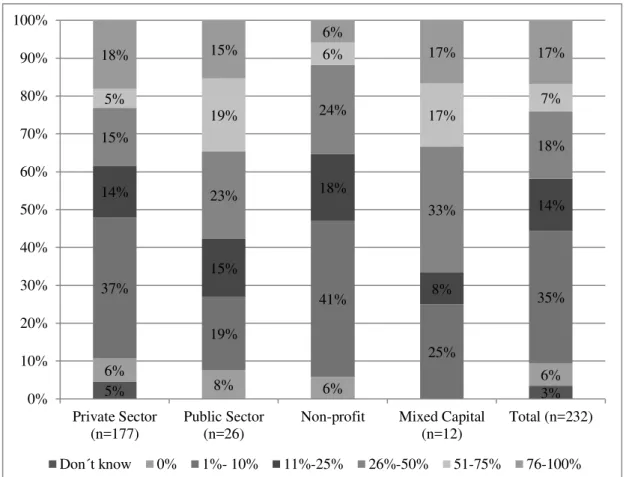
Regarding unionization, Figure 1 shows that 41% of organizations have up to 10% of staff unionized, therefore a low level of union membership. This proportion is similar to that in the private sector, with 43% of organizations. On the other hand, in the private sector, 23% of organizations are identified as having over 50% of their workers unionized. This proportion is 34% for both the public sector and mixed capital organizations. The proportions of unionized workers are higher in the public sector and mixed capital enterprises. At roughly a third of these organizations, the level of unionization is higher than 50% of workers. The private sector and the non-profit sector also have the highest
proportions – 43% and 47%, respectively, of organizations with low unionization rates (between 0%
Figure 1. Proportion of the Total Number of Employees at the Organization Who Are Unionized In this figure there are 122 missing data. Source: Fischer, A. L., & Amorim, W. A. C. (Orgs.). (2014). Pesquisa CRANET –
Brasil – 2014 [Data base]. São Paulo: CRANET, FEAUSP.
The number of respondents in Figure 1 is lower than in other figures because many HR managers in Brazil do not know the number of union members, as in many companies the monthly fee paid by workers to their unions are not discounted in the payroll and is not sent by the company to the union, making it difficult this control by the company.
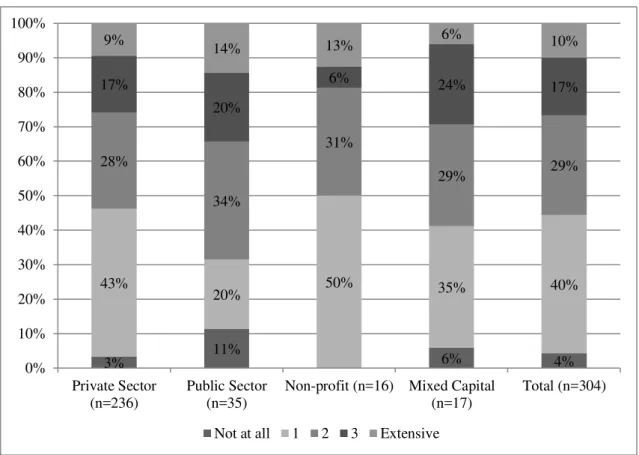
Figure 2 presents data regarding influence of the union on the organization. Only 4% consider that the union has no influence at all. The highest proportion comprises those that consider influence of the union between little and average (69%). On the other hand, unions have an extensive influence on approximately 10% of companies/institutions.
5% 3%
6%
8% 6% 6%
37%
19%
41%
25%
35% 14%
15%
18%
8%
14% 15%
23%
24%
33%
18% 5%
19%
6%
17%
7%
18% 15%
6%
17% 17%
0% 10% 20% 30% 40% 50% 60% 70% 80% 90% 100%
Private Sector (n=177)
Public Sector (n=26)
Non-profit Mixed Capital (n=12)
Total (n=232)
Figure 2. Extent to Which Unions Influence the Organization
In this figure there are 50 missing data. Source: Fischer, A. L., & Amorim, W. A. C. (Orgs.). (2014). Pesquisa CRANET –
Brasil – 2014 [Data base]. São Paulo: CRANET, FEAUSP.
At any rate, when comparing against the data related to the level of unionization from the previous figure, about one third of public sector and mixed capital organizations reported influence of the union to be between reasonable or great extent.
The following table provides information about recognition of the union by organizations for the purpose of collective bargaining.
Table 4
Number of Enterprises that Recognize the Union for Collective Bargaining Purposes
Sector
Private Sector (n=272)
Public Sector (n=43)
Non-profit (n=22)
Mixed Capital (n=17)
Total (n=354)
n 259 31 20 17 327
% line 79% 9% 6% 5% 100%
% row 95% 72% 91% 100% 92%
Note. In this table there are 27 missing data. Source: Fischer, A. L., & Amorim, W. A. C. (Orgs.). (2014). Pesquisa CRANET
– Brasil – 2014 [Data base]. São Paulo: CRANET, FEAUSP.
Data demonstrate that the union is recognized for bargaining purposes by nearly all organizations. The exceptions are in the public sector, where 28% of organizations do not recognize the union. It must be noted that the data in this table is strongly influenced by Brazilian labor legislation, in which the union is the legal representative (defined according to a territorial base) of employees of private organization (both for- and non-profit) and of mixed capital entities. While trade unions are allowed to operate in the public sector, the right to collective bargaining and, consequently, to union representation
3% 11% 6% 4%
43%
20% 50% 35% 40%
28%
34%
31%
29% 29%
17%
20%
6% 24%
17% 9%
14% 13%
6% 10%
0% 10% 20% 30% 40% 50% 60% 70% 80% 90% 100%
Private Sector (n=236)
Public Sector (n=35)
Non-profit (n=16) Mixed Capital (n=17)
Total (n=304)
still remains open. This fact is the likely justification for the lower proportion of public organizations that recognize unions as the workers’ representative for collective bargaining purposes.
Table 5 shows that 37% of the surveyed organizations have an advisory committee/workers’ council, with a higher proportion at mixed capital companies, 53%, falling to 36% and 44%, respectively, in the private and public sector. The data obtained in the survey do not allow for insight on whether such councils have some degree of relationship to workers’ unions. However, these figures can be considered a breakthrough in terms of worker participation, since council experiences at companies
were in large part confined to the ABC Paulista (São Paulo metropolitan region) 20 years ago.
Table 5
Number of Organizations that Have an Advisory Committee or a Workers’ Council
Sector
Private Sector (n=271)
Public Sector (n=43)
Non-profit (n=22)
Mixed Capital (n=17)
Total (n=353)
n 97 19 6 9 131
% line 74% 15% 5% 7% 100%
% row 36% 44% 27% 53% 37%
Note. In this table there are 223 missing data. Source: Fischer, A. L., & Amorim, W. A. C. (Orgs.). (2014). Pesquisa CRANET
– Brasil – 2014 [Data base]. São Paulo: CRANET, FEAUSP.
The following data are about aspects concerning fundamental and sensitive points of labor relations, connected to flexible scheduling and employment contracts. The average of annual turnover was determined at 18.10% of staff. This average is lower than the national average, which in 2014 reached 62.8% (DIEESE, 2015). Staff at mixed capital enterprises is much more stable, with turnover at just 7.22%. Independently, the turnover rate is high in general, leading to the perception that workers are not satisfied with the quality of jobs offered, given that in the period of lower unemployment through 2011, the proportion of workers who took the initiative to resign also grew (DIEESE, 2011).
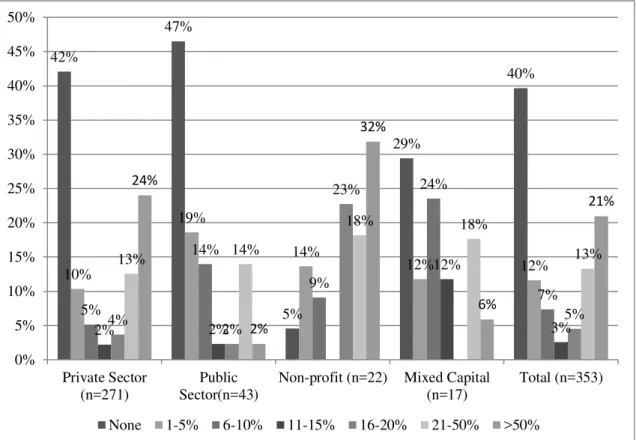
Figure 3 shows that the private sector and non-profit organizations lead in the category of organizations with more than 50% of employees working on weekends, at 24% and 32% of their respective totals. This suggests little influence of the union, given that trade unions are opposed to
weekend work because it affects the worker’s life and family routine, as well as leading to potential
Figure 3. Percentage of Employees Working on Weekends
In this figure there is 1 missing data. Source: Fischer, A. L., & Amorim, W. A. C. (Orgs.). (2014). Pesquisa CRANET – Brasil
– 2014 [Data base]. São Paulo: CRANET, FEAUSP.
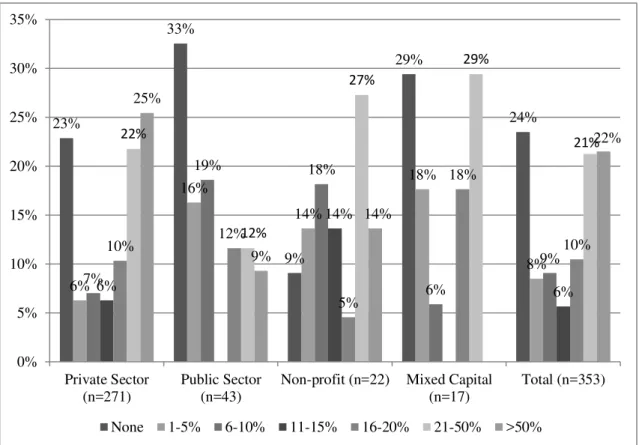
The first finding from the Figure 4 is that overtime is used by a significant share of organizations in all the surveyed sectors. In private sector, public sector and mixed capital organizations, respectively 77%, 67% and 71% have employees working overtime. Within the private sector, approximately one fourth of the organizations have 50% or more of their staff working overtime. Again, the data suggest little influence of the union, given that unions are opposed to a great deal of overtime work, both because of the negative impact on the health of workers and because it limits new hires by companies. Figure 5 shows that flexible scheduling is significantly present in all sectors studied.
42%
47%
5%
29%
40%
10%
19%
14%
12% 12%
5%
14%
9%
24%
7%
2% 2%
12%
3% 4%
2%
23%
5%
13% 14%
18% 18%
13% 24%
2%
32%
6%
21%
0% 5% 10% 15% 20% 25% 30% 35% 40% 45% 50%
Private Sector (n=271)
Public Sector(n=43)
Non-profit (n=22) Mixed Capital (n=17)
Total (n=353)
Figure 4. Proportion of Employees that Work Overtime
In this figure there is 1 missing data. Source: Fischer, A. L., & Amorim, W. A. C. (Orgs.). (2014). Pesquisa CRANET – Brasil
– 2014 [Data base]. São Paulo: CRANET, FEAUSP.
Figure 5. Proportion of Employees Working Flexible Schedules
In this figure there is 1 missing data. Source: Fischer, A. L., & Amorim, W. A. C. (Orgs.). (2014). Pesquisa CRANET – Brasil
– 2014 [Data base]. São Paulo: CRANET, FEAUSP. 23% 33% 9% 29% 24% 6% 16% 14% 18% 8% 7% 19% 18% 6% 9% 6% 14% 6% 10% 12% 5% 18% 10% 22% 12% 27% 29% 21% 25% 9% 14% 22% 0% 5% 10% 15% 20% 25% 30% 35% Private Sector (n=271) Public Sector (n=43)
Non-profit (n=22) Mixed Capital (n=17)
Total (n=353)
None 1-5% 6-10% 11-15% 16-20% 21-50% >50%
53% 60% 27% 35% 51% 9% 12% 14% 6% 9% 6% 7% 14% 6%
4%5% 5% 5% 4%
2% 9% 5% 14% 2% 18% 6% 13% 9% 12% 14% 53% 12% 0% 10% 20% 30% 40% 50% 60% 70% Private Sector (n=272) Public Sector (n=43) Non-profits (n=22) Mixed Capital (n=17) Total (n=353)
Among private and public sectors organizations, 47% and 40% of employees respectively have flexible scheduling for some percentage of their workers. At mixed capital organizations and in the non-profit sector, this proportion reaches 65% and 73%. This data also suggests little influence of the union,
since unions oppose to flexible scheduling because it interferes with workers’ control over their own
personal and family routine.
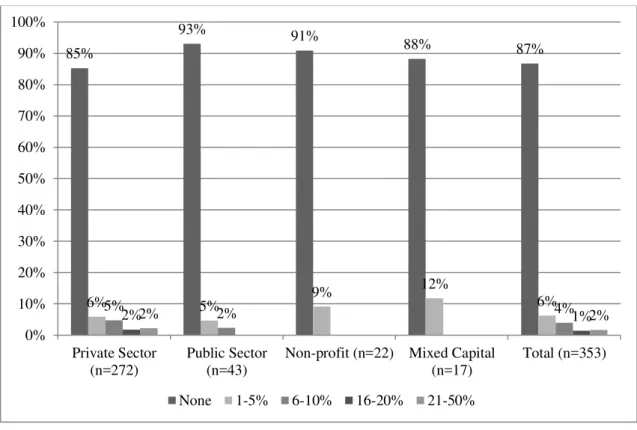
Figure 6 demonstrates that work from home is relatively rare in all the four sectors studied. The highest proportions are found in the private sector and among mixed capital organizations, with 15% and 12% of the respective totals.
Figure 6. Proportion of Employees Working from Home
In this figure there is 1 missing data. Source: Fischer, A. L., & Amorim, W. A. C. (Orgs.). (2014). Pesquisa CRANET – Brasil
– 2014 [Data base]. São Paulo: CRANET, FEAUSP.
Figure 7 shows that the reduced work week is not a common resource in all the sectors studied. From this perspective, the greatest share of organizations offering these conditions are in the public and mixed capital sectors, with 14% and 12% of the cases, respectively.
85%
93% 91%
88% 87%
6% 5% 9%
12%
6% 5%
2% 4%
2%2% 1%2%
0% 10% 20% 30% 40% 50% 60% 70% 80% 90% 100%
Private Sector (n=272)
Public Sector (n=43)
Non-profit (n=22) Mixed Capital (n=17)
Total (n=353)
Figure 7. Proportion of Employees with a Reduced Work Week
In this figure there is 1 missing data. Source: Fischer, A. L., & Amorim, W. A. C. (Orgs.). (2014). Pesquisa CRANET – Brasil
– 2014 [Data base]. São Paulo: CRANET, FEAUSP.
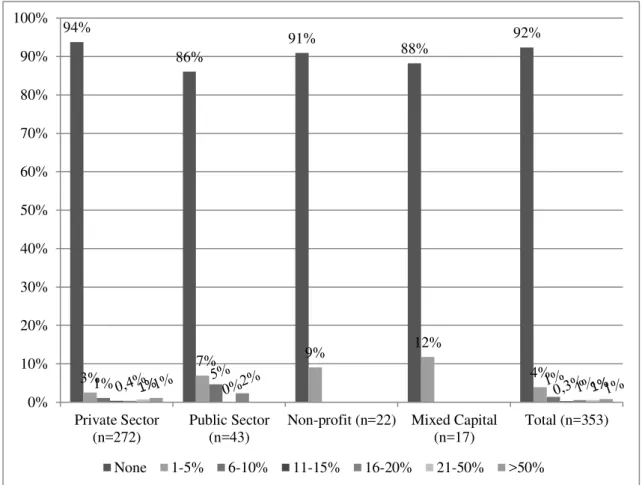
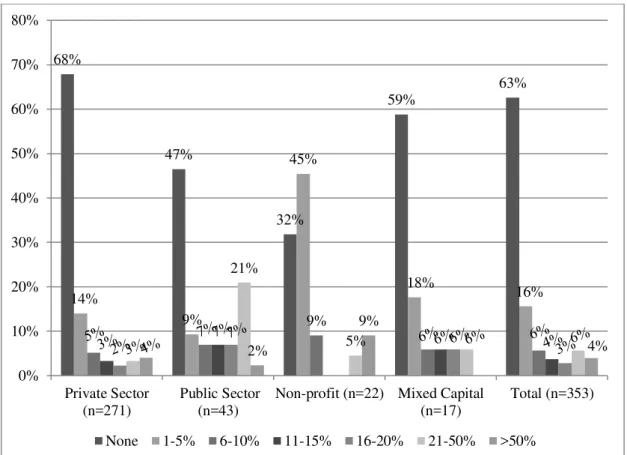
Data also show that the proportion of employees working on a temporary/casual labor basis is found in relatively similar proportions in the private, mixed capital and non-profit sectors (27%, 29% and 36%, respectively). In public sector organizations, temporary/casual labor is less common, with 21% of cases. It should be noted that even in the public sector this rate is high. This data suggests even more strongly the low level of influence of the union, given that unions are radically opposed to temporary contracts.
Figure 8 shows data on fixed-term employment. Like the presence of temporary work, fixed-term employment is also found in an expressive share of organizations in all four surveyed sectors.
94%
86%
91%
88%
92%
3%
7% 9%
12%
4% 1%
0% 10% 20% 30% 40% 50% 60% 70% 80% 90% 100%
Private Sector (n=272)
Public Sector (n=43)
Non-profit (n=22) Mixed Capital (n=17)
Total (n=353)
Figure 8. Proportion of Employees on Fixed-Term Contracts
In this figure there is 1 missing data. Source: Fischer, A. L., & Amorim, W. A. C. (Orgs.). (2014). Pesquisa CRANET – Brasil
– 2014 [Data base]. São Paulo: CRANET, FEAUSP.
Fixed-term employment is more common at organizations in the public, mixed capital and non-profit sectors, with 53%, 41% and 68% of organizations, respectively. Although proportionally less frequent, practically a third of private organizations use fixed-term employment. The percentages of employees hired in such conditions vary in all sectors.
Final Remarks
The data point out to contradictions in the way that respondents (HR managers) see unions
influence. Two expressive and aligned findings indicate low unionization – an objective fact that does
not belie the country’s official statistics – and management perceptions that unions have little influence on organizations. On the other hand, almost all participating organizations recognize the union influence for collective bargaining purposes and, through these negotiations, for defining general terms of employment (wage increases, minimum wages, working schedules, benefits and other items). In other words, contrary to what the perception declared by respondents suggests, the unions are presumably
responsible, to some degree, for the cost of payroll – and, as such, they would have some influence on
HR management of organizations.
These contradictions are undoubtedly related to the characteristics of the Brazilian industrial relations system. The financing of the union structure through union taxes, and the automatic expansion of collective bargaining agreements to cover all workers, unionized or not, are some of the elements that
prevent higher levels of unionization. On the other hand, collective bargaining – as an inescapable
institution of labor market regulation – empowers the unions. Also in terms of influence, the proportion
of organizations that characterize workers’ committees or councils also indicates some potential for
influence of the union over them. 68%
47%
32%
59%
63%
14%
9%
45%
18%
16% 9%
21%
5% 2%
9%
4% 0%
10% 20% 30% 40% 50% 60% 70% 80%
Private Sector (n=271)
Public Sector (n=43)
Non-profit (n=22) Mixed Capital (n=17)
Total (n=353)
It follows from those observations that – instead of the degree of unionization – a more appropriate indicator of influence of the trade union should perhaps be sought in the content of agreements signed between workers and employers, especially regarding compensation.
This is because other union-sensitive aspects, such as weekend work, overtime and the use of temporary labor, emerged expressively as HR practices among the organizations. In such cases, union influence and resistance to diminution of rights indicated by these practices at organizations seemed reduced. Regarding work from home, telecommuting, reduced work week or even fixed-term employment contracts, these practices at the organizations did not reach significant levels in the survey. Especially here, where these practices represent new trends, these results cannot be associated with trade union resistance or action.
All the data presented and discussed in this paper represent a step forward on long-standing concerns among researchers and managers in the fields of HR and IR, in terms of the practical and theoretical distance between them. This is because they clearly indicate that unions are in the way of organizations and their respective HR departments when defining important terms of collective hiring of labor and, by extension, the management of their employees. At the same time, it is unsettling that this is not considered relevant by management in terms of influence on organizations.
If unions are not actually relevant mediators for organizations, this could mean that HR departments would tend to be successful in defending their internal labor market against external factors, with autonomy toward the external market. More than that, this attitude is not very conducive to participation. On the other hand, this perception among managers may also be due to the difficulty in identifying the union as a social actor whose position has been consolidated over the last 20 years, despite all the fluctuations of the domestic economy. In this case, the role of HR departments, as it was over 20 years ago, would still be marked by the lack of a broader perspective on their sphere of activity and/or by willingness to engage in collective bargaining.
Collective bargaining is mandatory in Brazilian legislation, such as several general terms of employment. Brazilian legislation is too rigid, prescriptive and detailed and this strong state regulation reserves to all trade unions an automatic participation in the negotiation process with employers. Even so, in general, trade union action throughout Brazil is rather inefficient. In this scenario, the perception of HR managers of a relative union influence, although inefficient, is an expected consequence. Within the Brazilian Industrial Relations System there is a small set of very active, efficient and combative unions, for example, for metallurgists and bank employees. But they are the exception, not the rule.
Acknowledgments
The authors would like to thank CNPq (Brazilian National Research Board) and FAPESP (São Paulo Research Foundation) for their support.
References
Abelson, M. A., & Baysinger, B. D. (1984). Optimal and dysfunctional turnover: toward an
organizational level model. Academy of Management Review, 9(2), 331-341.
http://dx.doi:org/10.5465/AMR.1984.4277675
Amorim, W. A. C. (2015). Negociações coletivas no Brasil: 50 anos de aprendizado. São Paulo: Atlas.
Amorim, W. A. C., & Fischer, A. L. (2015). Relações de trabalho, administração de recursos humanos e ambiente econômico e social no Brasil: período 1990-2010. In W. A. C. Amorim (Org.),
Araujo, E. M. V. (2008). Movimentos sociais e a verdadeira valorização do trabalho sob a perspectiva constitucional. In C. A. J. Henrique, G. N. Delgado, M. T. Viana, & P. H. Ribeiro (Orgs.),
Trabalho e movimentos sociais (pp. 69-92). Belo Horizonte: Del Rey.
Bamber, G. J., Ryan, S., & Wailes, N. (2004). Globalization, employment relations and human resources
indicators in ten developed market economies: international data sets. The International Journal
of Human Resource Management, 15(8), 1481-1516.
http://dx.doi.org/10.1080/0958519042000257968
Barbosa, A. C. Q. (2005). Relações de trabalho e recursos humanos (Edição Especial). Revista de
Administração de Empresas, 45, 121-126. http://dx.doi.org/10.1590/S0034-75902005000500010
Barbosa, A. F. (2008). A formação do mercado de trabalho brasileiro. São Paulo: Alameda.
Bronfenbrenner, K. (Ed.). (2007). Global unions: challenging transnational capital through
cross-border campaigns. New York: ILR/Cornell Paperbacks.
Camargos, R. C. M., & Serrão, R. S. (2011). Três décadas de negociação coletiva no Brasil: contextos,
resultados e desafios. In M. C. Cacciamali, R. Ribeiro, & J. Macabira (Orgs.), Século XXI:
transformações e continuidades nas relações de trabalho (pp. 79-98). Fortaleza: Instituto de Desenvolvimento do Trabalho, Banco do Nordeste do Brasil, USP.
Cardoso, A. M. (2002). O sindicalismo no Brasil: breve excurso sobre mudanças e permanências. In A.
M. Cardoso, M. A. Santana, J. M. Camargo et al. (Eds.), Sindicalismo e relações trabalhistas (n.
2, pp. 11-34). Rio de Janeiro: Fundação Konrad Adenauer.
Cardoso, A. M. (2014). Os sindicatos no Brasil. In Instituto de Pesquisa Econômica Aplicada &
Ministério do Trabalho e Emprego (Eds.), Boletim mercado de trabalho: conjuntura e análise
(Ano 20, n. 56, pp. 21-27). Brasília: Ipea & MTE.
Carvalho, A. M., Neto (2001). Relações de trabalho e negociação coletiva na virada do milênio: estudo
em quatro setores dinâmicos da economia brasileira. Petrópolis: Vozes.
Carvalho, A. M., Neto (2009). A reforma da estrutura sindical brasileira: pressupostos mais do que
necessários. In C. H. Horn & S. G. C. L. Silva (Orgs.), Ensaios sobre sindicatos e reforma sindical
no Brasil (pp. 126-145). São Paulo: LTr.
Carvalho, A. M., Neto (2010, setembro). Relações de trabalho e gestão de pessoas: entre o macro e o
micro? Provocações epistemológicas. Anais do Encontro Nacional da Associação Nacional de
Pós-Graduação e Pesquisa em Administração, Rio de Janeiro, RJ, Brasil, 34.
Chahad, J. P. Z., & Pozzo, R. G. (2013, junho). Mercado de trabalho no Brasil na primeira década do
século XXI: evolução, mudanças e perspectivas – desemprego, salários e produtividade do
trabalho. Informações FIPE, 393, 11-29.
Chaison, G. N. (1996). Union mergers in hard times: the view from five countries. Ithaca, NY: Cornell
University Press.
Clark, P. F. (2009). Building more effective unions (2nd ed.). New York: ILR/Cornell.
Colvin, A. J., Batt, R., & Katz, H. C. (2001). How high performance human resource practices and
workforce unionization affect managerial pay. Personnel Psychology, 54(4), 903-934.
http://dx.doi.org/10.1111/j.1744-6570.2001.tb00236.x
Conceição, J. J. (2009). O abc da crise. In S. Sister (Org.), O abc da crise (pp. 17-54). São Paulo: Editora
Decreto-lei n. 5.452, de 1º de maio de 1943. (1943). Aprova a consolidação das leis do trabalho. Brasília, DF: Diário Oficial da União.
Departamento Intersindical de Estatística e Estudos Socioeconômicos. (2001). Situação do trabalho no
Brasil. São Paulo: Autor.
Departamento Intersindical de Estatística e Estudos Socioeconômicos. (2011). Rotatividade e
flexibilidade no mercado de trabalho. São Paulo: Autor.
Departamento Intersindical de Estatística e Estudos Socioeconômicos. (2014). Rotatividade e políticas
públicas para o mercado de trabalho. São Paulo: Autor.
Departamento Intersindical de Estatística e Estudos Socioeconômicos. (2015). Rotatividade no mercado
de trabalho – Sumário executivo. São Paulo: Autor.
Faria, F. N., & Rosignoli, J. B. (2008). Atuação transnacional: uma perspectiva para os sindicatos no mundo globalizado. In C. A. J. Henrique, G. N. Delgado, M. T. Viana, & P. H. Ribeiro (Orgs.),
Trabalho e movimentos sociais (pp. 195-216). Belo Horizonte: Del Rey.
Ferreira, J. M. C. (2016). A crise no mundo do trabalho. Lisboa, Portugal: Clássica Editora.
Fischer, A. L., & Amorim, W. A. C. (Orgs.). (2014). Pesquisa CRANET – Brasil – 2014 [Data base].
São Paulo: CRANET, FEAUSP.
Fleury, M. T. L., & Fischer, R. M. (1992). Relações de trabalho e políticas de gestão: uma história das
questões atuais. Revista de Administração da USP, 27(4), 5-15.
Giannikis, S. K., & Mihail, D. M. (2011). Flexible work arrangements in Greece: a study of employee
perceptions. The International Journal of Human Resource Management, 22(2), 417-432.
http://dx.doi.org/10.1080/09585192.2011.540163
Gomes, M. N. (2011). Reflexões sobre o sindicalismo contemporâneo: estudos em homenagem a
Marcos Marçal. Belo Horizonte: RTM.
Gonzaga, G. (1998). Rotatividade e qualidade do emprego no Brasil. Revista de Economia Política,
18(69), 120-140. Retrieved from http://www.rep.org.br/PDF/69-8.PDF
Gordon, M. E., & Turner, L. (Eds.). (2000). Transnational cooperation among labor unions. New York:
ILR/Cornell Paperbacks.
Guimarães, N. A., Hirata, H., & Sugita, K. (Orgs.). (2009). Trabalho flexível, empregos precários?: Uma comparação Brasil, França, Japão (pp. 145-167). São Paulo: Editora da Universidade de São Paulo.
Hausknecht, J. P., & Holwerda, J. A. (2013). When does employee turnover matter? Dynamic member
configurations, productive capacity, and collective performance. Organization Science, 24(1),
210-225.http://dx.doi.org/10.1287/orsc.1110.0720
Hirata, H. (2006). Globalização e divisão sexual do trabalho. São Paulo: HUCITEC.
Katz, H. C., Lee, W., & Lee, J. (Eds.). (2004). The new structure of labor relations tripartism and
decentralization. Ithaca: Cornell University Press.
Kaufman, B. E. (2002). The role of economics and industrial relations in the development of the field
of human resource management. Management Decision, 40(10), 962-970.
Kochan, T. (2000). Communications: on the paradigm guiding industrial relations theory and research.
Industrial & Labor Relations Review, 53(4), 704-711. http://dx.doi.org/10.1177/001979390005300408
Leite, M. P. (1997). Reestruturação produtiva e sindicatos: o paradoxo da modernidade. In M. P. Leite
(Org.), O trabalho em movimento: reestruturação produtiva e sindicatos no Brasil (pp. 9-30).
Campinas: Papirus.
Lucena, H., & Covarrubias, A. (2006). Industrial relations in Latin America. In D. G. Collings, M.
Morley, & P. Gunnigle (Eds.), Global industrial relations (pp. 53-65). London: Routledge.
Merrien, F. X. (2007). O novo regime econômico internacional e o futuro dos estados de bem estar
social. In M. G. Delgado & L. V. Porto (Orgs.), O estado do bem estar social no século XXI (pp.
119-159). São Paulo: LTr.
Neves, M. A. (1998). Reestruturação produtiva e estratégia no mundo do trabalho: as consequências
para os trabalhadores. In A. M. Carvalho Neto &. R. A. A. Carvalho (Orgs), Sindicalismo e
negociação coletiva nos anos 90 (pp. 329-338). Belo Horizonte: IRT da PUC Minas.
Neves, M. A. (2006). As novas configurações do trabalho: diversidade, precarização e dominação. In
M. S. G Porto & T. Dwyer (Orgs.), Sociologia em transformação: pesquisa social do século XXI
(pp. 147-168).Porto Alegre: Tomo Editorial.
Orellano, V. I. F., & Pazello, E. T. (2006). Evolução e determinantes da rotatividade da mão-de-obra
nas firmas da indústria paulista na década de 1990. Pesquisa e Planejamento Econômico, 36(1),
179-207. Retrieved from http://ppe.ipea.gov.br/index.php/ppe/article/viewFile/27/7
Parry, E. (Org.). (2011). Cranet survey on comparative human resource management international
executive report 2011. Cranfield, United Kingdom: CRANET, Cranfield University.
Pastore, J., & Zylberstajn, H. (1988). A administração do conflito trabalhista no Brasil. São Paulo: Instituto de Pesquisas Econômicas.
Piccinini, V. C., & Oliveira, S. R. (2011). Organização do trabalho num contexto de liberalização. In M.
C. Cacciamali, R. Ribeiro, & J. Macambira (Orgs.), Século XXI: transformações e continuidades
nas relações de trabalho (pp. 287-308). Fortaleza: IDT, BNB, USP.
Piccinini, V. C., Oltramari, A. P., & Oliveira, S. R. (2007, setembro). Novos arranjos, antigos
questionamentos: flexibilização do trabalho e controle em redes de empresas. Anais do Encontro
Nacional da Associação Nacional de Pós-Graduação e Pesquisa em Administração, Rio de Janeiro, RJ, Brasil, 31.
Piore, M. J. (2011). Whither industrial relations: does it have a future in post-industrial society? British
Journal of Industrial Relations, 49(4), 792-801. http://dx.doi.org/10.1111/j.1467-8543.2011.00880.x
Pochmann, M. (1998). Sindicalismo patronal brasileiro – auge e declínio. São Paulo em Perspectiva,
12(1), 104-117. Retrieved from
http://produtos.seade.gov.br/produtos/spp/v12n01/v12n01_13.pdf
Richbell, S., Brookes, M., Brewster, C., & Wood, G. (2011). Non-standard working time: an
international and comparative analysis. The International Journal of Human Resource
Management, 22(4), 945-962. http://dx.doi.org/10.1080/09585192.2011.555135
Rodrigues, I. J., & Ramalho, R. (2014). Novas configurações do sindicalismo no Brasil? Uma análise a
partir do perfil dos trabalhadores sindicalizados. Revista de Sociologia da UFSCAR, 4(2),
381-403. Retrieved from
Rodrigues, J. A. (1979). Sindicato e desenvolvimento no Brasil. São Paulo: Edições Símbolo.
Santana, M. A. (2002). O sindicalismo brasileiro nos anos 1980/2000: do ressurgimento à reorientação.
In A. M. Cardoso, M. A. Santana, J. M. Camargo et al. (Eds.), Sindicalismo e relações
trabalhistas (n. 2, pp. 35-50). Rio de Janeiro: Fundação Konrad Adenauer.
Sarcedo, C. L. W. (2016). Autonomia privada coletiva no Brasil: uma reforma necessária (Tese de
doutorado). Faculdade de Direito da USP, São Paulo, São Paulo, Brazil.
Silva, L. M. (2011). Redes sindicais em empresas multinacionais: contornos de um sindicalismo
cosmopolita? In M. C. Cacciamali, R. A. Ribeiro, & J. Macambira (Orgs.), Século XXI:
transformações e continuidades nas relações de trabalho (pp. 239-266). Fortaleza: IDT, BNB, USP.
Singer, P. (1999). A crise das relações de trabalho. In M. R. Nabuco & A. M. Carvalho Neto (Orgs.),
Relações de trabalho contemporâneas (pp. 31-45). Belo Horizonte: IRT da PUC Minas.
Visser, J. (1997). Learning to play: the Europeanisation of trade unions. In P. Pasture & J. Verberckmoes
(Eds.), Working-class internationalism and the appeal of national identity (pp. 231-56). Oxford:
Berg.
Weller, S. (2007). Regulating clothing outwork: a skeptic’s view. The Journal of Industrial Relations,
49(1), 67-86. http://dx.doi.org/10.1177/0022185607072243
Authors’ Profiles
Antonio Carvalho Neto
Av. Itaú, 525, Prédio Redentoristas, Campus Coração Eucarístico, 30535-012, Belo Horizonte, MG, Brazil. E-mail address: [email protected]
Wilson Aparecido Costa de Amorim
Av. Prof. Luciano Gualberto, 908, Building 1, Office E-193, 05508-010, São Paulo, SP, Brazil. E-mail address: [email protected]
André Luiz Fischer