! "# $ % # &
'( ( ) * )$+$,(
Coimbatore Institute of Technology, Coimbatore 641 014, Tamilnadu, India *Corresponding Author: [email protected]
This paper discusses the influence of flux cored arc welding (FCAW) process parameters such as welding current, travel speed, voltage and CO2 shielding gas flow rate on bead profile, bowing distortion and angular distortion of 409 M ferritic stainless steel sheets of 2 mm thickness. The bowing and angular distortions of the welded plates were measured using a simple device called profile tracer and Vernier bevel protractor respectively. The study revealed that the FCAW process parameters have significant effect on bead profile, and distortion. The relationship between bead profile and distortions were analyzed. Most favorable process parameters that give uniform bead profile and minimum distortion for the weld are recommended for fabrication.
Keywords: Ferritic stainless steel, Flux cored arc welding, Distortion, Bead profile, Optimization.
Shielding gas flow rate, l/min Welding current, A
Welding voltage, V Welding travel speed, mm/s
AD Angular distortion BD Bowing distortion
BW Bead width
CCD Central composite rotatable design matrix CTE Coefficient of thermal expansion
FCAW Flux cored arc welding GMAW Gas meal arc welding
PN Penetration
RN Reinforcement
SMAW Shielded metal arc welding
The welded component encounters various types of distortion such as transverse shrinkage, longitudinal shrinkage, angular, bowing, etc. [2]. These distortions are affected by heat input, penetration, joint type, and plate thickness [3]. Various material factors influencing the degree of distortion are coefficient of thermal expansion, thermal conductivity, yield point, and specific heat per unit volume [4]. It is stated that solidification shrinkage and thermal contraction of the weld metal is responsible for angular distortion [5, 6]. Several other factors such as penetration and the shape and dimensions of weld metal are also responsible for distortion [7].
It is also reported that, weld bead profile was greatly influenced by welding process parameters such as welding speed, welding current, shielding gas flow rate and root gap [8, 9]. Raj et al. [10] reported that, convection was responsible for the shape of the weld puddle. Convection currents are set up in the weld pool by surface tension induced flows, electromagnetic forces created by the arc current and magnetic fields, buoyancy forces created by density differences between hot and cold metal and aerodynamic forces by gas flow on the surface of the weld pool. Weld pool shape is also important in development of grain structure and dendrite growth [11].
Role of FCA Welding Process Parameters on Bead Profile, Angular and .
partially ionized, producing free electrons and current flow. As the disassociated gas comes in contact with the relatively cooled work surface, the atoms recombine, and generate additional heat resulting in increased heat input [16 17].
Measuring AD is an important step in controlling angular distortion. Huang [15] used dial indicator to measure AD of AISI 304 stainless steel welded plates. Pal et al. [16, 18] measured AD of low carbon steel using dial indicator. Dye et al. [19] used coordinate measuring machine to calculate AD of IN718 super alloy. Measurement of BD using Vernier height gauge was reported by Parmar [20]. Though various methods are being used to predict the distortion, these methods are either complex or consume more time. In this paper, a simple and reliable method applied to measure both BD and AD is reported. A low cost profile tracer has been developed to measure the BD and a Vernier bevel protractor is used for measuring AD. BD measured by the profile tracer is compared with that measured by Vernier height gauge and a good agreement is found between them.
Mandal and Pamar [21] used a statistical method of design of experiment techniques to develop mathematical model correlating GMAW process parameters to distortion and reported that welding speed had a positive effect on AD. Murugan and Gunaraj [22] studied the effect of process parameters on AD in GMAW of 25 mm thick structural steel plate. They developed a mathematical model for predicting AD based on five level four factor central composite rotatable design matrix.
Though ample research works have been reported in predicting weld bead geometry and AD for GMAW process, but a very few works have been carried out to study the effects of FCAW process with CO2 gas external shielding on stainless
steel weld metal. In the present work, an effort has an investigation has been carried out to study the effect of FCAW process parameters such as welding current ( ), travel speed ( ), voltage ( ) and shielding gas flow rate ( ) on bead profile, BD and AD and process parameters are most favorable to recommend for production.
Ferritic stainless steels plates of size 250×125×2 mm were used for this study and the chemical composition of the ferritic stainless steel (409M) and the flux cored wire (309 LT 1) is given in Table 1. The FCAW welding process parameters such as , and and were selected for the present study. The selected process parameters and their levels are presented in Table 2. A central composite rotatable design matrix shown in Table 3 was developed to conduct the experiment to minimize time and effort required [23]. The two plates were tack welded at three places and straightened to remove distortion. The sheets were butted with 1.2 mm root gap and welded by 1.2 mm diameter flux cored wire at the opposite side of the tack weld in down hand position using a semi automatic linear manipulator as per the design matrix.
weld bead for a smooth appearance without any visible defects such undercut, porosity, blow hole, slag inclusions, etc. the upper limit of a factor was coded as +2, and the lower limit was coded as 2. The coded values for intermediate values were calculated using the following equation.
= 2[2 ( + )] /( )
where is the required coded value of a variable , is any value of the variable from to ,
is the lower level of the variables, is the upper level of the variable.
! ! "
! # $ $ %
After welding the BD of both sides of the welded sheet were measured using a profile tracer shown in Figs. 1 and 2. AD was measured using Vernier bevel protractor shown in Fig. 3, at three places and the average values were recorded. The measured bowing and angular distortions are given in Table 3.
&
To measure weld bead geometry, specimens of 20 mm width were prepared from welded sheets by shearing at its center perpendicular to welding direction. The sheared end faces of the specimen were polished and etched with an enchants prepared using 20 grams of ammonium bifluoride and 0.5 grams of potassium metabisulfide in 100 ml distilled water and the bead profiles on both sides of the specimens were traced using a reflective type optical profile projector at a magnification of 10×. The profile images were imported to Autode desk AutoCAD 2004 software as a raster image and the bead dimensions on the both sides of the specimen were calculated.
' ! ( )
! ! * $ * !
+ , * -&./ % - 0
0.048 22.03 12.11 0.09 1.23 0.64 0.02 0.006 0.13
* -1./
* * "
0.027 11.89 0.326 NIL 0.953 0.588 0.02 0.008 NIL 0.75 0.03
* $ 2 %
- - .
1 # A I 60 70 80 90 100
2 # mm/s 4 5 6 7 8
3 # 3 V V 16 18 20 22 24
Role of FCA Welding Process Parameters on Bead Profile, Angular and .
* ' $ $
$
& ' 3 " $
1
The FCA welded joints of 409M were sectioned perpendicular to the welding direction for metallographic examination. The cross sections of the joints were polished and the fusion zone was etched using 10% oxalic acid as per ASTM E 340. The joints were analyzed at low magnification of 10× by stereoscopic microscope.
& 4
'
The Central composite rotatable design matrix and estimated bead geometry, and distortion is given in Table 3.
From the measured values of bead dimensions and distortions provided in Table 3, regression models relating process parameters to bead dimension and distortion were developed using Systat software. The developed models are given below.
4 , 05
1.432 + 0.222I 2.97 0.115 + 0.395 0.0022 0.031 2
+ 0.021 + 0.077 (1)
$ , 05
3.497 0.243 + 3.219 0.138 + 0.18 + 0.0022 0.018
" + , 05
17.821 0.091 + 5.908 + 0.376V 0.351 0.353 2
+ 0.009 0.165 (3)
"' , 05
26.293 + 0.456 0.485 + 1.295 0.147 0.0042 + 0.181 2
+ 0.013 0.089 0.049 (4)
' , 05
57.287 0.064 + 2.086 + 3.227 + 3.277 0.213 2 – 0.074 2
+ 0.017 0.018 0.095 (5)
The direct effect of FCAW process parameters such as , , and on bead width, penetration, reinforcement, BD and AD are predicted from the regression Eqs. (1) (5) and presented in graphical form in Sections 3.1 3.4.
& ! ! 4 '
" 6 ( '
The multiple , 2 and adjusted square multiple of both full and reduced models for all measured parameters are given in Table 4.
! # $
" '
7 3 7
"#8 $ 8 4 8 "'8 '8
. 70 5 18 12 4.9299 2.00 1.6224 1.8 3.0
. 90 5 18 12 5.021 2.00 1.6083 1.4 2.5
.& 70 6 18 12 4.2154 2.12 0.624 2.5 2.0
.1 90 7 18 12 5.3133 2.15 1.3626 1.5 3.0
.9 70 5 22 12 7.2629 2.25 1.595 3.0 4.5
.: 90 6 22 12 6.5269 2.53 0.5403 2.0 6.2
.; 70 7 22 12 6.0822 2.21 0.4988 2.4 3.0
.< 90 7 22 12 6.3551 2.28 0.6116 2.5 4.2
./ 70 5 18 16 5.8078 2.06 1.8328 1.5 4.1
. 90 5 18 16 6.8373 3.12 0.7085 1.9 2.1
70 7 18 16 4.3925 2.15 1.000 1.5 2.5
90 7 18 16 4.3817 2.00 0.7881 1.5 2.1
& 70 5 22 16 6.2871 2.48 0.8308 1.4 3.0
1 90 6 22 16 8.0794 3.37 0.5442 1.5 4.0
9 70 6 22 16 6.1 2.5 0.7323 0.9 3.0
: 90 7 22 16 5.9451 2.09 0.8583 1.9 2.8
; 60 5 20 14 5.5694 2.57 0.3678 0.5 3.5
< 100 6 20 14 6.4498 3.60 0.8857 0.2 5.0
/ 80 4 20 14 6.2344 2.12 1.3857 3.3 3.9
. 80 7 20 14 4.3178 2.31 0.7676 2.0 3.5
80 4 16 14 4.2297 2.03 2.3199 1.5 3.2
80 6 24 14 7.3824 2.75 0.9394 1.9 3.8
& 80 6 20 10 5.4902 2.19 0.8682 1.6 3.3
1 80 6 20 18 5.8474 2.66 0.6819 1.5 4.2
9 80 5 20 14 6.8245 2.52 0.9445 2.5 3.8
: 80 6 20 14 6.7982 2.17 1.183 1.5 4.0
; 80 6 20 14 6.6908 2.15 1.2304 2.8 4.3
Role of FCA Welding Process Parameters on Bead Profile, Angular and . 0
1 ( = *> 4
&
+
+
From Fig. 4, it is inferred that, bead width increases linearly with increase in current. From the literature it is observed that, during the welding the flux pole make the droplet transfer non axial and hence, the droplets imping on the pheriphery of the weld pool and not at the centre. Moreover the rotation of the droplet about the wire tip causes the arc also to move, which causes a wider heating rather than concentrated heating. Width of the heating increases with the increase in current and results in wider weld bead. It is also inferred that, the reinforcement increases with the increase in electrode melting rate with increase in .
1 ' # ! " $ '
Initially at low current (60 A), higher penetration is observed. It could be due to decrease in bead width and reinforcement. Further increase in results in decrease
*> = *> *
$
0.918 0.842 0.784 0.179
4
0.920 0.847 0.770 0.185
4
0.835 0.697 0.600 0.294
4
0.841 0.707 0.595 0.296
" +
0.877 0.770 0.710 0.541
4
0.882 0.778 0.707 0.544
"'
0.830 0.689 0.594 0.430
4
0.831 0.691 0.559 0.448
'
0.853 0.727 0.644 0.559
4
0.868 0.753 0.647 0.557
in penetration. It could be attributed to widening of bead width and increase in reinforcement penetration. As the increases above 80 A the penetration increases. The increase in penetration may be attributed to the fact that droplet size decreases resulting from increased momentum of the droplet and also the increased arc force causes more melting of the base metal resulting in deeper penetration [24].
The stainless steel sheets welded at various welding conditions and the corresponding bead profiles obtained are depicted in Figs. 5(a) and (b). Specimens F17 and F25 welded with 60 A and 80 A have weld width respectively 5.57 mm and 6.82 mm and reinforcement 0.37 mm and 0.94 mm respectively. Figures 5(a) and (b) indicate that, as the current increases the bead width also increases. The same trend is observed in other trials F07 and F08 shown in Figs. 5(c) and (d).
Further increase in the current (100 A) results in decrease in bead width (6.45 mm) and corresponding bead profile is shown in Fig. 5(d). A decrease in bead width contradicts to the aforesaid discussion. It could be due to increase in welding speed (6 mm/s). However the decrease in bead width is very minimum (0.4 mm) when compared to the trial No. F25. It is evident from Fig. 4 that Angular distortion (AD) increases with increase in . However, Bowing distortion (BD) initially increases with the increase in and then decreases with the further increase in . The variations in distortions are explained with the help of bead profiles.
Bead profiles corresponding to trials F17 and F25 indicate that when is higher bead width is also higher. The increase in the bead width results in increase BD and the AD due to the increase in shrinkage of weld metal present at the weld face. The same result is also observed from the bead profiles corresponding to trials F07 and F08. From the bead profile corresponding to trial F18, it is observed that, the effect of the increase in the BD and the AD due to the increase in the and the bead width is counteracted by the increase in penetration and results in decrease in BD. When penetration increases longitudinal shrinkage at the weld root increases and plates are pulled down resulting in decrease in BD. However, the very little increase in transverse shrinkage due to the increase in penetration has less effect on AD. When bead width increases AD also increases due to the transverse shrinkage of weld metal at the weld face.
&
+
+
Figure 6 depicts that, an increase in voltage results in increase in bead width and penetration and decrease in reinforcement. Increase in voltage results in increase in arc length and spreading of arc cone occurs. On widening of arc base results in increase in the bead width and decrease in reinforcement . The increase in the bead width results in higher BD and AD due to increase in longitudinal and transverse shrinkage of weld face. The result is explained with the help of bead profiles shown in Fig. 7. The sheets welded with 18 Volts (F04) results in lower bead width (5.31 mm) and higher reinforcement (1.36 mm) compared with that of the sheet welded with 22 V shown in Figs. 5(d) and 7(a). The same trend is observed from Figs. 7(b) and (c) for trials F01 and F05 welded with 18 V, 22 V respectively.
Role of FCA Welding Process Parameters on Bead Profile, Angular and . 1
9 " $ * # + '
: ' 3 " $ '
; " $ * # # 3
& &
+
From Fig. 8, it is found that bead width and reinforcement decreases with increase in welding speed ( ). The decrease in bead width and reinforcement is attributed to the decrease in deposition rate and heat input when increases. Initially lesser penetration is observed at low welding speed. At low welding speed, the advancing arc impinges on the molten weld pool rather than on the base metal, which results in increase in reinforcement. Further increase in the welding speed results in increase in penetration. It may due to impinging of the arc directly on the base metal.
The above said discussions are substantiated with the corresponding bead profiles shown in Fig. 9. Trial F19 shown in Fig 9(a), welded with lower ѵ (4 mm/s) results in increase in bead width (6.23 mm) and reinforcement (1.39 mm). This in turn increase longitudinal and lateral shrinkage at the weld surface and results in higer BD (3.3 mm) and AD (3.9°). The plates (Trail F20) welded with higher (7 mm/s) shown in Fig. 9(b), have lower bead width(4.32 mm) and (0.77 mm) and results in lesser BD (2 mm) and AD (3.5°). The BD decreases with increase in the ѵ upto 6 mm/s. Further increase in the ѵ results in increase in the BD and it may due to decrease in penetration.
Role of FCA Welding Process Parameters on Bead Profile, Angular and .
higher deposition rate and increases bead width and reinforcement and results in higher AD. Whereas the plate welded with 7 mm/s results in lower bead width and reinforcement and results in lower AD.
< ' # * " $ '
/ " $ * # + 3 .
& 1
+
+
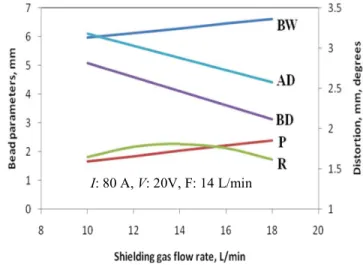
From Fig. 10, it is observed that, an increase in shielding gas flow rate ( ) results in increase in bead width and penetration. When the shielding gas velocity increases the surface flow of liquid sets up an outward current resulting in wider and deeper penetration. It is found from the figure that, is not significantly affected by the .
Literature reveals that, the heat input increases with increase in the regardless of the shielding gas [25].Further more, the number of CO2 molecules
increase with the increase in shieling gas flow rate and results in rise in heat input due to recombination of dissociated carbon monoxide and oxygen at the arc temperature [26]. The shielding gas spreads wider on leaving from the nozzle due to increase in . There is high probability of recombination at comparatively cooler regions of the arc.
The aforesaid discussions are explained with the help of bead profiles presented in Fig. 11. Trials F06 and F14 are welded with 12 l/min and 16 l/min CO2 result in bead width of 6.32 mm and 8.08 mm shown in Figs. 11(a) and
(b) respectively. The bead width and penetration of the trials F02 and F10 welded with 12 l/min and 16 l/min are 5.02 mm, 6.83 mm respectively and presented in Table 3. From Table 3, it is observed that, the trials F01 and F09 welded with 12 l/min and 16 l/min resut in 4.93 mm and 5.81 mm respectively. Table 3 indicates the same trend for the trials F23 and F24 welded with different flow rate. From these datas it is inferred that, the bead width increases with increase in flow rate.
However, Fig.11, depicts that, an increase in the flow rate results in decrease in BD. It could be attributed to the fact that, as the increases, the velocity of the shielding gas increases resulting in increase in penetration. When penetration increases the sheets are pulled at the root counteracting the effect of weld face shrinkage.
. ' " $ '
Role of FCA Welding Process Parameters on Bead Profile, Angular and .
" $
* # + 3 + 4
The trials F06 and F14 are result in 2.5 mm and 3.3 mm penetration respectively and presented in Table 3. From the Table 3, it is observed that, the trials F14 welded with higher (16 l/min) results in decrease in the BD (1.5 mm) and AD (4°) due to increase in the .
Furthermore it is also stated that, the intensity of the gas stream in shielded metal arc welding increases with coating thickness, such that heavily coated electrodes may be used for cutting metal. This conclusion holds good for the sheets welded with higher . It is also concluded that, the shape of the weld pool is to some degree dependent on gas flow in the arc column and such flow generates a pool that is deep relative to the width [27].
1
$
$
'
2
"
$
From the bead profile it is observed that, the specimen welded with low voltage (i.e., 18 V) result in higher convexity and reduced back width and another specimen welded with high current (i.e., 100 A) result in excessive penetration. Hence to optimize process parameters that give better bead profile current and voltages are selected as 70 to 90 & 20 to 22 respectively. To minimize cost the gas flow rate is restricted to 10 l/min and to improve productivity travel speed is selected between 5 to 7 mm/s. FCAW process optimization was carried out subject to the above constraints. When the objective function for distortion is most favorable the following set of process parameters are obtained and given in Table 5. The most favorable bead is shown in Fig. 12.
9 $ $
9 !
The role of FCAW process parameters such as , , and on bead profile, angular and bowing distortion of 2 mm thick AISI 409M ferritic stainless steel welded plates was studied with the help of mathematical models. The main conclusions derived from the investigation are given below
The measurement of bowing and angular distortion using profile tracer and Vernier bevel protractor is simple and reliable.
A critical analysis of the results from this study with those published in the literature indicates that the increases in bead width result in increase in bowing and angular distortion. However, the bowing distortion decreases with increase in root penetration.
A weld made with welding voltage, current and travel speed maintained in the range of 20 22 V, 80 90 A and 5 to 7 mm/s respectively shall have desirable bead shape and recommended for production.
4
1. American Welding Society (2008). (5th ed.).
AWS, USA.
2. Masubuchi, K. (1980) !
! " . New York: Pergamon Press.
3. Huang, H. Y. (2009). Effect of shielding gas composition and active flux on
GTAW weldments. # $ , 30(7)(2404 2409.
4. Son, K.J.; Yang, Y.S.; and Beom, H.G. (2000). Analysis of angular distortion in weldments using laminated plate theory. %
& , 5(4), 245 249.
5. Pavlovsky, V.I.; and Masubuchi, K. (1994). Research in the U.S.S.R. on residual stresses and distortion in welded structures.
' ( 338, 44 48.
$ 2
$ %
$ Min. Max.
# ! A 60 90 80
# mm/ s 5 7 6
# 3 V 20 24 20
+ l/min 10 12 10
, 0
"# $ 4 ' ' "' "# $ 4 ' ' "'
Role of FCA Welding Process Parameters on Bead Profile, Angular and .
6. Park, J. U.; Lee, H. W.; and Bang, H. S. (2002). Effects of mechanical constraints on angular distortion of welding joints”. %
& , 7(4), 232 239.
7. Michaleris, P.; and De Biccari, A. (1997). Prediction of welding distortion. & , 76, 172 s 180 s.
8. Esme, U.; Bayramoglu, M.; Kazancoglu, Y.; and Ozgun S. (2009). Optimization of weld bead geometry in TIG welding process using grey relation analysis and Taguchi method. # % y, 43(3), 143 149.
9. Juang, S.C.; and Tarng, Y.S. (2002). Process parameters selection for optimizing the weld pool geometry in the tungsten inert gas welding of
stainless steel. & # % , 122(1), 33 37.
10. Raj, B.; Shankar, V.; and Bhaduri, A.K. (2006). % ) . Alpha Science International Ltd, Reprint Edition. 11. Kou, S. (2002). # (2nd ed.). Wiley Interscience.
12. Tsai, C.L.; Park, S.C.; and Cheng, W.T. (1999). Welding distortion of a thin plate panel structure. & , 78(5), 157s 165s.
13. Vinokurov, V.A. (2002). . United Kingdom:
Wetherby British Library.
14. Liu, C.; and Zhang, J.X. (2010). Numerical simulation of transient welding angular distortion with external restraints. %
& , 14(1), 26 31.
15. Huang, H. Y. (2010). Argon hydrogen shielding gas mixtures for activating
flux assisted gas tungsten arc welding. # #
% , 41(11), 2829 2835.
16. Pal, K.; Bhattacharya, S.; and Pal, S.K. (2010). Multisensor based monitoring of weld deposition and plate distortion for various torch angles in
pulsed MIG welding. & #
% , 50(5 8), 543 556.
17. Marya, M.; Edward, G.R.; and Liu, S. (2004). An investigation on the effects of gases in GTA welding of a Wrought AZ80 magnesium alloy.
& , 83(7), 203s 212s.
18. Pal, S.; Malviya, S.K.; Pal, S.K.; and Samantaray, A.K. (2009). Optimization of quality characteristics parameters in a pulsed metal inert gas welding process using grey based Taguchi method. &
# % , 44(11 12), 1250 1260.
19. Dye, D.; Hunziker, O.; Roberts, S.M.; and Reed, R.C. (2001). Modeling of the mechanical effects induced by the tungsten inert gas welding of the IN718
Super alloy. # # % , 32(7), 1713 1725.
20. Parmar, R.S. (2008). . New Delhi:
Khanna Publishers.
21. Mandal, A.; and Pamar, R.S. (1997). Effect of process variables and angular distortion of pulse gas metal arc welded HSLA plates.
22. Murugan, V.V.; and Gunaraj, V. (2005). Effect of process parameters on angular distortion of gas metal arc welded structural steel plates.
& , 11, 165s 171s.
23. Kannan, T.; and Murugan, N. (2006). Effect of flux cored arc welding process parameters on duplex stainless steel clad quality. &
# % , 176(1 3), 230 239.
24. Mostafa, N.B.; and Khajavi, M.N. (2006). Optimization of welding parameters for weld penetration in FCAW. &
# # ) , 16(1 2), 132 138.
25. Norio, K.; Shogo, T.; and Kunimasa, T. (2004). Effect of shielding gas on welding distortion of laser welded aluminum alloy sheet. #
) , 52(2), 217 222. University of Fukui, Japan.
26. Banerjee, R. (2005). The role of gases in welding and cutting processes* & , 38(3), 13 22.