determination of alKalinity and diSSoCiation
ConStantS of HigH Salinity WaterS: uSe of f5bC
titration funCtion.
Cavalcanti, B.F.1*, Agostinho, L.C.L.2 and Nascimento, L.2
1 Civil Engineering Department1- Federal University of Campina Grande – UFCG
E-mail: [email protected]
2 Federal University of Paraiba, Materials Department, João Pessoa, PB.
abstract: Measurements of parameters expressed in terms of carbonic species such as Alkali-nity and Acidity of saline waters do not analyze the influence of external parameters to the titration such as Total free and associated Carbonic Species Concentration, activity coefficient, ion pairing formation and Residual Liquid Junction Potential in pH measurements. This paper shows the development of F5BC titration function based on the titrations developed by Gran (1952) for the carbonate system of natural waters. For practical use, samples of saline waters from Pocinhos reservoir in Paraiba were submitted to titration and linear regression analysis. Results showed that F5BC involves F1x and F2x Gran functions determination, respectively, for Alkalinity and Acidity calculations without knowing “a priori” the endpoint of the titration. F5BC also allows the determination of the First and Second Apparent Dissociation Constant of the carbonate system of saline and high ionic strength waters.
Keywords: Saline waters; Alkalinity; Dissociation constants.
1. introduCtion
Surface waters and groundwaters in the Northeast semi – arid region of Brazil are clas-siied as high ionic strength waters. These waters exhibit excess of salt concentration, high hardness and are supersaturated with calcium carbonate, CaCO3.
Total carbonic species concentration, CT in saline waters is represented by the sum of the carbonate species such as carbonic gas, CO2, total bicarbonate (where T refers to total concentra-tions; i.e., free species and ion pairing or associa-ted species), HCO3T- and total carbonate (free and associated species), CO3
2-T. The system H2CO3* + HCO3
-T + CO3
2-T (where H2CO3* refers to the sum of carbonic acid and carbonic gas) is determined from pH electrometric measurement and from any
parameter deined in terms of the carbonic species [9]. In practice, it is dificult to measure CT and, hence, it is deined Total Alkalinity in order to de -termine all carbonic species.
Equations for Alkalinity and Acidity are as follows (in calcium carbonate scale, mg/LCa-CO3):
Alc = - H+ + HCO -3T+ CO
2-3T+ OHT
- (1)
Ac = H2CO3* + HCO -3T+ H
+ – OH T
- (2)
depends on CT and ionic matrix of the solution (ion pairing) and the irst dissociation constant must be known. The endpoint of titration known as the H2CO3* equivalence point, pHe1 varies with CT and pk”1 (where p refers to the negati-ve decimal logarithm). This point is ginegati-ven by (in molar scale):
[H+] = + [HCO
-3] T+ CO3
2-T+ OH
-T (3)
From the above proton balance equation Alkalinity is deined by equation (1) in molar sca -le as follows:
[Alk] = - [H+] + [HCO
-3] T+ CO3
2-T+ OH
-T (4) In fact, it is only necessary to know one mass parameter and pH to determine species con-centrations. The inverse is true: if two mass para-meters values are known, it is possible to determi-ne pH provided dissociation constants are known. In low ionic strength waters it can be as-sumed that molarity = molality = mole fraction. However, in high salinity waters these equalities cannot be made. In these waters, the determina-tion of single ion activity coeficients is a problem because thermodynamically it is not possible to measure single ion activity coeficients. A further factor affecting activities of ions in saline waters is the formation of ion pairs between opposite-ly charged ions in solution. These ion pairs may have zero or positive or negative charge. It also affects the ionic strength of solution and solubi-lity products. In general, most weak acid species (like the carbonate system) ion pair with the prin-cipal cations in high salinity waters; for instance, Mg2+,Ca2+, Na+ and K+. However, invariably weak acid concentrations are very much less than cation concentrations. Consequently, cation – weak acid ion pairing has negligible effect on cation con-centration but has a profound effect on weak acid concentrations.
Measured or observed pH in high salinity waters is also termed operational pH and is dei -ned as [3]:
pH = - log (H+) op = -logfH+op - log [H+] (5)
and fHop = κfH+ (6)
where κ = Residual Liquid Junction Poten-κ = Residual Liquid Junction Poten- = Residual Liquid Junction Poten-tial effect which has a constant value for a
particu-lar solution. This parameter is different from one and pH observed is no longer simply related to the molar concentration of hydrogen ion. Hence, pHop is different from true pH (pHt) of solution. The operational pH is linked to the true pH as fol-lows:
pHop = - logκfH+ [H+] = pHop – pκ (7)
Estimation of RLJP effects; i.e., determi-nation of κ requires the estimation of fH+ [3]. However, k” (RLJP) can be determined theoreti-cally and experimentally by applying the modiied Gran titration procedure [10]. Functions devel-oped by Gran in 1952 for the carbonate system of low ionic strength natural waters (ionic strength less than 0,1) allow to obtain with great accuracy the volume of strong acid added to the particu-lar equivalence point although it is not possible to know pH value of this point. For each of the three equivalence points two linear functions can be formulated. When the linear fraction of each plot is extrapolated to a function value equal to zero, the corresponding value of the strong base added is equal to the necessary volume to titrate back to the equivalence point under research. This is the way to determine Alkalinity and Acidity or one of its forms.
Function F5BC can be applied to saline waters in order to obtain the apparent dissociation constants which incorporate the effects of Re-sidual Liquid Junction Potential. Application of these constants for calculating saturation indexes of saline waters can determine quantitatively the amount of calcium carbonate precipitated (super-saturation) or dissolved (under(super-saturation). This determination allows the establishment of water treatment techniques to improve the water quality. Function F5BC also allows the determination of Acidity and Alkalinity of saline waters and incor-porates activities effects and ion pairing forma-tion.
2. tHeory
is applied initially in the pH region 9.0 ≤ pHop ≤ 9, 5 (where op refers to operational or measured pH value) and its development is given by:
notation
(i) Alkalinity and Acidity forms:
- Total Alkalinity or Alkalinity: Alk
- Bicarbonate or Phenolphthalein Alkalinity: AlcHCO3
- Total Acidity or Acidity: Ac
- Bicarbonate Acidity or CO2 Acidity: AcHCO3
(ii) Volumes:
- Volume of strong acid required to the bicar-bonate equivalence point or pHe2 (unknown
volume): v2, ml
- Volume of strong acid require to the H2CO3* equiva-lence point or pHe1 (unknown value) v1, ml
- Volume of strong base added to the carbonate equivalence point or pHe3: v3, ml
- Initial volume of the solution under investiga-tion: vo, ml
- Incremental volume of strong acid added: vx, ml
(iii) Titrants:
- Molar concentration of the strong acid added, HCl to pHe1 andpHe2: ca, mol. 1-1
- Molar concentration of strong base added to pH e3: cb, mol. 1-1
The development of F5BC function con-siders that initially in the pH range of titration, Acidity is given by:
[Ac] = v3cb / {vo + vx} = v3cb / vT (8)
At some point “x” in the pH range of ti-tration, Acidity and Bicarbonate Acidity are given by:
[Ac] x = {v3 - vx} cb /vT (9)
[AcHCO3] x = {v2 - vx} cb. / vT (10) In this pH range, equations deining Acidi -ty and Bicarbonate Acidi-ty are approximated to:
[Ac] x ≈ [HCO3-] (11)
[AcHCO3] x = - [CO32-] (12)
Substituting the above equations into equa-tions (9 and 10), respectively:
[CO32-] = {v
x - v2} cb / vT (13)
[HCO3-] = { v
3 - vx} cb / vT (14)
From the deinition of the second dissocia -tion constant of the carbonate system:
[HCO3-] / [CO 3
2-] = k’ 2 / (H
+) = {v
3 - vx} / {vx - v2} (15) For natural waters with low ionic strength (I ≤ 0, 10), the measured or observed pH is the real or true pH of the solution and F5BC function is given by:
10 pH {v
x- v2} = 1/ fH k’2 {v3 - vx} = F5BC (16a)
For high salinity waters, the effects of RLJP are taken into account and the observed pH is the pH read off from the pH – meter. In this case, function F5BC is deined as:
10pHop {v
x - v2} = 1/ fHop. k’2 {v3 - vx} = 1/ k’2op
{v3 - vx} = F5BC (16b)
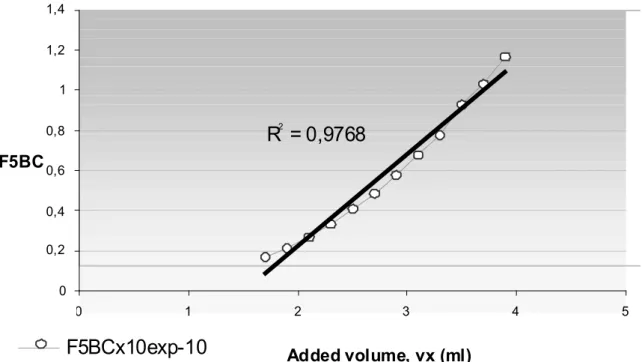
The plot of F5BC versus volume vx added shows a linear relationship with slope given by:
D5 = 1/k’2; D’5 = 1 / fHk’2; D”5 = 1/k’2a (17a)
where, k’2ap = second apparent dissociation cons-tant for saline waters.
The extrapolation of the F5BC function to the zero abscises axis gives vx = v3 (see Figure 1 below). Acidity is determined as follows:
R
2= 0,9768
0 0,2 0,4 0,6 0,8 1 1,2 1,4
0 1 2 3 4 5
Added volume, vx (ml)
F5BCx10exp-10
F5BC
figure 1. F5BC function versus volume of added titrant, ml. The apparatus used in the F5BC titration of test solution is shown in Figure 2 and are descri-bed as follows: A reactor consisting of a perspex cylinder of known volume. The cover of this re-actor is slightly concave to aid the removal of air bubbles prior to the commencement of the experi-ment. At the center of the cover is a long Perspex pressure regulating outlet tube with a diameter of 3 mm that has three functions: (i) it provides a means of removing air bubbles from the reactor prior to commencing a titration; (ii) it maintains a constant pressure within the reactor during a titration, and (iii) it minimizes the possibility of CO2 exchange between the test solution and the atmosphere. The cover of the reactor is itted also with three rubber sealed ringed apertures to loca-te (i) a dropping pipetloca-te feed from the piston bu-rette, (ii) a pH electrode and (iii) a thermometer. The head of the dropping pipette has a very ine aperture which is curved slightly to prevent acid diffusion during an experiment. The electrometric measurements are carried out with a digital high precision pH meter with an input impedance gre-ater than 10 12 ohm in combination with the solid state, drift free ampliier. The pH meter displays
Digital pH meter
Pressure regulating outlet
Water bath
Thermometer Thermostat
Piston burette Combined
electrode
Magnetic stirrer
figure 2. Apparatus used for the development of F5BC function.
3. f5bC appliCationS
3.1 – Selection of Samples
figure 3. Pocinhos reservoir located in the semi – arid region of Paraiba state in Brazil.
3.2 – experimental results
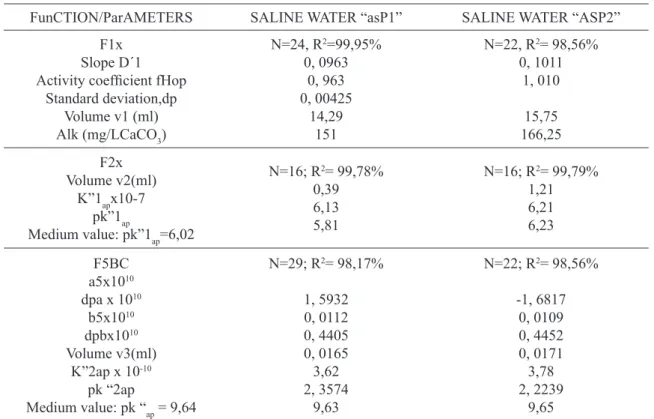
In the development of F5BC function are obtained some data of F1x and F2x modiied Gran functions that allows the determination of Alkali-nity and irst dissociation constant of the carbona -te sys-tem. Alkalinity is de-termined as follows:
For F1x = 0 then v1 = 14, 292 ml, the signiicance level is R2 = 0, 99954 for standard
deviation of 0, 00425; the operational activity coeficient for hydrogen is fHop = 0, 9630 and Alkalinity is Alk = 14, 292 x 0, 095/450. Therefo-re, Alkalinity is given by: Alk (AsP) = 3, 02 x 10-3 mol. l-1 or Alk = 151mg/L CaCO
3.
For this water, theoretical Alkalinity is 2, 324 x10-3 moles. L-1 or 116.20 mg/L CaCO
3. Simi-larly the Acidity of sample AsP is calculated from equation (18) by using the volume of strong base added to the carbonate equivalence point; i.e., vo-lume v3 (ml).
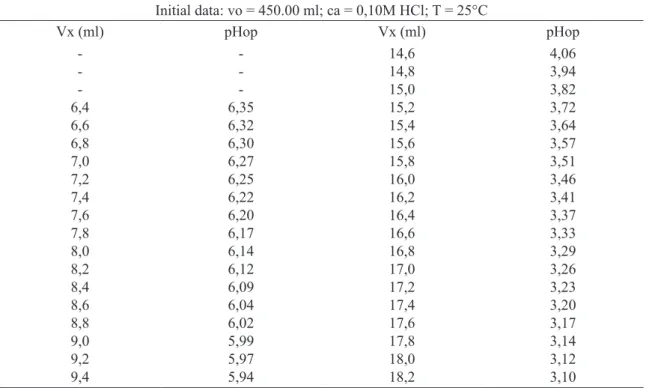
The second apparent dissociation constant for saline waters, k”2ap is obtained by applying F5BC function and mixed titration in the pH range
table 1. pH values obtained by titration with F5BC function in pH range 3.00 ≤ pHop ≤ 6,35 for saline water
asP1.
Initial data: vo = 450.00 ml; ca = 0,10M HCl; T = 25°C
Vx (ml) pHop Vx (ml) pHop
-6,4 6,6 6,8 7,0 7,2 7,4 7,6 7,8 8,0 8,2 8,4 8,6 8,8 9,0 9,2 9,4
-6,35 6,32 6,30 6,27 6,25 6,22 6,20 6,17 6,14 6,12 6,09 6,04 6,02 5,99 5,97 5,94
14,6 14,8 15,0 15,2 15,4 15,6 15,8 16,0 16,2 16,4 16,6 16,8 17,0 17,2 17,4 17,6 17,8 18,0 18,2
table 2. Parameters results used for determining Alkalinity and apparent dissociation constants of saline water from Pocinhos reservoir or asP sample.
FunCTION/ParAMETERS SALINE WATER “asP1” SALINE WATER “ASP2”
F1x Slope D´1
Activity coeficient fHop
Standard deviation,dp Volume v1 (ml) Alk (mg/LCaCO3)
N=24, R2=99,95% 0, 0963
0, 963 0, 00425
14,29 151
N=22, R2= 98,56% 0, 1011
1, 010
15,75 166,25
F2x Volume v2(ml)
K”1apx10-7 pk”1ap
Medium value: pk”1ap=6,02
N=16; R2= 99,78% 0,39 6,13 5,81
N=16; R2= 99,79% 1,21 6,21 6,23
F5BC a5x1010 dpa x 1010
b5x1010 dpbx1010 Volume v3(ml)
K”2ap x 10-10 pk “2ap
Medium value: pk “ap = 9,64
N=29; R2= 98,17%
1, 5932 0, 0112 0, 4405 0, 0165 3,62 2, 3574
9,63
N=22; R2= 98,56%
-1, 6817 0, 0109 0, 4452 0, 0171 3,78 2, 2239
9,65
N = number of data; R2= signiicance level; dp = standard deviation, k”1ap e k”2ap = irst and second apparent dissociation constant for saline waters, respectively.
4. diSCuSSion and ConCluSionS
The errors in the estimation of Alkalinity and Acidity or one of its forms are generally attri-buted to the following factors: i) The pH reading in the pH meter do not show when the inlexion point is achieved; (ii) Depending on the buffer ca-pacity of the titration endpoint, some small errors in the estimation of the equivalence point under investigation will give rise to severe errors in the measurements of parameters in aqueous phase.
Some external effects in the determina-tion of equivalence points of the carbonate sys-tem were analyzed by Loewenthal and Marais (1986) as follows: (a) Increase in ionic strength and temperature of the aqueous solution modify the bicarbonate equivalence point and the carbo-nate equivalence point. However do not affect the CO2 equivalence point; (b) Any change in some
carbonic species of the aqueous solution modiies also the Total Carbonate Species Concentration. This variation is negligible for pHe2. However, the pHe1 and pHe3 equivalence points are affec-ted. Consequently, when determining Alkalinity (pHe1 equivalence point) it is convenient to use a closed reactor to avoid changes in CT due to a possible increase in CO2 and (c) The exchange between CO2 and environmental air and ionic spe-cies in solution affects pHe1 causing a pH depres-sion due to loss of CO2. For pHe3 there will be absorption of CO2 and, hence, pH of the endpoint titration will be depressed. No effect is observed in pHe2.
Therefore for saline waters and hard waters the pHe1 endpoint will be strongly affected.
The use of F5BC function avoids this in-convenience. As to the estimation of dissociation constants, F5BC function has the advantage to in-clude the inluence of several factors such as Resi -dual Liquid Junction Potential in pH electrometric
measurements and electrometric measurement in terms of activity coeficients determination. This function also gives an accurate determination of the volume of strong base added to the equivalen-ce point under investigation although this point is not known.
resumo: Medições de parâmetros expressos em termos de espécies carbônicas tais como Alca-linidade e Acidez de águas Salinas não analisam a influencia de parâmetros externos tais como Concentração de Espécies Carbônicas livre e associada, formação de pares iônicos e Potencial de Residual de Junção Líquida em medições de pH. Este artigo mostra o desenvolvimento da função titulométrica F5BC com base nas titulações desenvolvidas por Gran (1952) para o sistema carbonatado de águas naturais. Para uso prático, amostras de água salina do açude de Pocinhos, PB foram submetidas à titulação e análise de regressão linear. Os resultados mostra -ram que a função F5BC compreende a determinação das funções tipo Gran F1x e F2x, respecti-vamente, para a obtenção de Alcalinidade e de Acidez sem conhecer “a priori” o ponto final da titulação. A função F5BC permite também a determinação da Primeira e da Segunda Constante Aparente de Dissociação do sistema carbonatado de águas salinas e de alta força iônica.
palavras – chave: águas Salinas; Alcalinidade; Constantes de Dissociação.
referenCeS
[1] APHA, Am. Publ. Health Assoc., Standard Methods for the Examination of Water and Wastewater, USA, 2000.
[2] Araújo, L.M.L., A Determinação da Alcalinidade Total de
águas Naturais a 25°C, M. Sc. Thesis, Federal University of Campina Grande, 1984.
[3] Cavalcanti, B. F., Residual Liquid Junction Potentials in Binary Chloride Systems, M.Sc. Thesis, University of Cape Town, South Africa , 1981.
[4] Cavalcanti, B.F., Influence of Temperature and Ionic Strength on the First Dissociation Constant of the Carbonic System in Natural Waters, I SIBESA, In: Anais ABES/ANDIS, Vol.2, Tomo I, RJ, 1992, .256 – 272.
[5] Friend, J.F.C. and Loewenthal, R.E., Chemical conditioning of low and medium salinity Waters, Stasoft Version 3, 0, Water Research Commission Report, Pretoria, 1992, 80p.
[6] Gran, G., Determination of the Equivalent Point in Potentiometric Titration, Part II, Analyst, V.77,1952, p.661 – 672.
[7] Laraque, A., Estudo e Previsão da Qualidade da água de Açudes no Nordeste Semi – árido Brasileiro, Relatório SUDENE/DPG/PRW, Convênio ORSTOM, SUDENE, Recife, PEE, 1989, 95p.
[8] Liesching, P, Loewenthal, R.E. and Marais, G.v.R., Ion Pairing Determination in High Salinity Waters, Water Research Report, UCT, South Africa, 1979.
[9] Loewenthal, R.E. and Marais, G.v.R., Carbonate Chemistry of Aquatic Systems: Theory and Application, Ann Arbor Science, Michigan, USA, 1976.
[10] Loewenthal, R.E., Wiechers, H.N.S. and Marais, G.v.R., Softening and Stabilization of Municipal Waters, Water Com. Report., Pretoria, South Africa, 1986.