Mauro António Moreira Guerra
M. Sc. in Physics EngineeringElectron Impact Ionization Cross
Sections and Analysis of X-ray Spectra
A thesis submitted for the degree of Ph. D. in Physics
Supervisor: Professor José Paulo Moreira dos Santos,
Associate Professor with Aggregation,
Physics Department
Examining Committee:
Chair: Dean of the New University of Lisbon External Examiner: Professor José Manuel Pires Marques
Internal Examiner: Professor Maria Adelaide de Almeida Pedro de Jesus
Other Members: Professor Fernando António de Freitas Costa Parente Doctor Paul Indelicato
Professor Joaquim Marques Ferreira dos Santos Professor Ana Maria Almeida e Costa
Electron Impact ionization Cross
Sections and Analysis of X-ray Spectra
Mauro Ant´
onio Moreira Guerra
Electron Impact ionization Cross Sections and Analysis of X-ray Spectra Copyright c2012 by Mauro A. M. Guerra, FCT/UNL and UNL.
All rights reserved.
Faculdade de Ciˆencias e Tecnologia and Universidade Nova de Lisboa have the perpetual right and with no geographic limitation, to archive and publish this dissertation using printed or digital copies, or by other known, or yet to be invented, method, and to divulge it through scientific repositories, and to admit its copy and distribution to educational or research proposes, not commercial, if the merit is attributed and
Acknowledgements
This work could not have been done without the greatly appreciated effort of several people, the first of which is my supervisor Prof. Jos´e Paulo dos Santos, who constantly encouraged and challenged me throughout my academic program, never accepting less than my best efforts. Thank you.
To Doctor Paul Indelicato I express my sincere gratitude for welcoming me at is group of the LKB in Paris. His scientific skills as well as his human qualities will forever be an example. I would also like to acknowledge Doctor Csilla Szabo for the immense help in reviewing my thesis and for making my stay in Paris as enjoyable as possible. To Dr. Alexandre Vallette and Dr. Martino Trassinelli for, not only, the great physics discussions but also for being my rock climbing partners in France. To the rest of the LKB group with whom I had the pleasure of doing science, Dr. Alexandre Gumberidze, Dr. Eric Olivier Le-Bigot and Dr. Stephane Boucard.
Aos meus colegas de curso que se tornaram em grandes amigos, Doutor Rui Pinto pela sua maneira de ver o mundo e pelos excelentes conselhos, Doutora Diana Guimar˜aes por me mostrar que a for¸ca de vontade supera qualquer obst´aculo, ao Doutor Pedro Amaro pelas excelentes discuss˜oes cient´ıficas e pela ajuda ao longo deste trabalho. Ao Doutor Rodrigo An-tunes pela maneira feliz como me faz olhar para a vida e ao Diogo pelas excelentes discuss˜oes filos´oficas que me fazem muitas vezes rever as minhas prioridades.
Por ´ultimo, embora n˜ao com menos peso, as pessoas mais importantes na minha vida pessoal, aos meus pais, sem os quais nunca teria conhecido o doce sabor da vida e de tudo o que cont´em. Ao Ant´onio e `a Gra¸ca por me terem sempre tratado como um filho e aos meus irm˜aos por todo o carinho que me d˜ao. Principalmente a ti, Mafalda, por todos os momentos felizes que j´a pass´amos e pelos que ainda vir˜ao.
Abstract
Knowledge of ionization and excitation cross sections is of fundamental importance for un-derstanding collision-dynamics and electron-atom interactions, as well as in several applied fields such as radiation science, astrophysics and plasma physics. These areas of study need enormous and continuous quantities of data, within a certain accuracy level, for different targets over a wide range of energy values. Plasma diagnosis is a particular field in which analytical expressions for electron impact ionization cross sections are welcome.
In the first part of this thesis, we have derived new expressions for the analytical calcu-lation of ionization cross sections by electron impact based on the binary encounter Bethe (BEB) model, valid from ionization threshold up to relativistic energies. The new modified binary-encounter Bethe model (MBEB), and its relativistic counterpart (MRBEB) expres-sions are simpler than the BEB (nonrelativistic and relativistic) expresexpres-sions because they require only one atomic parameter, namely the binding energy of the electrons to be ionized, and use only one scaling term for the ionization of all sub-shells of neutral atoms and ions.
The new models are used to calculate the K-, L- and M-shell ionization cross sections by electron impact for several atoms withZ from 6 to 83, as well as direct electron impact ion-ization cross sections for several ionion-ization stages of Kr, Ar and Fe. Excitation-autoionion-ization cross sections were evaluated using the First Order Many Body Theory (FOMBT) for Kr+, Kr5+, Kr6+, Kr10+, Kr15+and Kr17+. Our results were compared to configuration-averaged
distorted-wave (CADW) calculations, the widely used Lotz formula and available experimen-tal results. Direct ionization cross sections for the Ar and Fe isonuclear series were also calculated with the goal of assessing the versatility of the MRBEB model for computing electron impact ionization cross sections of species that are usually present in plasmas of any type.
In the second part of this thesis, Ar plasmas, generated in electron-cyclotron-resonance ion-sources (ECRIS), are used to performstate-of-the-art highly charged ions X-ray transi-tion energy measurements with a double-crystal-spectrometer (DCS). Such a spectrometer, used for the first time on a highly charged ion transition, provides absolute (reference-free) measurements in the X-ray domain. From this measurements we were able to extract use-ful information about the plasma conditions inside the ECRIS chamber, such as the ionic temperatures, charge-state-distribution and electronic densities.
The measurement of the relativistic magnetic dipole transition, 1s2s 3S
1 → 1s2 1S0,
in He-like Ar has been performed and a transition energy of 3104.1605(78) eV was found, which corresponds to an accuracy of 2.5 ppm. This value is the most accurate, reference-free measurement done for such a transition and is in good agreement with recent QED predictions. From the DCS measurements, we were also able to probe the natural width of several lines. The natural width of the diagram line 1s2p 1P1 → 1s2 1S0 is found to be
79.08±10.40 meV which corroborates the theoretical value of 70.4 meV.
with our MRBEB model. For this purpose, a wide scan containing several transitions of the highly charged Ar ions has been done, and an iterative process using balance equations of the plasma species was used to obtain the charge-state-distribution.
Resumo
O conhecimento dos valores das sec¸c˜oes eficazes de ioniza¸c˜ao e excita¸c˜ao ´e de uma importˆancia fundamental no estudo de colis˜oes at´omicas e interac¸c˜oes electr˜ao-´atomo, bem como em diversos campos de f´ısica aplicada tal como ciˆencia da radia¸c˜ao, astrof´ısica e f´ısica dos plasmas. Estas ´areas de estudo necessitam de quantidades enormes e num espectro cont´ınuo de dados de sec¸c˜oes eficazes, dentro de um certo n´ıvel de precis˜ao, para diversos alvos dentro de uma gama de energias bastante alargada. O diagn´ostico de plasmas ´e um campo particular em que express˜oes anal´ıticas para o c´alculo de sec¸c˜oes eficazes de ioniza¸c˜ao por impacto electr´onico s˜ao bem recebidas.
Na primeira parte desta tese, foram derivadas novas express˜oes para o c´alculo anal´ıtico de sec¸c˜oes eficazes de ioniza¸c˜ao por impacto electr´onico, baseadas no modelo do encontro bin´ario de Bethe (BEB), que s˜ao v´alidas desde o limiar de ioniza¸c˜ao at´e energias relativistas. O novo modelo do encontro bin´ario de Bethe modificado (MBEB) e a sua vers˜ao relativista (MRBEB) utiliza express˜oes que s˜ao mais simples do que as do modelo BEB (relativista e n˜ao-relativista), porque requerem apenas um parˆametro at´omico, nomeadamente a energia de liga¸c˜ao dos electr˜oes que ser˜ao ionizados, e utilizam apenas um factor de escala para a ioniza¸c˜ao de qualquer camada electr´onica de ´atomos neutros ou i˜oes.
Os novos modelos foram usados para calcular sec¸c˜oes eficazes de ioniza¸c˜ao para as camadas K, L e M para diversos ´atomos com n´umero at´omicoZentre 6 e 83, bem como sec¸c˜oes eficazes de ioniza¸c˜ao directa para diversos estados de carga de i˜oes de Kr, Ar e Fe. Sec¸c˜oes eficazes de excita¸c˜ao-autoioniza¸c˜ao foram calculadas usando a teoria de muitos corpos em primeira ordem (FOMBT) para os i˜oes Kr+, Kr5+, Kr6+, Kr10+, Kr15+ e Kr17+. Os nossos resultados foram comparados com c´alculos de configura¸c˜ao m´edia de ondas distorcidas (CADW), com a recorrentemente utilizada f´ormula de Lotz e resultados experimentais dispon´ıveis. Sec¸c˜oes eficazes de ioniza¸c˜ao directa para as s´eries isonucleares de Ar e Fe tamb´em foram calculadas com o objectivo de estudar a versatilidade do modelo MRBEB no c´alculo de sec¸c˜oes eficazes de ioniza¸c˜ao de esp´ecies que usualmente est˜ao presentes em plasmas de todos os tipos.
Na segunda parte desta tese, plasmas de argon gerados em fontes de i˜oes de ressonˆancia de electr˜oes em ciclotr˜ao (ECRIS), foram usados para medir energias de transi¸c˜ao em i˜oes altamente carregados com um espectr´ometroestado-da-arte de duplo cristal (DCS). Este es-pectr´ometro, usado pela primeira vez numa transi¸c˜ao de um i˜ao altamente carregado, provi-dencia medidas absolutas (sem referˆencia a outras linhas) no dom´ınio da radia¸c˜ao X. Destas medi¸c˜oes consegu´ımos extrair informa¸c˜ao ´util acerca das condi¸c˜oes do plasma no interior da cˆamara do ECRIS, tal como a temperatura dos i˜oes, a distribui¸c˜ao de estados de carga e a densidade electr´onica.
A medi¸c˜ao da transi¸c˜ao dipolar magn´etica relativista, 1s2s 3S1 → 1s2 1S0, em i˜oes de
intr´ınseca de v´arias linhas. A largura intr´ınseca da linha 1s2p 1S
1 → 1s2 1S0 obtida foi de
79.08±10.40 meV o que est´a de acordo com o valor te´orico de 70.4 meV.
A distribui¸c˜ao de estados de carga dos i˜oes de Ar dentro do plasma foi calculada com o uso das sec¸c˜oes eficazes de ioniza¸c˜ao obtidas na primeira parte da tese com o modelo MRBEB. Para este prop´osito, um espectro largo, contendo v´arias transi¸c˜oes dos i˜oes de argon alta-mente carregados, foi obtido experimentalalta-mente, e atrav´es de um processo iterativo, usando equa¸c˜oes de balan¸co de esp´ecies no plasma, a distribui¸c˜ao de estados de carga do plasma foi obtida.
List of Publications and Manuscripts
The work performed in this thesis gave origin to the following list of published articles and manuscripts for publication.
• M. Guerra, F. Parente and J. P. Santos, Electron impact ionization of atomic target inner-shells, Journal of Physics: Conference Series, Volume194, Number 4, p.042047, (2009),
• J. P. Santos, M. Guerra and F. Parente, New expression for the K-shell ionization, Journal of Physics: Conference Series, 388, 042047, (2012),
• P. Amaro, S. Schlesser, M. Guerra, E. O. Le Bigot, J. M. Isac, P. Travers, J. P. Santos, C. I. Szabo, A. Gumberidze and P. Indelicato, Absolute measurement of the ”relativis-tic M1” transition energy in heliumlike argon. Physical Review Letters 109, 043005, (2012).
• M. Guerra, F. Parente, P. Indelicato and J. P. Santos,Modified binary encounter Bethe model for electron-impact ionization, International Journal of Mass Spectrometry, Vol-ume 313, Number 1, p.1-7, (2012)
• C. I. Szabo, P. Indelicato, E.-O. LeBigot, A. Vallette, P. Amaro, M. Guerra and A. Gumberidze, Progress on Precision Measurements of Inner Shell Transitions in Highly Charged Ions at an ECR Ion Source, Proceedings of the 17th International Conference on Atomic Processes in Plasmas, 19-22 July 2011, Queen’s University, Belfast, AIP Conference Proceedings 1438, 236-239 (2012)
• P. Amaro, C. I. Szabo, S. Schlesser, A. Gumberidze, E. G. Kessler, Jr, A. Henins, E.O. Le Bigot, M. Trassinelli, Jean-Michel Isac, Pascal Travers, M. Guerra, J. P. Santos and Paul Indelicato,A vacuum double-crystal spectrometer for reference-free highly charged ions X-ray spectroscopy, Rad. Phys. Chem.,Accepted(2012) arXiv:1205.4520v1 [physics.atom-ph]
• M. Guerra, F. Parente and J. P. Santos, Electron impact ionization cross sections of several ionization stages of Kr, Ar and Fe, International Journal of Mass Spectrometry, Submitted (2012).
• C. I. Szabo, S. Schlesser, P. Amaro, M. Guerra, E.-O.L. Bigot, J.-P. Santos, A. Gum-beridze and P. Indelicato, Measurement of the Natural Width of Transitions in He-like and Be-like Argon, Phys. Rev. A.,In Preparation, (2012).
Contents
Page
Acknowledgements iii
Abstract / Resumo v
Publications iii
Contents v
List of Figures ix
List of Tables xi
List of Acronyms xiii
Part I – Electron impact ionization cross sections 1
1 Introduction 3
1.1 Goals and Motivation . . . 3
1.2 Electron Impact Cross Sections . . . 4
1.2.1 Overview of the approximations used in atomic collisions . . . 4
1.2.1.1 The Born approximation . . . 5
1.2.1.2 The Bethe approximation (BeA) . . . 5
1.2.1.3 The Coulomb-Born approximation (CBA) . . . 5
1.2.1.4 Born approximation with exchange (BAE) . . . 5
1.2.1.5 The sudden approximation (SA) . . . 6
1.2.1.6 The Binary Encounter Approximation (BEA) . . . 6
1.2.1.7 The distorted wave approximation (DWA) . . . 6
1.2.1.8 Close-Coupling approximation (CCA) . . . 6
1.2.1.9 The Pseudo-state approximation (PsA) . . . 7
1.2.1.10 The R-Matrix method . . . 7
1.3 Thesis Outlook . . . 8
2 Scattering Cross Sections 9 2.1 Rutherford scattering . . . 9
2.2 Scattering of like-particles . . . 12
2.2.1 Coulomb scattering of like-particles . . . 13
Contents
2.4 Binary encounter (BE) theory . . . 14
2.5 Binary encounter dipole (BED) model . . . 16
2.6 Binary encounter Bethe (BEB) model . . . 19
2.7 Relativistic binary encounter Bethe (RBEB) model . . . 21
2.8 Considerations on the binary encounter Bethe models . . . 22
3 Scaling Rules of Binary Encounter Cross Sections 25 3.1 Scaling factors of the BEB model . . . 25
3.2 X-Type scaling . . . 27
3.2.1 Binary encounter ionization region . . . 29
3.3 Modified binary encounter Bethe (MBEB) model . . . 32
4 Results 35 4.1 Electron impact ionization of inner-shells . . . 35
4.1.1 K-shell ionization . . . 35
4.1.2 L- and M-shell ionization . . . 38
4.2 Electron impact total ionization of highly charged ions . . . 38
4.2.1 Kr isonuclear series . . . 41
4.2.2 Ar isonuclear series . . . 42
4.2.3 Fe isonuclear series . . . 42
5 Conclusions 51 5.1 Conclusions . . . 51
Part II – X-ray spectroscopy of an electron-cyclotron-resonance ion-source Ar plasma 53 6 Experimental Aparattus 55 6.1 Goals and Motivation . . . 55
6.2 Electron-Cyclotron-Resonance Ion-Source (ECRIS) . . . 56
6.3 Double Crystal Spectrometer (DCS) . . . 59
6.3.1 X-ray input . . . 61
6.3.2 Crystal diffraction . . . 63
6.3.3 X-ray detection . . . 64
6.4 Temperature Control . . . 65
6.4.1 Temperature Miscalibration . . . 66
7 Radiative Transitions on He-Like Ar 69 7.1 Measurement of the ”‘Relativistic M1”’ Transition Energy in He-like Ar . . 69
7.2 Line Widths of Transitions in Heliumlike Argon . . . 71
7.2.1 Doppler Broadening of the Ar ions in the ECRIS Plasma . . . 74
7.2.2 Measurement of the He-like Diagram Line 1s2p1P1 →1s2 1S0 Spectral Width . . . 75
8 Analysis of an Ar X-ray spectrum from an ECRIS plasma 77 8.1 X-ray spectrum from an Ar plasma . . . 77
8.2 Processes of Creation and Decay of Highly Excited States in an ECRIS . . 77
Electron Impact ionization Cross Sections and Analysis of X-ray Spectra
8.3 Distribution of Electron Energies in the Plasma . . . 78
8.3.1 Gauss-Laguerre integration . . . 79
8.3.1.1 Maxwell distribution . . . 79
8.3.1.2 Non-Maxwell distribution . . . 80
8.3.2 Electron Impact Ionization . . . 81
8.3.2.1 Electron Impact Single Ionization . . . 81
8.3.2.2 Electron Impact Multiple Ionization . . . 81
8.3.3 Electron Impact Excitation . . . 82
8.4 Calculation of Line Intensities . . . 83
8.5 Analysis of an Ar Plasma with the DCS . . . 84
8.5.1 DCS Wide Spectrum . . . 85
8.5.2 Interpretation of the X-ray Spectrum Emitted by Ar ions in an ECRIS plasma . . . 85
9 Conclusions 91 9.1 Conclusions . . . 91
Bibliography 93
List of Figures
Page
Figure 2.1 Kinetic energy diagram for a free and bound electron collision . . . 15
Figure 2.2 Vriens Φ function . . . 16
Figure 2.3 Relative difference between the BEBV and BEB models . . . 21
Figure 2.4 Role of the approximations performed in BEB theory . . . 23
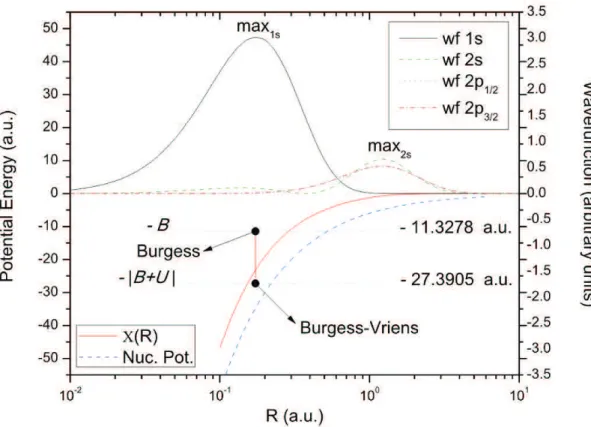
Figure 3.1 Effective potential,X(R), for carbon . . . 29
Figure 3.2 X andRK parameters for K-shell ionization . . . 30
Figure 3.3 Binary encounter region. . . 31
Figure 3.4 Coefficient of the 1s term . . . 32
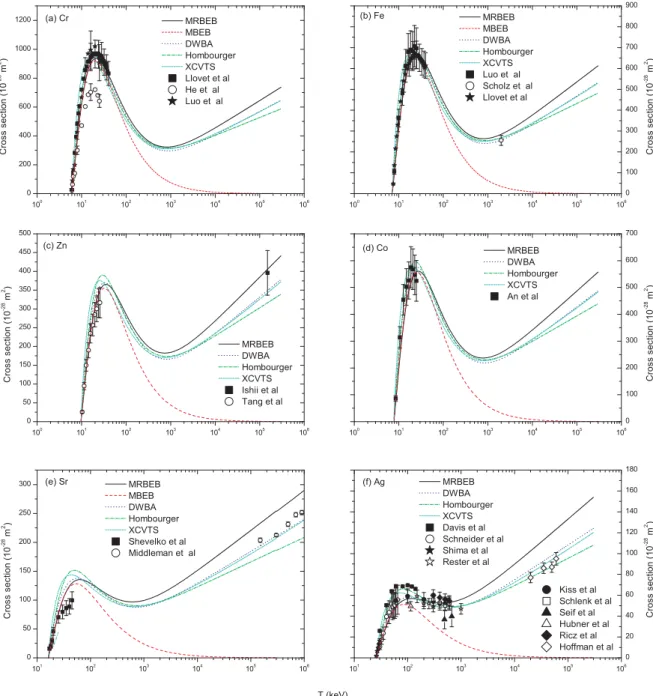
Figure 4.1 K-shell cross sections for C, Ne, Si, Sc, Ti and V . . . 43
Figure 4.2 K-shell cross sections for Cr, Fe, Zn, Co, Sr and Ag . . . 44
Figure 4.3 L-shell cross sections for Se, Kr, Ag, Sb, Xe and Ba . . . 45
Figure 4.4 M-shell cross sections for Pb and Bi . . . 46
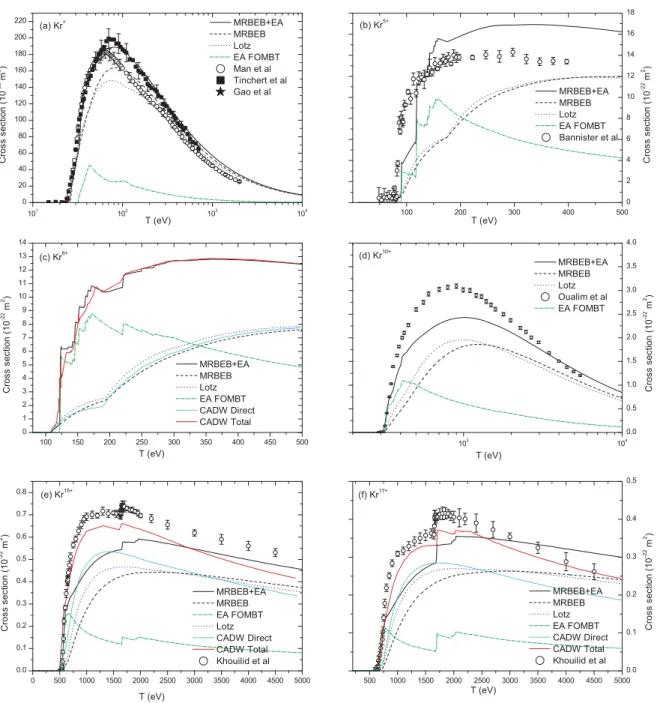
Figure 4.5 Total electron impact cross sections of Kr ions . . . 47
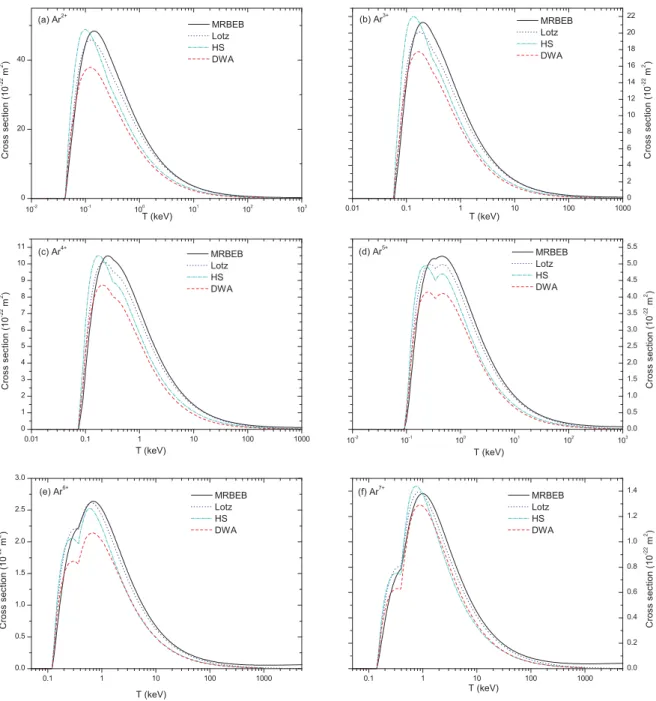
Figure 4.6 Total direct electron impact cross sections of Ar ions . . . 48
Figure 4.7 Total direct electron impact cross sections of Fe ions . . . 49
Figure 6.1 Principle of a 10 GHz ECRIS. . . 57
Figure 6.2 Representation of the SIMPA ECRIS . . . 58
Figure 6.3 DCS representation of the two operating modes . . . 59
Figure 6.4 Top view illustration of a DCS . . . 60
Figure 6.5 DCS setup . . . 61
Figure 6.6 Distribution of Rays Reaching the First Crystal for a Given Wavelength . . 62
Figure 6.7 Intensity of the x rays Reaching the Detector for a Given Energy . . . 62
Figure 6.8 Reflectivity Profile of the Si(111) Crystals . . . 64
Figure 6.9 Self-Optimized Parameters Temperature Record . . . 65
Figure 6.10 Labview Front Panel of the DCS Measurement Control. . . 66
Figure 6.11 Front-to-back Measured Crystal Temperatures . . . 67
Figure 6.12 Front-to-back Measured Crystal Temperatures with Better Heat Conduction 68 Figure 6.13 Front-to-back Temperatures Calibration . . . 68
Figure 7.1 Experimental Parallel Spectrum. . . 70
Figure 7.2 Experimental AntiParallel Spectrum. . . 71
Figure 7.3 Measurements of theM1 Transition Energy. . . 73
Figure 7.4 ReducedχSquared as a Function of the Gaussian Width. . . 75
List of Figures
List of Tables
Page
Table 3.1 Qvalues for H, He and Ne . . . 26
Table 3.2 Scaling factors . . . 27
Table 4.1 K-, L- and M-shells binding energies . . . 36
Table 4.2 Ground state configurations and threshold energies for Kr ions . . . 40
Table 7.1 Contributions to the uncertainty of theM1 transition energy . . . 72
Table 7.2 Comparison Between Theoretical and Experimental Values for theM1 Transi-tion. . . 72
Table 7.3 Natural Widths of the Measured He-like Ar Diagram Line . . . 76
Table 8.1 Ionization Energies for theK, KLandKLLIonization of Ar . . . 82
Table 8.2 Transitions Included in the Theoretical Ar Plasma Spectrum . . . 88
List of Acronyms
CSD Charge State Distribution.
ECRIS Electron-Cyclotron-Resonance Ion-Source.
EIICS Electron-Impact Ionization Cross Sections.
BEB Binary-Encounter Bethe Model.
RBEB Relativistic Binary-Encounter Bethe Model.
XRF X-ray Fluorescence.
AES Auger Electron Spectroscopy.
EELS Electron Energy Loss Spectroscopy.
EPMA Electron Probe Microanalysis.
PWBA Plane-Wave Born Approximation.
CCC Convergent Close-Coupling Method.
BA Born Approximation.
BeA Bethe Approximation.
CBA Coulomb-Born Approximation.
BAE Born Approximation with Exchange.
SA Sudden Approximation.
DWA Distorted Wave Approximation.
CCA Close-Coupling Approximation.
PsA Pseudostate Approximation.
DCS Double Crystal Spectrometer.
QED Quantum Electrodynamics.
SDCS Singly Differential Cross Section
TICS Total Ionization Cross Section
List of Tables
BED Binary-Encounter Dipole Model.
BEQ Binary-Encounter Q Model.
BEBV Binary-Encounter Bethe-Vriens Model.
RPWBA Relativistic Plane-Wave Born Approximation.
MCDFGME Multiconfiguration Dirac-Fock General Matrix Elements.
MBEB Modified Binary-Encounter Bethe Model.
MRBEB Modified Relativistic Binary-Encounter Bethe Model.
DWBA Distorted Wave Born Approximation.
CADW Configuration-Averaged Distorted Wave.
FOMBT First Order Many-Body Theory.
HS Hydrogenic Scaling Model.
DI Direct Ionization.
EA Excitation-Autoionization.
SIMPA Source d’Ions Multicharg´es de Paris.
BSQED Bound-State Quantum Electrodynamics.
EBIT Electron Beam Ion Trap.
HCI Highly Charged Ions.
INSP Institut des NanoSciences de Paris.
PSI Paul Scherrer Institute.
FWHM Full Width at Half Maximum.
NIST National Institute of Standards and Technology.
Part I
Chapter
1
Introduction
1.1
Goals and Motivation
In the last decades, with the onset of fusion plasma physics, x-ray spectroscopy for plasma diagnostics has been a trendy topic, being thoroughly studied by several groups. One of the main problems in plasma diagnostics is the determination of the ion charge-state distribution (CSD) inside the plasma. The most used method for inferring the CSD is through extracted ion beam currents, but it is not very reliable because the extraction is optimized for a partic-ular charge state and also because the ions are extracted from the plasma edges, so it does not fully represents the CSD inside the plasma. Alternatively, the CSD could be obtained through the analysis of high-resolution x-ray spectra emitted from the plasma [1–4]. Similar processes for optical plasma diagnostics were reviewed in the work of Boffardet al. [5].
Theoretical methods for estimating the CSD inside the plasma have been developed by our group in the last decade, based on the work of Douyssetet al. [6] and K¨uchleret al. [7]. In 2001, a detailed analysis of K x-ray spectra emitted by Ar ions in an electron-cyclotron-resonance ion-source (ECRIS) plasma [8] was performed. That work showed that a correct analysis of these spectra calls for a detailed and careful examination of all excitation and ionization processes that could lead to the detected lines. In 2009 and 2010, an improved method was used to estimate the ion CSD in ECRIS through the analysis of x-ray emitted by Sulphur plasmas, and it was concluded that the role of single and multiple electron impact ionization is very important to reproduce all the features in the experimental x-ray spectra [9]. Also, a more realistic electron energy distribution was used. Since electrons in a ECRIS plasma are far from thermodynamical equilibrium, their energy distribution is highly non-Maxwellian and can be represented by two populations with different temperatures, instead of only one.
The main goal of the first part of this thesis is to obtain an analytical expression, free of adjustable parameters, that can calculate the electron-impact ionization cross sections (EIICS) for all the sub-shells of a wide range of elements of the periodic table in any charge state. Being one of the fundamental ingredients in the analysis of x-ray spectra, it is very important that the accuracy over a wide range of targets, such as inner- and outer-shells of neutral atoms and ions in all of the periodic table, is maintained within a reasonable accuracy range.
The choice for our starting point is a widely used expression, developed by Kim and Rudd [10] in 1994, that successfully combines the binary-encounter theory with the dipole interaction of the Bethe theory for fast incident electrons [11], and meets some of the above mentioned requirements.
Introduction
the target particle’s binding energy (B) and the target particle’s kinetic energy (U); generate direct ionization cross section curves for neutral atoms, which are reliable in intensity (± 20%) and shape, for many atomic systems, from the ionization threshold to a few keV in the incident energy [12, 13]. If its relativistic version (RBEB) [14] is considered the energy range stretches to thousands of keV [15] .
1.2
Electron Impact Cross Sections
Knowledge of ionization and excitation cross sections is of fundamental importance for under-standing collision-dynamics and electron-atom interactions, as well as in several applied fields such as radiation science, astrophysics, elemental analysis using x-ray fluorescence (XRF), Auger electron spectroscopy (AES), electron energy loss spectroscopy (EELS) and electron probe microanalysis (EPMA), and, as has been explained before, in plasma diagnostics. These areas of study need enormous and continuous quantities of data, within a certain accuracy level, for different targets over a wide range of energy values.
Electron impact ionization and excitation have been actively studied by many research groups since the 1920’s. Most of the work produced was based on classical collision theory, and several first principle theories were developed [11, 16–20]. The most important work in the field of electron-atom collision was made by Bethe (1930) who derived the correct form of the ionization cross section shape for high-energy collisions [11] using the plane-wave Born approximation (PWBA). Since then, several empirical and semi-empirical models have been proposed to describe electron impact ionization of atoms and molecules [21–26], and several reviews on them were published [27, 28].
All works can be divided into three types: those based on quantum mechanics, which have a far superior accuracy than their classical counterparts but at the cost of complexity; those based on classical mechanics, which give rise to much simpler expressions at the cost of accuracy; and semi-empirical ones, that are often based in the classical formulations. The simpler quantum mechanical models for electron impact ionization tend to fair better than the classical models for high energies, essentially because of the use of the Born approximation, although for collisions where the momentum transfer is large, the classical expressions seem to be better at describing the ionization. Empirical and semi-empirical models can be very simple to use, but the fact that the experimental cross sections are scarce for some elements and sub-shells does not make it easy to pinpoint the accuracy of such models for the entire range of targets. They are, however, a very good way to get an estimate of the cross sections for a fairly wide range of elements and sub-shells.
With the advance of quantum mechanical computational methods, some very sophisti-catedab initiotheories became available such as the convergent close coupling (CCC) [29, 30], the R-matrix method [31] and exterior complex scaling [32]. These calculations, however, are very time-consuming, limiting the domain of applicability of such models [29, 30, 33, 34].
In the last years, many analytical formulas have been developed to overcome these difficul-ties, some of them empirical [35–37] and others derived from first principles [10, 14, 38, 39]. Analytical expressions, derived from first principle are still widely used in all the fields of physics described above, even in a era where the large and steady increment in computa-tional power seem to consistently elevate numerical computations.
1.2.1 Overview of the approximations used in atomic collisions
Electron Impact ionization Cross Sections and Analysis of X-ray Spectra
starting point for the work developed in this thesis.
1.2.1.1 The Born approximation
The Born approximation (BA) usually refers to the first Born approximation. In this ap-proximation, the incident and scattered particles are described as plane waves that remain undistorted by the interaction. Only direct ionization is treated, and for electron impact, electron exchange and spin are not taken into account. No coupled equations are involved since the solution to the scattered amplitude is unique. The validity of the first Born approx-imation remains essentially for high velocity projectiles, but accurate cross sections can only be obtained if good quality wave functions for the stationary states of the of the colliding structures are available.
At low energies, the first Born approximation usually overestimates the scattering cross sections, however it may be used at very low impact energies provided that the interaction energy is too shallow to accommodate a bound state of the interacting system [40].
1.2.1.2 The Bethe approximation (BeA)
In the Bethe theory for the stopping power of fast projectiles [11], a slight modification of the Born approximation was performed, in which Bethe made an additional assumption that the product of the momentum transfer and the range of the interaction is small. In this way, the exponential term in the Born approximation for the scattered amplitude can be expanded, and the following integration carried out term by term.
Doing this leads to a series of terms that can be related to atomic transition moments (electric dipole, quadrupole, etc.). Bethe has shown that the soft collisions take place es-sentially through the dipole interaction between the incident particle and the target electron [10], so only the first term after integration can be used to account for soft collisions. This method is also called Bethe-Born approximation.
1.2.1.3 The Coulomb-Born approximation (CBA)
The Coulomb-Born approximation (CBA) is useful in describing collisions of electrons and ions with target ions, in which the Coulomb interaction of the projectile with the target nucleus can be important. The Born plane wave are replaced by Coulomb wave functions corresponding to the nuclear charge. For highly charged ions, the long range Coulomb inter-action is dominant, and all other interinter-actions may be treated as small perturbations. In this way, it is not expected to hold for collisions between electrons and neutral atoms. Comparing to the Born approximation, we usually get better results in electron-ion scattering with the Coulomb theory than in the Born approximation for electron-neutral scattering.
1.2.1.4 Born approximation with exchange (BAE)
In 1928, the first attempt to include exchange in the Born formalism was made by none other than J. R. Oppenheimer. He made the same basic assumptions as used in the Born approximation, but his method of calculating the exchange amplitude is less satisfactory than the Born method for direct scattering, in the sense that it sometimes leads to incorrect results, mainly because in the Born-Oppenheimer approximation [41] the initial and final states are not orthogonal. This results in the fact that the addition of any constant to the interaction potential gives a non-zero change in the exchange amplitude. The Born approximation tends to excessively overestimate the scattering cross sections.
Later, Bateset al., were able to develop a formulation that was correct to first order and that included the orthogonality between the initial and final states [41].
Introduction
Another improvement was made by V. I. Ochkur, who suggested that the exchange am-plitude should be regarded as an expansion in inverse powers of the impact energy, with the result of only the first term being retained since higher terms would cause the result to diverge at low impact energies. The Ochkur approximation to the exchange integral is a good approximation only at impact energies that are high enough for the integral to be small.
1.2.1.5 The sudden approximation (SA)
The sudden approximation (SA) was introduced by Enrico Fermi in 1936, and describes a many-body scattering problem in terms of two-body amplitudes, that are well known. This method rests on the assumption that, apart from having to determine a velocity distribution of the target electron, it plays no part in the scattering calculation. Another statement of the basic assumption is that the interaction occurs at a much shorter time than the orbital motion period of the target electron, or, in other words, the interaction is sudden. One would, therefore, expect the approximation to hold at energies much higher than the binding energy of the target particle being considered and/or the reduced wavelength of the relative motion of the projectile and target system is much smaller than the mean separation of the constituents of the target atom.
1.2.1.6 The Binary Encounter Approximation (BEA)
In the Binary Encounter Approximation (BEA), the incident and target electron’s interaction is treated as a billiard ball-like collision. A straightforward analytical expression for the scattering amplitude in this formalism can be easily derived from first principles. Exchange is included as in the Mott formalism [40, 42] and a velocity distribution for the target electron is assigned, unlike the Mott and Rutherford theories, which are only valid for collisions with free electrons at rest. The close or hard collisions are very well described by this theory as is expected, but the lack of a long range interaction results in soft or distant collisions that deviates from the expected Bethe-Born approximations. The predictions of near threshold cross sections are thus very good but the asymptotic behaviour does not have the correct form. The binary encounter approximation matches most of requirements in our goals, and thus will be our starting point for the construction of a reliable, analytical, parameter-free electron impact ionization model.
1.2.1.7 The distorted wave approximation (DWA)
The distorted wave approximation takes into account the distortion of the incident and scat-tered waves by the static field of the target. From the calculation of the excitation of an electron in the hydrogen atom, in a time-independent quantum mechanical calculation, one eventually arrives at an asymptotic solution that corresponds to a distorted wave with the asymptotic form of a plane wave and an outgoing spherical wave. The incoming wave is described by a plane wave and the scattered wave is represented by a distorted wave with the asymptotic behaviour of a spherical wave [43]. This approximation provides a very good compromise between computation time and accuracy, although for very high incident energies the size of the matrices involved result in a overcharge of computational resources even for state of the art machines.
1.2.1.8 Close-Coupling approximation (CCA)
In the close-coupling approximation, the wave function for the projectile and target system is expanded in terms of a complete set of eigenfunctions ψ0 of the target Hamiltonian. We
Electron Impact ionization Cross Sections and Analysis of X-ray Spectra
N-electron atom, we write
ψ(r1,r2) =
X
γ
Fγ(r1)ψ0(γ,r2), (1.1)
where r1 represents the spatial and spin coordinates of the the projectile and r2 the
coor-dinates of the atomic electrons. Any possible combination of the good quantum numbers is represented byγ.
The overall wave function must be antisymmetric, and the functions Fγ(r1) describe the
radial motion of the projectile relative to the target in its various quantum states. The close-coupling approximation allows us to retain only a small number of terms in the wave function expansion [Eq. (1.1)]. The number of terms retained depends on the number of allowed scattering channels. These channels are a function of the number of possible outcomes in a collision: elastic scattering, excitation, dissociation, charge transfer, and so on. The channels are said to be open if they are allowed by conservation laws, otherwise they are considered closed.
The radial part of the scattering wave functions satisfy a set ofM (M being the number of channels) integrodifferential equations of the form
d2
dr2 +k 2
i −
li(li+ 1)
r2
~2
2me
Fi(r) = M
X
j=1
Vij(r)Fj(r) +
Z ∞
0
Wij r, r′Fj r′dr′,
whereVij(r) is a direct electron-electron plus electron-nucleus potential, andWij(r, r′) is the
exchange term. Ther′
refers to the exchanged electron.
These closed-coupling equations can provide accurate cross sections if all of the target states lying close to the initial and final states are included in the expansion [Eq. (1.1)]. The slow convergence of the truncated expansions makes this method intractable at high impact energies, at which more states are available and more angular momenta become important. Also, if we try to use close-coupling to calculate scattering from excited states, the close spacing of the energy levels makes the procedure much more time-consuming. This method is, however, effectively exact in the prediction of the positions and shapes of threshold effects and resonances in low-energy collisions of electrons with ground-state atoms, contrary to the other methods mentioned above. This method is one of the most accurate way of calculating electron impact ionization cross sections, but only very simple systems can be completely studied with this formalism.
1.2.1.9 The Pseudo-state approximation (PsA)
As we have seen, computational difficulties increase rapidly with the number of target eigen-functions used in the close-coupling expansion; in practice, only a few of bound-states and continuum states are included. One method to overcome this difficult is to include in the wave function expansion some functionφnFn(r1) where φn is not a target eigenfunction but
a function representing an appropriate average of bound and continuum states. These states are thus not real, and for this reason they are called pseudo-states. Although there is no unique way to choose which pseudo-states to be used, some questions of normalization and orthogonality must be addressed. This pseudo-states can in turn introduce fictitious thresh-olds and resonances, and this artefacts can lead to inaccuracies in computed cross sections.
1.2.1.10 The R-Matrix method
TheRmatrix was introduced in nuclear physics by Wigner in 1946 [44, 45] and since has been developed by Burke, Noble and Schneider and subsequently widely used in atomic physics. A very good review can be seen in Ref. [46].
Introduction
The reactanceR matrix is related to the scatteringS matrix by the equation
S= (1 +iR) (1−iR)−1.
As expected, the R matrix is Hermitian, and if the potential describing the scattering is real, the elements Rij are real and the matrix is symmetric. This is why it is frequently
advantageous to work with R instead of the S matrix. Furthermore, any approximation to
R that preserves the symmetry of the matrix ensures that S is unitary and hence that the total number of particles in the system is conserved.
In this method, the configuration space is divided into two regions. For the scattering of electrons from an atom, one can exclude exchange outside some radius r0. Hence, ifr > r0,
the collision is described by coupled differential instead of integrodifferential equations that often have analytic solutions easily obtained. The basic problem is, then, to calculate theR
matrix elements in the internal region r > r0. The S matrix and cross section can then be
obtained from the R matrix trough the solution of the external region. The computational time required for such calculations compete with those of the DWA.
1.3
Thesis Outlook
After describing the main goals and motivations behind this thesis, a brief outlook of the organization of this work is in order. This thesis is comprised of two parts,
• Part I is entirely devoted to the formulation and subsequent testing of an analytical expression for the calculation of electron impact ionization cross sections. The deriva-tion of the key ingredients of the theory are presented and the role of the scaling laws for binary encounter theories is analysed. The modified expression is then compared to inner-shell ionization experimental and theoretical results as well as total ionization of highly charged ions.
Chapter
2
Scattering Cross Sections
2.1
Rutherford scattering
The scattering of charged particles has been under the scope of scientists since the begin-ning of last century. One of the first puzzling phenomena observed was the Geiger-Mardsen experiment, which lead to the development of the Rutherford model for scattering.
Scattering in a coulomb field is of particular interest for physicists that study charged particles interactions. In the case of a elastic colision we can use quantum mechanics to describe the scattering cross section and it will yield the same result as if we use classical physics.
When there is a fixed direction (in this case, the direction of the incident particle), Schroedinger’s equation can be solved by using a set of parabolic coordinates (ξ, η, φ).
The Schroedinger equation, withµas the reduced mass between the two colliding particles,
−~ 2
2µ∆ +V (r)
ψ=Eψ, (2.1)
becomes, if we set the potential as being of a Coulomb nature, V =−1r =−ξ+2η 4
ξ+η ∂ ∂ξ ξ∂ψ ∂ξ + ∂ ∂η η∂ψ ∂η + 1 ξη
∂2ψ ∂φ2 + 2
E+ 2 ξ+η
ψ= 0. (2.2)
Since the problem of the scattering of a particle in a central field is axially symmet-ric, and hence independent of the coordinate φ, we can write the particular solution of the Schroedinger’s equation as
ψ=ψ1(ξ)ψ2(η). (2.3)
Substituting Eq. (2.3) in (2.2), we obtain, after separation of variables
∂ ∂ξ
ξ∂ψ1(ξ) ∂ξ + 1 4k 2ξ −a
ψ1(ξ) = 0, (2.4)
∂ ∂η η∂ψ ∂η + 1 4k
2η−b
ψ2(η) = 0,
with the separation variables obeying the following relation
a+b= 1.
Scattering Cross Sections
will be the same for attractive fields, hence the scattering of positrons by electrons will have the same cross sections, in Rutherford’s theory, as the electron-electron case.
Now we shall find the solution of Schroedinger’s equation which, for larger (and negative z, since we are saying that the incident particle travels with the direction of the positivez), has the form of a plane wave
ψ≈eikz, −∞< z <0, r→ ∞,
corresponding to a particle travelling in the positive z-axis direction and very far away from the scattering center. In parabolic coordinates, this takes the form
ψ≈eik(ξ−η)/2, η→ ∞, ξ∈R.
One easy way to satisfy this condition will be to set
ψ1(ξ) =eikξ/2, (2.5)
and
ψ2(η)≈e−ikη/2. (2.6)
Substituting Eq. (2.5) in the first equation of the system (2.4), we observe that this function does indeed satisfy the equation, provided that a= 12ik. The second equation, with b= 1−a, will then become
∂ ∂η η∂ψ ∂η + 1 4k
2η−1 +1
2ik
ψ2(η) = 0.
Given the guess we made earlier forψ2(η), we shall seek the above equation’s solution in
the form
ψ2(η) =e−ikη/2w(η),
were the functionw(η) must tend to a constant asη→ ∞. The resulting differential equation will be
ηw′′+ (1−ikη)w′−w= 0, (2.7) which, introducing the new variableη1=ikη, can be reduced to the equation for a confluent
hypergeometric function with parameters α =−i/k, and γ = 1. We must choose the right solution of Eq. (2.7), so that the product of it byψ1(ξ) will only contain an outgoing spherical
wave. It can be written as (A being an arbitrary constant) w=A×F(−1/k,1, ikη).
Assembling the functions obtained and choosing a normalization constant such that the incident wave will have unit amplitude, we get the wavefunction [Eq. (2.3)], describing the scattering, as
ψ=e−π/2kΓ
1 + i k
eik(ξ−η)/2F
−1k,1, ikη
. (2.8)
For simplicity in calculating the cross section from the wave equation, we need to obtain the asymptotic behaviour of Eq. (2.8), and after changing to spherical polar coordinates, and some straightforward algebraic calculation, we have the final asymptotic expression for the wavefunction
ψ=
1 + 1 2k3r(1−cosθ)
eikz+(i/k) log(kr−krcosθ)+f(θ) r e
ikr−(i/k) log(2kr)
, (2.9)
with
f(θ) =− 1 2k2sin2 1
2θ
e(2i/k) log sinθ/2Γ (1 +i/k)
Electron Impact ionization Cross Sections and Analysis of X-ray Spectra
The first term in Eq. (2.9) represents the incident wave, and we can see that even at large distances, the wave is somewhat distorted, mainly because of the logarithmic term in the phase and the presence of the 1/rdependence in the amplitude.
Thus, bearing in mind that the effective scattering cross section can be calculated as dσ=|f(θ)|2dΩ, we get for the Rutherford cross section
dσ= dΩ 4k4sin4 1
2θ
,
or in ordinary units,
dσ= α 2mv2
2 dΩ
sin4 12θ, (2.11) where we have set the relative velocity of the particlesv=k~/m, andα is the fine-structure
constant. Expression (2.11) is the familiar Rutherford’s formula given by classical mechanics, as can be seen in the references [43] and [40].
Expressing Eq. (2.11) in a coordinate system in which one of the particles is at rest is very easy, since we know that for a collision between particles with the same mass, changing from the center of mass frame to the laboratory frame corresponds to changing fromθ→2ϑ. The element of solid angledΩ must be replaced by 4 cosϑdΩ in the new coordinate system. After algebraic manipulation, Eq. (2.11) becomes
dσ= α mv2
2 1
sin4ϑ,cosϑdΩ, (2.12) wherevis the relative velocity between the two electrons andm is the electron rest mass. At this point it is convenient to express the scattering angleϑin terms of the energy which the ejected electron has after the collision. As is well known, when a particle of kinetic energy T = 12mv2 collides with another of the same mass at rest, the energy with which the particles are left is
W =Tsin2ϑ, T−W =Tcos2ϑ, (2.13) where W stands for kinetic energy of the ejected electron. In order to solve Eq. (2.12) with respect to the energy of the ejected electron, we express dΩ in terms of dW by the relation cosϑdΩ = 2πsinϑcosϑdϑ = (Tπ)dW. Substituting in Eq. (2.12) and writing the fine-structure constantα as a function of the Bohr radius, we get the energy distribution of the ejected electron
dσ(W, T)
dW =
4πa20R2 T
1
W2. (2.14)
In Eq. (2.14), T is the non-relativistic relative kinetic energy of the incident electron,W is the kinetic energy of the ejected electron,a0 is the Bohr radius (a0 = 5.29×10⁻¹¹ m) and
R is the Rydberg energy (R = 13.6 eV). After inspection, we see that Eq. (2.14) diverges forW →0, although we know that for a real atom, the cross section for ejecting an electron withW = 0 is finite. To overcome this difficulty we can replace W by the energy transfer
E=W +B, (2.15)
whereB is the binding energy of the ejected electron. With this substitution, the Rutherford cross section becomes
dσ(W, T)
dW =
dσ dE =
4πa20N R2 T
1
E2, (2.16)
where we have inserted the number of bound electrons,N, in the sub-shell.
Scattering Cross Sections
2.2
Scattering of like-particles
In the case of electron-electron collision, which is the main subject in this part, the indistin-guishability of the colliding particles raise special considerations. As we know, this identity leads, in quantum mechanics, to the appearance of a peculiar exchange interaction between them. This has an important effect on scattering as described by Mott [42]. The orbital wave-function of a system with two like-particles must be symmetric or antisymmetric with respect to coordinate change, according to whether their total spin is even or odd [40]. The wavefunc-tion that describes the scattering, and which is obtained by solving the usual Schroedinger’s equation [Eq. (2.1)], must then be symmetrized or anti-symmetrized with respect to the particles. In this case, an interchange of the particles, corresponds to reversing the direction of the radius vector joining them, and in the coordinate system in which the center of mass is at rest, this is equivalent to changing the scattering angleθ toπ−θ(and hencez=rcosθ becomes−z). So, instead of the asymptotic expression, [Eq. (2.9)] we have
ψ≈eikz ±e−ikz+ e
ikr
r [f(θ)±f(π−θ)]. (2.17) It is impossible to distinguish the two electrons apart, so we can’t say which of them scatters and which is scattered, thus we now have two incident plane waves that propagate in opposite directions, and the outgoing spherical wave must take into account the scattering of both particles. The probability current calculated from it, must then result in the probability that either one of the particles will be scattered into the elementdΩ of solid angle considered. The effective cross section will be the ratio between this current and the current density of either of the incident plane waves. This results, as before, in the squared modulus of the eikrr term’s coefficient in the wave function [Eq. (2.17)].
If the total spin of the colliding particles is even (symmetric form), the effective cross section must take the form
dσ+=|f(θ) +f(π−θ)|2dΩ, (2.18) and if the spin is odd (antisymmetric form) it is
dσ−
=|f(θ)−f(π−θ)|2dΩ. (2.19) In classical mechanics, the probability that either particle would be scattered through a given solid angle dΩ would be just the sum of probabilities that one of them is deviated by an angleθ and the other by an angleπ−θ. In other words, the effective cross section would be
dσ=|f(θ)|2+|f(π−θ)|2dΩ. The appearance of the interference term, f(θ)f∗
(π−θ) +f∗
(θ)f(π−θ) characterizes the exchange interaction, and its nature is purely quantum mechanical.
In the symmetric [Eq. (2.18)] and antisymmetric [Eq. (2.19)] cross sections, one needs to know the definite value of the total spin but, usually, such information is not available. We must, then, average over all possible spin states to calculate the effective cross section assuming that all spin states are equally probable. It is well known that of the total number of spin states of a system with two particles with spin s (s being half-integral), s(s+ 1) states correspond to an even total spin, and (s+ 1) (2s+ 1) to an odd total spin (if s is integral the inverse applies). So, using the Lagrange definition of probability [40], we get that the probability that the system of two colliding, half-integral spin, particles will have an even total spinS iss/(2s+ 1) and the probability of oddS is (s+ 1)/(2s+ 1). Hence, the effective cross section will be
dσ±= s 2s+ 1dσ
++ s+ 1
2s+ 1dσ
−
Electron Impact ionization Cross Sections and Analysis of X-ray Spectra
Substituting Eqs. (2.19) and (2.18) on Eq. (2.20), we obtain
dσ±=
|f(θ)|2+|f(π−θ)|2− 1
2s+ 1[f(θ)f
∗
(π−θ) +f∗(θ)f(π−θ)]
dΩ. (2.21)
2.2.1 Coulomb scattering of like-particles
As an example we will obtain the formulas for electron-electron scattering. We know that the interaction between the two electrons is of a Coulomb nature, so if we insert the scattering amplitude, obtained for the Rutherford expression, [Eq. (2.10)],
f(θ) =− 1 2k2sin2 1
2θ
e−(2i/k) log sinθ/2Γ (1 +i/k)
Γ (1−i/k), (2.22) in Eq. (2.21), and sets= 12 we obtain
dσ±= e2 mv2 2 1 sin4 12θ+
1 cos4 1
2θ −
cose~2v log tan2 12θ
sin2 12θcos2 1 2θ
dΩ (2.23)
where,m and eis the electron’s mass and charge respectively,v is the electron’s velocity on the center of mass coordinate system and~is Plank’s constant divided by 2π. If we transform
the formula to a coordinate system in which one of the electrons is at rest, we obtain [40]
dσ±=
2e2 mv2
2
1 sin4ϑ+
1 cos4ϑ−
cose~2vlog tan
2ϑ
sin2ϑcos2ϑ
cosϑdΩ (2.24)
where the element of solid angle, dΩ = sinθ dθdφ was replaced by 4 cosϑsinϑ dϑdφ = 4 cosϑdΩ.
2.3
Mott cross section
Based on the derivation above, Mott has generalized the Rutherford cross section for the collision between two electrons, by taking exchange into account [40, 42]. As in the Rutherford expression [Eq. (2.14)], by solving the singly differential cross section (SDCS) to obtain the energy distribution of the ejected electron,W, we get
dσ(W, T)
dW =
4πa20R2 T
1 W2 −
Φ
W (T −W) + 1 (T −W)2
, (2.25)
where Φ is a function of E and T that lies is the [0,1] interval and approaches 1 for large values ofT, and is given by
Φ = cos "s
R T +B
ln T B # . (2.26)
As before,T is the non-relativistic kinetic energy of the incident electron and T−W is the kinetic energy of the scattered electron. The first term of Eq. (2.25) is the direct collision term as in the Rutherford formula, while the third term represents the exchange. The second term is the interference between the direct and exchange terms. Note that the Mott expression is symmetric in respect to the kinetic energies of the ejected electron W and the scattered electron T−W, as it was expected to be. Similarly to the Rutherford expression, the Mott SDCS diverges when W → 0 and W → T, which is not true for a real atom because the
Scattering Cross Sections
binding energy must be overcome for a bound electron to be ejected. Hence, by substituting W for the energy transfer, E [Eq. (2.15)], we get
dσ(W, T)
dW =
dσ dE =
4πa20N R2 T
1 E2 −
Φ
E(T −W) + 1 (T −W)2
, (2.27)
where we have included the occupation number, N, of the sub-shell undergoing ionization. Note that while the original Mott cross section, Eq. (2.25), is an exact solution for two unbound electrons, [Eq. (2.27)] is an approximation for a bound target electron, which becomes a very good approximation for W ≫B.
2.4
Binary encounter (BE) theory
Up to now the cross sections derived report to an electron with kinetic energy T colliding with another electron at rest. To better describe the ionization of an atom by an electron, Vriens, following the work of Gryzinski, proposed that the target electron should be assigned a velocity or momentum distribution to represent its orbital motion [21, 47]. Such momentum distribution is usually derived from the bound electron wave function.
Deriving the binary encounter cross section for the collision between two electrons we can, from first principles, arrive at an exact solution for a collision between an incident electron with kinetic energy T and a target electron with an average kinetic energy U. The average kinetic energy is obtained through
U ≡
p2
2m ,
where p is the momentum operator in a given sub-shell. The quantum mechanical solution for this problem can be calculated analytically and the symmetrical binary encounter model of Thomas, Burgess and Vriens can be presented as [47]
dσ(E, T) = 4πa
2 0N R2
T
1 E2 +
4U 3E3 +
1 (T−U−E)2 + 4U
3 (T −U −E)3 −
Φ E(T −U −E)
dE. (2.28)
Due to the Coulomb interaction between the elements involved in the process, we should note that the incident and ejected electrons energies are not constant throughout the collision, and must be changed if we want to better describe the ionization of multi-electronic atoms. Burgess and Vriens have proposed a change in the binary encounter cross section to describe this effect. As can be seen in Fig. 2.1, the changes are due to the Coulomb interaction between the incident and ejected electron with the nucleus and other bound electrons.
For hydrogen, the potential energy of an electron in the lowest bound state corresponds to 1 a.u. because it is the sum of the binding energy B and the kinetic energy U. Vriens proposed that this change in energy should be inserted in the binary encounter theory, Eq. (2.28), although it is only correct for Hydrogen. Hence, if we changeT →T +U+B, which should be referred from now on as the ”‘Burgess-Vriens”’ term or denominator, and taking into account Eq. (2.15), we can simplify the binary encounter expression to
dσ(E, T) = 4πa
2 0N R2
T+U+B
1 E2 −
Φ
E(T −W) + 1 (T −W)2 +4U
3
1 E3 +
1 (T−W)3
dW. (2.29)
Electron Impact ionization Cross Sections and Analysis of X-ray Spectra
Figure 2.1: Kinetic energies of the primary and secondary electrons before and after the binary collision as proposed by Vriens.
encounter-derived models, the Vriens Φ function is set to unity, although this approximation is only valid if the binding energy of the atomic electron is much higher than the Rydberg energy, and we can get differences of as much as 15% in the cross section values for binding energies of few eV. This may be of some importance for molecules and outer shell ionization of atoms and lowly charged ions. In Fig. 2.2 we can see the behaviour of the Φ function for severalB/R ratios.
At this point it is convenient to express the energy variables in units of the binding energy B of the electrons in a sub-shell;
t = T /B, w = W/B,
u = U/B,
S = 4πa20N(R/B)2. (2.30)
Performing this variable substitution, we get
dσ(W, T)
dW =
dσ(w, t) Bdw
= S
B(t+u+ 1)
1 (w+ 1)2 +
1 (t−w)2 −
φ (w+ 1) (t−w) +4u
3
1 (w+ 1)3 +
1 (t−w)3
, (2.31)
Scattering Cross Sections
Figure 2.2: Plot of the Vriens Φ function for severalB/R ratios.
with
φ= cos s
R
B(t+ 1)lnt !
. (2.32)
2.5
Binary encounter dipole (BED) model
The following derivation was originally proposed by Kim and Rudd [10], and is transcribed here to better understand the origin of each term of the final expression. The binary encounter singly differential cross section, Eq. (2.31), can be recast as a series
dσ(W, T)
dW =
S B
3
X
n=1
Fn(t)
1 (w+ 1)n +
1 (t−w)n
, (2.33)
where the terms containingw+ 1 represent the secondary electron, which is ejected from the target after the collision, and the terms containing t−w represent the primary or scattered electron which has lost energy in the collision. As was mentioned before, the n = 1 terms represents the interference between the direct and exchange collisions, the n = 2 terms is due to the close or hard collisions, in which the momentum transfer from the primary to the secondary electrons is large. The terms corresponding to n= 3 accounts for the broadening of the energy distribution due to the intrinsic momentum of the bound electron in the atom. The binary encounter cross section, Eq. (2.31), can be reproduced by the following choice of Fn(t)
F1 =−
F2φ
t+ 1, F2= 1
t+u+ 1, F3 =
4u
Electron Impact ionization Cross Sections and Analysis of X-ray Spectra
The total ionization cross section (TICS) can be obtained by integrating Eq. (2.33) from w= 0 to w= (t−1)/2, with the choice of functions of Eq. (2.34). Hence, we get
σBE =
Z (t−1)/2
0
dσ(w, t)
dw dw (2.35)
= S
F1lnt+F2(1−t
−1
) +1
2F3(1−t
−2
)
. (2.36)
Analysing the asymptotic (t≫1) behaviour of Eq. (2.36), we conclude that the obtained trend (σBE →t−1) is in disagreement with the prediction of Bethe’s ”Theory of the Passage of
Fast Corpuscular Rays Through Matter” [11] and with experimental results. A more realistic asymptotic t dependence is predicted by Bethe’s theory, namely t−1
lnt, which arises from the dipole interaction of soft or far collisions. In order to correct such deficiency, one must consider that at high energies (t≫w), the terms (t−w)−n may be ignored, i.e.
dσ(W, T)
dW = S B 3 X n=1
Fn(t)fn(w), (2.37)
with
fn(w) =
1
(w+ 1)n, forn= 1,2, (2.38) whileFn(t) andf3(w) are to be determined. In order to derive an expression that combines
the classical binary encounter theory with the leading dipole part of Bethe’s theory, we need to introduce the stopping cross section for ionization,σSP, which is defined by
σSP≡
B R
Z (t−1)/2
0
(w+ 1)dσ(w, t)
dw dw. (2.39)
The asymptotic limits of σBE and σSP are obtained by substituting Eq. (2.37) on Eqs.
(2.35) and (2.39):
σBE=S(F1lnt+F2+F3G), (2.40)
where
G= Z ∞
0
f3(w)dw, (2.41)
and
σSP= SB
R ((ln 2)F1t+F2lnt+F3H), (2.42) where
H = Z ∞
0
(w+ 1)f3(w)dw. (2.43)
The upper limits for the integration of Gand H have been extended to ∞ in the antic-ipation thatf3(w) diminishes rapidly enough as w→ ∞. This way, the asymptotic part of
f3(w) does not contribute to the asymptotic tdependence in Eqs. (2.40) and (2.42) hence,
it is a requirement thatf3(w)→w−m withm >2 forw≫1.
The asymptotic ionization and stopping cross sections,σBandσBSP respectively, derived
by Bethe in the first Born approximation [11, 28] are,
σB=
SQ 2
lnt
t , (2.44)
where
Q= 2BM
2 i
N R , M
2 i = R B Z ∞ 0 1 w+ 1
df(w)
Scattering Cross Sections
and
σBSP =
2SB R
lnt
t . (2.46)
In the derivation of Eq. (2.46), excitations to both discrete and continuum states were included, because the coefficient of the t−1
lnt term for ionization alone, not only is very hard to calculate but will also be different from one atom to another. Nevertheless, at high incident energies, ionization processes account for more than 80% of the cross section [48], hence using both excitations and ionization is a simple yet effective way of obtaining the asymptotic stopping power in the Bethe’s formalism. Matching the asymptotic expressions for ionization and stopping cross sections of the binary encounter theory, Eqs. (2.40) and (2.42) with those obtained by Bethe, Eqs. (2.44) and (2.46), respectively we get
F1lnt+F2+F3G =
Q 2
lnt
t , (2.47)
(ln 2)F1t+F2lnt+F3H = 2
lnt
t . (2.48)
There is no functionF1(t) that will yield a t−1lnt dependence on both Eqs. (2.47) and
(2.48), so we choose F1 in such a way that it will fall off faster thant−1lnt so as to become
asymptotically negligible in both equations. The simplest way to accomplish this is to make F1 ∝t−2. This is consistent with the t dependence of the F1 term in the binary encounter
cross section, Eq. (2.34), as long as we make it negative. If we choose F2 ∝ t−1, as in the
binary encounter expression, the second term of Eq. (2.47) becomes asymptotically negligible, but the second term in Eq. (2.48) yields the expected t−1
lntdependence. With this choices for the first two coefficients, F3 dominates the asymptotic equation for ionization, while for
the stopping cross section Eq. (2.48), the second and third terms dominate. The asymptotic SDCS expression in the Bethe theory is given by [49]
dσ dw =
Slnt N t
1 w+ 1
df(w)
dw , (2.49)
where df(w)/dw is the differential oscillator strength. Since the asymptotic limit of Eq. (2.37) is
dσ
dw =SF3(t)f3(w), (2.50) we can conclude from Eqs. (2.49) and (2.50) that
F3(t)f3(w) = lnt
N t 1 w+ 1
df(w)
dw . (2.51)
An obvious choice is to set
F3(t) =
lnt
t and f3(w) =
1 N(w+ 1)
df(w)
dw . (2.52) From this choice of f3(w), the definition of Mi2 [Eq.(2.45)] and Eqs. (2.41) and (2.43)
respectively, we get
G = 1
N Z ∞
0
1 w+ 1
df(w) dw dw = BM
2 i
RN , (2.53)
and
H = 1
N Z ∞
0
df(w) dw dw, = Ni
Electron Impact ionization Cross Sections and Analysis of X-ray Spectra
where
Ni ≡
Z ∞
0
df(w)
dw dw. (2.55)
This choice of f3(w) satisfies the requirement made above which led to the extension of
the integral limits in Eqs. (2.41) and (2.43) to ∞, since the differential oscillator strength [28] diminishes in the asymptotic region faster thanw−3.5
.
To find F2(t) and F3(t) we start by writing F2 =at−1, then from the second and third
terms of Eq. (2.48) we get
alnt
t +
Nilnt
N t = 2 lnt
t , (2.56)
which leads toa= 2−(Ni/N), or
F2(t) =
2−(Ni/N)
t and F3(t) =
lnt
t for t≫1. (2.57) What we have done so far was basically to let the F3f3 term in Eq. (2.33) represent the
dipole interaction. The Bethe theory is not usually used in the symmetric form, i.e., it does not have the exchange and interference terms as in the Mott cross section. It is not clear what the appropriate symmetric form of the dipole interaction should be, so we simply omit the exchange term (t−w)−3 in Eq. (2.33). Besides, the exchange interaction becomes negligible at high incident energies where the dipole interaction is important.
Finally, the choice forF3 and f3 is combined with the symmetric binary encounter cross
section, Eq. (2.34), and result in
F1 =−
F2φ
t+ 1, F2=
2−(Ni/N)
t+u+ 1 , F3 = lnt
t+u+ 1. (2.58) We can now write the SDCS of a sub-shell, based on the BED model, by combining the definition off3(w) defined in Eq. (2.52), theFn(t) coefficients defined in Eq. (2.58) on Eq.
(2.33)
dσ(W, T)
dW =
S B(t+u+ 1)
φ(Ni/N)−2 t+ 1
1 (w+ 1) +
1 (t−w)
+ [2−(Ni/N)]
1 (w+ 1)2 +
1 (t−w)2
+ lnt N(w+ 1)
df(w) dw
. (2.59)
In order to use the BED model, values ofB, U, N and the differential oscillator strengths, df(w)/dw, are needed for each sub-shell of an atom. Of these values, B and N are readily available in the literature, while the average kinetic energyU can be calculated from electronic structure codes such as those developed by Desclaux and Indelicato [50, 51] and Froese-Fisher [52]. Differential oscillator strengths are usually harder to get, although total and partial values ofdf(w)/dw for many atoms can be found in the literature.
In Ref. [10] a list with the relevant values for the application of the BED model to H, He, Ne and H2 is presented. The differential oscillator strengths for these targets are also
listed as fits to experimental values except for H for which theoretical values have been used in the fitting process. Although any form of theoreticaldf(w)/dw can be used, analytic fits are certainly more convenient to use than numerical tables or graphs.
2.6
Binary encounter Bethe (BEB) model
As Kimet al [10] pointed out, although the BED model is substantially simpler to use than most ab initio theories for electron impact ionization, the differential oscillator strengths are usually not very simple to obtain, especially sub-shell by sub-shell. Because of this,

![Table 4.2: Ground state configurations obtained from reference [73] and threshold ener- ener-gies for ionization and excitation-autoionization (EA) for Kr + , Kr 5+ , Kr 6+ , Kr 10+ , Kr 15+](https://thumb-eu.123doks.com/thumbv2/123dok_br/16541035.736729/62.892.112.776.205.399/ground-configurations-obtained-reference-threshold-ionization-excitation-autoionization.webp)