Article
0103 - 5053 $6.00+0.00*e-mail: [email protected]
Novel Platinum(II) Complexes of Long Chain Aliphatic Diamine Ligands with
Oxalato as the Leaving Group. Comparative Cytotoxic Activity Relative to
Chloride Precursors
Heveline Silva,a Carolina V. Barra,a Fillipe V. Rocha,a Frederic Frézard,b
Miriam T. P. Lopesc and Ana Paula S. Fontes*,a
aDepartamento de Química, Universidade Federal de Juiz de Fora,
36036-900 Juiz de Fora-MG, Brazil
bDepartamento de Fisiologia e Biofísica and cDepartamento de Farmacologia,
Universidade Federal de Minas Gerais, 31270-901 Belo Horizonte-MG, Brazil
Os complexos de platina são importantes no desenvolvimento de drogas anticancerígenas. Sua citotoxicidade pode ser afetada pelos ligantes abandonadores, devido ao mecanismo da reação de hidrólise que ocorre antes da ligação do complexo ao DNA. Os grupos não-abandonadores, como as diaminas lipofílicas, também podem afetar a velocidade de entrada do composto na célula. Neste trabalho é descrita a síntese de novos complexos de platina(II) contendo ligantes oxalato e derivados de etilenodiamina N-substituída por uma cadeia carbônica longa de tamanho variável. Os produtos foram caracterizados por análise elementar, espectroscopia de absorção na região do infravermelho e ressonância magnética nuclear de 1H, 13C e 195Pt. A atividade biológica
dos complexos foi investigada em linhagens de células tumorais (A549, B16-F1, B16-F10,
MDA-MB-231) e não-tumorais (BHK-21 e CHO). O tamanho da cadeia carbônica afetou a citotoxicidade e os complexos com oxalato mostraram-se menos citotóxicos do que os análogos com cloretos.
Platinum complexes play an important role in the development of anticancer drugs. Their cytotoxicity can be inluenced by the nature of the leaving ligands, due to the hydrolysis reaction that occurs prior to the binding of the platinum complex to DNA. Also, non-leaving groups such as lipophilic diamines may affect cellular uptake. In this work, we describe the synthesis of platinum(II) complexes having oxalato and long chain aliphatic N-alkyl ethylenediaminesas ligands. The products were characterized by elemental analyses, infrared spectroscopy and 1H, 13C and 195Pt NMR spectroscopy. Biological activity was assessed against tumor cell lines (A
549,
B16-F1, B16-F10, MDA-MB-231) and non-tumor cell lines (BHK-21 and CHO). The length of the carbon chain affects the cytotoxicity and the oxalato complexes were less cytotoxic than the respective chloride-containing analogues.
Keywords: ethylenediamine, oxalato, platinum complexes, antitumor agents
Introduction
Cisplatin and carboplatin are widely used anticancer drugs for the treatment of testicular, ovarian, head, neck and non-small-cell lung cancer.1-3 However, their clinical
usefulness has frequently been limited by severe side effects, such as nephrotoxicity, ototoxicity and neurotoxicity, and by the emergence of cancer cells resistant to cisplatin. 4-6
Carboplatin was designed to overcome the severe side effects of cisplatin, and, indeed, the replacement
of the labile chloride ligands by a comparatively more stable bidentate O-O leaving group resulted in a modiied pharmacodynamic behavior and a more tolerable toxicological profile.7 However, the cross-resistance
between cisplatin and carboplatin makes them both ineffective in the treatment of patients who fail to respond to therapy.
platinum(II), which has shown a wide and markedly different spectrum of activity and, more importantly, no cross-resistance to cisplatin and carboplatin. The non-hydrolyzable dach ligand makes the complex less polar, which has been proposed to contribute to a better cellular uptake.8,9 Platinum-DNA adducts, which are
formed following uptake of the drug into the nucleus of cells, activate several cellular processes that mediate the cytotoxicity of these platinum drugs.10
Leaving groups, such as chloride in cisplatin and oxalato in oxaliplatin, can modify both the kinetics of hydrolysis and the reactivity of the drug. Non-leaving groups can confer different characteristics to platinum compounds, improving their cytotoxic activity by modifying cellular uptake and the way the complex interacts with DNA.11
Amphiphilic diamines with a long, N-alkyl chain may present surfactant properties.This feature can increase the afinity of the compounds for the cell membrane and thus facilitate their cellular uptake.12
Our research group has already investigated platinum complexes derived from long chain aliphatic diamines. It has been shown that the length of the carbon chain affects cytotoxity and cellular uptake of the chloride complexes.13
The impact of a different leaving group (oxalato) on the cytotoxic activity of the products was investigated in the present work using several cell lines such as breast and lung cancer cells. The toxicity of the complexes was also assessed in non-tumor cell lines such as kidney cells (BHK-21), which allowed us to examine a possible decrease in nephrotoxicity.
Results and Discussion
Chemistry
The platinum complexes with chloride and ethylenediamine derivatives (1, 2, 3 and 4) were prepared by a procedure analogous to that reported earlier by our research group for the propanodiamine derivatives.13,14
The platinum complexes with oxalato (5, 6, 7 and 8), in
their turn, were obtained from the chloride precursors (Scheme 1) using an extension of Dhara`s method.15 In
this case, the reaction with silver nitrate was performed irst and the resulting insoluble silver chloride was iltered off. Then, sodium oxalate was added to produce the desired complexes. Considering that the substituted nitrogen of the diamine is pro-chiral, the products are enantiomeric mixtures and no attempt was made to separate them.
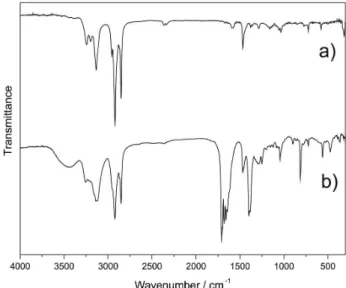
For all complexes, the IR spectra (Table 1) show absorptions corresponding to ν(N-H) at 3200-3100 cm-1
and ν(C-H) around 2920 cm-1. The IR spectra of the
chloride compounds show absorptions corresponding to
ν(Pt-Cl) around 320 cm-1, characteristic of cis platinum
compounds. For the oxalato complexes, the disappearance of the absorption due to ν(Pt-Cl)at 320 cm-1 is noticeable,
as well as the appearance of absorptions for ν(Pt-O)around
550 cm-1 (Figure 1). Other bands were recorded at 1670
and 810 cm-1 and were assigned to ν(C=O)and ν(C-C=O),
respectively.
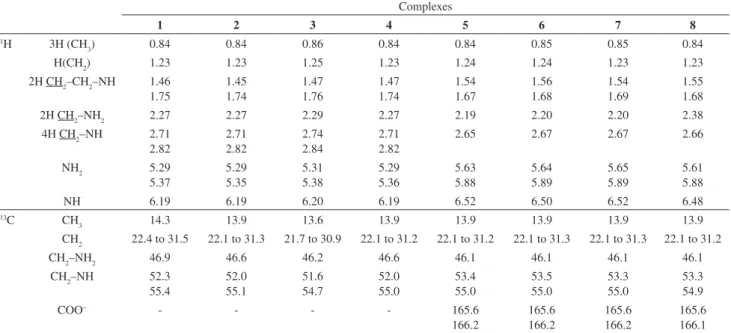
NMR spectra were acquired using dmso-d6 as the solvent. The chemical shifts are shown in Table 2.
Figure 1. IR spectra: (a) Complex 1; (b) Complex 5.
Scheme 1. Synthetic route for oxalato platinum complexes from chloride precursors.
K2PtCl4
NH NH2
CH3(CH2)n
Pt
Cl Cl
NaO ONa
O
O CH3(CH2)nNH NH2
Pt
O O
O O
1 n = 7
2 n = 9 3 n = 11
4 n = 13 5 n = 7
6 n = 9 7 n = 11 8 n = 13
NH NH2
CH3(CH2)n
In the 1H NMR spectra of the diamines, signals around
d 0.9 (CH3) as a triplet, 1.2 (CH2), 2.6 (CH2-NH) and
2.8 (CH2-NH2) as multiplets were observed. In the d 1.4 to 2.5 region, the signals corresponding to the NH2 and NH hydrogens could be seen as triplet resonances. In the
1H NMR spectra of the complexes, a high frequency shift
was observed for the signals relative to the NH and NH2 hydrogens. They appeared as three broad signals in the d 5.2 to 6.2 region for the chloride complexes and 5.6 to 6.5 for the oxalato analogues.
No significant difference was observed when the
13C NMR spectra of the diamines was compared with the
spectra of the complexes. Signals corresponding to the CH3 group occurred around d 14. In the d 22-32 region, signals attributable to the carbons from the aliphatic chain
were observed. The carbon atoms directly bound to NH2
and NH gave signals in the d 40-50 region. For the oxalato complexes, signals corresponding to the carboxylato carbon were observed around d 166.
The 195Pt NMR spectra (Figure 2) for complexes
1-4 showed only one signal around d –2350, while for
complexes 5-8 only one signal, around d –2050, was observed. These chemical shift values are in agreement with data reported for similar compounds in the literature.16-18 As
expected, a shift to high frequency was observed, caused by the replacement of the chloride by oxalato, which altered the coordination sphere around the platinum ion.
The results of elemental analysis obtained for the complexes are in good agreement with the calculated values.
Cytotoxic activity
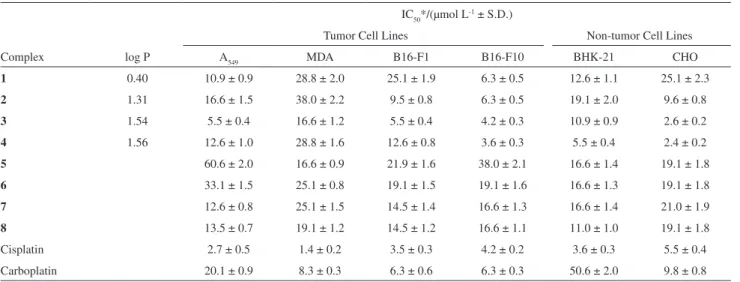
To analyze the potential of the compounds as antitumor agents, their cytotoxicity was evaluated in comparison to cisplatin and carboplatin in a panel of four tumor cell lines: lung cancer (A549), melanoma (B16-F1 and B16-F10) and breast adenocarcinoma (MDA-MB-231), Table 3. The complexes were also examined for their cytotoxic properties on two types of non-tumor cell lines, kidney (BHK-21) and ovarian (CHO). The IC50 values, calculated from the dose survival curves obtained after 120 h of drug exposure (MTT test), are shown in Table 3.19
Table 1. Main IR absorptions (cm-1)
Complexes
1 2 3 4 5 6 7 8
N–H 3187 3134 3134 3134 3131 3128 3137 3136
C–H 2927 2922 2920 2920 2923 2919 2918 2917
C=O - - - - 1671 1679 1679 1678
C–C=O - - - - 806 814 813 813
Pt–O - - - - 553 559 559 558
Pt–Cl 318 316 321 318 322 321 315 313 - - -
-Table 2.1H and 13C NMR data (ppm); solvent: dmso-d
6
Complexes
1 2 3 4 5 6 7 8
1H 3H (CH
3) 0.84 0.84 0.86 0.84 0.84 0.85 0.85 0.84
H(CH2) 1.23 1.23 1.25 1.23 1.24 1.24 1.23 1.23
2H CH2–CH2–NH 1.46 1.75 1.45 1.74 1.47 1.76 1.47 1.74 1.54 1.67 1.56 1.68 1.54 1.69 1.55 1.68
2H CH2–NH2 2.27 2.27 2.29 2.27 2.19 2.20 2.20 2.38
4H CH2–NH 2.71 2.82 2.71 2.82 2.74 2.84 2.71 2.82
2.65 2.67 2.67 2.66
NH2 5.29
5.37 5.29 5.35 5.31 5.38 5.29 5.36 5.63 5.88 5.64 5.89 5.65 5.89 5.61 5.88
NH 6.19 6.19 6.20 6.19 6.52 6.50 6.52 6.48
13C CH
3 14.3 13.9 13.6 13.9 13.9 13.9 13.9 13.9
CH2 22.4 to 31.5 22.1 to 31.3 21.7 to 30.9 22.1 to 31.2 22.1 to 31.2 22.1 to 31.3 22.1 to 31.3 22.1 to 31.2
CH2–NH2 46.9 46.6 46.2 46.6 46.1 46.1 46.1 46.1
CH2–NH 52.3
55.4 52.0 55.1 51.6 54.7 52.0 55.0 53.4 55.0 53.5 55.0 53.3 55.0 53.3 54.9
COO− - - - - 165.6
We observed that, in all cell lines assessed, the cytotoxicity was inluenced by the leaving group, with oxalato complexes showing decreased activity compared to chloride precursors. Especially with the B16-F10 cell line, IC50 values vary from 6.3 to 3.6 µmol L-1 for chloride
complexes (1-4) and from 38.0 to 16.6 µmol L-1 for the
oxalato analogues (5-8). With the A549 cell line, while the IC50 value for chloride complexes is around 10 µmol L-1,
those for the oxalatos vary from 60.6 to 13.5 µmol L-1.
The nature of the non-leaving group also affects cytotoxicity. The cytotoxic activity of the compounds in tumor cell lines exhibits an increasing trend with the increase of the carbon chain length when comparing complexes having 8, 10 and 12 carbons in the alkyl moiety.
The analogues containing 14 carbons show less or similar activity. This structure/activity relationship is conirmed by log P values for the corresponding chloride complexes (Table 3), which were determined from the partition coeficients in n-octanol/water. This parameter is used to determine the lipophilic character of drugs: hydrophobic
compounds will have a high log P value whereas
hydrophilic compounds will have it low. We have found that as log P increases IC50 values decrease, i.e., increasing complex hydrophobicity increases cytotoxic activity.20,21
This correlation has been observed before by our group for similar platinum(II) complexes with ligands derived from 1,3-propanediamine; it can be explained based on the lipophilicity of the compounds.13 The more lipophilic the
Figure 2. 195Pt NMR spectra: (a) Complex 1; (b) Complex 5.
Table 3. log P and cytotoxic activities (IC50) of the platinum complexes against tumor and non-tumor cell lines
Complex log P
IC50*/(µmol L-1 ± S.D.)
Tumor Cell Lines Non-tumor Cell Lines
A549 MDA B16-F1 B16-F10 BHK-21 CHO
1 0.40 10.9 ± 0.9 28.8 ± 2.0 25.1 ± 1.9 6.3 ± 0.5 12.6 ± 1.1 25.1 ± 2.3
2 1.31 16.6 ± 1.5 38.0 ± 2.2 9.5 ± 0.8 6.3 ± 0.5 19.1 ± 2.0 9.6 ± 0.8
3 1.54 5.5 ± 0.4 16.6 ± 1.2 5.5 ± 0.4 4.2 ± 0.3 10.9 ± 0.9 2.6 ± 0.2
4 1.56 12.6 ± 1.0 28.8 ± 1.6 12.6 ± 0.8 3.6 ± 0.3 5.5 ± 0.4 2.4 ± 0.2
5 60.6 ± 2.0 16.6 ± 0.9 21.9 ± 1.6 38.0 ± 2.1 16.6 ± 1.4 19.1 ± 1.8
6 33.1 ± 1.5 25.1 ± 0.8 19.1 ± 1.5 19.1 ± 1.6 16.6 ± 1.3 19.1 ± 1.8
7 12.6 ± 0.8 25.1 ± 1.5 14.5 ± 1.4 16.6 ± 1.3 16.6 ± 1.4 21.0 ± 1.9
8 13.5 ± 0.7 19.1 ± 1.2 14.5 ± 1.2 16.6 ± 1.1 11.0 ± 1.0 19.1 ± 1.8
Cisplatin 2.7 ± 0.5 1.4 ± 0.2 3.5 ± 0.3 4.2 ± 0.2 3.6 ± 0.3 5.5 ± 0.4
Carboplatin 20.1 ± 0.9 8.3 ± 0.3 6.3 ± 0.6 6.3 ± 0.3 50.6 ± 2.0 9.8 ± 0.8
compound is, the more rapidly it enters cells and the higher is its cytotoxic activity. The time the drug takes to enter the cells can explain why the chloride complexes were, in general, more cytotoxic than the corresponding oxalato complexes. Pereira-Maia and Garnier-Suillerot22 have
shown that carboplatin is less toxic than cisplatin because carboplatin enters cells at a slower rate, and that may be what is occurring for the complexes reported herein. As another possible explanation, the rate of hydrolysis of the leaving group may differ between the chloride and oxalato complexes. Hydrolysis of the oxalato complexes requires initial ring-opening, ligand displacement by chloride and subsequent conversion to the aquo and/or hydroxy species, thus requiring more time to bind with the DNA bases.23,24
Cisplatin and carboplatin are more cytotoxic than the amphiphilic complexes, except when compared to carboplatin in A549 cell line, against which six of the amphiphilic complexes were more cytotoxic.
It is interesting to note that all the compounds exhibited lower cytotoxicity than cisplatin against non-tumor kidney cell (BHK-21), since nephrotoxicity is one of the most severe side effects caused by cisplatin. Also, compounds
1-4 were less toxic than cisplatin and carboplatin against non-tumor ovarian cell (CHO). A good alternative platinum drug to be used in cancer chemotherapy should be toxic in tumor cells and less aggressive in normal cells to avoid the various side effects.
Experimental
IR spectra were obtained on a Bomem FT IR MB-102 spectrometer in KBr pellets. 1H NMR (300 MHz), 13C
NMR (75 MHz) and 195Pt NMR (64 MHz) spectra were
recorded on a Bruker spectrometer. For 13C NMR proton
decoupling was used. Elemental analyses were performed at the Universidade de São Paulo, Brazil.
Reagents
All chemicals were reagent grade and were used without further puriication, except for the reagents used in cytotoxic activities which were iltered (0.2 µm).
Synthesis of N-alkyl diamines
The general procedure for preparation of the N-alkyl
diamines (N-octyl-1,2-ethanediamine, N
-decyl-1,2-ethanediamine, N-dodecyl-1,2-ethanediamine and
N-tetradecyl-1,2-ethanediamine) is analogous to the one previously described by our group for the N-alkyl diamines derived from propanediamine.13
Synthesis of chloride complexes 1-4 (Scheme1)
To a solution of K2PtCl4 (0.415 g, 1 mmol) in water (5 mL), the appropriate diamine (1 mmol) dissolved in water/ methanol (5 mL) was slowly added during 4 h. After stirring for 24 h at room temperature, the pallid yellow solid formed was iltered off, washed with water, methanol and dried.
Yields: (1) 0.368 g (84%), (2) 0.372 g (80%), (3) 0.405 g (82%), (4) 0.421g (80%). Anal. Calc. for C10H24Cl2N2Pt
(Compound 1): C, 27.40; H, 5.52; N, 6.39%. Found: C,
27.76; H, 5.34; N, 6.19%. C12H28Cl2N2Pt (Compound 2): C, 30.91; H, 6.05; N, 6.01%. Found: C, 30.70; H, 5.85; N, 6.02%. C14H3Cl22N2Pt (Compound 3): C, 34.01; H, 6.52; N, 5.67%.Found: C, 34.61; H, 6.45; N, 5.78%. C16H36Cl2N2Pt
(Compound 4): C, 36.78; H, 6.95; N, 5.36%. Found:C,
37.65; H, 6.84; N, 5.51%.
Synthesis of oxalato complexes 5-8 (Scheme 1)
To the chloride complexes (1 mmol) in acetone (10 mL), AgNO3 (2.2 mmol) was added. After stirring for 24 h at 60 °C, the white solid formed (AgCl) was iltered off. The iltrate was concentrated to dryness in a rotaevaporator and the yellow solid was dissolved in acetone and iltered to eliminate any excess of AgNO3. Na2C2O4 (0.303g; 1 mmol) in water (100 mL) was added to the iltrate. After stirring for 24 h at 50 °C, a beige precipitate was formed. The products were isolated by iltration, washed with water, methanol and dried. Yields: (5) 0.239 g (53%), (6) 0.418 g (86%), (7) 0.430 g (84%), (8) 0.515 g (95%). Anal. Calc. for C12H24N2O4Pt (Compound 5): C, 31.65; H, 5.31; N, 6.15%. Found: C, 30.47; H, 4.99; N, 6.37%. C14H28N2O4Pt (Compound 6): C, 34.78; H, 5.84; N, 5.79%.Found: C, 34.71; H, 5.84; N, 5.93%. C16H32N2O4Pt (Compound 7): C, 37.57; H, 6.31; N, 5.48%. Found: C, 35.55; H, 5.86; N, 5.14%. C18H36N2O4Pt (Coumpound 8): C, 40.07; H, 6.72; N, 5.19%. Found: C, 39.95; H, 6.71; N, 5.29%.
Partition coeficients
Partition coeficients for the platinum complexes were determined in duplicate in an n-octanol/water system.25
Each complex was dissolved in n-octanol at 20 µmol L-1
and, subsequently, an equal volume of water was added. The mixtures were shaken mechanically for 24 h to ensure the distribution between the two solvent phases. The platinum concentration was determined in both phases by GFAAS in a THGA-Perkin Elmer spectrophotometer equipped with a graphite tube atomizer and an Analyst 600 auto sampler. Results are expressed as logarithm of P (log P), where P
Cell lines and cultures
The cytotoxic activities were investigated against the following tumor cell lines: A549 human non-small cell lung carcinoma, B16-F1 mouse non-metastatic cell skin melanoma, B16-F10 mouse metastatic cell skin melanoma, MDA-MB-231 human cell breast adenocarcinoma, and non-tumor cell lines such as BHK-21 hamster cell kidney and CHO hamster cell ovary.
These cells were obtained from the Ludwig Institute of Cancer Research, São Paulo-Brazil (B16-F1, B16-F10 and MDA-MB-231), from the cell bank of the Universidade Federal do Rio de Janeiro, Rio de Janeiro-Brazil (A549) and from the Centro Panamericano de Febre Aftosa, Rio de Janeiro-Brazil (BHK-21 and CHO). They were propagated in cell culture medium RPMI 1640 pH 7.4, supplemented with 10% heat-inactivated Fetal Bovine Serum (FBS), Hepes (4-(2-hydroxyethyl)-1-piperazineethanesulfonic acid, 4.0 mmol L-1), NaHCO
3 (14.0 mmol L
-1), ampicillin
(0.27 mmol L-1) and streptomycin (0.06 mmol L-1).
Cells were harvested by trypsinization, seeded in 100 µL of cell culture medium at deined densities (ranging from 0.5 × 10³ to 2 × 10³ living cells per well, depending on the
cell line) into 96-well tissue culture plates and incubated at
37 °C in a humidiied atmosphere containing 5% CO2 for
24 h. Stock solutions of the test substances in dmso were serially diluted in cell culture medium. 100 µL of these four dilutions were added to the cells in six wells each. For a negative control, 100 µL of cell culture medium were added to twelve wells (100% value). After drug exposure for 120 h at 37 °C and 5% CO2, the cells were incubated with MTT (3-(4,5-dimethyl-2-thiazolyl)-2,5-diphenyl-2H tetrazolium bromide, Sigma-Aldrich) 0.01 mol L-1 in water solution
(added in aliquots of 10 µL per well)for 4 h at 37 °C and 5% CO2.MTT is metabolized by living cells resulting in a violet complex which was solubilized in 100 µL of dmso and determined by the colorimetric method using an ELISA reader at 570 nm. Positive controls, such as cisplatin and carboplatin, were also used against these cell lines.
The raw data were normalized to the untreated control cells and related to the metabolic activity of the viable treated cells. The IC50 values, concentration required to inhibit 50% of cell growth, were calculated by four-parameter nonlinear regression using GraphPad Prism 5.0 software (San Diego, USA).27
Conclusions
Novel platinum(II) complexes of long chain aliphatic diamine ligands with oxalato as the leaving group have been prepared and characterized. The effect of these
compounds on tumor and non-tumor cell lines has been investigated. The chloride complexes are more cytotoxic than the corresponding oxalato complexes, probably due to the faster rate of hydrolysis of the formers. Another possibility could be related to the difference in the rate of cellular uptake. The relationship between cytotoxicity and carbon chain length was conirmed independently of the leaving group used.
Acknowledgments
To FAPEMIG and CNPq for inancial support and fellowships.
References
1. Natile, G.; Coluccia, M.; Coord. Chem. Rev. 2001, 216, 383. 2. Pratt, W. B.; Ruddon, R. W.; Ensminger, W. D.; Maybaum, J.;
The Anticancer Drugs, Oxford University Press: New York, 1994, pp. 133-139.
3. Hambley, T. W.; Coord. Chem. Rev.1997, 166, 181. 4. Sykes, A. G.; Platinum Met. Rev.1988, 32, 170.
5. Pasini, A.; Zunino, F.; Angew Chem., Int. Ed. 1987, 26, 615. 6. Farrell, N.; Qu, Y.; Hacker, M. P.; J. Med. Chem. 1990, 33, 2179. 7. Summa, N.; Soldatovic, T.; Danlenburg, L.; Bugarcic, Z. D.;
Eldik, R. V.; J.Biol. Inorg. Chem.2007, 12, 461.
8. Bolelikas, T.; Vougiouka, M.; Oncol. Reports 2003, 10, 1663.
9. Mathé, G.; Kidani, Y.; Sekiguichi, M.; Eriguchi, M.; Fredj, G.; Peytavin, G.; Misset, J. L.; Brienza, S.; de Vassals, F.; Chenu, E.; Bourut, C.; Biomed. Pharmacother.1989, 43, 237. 10. Lippard, S. J.; Wang, D.; Nat. Rev. Drug Discov. 2005, 4, 307. 11. Fontes, A. P. S.; de Almeida, S. G.; Nader, L. A.; Quim. Nova
1997, 20, 398.
12. Schreier, S.; Malheiros, S. V. P.; de Paula, E.; Biochim. Biophys. Acta, Biomembr. 2000, 1508, 210.
13. Silva, H.; Barra, C. V.; da Costa, C. F.; de Almeida, M. V.; César, E. T.; Silveira, J. N.; Garnier-Suillerot, A.; de Paula, F. C. S.; Pereira-Maia, E. C.; Fontes, A. P. S.; J. Inorg. Biochem. 2008,
102, 767.
14. Miller, B.; Wild, S.; Zorbas, H.; Beck, W.; Inorg. Chim. Acta
1999, 290, 237.
15. Dhara, S. C.; Indian J. Chem. 1970, 8, 193.
16. de Almeida, M. V.; Chaves, J. D. S.; Fontes, A. P. S.; César, E. T.; Gielen, M.; J. Braz. Chem. Soc.2006, 17, 1266.
17. de Almeida, M. V.; César, E. T.; Felício, E. C. A.; Fontes, A. P. S.; J. Braz. Chem. Soc. 2000, 11, 154.
18. Fiebig, H. H.; Heuss, H.; Vonpawel, L.; Gatzemeier, U.; Manegold, C.; Edler, L.; Berdel, W.; Onkologie1996, 19, 328. 19. Monti, E.; Gariboldi, M.; Maiocchi, A.; Marengo, E.; Cassino,
20. Platts, J. A.; Oldield, S. P.; Reif, M. M.; Palmucci, A.; Gabano, E.; Osella, D.; J. Inorg. Biochem.2006, 100, 1199.
21. Oldield, S. P.; Hall, M. D.; Platts, J. A.; J. Med. Chem. 2007,
50, 5227.
22. Pereira-Maia, E. C.; Garnier-Suillerot, A.; JBIC, J. Biol. Inorg. Chem. 2003, 8, 626.
23. Ma, E. S. F.; Bates, W. D.; Edmunds, A.; Kelland, L. R.; Fojo, T.; Farrell, N.; J. Med. Chem.2005, 48, 5651.
24. Canovese, L.; Cattalini, L.; Chessa, G.; J. Chem. Soc., Dalton Trans.1988, 8, 2135.
25. Screnci, D.; McKeage, M. J.; Galettis, P.; Hambley, T. W.; Palmer, B. D.; Baguley, B. C.; Br. J. Cancer2000, 82, 966. 26. Guerra, W.; Silva, I. R.; Azevedo, E. A.; Monteiro, A. R. S.;
Bucciarelli-Rodriguez, M.; Chartone-Souza, E.; Silveira, J. N.; Fontes, A. P. S.; Pereira-Maia, E. C.; J. Braz. Chem. Soc.2006,
17, 1627.
27. Garmann, D.; Warnecke, A.; Kalayda, G. V.; Kratz, F.; Jaehde, U.; J. Controlled Release 2008, 131, 100.
Submitted: October 15, 2009