9 Radiological and histological correlation of non-palpable breast lesions using the BI-RADS
Radiol Bras 2007;40(1):9–11 Original Article
RADIOLOGICAL AND HISTOLOGICAL CORRELATION
OF NON-PALPABLE BREAST LESIONS IN PATIENTS SUBMITTED
TO PREOPERATIVE MARKING ACCORDING TO BI-RADS
CLASSIFICATION*
Vaneska de Carvalho Melhado1
, Beatriz Regina Alvares2
, Orlando José de Almeida3
OBJECTIVE: To evaluate the positive predictive value for BI-RADS (Breast Imaging Reporting and Data Sys-tem) categories 3, 4 and 5, correlating mammographic and histological diagnosis in non-palpable breast le-sions. MATERIALS AND METHODS: Analytical-descriptive study of 169 women submitted to stereotactic localization for surgical biopsy of non-palpable breast lesions. Mammographic and histological findings were correlated, analyzing the predictive positive value for each category. RESULTS: Forty-two (24.8%) cases were diagnosed with breast cancer — only one in category 3, 19 in category 4, and 22 in category 5. The positive predictive value for categories 3, 4A, 4B, 4C and 5 were, respectively, 3.4%, 10.3%, 11.3%, 36% and 91.7%. Microcalcifications were the most frequent finding related to malignancy, present in 61.5% of these cases. CONCLUSION: The present study has demonstrated that BI-RADS allows a safe prediction of high suspicion of malignancy in lesions category 5 and low suspicion for category 3. As regards the cat-egory 4, the positive predictive value has shown a progressive increase in subcategories A, B and C, dem-onstrating that this subclassification represents an invaluable contribution for a more detailed and accurate assessment of lesions suspicious for malignancy.
Keywords: Breast cancer; Mammography; BI-RADS; Histological diagnosis.
Correlação radiológica e histológica de lesões mamárias não-palpáveis em pacientes submetidas a marcação pré-cirúrgica, utilizando-se o sistema BI-RADS.
OBJETIVO: Avaliar as categorias 3, 4 e 5 da classificação BI-RADS (Breast Imaging Reporting and Data Sys-tem) como fator preditivo para malignidade, correlacionando os achados mamográficos e histológicos em lesões não-palpáveis da mama. MATERIAIS E MÉTODOS: Estudo analítico descritivo de 169 mulheres sub-metidas a biópsia cirúrgica, após localização estereotáxica de lesões mamárias não-palpáveis. As mamogra-fias dessas pacientes foram classificadas de acordo com a quarta edição do BI-RADS, avaliando-se as cate-gorias 3, 4 (A, B e C) e 5. Correlacionaram-se os achados mamográficos com os exames histológicos das lesões, avaliando-se o valor preditivo positivo em cada categoria. RESULTADOS: No total de 169 casos, foram diagnosticados 42 casos de câncer (24,8%). Destes, houve apenas um caso na categoria 3, 19 casos na categoria 4 e 22 casos na categoria 5. Os valores preditivos positivos para as categorias 3, 4A, 4B, 4C e 5 foram, respectivamente, de 3,4%, 10,3%, 11,3%, 36% e 91,7%. As microcalcificações foram o achado mais freqüente relacionado à doença maligna, ocorrendo em 61,5% do total. CONCLUSÃO: Este estudo demonstrou que a classificação BI-RADS permite predizer com segurança que há alta suspeição de maligni-dade para achados classificados na categoria 5 e diminuta chance para os achados da categoria 3. Quanto à categoria 4, foi constatada elevação progressiva dos valores preditivos positivos nas subcategorias A, B e C, mostrando que esta subdivisão contribui de forma mais detalhada e precisa na indicação de lesões sus-peitas para malignidade.
Unitermos: Câncer de mama; Mamografia; BI-RADS; Diagnóstico histológico. Abstract
Resumo
* Study developed at Centro de Atenção Integral à Saúde da Mulher (CAISM) Department of Radiology – Universidade Esta-dual de Campinas, Campinas, SP, Brazil, with financial support from Fundação de Amparo à Pesquisa do Estado de São Paulo (Fapesp).
1. MD, Resident in Gynecology and Obstetrics at Faculdade de Ciências Médicas da Universidade Estadual de Campinas.
2. Assistant Professor for Department of Radiology at Facul-dade de Ciências Médicas da UniversiFacul-dade Estadual de Campi-nas.
3. Responsible for Service of Mammography – Policlínica II/ Prefeitura Municipal de Campinas.
Mailing Address: Dra. Vaneska de Carvalho Melhado. Rua 3-A, 94, Vila Alemã. Rio Claro, SP, 13506-660 – Brazil. E-mail: [email protected]
Received October 7, 2005. Accepted after revision April 6, 2006.
INTRODUCTION
Mammography is the most specific and sensitive method for diagnosis of breast cancer at its earliest presentation(1). Annual mammographic screening in women above 40 years of age identifies 100 to 200 new cases of suspect lesions for each 20,000 mammograms presenting like non-palpable lesions and requiring histological study, the preoperative localization being one amongst the available options(2). So,
not-withstanding the good performance of mammography in the identification of early stages of breast neoplasms, only 15% to 30% of non-palpable lesions submitted to surgical biopsy are malignant(3). This has resulted in the elaboration of a proposal for classifying mammographic findings aim-ing at improvaim-ing the performance of the method and reducing the frequency of bi-opsies with benign diagnosis(4).
10
Melhado VC et al.
Radiol Bras 2007;40(1):9–11
and Data System (BI-RADS®) to
standard-ize the terminology employed for mammo-graphic reports elaboration and for recom-mendations to be adopted. The fourth BI-RADS edition, of November/2003, pro-posed seven categories for mammographic findings: negative for malignancy (1), be-nign (2), probably bebe-nign (3), suspect for malignancy (4), highly suspect for malig-nancy (5), with proved maligmalig-nancy (6) and requiring additional evaluation (0). The category 4 was subdivided into A, B and C(5,6).
The present study had the objective to evaluate the positive predictive value for BI-RADS (fourth edition) for categories 3, 4A, 4B, 4C and 5, correlating mammo-graphic and histological diagnosis in non-palpable breast lesions, and verifying which are the findings of more relevance for breast cancer diagnosis in each cat-egory.
MATERIALS AND METHODS
Experienced radiologists performed mammographic analysis of 169 non-pal-pable breast lesions of patients submitted to biopsy in the period between September/ 2003 to April/2004. The findings were clas-sified according to BI-RADS, and catego-ries 3, 4A, 4B, 4C and 5 were evaluated. The mammograms evaluated in the present study were performed in a Mammomat 3000 Nova (Siemens) equipment, in craniocaudal and medial-lateral oblique views, besides supplementary views with magnification and focal compression. The patients were submitted to preoperative marking of lesions by means of stereotac-tic mammography in 90.53% (153) of cases, or ultrasound in 9.46% (16).
The breast tissue specimens obtained by surgical biopsies were processed for sec-tions in paraffin blocks and hematoxilin-eosin staining, and the diagnoses were elaborated by pathologists specialized in breast pathology.
This was a descriptive-analytical type study to evaluate the agreement between the updated BI-RADSclassification and the histological diagnoses in non-palpable breast lesions, by calculating the positive predictive value (PPV). Also, a correlation was made between the most relevant
radio-logical findings and malignant neoplasms for each category.
RESULTS
Amongst the patients included in the present study, 36.1% were less than 50 years old, 36.7% were 50–59 years old, and 27.2% were 60 or more years old.
Of the total 169 cases evaluated, the percentual distribution of mammographic diagnoses according to BI-RADS was the following: 17.2% (29) for category 3, 68.6% (116) for category 4, and 14.2% (24) for category 5. Focusing only on category 4, its subcategories had the following percentual distribution: 25% (29/116) for the subcat-egory A, 53% (62/116) for the subcatsubcat-egory B, and 22% (25/116) for subcategory C.
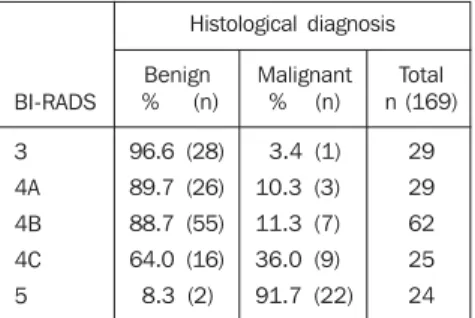
Forty-two (24.8%) cases were diag-nosed with breast cancer — one in category 3, three in the category 4A, seven in cat-egory 4B, nine in catcat-egory 4C, and 22 in category 5. Therefore, PPV were: 3.4% (1/29) for BI-RADS 3, 10.3% (3/29) for BI-RADS 4A, 11.3% (7/62) for BI-RADS 4B, 36% (9/25) for BI-RADS 4C and 91.7% (22/24) for BI-RADS 5 (Table 1).
Amongst lesions classified as BI-RADS 3 there was only one case of breast cancer, whose radiological finding was focal asym-metry. In the other categories, the mammo-graphic findings most frequently associated with breast cancer were those included in category 4A, punctate microcalcifications with segmental distribution in 66.7% (2/3) of cases; in category 4B, amorphous, het-erogeneous punctate microcalcifications, in 57.1% (4/7) of cases; in category 4C, spiculated architectural distortion, in 66.7% (6/9) of cases; for lesions classified as BI-RADS 5, pleomorphic microcalcifi-cations in a branching pattern were present
in 72.7% (16/22) of breast cancers. Over-all, the radiological findings most fre-quently associated with malignant disease were microcalcifications present in 61.5% of total cases (Table 2).
The most frequent malignant breast neoplasm was ductal carcinoma in situ in 59.5% (25/42), followed by invasive duc-tal carcinoma in 33.3% (14/42), lobular carcinoma in situ in 4.8% (2/42) and inva-sive lobular carcinoma in one case.
The diagnosis of atypical ductal hyper-plasia occurred in 7.1% (12/169) of total cases, all of them in the category 4. In 66.7% (8/12) of total cases, the findings were microcalcifications, and in 33.3% (4/ 12), architectural distortion. The two cases classified as BI-RADS 4A presented with clustered, round, linear and punctate microcalcifications, tending to coales-cence. On the other hand, category 4B had four cases of amorphous, heterogeneous and punctate microcalcifications, and one case of clustered microcalcifications with linear distribution. In category 4C, one case of clustered, pleomorphic calcifications with linear distribution, and four cases of architectural distortion.
DISCUSSION
The BI-RADS classification has repre-sented the first attempt to standardize mam-mographic findings in descriptive terms, constituting an important ancillary tool in both in cases of suspect malignancy and definition of conduct to be adopted(5,7–9). Studies correlating mammographic and histological findings in non-palpable breast lesions employing the BI-RADS classifica-tion have found PPV for breast cancer be-tween 12.3% and 47.8%(4,7,8,10–12). In the present study, 24.8% from the total of biopsied non-palpable breast lesions had a histological diagnosis of malignant disease. The percentage of probably benign mammographic findings submitted to bi-opsy was high (17.2%), above the values found by other studies which have ranged between 2% and 11%(4,7,8,10). As 96.5% of lesions classified as category 3 were be-nign, this has contributed for decreasing the PPV in the global evaluation of categories by the present study. Analyzing the PPV exclusively in relation to category 3, the Table 1 Correlation of BI-RADS categories 3, 4A,
4B, 4C and 5 with histological diagnoses.
BI-RADS
3
4A
4B
4C
5
Benign
% (n)
96.6 (28)
89.7 (26)
88.7 (55)
64.0 (16)
8.3 (2)
Histological diagnosis
Malignant
% (n)
3.4 (1)
10.3 (3)
11.3 (7)
36.0 (9)
91.7 (22) Total n (169)
29
29
62
25
11 Radiological and histological correlation of non-palpable breast lesions using the BI-RADS
Radiol Bras 2007;40(1):9–11
value was 3.4% — compatible with mean values reported by other studies(4,7,8,11). The high number of surgical biopsies in prob-ably benign lesions can be explained by the difficulty to perform a semiannual mam-mographic follow-up in many patients originating from other locations.
Correlating histological and radiologi-cal findings in category 4 breast lesions, in our study, the PPV was 16.4%, while other authors have found PPV ranging between 4% and 45%(4,7,8,10–12).
In the present study, we have found 12 cases of breast lesions classified as BI-RADS category 4 with diagnosis of atypi-cal ductal hyperplasia which have not been included in the PPV calculation. Accord-ing to Heywang-Köbrunner et al., the “atypical ductal hyperplasia represents a borderline lesion, whose malignancy risk in comparison with the normal population is increased in four to five times”(13). If the cases of atypical ductal hyperplasia were included in the category 4 PPV calculation, we would found an increase to 26.7%.
Analyzing the findings in subcategories 4A, 4B e 4C, we have found, respectively, PPV of 10.3%, 11.3% and 36%. If we in-cluded atypical ductal hyperplasia in this category, the values would change to 17.2%, 19.4% and 56%. Therefore, these findings have demonstrated an increasing sensitivity of BI-RADS subcategories 4A, 4B and 4C for detecting suspect breast
le-sions and those considered with risk for malignancy.
More recent studies on subcategories 4A, 4B and 4C have not been found in the literature, so it has not been possible to es-tablish a correlation with the values ob-tained in the present study(9–12).
As regards category 5, we have found a PPV of 91.7% for malignancy, a value compatible with data of the literature(4,7,8, 10,11). In lesions classified as BI-RADS5,
we have observed one case of sclerosing adenosis, and another of radial scar, situa-tions where a differential diagnosis is not feasible by means of mammography, so this is a mandatory indication for an excisional biopsy(6,14).
CONCLUSION
The present study has demonstrated that the BI-RADS classification allows a safe prediction of high suspicion for malig-nancy in lesions classified as category 5, and minimal suspicion in lesions classified as category 3. As regards category 4, a pro-gressive increase in PPV was observed in subcategories A, B and C, demonstrating that this subdivision contributes in a more detailed and accurate way for indicating lesions suspect for malignancy.
REFERENCES
1. Bellantone R, Rossi S, Lombardi CP, et al. Non-palpable lesions of the breast. Diagnostic and
Table 2 Distribution of radiological findings in BI-RADS categories 3, 4A, 4B, 4C and 5 in women with breast malignant neoplasm.
Radiological findings
Focal asymmetry
Focal asymmetry with microcalcifications
Architectural distortion
Nodule
Microcalcifications
4A
–
–
–
–
3 3
1
–
–
–
–
4B
–
–
–
1
6 4C
–
1
6
1
1 5
–
–
–
6
16
Total
n (%)
1 (2)
1 (2)
6 (14)
8 (19)
26 (62) BI-RADS
therapeutic considerations. Minerva Chir 1994; 49:327–333.
2. Frasson A, Farante G, Sacchini V, et al. Localiza-ção pré-operatória de lesões mamárias não-pal-páveis. Rev Bras Ginecol Obstet 1993;3:35–44. 3. Hall FM, Storella JM, Silverstone DM, Wyshak G. Nonpalpable breast lesions: recommendations for biopsy based on suspicion of carcinoma at mammography. Radiology 1988;167:353–358. 4. Orel SG, Kay N, Reynolds C, Sullivan DC.
BI-RADS categorization as a predictor of malig-nancy. Radiology 1999;211:845–850. 5. D’Orsi CJ. Illustrated Breast Imaging Reporting
and Data System. 4th ed. Reston: American Col-lege of Radiology, 2003.
6. Rocha DC, Bauab SP. Atlas de imagem da mama. Correlação mamografia/ultra-sonografia, incluin-do ressonância magnética e BI-RADS. 2ª ed. Rio de Janeiro: Revinter, 2004.
7. Liberman L, Abramson AF, Squires FB, Glassman JR, Morris EA, Dershaw DD.The Breast Imaging Reporting and Data System: positive predictive value of mammographic features and final assess-ment categories. AJR Am J Roentgenol 1998;171: 35–40.
8. Bérubé M, Curpen B, Ugolini P, et al. Level of suspicion of mammographic lesion: use of fea-tures defined by BI-RADS lexicon and correla-tion with large-core breast biopsy. Can Assoc Radiol J 1998;49:223–228.
9. Vieira AV, Toigo FT. Classificação BI-RADS: categorização de 4.968 mamografias. Radiol Bras 2002;35:205–208.
10. Kestelman FP, Canella EO, Arvellos NA, et al. Classificação radiológica nas lesões não-palpá-veis da mama. Análise de resultados do Hospital do Câncer III – INCA-MS. Radiol Bras 2001;34 (Supl 1):20.
11. Giannotti IA, Giannotti Filho O, Scalzaretto AP, Visentainer M, Elias S. Correlação entre diagnós-tico por imagem e histologia de lesões não-palpá-veis de mama. Rev Bras Cancer 2003;49:87–90. 12. Roveda Jr D, Campos MSDA, Ferezin PC, Fer-reira ACP, Valle MJR. Valor preditivo das anor-malidades mamográficas pelo sistema BI-RADS na ausência de lesões palpáveis das mamas. Ra-diol Bras 2001;34(Supl 1):21.
13. Heywang-Köbrunner SH, Schreer I, Dershaw DD, et al. Mama: diagnóstico por imagem. Correlação entre mamografia, ultra-sonografia, ressonância magnética, tomografia computadorizada e proce-dimentos intervencionistas. 1ª ed. Rio de Janeiro: Revinter, 1999;141–155.