Abstract
This study compares ball, bar-clip and bar-ball attachment systems for implant-retained mandibular overdentures with three implants. The first implant is placed in the middle of the mandible and the other two are imbedded in the first premolar regions. Linear elastic finite element analysis is used for design analysis. Three dimension-al geometry of the mandible is generated from computed tomogra-phy. Other parts are modeled using SolidWorks software. The foodstuff is positioned at the right first molar, representing the most frequent masticating situation. To obtain accurate mesh-independent results, finite element models are solved using several mesh grids. They are then validated by means of a detailed conver-gence analysis. The results demonstrate that the highest von-Mises stress in the bone is always located around the neck of the implant, at its upper threads. Ball and bar-ball attachments transfer the highest and lowest stresses to the bone surrounding the implants, respectively. The lowest stresses in the cortical and cancellous bones are due to bar-ball attachment. Yet, the overdenture gets its maximum movement for this arrangement. Consequently, the use of bar-ball attachment is only recommended for the cases in which stress transferred to peri-implant bone is more important than overdenture stability. Among the three treatment designs, ball attachment seems to exhibit the lowest lateral and overall dis-placements and hence, better overdenture stability.
Keywords
Overdenture stability, cortical bone, cancellous bone, implant
Finite Element Study of Three Different Treatment Designs
of a Mandibular Three Implant-Retained Overdenture
1 INTRODUCTION
Currently, implant-retained overdentures have become one of the most preferred options for a com-plete treatment of edentulous patients (Daas et al. (2008) and Parkash et al. (2009)). The high suc-cess rate of this therapy is well documented by Celik and Uludag (2007). Edentulous patients who
M. Shishesaza A. Ahmadzadehb A. Baharanc
a Department of Mechanical Engineer-ing, Shahid Chamran University of Ah-vaz, AhAh-vaz, Iran
E-mail address: [email protected] b Jondishapour Medical Science Univer-sity, Dept. of Dentistry
E-mail address:
[email protected] c Former Graduate Student, Mechanical Engineering Dept., Shahid Chamran University of ahvaz.
E-mail address:
http://dx.doi.org/10.1590/1679-78253212
use complete dentures often experience problems such as pain and insufficient stability of denture during mastication. Batenburg et al. (1998) showed that these problems can be reduced using plant-retained overdenture. According to a work done by Grageda and Rieck (2014), a single im-plant mandibular overdenture significantly increases the satisfaction an d quality of life of patients with edentulism, while the use of a metal-reinforced framework inside the acrylic resin base provides better rigidity to prevent denture fracture.
In some patients, two to four implants are used in the interforaminal region to support mandib-ular overdentures (Batenburg et al. (1998)). Some of the previous works (Celik and Uludag (2007); Meijer et al. (1994)), have not been able to find any difference in the clinical state of patients treat-ed either with two or four implants. However, Parkash et al. (2009) concludtreat-ed that four-implant systems are better choices than two-implant systems.
Implant-retained overdentures have various attachment systems including clip, ball, bar-ball, O-ring and magnet. Several studies have evaluated the effect of these attachments on implant-retained mandibular overdentures (Daas et al. (2008); Parkash et al. (2009); Celik and Uludag (2007); Meijer et al. (1993) and Menicucci et al. (1998)). The forces resulted from mastication are transferred to implants and produce stress in peri-implant bone. These stresses must be in the cer-tain and safe range. Very high or very low stress values can cause bone resorption and failure of treatment concept.
Long-term function of a dental implant system will depend on the biomechanical interaction be-tween bone and the implant. Methods for evaluation of stresses around dental implant systems in-clude photoelasticity, finite element analysis and strain measurement on the bone surface. The finite element (FE) method offers several advantages over the other methods. This includes accurate rep-resentation of complex geometries, ability of modification of the model and better reprep-resentation of internal stresses and other mechanical quantities (Meijer et al. (1996)).
The influence of implant number on the biomechanical behavior of mandibular implant-retained/supported overdentures was studied by Liu et al. (2013) through three-dimensional finite element analysis. The aim of this study was to evaluate strain distribution in peri-implant bone, stress in the abutments and denture stability of mandibular overdentures anchored by different numbers of implants of the same type under different loading conditions.
A survey by Dias et al. (2013) on patient satisfaction with the mandibular 2-implant–retained overdenture therapy revealed that 79% of participants were satisfied with their masticatory ability, 84% were satisfied with the comfort of the prosthesis, and 89% were satisfied with the esthetics of their new prosthesis. Moreover, 85% of participants reported satisfaction with the overall treatment experience, and 90% recommended the same treatment to a friend. Similar studies were performed to examine the influence of mandibular two-implant retained overdentures on life quality of denture wearers aged between 65-82 (Geckili et al. (2011)), and patient satisfaction and long-term effective-ness of tooth replacement with mandibular implant-retained overdentures (Pan et al. (2014)).
clinical outcome, the oral health-related quality of life, and the subjective chewing ability of pa-tients with mandibular complete dentures retained by a single implant placed in the mandible mid-line (Harder et al. (2011)).
There are various stress transfer studies on two and four-implant-retained mandibular overden-ture designs. Among these, one may point to a work done by Tolga and Murat (2015). However, the influence of various types of attachments on stress distribution in three-implant-retained man-dibular overdenture designs has not been sufficiently assessed. The work presented by Celik and Uludag (2007) emphasizes more on photoelastic stress analysis around the implant embedded in a homogenous supporting structure fabricated with photoelastic resin (PL-2). The results were de-duced for vertically oriented and inclined implants and generated stress patterns in the resin were monitored photoelastically and recorded photographically. No real values for stress distribution and patterns were reported.
Based on the available literature, it appears that there are still some major questions which yet have to be answered regarding the influence of various types of attachments on stress distribution in a three-implant mandibular overdenture. To mention a few, one can point out to the effect of composite bone structure, geometry and property of the mandible on stress distribution in the cor-tical and cancellous bones, the effect of attachment design on stresses developed in the mating parts and around the implant, the stability of the overdenture based on each treatment design and final-ly, the induced maximum stresses developed in the cortical and cancellous bones (in each type of attachment) during mastication process. The latter may be used to predict the possibility of bone resorption in the mandible. For this purpose, in this work, three types of attachments, namely, ball, bar- bar and bar - clip attachments will be used to study the foregoing effects. Three dimensional finite element analysis will be used to model and simulate each part (in each treatment design), using its real geometric shape, dimension and property. The mastication load on the foodstuff will be simulated by proper application of load to each muscle. The resulting stress distributions and deformation patterns are then used to offer the best treatment design for reaching better overden-ture stability and preventing mandible bone resorption.
2 BASIC FORMULATIONS
2.1 Model Generation and Description
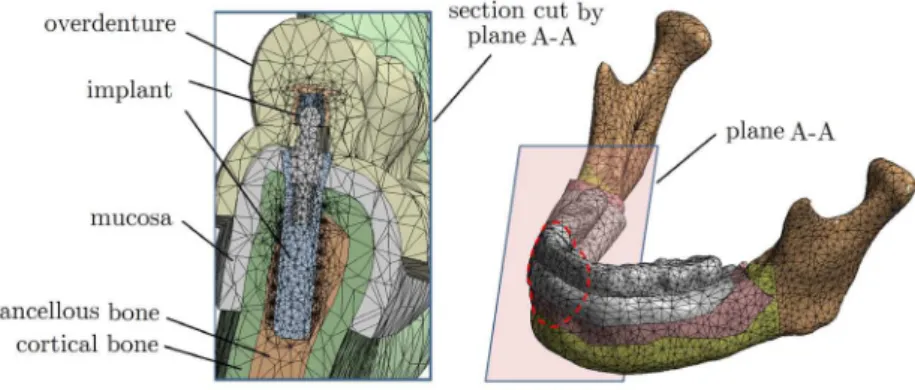
et al. (2008)). Additionally, as shown in Fig. 1, a layer of mucosa with a thickness of 2 mm (To-kuhisa et al. (2003)) was added to the resulting model.
(a) without overdenture (b)with overdenture
Figure 1: (a) Addition of mucosa (in red) on three-dimensional model of the mandible.
As shown in Fig. 2, three types of attachments were used, each at a time, to study their sole behavior and effect, on stress distribution in the mandible and overdenture movement.
(a)
(b) (c)
Among the constituents used in the three different designs, one can point out to a standard im-plant with a length of 12 mm and diameter of 4.1 mm, anchor, lamella, titanium housing, abut-ment, coping, screw carrying system (SCS) screw, U-shape cross-section bar and clip. Figure 3 shows the overdenture with its exploded views of mating parts used in each design.
(a) ball attachment (b) bar- ball attachment
(c) bar - clip attachment
Figure 3: Exploded views of mating parts in each implant treatment design.
2.2 Material Properties
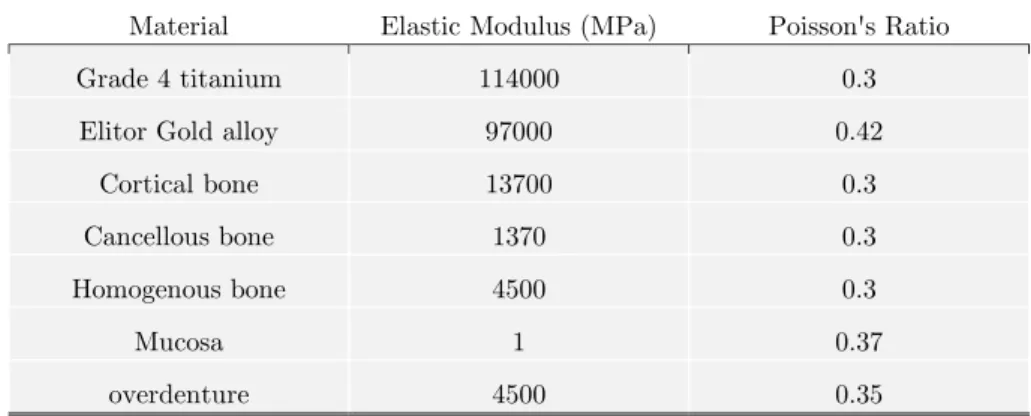
Material Elastic Modulus (MPa) Poisson's Ratio
Grade 4 titanium 114000 0.3
Elitor Gold alloy 97000 0.42
Cortical bone 13700 0.3
Cancellous bone 1370 0.3
Homogenous bone 4500 0.3
Mucosa 1 0.37
overdenture 4500 0.35
Table 1: Mechanical properties of components (Daas, et al. (2008)).
2.3 Contact Between Components
Due to the large number of mating parts in each model, many contact areas were defined and simu-lated properly in the finite element model. These surfaces were defined in accordance with their physical use and contact conditions. In the ball and bar-ball attachments, frictional contacts were imposed between lamella and ball abutment, while for the bar-clip attachment, this type of contact was imposed between the bar and clip (see Fig. 2). Friction coefficients between these contact sur-faces are tabulated in Table 2. Zero frictional coefficient was assigned for the contect between over-denture and mucosa was considered to be zero (Takayama et al. (2001)). Additionally, Due to a perfect bond between the implants and the bones, they were assumed totally osseointegrated.
Material of contact surfaces Friction coefficient References
Titanium-Elitor 0.299 Guda et al. (2008)
Elitor-Elitor 0.4 Chun et al. (2005), Ohida et al. (2010)
Table 2: Friction coefficients between contact elements.
2.4 Finite Element Model
Finite element analyses of the models were performed using ANSYS Workbench software V14. SOLID187 element was used for mesh generation. This element is a higher order 3-D, 10-node ele-ment having three degrees of freedom at each node, namely, three translations in the nodal x, y and
z directions. CONTA174 and TARGE170 elements were used to define contacts between the com-ponents. These elements can simulate both bonded and frictional contacts.
-stress value in the new mesh -stress value in the former mesh error
stress value in the new mesh
In this work, the highest error value used as a set point for selection of final results was 4.6%. Based on this value, the total number of final elements and nodes in each model (for the three treatment designs shown in Fig. 3) is reported in Table 3. The complete Meshed model with all constituents is shown in Fig. 4.
Treatment design Number of solid elements Number of contact
ele-ments Number of nodes
Ball 546569 139518 851266
Bar-clip 680103 147918 1045051
Bar-ball 641639 140697 989363
Table 3: Specifications of generated meshes.
Figure 4: Meshed model of the mandible and its overdenture with an implant.
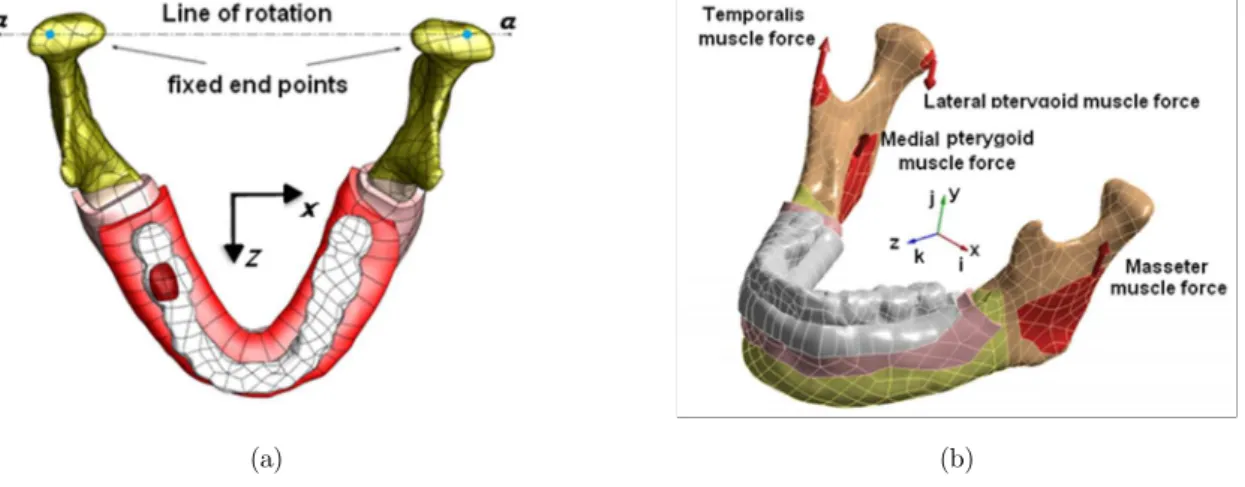
Simulation of proper boundary conditions is an important step in any finite element analysis. This has a direct affect on final results (Meijer et al. (1993)). In this work, as shown in Fig. 5(a), the x–z plane is assumed to be parallel to the occlusal plane. The y- axis points outward and normal to this surface.
The magnitudes of muscular forces are extracted from Korioth and Hannam (1994). The model is loaded with distributed forces at muscles’ attachment regions. It is assumed that the muscles are directly in contact with the bone and the applied forces are resulted from isometric contraction of the muscles. Four pairs of muscles (masseter, medial pterygoid, lateral pterygoid and temporalis) have the most contribution in mastication (see Fig. 5(b)). Insertion regions of the muscles are se-lected according to the past studies (Daas et al. (2008) and Cruz et al. (2003)).
(a) (b)
Figure 5: Modeled mandible (a), supports and movement, (b) muscular forces.
Muscular pattern presented by Korioth and Hannam (1994), is used to determine values of forces. According to Daas et al. (2008), the muscular actions generate a reaction force of 100 N on the first right molar. The values of muscular forces required to simulate this reaction were genereat-ed and are shown in Table 4.
Muscle Left side of the mandible Right side of the mandible
Masseter 37.527 45.030
Medial pterygiod 26.233 36.726
Lateral pterygoyd 10.873 5.018
Temporalis 42.567 50.696
Table 4: Values of muscular forces (N).
4 NUMERICAL RESULTS AND DISCUSSION
4.1 Overdenture Behavior
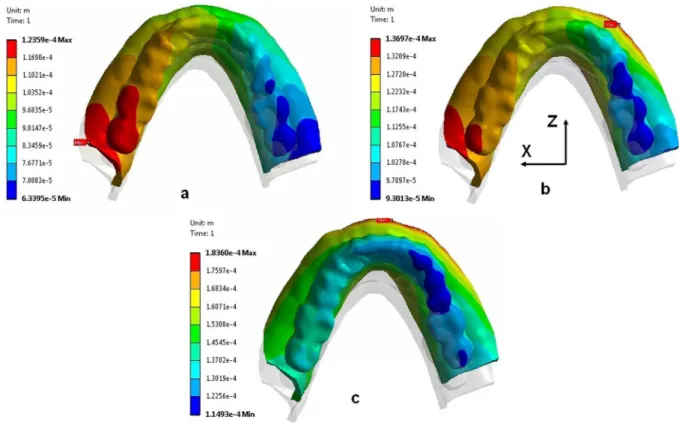
shifted up with respect to the right side, due to the load on the foodstuff on the right first molar. For ball, bar-ball and bar-clip designs, the highest overdenture deformations occur on the left side while, the highest value is due to bar-ball arrangement. According to Fig. 6, the smallest lateral overdenture deformation belongs to ball treatment design. The results showed that the largest com-ponent of the total deformation was due to lateral z displacement. Additionally, the x component of the total deformation was the smallest component in all three treatment designs.
Figure 6: Lateral overdenture deformation along z axis for: a) ball, b) bar-clip and c) bar-ball designs (all dimensions in meter).
Additionally, total deformation of the mandible with its implant-retained overdenture is shown in Fig. 7 for the three treatment designs shown in Fig. 3. The loading condition is the same for all cases. According to Fig. 7, a ball attachment design produces the least overall displacement, and hence better overall denture stability. A bar – clip attachment produces an overall displacement slightly higher than that of ball attachment. The highest mandible displacement appears to occur in bar-ball attachment design.
Table 5 reports the values of maximum total overdenture displacements. For further compari-son, maximum deflections along x, y and z directions are given in Table 6. These values do not oc-cur at the same nodal point.
experience the lowest lateral and overall displacements and hence, shows better overdenture stabil-ity.
(a) ball attachment (b) bar – ball attachment
(c) bar – clip attachment
Figure 7: Total deformation of the mandible for the three treatment designs. (all dimensions in meter).
Treatment design Ball Bar-clip Bar-ball
Displacement (mm) 0.173 0.185 0.231
Table 5: Maximum overall overdenture displacement for three different treatment designs (mm).
Treatment design Lateral deflection along
x-axis
Transverse deflection along y-axis
Lateral deflection along
z-axis
Ball design 0.064 0.118 0.124
Bar-clip design 0.053 0.122 0.137
Bar-ball design 0.050 0.147 0.184
4.2 Stress distribution in peri-implant bone
von-Mises stress is used for evaluation of stresses in all postulated treatment designs. In all cases, the highest stress in the bone occurs around the neck of the right side implant, at its upper threads (see Figs. 8-11). The foodstuff is positioned on this side. The value of this stress diminishes rapidly toward the end of implant. According to Figs. 8 and 9, the stress in cortical bone is much higher than that of the cancellous bone. Table 7 summerizes the peak values of von-mises stresses in three applied treatment designs. As observed, the ball design treatment produces the highest von-mises stress in the cortical and cancellous bones.
Treatment design
Cortical bone Cancellous bone
Right implant
Middle implant
Left implant
Right implant
Middle implant
Left implant
Ball 15.58 (MPa) 8.81 (MPa) 7.02 (MPa) 4.24 (MPa) 1.69 (MPa) 1.29 (MPa)
Bar – ball 12.28 (MPa) 7.46 (MPa) 6.74 (MPa) 2.39 (MPa) 1.52 (MPa) 1.01 (MPa)
Bar – clip 14.41 (MPa) 5.65 (MPa) 6.25 (MPa) 3.78 (MPa) 1.30 (MPa) 1.14 (MPa)
Table 7: Maximum von Mises stresses in peri-implant bone.
Figure 9: von-Mises stress distribution in cortical and cancellous bones at the right side implant for: (a) ball, (b) bar-clip and (c) bar-ball attachment.
(a) ball attachment (b) ball – bar attachment
(a) ball atachment (c) bar – ball attachment
(c) bar – clip attachment
Figure 11: Stress distribution in cancellous bone for three treatment design.
Figures 10 and 11 show the complete stress distribution in the cortical and cancellous bones. Location of peak von-Mises stress in each case is marked with an arrow. According to Fig. 11, most of the cancellous bone experiences a uniform state of stress. A close study of Figs. 7-11 reveals that although a ball treatment design produces the lowest overall displacement in overdenture, it results in highest stresses in the cortical and cacellous bones (compared to other treatment designs) during mastication process.
4.3 Stresses in Metal Parts
Treatment design Ball Bar-clip Bar-ball Maximum von-Mises stress
(MPa) 164.13 158.54 334.71
Table 8: Maximum von-Mises in the metal parts.
(a) implant (b) ball abutment
(c) titanium housing (d) lamella
(a) implant (b) abutment
(c) ball (d) bar
(d) titanium housing (e) lamella
(a) implant (b) abutment
(c) clip (d) Bar
Figure 14: von-Mises stress distribution in the right implant parts for bar-clip treatment.
4.4 Discussion of Results
Human mandible shows a complex biomechanical behavior under functional loading. Many re-searchers believe that the deformation of mandible due to muscular forces affects the stresses in peri-implant bone (Parkash et al. (2009); Meijer et al. (1993); Menicucci et al. (1998); Meijer et al. (1996); Cruz et al. (2003)). Consequently, application of proper musculature is a necessary step toward simulation of actual results. Additionally, to reach proper results, it is of great importance to accurately model all interactions between mating parts in each treatment. Proper convergence of final results guarantees better simulation of stresses and displacements, and hence, more reliable judgment on results for each treatments.
foodstuff). Obviously, lower displacements which are due to the nature of each treatment design and position of the anchorage elements can cause better overdenture stability. The bar-ball attach-ment appears to experience the most overdenture displaceattach-ment under unilateral masticatory load. For ball treatment design, this displacement appears to be the least, and hence, better overdenture stability.
Based on similar treatment models, the highest stresses in the cortical and cancellous bones for double-implant systems expressed in the past studies, have been lower than the ultimate strength of the respective bones (Baggi et al. (2008); Hansson and Werke (2003)). The results of present study show similar behavior for triple-implant systems used in this work. Hence, bone resorption does not occur. The highest stresses in peri-implant bone concentrate around the neck of the implants (i.e. cortical bone). This result has been also reported in other past studies for other configurations (Daas et al. (2008); Menicucci et al. (1998); Meijer et al., (1996); Cruz et al. (2003); Baggi et al. (2008)). Stress concentration in these regions can be due to higher elastic modulus of the cortical bone in comparison with cancellous bone. Maximum and minimum stresses in the bone (due to presence of implants) appear to occur in the ball and bar-ball attachments, respectively.
Maximum von-Mises stresses in metal parts of the ball and bar-ball attachments occur in the ball abutment. In the bar-clip attachment, maximum stress concentration happens to be at the clip to overdenture junction. Deformation of the overdenture and lifting of non-working side exerts a bending moment to the attachment systems and creates additional stresses in metal parts. Higher stresses in ball abutment of the bar-ball attachment (compared to the two other treatment designs) seem to be due to larger deformation of the overdenture.
5 CONCLUSIONS
In this work stress distribution in three different commercially-available dental implants under functional loads has been numerically investigated by means of static linearly elastic three-dimensional finite-element analysis. Three three-dimensional geometry of the mandible was generated using computer tomography. Perfect photos of mandible were prepared using CT-scan technology. Three-dimensional numerical models were built-up using RapidForm and SolidWorks softwares. The studied attachment systems included ball, bar-clip and bar-ball. In all cases, three implants supported the overdenture while the right first molar was selected for the position of foodstuff. Comparison of the overdenture displacements showed the importance of the attachment systems. The bar-ball attachment appears to experience the most overdenture displacement under unilateral masticatory load. The overdenture showed less displacement for ball and bar-clip attachments. Among the latter two, the ball treatment design appears to experience the least displacement. This provides better overdenture stability for this design configuration.
dis-placement of the overdenture with this attachment can be the reason. In the bar-clip design, the induced stresses in the metal parts and peri-implant bone were lower than those of the ball treat-ment design, although the differences did not appear to be significant. Since in some clinical situa-tions it is required to get more support from edentulous ridge, then, it may be advisable to use bar – ball treatment due to its lower transfer of stresses to the peri-implant bone.
References
Baggi, L., Cappelloni, I., Maceri, F., Vairo, G., (2008). Stress-based performance evaluation of osseointegrated dental implants by finite element simulation, Simulation Modeling Practice and Theory 16: 971-987.
Batenburg, R.H.K., Meijer, H.J.A., Raghoebar, G.M., Vissink, A., (1998). Treatment concept for mandibular over-dentures supported by endosseous implants: a literature review, International Journal of Oral Maxillofacial Implants 13: 539-45.
Celik, G., Uludag, B., (2007). Photoelastic stress analysis of various retention mechanisms on 3-implant-retained mandibular overdentures, The Journal Prosthetic Dentistry 97: 229-35.
Chun, H.J., Park, D.N., Han, C.H., Heo, S.J., Koak, J.Y., (2005). Stress distributions in maxillary bone surrounding overdenture implants with different overdenture attachments, Journal of Oral Rehabilitation 32: 193-205.
Cruz, M., Wassall, T., Toledo, E.M., da Silva Barra, L.P., de Castro Lemonge, A.C., (2003). Three dimensional finite element stress analysis of a cuneiform-geometry implant, International Journal of Oral Maxillofacial Implants 18: 675-84.
Cune, M., Burgers, M., van Kampen, F., de Putter, C., van der Bilt, A., (2011). Mandibular overdentures retained by two implants: 10-year results from a crossover clinical trial comparing ball-socket and bar-clip attachments, The Journal of Prosthetic Dentistry 105: 136.
Daas, M., Dubois, G., Bonnet, A.S., Lipinski, P., Rignon-Bret, C., (2008). A complete finite element model of a mandibular implant-retained overdenture with two implants: Comparison between rigid and resilient attachment configuration, Medical Engineering Physics 30: 218-225.
Dias, R., Moghadam, M., Kuyinu, E., Jahangiri, L., (2013). Patient satisfaction survey of mandibular two-implant– retained overdentures in a predoctoral program, The Journal of Prosthetic Dentistry 110: 76-81.
Geckili, O., Bilhan, H., Bilgin, T., (2011). Impact of mandibular two-implant retained overdentures on life quality in a group of elderly Turkish edentulous patients, Archives of Gerontology and Geriatrics 53: 233–36.
Grageda, E., Rieck B., (2014). Metal-reinforced single implant mandibular overdenture retained by an attachment: A clinical report The Journal of Prosthetic Dentistry 11: 16-19.
Guda, T., Ross, T.A., Lang, L.A., Millwater, H.R., (2008). Probabilistic analysis of preload in the abutment screw of a dental implant complex, The Journal Prosthetic Dentistry 100: 183-93.
Hansson, S., Werke, M., (2003). The implant thread as a retention element in cortical bone: the effect of thread size and thread profile: a finite element study Journal of Biomechanics 36: 1247-58.
Harder, H., Wolfart, S., Egert, C., Kern, M., (2011). Three-year clinical outcome of single implant-retained mandibu-lar overdentures—Results of preliminary prospective study, Journal of dentistry 39: 656-61.
Huang, H.L., Hsu, J.T., Fuh, L.J., Tu, M.G., Ku, C.C., Shen, Y.W., (2008). Bone stress and interfacial sliding analy-sis of implant designs on an immediately loaded maxillary implant: A non-linear finite element study, Journal of Dentistry 36: 409-17.
Liu, J., Pan, S., Dong, J., Mo, Z., Fan, Y., Feng, H., (2013). Influence of implant number on the biomechanical be-havior of mandibular implant-retained/supported overdentures: A three-dimensional finite element analysis, Journal ofdentistry 41: 241-9.
Meijer, H.J.A., Starmans, F.J.M., Steen, W.H.A., Bosman, F., (1994). A three-dimensional finite element study on two versus four implants in an edentulous mandible, International Journal of Prosthodontics 7: 271-79.
Meijer, H.J.A., Starmans, F.J.M., Steen, W.H.A., Bosman, F., (1993). A three dimensional finite element analysis of bone around dental implants in an edentulous human mandible, Archives of Oral Biology 38: 491-96.
Meijer, H.J.A., Starmans, F.J.M., Steen, W.H.A., Bosman, F., (1996). Loading conditions of endosseous implants in an edentulous human mandible: a three dimensional finite element study, Journal of Oral Rehabilitation 23: 757-63. Menicucci, G., Lorenzetti, M., Pera, P., Preti, G., (1998). Mandibular implant-retained overdenture: finite element analysis of two anchorage systems, International Journal of Oral Maxillofacial Implants 13: 369-76.
Ohida, M., Yoda, K., Nomura, N., Hanawa, T., Igarashi, Y., (2010). Evaluation of the static frictional coefficients of co-cr and gold alloys for cone crown telescope denture retainer applications, Dental materials Journal 29: 706-12. Pan, Y.H., Yu, L.M., Lin, T.M., (2014). Dental implant-retained mandibular overdenture therapy: A clinical study of patients’ response, Journal of Dental Sciences 9: 118-24.
Parkash, V., D'Souza, M., Adhikari, R., (2009). A comparison of stress distribution and flexion among various de-signs of bar attachments for implant overdentures: a three dimensional finite element analysis, Indian Journal of Dental Research 20: 31-36.
Takayama, Y., Yamada, T., Araki, O., Seki, T., Kawasaki, T., (2001). The dynamic behaviour of a lower complete denture during unilateral loads: Analysis using the finite element method, Journal of Oral Rehabilitation 28: 1064-74. Tao, C., Guifeng, S., Jingyu, H., Xiaoji, H., Yining, W., Yan-Fang, R., (2012). Patient satisfaction and masticatory efficiency of single implant-retained mandibular overdentures using the stud and magnetic attachments, Journal of dentistry40: 1018- 23.
Tokuhisa, M., Matsushita, Y., Koyano, K., (2003). In vitro study of a mandibular implant overdenture retained with ball, magnet, or bar attachments: comparison of load transfer and denture stability, International Journal of Pros-thodontics 16: 128-34.