Tourist promotion on Twitter
Verónica Altamirano-Benítez
Department of Communication Sciences, Faculty of Communication, Private Technical University of Loja, Ecuador
José Miguel Túñez-López
Departament of Communication Sciences, Faculty of Communication Sciences, University of Santiago de Compostela, Spain
María Fabiana Altamirano-Benítez
Department of Audiovisual Communications and Advertising, Faculty of Social Sciences and Communication, University of Vigo, Spain
Abstract
Tourism represents an important source of income in many countries. Aware of this fact, Ibero-American governments seek to invest in digital communication to promote themselves and position themselves as tourist destinations. Twitter is one of the most influential social net-works in the commercial sphere, due to the amount of conversations it produces around brands, adding value to its image and influencing purchasing decisions. In addition, it is also a useful tool for collecting user opinions, due to the monitoring facility it provides. This network also allows organizations to provide personalized and immediate attention to their audiences, providing them with more pleasant contact experiences. This paper investigates the presence of Ibero-American governments on Twitter, as well as their interaction with 2.0 tourists. To this end, a comparative analysis was carried out between the months of March and August (including high and low seasons) of 2015 and 2018. The results showed that Ibero-American governments use Twitter as a platform for communication and tourism promotion, but without the presence of a communication strategy that strengthens the image and positioning of the tourist destination. It is not surprising, therefore, that there is a lack of planning for presence on the network, since periods of excessive participation in Twitter alternate with phases of abandonment, which affects the participation rates of the tourist and the involvement achieved.
Keywords
public relations 2.0; communication 2.0; Twitter; tourism promotion; Ibero-America
Promoção turística no Twitter
ResumoO turismo representa uma importante fonte de receita em muitos países. Cientes deste facto, os governos ibero-americanos procuram apostar na comunicação digital para se promo-verem e para se posicionarem como destinos turísticos. O Twitter é uma das redes sociais mais influentes no âmbito comercial, devido à quantidade de conversações que produz em torno das marcas, acrescentando valor à sua imagem e influenciando as decisões de compra. Para além disso, também é uma ferramenta útil para recolher as opiniões dos utilizadores, pela facilidade de monitorização que fornece. Esta rede permite, ainda, que as organizações prestem uma aten-ção personalizada e imediata aos seus públicos, proporcionando-lhes experiências de contacto
mais agradáveis. Este trabalho investiga a presença dos governos ibero-americanos no Twitter, bem como a sua interação com os turistas 2.0. Para tal, realizou-se uma análise comparativa entre os meses de março e agosto (incluindo épocas alta e baixa) de 2015 e 2018. Os resultados mostraram que os governos ibero-americanos utilizam o Twitter como plataforma de comu-nicação e de promoção turística, mas sem a presença de uma estratégia de comucomu-nicação que fortaleça a imagem e o posicionamento do destino turístico. Não é de estanhar, por isso, que se verifique a falta de planeamento da presença na rede, já que se alternam períodos de excessiva participação no Twitter com fases de abandono, o que incide nos índices de participação do tu-rista e no envolvimento alcançado.
Palavras-chave
relações públicas 2.0; comunicação 2.0; Twitter; promoção turística; Ibero-América
Introduction
The tendency of society to relate through communities – networks – that share sim-ilar interests is the basis for the creation of social media. Castells (2005) considers that “the new electronic means of communication do not stray from traditional cultures, but absorb them” (p. 403). In this way, social media allows the creation of digital communi-ties in which relationships are established between individuals with equivalent interests. López-Carril, Villamón Herrera and Añó Sanz (2019) state that “social media is an umbrella concept that encompasses communication tools based on internet technolo-gies and new media, which allow organizations and/or individuals to interact, exchang-ing information and content generated individually or shared, in real time or asynchro-nously” (p. 471).
In this scenario, social media are being used to putting into practice relational mar-keting strategies, which seek to create virtual communities around a brand or product. In these online communities, consumer participation is valued, in a two-way communica-tion process, which privileges the principles of dialogue, transparency and collaboracommunica-tion (López & Moreno, 2019). Thus, social media is a “real meeting place where users with common expectations share information about the products that interest them” (Túñez-López, Sixto García & Guevara-Castillo, 2011, pp. 53-65).
In this context, tourist companies should promote the creation of these virtual communities, seeking to obtain direct information from their audiences, control what is said about them and, consequently, make improvements and adaptations in their ser-vices, in order to respond to the needs of the market and, mainly, to strengthen relations with their public.
On web 2.0 “interaction with and between individuals is enhanced, since the net-work simplifies the business processes of organizations and the daily lives of consum-ers” (Martínez Sala, 2018, p. 5). That is why tourists also tend to prefer social networks when planning their trips. In an investigation conducted by Paniagua and Huertas (2018a) it was noticed that 70% of travelers, before choosing a vacation spot, search for information on the web search engines and in the official digital spaces of the different
destinations, with the objective of identifying the main attractions, the best gastronomic routes, leisure activities, shopping opportunities, as well as available excursions. No wonder, therefore, that Tripadvisor (26,1%), the official Facebook page of each tourist destination (18,9%), travel blogs (13%) and destination blogs (10%) and Facebook ac-counts of friends and family represent the media to which tourists give greater credibility. Nevertheless, there are still those who prefer to resort to traditional travel agencies, as these allow the existence of an official face in cases of complaints, for example. Even so, it is confirmed what Túñez-López, Altamirano and Valarezo (2016) stated in 2016:
tourist 2.0 uses the internet not only as a source of information, but also plans his trip using technological tools, operating in collaborative commu-nities in which he finds comments, suggestions, and opinions from other travelers. His participation in these spaces is active, voluntary, and commit-ted, so he is also recognized as a tourism promoter who generates content, shares his experiences and recommendations. (p. 250)
Due to their impact and their capacity for social penetration, social media have become important tools for organizational communication, with great relevance in the tourist area. But it is the users who establish the rules and decide what activity to do, what to see, which brand to follow and how to communicate and companies are con-demned to adapt to this new reality.
Tourist 2.0 requires a 2.0 attitude (updating, participation and interaction) and a commitment from tourist organizations that, if they wish to relate successfully in the online scenario, they must establish strategic, dynamic, creative and interactive commu-nication. “There is no doubt that without commitment, without strategy, without target and without humanization of the brand, there is no effective management of social me-dia” (Ayestarán, Rangel & Ana, 2012, p. 238).
Theoretical framework
Tourism communication is constantly changing. It has evolved from mass-con-trolled communication, centered on the asymmetric and vertical promotion of popular tourist destinations, to a new era of web-based multimedia information (Túñez-Lopes et al., 2016). The Cluetrain manifesto (Levine, Locke, Searls & Weinberger, 2000) stated that markets are conversations. However, nowadays, markets are relationships, because it is no longer enough to listen to audiences. Tourism organizations must learn to re-late to them within new digital outlines, adapting their communication processes to the changes that mark tourists 2.0 and to information and communication technologies (ICT), creating direct and bidirectional communication channels with specific audiences.
Public relations 2.0
The evolution of public relations is evident. Cuenca Fontbona and Matilla (2015) carried out an analysis verifying this progress. Summarizing the contributions of several
authors, they realized that in 2000 a classic concept prevailed, which defined public rela-tions as the quality of relarela-tions and communication in public management, highlighting a very close vision of the individual and the concept of trust generated through commu-nication and interaction between organizations and audiences. In 2010, the notion of intangible assets was incorporated, and public relations started to be defined as reputa-tion management. Based on these two premises, the new digital media have dialogical, interactive and relational properties that make them the ideal mechanism to support the strategic management of public relations (Grunig, 2009, quoted in Costa, 2016).
Tourism activity is characterized by the intense use of information. This circum-stance can be explained by the remarkable impact of ICT on consumption and produc-tion processes (Ivars Baidal & Solsona Monzonís, 2016) and by their influence on the purchase decision.
The implementation of these new technologies in public relations helps organiza-tions to achieve their goals, to cultivate their relaorganiza-tions with society and to reduce conflict, when their communication is strategic, planned, symmetrical, integrated and ethical (Pa-ricio Esteban, Femenía Almerich, Del Olmo Arriagay & Sánchez Valle, 2019). In addition, these digital media allow activities and communication strategies to be carried out in a more segmented and effective way (Fernández Rincón & Hellín Ortuño, 2018).
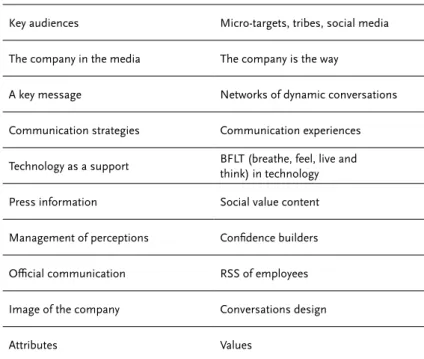
In this scenario, the evolution of public relations in the 2.0 context is evident (Table 1) and this should be reflected in the communication planning.
Traditional public relations Public relations 2.0
Key audiences Micro-targets, tribes, social media The company in the media The company is the way
A key message Networks of dynamic conversations Communication strategies Communication experiences Technology as a support BFLT (breathe, feel, live and think) in technology Press information Social value content Management of perceptions Confidence builders Official communication RSS of employees Image of the company Conversations design
Attributes Values
Table 1. Traditional public relations versus public relations 2.0 Source: Fernández, 2010, pp. 1-2
Based on the differentiation presented by Fernández (2010), it can be said that public relations 2.0 requires a greater commitment from tourism organizations in estab-lishing links with the target audience. In this sense, Ramos Ostio (2012) defines public relations 2.0 as:
the discipline that provides reciprocal, interactive, dynamic and necessar-ily continuous communication between an organization and its audiences, through the internet. It is aimed at a proactive, informed, hypersegmented public that, in some cases, will facilitate the organization’s work, due to its previous interests and, in others, it will hinder dialogue due to the power of selection, creation and filtering of information. (p. 75)
In this new scenario, social media should be considered as public relations tools, taking into account their potential to create dialogue and establish relationships with audiences (Huertas Roig & Mariné Roig, 2014). This dialogue must be symmetrical, constant and committed to the interests of users (Viñarás Abad & Cabezuelo Lorenzo, 2012). In addition, he said, social media allows the identification of established commu-nities that have interests in common with the tourism organization.
But as usual, any communication procedure requires strategic planning, through the implementation of a communication plan. Concerning public relations 2.0, this plan-ning must be governed by the following premises:
• to create public profiles that respect the organization’s strategy;
• to generate content suitable for each medium and go beyond the institution’s news and news; • to participate actively and regularly in publications;
• to not fear the loss of control, allowing users to interact, comment and promote; • to generate value and enrich the users’ experience;
• to incorporate people with experience (Gómez Vílchez, 2012).
To these premises must be added the monitoring and permanent assessment of the digital environment. One should never fail to follow the conversations that take place in the virtual communities (own and external), as their constant monitoring exposes the shared opinions about the destination, so that it is possible to offer a service more aligned with the requirements and with the needs of the tourist 2.0.
Twitter as a platform for public relations 2.0
Twitter is a free platform that allows the creation and publication of content on the web. It is linked to the culture of mobile phones and text messages. Its dimension as an online social network gives messages the potential for instant sharing and its global character makes it an extraordinary tool for monitoring information, sources and trends (Orihuela, 2010), offering the possibility to “listen” to markets and customers in a dif-ferent, empathetic and close way, optimizing its dialogical potential (García Medina, Miquel-Segarra & Navarro-Beltrá, 2018).
Twitter is probably one of the most influential social networks in the commercial sphere due to the number of messages and conversations it produces around brands, intervening in the creation of their images and influencing purchase decisions. A suc-cessful brand community can help strengthen consumer loyalty by serving as a multi-directional communication and knowledge-sharing channel (Andersen, 2005, quoted in Sánchez Jiménez, 2018). On the other hand, Twitter is also an important tool to collect opinions from users, due to the monitoring facility it provides, allowing personalized and immediate attention, generating a pleasant experience with customers who value the response of organizations.
It is important to remember that:
we are facing a consumer who demands and accesses much more informa-tion, precisely thanks to the internet, where, with the click of a button, an infinite amount of data is obtained, both from the offer, as from companies or other users: comments on blogs, networks, websites... All this means that the consumer is much more demanding; therefore, companies must adapt by showing themselves to be attractive and competitive, in various ways, in order to reach all users, providing them with the information they require. (Araújo Vila, Cardoso & Filipe de Araújo, 2019, p. 22)
Thus, Twitter should be a tool that facilitates a more personal contact with the new digital tourist, helping him before and during the trip, while benefiting for the tourist destination (Torrado Rodríguez & Blanco Gregory, 2019).
This new form of communication has revolutionized the world and its influence depends on the quality of the content generated. It is not just about getting followers, it is about providing relevant information so that they stay on the web.
Methodology
The objective of this investigation was related to the analysis of communication 2.0 on the Twitter pages of Ibero-American governments, by applying the model of evaluation of communication 2.0 in social media (Altamirano Benítez, Marín-Gutiérrez & Ordóñez González, 2018; Altamirano Benítez, Ochoa & Túñez-López, 2018), which analyzes four variables: the presence on the network, growth, the activity of government agencies and the interactivity between governments and tourists 2.0.
Qualitative methodology was applied in order to conceptualize the management of tourism communication and 2.0 communication processes, defining models and trends in digital environments. The quantitative study, on the other hand, helped to measure possible relationships between variables. For this quantitative analysis, data were col-lected from the different performance indicators (KPI), with the aim of verifying relation-ships, which helped to describe the behavior of tourism organizations and tourists, in digital environments.
The study thus enabled a descriptive analysis of the Twitter accounts of the 22 Ibero-American governments in two different periods, which allowed for a comparative approach. In order to have data on the presence on the network of each of the govern-ments, the PRGS (presence, answer, generation and suggestion) model, proposed by Interactive Advertising Bureau Spain (2016), was used as a reference, which obtains this data from the sum of the tweets published by the followers. To determine the growth of tourism accounts on Twitter, two performance indicators (KPIs) were used: (1) the num-ber of followers and (2) the total growth of the network. In order to examine the activity of government accounts, a review of the main performance indicators was used, such as the number of publications, the frequency or number of daily publications and the mul-timedia resources used. In turn, interactivity was analyzed by assessing the responses, suggestions and levels of participation of users and, in addition, the level of response from government agencies, to obtain engagement data. To measure the tourist commu-nication 2.0 index, indicators of presence, growth, activity, participation and engagement were used.
To generate valid and comparable indexes, the results were standardized using the minimum and maximum formula.
Data collection was carried out with a convenience sample, but sufficiently repre-sentative due to its time span and the inclusion of all the actors that make up the study universe. The analysis period extended from March to August – to include the high and low seasons of tourism in the years 2015 and 2018.
Results
Presence and impact
Twitter, as a tool of direct communication, presents an extraordinary growth, which, as is predictable, is reflected in the social, cultural, political and economic life of a coun-try or region (Fainholc, 2011). In addition, Twitter is a social platform that enhances the visibility, credibility and growth of any business (Ramos, 2013).
In 2015, “the growth of Twitter users in Ibero-America reached 17,4%, exceeding the world average (14,1%). At first glance, this means a significant expansion of the social network in the region, given the observable conditions in terms of internet use per capita” (Villalobos, 2015, § 2). This positions Twitter as the second most used social network for tourism promotion, with 20 countries integrating it in their 2.0 communication strategies. In 2018, Panama also incorporated the platform into its tourism communication strategy.
To analyze network presence, the PRGS model from Interactive Advertising Bureau Spain (2016) was applied. In the two study periods, Mexico led the ranking of attend-ance and, in 2015, the second position was occupied by Ecuador, followed by Brazil and Spain; in 2018, Spain took second place in the ranking, followed by Ecuador, Brazil and Colombia. In the Spanish government’s account, the network presence is also influenced by the number of tweets it publishes in the two periods, being one of the most active in the network (Graph 1).
Graph 1: Presence
Nevertheless, with reference to the global penetration of the social network, the data show little impact achieved by the accounts of Ibero-American governments on Twitter. In 2015, Mexico and Ecuador reached only 0,1% of the 320 million registered
us-ers on the network1 and, in 2018, Mexico reached 0,5% and Spain, the second country
with the highest number followers, achieved 0,09% of the 335 million users (Twitter ya no crece más en usuários, 2018).
Growth
To assess growth, the analysis is made from KPI1 = number of followers and KPI2 = total network growth.
Number of followers
One of the main characteristics of social media is the fact that they need a com-munity that promotes relationships. However, the countries of Ibero-America have no impact with the accounts created for the promotion of tourism. By conducting a com-parative analysis between 2015 and 2018, Mexico gained 1.468.102 followers, followed by Cuba and Nicaragua, which grew 100% over the three years. Portugal, Spain, Costa Rica, Argentina and Guatemala reached between 50 and 75 percentage points (Graph 2).
Graph 2: Number of followers
Bolivia, Honduras and Brazil, during this period, lost, respectively, 100%, 62% and 37% of their followers and it should be emphasized that Bolivia’s account is no longer active. Countries like Ecuador and Paraguay had a lower growth, between three and six percentage points.
Total growth
Total growth was calculated by comparing the number of followers at the beginning and end of a period. When comparing 2015 and 2018, it is evident that Venezuela, Bolivia, Ecuador, El Salvador and Uruguay have failed to increase the number of users.
The accounts that registered the greatest growth were Nicaragua (234%), followed by Guatemala (96%) and Spain (1,7%). There was also a decrease in Colombia (91%), Argentina (72%) and Chile (52%) (Graph 3).
Graph 3: Total growth
Activity in tourist accounts
The activity was analysed through the interrelationships that are derived from anal-ysis of KPI1= the number of publications, KPI2= the frequency or number of daily publica-tions, and KPI3= the multimedia resources used.
Number of publications
The level of updating of tourist accounts is intermittent, as there are periods of ex-cessive participation followed by days of inactivity. The number of publications is variable and there are countries like Spain, Portugal and Panama that have increased the number of publications. For example, Portugal exceeds 3.000 tweets. However, there are coun-tries that register a high number of publications in 2015, but in 2018 their participation decreased, as can be seen in Graph 4.
Graph 4: Number of publications
Number of daily publications
When comparing the data in 2015 and 2018, it was found that Ibero-American gov-ernments did not manage Twitter accounts strategically. Taking as a model the study “Internet Republic”, by Sánchez Amboage, Rodríguez Fernández, Martínez Fernández, Rodríguez Vázquez and Álvarez de la Torre (2014), it is argued that the ideal average number of publications in this social network is five to seven tweets per day.
In 2015, 85% and in 2018, 90,5% of the accounts did not update the network fre-quently, with five countries found each year that did not publish daily. On the contrary, in the first period analyzed, Spain and Colombia saturated the network with 15 posts per day and, in the second period, Spain increased its publications to 22 posts per day and Portugal to 18 daily publications.
In 2015, however, there were two accounts (Venezuela and Dominican Republic) that maintained an ideal level of publication, according to the study mentioned above. In 2018, no country was able to optimize its publications.
Graph 5: Number of daily publications
Multimedia resources
The implementation of multimedia resources in social media and the assessment of their impact is a topic of interest to many academics. Multimedia, which is under-stood as the confluence of various means to transmit a message, finds, in web 2.0, a fun-damental ally. The new technological tools allow content such as images, videos, texts and sounds to reach users easily. In fact, the convergence of these formats becomes the key to digital communication (Costa Sánchez & Piñeiro Otero, 2014).
To make the offer more tangible and attract more tourists, the preferred multi-media resources of the Ibero-American governments were images, used in 44% of the tweets, followed by the links, found in 24% of the posts, and the combination of the two resources, which are present in 20% of publications. On the other side, 12% of publica-tions are text.
It should be noted that, despite the importance attributed to video as a resource for tourism promotion (Martínez-Sala & Campillo Alhama, 2018), this resource was not incorporated in the tourist campaigns analysed (Graph 6).
Graph 6: Multimedia resources
Interactivity
Based on the premise interactivity fuels engagement explained by Fondevila Gas-cón, Berianin Bañares, Olmo Arriaga and Valero Hermosilla (2014), interactivity becomes a key element to study in tourist communication 2.0. In this study, interactivity is ana-lyzed with KPI1 = the responses, suggestions, and levels of user engagement and KPI2 = the level of service of government agencies to obtain engagement data.
Response
To evaluate the response of tourists 2.0, the PGRS model (Interactive Advertising Bureau Spain, 2016) was used. It can be said that the response of users on Twitter is determined by the network presence of government agencies, the permanent updating of the account and the quality of the published content. In the two study periods, Spain, with 137.525 (2015) and 332.001 (2018) likes, consolidates itself as the country with the greatest acceptance. In 2015, the Dominican Republic and Colombia follow, and in 2018, Mexico and Brazil. It should be noted that there is a proportional relationship with the number of posts in these accounts, except in the case of Mexico, which, with 13% fewer publications, reaches a greater impact, probably due to the quality of these publications.
Countries that do not obtain user participation are those that do not update their accounts: in 2015, Paraguay and Peru and, in 2018, Bolivia and Honduras (Graph 7).
Graph 7: Response
Suggestion
The viral nature generated by the content published on Twitter is essential to as-sess the impact of a tourism account. The PRGS Model was used to measure the sug-gestion through the retweets made by the followers. In the analysis, results similar to the response were obtained, with the countries that managed the greatest viral content, in 2015, being Spain, Colombia and the Dominican Republic and, in 2018, Spain, Mexico and Brazil (Graph 8).
Graph 8: Suggestion
Participation
The participation rate of users on Twitter was obtained by adding the total number of responses to the total number of suggestions made. To the results, the min.-max. formula was applied, which allowed standardization of data to catalog tourist accounts.
It was observed, then, that the Spanish account, both in 2015 and in 2018, was the only one that achieved success among users, and can be evaluated as participatory. But in 2018, Mexico also led the ranking, due to the communication strategies implemented. However, 56% of the analyzed sample was not very participative and 37% did not reach the minimum scores (Table 2).
2015 2018
Country Rate Country Rate Category
ES 100 ES 100 Parcipatory MX 73 CO 8 BR 19 Improvable DO 8 PT 6 MX 5 UY 5 BR 5 DO 4 CR 3 SV 4 CL 2 NI 3 GT 2 CO 3 AR 2 CR 2 EC 1 PA 2 PT 1 CL 2 NI 1 EC 1 PY 1 SV 0,4 GT 0,5 Deficient VE 0,4 PY 0,5 UY 0,2 CU 0,3 BO 0,2 PE 0,3 CU 0,1 AR 0,03 HN 0 VE 0,01 PE 0 HN 0 PA 0 BO 0
Table 2: Rate of participation
Response level
The 2.0 commitment that tourist organizations must acquire when using social media as platforms for promotion prescribes the success they can achieve in the digital environment. Based on this principle, the response level was calculated as a function of the conversation rate, understood as interactions with other profiles, using identifica-tions (@).
Reaching 80% in 2015 and 56% in 2018, Brazil consolidated itself as the country with the best conversation rate and, although it did not respond directly to internet us-ers, its 2.0 communication strategy sought to promote interaction, by identifying other Twitter accounts.
In 2015, with a large margin of difference, the Dominican Republic (9%) and Chile (8%) interacted very little with followers through identifications, which indicates that it is not in the interest of their governments to promote interaction on the network. In 2018, Spain improved its conversation rate to 34%, while the Dominican Republic rose by five percentage points. Countries like Uruguay, Peru and Ecuador, with a rate of 0% in 2015, now have a conversation level of 28%, 3% and 2% respectively. However, talking
to followers is not a priority for governments and 50% of the sample does not interact at this time.
These results coincide with the conclusions of Castelló Martínez, Del Pino Romero and Ramos Soler (2014), who showed that most brands understand Twitter as an infor-mation channel, in which users receive content, instead of classifying it as an opportu-nity to dialogue with consumers and understand their needs and concerns.
Finally, Venezuela’s tourist account promotes itself as the channel of interaction with tourists, however, as shown, it does not fulfill the objective of its creation, due to the little interaction it maintains with tourists 2.0 (Graph 9).
Graph 9: Conversation rate
Engagement
Engagement, according to González-Bernal, Roncallo-Dow and Arango-Forero, 2018 (quoted in Ventín Sánchez, 2019), is a complex and multidimensional concept that the authors apply to the study of audiences from four dimensions: the user experience (motivations and expectations), emotional response, the result of the cognitive process (attention, memory and learning) and behaviors and participations. Engagement con-sists of an interactive and bilateral process between some subjects (citizens, workers, customers, users and social networks) and some organizations (public administration, company, digital platform). On the subjects’ side, engagement refers to both a cognitive state and its own manifestation, since it materializes the symbolic representations made through the use of social networks (like, share, comment) such as physical gestures, at-titudes or expressions of opinions (Ballesteros Herencia, 2019).
In this way, the relationship established between tourism organizations in Ibero-America and 2.0 tourists on Twitter determines engagement in the social environment. To calculate it, the following formula, previously utilized in several investigations (Cvi-jikj & Michahelles, 2013; Martínez-Fernández, Sánchez-Amboage, Mahauad-Burneo & Altamirano-Benítez, 2015; Valerio, Herrera, Herrera & Rodríguez, 2014), was used:
Engagement = Likes + retweets x 100 Nº followers
Due to factors such as updating the network in a non-strategic and frequent way, as well as the low commitment 2.0 of government agencies in Ibero-America, Twitter engagement was also low.
In 2015, Spain led all aspects analysed, maintaining an engagement of 141, followed by the Dominican Republic with an engagement level of 54 points, Costa Rica with 45 points and Nicaragua, very close to this value, with 41 points. There are seven countries where the level of engagement is less than 33.
In 2018 the engagement of Twitter accounts improved. Nicaragua reached 164 points, followed by Spain with a score of 147 and Brazil, with 71, but the other countries do not exceed 30 points (Graph 10).
Graph 10: Engagement
The results showed that Ibero-American organizations must improve their digital strategies to achieve greater engagement with 2.0 tourists. It must be remembered that the power of the brand is something emotional (Liberos, Núñez, Bareño, García, Gutié-rrez & Pino, 2014), so it is important to invest in commitment and involvement with consumers.
Index of communication 2.0 on Twitter
In order to know the 2.0 tourist communication index, the 2.0 communication evaluation model was applied to social media (Altamirano-Benítez et al., 2018). As pre-viously mentioned, Twitter is a participatory, interactive and committed tool. Thus, the model for evaluating its effectiveness integrates the presence, growth, activity, participa-tion, response and engagement indices. These indices are generated by standardization with the minimum and maximum formula.
After creating the indices for each of the Twitter accounts of the tourist destina-tions, the results of the analysed variables were added and divided by six, in order to weight and catalog the results (Table 3).
Fanpage
Presence
Indicators Index Formula application
Fanpage 1 1.837.643 100 Calculation of the index of presence (NPi) of the fanpage 2:
Fanpage 2 1.136.504 58 NPi = x 100
Fanpage 3 1.111.591 56
NPi= x 100
Fanpage 4 176.287 0
X = value of the analyzed fanpage 1.136.504 NPi = x 100
Fanpage
Presence
Indicadors Index Formula application
Min = is the minimun value of all fanpages 176.287
Max = is the maxium value of all fanpages 1.837.643 NPi= 57,79
Table 3: Formula application example (Altamirano-Benítez et al., 2019)
From the evaluation, it can be concluded that communication processes 2.0 are not optimal, it is even evidenced that the indices decrease from period to period. Spain maintains its acceptable category, but in 2018 it is surpassed by Mexico due to the parti-cipation promoted by its users.
Country 2015 Country 2018 Category
Efficient 81 - 100 Acceptable high 61 - 80 ES 60 MX 51 Acceptable 41 - 60 ES 48 MX 39 BR 30 Aceptable low 21 - 40 BR 30 CO 28
DO 19 CL 19 Improvable 0 - 20 EC 14 PT 17 CL 13 AR 16 CR 9 SV 11 GT 9 NI 9 AR 8 DO 8 NI 8 HN 7 VE 8 CR 7 PY 6 CO 7 UY 6 UY 6 BO 4 PA 6 CU 4 EC 6 PT 4 PE 5 SV 2 PY 4 HN 1 BO 4 PE 1 CU 2 PA 0 GT 2 VE 1
Table 4: Communucation index 2.0
The analysis showed that 17 (in 2015) and 18 (in 2018) of tourist accounts are clas-sified as upgradeable, as they do not exceed the 20 points of the 2.0 communication index (Table 4). It can then be concluded that, on Twitter, there is no 2.0 tourist commu-nication. The social network is used for the unidirectional sending of content, becoming a traditional information medium. Thus, the levels of interaction with users should be improved, mainly.
The tourist 2.0 that uses Twitter is more participatory and demands better quality content. In addition, Twitter is a platform that attracts adult users. The percentage of young people (10 to 17 years old) with a presence in this network is low, so there are rea-sons why cognitive maturity (between 30 and 45 years old) makes Twitter an innovative network (Infra, 2010, quoted in Aladro Vico & Villalba de Benito, 2014, p. 22).
Finally, the behavior and commitment 2.0 of tourist organizations is low, which is reflected in the low levels of updating and responses on the network.
Discussion and conclusions
There were considerable changes between the two study periods. Paradoxically, tourism organizations in 2018 are, against prognosis, less active on the network and interact less with their audience, despite the fact that 2.0 tourists are more active on Twitter. Due to this traditional behavior, there was a decrease in the number of follow-ers in some of the tourist accounts. This reaction can happen due to two factors: ei-ther users are more demanding with the content they search on the web or ei-there is an
influence of the current crisis on Twitter, which confers more than three years of inertia in this network2.
Despite the importance of Twitter as a platform for exchanging opinions in many countries around the world, it can be said that its reach in number of users is relatively modest. Twitter published its report in the second quarter of 2018, where it declared 355 million monthly active users worldwide, a figure that was slightly lower in the period from January to March3. Instagram reached 1 billion in June 2019 and Facebook surpassed 2,2 billion users.
In this study, Twitter recorded 346.213 interactions in 2015 and 1.016.338 in 2018. Such data demonstrates a change in the behavior of tweeters, as more interactions do not mean better interactions. In fact, in 2015, users were more involved, sharing content. But, in 2018, participation was limited to clicking on the “like” button. This is, moreover, a behavior proportional to that of organizations, which were less committed to the man-agement of communication 2.0 in 2018. Ibero-American governments need to invest in strategic public relations planning in order to better understand their environment and their target audience.
Research has shown, in fact, that user participation is proportional to activity in organizations’ accounts. The greater the number of publications, the greater the interac-tion of users. However, an interesting variable was found: the quality of the published content. When there was a good content strategy, success on the network was ensured, therefore, the premise that less is more is confirmed and that adequate content manage-ment is necessary to reach users’ commitmanage-ment (López de Ayala, Catalina & Fernández, 2018).
It was also concluded that there is strategic communication in the organizations analysed, with a plan regulated by objectives. The contents of traditional campaigns are “recycled” or content is produced in an improvised fashion and, consequently, their qual-ity is compromised. In addition, there is a shift from excessive publication on some days to the absence of information on others, as mentioned by Paniagua and Huertas (2018b):
the personalization of tourist information and products is the future; des-tinations must program personalized products, depending on the type of audience and their different needs: traveling with children, young people, sun and beach, culture, escapades, etc.; and social media is an important channel to segment the offer. Therefore, it is important to know exactly through which social media each type of audience is reached and also to know exactly what information users are looking for. Thus, social media must be carefully selected, as well as the use of each and the content to be published. (p. 529)
For this reason, it no longer makes sense to think of communication as transmit-ting information. The publics are not only the recipient of the message, but they must be 2 Retrieved from https://es.statista.com/grafico/14930/usuarios-mensuales-activos-de-twitter-en-todo-el-mundo/
thought of as producers of information and as participants in the co-creation of content, becoming promoters of tourist destinations. Thus, communication strategies must be implemented in social networks that allow the establishment of relationships with the public, based on dialogue, interaction, and participation. Tourism companies cannot and should not become transmitters of information, but they must take an active role and listen to their audiences, in order to manage relationships that will strengthen the image and reputation of the tourist destination.
This work made it evident that communication 2.0 has not evolved in Ibero-Amer-ica. Social media are still considered an exclusive platform for the transmission of infor-mation, without interaction with tourists. Therefore, it is not possible to talk about the development of public relations, because there is no involvement with consumers, but only the desire to keep them informed or to promote products or services. Such a context does not contribute to the construction of the image and reputation of the tourist desti-nation, much less to its positioning.
Translation: Verónica Altamirano-Benítez, José Miguel Túñez-López and María Fa-biana Altamirano-Benítez
References
Aladro Vico, E. & Villalba de Benito, S. (2014). Twitter como difusor de innovaciones. In A. Fernández Paradas (Ed.), Interactividad y redes sociales (pp. 19-36). Madrid: Editorial ACCI.
Altamirano-Benítez, V., Marín-Gutiérrez, I. & Ordóñez Gonzáçez, K. (2018). Comunicación turística 2.0 en Ecuador. Análisis de las empresas públicas y privadas. Revista Latina de Comunicación Social, 73, 633-647. https://doi.org/10.4185/RLCS-2018-1273
Altamirano-Benítez, V., Ochoa, S. & Túñez-López, M. (2018) Models to assess communication 2.0 on websites and organizational social media. In 13th Iberian Conference on Information Systems and Technologies (CISTI) (pp. 1-6). Caceres: IEEE. https://doi.org/10.23919/CISTI.2018.8399432
Araújo Vila, N., Cardoso, L. & Filipe de Araújo, A. (2019). La comunicación 2.0 en el sector turístico español: análisis de las webs oficiales de promoción turística. International Journal of Marketing, Communication and New Media, 5, 5-25.
Ayestarán, R., Rangel, C. & Ana, S. (2012). Planificación estratégica y gestión de la publicidad. Conectando con el consumidor. Madrid: ESIC Editorial.
Ballesteros Herencia, C. (2019). La representación digital del engagement: hacia una percepción del compromiso a través de acciones simbólicas. Revista de comunicación, 18(1), 215-233. https://doi. org/10.26441/RC18.1-2019-A11
Castells, M. (2005). La era de la información. Economía, sociedad y cultura. Mexico: Siglo XXI Editores. Castelló Martínez, A., Del Pino Romero, C. & Ramos Soler, I. (2014). Twitter como canal de comunicación
corporativa y publicitaria. Communication & Society, 27(2), 21-54.
Costa-Sánchez, C. (2016). Relaciones públicas y social media. Proactividad de las empresas españolas en las redes sociales audiovisuales. Revista Internacional de Relaciones Públicas, 11(6), 235-254.
Costa Sánchez, C. & Piñeiro Otero, T. (2014). Estrategias de comunicación multimedia. Barcelona: Editorial UOC.
Cuenca Fontbona, J. & Matilla, K. (2015). Medición de las relaciones públicas mediante modelos, indicadores y técnicas: estudio vertical. In K. Mantilla (Ed.), Cambio social y relaciones públicas (pp. 21-46). Catalonia: UOC Ediciones.
Cvijikj, I. & Michahelles, F. (2013). Online engagemet factors on Facebook brand pages. Social Network Analysis and Mining, 3, 843-861. https://doi.org/10.1007/s13278-013-0098-8
Fainholc, B. (2011). Un análisis contemporáneo del Twitter. Revista de Educación a Distancia 26, 1-12. Fernández, M. (2010). Relaciones públicas 2.0. Revista Razón y Palabra, 11(52) , 1.
Fernández Rincón, A. & Hellín Ortuño, P. (2018). Filantropía y empresas vitivinícolas. Gestión de la
información desde los medios sociales 2.0. Obra Digital: Revista de Comunicación, 15, 31-49. https://doi. org/10.25029/od.2017.180.15
Fondevila Gascón, J., Berianin Bañares, A., del Olmo Arriaga, J. & Valero Hermosilla, J. (2014). Interactividad, multimedia e hipertextualidad en el periodismo digital deportivo en España. In A. Fernández Paradas (Ed.), Interactividad y redes sociales (pp. 231-244). Madrid: Editorial ACCI.
García Medina, I., Miquel-Segarra, S. & Navarro-Beltrá, M. (2018). El uso de Twitter en las marcas de moda. Marcas de lujo frente a marcas low-cost. Cuadernos.Info, (42), 55-70. https://doi.org/10.7764/ cdi.42.1349
Gómez Vílchez, S. (2012). Evaluación de preferencia y participación. Museos españoles y redes sociales. Revista TELOS (90), 79-86.
Huertas Roig, A. & Mariné Roig, E. (2014). Uso y utilidades de las herramientas de análisis online para la evaluación de la comunicación de las marcas de destino a través de los social media. Revista Sphera Publica [Special Vol.], 117-134.
Interactive Advertising Bureau Spain. (2016). IV estudio de la actividad de las marcas en medios sociales. Retrieved from https://iabspain.es/estudio/
iv-estudio-de-la-actividad-de-las-marcas-en-medios-sociales-version-completa/
Ivars Baidal, J. & Solsona Monzonís, J. (2016). Gestión turística y tecnologías de la información y la comunicación (TIC): el nuevo enfoque de los destinos inteligentes. Documents d’Anàlisi Geogràfica, 62(2), 327-346
Levine, R., Locke, C., Searls, D. & Weinberger, D. (2000). The Cluetrain manifesto. The end of business as usual. EUA: Perseus Books Group.
Liberos, E., Núñez, Á., Bareño, R., García, R., Gutiérrez, J. C. & Pino, G. (2014). El libro del marketing interactivo y la publicidad digital. Madrid: ESIC Editorial.
López-Carril, S., Villamón Herrera, M. & Añó Sanz (2019). Conceptualización de los medios sociales: oportunidades para la gestión del deporte. Retos, 36, 468-473.
Lopez, E. & Moreno, B. (2019). A gestão dos meios sociais na administração local: analisses dos municipios rurais na Espanha. Vivat Academia, 148, 77-99. https://doi.org/10.15178/va.2019.148.77-99
López de Ayala, M.C., Catalina, B. & Fernández, J.G. (2018). Estrategias de las empresas de campos de golf en Twitter. Su influencia sobre la interactividad de los públicos. Communication Papers, 7(15), 231-245. https://doi.org/10.33115/udg_bib/cp.v7i15.22193
Martínez-Fernández, V. A., Sánchez-Amboage, E., Mahauad-Burneo, M. D. & Altamirano-Benítez, V. (2015). La gestión de los medios sociales en la dinamización de destinos turísticos termales: análisis crosscultural de modelos aplicados en España, Portugal y Ecuador. Revista Hologramática , 2(23), 47-60.
Martínez Sala, A. M. (2018). Marketing 2.0 aplicado al sector turístico: la función comercial de los sitios webs de las organizaciones de marketing de destinos. Vivat Academia. Revista de Comunicación, 143, 01-23. http://doi.org/10.15178/va.2018.143.01-23.
Martínez-Sala, A. & Campillo Alhama, C. (2018). El video como soporte en la narrativa digital de los eventos turísticos 2.0. Miguel Hernández Communication Journal, 9(1), 227-260. https:// doi.org/10.21134/mhcj. v0i9.230
Orihuela, J. (2010). El modelo ideal de interactividad es la conversación. Entrevista a José Luis Orihuela. Revista Icono 14, 9-21.
Paniagua, F. & Huertas, A. (2018a). Credibilidad en los medios sociales de los destinos turísticos. Revista de la Asociación Española de Investigación de la Comunicación, 5(9), 120-130. https://doi.org/10.24137/ raeic.5.9.14
Paniagua, F. & Huertas, A. (2018b). El contenido en los medios sociales de los destinos turísticos y la búsqueda de información de los usuarios. Cuadernos de Turismo, 41, 513-534. https://doi.org/10.6018/ turismo.41.327131
Paricio Esteban, M.P., Femenía Almerich, S., Del Olmo Arriagay, J. & Sánchez Valle, M. (2019). La web y la sala de prensa como herramientas de relaciones públicas en la comunicación de moda. Revista Prisma Social, 24, 99-134.
Ramos, J. (2013). Twitter para empresas. La guía definitiva de marketing en Twitter. Spain: Edición Kindle. Ramos Ostio, M. (2012). Relaciones públicas. 2.0: el uso de los medios sociales en la estrategia de
comunicación online de marcas ciudad españolas. Revista Internacional de Relaciones Públicas, 2(3), 71-90. https://doi.org/10.5783/RIRP-3-2012-04-71-9
Sánchez Amboage, E., Rodríguez Fernández, M., Martínez Fernández, V., Rodríguez Vázquez, C. & Álvarez de la Torre, J. (2014). El uso de los medios sociales Facebook y Twitter en los balnearios de Galicia. In J. Solsona Monzonís (Ed.), XVIII Congreso AECIT 2014 (pp. 12). Benidorm. https://doi.org/10.13140/ RG.2.1.4830.8969
Sánchez Jiménez, M. (2018). Análisis de la estrategia en las redes sociales oficiales desarrollada por el Consejo de Promoción Turística de México. Revista CIMEXUS, 8(1), 13 -29.
Torrado Rodríguez, G. & Blanco Gregory, R. (2019). Uso de internet y redes sociales para la práctica turística caso de Extremadura. Almenara: revista extremeña de ciencias sociales, 11, 119-153.
Túñez-López, M., Altamirano, V. & Valarezo, K. (2016). Comunicación colaborativa de turismo 2.0:
promoción, publicidad e interactividad en sitios web de turismo de gobierno en América Latina. Revista Latina de Comunicación Social, 71, 249-271. https://doi.org/10.4185/RLCS-2016-1094
Túñez-López, M., Sixto García, J. & Guevara Castillo, M. (2011). Redes sociales y marketing viral: repercusión e incidencia en la construcción de la agenda mediática. Revista Palabra Clave, 14(1), 53-65. https://doi. org/10.5294/pacla.2011.14.1.3
Twitter ya no crece más en usuarios (2018, August 17). Expansión Economía Digital. Retrieved from https:// www.expansion.com/economia-digital/companias/2018/08/17/5b618387268e3e9c558b458e.html
Valerio, G., Herrera, N., Herrera, D. & Rodríguez M. (2014). En Facebook el tamaño sí importa. Engagement y el impacto de la longitud del mensaje en las fanpages de las universidades mexicanas. Revista digital universitaria, 15(2). Retrieved from http://www.revista.unam.mx/vol.15/num2/art12/
Villalobos, D. (2015, May 20). América Latina registrará el crecimiento más grande en usuarios de Twitter en 2015. Fayerwayer. Retrieved from https://www.fayerwayer.com/2015/05/ america-latina-registrara-el-crecimiento-mas-grande-en-usuarios-de-twitter-en-2015/
Viñarás Abad, M. & Cabezuelo Lorenzo, F. (2012). Claves para la participación y generación de contenido en las redes sociales: estudio de caso del Museo del Prado en Facebook. Revista de Estrategias, Tendencias e Innovación en Comunicación, (3), 87- 103. https:// doi.org/10.6035/2174-0992.2012.3.6
Ventín Sánchez, J. (2019). Audiencias: de lo teórico a lo práctico. Tradiciones de un concepto falsable. Palabra Clave, 22(1), 1-6. https://doi.org/10.5294/pacla.2019.22.1.11
Biographical notes
Verónica Altamirano-Benítez holds a PhD in Communication and Creative Indus-tries with international mention and Cum Laude. She holds a master’s degree in Com-munication and Creative Industries from Santiago de Compostela University (Spain), a diploma in Organizational Communication, Communication for Development and a bachelor of Social Communication from the Private Technical University of Loja (UPTL) (Ecuador). She has an Extraordinary Doctoral Prize in the area of Social and Legal Sci-ences. She is a member of UTPL’s quality team, co-author of international books and articles in scientific and informative journals. She is part of the research groups: “Com-munication and Digital Culture”; Xescom; “International Research Network for Peace Communication and Culture Management”. Its publications include topics related to or-ganizational communication, tourism communication, communication 2.0, digital com-munication, political communication and communication for development.
ORCID: https://orcid.org/0000-0003-1238-1886 Email: [email protected]
Address: Private Technical University of Loja, Department of Communication Sci-ences, San Cayetano, s/n, Campus UTPL, 110104, Ecuador
José Miguel Túñez-López has a PhD in Journalism from the Autonomous University of Barcelona and is a professor of Organizational Communication and Communication Strategies at the Department of Communication Sciences at the University of Santiago de Compostela (USC). He works as a professor of several ibero-american organizations and universities teaching processes and planning of communication management. He is a consultant and member of the USC’s “New Media” research group since December 2007. He has authored hundreds of information pieces, papers and books regarding communication. He was the dean of the Faculty of Communication Sciences at USC (2004-2009) and is currently the director of the Graduate Program in Contemporary Communication and Information. He received the Reina Sofía National Journalism Award.
ORCID: https://orcid.org/0000-0002-5036-9143 Email: [email protected]
Address: University of Santiago de Compostela, Department of Communication Sciences, Faculty of Communication Sciences - Avda de Castelao, s / n. North Campus, 15782, Santiago de Compostela, Spain
Maria Fabiana Altamarino-Betínez holds a master in Social Communication and Digital Content Creation from the University of Vigo. She is an engineer in Business Administration from the Private Technical University of Loja (UTPL) (Ecuador), and has an Advanced Refinement level in the Academic Linguistique Internationale (Montreal - Canada).
ORCID: https://orcid.org/0000-0003-0083-8367 Email: [email protected]
Address: University of Vigo, Faculty of Social Sciences and Communication, De-partment of Audiovisual Communication and Advertising, San Cayetano, s/n, Campus UTPL, 110104, Spain
* Submited: 26/06/2019 * Accepted: 31/10/2019