Sho
rt
R
ep
or
t
J. Braz. Chem. Soc., Vol. 21, No. 6, 1126-1128, 2010. Printed in Brazil - ©2010 Sociedade Brasileira de Química 0103 - 5053 $6.00+0.00
*e-mail: [email protected]
Application of a Purge-and-Trap System for Fixed-NH
4+Determination by Matrix
Interference Free Ion Chromatography in Oil Reservoir Rocks
Fernanda V. M. Pontes,a Manuel C. Carneiro,a Delmo S. Vaitsman,b
Maria Inês C. Monteiro,*,a Lílian I. D. da Silvaa and Arnaldo A. Netoa
aCoordenação de Análises Minerais, Centro de Tecnologia Mineral (CETEM), Av. Pedro Calmon, 900,
Cidade Universitária, 21941-908 Rio de Janeiro-RJ, Brazil
bDepartamento de Química Analítica, Instituto de Química, Universidade Federal do
Rio de Janeiro, Av. Athos da Silveira Ramos, 149, Cidade Universitária, 21941-909 Rio de Janeiro-RJ, Brazil
É proposto um método para determinação de NH4+-ixo utilizando um sistema de arraste
imerso em um banho ultrassônico para extração de NH3 e cromatograia de íons para determinação de NH4+. O método é mais rápido, simples e sensível (LOD = 4,4 µg g−1 NH
4+) que o método
clássico Kjeldahl.
A method for ixed-NH4+ determination using a system immersed into an ultrasonic bath for
NH3 extraction and ion chromatography for NH4+ determination is proposed. The method is faster,
simpler and more sensible (LOD = 4.4 µg g−1 NH
4+) than the classical Kjeldahl method.
Keywords: ixed-ammonium, sandstone, ion chromatography, ultrasound-assisted purge-and-trap system.
Introduction
The determination of ixed-NH4+ in sedimentary rocks
has been applied in geochemical studies for exploration purposes, especially in the oil industry.1-8 The studies are
based on a conceptual model of NH4+ ixation in oil source
rocks during the burial diagenesis. This model explains why larger relative quantities of NH4+ are ixed in transformed
authigenic clays (e.g. illite, illite-smectite or
illite-smectite-vermiculite), in sandstones and is generally consistent with depth-diagenesis schemes for clay minerals and generation of hydrocarbons from the thermal maturation of organic matter. Relative changes in ixed-NH4+ concentrations serve
as indicators of hydrocarbons formation or may indicate their pathways during the migration from source beds to reservoirs.2,4
The wet analytical methods for ixed-NH4+ determination
have been carried out in three steps: (i) previous removal
of inorganic exchangeable-N with an extractant (e.g.,
2 mol L-1 KCl), followed by the organic-N removal with
an oxidant reagent (e.g., KOBr or NaOCl) 2,4,9 or removal
of exchangeable-N and organic nitrogen species with
1 mol L-1 KOH; (ii) release ixed-NH
4+ by destruction of
the silicates with a HF and HCl mixture1,10 and (iii) Kjeldahl
steam distillation.2,4,9,10 The ammonium concentration in the
solution obtained after the distillation has been determined by titrimetric;2,4,10 or colorimetric methods.11 A limit of
detection (LOD) of 56 mg kg-1 for ixed-NH
4+ determination
in sedimentary rocks was reported.2
A simpliied purge-and-trap system for NH3 extraction was recently used for total nitrogen determination.12 This
system presented many advantages, among them, the matrix interference elimination, mainly Na+, which was
necessary for NH4+ determination by ion chromatography.
In the present work, this system was proposed for ixed-NH4+ determination. All results were compared with those
obtained with the classical Kjeldahl method. Sandstones from Brazilian oil reservoirs with different ixed-ammonium were analyzed.
Experimental
Apparatus and operating conditions
Pontes et al. 1127 Vol. 21, No. 6, 2010
of 40 kHz and volume of 3 L to convert the released-NH4+
into NH3 vapor was used. A water-bath model 304-149 from Quimis Aparelhos Cientíicos (Diadema, SP, Brazil) was used to remove exchangeable-NH4+ and organic-N
from the samples by the proposed and comparative methods. A CELM centrifuge model LS-3 (Barueri, SP, Brazil) with 3200 rpm of speed was used. A Metrohm chromatography system (Herisau, Switzerland) with a dialysis membranemodel788, a vacuum degasser model 837 and a conductivity detector model 819 were used for NH4+ determination. Integrated areas were used to
quantify ion signals. Ammonium separation was carried out in a METROSEP C2 250/4.0 column (Herisau, Switzerland) with 7.0 µm particle diameter. The low-rate of the eluent (4.0 mmol L−1 tartaric acid/0.75 mmol L-1
2,6-pyridinecarboxylic acid) was kept at 1.0 mL min-1;
the column temperature was 35 °C and the running time was 15 min. The sample loop volume was 20 µL. The mineralogical characterization of all samples was carried out by X-ray diffraction (XRD, powder method) using a Bruker diffractometer model AXS D5005 equipped with Goeble mirror. Working conditions were: CoKα monochromatic radiation, 40 mA and 35 kV. Samples were run at a speed of 0.02 degree s-1. Qualitative
mineralogical determination was estimated with DiffracPlus
software.
Reagents, standards and samples
All chemicals used were of analytical grade. The water was puriied with a reverse osmosis system model Elix 5 and deionized Milli-Q from Millipore Indústria e Comércio Ltda. (Barueri, SP, Brazil). The following solutions were used: 1 mol L-1 KOH, 7.5 mol L-1 HF,
1 mol L-1 HCl, 0.1 mol L-1 HCl and 1000mg L-1 NH 4+
(NH4Cl) stock standard solution. The intermediate standard solutions were daily prepared. Sandstones from Brazilian oil reservoirs with different ixed-NH4+
concentrations were analyzed.
Removal of exchangeable-N and organic-N
An aliquot of 25 mL of 1.0 mol L-1 KOH was added to
a 50 mL polypropylene centrifuge tube containing 0.2 g of sample, pre-treated as Pontes et al.12described. The mixture
was then heated at 80 °C for 8 h in a water-bath. After the mixture reached room temperature, the phases were separated by centrifugation. The supernatant was discarded, and the residue was washed three times with 5 mL of 1 mol L-1 KOH and inally with water. This procedure was
adopted for the comparative and proposed methods.
Release of ixed-NH4+
An aliquot of 10 mL of a mixture containing 7.5 mol L-1
HF and 1.0 mol L-1 HCl was added to the polypropylene
centrifuge tube containing the residue. The mixture was heated in a water-bath at 80 °C for 12-16 h, until it was almost dry. This procedure was adopted for both comparative and proposed methods.
Released-NH4+ determination by the comparative method
After the mixture has reached the room temperature, it was transferred to a polypropylene distillation tube of the Kjeldahl system. Then, NH3 was distilled, collected as NH4+ and determined by the indophenol colorimetric
method.12
Ammonia extraction by the US-assisted purge-and-trap system (proposed method)
The low diagram for the NH3 extraction by US-assistance was similar to that showed by Pontes et al.12
with the following modiications: all tubes were made of Telon and the manifold were of polypropylene; the dimensions of the reaction tube and the NH3 collection tube were 2.7 cm i.d. and 12 cm length; the dimensions of the U tube were 0.3 cm i.d. and 13 cm length; the manifold (0.6 cm i.d.) had six tips to connect six sets and one more tip to connect the vacuum pump. The polypropylene tube containing the released-NH4+ in solution was connected
to the U tube, and then the procedure was the same as Pontes et al.12 described.
Results and Discussion
Analytical results
The working concentration of NH4+ was in the
range of 100 to 800 µg L−1; the linear regression of the
analytical curve gave a slope of 0.1863 mV s L µg-1
and the correlation coeficient of the calibration curve was higher than 0.99. The blank measurement was 13 ± 2 µg L-1 NH4+ (n = 10). The LOD was 4.4 µg g-1 NH4+. It was calculated from the equation LOD = 3SBL/b, where
SBL was the standard deviation of ten blank concentration measurements and b was the slope of the calibration curve.
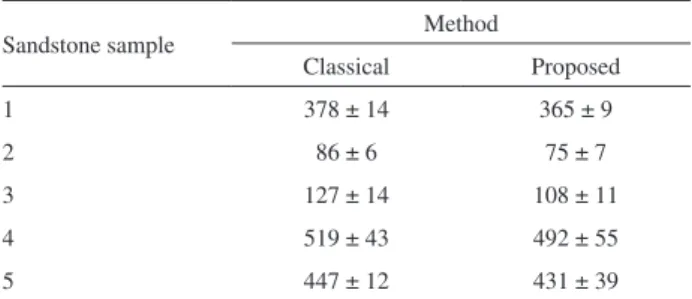
The relative standard deviations (RSD) were lower than 11% (n = 3). Good agreement was found between the results of ixed-NH4+ obtained by the proposed method and
Application of a Purge-and-Trap System for Fixed-NH4+ Determination J. Braz. Chem. Soc.
1128
presence of illite, which probably was responsible by the NH4+ ixation.
Conclusion
The simpliied method for ammonia extraction is faster and simpler than the classical Kjeldahl steam distillation method. The limit of detection (LOD) was 4.4 µg g−1 NH
4+.
The relative standard deviations (RSD) were lower than 11% (n = 3).
Table 1. Concentrations (µg g−1) of the ixed-NH
4+ in sandstone samples
obtained by the classical and proposed methods (n = 3)
Sandstone sample Method
Classical Proposed
1 378 ± 14 365 ± 9
2 86 ± 6 75 ± 7
3 127 ± 14 108 ± 11
4 519 ± 43 492 ± 55
5 447 ± 12 431 ± 39
References
1. Stevenson, F. J.; Geochim. Cosmochim. Acta1962, 26, 797. 2. Williams, L. B.; Ferrell. Jr. R. E.; Chinn, E.W., Sassen, R.; Appl.
Geochem.1989, 4, 605.
3. Bradley, A. D.; Vickers, B. P.; Peachey D.; Appl. Geochem.
1990, 5, 471.
4. Williams, L. B.; Wilcoxon, B. R.; Ferrell, R.E. Sassen, R.; Appl. Geochem.1992, 7, 123.
5. Lindgreen, H.; Clay Miner.1994, 29, 527.
6. Drits,V. A.; Lindgreen, H.; Salyn, A. L.; Am. Mineral.1997,
82, 79.
7. Boyd, S. R.; Chem. Geol.1997, 137, 57.
8. Holloway, J.M.; Dahlgren, R. A.; Casey, W. H.; Chem. Geol.
2001, 174, 403.
9. Bremner, J. M. In Methods of Soil Analysis, Part 2, Agronomy 9;
Black, C. A. ed., 1965, pp. 1149-1178.
10. Dhariwal, A. P. S.; Stevenson, F. J.; Soil Sci.1958, 86, 343.
11. Stevenson, F. J.; Science1959, 130, 221.
12. Pontes, F. V. M.; Carneiro, M. C.; Vaitsman, D. S.; Da Rocha, G. P.; Da Silva, L. I. D.; Neto, A. A.; Monteiro, M. I. C.; Anal. Chim. Acta2009, 632, 284.
Received: March 6, 2009