A Two Band Model for Superconductivity:
Probing Interband Pair Formation
R. E. Lagos
a)and G. G. Cabrera
b)a)
Departamento de F´ısica, IGCE, Universidade Estadual Paulista (UNESP)
CP. 178, 13500-970, Rio Claro, SP, Brazil b)
Instituto de F´ısica ‘Gleb Wataghin’, Universidade Estadual de Campinas (UNICAMP)
CP. 6165 Campinas, SP 13083-970 Brazil
Received on 23 May, 2003
We propose a two band model for superconductivity. It turns out that the simplest nontrivial case considers solely interband scattering, and both bands can be modeled as symmetric (around the Fermi level) and flat, thus each band is completely characterized by its half-band widthWn(n=1,2). A useful dimensionless parameter is
δ, proportional toW2−W1. The caseδ= 0retrieves the conventional BCS model. We probe the specific heat,
the ratio gap over critical temperature, the thermodynamic critical field and tunneling conductance as functions ofδ and temperature (from zero toTc). We compare our results with experimental results forM gB2 and
good quantitative agreement is obtained, indicating the relevance of interband coupling. Work in progress also considers the inclusion of band hybridization and general interband as well as intra-band scattering mechanisms.
1
Introduction
Magnesium Diboride (M gB2) appears to be a rather “un-conventional” conventional superconductor [1, 2]. Two band effects observed as deviations of conventional BCS in-clude: anomalous specific heat [3] and two gaps features (in-cluding double peaked tunneling conductance spectra) [4-10]. The superconductive mechanism, nevertheless seems to be conventional phonon BCS-like [11]. In this short com-munication we present a two band model based on the clas-sical work by Suhl et al. [12] and on an extension of the latter applied to highTccompounds [13]. We mention other multiband models in the literature [14-21], and some cal-culations and fittings within a multiband and strong cou-pling context include Ref. [22-25]. In section II we intro-duce a two band model [12, 13] and within the usual BCS scheme we compute the mean field expressions for the free energy, entropy, critical field, conductance, and the selfcon-sistent equations for the gaps functions. In particular we consider the simplest case: solely interband pairing cou-pling via phonons. In section III we compare our simple model with some experimental results for the case ofM gB2 [26, 1, 27], indicating that the interband pairing mechanism is somehow relevant. Finally in section IV we present some concluding remarks and future work.
2
The two band model
Our model follows Ref. [12, 13], with the Hamiltonian
H = k,m
Ek,m
c†k,mck,m−c−k,mc†−k,m
−1
N
kq,m
Vn,mc†k,nc†−k,nc−q,mcq,m (1)
where thec†k’s are the usual creation operators,Ek,mare the bands dispersion (m = 1,2),Vn,mare the positive pairing coefficients(V12 =V21 andD =V11V22−V122 = 0). We have definedk= (k,↑),−k= (−k,↓),Nis the number of sites and the last summation is with the usual energy cutoff ωD. The order parameters∆nare defined as the expectation values
∆n= 1 N
k,m Vn,m
c†k,mc†−k,m
The effective Hamiltonian is given by (within the Hartree Fock scheme for anomalous pairing, see Ref. [13])
Heff=N E0+
k,m
Ψ†k,m(Ek,mσz−∆mσx) Ψk,m
E0= 1 D
V22∆21+V11∆22−2V12∆1∆2
, Ψk,m≡ c
k,m c†−k,m
⌈
andσx,σzare the usual Pauli matrices.The free energy per siteF is given by
exp (−βN F) =Trexp
−βHeff
F =E0+ T N
k,m
lnfk,m(1−fk,m)
wheref(ω) = (exp(βω) + 1)−1, ωk,m =
E2
k,m+ ∆2m and fk,m = f(ωk,m). The relative free energy δF = F −F(∆1 = ∆2 = 0), the thermodynamic critical field
Hc, entropy (per site) and specific heat are given, respec-tively by
δF(T) =E0− T N
k,m
ln (1 + coshβωk,m) (1 + coshβEk,m)
=−8π1 H2 c
(2)
S=−2
N
k,m
((1−fk,m) ln(1−fk,m) +fk,mlnfk,m)
(3)
⌋ ⌈
CV =T
∂S ∂T V =
2β2 N
k,m
fk,m(1−fk,m)
ω2 k,m+
1 2β
∂∆2 m
∂β (4)
The condensation energy is given by
δF(T = 0) =WC=E0− 1 N
k,m
(ωk,m−Ek,m) (5)
and the superconductor- normal tunneling differential conductance (conveniently scaled) is defined by
G(V) =−
m
dερm,S(ε)
∂f(ε+V)
∂ε (6)
ρm,S(ε) =ρm
sign(ε)ε2−∆2 m
Real
(ε+iΓ)2 (ε+iΓ)2−∆2
m
, Γ→0+
Minimization of the free energy with respect to the gaps functions,yields a coupled nonlinear system of integral equations for the gaps, to be solved selfconsistently, and given by
(V22−DR1(∆1, T)) ∆1−V12∆2 = 0
(7)
−V12∆1+ (V11−DR2(∆2, T)) ∆2 = 0
where
Rm(∆m, T) = +ωD
−ωD
dερm(ε)S
ε2+ ∆2 m
, S(x) = 1 2xtanh
x
2T
⌈
and withρm(ε)the density of states associated to the respec-tive band. The transition temperature is the highest temper-atureTc =βc−1,solution of
(V22−DR1(0, Tc)) (V11−DR2(0, Tc)) =V122
3
Results
V11 = V22 = 0, V12 = λ, the simplest relevant case [12, 13]. We consider two flat symmetric bands, with ρm(ε)≡ρm(0) =ρm.
The gaps equations (7) now read
∆m=λρn∆nR(∆n, T), n=m= 1,2
R(∆, T) =
ωD
0
dε
√
ε2+ ∆2tanh
β
2
ε2+ ∆2
At zero temperaturethe gaps equations are given by (in conveniente units)
φ1 =
2∆1(T = 0) 3.53Tc
= exp1 ξ(1−a)
(8)
φ2 =
2∆1(T = 0) 3.53Tc
= exp1 ξ
1−1a
whereξ2=λ2ρ
1ρ2andasatisfies a selfconsistent equation. An excellent approximate solution is given by
lna= ξθ
2−θ, θ= ln
1 +δ 1−δ with
−1< δ= ρ1−ρ2 ρ1+ρ2
<1
Notice that all the above mentioned observables will yield the standard BCS expressions [28] in the limitδ= 0.
The critical temperature is given by Tc = 1.13ωDexp(−ξ−1).
We label the bands such that δ > 0. If we consider M gB2, from Ref. [1, 27] we have Tc ≃ 40 0K,ωD ≃ 8000K
yielding ξ ≃ 0.32. From Ref. [26] we approx-imate W1 ≈ 5.6eV (ρ1 ≈ 0.179eV−1), W2 ≈ 14.eV (ρ2≈0.071eV−1)yieldingδ≈0.432.
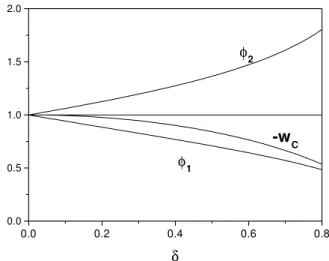
In Fig. 1 we plot the normalized gapsφmat zero tem-perature, Eq.(8), and (minus) the condensation energy−Wc Eq.(5), both as function of δ.The condensation energy is normalized to the BCS reference statei.e. Wc=δF(δ, T = 0)/δF(δ= 0, T = 0)(see Eq.2). The chosen normalization yields the standard BCS (weak coupling) value of unity for the gaps and the condensation energy. Asδis varied away from zero the condensation energy is less than the standard BCS. One gap will depart from weak to ‘a medium coupling regime’ (φ2>1), conversely the other gap will dive towards ‘a less than weak coupling regime’ (φ1 <1), with the geo-metrical averageφ1(δ)φ2(δ) ≡1always in the standard weak coupling regime. These features seem consistent as we fit the parameterδwith experimental data [1]-[10].
In order to solve for the gaps, Eq.(7), we can use the available low temperature and near the critical temperature expansions [28]. These allow us to nicely interpolate, for the full temperature regime0 ≤τ =T /Tc ≤1. Once this
is done we can readily compute the specific heat, Eq.(4), en-tropy, Eq.(3), and the thermodynamic critical field, Eq.(2).
0.0 0.2 0.4 0.6 0.8
0.0 0.5 1.0 1.5 2.0
-w
Cφ2
φ1
δ
Figure 1. Gapsφmat zero temperature and (minus) the
condensa-tion energy−Wcversusδ.Convenient unitsφm= 2∆0m/3.53Tc
andWc=δF(δ, T= 0)/δF(δ= 0, T = 0). See text.
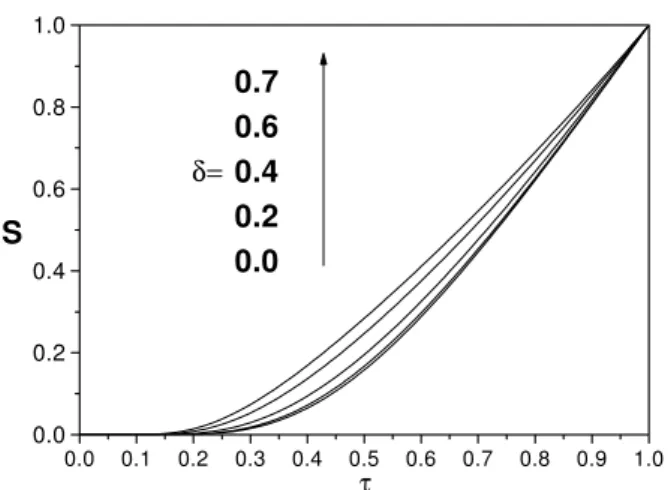
In Fig. 2 we plot the specific heatCV (normalized to the normal state value atTc) versus the temperatureτ for several values ofδ.The standard BCS result is represented by the curveδ= 0.The anomalous behavior ofCV consists in going under the BCS value in the region0.5 < τ < 1, and going over the BCS value in the region0 < τ < 0.5. This feature is in very good agreement with Ref. [3]. In Fig. 3 we plot the entropyS(normalized to the normal state value atTc) versus the temperatureτfor several values ofδ. The standard BCS result is represented by the curveδ= 0. Asδdeparts from zero (bands are less ‘identical’) the sys-tem increases its entropy. In Fig. 4 we plot the thermody-namic critical field (normalized to the reference stateδ= 0, T= 0) versus the temperatureτfor several values ofδ.The standard BCS result is again represented by the curveδ= 0. Asδincreases the critical field is reduced when compared to the BCS value. This is in agreement with experimental results [3].
0.0 0.1 0.2 0.3 0.4 0.5 0.6 0.7 0.8 0.9 1.0 0.0
0.5 1.0 1.5 2.0 2.5
δ=0.7 δ=0.6 δ=0.4
δ=0.2 δ=0.0
CV
τ
Figure 2. Specific heatCV versusτ = T /Tcfor severalδ
0.0 0.1 0.2 0.3 0.4 0.5 0.6 0.7 0.8 0.9 1.0 0.0
0.2 0.4 0.6 0.8 1.0
0.7 0.6 0.4 0.2 0.0 δ=
S
τ
Figure 3. EntropySversusτ =T /Tcfor severalδvalues;
nor-malized to the normal state entropy atTc: Sn(Tc) = 4π2(ρ1 +
ρ2)Tc/6.See text.
0.0 0.1 0.2 0.3 0.4 0.5 0.6 0.7 0.8 0.9 1.0 0.0
0.2 0.4 0.6 0.8 1.0
0.0 0.2 0.4 0.6 0.7 δ= Hc
τ
Figure 4. Thermodynamic critical fieldHcversusτ =T /Tcfor
severalδvalues; normalized to the reference (BCS) stateT = 0, δ= 0, H2
c(τ) =F(τ, δ)/F(0,0).See text.
-20 -16 -12 -8 -4 0 4 8 12 16 20
0 1 2 3
τ=0.5
τ=0.1
τ=0.2 τ=0.0 δ=0.5
G(V)
V(meV)
Figure 5. Tunneling conductance for several temperatures, at δ = 0.5, versus applied voltage. A small dispersion is included Γ = 0.1meV [22]. See text.
In Fig. 5 we plot the conductance, Eq.(6) versus applied voltage, for a fixed value ofδ = 0.5, and for several tem-peratures, and where a small dispersion is included,Γ = 0.1
meV [22].The double peaked form is in very good agree-ment with observations (see for example Ref. [7]).
4
Concluding Remarks
We presented the simplest relevant two band model for superconductivity, based on a standard BCS-like pairing mechanism. We computed the gaps equations at zero tem-perature. Also the specific heat, entropy, critical field and conductance as function of temperature. We considered the simplest interband scattering mechanism (one pairing pa-rameter) and two planar symmetrical bands (one parame-ter band model). Our results seems to be in very good agreement with some experimental results on the compound M gB2, indicating that interband pairing is somehow rele-vant for this compound. These results are being investigated further. Work in progress incorporates intraband pairing mechanisms, an hybrid-like interband pairing mechanism [13], absent in most of the theoretical models, and a more involved band structure.
References
[1] C. Buzea and T. Yamashita; Supercond. Sci. Tech14, R115 (2001).
[2] M. Angst and R. Puzniak; arXiv:cond-mat/0305048.
[3] F. Bouquet, R. A. Fisher, N. E. Phillips, D. G. Hinks, and J. D. Jorgensen; Phys. Rev. Lett.87, 047001 (2001).
[4] S. Tsuda, T. Yokoya, T. Kiss, Y. Takano, K. Togano, H. Kito, H. Ihara, and S. Shin; Phys. Rev. Lett.87, 177006 (2001).
[5] S. Tsuda, T. Yokoya, Y. Takano, H. Kito, A. Matsushita, F. Yin, H. Harima, and S. Shin; arXiv: cond-mat/0303636.
[6] G. Karapetrov, M. Iavarone, W. K. Kwok, G. W. Cabtree, and D. G. Hinks; Phys. Rev. Lett.87, 4374 (2001).
[7] M. Iavarone, G. Karapetrov, A. E. Koshelev, W. K. Kwok, G. W. Cabtree, and D. G. Hinks; arXiv:cond-mat/0203329.
[8] A. Sharoni, I. Felner, and O. Millo; Phys. Rev. B63, 220508 (2001).
[9] H. Schmidt, J. F. Zasadzinski, K. E. Gray, and D. G. Hinks; Rev. B63, 220504 (2001).
[10] Y. Bugoslavsky, Y. Miyoshi, G. K. Perkins, A. V. Berenov, Z. Lockman, J. L. MacManus-Driscoll, L. F. Cohen, A. D. Caplin, H. Y. Zhai, M. P. Paranthaman, H. M. Christen, and M. Blamire; Supercon. Sci. Tech.15, 526 (2002).
[11] X. K. Chen, M. J. Konstantinovi´c, J. C. Irwin, D. D. Lawrie, and J. P. Franck; Phys. Rev. Lett.87, 157002 (2001).
[12] H. Suhl, B. T. Matthias, and L. R. Walker; Phys. Rev. Lett.3, 552 (1959).
[13] R. E. Lagos, Solid State Commun.79, 323 (1991).
[14] T. ¨Ord and T. N. Kristoffel, Physica C370, 17 (2002).
[15] K. Yamaji; J. Phys. Soc. Jap.59, 677 (1990), ibid.701476 (2001).
[16] M. Imada; J. Phys. Soc. Jap.70, 1218 (2001).
[18] J. E. Hirsch and F. Marsiglio, Phys. Rev. B 64, 144523 (2001).
[19] V. P. Ramunni, G. M. Japiass´u, and A. Troper; Physica C 364-365, 190 (2001)
[20] I. N. Askerzade and A. Gencer; J. Phys. Soc. Jpn.71, 1637 (2002)
[21] T. Mishonov and E. Penev; arXiv:cond-mat/0206118.
[22] H. J. Choi, D. Roundy, H. Sun, M. L. Cohen, and S. G. Louie; arXiv:cond-mat/0111183, Nature418, 758 (2202).
[23] C. Joas, I. Eremin, D. Manske, and K. H. Bennemann; Phys. Rev.65, 132518 (2002).
[24] A. A. Golubov, J. Kortus, O. V. Dolgov, O. Jepsen, Y. Kong, O. K. Andersen, B. J. Gibson, K. Ahn, and R. K. Kremer; J. Phys. Condens. Matter14, 1353 (2002).
[25] A. Brinkman, A. A. Golubov, H. Rogalla, O. V. Dolgov, and J. Kortus; Phys. Rev. B65180517 (2002).
[26] J. M. An and W. E. Pickett; Phys. Rev. Lett.86, 4366 (2001).
[27] J. Kortus, I. I. Mazin, K. D. Belashchenko, V. P. Antropov, and L. L. Boyer; Phys. Rev. Lett.86, 4656 (2001).