Compressible Kelvin-Helmholtz Instability
at the Terrestrial Magnetopause
Alejandro G.Gonzalez
InstitutodeFsiaArroyoSeo, UniversidadNaionaldelCentrode la
ProviniadeBuenosAires,Pinto399, 7000Tandil,BuenosAires,Argentina
JulioGratton
,Fausto T. Gratton
,
INFIPInstitutode FsiadelPlasma,Faultadde CieniasExatasyNaturales,
UniversidaddeBuenosAires, PabellonI,CiudadUniversitaria,1428, BuenosAires,Argentina
and CharlesJ. Farrugia
Spae SieneCenter,Universityof NewHampshireatDurham,NH,USA.
Reeivedon30June,2002
TheompressiblemagnetohydrodynamiKelvin-Helmholtzinstability oursintwovarieties,one
that anbe alled inompressible as it exists inthe limit of vanishing ompressibility (primary
instability),while the other exists onlywhenompressibility is inludedinthemodel(seondary
instability). In previous work we developed tehniques to investigate the stability of a surfae
of disontinuity between two dierent uniform ows. Our treatment inludes arbitrary jumpsof
theveloity andmagnetieldsaswellas ofdensityandtemperature,withnorestrition onthe
wavevetorofthemodes. Thenitallowsstabilityanalysesofomplexongurationsnotpreviously
studiedindetail. Hereweapplyourmethodstoinvestigatethestabilityofvarioustypialsituations
ourring at dierent regions of the front side, and the near anks of the magnetopause. The
physialonditionsofthevetorandsalareldsthatharaterizetheequilibriuminterfaeatthe
positionsonsideredareobtainedbothfromexperimentaldataandfromresultsofsimulationodes
ofthemagnetosheathavailableinthe literature. Wegive partiularattentiontotheompressible
modesinongurationsinwhihtheinompressiblemodesarestabilizedbythemagnetishear. For
ongurationsofthefrontofthemagnetopause,whihhavesmallrelativeveloities,wendthatthe
inompressibleMHDmodelgivesreliableestimatesoftheirstability,andompressibilityeetsdo
notintroduesignianthanges. However,attheanksofthemagnetopausetheourreneofthe
seondaryinstabilityandtheshiftoftheboundaryoftheprimaryinstabilityplayanimportantrole.
Consequently,ongurations thatarestableifompressibilityisnegletedturnouttobeunstable
whenitisonsideredandthestabilitypropertiesarequitesensitiveonthevaluesoftheparameters.
Thenompressibilityshouldbetakenintoaountwhenassessingthestabilityproperties ofthese
ongurations, sine the estimates basedon inompressible MHDmay be misleading. A areful
analysisisrequiredineahase,sinenosimpleruleofthumbanbegiven.
I Introdution
The Kelvin-Helmholtz Instability (KHI) an our in
laboratory and astrophysial plasmas when two (or
more) regionsarein relativemotion. Otherproperties
oftheplasma(likemagnetield,densityand
tempera-ture)mayalsohangearossthetransitionlayer.These
hangesmodifythestabilityandotherpropertiesofthe
modes,thusompliatinganalysis. TheKHImayour
attheterrestrialmagnetopause,theboundarythat
sep-arates theinterplanetarymagnetield (IMF) present
inthemagnetosheath,andthegeomagnetieldinside
the magnetosphere. The relative motion is generated
by thesolarwindowingthroughthe magnetosheath.
Theow veloity and the magneti eld are assumed
parallelto the transitionlayer, andthe magnetield
mayhangeitsdiretion(magnetishear)andits
mag-nitudearossthetransition. Thelowfrequeny
magne-tohydrodynami(MHD)modesshallbeourmain
on-ernheresinetheirinstabilitymayproduelarge-sale
turbulene. The KHI is onsidered a major soure of
anomaloustransportofmomentumfromthesolarwind
intothemagnetosphere,andaauseofvisousdragat
themagnetopause. Thisissopartiularlyduring
peri-odsofnorthwardIMF,whenthereonnetion of
mag-netilinesislesslikelyto our. Weshallnotonsider
other unstablemodes that analsoarise loseto, and
inside the magnetopause, in frequeny ranges higher
thanthose treatedbyMHD. These modes leadto
mi-rosopiturbulenethat aetsthetransport
proper-tiesoftheplasmaatsmallerwavelengths. Weshallalso
negletdissipativeeetssothatourtreatmentshallbe
basedonidealMHD.TheKHIatthemagnetopausehas
beenexaminedsine the1950's, andalargeliterature
hasgrownon thissubjet. Wequote heresomereent
reviews[?℄,[?℄,[? ℄among severalothers.
The theory of the KHI for arbitrary geometry is
exeedingly ompliated, but fortunately in many
ir-umstanes,thewavelengthoftheperturbationisvery
small as ompared to the urvature radii of the
tran-sition layer. Then the problem an be treated in a
planeslabgeometry,inwhih theunperturbed
quanti-ties(density, pressurep,magneti eld B andmass
owveloityu)dependonlyontheyoordinate
(per-pendiulartothetransitionlayer). Adierential
equa-tionforthelinearMHDperturbationsofstratied
plas-mas [?℄,and its generalization to inlude the eet of
gravity[?℄,anbeusedasastartingpointtoinvestigate
theseproblems.
If the wavelength of the perturbation is large as
ompared to the thikness of the transition layer, we
anignorethestrutureofthetransitionandassumeit
isamathematialsurfae(aty=0)separatingtwo
in-nite, uniform plasmaregions. Theproblem anthen
be treated by means of standard normal mode
anal-ysis. The equations of ideal MHD and the
parame-ters of the onguration do not involve either a
fre-queny or a length sale. Therefore the theory only
preditsthe (omplex) phaseveloityv of the
pertur-bation(v =!=k
t
), as afuntion of the parametersof
theplasma,ofthemassveloitiesoftheuniformregions
and of thewavenumberk
t (k
x ;0;k
z
) ofthe
pertur-bation of the interfae. Then an algebrai dispersion
relationisobtained,whoserootsyield v.
Within the inompressible MHD approximation
(IMHD) it is possible to derive a simple formula for
the phase veloity. Beause of this, the IMHD result
isoftenemployedinspae physistointerpretthe
ob-served data and to examine the stability of the
on-guration. Sometimes the tait assumption is made
that the ompressibility eets thus negleted should
(ifany)improvestability. Thisassumptionisbasedon
wellknowntheorems(seeforexample[?℄)derivedfrom
a variational priniple, aording to whih
ompress-ibilityleadstoapositiveontributiontotheenergyof
theplasmaandsotendstostabilizeit. However,these
resultsannotbeappliedhere,sineduetothepresene
ofmassowtheplasmaansustainperturbationswith
a negative energydensity that anlead to instability.
This isaonsequeneofthetransformationproperties
oftheenergydensityW ofaperturbationof
wavenum-berk
t
andfrequeny!underGalileantransformations.
Let theprimes denote thequantities alulated in the
refereneframeoftheplasmathatmoveswitha
velo-ityu(u
x ;0;u
z
)withrespettotheobserver,andthe
quantities withoutprimes refer to theobserverframe.
ThenwehaveW 0
=! 0
=W=!. Notiethatthe
Doppler-shiftedfrequeny in the plasmaframe! 0
=! uk
t
anbenegativeifu
k =uk
t =k
t
issuÆientlylarge(the
phaseveloityintheplasmaframeisthenv 0
=v u
k ).
Sine W 0
is always positive, the energydensity of the
perturbation as measured in the laboratory frame is
thennegative. Anegativeenergydensityperturbation
mayleadtoinstabilityifitouplestoapositiveenergy
density perturbation, sineboth angrowwithout an
externalsoureofenergy.
InIMHD, theinstabilityarises from perturbations
oftheinterfaethat areexponentiallydampedinboth
plasma regions (like surfae gravity waves in water).
The penetration depth of these perturbations is equal
totheirwavelength2=k
t
. Theinstabilityourswhen
u
k
exeeds a ritial value u
i
(see below), suh that
their energy density (in the laboratory frame) is
pos-itive in one region and negative in the other. These
perturbationsgrowbeauseenergyistransferredaross
theinterfaefromthenegativeenergydensityregionto
theother,andremainsloalizedasitannotbe
trans-ported away aross the magneti eld. This
instabil-itywillbealledprimary KHI.Notiethat theAlfven
wave onlytransports energyalong theeld lines, and
doesnotpartiipateintheKHIifthetransitionregion
hasavanishingthikness.
The essential dierene between IMHD and
om-pressibleMHD (CMHD)isthat inthelatterthereare
perturbations (the fast andslowmagnetosoni waves)
that propagate in the bulk of the plasma and
trans-portenergy arossthemagnetield (seefor example
[?℄) Consequently, theeet of ompressibility on the
Kelvin-Helmholtzinstabilityisomplex,leadingtothe
stabilization of ertain perturbations, the
destabiliza-tionof others, and theourreneof modes that have
noanalogueinIMHDandthatmayleadtonew
insta-bilities. Letusbrieydisussthebasiphysisinvolved.
Considerrst the primary KHI. Due to
ompress-ibility, ifu
k
is suÆiently largethe perturbation may
be able to propagate in both regions as fast
magne-tosoniwaves. Whenthishappens,theperturbationis
stable, and itis seenby the observerasapair of fast
magnetosoni wavesradiated awayfrom the interfae.
Oneofthesewaveshasanegative,andtheothera
pos-itiveenergydensity[?℄,[?℄. Inthisway,perturbations
that areunstable aordingto IMHDare stabilized by
ompressibility. However,in addition to this large-u
k
stabilization, there is another eet of ompressibility
for the onset of the instability is lowered (u
u
i ).
This is a destabilizing eet, sine perturbations that
are stable aording to IMHDbeome unstable when
ompressibilityistakenintoaount. Asweshallshow
later,thiseetisimportantinthemagnetopause. The
penetrationdepthoftheunstablemodesisalsoaeted
byompressibility,andisnolongergivenby2=k
t .
Yet,therearefurthereetsofompressibility. Due
to the existene of the slow magnetosoni waves new
kindsofperturbationsoftheinterfaearepossible,that
havenoounterpartinIMHD.Someofthese
perturba-tions are stable evanesent osillations, and other are
slowmagnetosoniwavesin bothregions(radiationof
apairof slowmagnetosoniwaves). However,someof
these new perturbationsmay be unstable. These new
instabilities (alledseondary KHI)arefoundin
inter-vals of u
k
that orrespond to stable perturbations
a-ording to IMHD. They lie totally, or partially, below
the ritialvalueu
fortheonset oftheprimaryKHI.
The ourreneofthe seondaryKHI is anadditional
destabilizing eet ofompressibility. Thegrowthrate
of theseondary modesis usually small. However, we
shall see that these modesannot be ignored,sinein
someongurationsof themagnetopausetheyare the
onlyunstablemodespresent.
Asubstantialontribution to theunderstandingof
theompressibilityeetsontheKelvin-Helmholtz
in-stability was given by Miura and Prithett [?℄.
How-ever,theseeets havenotyet beenfully explored for
general ongurations with density and temperature
disontinuitiesaswellasmagneti eld shear,suh as
those ourring in the magnetopause. For an
exten-sive revision of the literature and of the main results
on this subjet, see refs. [?℄, [?℄. Reently, we have
developedtehniques[?℄,[?℄,[?℄ to analyzethe
stabil-ity of an interfae separatingtwo uniform ows, with
arbitraryjumps intheveloity,magnetield, density
andtemperature,andwithnorestritionsonthewave
vetoroftheperturbation.
Theontentof this paper isas follows. InSetion
II we outline the basi theory. In Setion III we
ex-plain thetehniquesfor analyzing thedispersion
rela-tionandtheharateristisoftheunstablemodes.
Se-tionIVdisussestheseondaryKHI.Ausefulgraphial
tehniquethatsimpliestheomplexityofthestability
analysisisgiveninSetionV.Thephysialparameters
used in theappliationsto themagnetopausestability
areintroduedinSetionVI.Theresultsfortwo
exam-ples, (i) amodel of the front side magnetopause,and
(ii) an event observed at the near equatorial ank of
the magnetopausearegiven in Setion VII.We
deter-mine the stability of these ongurations, and study
the unstable modes that may our in them. The
nal remarks are in Setion VIII. We onlude that
theeetsof ompressibility mayintrodueimportant
hangeswithrespettothepreditionsofIMHD.
II Theory
Weonsidertwosemiinnite,uniformplasmaregionsin
relativemotion. Thegeometryoftheproblemisshown
in Fig. 1. Region 1 (y > 0), moves with aonstant
veloity u 0
1
, and region 2 (y < 0) moves with a
on-stant veloity u 0
2
. The veloities u 0
1 and u
0
2
and the
magnetieldsB
1 andB
2
areparalleltotheinterfae
(suÆxesi=1;2denote quantities pertaining toregion
1 and 2, respetively). At the interfae, p, , and B
anhavearbitrarydisontinuities,subjetto the
equi-libriumondition
p
1 +
B 2
1
8 =p
2 +
B 2
2
8
(1)
u
1
=
u
B
1
k
a
j
1
x
z
u
2
=–
u
B
2
k
a
y
2
x
z
region 1 (
y
> 0)
region 2 (
y
< 0)
j
2
p
1
p
2
r
1
r
2
y
1
Figure1. Geometryoftheproblem.
WeshallassumeidealCMHDandonsiderthe
lin-earadiabatiperturbationsofthisonguration. Sine
the growth rate of the instability does not depend
on u 0
1 and u
0
2
separately, but only on their dierene
2u =u 0
1 u
0
2
, weuse a referene frame moving with
the average veloity u 0
= (u 0
1 +u
0
2
)=2. In this frame
u
1
= u=ue
x , u
2
= u, and is the angle between
uand the wavenumberk
t (k
x ;0;k
z
) ofa
perturba-tion whose frequeny is !; the phase veloity is then
v=!=k
t
. Onethephaseveloityoftheperturbation
isfound,weanobtainitsvaluein theobserverframe
bymeansoftheGalileantransformationv 0
=v u 0
k .
The (Doppler-shifted) frequenies in the plasma
framesare!
1
=! u
k k
t
inregion1and!
2
=!+u
k k
t
inregion2,andtheorrespondingphaseveloitiesare
v
1
=v u
k ; v
2
=v+u
k
(2)
We shall denote by
i
the angles betweenB
i and
k
t
,andby'
i
theanglesbetweenB
i
andu. Theangle
betweenk
t
anduis,sothatu
k
=uos. Weemploy
A i = B i p 4 i
=Alfvenveloity ; S
i = r p i i
=Soundveloity(=5=3) (3)
d i = p A 2 i +S 2 i ; a i =A i os i ; b i =(A i S i =d i )os i (4) q i = q 1 2 (d 2 i + p d 4 i 4d 2 i b 2 i ; m i = q 1 2 (d 2 i p d 4 i 4d 2 i b 2 i (5) i = r (v 2 i q 2 i )(v 2 i m 2 i ) d 2 i (v 2 i b 2 i )
; withRe(
i
)>0;orIm(
i
)>0 ifRe(
i )=0
(6)
d
Ineahoneoftheuniformregions,thegeneralform
oftheperturbation is
i =e i(k t x !t) (C i e k t i y +D i e k t i y ) (7)
Inthisformula,
i
denotesthey-omponentofthe
dis-plaement,andC
i andD
i
areonstants. The
penetra-tiondepthoftheperturbationinregioniisproportional
to1=Re(
i ).
When Re(
i
) = 0, it an be reognized that eq.
(6) is the dispersion relation for the fast and slow
magnetosoni wavesin a semiinnite uniform moving
plasma; their wavevetoris (k
x ;k t Im( i );k z ). When Re( i
)6=0,eq. (6)isthedispersionrelationfor
evanes-ent perturbations, andof oursein this asethe
am-plitudesoftheexponentiallygrowingperturbations(D
1
andC
2
)ineq. (7)mustvanishsinetheplasmaextends
to(+ or )innity.
Theboundary onditionsat y=0(ontinuityof
andofthenormalstress)oupletheperturbationsof
re-gions1and2. Theouplingleadstoamatrixequation
that relatestheamplitudesC
i ,D i : C 1 D 1 = 1 2 1 (v 2 1 a 2 1 ) T S S T C 2 D 2 (8) Here T= 1 (v 2 1 a 2 1 ) 1 2 (v 2 2 a 2 2 ) 2
; S= 1 (v 2 1 a 2 1 ) 1 + 2 (v 2 2 a 2 2 ) 2 (9) d
The matrix equation (8) may be used to
investi-gatemanyproblemsinvolvingloalizedmodesaswellas
thereetionandtransmissionofmagnetosoniwaves.
Sine unstable modes and stable surfae osillations
have Re(
1;2
) 6= 0, we must have C
1 = D
2
= 0 and
thentheorrespondingdispersionrelationis
T= 1 (v 2 1 a 2 1 ) 1 2 (v 2 2 a 2 2 ) 2
=0 (10)
Thepropagating modeshaveRe(
1;2
)=0,so that
there isno restritionontheC
i , D
i
. Inthis ase,the
onditionsT=0andS=0determinethepolesandthe
zerosofthereetionoeÆient. Notiethatthesignof
they-omponentofthegroupveloityofmagnetosoni
wavesmaybedierentfromthesignofRe(
1;2
). Then
one must examine thegroupveloities in eah region,
to asertain whih of these onditions yields the
dis-persionrelationforradiationofapairof waves,orfor
thetotaltransmissionofwaves(andtheirtime-reversed
proesses).
III Classiation of the modes
Toinvestigatetheroots ofthedispersionrelation(10)
itisusefultointrodueapolynomialP assoiatedtoit.
It is obtainedbytaking thenumeratorof theprodut
TS,thuseliminatingthesquareroots:
Clearly, the roots of P = 0 enompass the
solu-tionsof T=0('true'roots)aswell asthoseofS =0
('spurious'roots),andwemustdisardthelatterwhen
welookforloalizedmodes. Aordingly,weall'true
branh'(T)thesetofsolutionsofT=0,and'spurious
branh'(S) thesolutionsof S=0. TheT branhand
theSbranhonsistofseveralpiees(thatweall
'seg-ments'), eah ofwhihis aontinuous manifoldin the
parameterspaeoftheproblem. Theyarearrangedin
suhawaythatanygivenTsegmentisboundedbyone
ormoreS segments(andvie-versa). Letusonsidera
rootv (realoromplex)ofP thatbelongstoaertain
segmentT
j
. If theparametershange, v movesalong
T
j
untileventuallyitarrivesto theboundarybetween
T
j
andasegmentS
l
ofS. Asitrossesthisboundary,
veasestobelongtothetruebranhandbeomes
spu-rious. ItisimportanttonotiethattheT-Sboundaries
ouronlyforv real,at thepointswhere
1;2
=0;1.
This is fortunate, sine it simplies onsiderably the
analysis ofthetopologyoftheTandS branhes.
A onvenientwayto visualize the real roots of the
dispersionrelation(10)andsounravelthetopologyof
theTandSbranhesistouseagraphialmethod
intro-duedbyChandrasekhar[?℄. Thismethodtakes
advan-tageofthefatthattheproblemofndingtherootsv
ofP =0isequivalenttosolveforv
1 andv
2
theoupled
equations
P(v
1 ;v
2
)=0 (12a)
v
2 =v
1 +2u
k
(12b)
Fromanygivensolution(v
1 ;v
2
)ofthesystem(12),
one an obtainaroot v =(v
1 +v
2
)=2of P =0. The
realsolutionsofthissystemanbeeasilyfound
graph-ially in a(v
1 ;v
2
) diagram,astheintersetions of the
lineL givenby(12b)withtheurvesthatareobtained
solvingthebiubi(inv
1 andv
2
)equation(12a)forv
2 .
In Fig. 2 we show a typial Chandrasekhar
dia-gram, orresponding to the plasma onguration (d)
investigatedin Setion VII(notie thatthesaleof v
2
isdierentfromthatofv
1
foronvenieneindrawing).
ItsuÆestoonsiderasinglequadrant,sinetheurves
v
2 =v
2 (v
1
)are symmetrialunder reetionsonboth
axes. In Fig. 2, thelines v
2 =v
1 and v
2
= v
1
rep-resentthev- and u
k
- axes (exeptfrom asale fator
p
2).
Theperturbationintheregioni(i=1;2)isaslow
magnetosoniwaveifb
i j v
i jm
i
,andafast
magne-tosoniwaveifq
i jv
i
j. Itisevanesentif0jv
i jb
i
orm
i jv
i jq
i
(weshallallthelatterthe'slow'and
'fast'evanesentperturbations,nottobeonfusedwith
theslowandfastmagnetosoniwaves).Arealroot
be-longstotheTbranhifSign(v 2
1 a
2
1
)6=Sign(v 2
2 a
2
2 )(i.
e.,ifjv
1 j<a
1 andjv
2 j>a
2 ,orjv
1 j>a
1 andj v
2 j<a
2 );
R
2
R1
’
R1
R3
’
–q
1
–a
1
–m
1
–b
1
q
2
a
2
m
2
b
2
R3
T
2
T1
T1
’
S2
S1
S3
S3
’
L
A
A
B
B
’
’
200
u
k = u
d2
when L is tangent to T
2
. For u
k >u d2 the rootsv B , v B 0
areomplexonjugate,buttheystill
be-longtotheTbranh(sine rootsanpasstotheother
branh only for v real). Then u
k = u
d2
orresponds
to marginal stability, and one of the roots v
B , v
B 0 is
unstablefor u
k >u
d2
(the other isdamped). This
in-stability persists untilu
k =u
d6
, whenL is tangentto
thesegmentR
2
. Thenu
d6
orrespondsalsotomarginal
stability,andforu
k >u d6 ,v B ,v B 0
arestableradiation
modes. On the other hand, if oneonsiders valuesof
u
k
larger than that represented in Fig. 2, the points
A, A 0
movealongT 0
1
and eventuallypassintothe
seg-mentsR
1 ,R
0
1
,andthenv
A ,v
A 0
orrespondtoradiation
modes.
Let usnowonsider smallervaluesof u
k . As u
k is
redued,L movesdownwards. ThepointsB, B 0
move
on T
2
until they pass into S
2
. It an be shown that
for u
k
> 0, no new instability arises from the roots
v
B , v
B
0. On the other hand, the points A, A 0
move
along T 0
1
until theyoalese foru
k =u
d3
. Whenthis
happens,thedoublerootv
A =v
A
0 ismarginallystable.
Foru
d1 <u
k <u
d3
wehaveinstability,andv
A ,v
A 0
,are
omplexonjugate. Marginalstabilityisagainahieved
atu
k =u
d1 . Foru
k <u
d1
thepointsA,A 0
movealong
T
1
untiltheypassintoS
1
. Nootherinstabilityrelated
tov
A ,v
A 0
oursforu
k
>0. UsingdiagramslikeFig. 2
itispossibletoinvestigatethestabilityofany
ongu-rationofinterest. However,thismethodisunpratial,
sineweneedanewdiagramforeahorientationofk
t ,
and in addition, weannot determinethegrowthrate
oftheunstablemodes.
In theaseshownin Fig. 2thereare twounstable
intervals(foru
k
>0). Therst(in orderofinreasing
u
k
) involves v
A , v
A
0 and ours for u
d1 < u k < u d3 .
The seond ours for u
d2 < u
k < u
d6
, and involves
v
B , v
B 0
. This resultisdue tothespeialhoieof
pa-rametersof Fig. 2. In general,there anbeup tosix
positivevaluesof u
k
orrespondingto signiant(i.e.,
belongingto the Tbranh)double roots of P(v)= 0,
that we label u
d1 ;:::;u
d6
. Correspondingly, there an
beuptothreeunstableintervals,namely
u d1 <u k <u d3
seondaryintervalA (13a)
u d2 <u k <u d4
seondaryintervalB (13b)
u d5 <u k <u d6
primaryinterval (13)
As theparametersare varied,itmayhappen that the
pair(u
d3 ,u
d5
),orthepair(u
d4 ,u
d5
),oalesesand
be-omes omplex. In therst ase,the seondary
inter-valA mergeswiththeprimaryinterval. Intheseond
ase,theseondaryintervalBmergeswiththeprimary
interval(as in Fig. 2). In addition the seondary
in-tervals (13a, b) may also overlap partially or totally.
The seondary intervals an be extremely narrow for
somevaluesoftheparameters,inpartiulartheyvanish
when theperturbations areutesin either region1or
2. Fornegativeu
k
, aompletelysymmetrialresultis
obtained,inwhihthesignsofu
d1 ;:::;u
d6
arehanged,
theinequalities(13a-)arereversed,andtherolesofthe
root pairs (A, A 0
) and (B, B 0
) are exhanged. There
arenosimpleformulaeforu
d1 ;:::;u
d6 .
Tondthedoublerootsv
d1 ;:::;v
d6
ofP(v)andthe
orresponding u
k
valuesu
d1 ;:::;u
d6
wemust solve
nu-meriallyfor(u;v)thesystem
P(u;v)=0 ; P(u;v)=v=0 (14)
and disardtheroots belongingto the Sbranh. The
unstableintervalsanthenbemappedintheparameter
spaeoftheonguration(seeSetion V).
IV The seondary
Kelvin-Helmholtz instability
With thehelp ofdiagrams likeFig. 2it iseasyto
un-derstand the role of the ompressibility on the KHI.
As S i inreases, b i and m i approah a i
, and q
i
in-reases without bound, so that in the inompressible
limit (S
1 ;S
2
! 1) the seondary unstable intervals
disappear, and we are left only with the primary
un-stable interval,that now extends to innity. The
se-ondary KHI is then a onsequene of ompressibility,
aswellasthelargeu
k
stabilizationoftheprimaryKHI
at u
d6
. It isenlighteningto seein moredetailthe
ori-ginoftheseondaryKHI.NotiethatP(v
1 ;v
2
)anbe
written intheform
P(v
1 ;v
2 )=S
2 1 S 2 2 P in (v 1 ;v 2 )+S
2 1 P 1 (v 1 ;v 2 )+S
2 2 P 2 (v 1 ;v 2 )+P
3 (v 1 ;v 2 ) (15) In(15), P in (v 1 ;v 2 )=(v
and P 1 , P 2 , P 3
, arepolynomialswhose oeÆientsare
funtions of a
1 , a 2 , A 1 , A 2 , 1 and 2
. Then, in the
limitS
1 ;S
2
!1,ifweassumethat v
1;2
remainnite,
eq. (12a)reduesto P
in
=0,whosesolutionsare:
v 1 =a 1 (16a) v 2 =a 2 (16b) v 2 = r a 2 2 1 2 (v 2 12 a 2 1 ) (16) v 2 = r a 2 2 + 1 2 (v 2 12 a 2 1 ) (16d)
Thesesolutionsyield,respetively,theroots
v =v
a1 =u k a 1 (17a)
v=v
a2 = u k a 2 (17b)
v=v
K =u k 1 2 1 + 2 p (a 2 1 1 +a 2 2 2 )( 1 + 2 ) 4u 2 k 1 2 1 + 2 (17)
v=v
S =u k 1 + 2 1 2 p (a 2 1 1 a 2 2 2 )( 1 2 )+4u
2 k 1 2 1 2 (17d) d
The roots (17a) and (17b) are stable, and orrespond
toAlfvenwavespropagatinginregions1and2,
respe-tively. Theroots (17)havebeendisussedbyAxford
[?℄,[?℄, Chandrasekhar [?℄ and Southwood [?℄. They
yield the inompressible (primary) Kelvin-Helmholtz
instabilityfor
ju
k j>u
i = 1 2 r 1 2 1 2 (a 2 1 1 +a 2 2 2 ) (18)
Finally,theroots(17d)arespurious.
Someoftheroots(17a d)anoinideforspeial
valuesofu
k
. Forexample,when
u k =u D = 1 2 (a 1 +a 2 ) (19)
therootsv
a1 ,v
a2+ ,v
K
( or+aordingtothesign
ofa 2 1 1 a 2 2 2 )andv
S
oinideandtheirvalueis
v=v
D = 1 2 ( a 1 +a 2 ) (20)
This degeneray orresponds to the point D
1 (v 1 = a 1 , v 2 = a 2
), where the lines (16a d) ross. It
an be veried that u
i
u
D
, and that the
equal-ity holds only for a 2 1 1 a 2 2 2
= 0. Let us now
as-sume that S
1 ;S
2
are large, but nite. Then the term
S 2 1 P 1 (v 1 ;v 2 )+S
2 2 P 2 (v 1 ;v 2
) in (15) an be treated as
asmallperturbationthatouplesthedegenerateroots
v a1 , v a2+ ,v K+ (orv K ),v S
. Itanbeshownthat
partofthe degenerayisremoved,andsomeroots
a-quireanimaginarypart. Theunstablemodessoarising
(seondaryKHI) have no analogue among the purely
inompressiblemodes. It isinterestingto observethat
this instability appearsaround u
k u
D
, that is, in a
rangeofu
k
that isstable aordingtoIMHD, sineit
liesbelowu
i .
InadditiontoD
1
,therearethreeotherpointswhere
degeneray of the roots (17a d) ours, namely D
2
(u = u
D
, v = v
D ), D
3
(u = v
D
, v =u
D
) and D
4
(u= v
D
, v = u
D
). Theremovalof thedegeneray
atD
2
duetoompressibilityleadstooverstablemodes
likeat D
1
. Onthe otherhand,the removalof the
de-generaiesatD
3 andD
4
doesnotleadtoinstabilities.
V Stability diagrams
The problem of nding the loalized eigenmodes is
straightforward,iftedious,sinewemustalulate
nu-meriallytherootsofthepolynomialP(ofdegreeten),
thatdependsonsevenindependentparameters. Six of
them haraterize the plasma onguration; they an
be taken as the ratios r
b = B 2 =B 1 , r s = S 2 =S 1 and r d = 2 = 1
, the magnitude u of the relative veloity,
andtheangles'
1
from B
1
tou,and fromB
1 to B
2
(magnetishear angle). Theremainingistheangle
1
from B
1 to k
t
, and identiesthe perturbation we are
onsidering.
Notie,however,thatP (anditsroots)dependson
uonlythroughtheombination
Aordingly,weshallrepresenttheresultsofthe
anal-ysisbymeansofdiagramsinwhihweplotthegrowth
rate Im(v) of the unstable modes as funtions of
1
andu
k
,keepingxedtheremainingparameters(r
b ,r
s ,
r
d
, ) that determine P. An example is the stability
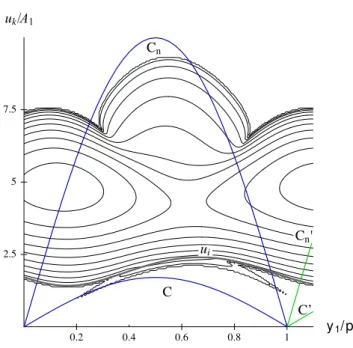
diagram shown in Fig. 3, in whih we have drawn a
ontourplot of Im(v) forthe parametersof aase
in-vestigatedin SetionVI(ase(d),r
b
=1:5, r
s
=2:67,
r
d
=0:117, = 80 Æ
). InFig. 3wehavealso drawn
theurveu=u
i (
1
) thatgivesthemarginalstability
ondition(18) aordingto the inompressible model.
Allthepointsofthestabilitydiagramaboveu
i (
1 )
or-respondto instabilityaordingto IMHD.Notiethat
theontourplotdoesnotrefertoauniqueplasma
on-guration, sine we have not yet speied u and '
1 .
Then it an be used for all the ongurations having
thesame valuesof r
b , r
s , r
d
and. This is adistint
advantagesinewithasinglegraphweanstudythe
ef-fetsofhangingthemagnitudeoftherelativeveloity
anditsorientationwithrespettothemagnetield.
In Fig. 3, we an see the main eets of
om-pressibility: thelarge-u
k
stabilizationandthesmall-u
k
destabilizationoftheprimaryinstability,andthe
pres-ene of the seondary instability in u
k
intervals that
are stable aordingto IMHD.It should also be
men-tionedthatforu
k
appreiablylargerthanu
i (
1 )(i. e.,
not very lose to it) the growth ratesalulated with
CMHD are always smaller thanthose alulatedwith
IMHD(17).
Toinvestigatea partiularonguration bymeans
ofthestabilitydiagramwemustdrawtheurveCgiven
by eq. (21), that depends on the two remaining
pa-rameters(u, '
1
)that haraterizeit. FollowingC we
nd the value of Im(v) for this onguration, for any
perturbationharaterizedbythe angle
1
. Sinethe
problemisinvariantunderthetransformation(v! v,
u
k
! u
k
),itsuÆestoalulatetheontourplotfor
u
k
0;ofourse,wemustthendrawtheurveC 0
given
byu
k
= uosin additiontoC.
In the example shown in Fig. 3 we see that the
ongurationdesribedbyCandC 0
(u=1:7A
1 , '
1 =
89:9 Æ
) is stable aording to IMHD, but is unstable
if ompressibility is taken into aount. Theunstable
modes our in the (approximate) range 40 Æ
1
50 Æ
andtheybelongtotheseondaryKHI.Their
max-imum growth rateis small (Im(v)0:04A
1
), but
sig-niant. It anbe observedthat other ongurations
withthesamevaluesofr
b ,r
s ,r
d
andanbemore
un-stable. TheextremeofIm(v)inFig. 3is2:115A
1 ;it
oursfor
1 25
Æ
andu
k 5A
1
,avaluethatrequires
averylargeu.
The meaning of the large-u
k
stabilization an be
laried by means of an example. Let us onsider in
Fig. 3ahypothetialongurationwithu=10A
1 and
'
1
= 89:9 Æ
. Thenew urves C
n and C
0
n
are similar
to CandC 0
, onlysaled bythefator10=1:7. Partof
C
n (for45
Æ
113
Æ
)liesin theupperpartofthe
stability diagram (u
k > u
d6
) orresponding to stable
perturbations: theseare thelarge-u
k
modes stabilized
by ompressibility. However, this onguration is
un-stable,sineC
n andC
0
n
passthroughtheunstablepart
ofthediagram(atually,itsmostunstablemodeshave
Im(v)verylosetotheextremevalueforthediagram).
Clearly, ongurations having verylarge u arealways
unstable,althoughlarge-u
k
stabilizationmayourfor
somemodes.
0.2
0.4
0.6
0.8
1
y
1
/p
2.5
5
7.5
u
k
/
A
1
C
C’
C
n
C
n
'
u
i
Figure3. Stabilitydiagramforase(d)ofSetionVII.The
linesCandC 0
orrespondtothevaluesofu
k
ofthe
ongu-ration,givenbyeq. (21). TheontoursofIm(v)arespaed
by0:2A
1
. Thelarge whiteareasatthe topandbottomof
thediagramorrespondtostableperturbations.
A few omments must be made onerning
stabil-ity diagrams like Fig. 3. To draw them we alulate
therootsofthedispersionrelationatdisretepointsof
a grid in the (
1 ;u
k
) plane. Sometimes, at the same
point (
1 ;u
k
) there are twounstable roots (this
hap-pens when the seondary intervals A and B overlap,
or when any one of them overlaps parts of the
pri-mary interval). In these instanes we show only the
largerIm(v). Theseondaryintervalsare verynarrow
in some (
1 ;u
k
) regions, and may not show up, due
to theoarsenessofourgrid(forthesameausesome
ontours appear wavy in Fig. 3). Nothwithstanding
thesedrawbaks,stabilitydiagramsareextremely
use-fultools,sinetheyprovideaneonomialandfastway
for ndingthe mostinteresting domains in parameter
spae. It isthen possibleto performmorepreiseand
detailed alulationsin these regions only, with
VI Parameters of magnetopause
ongurations
Before disussing the appliation of thetheory to the
magnetopause, it is onvenientto review how the
pa-rameters used in our formulae an be obtained from
thetheoretialmodelsorfrom spaeraftdata. We
as-sumethattheoutsideregion(asseenfromtheEarth)is
region1. Intheappliations,theparametersofthe
on-guration(theowveloitiesu 0
1 andu
0
2
andtheangles
B1;u 0
1 and
B1;u 0
2
fromB
1 tou
0
1 andu
0
2
,respetively)
are given in a referene frame at rest with respet of
theEarth. Inourtheoryweusearefereneframe
mov-ing with the average veloity u 0
= (u 0
1 +u
0
2
)=2, then
u
1
= u, u
2
= u, with u = (u 0
1 u
0
2
)=2. In what
follows,allveloitiesaregiveninkm/s. Weemploythe
followingformulae:
u= 1
2 q
u 02
1 +u
02
2 2u
0
1 u
0
2 os
u ; u
0
= 1
2 q
u 02
1 +u
02
2 +2u
0
1 u
0
2 os
u ;
u =
B
1 ;u
0
2 B
1 ;u
0
1
(22)
'
1 =
B
1 ; u
0
1
+Sign(sin
u )aros
u 0
1 u
0
2 os
u
2u
(23)
d
TheangleÆfromutou 0
isgivenby
Æ=Sign(sin
u )aros
u 02
1 u
02
2
4uu 0
(24)
Ineqs. (23)and(24)thefatorSign(sin
u
)isneededto
obtaintheorret determination of'
1
andÆ. Finally,
the phase veloity of the perturbation in the Earth's
frameisgivenby
v 0
=v u 0
os(
1 '
1
Æ) (25)
Toonsidertheremainingparameterswemust
dis-ussseparatelythetheoretialandspaeraftdata.
Data derived from theoretialmodels
The onditions for the exitation of the
Kelvin-Helmholtz instability on the dayside magnetopause
werereentlyinvestigatedintwopapers. One,byMiura
[?℄, reports numerial MHD simulations on the
devel-opmentoftheinstability,startingfromhyperboli
tan-gentproles of the unperturbed eld quantities. One
of themain results is that the magnetopauseappears
tobemoreKHunstablefornorthwardIMFonditions
thanforsouthwardpointingmagnetields. However,
the hoie of parameters for the simulations is more
adequate for the analysis of near ank ongurations
rather than dayside proper. The seond paper [?℄ is
based on a linear inompressible theory, and
spei-allyaddressesthedistributionoftheKHativityover
themagnetopausesurfae. ChartsofKHIgrowthrates,
relyingoninputparametersprovided byaMHD ode
that simulates thephysialonditions of thefrontside
magnetosheath, are given. One of the main results is
thatundernorthwardIMFonditions,theKHativity
is restrited to somewell dened regions of the
mag-netopause. Even when the IMF is due north, the
a-tivitydereasesasthelatitudeinreasesfromthe
mag-netopauseequator. In anthird paper [?℄ the latitude
dependene of the KHI is examined with a linear
in-ompressibletheory based on hyperboli tangent
pro-les, using our inompressible theory for a tangential
veloitydisontinuity.
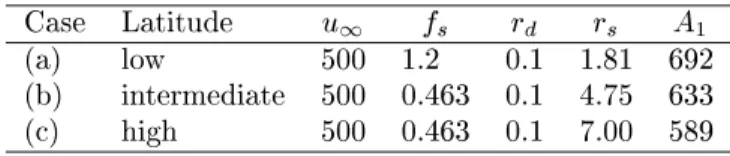
The data used here are given in Tables 1 and 2.
Those of Table 1 (also used in [?℄) proeed from ref.
[?℄andwerealulatedwiththemagnetosheathmodel
of ref. [?℄, whih is also desribed in [?℄. The IMF
is assumed to point exatly north. The positions are
atequator,middlelatitude,and highlatitude,alonga
meridianabout3hourseastof noon. Themain
dier-eneamong these positions is theinreaseoftheloal
magnetishear angle.
Table1. Parametersofongurationsofthefrontofthemagnetopauseaordingtothemodel.
Case Latitude f
u 0
f
b
f
d
r
b B
1 ;u
0
1
(a) low 0:2352 1:1994 0:7502 1:2670 90 Æ
0 Æ
(b) intermediate 0:2568 1:0875 0:7387 0:8935 81 Æ
6 Æ
() high 0:2945 1:0055 0:7259 0:5288 92 Æ
Table2. Additionalparametersof ongurationsofthefrontofthemagnetopause(r
s
hasbeenalulatedto
satisfytheequilibrium ondition,veloitiesareinkm/s).
Case Latitude u
1 f
s r
d r
s A
1
(a) low 500 1:2 0:1 1:81 692
(b) intermediate 500 0:463 0:1 4:75 633
() high 500 0:463 0:1 7:00 589
Wehavein this aseu 0
2
=0, thenu=u 0
=u 0
1 =2,
'
1 =
B
1 ;u
0
1 and v
0
= v u
0
os(
1 '
1
). The
model provides
B
1 ;u
0
1
, the shear angle , the ratio
r
b =B
2 =B
1
,aswellasthefollowingquantities:
f
u 0
=u 0
=u
1 ; f
b =B
1 =u
1 p
4
1 ; f
d =
1 =
1
(26)
In(?? ),u
1 and
1
aretheveloityandthedensity
ofthesolarwind,farfromtheinterationregion.
Beausethemagnetosheathmodeldoesnotprovide
magnetospherivaluesfortemperatureanddensity,
Ta-ble2omplementsthesetofparametersneededinthe
theory. Weassumeu
1
=500km/sandusetypial
val-uesofthedensityratioandofthetemperaturesinboth
regions, often observed in spaeraft rossings of the
magnetopause (expressed as r
d =
2 =
1 , r
s = S
2 =S
1
and f
s = S
1 =u
1
). Clearly r
d , r
s and f
s
must
sat-isfy the equilibrium ondition (1). In terms of the f
's and r's this implies2f
d f
2
s (1 r
d r
2
s ) =f
2
b (r
2
b 1).
So we rst assign r
d and f
s
, and then use this
rela-tiontoalulater
s
. Siner 2
s
mustbepositive,weneed
f 2
s > f
2
b (r
2
b
1)=2f
d
. When r
b
> 1 (as in ase (a)
below)this ondtionsetsalowerbound onf
s .
UsingthedataofTables1and2wethennd
u=f
u 0
u
1
2 ; A
1 =
u 0
1 f
b
f
u 0
p
f
d ; A
2 =A
1 r
b p
r
d ; S
1 =
u 0
1 f
s
f
u 0
; S
2 =r
s S
1
(27)
d
and from these quantities we alulate the remaining
parametersofourtheory.
Spaeraft data
At the anks of the magnetopause, the
magne-tosheathowissupersoniandtheeetsof
ompress-ibility on the KHI are expeted to be important. We
shall examine a onguration at the near equatorial
magnetopauseatdusk,observedby Interball/tail
dur-ingtheeventofJanuary11,1997. Thiswasatthetailof
aoronalmassejetionpassingEarth,duringwhihthe
dynamipressureofahighdensitysolarwindstrongly
ompressedthemagnetosphere. As aonsequene,
In-terball/tail was for some time in the magnetosheath,
and reentered the magnetosphere, after the dynami
pressure returned to lower values. During the
ross-ing of the magnetopause, from magnetosheath to low
latitude boundary layer, the spaeraft measured the
physial parametersneessary for a stability analysis.
A detailed study of the event is given in ref. [?℄,
to-getherwithadisussionoftheKelvin-Helmholtz
insta-bility,basedonaninompressiblemodel. Weintendto
revisitthatongurationwithourompressibletheory.
Theinterfaethatweshallonsideristhatbetweenthe
magnetosheathandthelowlatitudeboundarylayer.
Table3. ParametersoftheJanuary11,1997event(spaeraftdata,veloities areinkm/s).
Case u 0
1 u
0
2 M
A;1 M
S;1 r
b r
d
B1;u 0
1
B1;u 0
2
(d) 300 105 5:0 2:0 1:5 0:117 100 Æ
120 Æ
80 Æ
(e) 300 105 5:7 2:0 1:5 0:117 100 Æ
120 Æ
80 Æ
Table4. CalulatedparametersoftheJanuary11, 1997event(veloitiesareinkm/s).
Case u '
1 u
0
Æ r
s A
1
In therst line of Table3 we give theparameters
of the event (we use the denitions M
A;1
A
1 =u
0
1 ,
M
S;1 S
1 =u
0
1
). The seond line ontainsthe
param-eters of a hypothetial onguration with a slightly
larger value of M
A;1
, to asertain the eet of this
hange.
Wemustreognizethatowingto measurement
un-ertainties,thespaeraftdatadonotomplywiththe
equilibrium ondition (1) at the interfae. To emend
this aw, we replaed the measured r
s
(that is the
lessreliabledatum)bythe valuederivedusing the
re-mainingdataintheequilibriumondition,expressedas
2M 2
A;1 (1 r
d r
2
s )=M
2
S;1 (r
2
b 1).
Theexpressions ofu,u 0
, '
1
,Æ and v 0
aregivenby
eqs. (22)-(25), and the remaining quantities we need
are:
A
1 =u
0
1 =M
A;1 ; A
2 =A
1 r
b p
r
d ; S
1 =u
0
1 =M
S;1 ; S
2 =r
d S
1
(28)
d
Wenowinvestigatethestabilityofthese
ongura-tionsofthemagnetopause.
VII Stability of some
magne-topause ongurations
Congurations near the front of the
magne-topause
In the low latitude ase (a) there is no magneti
shear, so that the ute modes are unstable, both in
theinompressiblelimitandifompressibilityistaken
intoaount. InFig.4weomparethegrowthrate
ob-tainedwiththeompressiblemodelwiththatpredited
byIMHD(eq. 17). Itanbenotied thatthere isno
signiantdierene. Aninreaseoftherelative
velo-itybyafatorof3-4doesnothangethis onlusion.
0.46
0.48
0.5
0.52
0.54
0.02
0.04
0.06
y
1
/
p
Im (
V
)
/
A
1
Figure 4. Growth rate of the unstable modes of the low
latitudeonguration(ase(a)).TheresultsofCMHDand
IMHDare shownwith fulllinesand gray dashedlines,
re-spetively.Thetwonarrowbandsoftheseondary
instabil-ity near
1
=0:48 and
1
=0:52 arebarely disernible
astheirgrowthratesareverysmall.
The intermediate and high latitude ases are
sta-that oinides with the preditions of IMHD. In Fig.
5weshow the stability diagram for the high latitude
parameters. We an see the lowering of the ritial
valueu
, dueto ompressibility(alreadymentionedin
SetionI).Thiseetisofnoonsequeneforthe
on-guration() owingtothe lowrelativeveloity,but it
mayberelevantforongurationswithalargerelative
veloity(say,u1:5A
1 ).
0.2
0.4
0.6
0.8
1
y
1
/
p
0.5
1
1.5
2
u
k
/
A
1
C
u
i
Figure5. Stabilitydiagram fortheparametersofthe high
latitudease. TheurveCorrespondingtothe
ongura-tionindiatesthatase()isstable.
Aonguration in the near ank of the
magne-topause
The stability diagram orresponding to these
pa-rameters is shown in Fig. 3. It an be appreiated
thatthisongurationisstableaordingtotheIMHD
to theseondarymodes, whih haveno ounterpartin
IMHD.Thegrowthrateoftheinstabilityissmall, but
signiant,asanbeseeninFig. 6.
0.22
0.24
0.26
0.28
0.02
0.04
0.06
y
1
/
p
Im(
V
)
/
A
1
Figure6. Growthrateoftheseondarymodesforase(d).
When the line C of the onguration passes lose
to the marginal stability line for the primary modes,
as happened in this ase, the stability properties of
the onguration are very sensitive to slight hanges
of theparameters. This an beappreiated in Fig. 7,
in whih we show the growth rate of the instability,
foraslightlydierentorientationoftherelative
velo-ity u with respet to the magneti eld ('
1
= 75:5 Æ
instead of 89:9 Æ
). It an be notied that this hange
produes afourfold inreaseof the growth rateof the
seondary instability (and a shift towards larger
1 ).
The primary instability is also present now, although
its growth rate is muh smaller than that of the
se-ondarymodes. Thisisdueto thesmall-u
k
destabiliza-tion phenomenon, sine the modied onguration is
stillstableaordingtoIMHD.
0.3
0.35
0.4
0.1
0.2
y
1
/
p
Im (
V
)
/
A
1
Figure7. Eetof ahange ofthe orientationof the
rela-tiveveloitywithrespettothemagnetield. Thegure
represents the growth rate for ase (d), with '
1 = 75:5
Æ
insteadof89:9 Æ
. Notetheprimarymodesenteredaround
1
0:15.
If we hange the relative veloity, keeping the
re-mainingparametersxed(asifthesolarwindhadbeen
upwards, and the primary instability beomes
domi-nantfora30%(orlarger)inreaseofu.
In Fig. 8 we show the stability diagram for ase
(e), where M
A;1
diersfrom ase(d)by14%. The
ef-fetofthis hangeistoinreasethegrowthrateofthe
seondaryinstabilitywithrespettotheresultsofFig.
6. This modied onguration is stable aording to
IMHD.
0.2
0.4
0.6
0.8
1
y
1
/
p
1
2
3
4
u
k
/
A
C
u
i
1
Figure8.Stabilitydiagramfortheparametersoftheevent
of January11, 1997. TheurveCorrespondsto the
on-gurationofase(e).
VIII Conlusions
CompressibilityaetstheKelvin-Helmholtzinstability
byhangingtheunstabledomainsofthemodesalready
present in the inompressible model as well as their
growthrate. Modeswithlargeu
k
(theprojetionofthe
relativeveloityonthewavevetoroftheperturbation)
arestabilized. Atthesametimethelowerboundaryof
theunstableu
k
intervalshiftsdownwards,thus
destabi-lizingperturbationsthatarestableaordingtoIMHD,
foru
k <u
i
(theritialvalueformarginal
inompress-ibleinstability). Ontheotherhand,thegrowthrateof
the unstable modes above u
i
is reduedby
ompress-ibility. Inaddition,ompressibilityintroduesnew
un-stable modes (the seondarymodes)that do notexist
in IMHD, and that our for u
k
below u
i
. For these
reasons,ompressibilitymayplayanimportantrolein
determiningthestabilityofongurationswith a
rela-tiveveloityoftheorderofu
i .
Forongurationsofthefrontofthemagnetopause,
whih havesmall relative veloities, theIMHD model
gives reliable estimates of their stability, and
om-pressibilityeetsdonotintroduesignianthanges.
attheanksofthemagnetopause. AsshowninSetion
VII,in these asestheourreneoftheseondary
in-stabilityand theshift ofthe boundary ofthe primary
instabilityplayanimportantrole. Then,ongurations
thatarestableifompressibilityisnegletedturnoutto
beunstable whenitis onsidered. Inthese situations,
the stability properties are quite sensitive on the
val-ues oftheparameters. Theestimates basedonIMHD
maybemisleading,andaarefulanalysisisrequiredin
eahase, sineno simpleruleofthumb an begiven.
In these respets the stability diagrams introdued in
SetionVmayproveuseful,sineasinglegraphallows
to visualize the eet of hangingthe magnitude and
orientationoftherelativeveloity.
Aknowledgments
We aknowledge grants from CONICET (PIP
4521/96 and PIP 4535/96), the University of Buenos
Aires (Projets X151 and TX32) and NASA (grant
NAG5-2834).
Referenes
[1℄ M. G. Kivelson and S. H. Chen. The magnetopause:
Surfae waves and instabilities and their possible
dy-nami onsequenes. AGU Monograph 90, Physis of
Magnetopause, editedby P.Song, B.U. O.Sonnerup
and M. F. Thomsen. Geophys. Mon. Ser. 90, AGU,
Washington,DC,257(1995).
[2℄ A. Miura. Kelvin-Helmholtzinstability atthe
magne-topause: omputer simulations. AGU Monograph 90,
PhysisofMagnetopause,editedbyP.Song,B.U.O.
Sonnerup,andM.F.Thomsen.Geophys.Mon.Ser.90,
AGU,Washington,DC,285(1995).
[3℄ C. J. Farrugia, F. T. Gratton, and R. B.
Tor-bert. Visous-type proesses in the solar
wind-magnetosphere interation. Speial volume Challenge
toLong-StandingUnsolvedSpaePhysisProblemsin
the20thCentury.SpaeSieneReview,95(1/2),443
(2001).
[4℄ S. Duhauand J. Gratton. Kelvin-Helmholtz
instabil-ityofanisotropiplasmainamagnetield.J.Plasma
Phys.13,451(1975).
[5℄ F.Gratton, J.Gratton, and A.G.Gonzalez.
Conve-tive instability of internal modes inaelerated
om-pressibleplasmas.PlasmaPhys.ControlledFusion30,
435(1988).
[6℄ W.A.Newomb.Compressibilityeetsoninstability
growthrates.Phys.Fluids 26,3246(1983).
[7℄ M. G. Kivelson and D. J. Southwood. Coupling of
global magnetospheri MHDeigenmodes to eld line
resonanes. J.Geophys.Res.91,4345(1986).
[8℄ M.G.KivelsonandZ.-Y.Pu.TheKelvin-Helmholtz
in-stabilityonthemagnetopause.Planet.Spae. Si.32,
1335 (1984).
[9℄ A.G.GonzalezandJ.Gratton.TheKelvin-Helmholtz
instability in ompressible plasmas, in Pro. VIII
Latin-Amerian Workshop on Plasma Physis. Vol. 1
[10℄ A.MiuraandP.L.PrithettP.Nonloalstability
anal-ysisoftheMHDKelvin-Helmholtzinstabilityina
om-pressibleplasma.J.Geophys.Res.87,7431(1982).
[11℄ C.J.Farrugia,F.T.Gratton,L.Bender,J.M.Quinn,
R. B.Torbert, N. V. Erkaev and H. K. Biernat.
Re-ent work onthe Kelvin-Helmholtz instability at the
daysidemagnetopauseandboundarylayer.PolarCap
BoundaryPhenomena,editedbyJ.Moenetal.,Kluwer
AademiPublishers,Netherlands,1(1998).
[12℄ A.G.GonzalezandJ.Gratton.TheKelvin-Helmholtz
instabilityinaompressibleplasma: theroleofthe
ori-entationofthemagnetieldwithrespettotheow.
J.PlasmaPhys.51,43(1994).
[13℄ A.G.Gonzalez andJ.Gratton. Theroleof adensity
jumpintheKelvin-Helmholtzinstabilityofa
ompress-ibleplasma.J.PlasmaPhys.52,233(1994).
[14℄ A. G. Gonzalez, J. Gratton and M. Gonzalez. The
Kelvin-Helmholtz instability in ompressible plasmas
withmagnetieldshear.Pro.IXLAWPP,AIPConf.
Pro.563,47(2001).
[15℄ S.Chandrasekhar. Hydrodynami andHydromagneti
Stability.OxfordUniv.Press(1961).
[16℄ W. I. Axford. Quart. J. Meh. Appl. Math. 13, 314
(1960).
[17℄ W.I.Axford.Can.J.Phys.40,654(1962).
[18℄ D. J. Southwood. The hydrodynami stability of the
magnetospheriboundary.Planet. SpaeSi. 16, 587
(1968).
[19℄ A. Miura. Dependene of the magnetopause
Kelvin-Helmholtzinstabilityontheorientationofthe
magne-tosheathmagnetield.Geophys.Res.Lett.22,2993
(1995).
[20℄ C. J. Farrugia, F. T. Gratton, L. Bender, H. K.
Biernat, N. V. Erkaev, J. M. Quinn, R. B. Torbert
andV. Dennisenko. Chartsof joint Kelvin-Helmholtz
and Rayleigh-Taylor instabilities at the dayside
mag-netopauseforstronglynorthwardinterplanetary
mag-netield.J.Geophys.Res.103,6703(1998).
[21℄ J. E. Contn, F. T. Gratton and C. J. Farrugia. A
studyof Kelvin-Helmholtz modes for hyperboli
tan-genteldprolesappliedtothedaysidemagnetopause.
Fluidos2001,editedbyJ.C.Ferreri.ISBN
927-20148-0-9(2001).
[22℄ J.E.Contn.Ph.D.Thesis,Inestabilidadesdelaminas
de orriente on ujos de plasma y apliaiones a la
magnetopausadiurna.FaultaddeCieniasExatasy
Naturales,UniversidaddeBuenosAires(1999).
[23℄ N.V.Erkaev.ResultsoftheinvestigationofMHDow
aroundthemagnetosphere.Geomagn.Aeron. 28,455
(1988).
[24℄ C.J.Farrugia,F.T.Gratton,J.Contin,C.C.Cohei,
R. L. Arnoldy, K. W. Ogilvie, R. P. Lepping, G.
N. Zastenker, M. N. Nozdrahev, A. Fedorov, J.-A.
Sauvaud, J. T. Steinberg, and G. Rostoker.
Coordi-nated Wind, Interball/tail, and ground observations
ofKelvin-Helmholtzwavesat thenear-tail,equatorial
magnetopauseatdusk: January11, 1997.J.Geophys.