Assessment of motivation, expectations and satisfaction
of adult patients submitted to orthodontic treatment
Patrícia Gomide de Souza Andrade Oliveira1, Rubens Rodrigues Tavares2, Jairo Curado de Freitas3
Objective:The purpose of this study was to analyze the psychological aspects of adult patients who sought and under-went orthodontic treatment, evaluating their expectations and discomfort during treatment, as well as their satisfaction ater completion of dental movement. Results and Conclusions: Data obtained from previous published papers, and also from questionnaires answered by 54 patients, showed that adult patients stood out for their attention to details and high interest in the esthetic improvements provided by treatment, and also for a greater perception of their initial malocclusion. On the other hand, the same data showed that adult patients, once informed about the limitations of their treatment and having conidence on the orthodontist, presented a high level of satisfaction with treatment results, revealing themselves as good patients for indication and execution of orthodontic procedures.
Keywords:Orthodontics. Psychology. Behavior. Adults.
How to cite this article: Oliveira PGSA, Tavares RR, Freitas JC. Assessment of motivation, expectations and satisfaction of adult patients submitted to orthodon-tic treatment. Dental Press J Orthod. 2013 Mar-Apr;18(2):81-7.
Submitted: June 22, 2009 - Revised and accepted: October 26, 2010
» The author reports no commercial, proprietary or financial interest in the products or companies described in this article.
Contact address: Patrícia Gomide de Souza Andrade Oliveira Rua 1028 nº. 131, ap. 503, setor Pedro Ludovico
CEP: 74.823-130 – Goiânia / GO, Brazil E-mail: [email protected]
1 Specialist in Orthodontics.
2 Professor of the Orthodontics Specialization Program at the Brazilian Dental
Association - Goiás Section (ABO-GO).
3 Head of the Orthodontics Specialization Program, ABO-GO.
Objetivo: o propósito desse trabalho foi analisar as características psicológicas dos pacientes adultos que procuraram e se submeteram a tratamentos ortodônticos, avaliando suas expectativas, desconforto durante o tratamento e satisfação inal após a conclusão das movimentações dentárias propostas. Resultados e Conclusões: os dados obtidos por meio de uma revisão bibliográica e de questionários realizados com 54 pacientes demonstraram que os pacientes adultos se destacaram por serem mais detalhistas e exigentes em relação às melhoras estéticas proporcionadas pelo tratamen-to, e por apresentarem uma maior percepção de sua má oclusão antes do início do tratamento. Por outro lado, esses mesmos dados demonstraram que os pacientes adultos, uma vez bem esclarecidos sobre as limitações peculiares ao seu tratamento e sentindo-se bem amparados e orientados pelos proissionais responsáveis, apresentaram um alto índice de satisfação frente aos resultados inais do tratamento, sendo ótimos pacientes para a indicação e execução de proce-dimentos ortodônticos.
INTRODUCTION
Many authors conirm what orthodontists have been noticing on a daily basis in their private practices: The increasing number of adult patients seeking orthodontic treatment.3,4,6
When planning orthodontic treatment for patients in that scope, we should bear in mind that, generally, adults present a diferent experience in relation to buccal pa-thologies, and psychological limitations when compared to teenagers and children.
Focusing in the psychological aspects concerning adult patients, many studies prove that these patients have a greater awareness of their malocclusion, which may gen-erate very optimistic expectations about the inal results
of their treatment.4,10,11 In search for delivering a more
ef-icient treatment to such patients, it is mandatory that or-thodontists investigate and understand the expectations, diiculties, and motivations of this increasing group, in order to ofer assistance that matches their concerns.
The ofer of orthodontic treatment to adult patients, albeit becoming more common in the last decades, is not a product of our time. The irst reference to it was made by Pierre Fauchard, author of the irst scientiic Dentistry
book known to us as Le Chirurgien Dentiste from 1723.6
Epidemiologic data that has been gathered since the 80’s conirms the increase of the demand of patients in that age group (18 +) who want and need orthodontic treatment. In the United States, in 1988, it became clear that in large urban business centers, this demand rep-resented between 60 to 70% of all the patients looking for treatment. In Europe, studies from the beginning of the 80’s also show an increase in adult patients seeking
orthodontic care.6,11
Recent studies show that the frequency of maloc-clusion in adults is similar, if not higher to that observed in children and teenagers. According to oicial data released by the North American government in the NHANES III (Third National Health and Nutrition Survey), in the 90’s, only 41.1% of all American adults had an optimal overjet, 49% presented deep bite, 3.3% open bite, and there was also a signiicant occurrence of misalignment in upper and lower incisors, respectively
56% and 62.9%.3,12 In a similar way, the prevalence of
malocclusion in Eastern Europe adults, according to studies conducted within populations from Germany and Sweden, reached between 40 and 76% of the total
adult population from these regions.3
In 2003, a study made with 200 adult patients, evalu-ated the reasons which led them to initially reject the sug-gestion to undergo orthodontic treatment. The researchers found out the reasons to be, from the highest to the lowest prevalence: Long treatment time, the discomfort of wear-ing orthodontic appliances, rejection to the anti-esthetic appearance of brackets, concerns about pain, and fear of
disappointment with the inal treatment result.7
Within the large demand of adult patients who seek and need orthodontic assistance, literature has
shown that most of these patients are females,6,10 and
that the indication for them to seek for an
orthodon-tist comes from the family denorthodon-tist.6
Just like every health related treatment, orthodon-tic treatment in adults has its indications and contra-indications, which must be carefully assessed before any action takes place.
Highlighted among the indications are: The possi-bility of improving teeth implantation in the periodon-tal tissues, determining a more stable and harmonious occlusive pattern, distribution of edentulous spaces so that they can be restored later, improvement of the oc-clusal condition and protection of the stomatognathic system (especially the temporomandibular joint - TMJ) and satisfaction of the patients esthetical demands.
The cases where orthodontic treatment would be contraindicated in adult patients are: Existence of severe skeletal discrepancies (in these cases surgical treatment would be preferable), patients with systemic or advanced local diseases, cases of severe alveolar bone loss, when the results might not fulill the expectations of both the patient and the professional in charge of the treatment, questionable prognostic stability, and lack of patient
in-terest or motivation.13
The main reason that leads adult individuals to search for orthodontic care is their dissatisfaction with their den-tal and/or facial appearance; and many studies conirm that adult patients have greater perception of their dental esthetics thus presenting higher demands concerning the
results achieved ater orthodontic therapy.4,5,6,9 Another
frequent reason is the need for isolated dental movements so that other procedures aiming the control of periodon-tal disease prosthetic rehabilitation (implants or prosthe-sis), or cosmetic (dental reconstructions) can be executed
within a multidisciplinary planning.6
treatment showed that many of these patients presented a neurotic or unstable psychological proi le along with problems of self-esteem. These same studies alert ortho-dontists that this kind of patient tends to nurture great expectations, some of them even being unreal, regard-ing treatment results, and suggestregard-ing that the tangible results should be made as clear as possible to them in
order to avoid future disappointments.4,10,11
In 2005, researchers gave a satisfaction questionnaire to be answered by 100 patients treated in the Academic Center of Dentistry in Amsterdam three years at er they completed their orthodontic treatment. In that study it was observed that the most important issue in deter-mining patient satisfaction was the good orthodontist/ patient relationship during treatment and that female patients revealed lower satisfaction levels with the den-tofacial improvements achieved by treatment when compared to male patients.
The objective of the present study was to analyze, through questionnaires the psychological proi le of adult patients, most of them living in the city of Goiânia/GO, Brazil, who underwent orthodontic treatment, assessing their expectations, discomfort during treatment, and i nal satisfaction at er completion of the dental move-ments, in order to serve as a guideline for orthodontists during planning and executing their clinical treatment focusing on the satisfaction of their patients, minimiz-ing their discomfort, and establishminimiz-ing special procedure protocols for such patients.
MATERIAL AND METHODS
The material used in the present study was a set of 54 questionnaires given to adult patients, most of them residents in the city of Goiânia/GO (Brazil), who had
received orthodontic treatment from dentists special-ized in orthodontics living in that same city. Among the selected patients, 12 had completed their treatment at the Orthodontics Specialization Program Clinic at the ABO-GO and 42 had been treated in private prac-tices of orthodontists registered in the Regional Dental Council (CRO) as specialists.
The patients were selected according to the follow-ing inclusion criteria: 1 – completion of orthodontic treatment; 2 – Submitted to only one corrective orth-odontic treatment; 3 – Treatment initiated at er reach-ing the age of 20 years; 4 – Orthodontic treatment did not involve orthognathic surgical procedures; 5 – Ab-sence of any health problem that could inl uence in the orthodontic treatment.
Once selected, the patients were contacted by phone and were motivated to come either to the Orthodontics Specialization Program Clinic at the ABO-GO (pa-tients who had been treated at that institution) or to the private practice of their respective orthodontists.
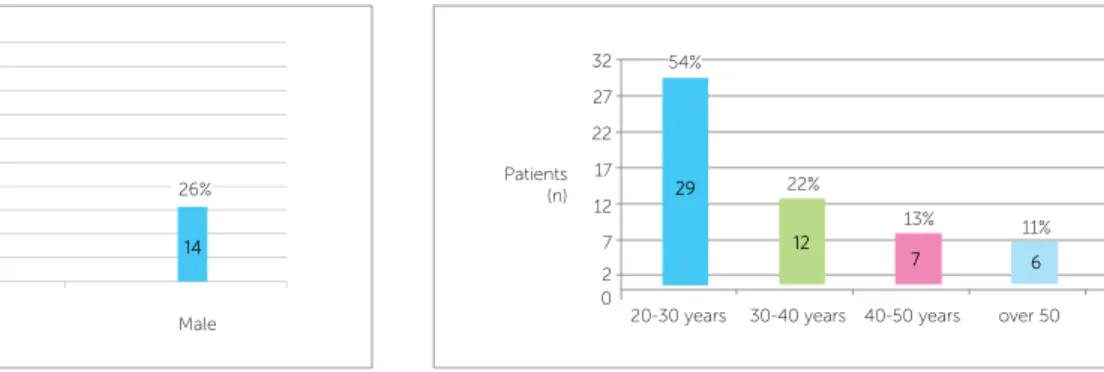
Concerning gender, 40 female patients and 14 male patients were evaluated (Fig 1).
The age which the patients started treatment ranged from 20 up to 61 years old, being that 29 of them started treatment in their second decade of life, 12 in their third decade of life, 07 in their fourth, and 06 at er being 50 years old (Fig 2).
At the moment each patient arrived to the practice, they were given the Informed Consent and at er sign-ing it, they all answered a questionnaire with 9 objective questions concerning the topic that was being investigat-ing. The questions were tailored so that they could an-swer them fast and objectively, and some blank space was given so that they could include personal considerations.
Figure 1 - Distribution of the sample by gender. Patients
(n)
Female Male
50
75%
26% 45
40
40
35 30 25 20 15
14
10 5 0
0
Figure 2 - Distribution of the sample according to the age at the beginning of the performed orthodontic treatment.
Patients (n)
20-30 years 30-40 years 40-50 years over 50 32
27 22 17 12 7 2
54%
22%
13% 11%
6 7
avoid a possible orthognathic surgery and the wish to receive dental implants aterwards. The data referring to the previous question are available on Table 3, and each patient could check more than one answer.
Regarding the discomforts experienced throughout treatment, 22 patients complained of pain ater activa-tion appointments (40%); 13 complained about the long time of active treatment (23.6%); 09 patients (16.3% from the total) claimed they hadn’t felt any discomfort during orthodontic treatment; 06 pointed to diiculties in dental hygiene and lossing, associated with wounds on their inner cheeks, as the main reason for discomfort (10.9%); 03 people were concerned about the unpleas-ant look of their braces (5.4%); 01 patient complained about periodontal inlammations linked to the treat-ment (1.8%); 1 complaint about recurrent aphthous le-sions during treatment, and none felt embarrassed about being among much younger patients at the orthodontic practice environment (Table 4).
The most important positive change observed by patients ater treatment conclusion was: The improve-ment of facial appearance for 39 patients (72.2%); 13 noticed changes in their chewing and/or speaking pat-tern (24%); 07 reported improvements in their peri-odontal conditions along with a better implantation of their teeth (12.9%); 01 patient checked all the answers above and 08 checked two answers (Table 5).
When comparing the actual results obtained with the pre-treatment expectations: 50% considered the obtained results to be better than what they had ex-pected; for 46.2% the results were similar to what they had expected; 3.7% considered that their expectations The data contained in the questionnaires were
clas-siied and transformed into tables and descriptive statis-tics were made.
RESULTS
Assessment of the answers to the questionnaire.
When the patients were asked about the reason for them to seek treatment only when adults, the answers were: 31% for a previous lack of inancial means; 30% were not previously bothered with the position of their teeth; 14% looked for treatment ater being told (in-sistently) by their general dentists; 9% said they didn’t know orthodontics could solve their dental problems; 2% believed orthodontic treatment was only suitable for teenagers and children, and 14% mentioned other reasons, and among these we found: The wish and the need of a better facial look, the need of preparation for dental implants, speech therapist recommendation, and TMJ discomfort (Fig 3).
Trying to assess the perception of malocclusion, before the beginning of orthodontic treatment, the patients informed that the aspects that were most an-noying them were: The poor appearance of the smile, 36 patients (61%); 09 patients pointed to problems with chewing (15.2%); 08 patients pointed to the empty spaces due to tooth loss (13.5%); 04 pointed to peri-odontal problems (inlammation, tooth mobility) cor-responding to 6.7% of the answers; and 02 pointed to diiculty in speaking (3.3%), being that 05 out of the 54 patients marked 2 answers to this question (Table 1).
When answering about the reasons for rejecting the initial indication to undergo orthodontic care, the an-swers were: 55.3% felt concerned with the perspective of the long duration of treatment; 17.8% had doubts about the true eiciency of orthodontic intervention; 12.5% were afraid of feeling pain during treatment; 10.7% rejected the unpleasant appearance of braces; and 3.5% said they had never rejected the idea of undergo-ing an orthodontic treatment (Table 2).
In relation to the reasons which led the patients to make the choice for receiving orthodontic treatment it was found that: 35.5% said about the suggestion of a general dentist; 27.1% already wanted to undergo treat-ment; 22% made up their minds ater talking to an orthodontist; 11.8% told they were inluenced by the opinion of their relatives and friends; and 3.3% men-tioned diferent reasons, such as the opportunity to
Figure 3 - Reasons that led patients to seek orthodontic treatment only in adult age.
31% 9%
14% 14%
30% 2%
Their dentist indication (14%)
Didn’t know orthodontics could solve their dental problem (9%) Thought the treatment was for children and adolescents (2%) Lack of prior inancial conditions (31%)
Table 1 - Patients perception of their smile, prior to orthodontic treatment.
Before the treatment, what was your chief complaint about your teeth?
Bad esthetics 36
Mastication problems 09
Edentulous space (closed during treatment) 08 Gingival problems (inlammations, tooth mobility) 04
Speaking problems 02
Number of patients that checked two answers 05
Table 3 - Determining factor in deciding for starting the treatment.
What made you start the orthodontic treatment?
Dentist orientation 21
You wanted already to receive the treatment 16 Chat with the orthodontist 13 Opinion and support from family, spouse and friends 07 Others (avoid orthognathic surgery, implants need) 02
Table 4 - Main discomfort brought by the treatment.
During treatment, what most displeased you?
Pain during and after activation sessions 22 Found the treatment too long 13
Nothing 09
Diiculty in cleaning and wounds in the mucosa. 07 Felt embarrassed with the appearance with appliance 03
Gingiva inlammation 01
Recurrent ulcer 01
Embarrassment in contact with children and adolescents 00
Table 2 - Reasons most mentioned for initial rejection of the treatment suggested.
What was bothering the most in the orthodontic treatment idea?
Long duration 31
Doubts on the treatment eiciency 10
Fear of feeling pain 07
Unaesthetic aspect of the appliance 06
Nothing 02
Number of patients that checked two answers 05
before treatment were fairly achieved; and none of them considered the treatment results to be inferior to their initial expectations.
In a question aiming to know if they would under-go orthodontic treatment again, it was concluded that 100% of patients did not regret undergoing it, and all of them said they would, based on their personal experi-ence, encourage other adults to go through orthodontic treatment if necessary
DISCUSSION
This study consisted in the subjective evaluation of 54 adult patients in the ixed retention stage. The pre-dominance of female patients (74%) is consistent with data found in previous studies that suggested that wom-en have a greater motivation to undergo orthodontic treatment when compared to men.
As seen in the results, when questioned about the reasons that led them to look for orthodontic assistance for the irst time when in a more advanced age, the most common answers were the following in order of impor-tance: 31.5% showed a previous lack of inancial means; 29.8% reported that the awareness of the need for orth-odontic treatment only raised at adult age. The high rel-evance of treatment costs seen in this local sample shows that this speciic population has serious inancial con-straints, which sometimes may prevent them from gain-ing access to better health and well-begain-ing conditions.
When assessing the chief concern of adult patients who sought late orthodontic treatment, it is clear that most of the patients had esthetic reasons (61%). This data corroborates with previous studies that show that the great majority of patients seek treatment to improve
their smile esthetics and their facial esthetics.2,8
A previous study also evaluated the reasons that led some adult patients to initially reject the indication for orthodontic treatment and found the following reasons, in relevance order: Long duration of the proposed treat-ment; discomfort caused by the braces, rejection to the anti-esthetic look of brackets, fear of pain, and the fear of
disappointment with the inal results.7 When comparing
the results achieved in this research with those of the one mentioned above, it is possible to observe in general, that patients showed similar doubts and concerns.
Among the factors indicated as determinant for the be-ginning of treatment were: A previous will to undergo it (27.1% of the patients), which shows a good acceptance of Table 5 - Subjective perception of patients front orthodontic treatment
re-sults.
After treatment, which motivation did you noticed more?
More beautiful smile (facial esthetic improvement) 39 Speech and mastication pattern improvement 13 Gingival and tooth implantation condition improvement 07
Others 04
adults when confronted with the indication for orthodon-tic treatment; 22% decided only ater consulting with an orthodontist, which also highlights the importance of a good professional/patient relationship, and 11.8% made the decision inluenced by spouses, friends and relatives.
In relation to the main discomforts experienced throughout the active treatment, the majority of pa-tients complained about pain during treatment and immediately ater the activation sessions (40%); some complained about the long period of treatment (23.6%); and 16.3% said they did not feel any discomfort or con-straint. In previous studies, patients highlighted dis-comfort as the worst aspect of orthodontic treatment, although classifying this discomfort as mild and short lasting (with a duration average of 2 days ater clinical activation of the appliances). In these same studies, ori-entation on the controlled use of painkillers and restric-tion in the ingesrestric-tion of hard foods on the days following the activations were enough to signiicantly minimize
the aforementioned discomfort.2,3
In a research made in 1981, all adult patients as-sessed, who were undergoing orthodontic care, consid-ered the treatment advantageous despite the discomfort related to treatment; they did not regret having started it, and would suggest it to others who were in doubt
about the cost-beneit ratio of orthodontic treatment.13
Other authors also found high level of satisfaction in pa-tients when faced with the results achieved through the
orthodontic treatment performed.3 These informations
were also conirmed by the present study.
When evaluating the level of satisfaction of patients ater treatment, it should be kept in mind that the analy-sis made by patients are based on subjective aspects and not technical ones, thus being under inluence of difer-ent agdifer-ents, such as, the kind of professional/patidifer-ent rela-tionship and variables such as gender. Another research in 2005 concluded that the most important aspect to afect the level of satisfaction of patients is not the inal quality of the treatment done, but a good relationship between the patient and his orthodontist. According to that same research, women were more critical regarding treatment results, although in previous studies mentioned by these authors, men had shown to be more demanding and crit-ical about the results of orthodontic treatment.
CONCLUSION
When assessing the characteristics of adult individu-als that underwent orthodontic treatment, it was found that this group is mainly constituted by women, be-tween 20 and 30 years old (53%) who were not satis-ied, mainly, with their smile esthetics (61%).
When patients were asked about the reason for not seeking orthodontic treatment earlier, the great major-ity answered that they did not have inancial conditions, or did not feel inconvenienced by the malocclusion they had. Unfortunately, the lack of economical conditions proved, at least in this set of Brazilian patients, to be a major restraint for them, having prevented their previ-ous access to the facial and smile esthetics improvements they were longing for.
Individual clinical planning and clarity in proce-dures, previously discussed with patients, can minimize the main reasons for initial rejection from patients when faced with orthodontic treatment, which were: Aversion to the long duration of treatment (55.3%), doubts about the eiciency of treatment (17.8%), fear of pain (12.5%), and discomfort with the esthetical aspect of ixed braces (10.7%). A good relationship between the orthodontist, the general practitioner and other professionals involved with the patient, along with a clear and careful initial ap-pointment can be considered decisive in making adult patients fell safe to efectively start orthodontic treatment.
Once the treatment is initiated, the information gathered suggests that orthodontists should be aware about reducing the discomfort felt during and ater ap-pliance activation appointments, which was a reason of complaint in 40% of the people interviewed; also to instruct their patients on dental hygiene techniques, and to elaborate a simpliied treatment plan to reduce, according to the possibilities, the total treatment time (regarded as uncomfortably long for 23.6% of patients).
1. Bos A, Vosselman N, Hoogstraten J, Prahl-Andersen B. Patient compliance: a determinant of patient satisfaction? Angle Orthod. 2005;75(4):526-31.
2. Breece GL, Nieberg LG. Motivation for adult orthodontic treatment. J Clin Orthod. 1986;20(3):166-71.
3. Buttke TM, Proit WR. Referring adult patients for orthodontic treatment. J Am Dent Assoc. 1999 Jan;130(1):73-9.
4. Capelloza Filho L, Braga SA, Cavassan AO, Ozawa TO. Tratamento ortodôntico em adultos: uma abordagem direcionada. Rev Dental Press Ortod Ortop Facial. 2001;6(5):63-80.
5. Carvalho KV, Miguel JAM, Carlini MG. Satisfação dos pacientes submetidos a tratamento ortocirúrgico. Ortod Gaúch. 2001;5(1):49-56. 6. Khan RS, Horrocks EN. A study of adult orthodontic patients and their
treatment. Br J Orthod. 1990;18(3):183-94.
7. Langlade M. Terapêutica ortodôntica. 3ª. ed. São Paulo: Ed. Santos; 2003. 844 p.
8. McKiernan EX, McKiernan F, Jones ML. Psychological proiles and motives of adults seeking orthodontic treatment. Int J Adult Orthodon Orthognath Surg. 1992;7(3):187-98.
REFERENCES
9. Moyers RE. Ortodontia. 4ª ed. Rio de Janeiro: Guanabara Koogan; 1999. 482 p.
10. Nattrass C, Sandy JR. Adult orthodontics: a review. Br J Orthod. 1995;22(4):331-7.
11. Proit WR, Fields WH. Ortodontia contemporânea. 2ª ed. Rio de Janeiro: Guanabara Koogan; 1995.
12. Proffit WR, Fields HW Jr, Moray LJ. Prevalence of malocclusion and orthodontic treatment need in the United States. Estimates from the NHANES III survey. Int J Adult Orthodon Orthognath Surg. 1998;13(2):97-106.
13. Tayer BH, Burek MJ. A survey of adult’s attitudes toward orthodontic therapy. Am J Orthod. 1981;79(3):305-15.