Influence of in vitro pigmenting of esthetic orthodontic ligatures on smile attractiveness
Camila Ferraz1, Marcelo Castellucci2, Márcio Sobral3
Objective: To evaluate the perception of dental students and orthodontists on the degree of influence that pigmented esthetic elastic ligatures have on smile attractiveness, by judging clinical photographs. Methods: Sixteen clinical facial photographs of the smile and 16 close up images of the smile of a single patient wearing monocrystalline porcelain orthodontic brackets, Teflon coated NiTi wire brackets and esthetic elastic ligatures of five different commercial brands were distributed into eight groups, G1 to G8 (Morelli®, Ortho Tecnology™, TP Orthodontics™, Unitek/3M™clear, Unitek/3M™ obscure, American Orthodontics™ clear, American Orthodontics™ pearl and American Orthodontics™ metallic pearl). Twenty ligatures were used in each group, totaling 160 ligatures. Half of them were used in their natural state, and the other half after in vitro pigmentation. All the pho-tographs were judged by 40 evaluators, 20 orthodontists and 20 dental students. Results: For orthodontists, American™ pearl (G7) ligatures were those that least influenced the degree of attractiveness of the smile in the two types of photographs used. For the dental students, in the facial photographs of the smile, ligatures with the best performance were Morelli® (G1), American™ clear (G6) and American™ pearl (G7) and in the close up photographs of the smile, American™ pearl, metallic pearl and clear (G7, G8 and G6). Conclusions: For both orthodontists and dental students, pigmentation of the elastic ligatures had a negative influence on the degree of attractiveness of smiles in the two types of clinical photographs evaluated.
Keywords: Elastomers. Esthetics. Pigmentation. Photograph. Smile.
Submitted: September 31, 2011 - Revised and accepted: August 6, 2012.
» Patients displayed in this article previously approved the use of their facial and in-traoral photographs.
» The authors report no commercial, proprietary, or financial interest in the products or companies described in this article.
Contact address: Camila Ferraz
Rua Dr. Gilberto Studart, 1369/702 – Cocó – Zip code: 60.192-095 – Fortaleza/CE - Brazil E-mail: [email protected]
1 Specialist in Orthodontics and Facial Orthopedics, Federal University of Bahia (UFBA).
MSc Student in Dentistry, Federal University of Ceara (UFC).
2 MSc in Dentistry, UFBA; Specialist in Orthodontics and Facial Orthopedics,
Catholic University of Minas Gerais (PUC-Minas). Professor of the Graduate Program in Orthodontics, UFBA.
3 MSc in Orthodontics, Federal University of Rio de Janeiro (UFRJ). Professor of the
Graduate Program in Orthodontics, UFBA. Diplomate by the Brazilian Board of Orthodontics.
How to cite this article: Ferraz C, Castellucci M, Sobral M. Influence of in vitro
pigmenting of esthetic orthodontic ligatures on smile attractiveness. Dental Press J Orthod. 2012 Sept-Oct;17(5):123-30.
Objetivo: avaliar, através de fotografias clínicas, entre estudantes de Odontologia e ortodontistas, o grau de influência que liga-duras elásticas estéticas pigmentadas exercem sobre a atratividade do sorriso. Métodos: foram utilizadas 16 fotografias clínicas faciais do sorriso e 16 de sorriso aproximado de um único paciente portando braquetes ortodônticos de porcelana monocrista-lina, fio de NiTi teflonado e ligaduras elásticas estéticas de cinco marcas comerciais diferentes, distribuídas em oito grupos, G1
a G8 (Morelli, Ortho Technology, TP Orthodontics,3M/Unitek clear, 3M/Unitek obscure, American Orthodontics clear,
Ame-rican Orthodontics pearl e AmeAme-rican Orthodontics metalic pearl). Foram utilizadas 20 ligaduras de cada grupo, totalizando 160 ligaduras. Metade delas foi utilizada em estado natural e a outra metade após pigmentação in vitro. Todas as fotografias foram julgadas por 40 avaliadores, sendo 20 ortodontistas e 20 estudantes de Odontologia. Resultados: para ortodontistas, as ligaduras American Orthodontics pearl (G7) foram as que menos influenciaram o grau de atratividade do sorriso nos dois tipos de fotografias utilizadas. Para os estudantes de Odontologia, nas fotografias faciais do sorriso, as que obtiveram o melhor
desempenho foram Morelli (G1), American Orthodonticsclear (G6) e American Orthodonticspearl (G7) e, nas fotografias de
sorriso aproximado, American Orthodontics pearl, metalic pearl e clear (G7, G8 e G6, respectivamente). Conclusões: tanto para ortodontistas quanto para estudantes de Odontologia, a pigmentação das ligaduras elásticas influenciou de forma negativa o grau de atratividade dos sorrisos nos dois tipos de fotografias clínicas avaliadas.
INTRODUCTION
Elastic ligatures are accessories commonly used in orthodontics and have wide application in holding the arch wires to the brackets.
Some laboratory studies have proved that these elastomeric materials are susceptible to pigmentation when in contact with some pigments, saliva and bac-teria.1,2,3 This leads to a reduction in their useful life and compromises esthetics during the course of treat-ment. These alterations have a direct relationship with the composition, raw material quality and degree of technology used in their manufacture, which in turn, varies greatly according to each manufacturer.4,5,6
With the purpose of masking these pigments, many manufacturers add colors to ligatures, however, this procedure makes them unsuitable for use in esthetic appliances. Moreover, acceptance of the use of colored ligatures varies a great deal according to the patients’ gender and age.7,8
Knowledge about the alterations in their physical and mechanical properties is of great interest for the clinical application of these materials, considering that they may remain in the oral cavity for an average of 30 days, and during this interval, it is very impor-tant for the properties with regard to elasticity and es-thetics to remain stable.1,4,5,6,9,10,11
When evaluating the susceptibility to pigmenta-tion of elastic orthodontic ligatures, some authors have used digital photographs and computerized analysis by means of the Adobe Photoshop program, and have concluded that these ligatures underwent change in color after an in vitro process of pigmentation. How-ever, there are still no studies that prove the clinical rel-evance of these color alterations on the appearance of the orthodontic appliance set during the smile.
Evaluations made by means of photographs may be used to analyze color alterations of various types of dental materials, as well as in analyzing facial attrac-tiveness and esthetics and of the smile, before, during and after orthodontic treatment by the most diverse group of examiners possible.8,12,13,14,15,16,17
Knowing that the phenomenon of color is a psy-chophysical response to the light/object interaction, which depends on the individual subjective perception of the observer, and with the aim of obtaining greater knowledge about the esthetic influence of these pig-mented elastomer materials on the appearance of the
patient’s smile during orthodontic treatment, makes it necessary to conduct clinical studies on the men-tioned subject.
With this intention, the perception of the degree of influence esthetic elastic ligatures submitted to a pro-cess of pigmentation have on the attractiveness of the smile was evaluated between dental students and or-thodontists by means of judging clinical photographs
MATERIAL AND METHODS
The present study is characterized by an experi-mental approach in which clinical facial photographs of the smile, and of the close up of a smile were used. The photographs had been taken of a single adult pa-tient with a harmonious face and smile,14 who had adequate tooth alignment and leveling in the maxil-lary arch, required fixed orthodontic treatment, and wished to use an esthetic appliance.
The sample consisted of 16 clinical facial photo-graphs of the smile (12.8 cm x 17.1 cm) and 16 close up images of the smile (19.2 cm x 9.07 cm) of a single patient.
The orthodontic appliance was composed of mono-crystalline porcelain brackets (Ortho Technology™, Tampa, Florida, USA), NiTi wire 0.016-in Teflon coated (PTFE – polytetrafluorethylene), shade A2 (Beijing Smart Technology CO™, Beijing, China) and esthetic elastic ligatures of five different commercial brands, distributed into eight groups, G1 to G8 (Morelli®, So-rocaba, São Paulo, Brazil, Ortho Technology™, Tampa, Florida, USA, TP Orthodontics™, La Porte, Indiana, USA, Unitek/3M™clear, Unitek/3M™obscure, St. Paul, Minnesota, USA, American Orthodontics™ clear, American Orthodontics™ pearl and American Ortho-dontics™ metallic pearl, Sheboygan, Wisconsin, USA).
Twenty ligatures were used in each group, totaling 160 ligatures. Half of them were used in their natural state, and the other half were submitted to an in vitro pigmentation process, as has previously been performed by other authors,2 by immersion in a solution composed of 250 ml of each of the following solutions: coffee, black tea, red wine, Coca-Cola soft drink without gas, infusion made with a roll of tobacco and artificial saliva.
receptacle with a lid on, and placed in an oven (Biom-atic – VOLT:220/110, AMP: 2/4, WATTS: 400) at 37°C for five days.18 Five days of immersion was defined after conducting a pilot study in which the ligatures from all the groups went through a pigmentation process for ten days. Only on the fifth day was there evident visual differentiation between the degree of pigmentation and the ligatures in each of the evaluated groups.
After removing the cups from the oven, each of the ligatures was removed with Mathieu plier (Starlet®, São Paulo, São Paulo, Brazil), rinsed in tap water for five seconds, dried with absorbent paper, stored in new, dry disposable plastic cups, also previously iden-tified according to each group, and immediately used for taking the photographs.
The present study was approved by the Research Eth-ics Committee of the UFBA School of Dentistry, Protocol Number 37/10 and registered with SISNEP FR 357694, CAAE 0023.0.368.000-10 on November 12, 2010.
After the patient had signed the Free and Informed Consent Term, the research began with placement of the maxillary fixed appliance from the central inci-sors to the second premolars. After the orthodontic
brackets were bonded, the esthetic wire was intro-duced and fixed to the brackets by means of the elastic ligatures distended using the Mathieu pliers (Starlet®, São Paulo, São Paulo, Brazil). Initially ligatures with-out pigmentation were used, and eight facial photo-graphs were taken (F) and eight close up photophoto-graphs of the smile (SA) (Fig 1). Afterwards, the same proce-dure was performed with pigmented ligatures, total-ing 32 photographs. To disttotal-inguish the groups of pho-tographs, those that were taken with pigmented liga-tures had the letter “P” added (FP and SAP) (Fig 2).
To standardize the photographs, the patient’s head was positioned with the aid of the head positioners of a cephalostat fixed to the clinic wall, in which the patient sat, with the Frankfort plane and bipupilar line parallel to the ground. In addition, the patient was instructed to keep a posed smile14,19 at the time the photographs were taken. In order to obtain a real front view contour of the patient’s face, the two head positioners of the cephalostat were at the same dis-tance from the camera, at 90º. This position was de-termined by the coincidence between the two points previously demarcated on the cephalostat with the
Figure 1 - Facial photographs of the smile: (A) without pigmentation and (B) with pigmentation. Close up photographs of the smile: (C) without pigmentation and (D) with pigmentation.
A
C
B
Table 1 - Distribution of elastic ligatures in the sample of photographs. *G - Group; F – Facial Photograph; FP – Pigmented Facial Photograph; SA – Close up Photograph of the Smile; SAP – Pigmented Close up Photograph of the Smile.
Brand Shade Groups Facial photographs Close up photographs of the smile Without Pigmentation With pigmentation Without Pigmentation With pigmentation
Morelli Cristal G1 G1F G1FP G1SA G1SAP
Ortho Technology Pearl G2 G2F G2FP G2SA G2SAP
TP OrthodonticsTM Clear G3 G3F G3FP G3SA G3SAP
Unitek/3M Clear G4 G4F G4FP G4SA G4SAP
Unitek/3M Obscure G5 G5F G5FP G5SA G5SAP
American OrthodonticsTM Clear G6 G6F G6FP G6SA G6SAP
American OrthodonticsTM Pearl G7 G7F G7FP G7SA G7SAP
American OrthodonticsTM Metalic
Pearl G8 G8F G8FP G8SA G8SAP
TOTAL 8 8 8 8
aid of a protractor (Unitek/3M™, St. Paul, Minnesota, USA), one on the base and the other on the rotating support.20 This setting enabled one to record the pa-tient’s real facial image and her approximate smile.
Digital photographic equipment EOS Rebel-EOS T1-i (Canon) was used, with a Macro EF 60 mm (Can-on) lens and circular flash MR14EX (Can(Can-on), with ex-posure compensation of +1. The distance between fo-cus and object was 1.0 m for the facial photographs of the smile, and 44 cm for the smile close up. The speed used was 1/125 s with a diaphragm aperture of 8.0.
After having obtained the 32 photographs, an album was prepared, using eight pages of photographic paper Fujicolor Crystal Archive Paper® (Fujifilm do Brasil Ltda., Manaus, Amazonas), size A3 (29.5 cm x 40.5 cm) containing four photographs per page. All the images were named according to the group to which each com-mercial brand belonged, and whether or not they were pigmented. The order of disposition of each photograph in the album, facial (F) or close up smile (SA), was de-fined in increasing numerical order of the group of the commercial brand of ligatures. These numbers were ran-domly defined, and only the researcher responsible for the project had information about the commercial brand to which each group belonged. The first 16 photographs were facial, and the following were the close up smile, both non pigmented and pigmented in this sequence.
For esthetic evaluation of the smile, all the photo-graphs were judged by 40 evaluators, of whom 20 were orthodontists, members of the Bahia Orthodontic Asso-ciation - ABOR-BA - (“Associação de Ortodontia da Ba-hia”), aged between 28 and 58 years (mean of 37.8 years),
with time since graduation ranging between one and 32 years (mean of 10.8 years) and 20 dental students, from the 1st semester of the undergraduate course in den-tistry at the Federal University of Bahia (UFBA, “Uni-versidade Federal da Bahia”). Although these students already had a certain degree of instruction, at this aca-demic stage, they did not yet have the technical-scien-tific knowledge of an orthodontist, and for the purpose of the present study, were considered lay persons. The number of evaluators was defined after sample calcula-tion, in accordance with the mean obtained from the quantity of pigmentation, with a level of significance of 5% and power of 80%.
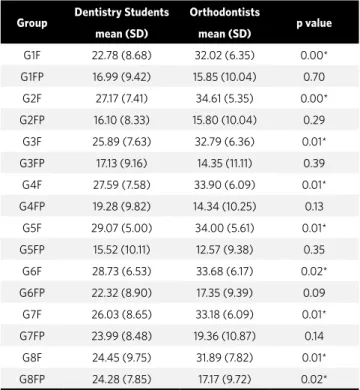
Table 2 - Mean, standard deviation F and FP and p value of the difference between the professional categories in each group.
*Statistically significant difference.
Group Dentistry Students Orthodontists p value mean (SD) mean (SD)
G1F 22.78 (8.68) 32.02 (6.35) 0.00*
G1FP 16.99 (9.42) 15.85 (10.04) 0.70
G2F 27.17 (7.41) 34.61 (5.35) 0.00*
G2FP 16.10 (8.33) 15.80 (10.04) 0.29
G3F 25.89 (7.63) 32.79 (6.36) 0.01*
G3FP 17.13 (9.16) 14.35 (11.11) 0.39
G4F 27.59 (7.58) 33.90 (6.09) 0.01*
G4FP 19.28 (9.82) 14.34 (10.25) 0.13
G5F 29.07 (5.00) 34.00 (5.61) 0.01*
G5FP 15.52 (10.11) 12.57 (9.38) 0.35
G6F 28.73 (6.53) 33.68 (6.17) 0.02*
G6FP 22.32 (8.90) 17.35 (9.39) 0.09
G7F 26.03 (8.65) 33.18 (6.09) 0.01*
G7FP 23.99 (8.48) 19.36 (10.87) 0.14
G8F 24.45 (9.75) 31.89 (7.82) 0.01*
G8FP 24.28 (7.85) 17.17 (9.72) 0.02*
Martins, or at his consulting rooms, so that the degree of lighting in these rooms was adequate and did not compromise evaluation of the photographs.
The data from each questionnaire were compiled in a spreadsheet, and after this, they underwent sta-tistical treatment. Initially, the central trend and dispersion measurements were calculated, and after confirmation of normality of the data, the Student’s t -test and ANOVA were performed, with a level of sig-nificance of 5% to define the difference between them. The Kappa test was performed to evaluate agreement among the orthodontists themselves, among the den-tal students themselves, and between the denden-tal stu-dents and orthodontists. For the orthodontists, Kappa 0.91 and among the dental students 0.87 was obtained, which means there was very good agreement among the evaluators of each group, but there was statistical difference between the two groups.
RESULTS
Facial photographs of the smile
The evaluation of the orthodontists and dental stu-dents varied with regard to the amount of loss of es-thetics of the smile after pigmentation. According to the orthodontists, these alterations were very signifi-cant, as the smiles in which the patient was using the American™ pearl (G7), American™ metallic pearl (G8) and Morelli® (G1) were those that underwent the least alterations as regards degree of attractiveness. For the dental students these differences were smaller and the ligatures that least influenced the esthetics of the smile were Morelli® (G1), American™ clear (G6) and Ameri-can™ pearl (G7) (Fig 2). Whereas those with the most unfavorable behavior, both from the point of view of orthodontists and dental students were ligatures of the Ortho Technology™ (G2) and Unitek/3M™ obscure (G5) commercial brands, respectively (Fig 2).
In the analysis of the absolute values with refer-ence to the degree of attractiveness attributed to this type of photograph, it was verified that the orthodon-tists evaluated the smiles in which the ligatures were without pigmentation (F) as being more esthetic than the dental students did, whereas their scores for attractiveness of the smiles obtained higher means, and there were statistically significant differences in all the groups (Table 2). As regards the photographs with ligatures submitted to pigmentation (FP), the
orthodontists were stricter and attributed lower scores to all groups, however, the majority without statistically significant difference, except for those in Group G8FP (p=0.02), in which the dental students did not identify the presence of important darken-ing in this group, and attributed much higher scores than the orthodontists did (Table 2). For the ortho-dontists, all the ligatures used were pigmented to a considerable extent.
Figure 2 - Mean and standard deviation of the difference FP – F between the commercial brands and categories evaluated.
Den. student
Category
Den. student Den. student Den. student Den. student Den. student Den. student Den. student
5 10 15 20 25
or
thodontist
or
thodontist
or
thodontist
or
thodontist
or
thodontist
or
thodontist
or
thodontist
or
thodontist
16.26
7.24 11.56
9.03 10.72 18.44 21.69
19.55
13.64 21.43
16.33
7.47 7.54 14.02
14.72
9.12
difG2F
Close up photographs of the smile
In these photographs the orthodontists’ and den-tal students’ evaluation was very close as regards the amount of loss of esthetics after pigmentation. Accord-ing to the orthodontists the smiles that showed smaller variations were those in which the patient was using American™ pearl (G7) ligatures. Whereas for the den-tal students, they were American™ pearl (G7), meden-tallic pearl (G8) and clear (G6) (Fig 3). Those with the most
unfavorable behavior, according to the orthodontists, were Ortho Technology™(G2), Unitek/3M™ (G4) and TP Orthodontics™ (G3), respectively, and according to the dental students they were Ortho Technology™(G2) and Morelli® (G1) (Fig 3).
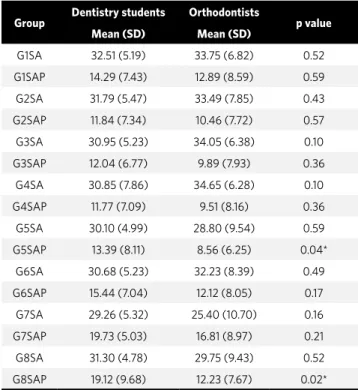
In the analysis of absolute values with reference to the degree of attractiveness attributed to this type of photograph, there was no clear difference between the evaluations made by dental students and ortho-dontists. Both groups attributed high scores to all the photos in which the ligatures were not pigmented (SA) and low scores to the majority of those with pigment-ed ligatures (SAP), except for those with Unitek/3M™ obscure (G5SAP) (p = 0.04) and American™ metallic pearl (G8SAP) ligatures (p = 0.02), in which the dental students did not observe important variations in the at-tractiveness of the smile (Table 3).
DISCUSSION
Some laboratory studies have proved that esthetic elastic ligatures are susceptible to pigmentation when in contact with some types of pigments1,2,3. Neverthe-less, these color changes were observed only by means of a computer program, thus did not evaluate as from which point these alterations could be noted in daily life, and become disturbing to the patient.
In 2009, Cavalcante2 observed that the brand that showed the worst performance; that is to say, that became most pigmented was Unitek/3M™ obscure, which is confirmed by the present study, in which the commercial brands of ligatures that most compromised the degree of attractiveness of the smile clinically after pigmentation, in the evaluation by both orthodontists and dental students of the facial photographs of the smile were Unitek/3M™ obscure (G5) and Ortho Tech-nology™ (G2). This could not be observed in the close up of the same, in which the data of these two studies differ, as the orthodontists indicated the brands Ortho Technology™ (G2), Unitek/3M™ clear (G4) and TP Or-thodontics™ (G3) and the dental students the commer-cial brands Ortho Technology™ (G2) and Morelli® (G1) as those that had the greatest degree of variation.
In the present study, according to the orthodon-tists, the degree of attractiveness of the smiles with the ligatures American™ pearl (G7) were those that underwent the smallest alterations in the two types of photographs used, which differs from the data Table 3 - Mean, standard deviation SA and SAP and p value of the
differ-ence between the professional categories in each group.
*Statistically significant difference.
Group Dentistry students Orthodontists p value Mean (SD) Mean (SD)
G1SA 32.51 (5.19) 33.75 (6.82) 0.52
G1SAP 14.29 (7.43) 12.89 (8.59) 0.59
G2SA 31.79 (5.47) 33.49 (7.85) 0.43
G2SAP 11.84 (7.34) 10.46 (7.72) 0.57
G3SA 30.95 (5.23) 34.05 (6.38) 0.10
G3SAP 12.04 (6.77) 9.89 (7.93) 0.36
G4SA 30.85 (7.86) 34.65 (6.28) 0.10
G4SAP 11.77 (7.09) 9.51 (8.16) 0.36
G5SA 30.10 (4.99) 28.80 (9.54) 0.59
G5SAP 13.39 (8.11) 8.56 (6.25) 0.04*
G6SA 30.68 (5.23) 32.23 (8.39) 0.49
G6SAP 15.44 (7.04) 12.12 (8.05) 0.17
G7SA 29.26 (5.32) 25.40 (10.70) 0.16
G7SAP 19.73 (5.03) 16.81 (8.97) 0.21
G8SA 31.30 (4.78) 29.75 (9.43) 0.52
G8SAP 19.12 (9.68) 12.23 (7.67) 0.02*
Figure 3 - Mean and standard deviation of the difference SAP – SA be-tween the commercial brands and categories evaluated.
Den. student Den. student Den. student Den. student Den. student Den. student Den. student Den. student
Cat
eg
ory
5 10 15 20 25
or
thodontist
or
thodontist
or
thodontist
or
thodontist
or
thodontist
or
thodontist
or
thodontist
or
thodontist
18.12
difG2SA
difG1SA difG3SA difG4SA difG5SA difG6SA difG7SA difG8SA
16.19 16.41 20.57
19.70
13.86 13.47 14.85 20.31
16.23 15.14
8.82
8.14 8.14
13.18
previously found,2 in which the ligatures that became least pigmented were those of the TP Orthodontics™ and American™ Clear brands.
According to the dental students, the smiles that underwent the smallest variations were those in which the patient was using Morelli® (G1), American™ clear (G6) and American™ pearl (G7) ligatures in the facial photographs of the smile, and American™ pearl, metal-lic pearl and clear (G7, G8 and G6) in the close up pho-tographs of the smile, obtaining a result close to those found by other authors,2,1 in which the American™ clear ligatures were also considered among the most stable.
Nevertheless, Cavalcante2 evaluated color changes by means of computerized comparison, using the Ado-be Photoshop program RGB indices, color histogram observation at the level of red, green and blue of digi-tal photographs of pigmented and unpigmented liga-tures, instead of clinical evaluation of photographs, as was done in the present study. A similar evaluation was performed in another study1, in which the varia-tion in ligature pigmentavaria-tion was evaluated only by means of a color measuring device.
Thus, it could be concluded that the perception and interpretation of color are subjective, and can vary ac-cording to the type of evaluator.12,17 Moreover, an iso-lated numerical evaluation alone is not sufficient for an adequate observation of the color changes each elastic ligature undergoes, as the factors such as the oral envi-ronment itself and the set formed by the tooth, bracket and ligature may mask the results of color changes that have already been proved numerically.
Knowing that the degree of stability as well as the other physical and mechanical properties of each of these ligatures is directly related to its components and the particular manufacturing process of each of the commercial brands, it is important to understand that the variation between the natural, non pigmented state and pigmented state (∆) is more important than the ini-tial and final absolute color values of each of them, since we cannot ignore the initial characteristics inherent to the material1 which, undoubtedly, will have a repercus-sion on the final aspect of the ligature evaluated.
This fact associated with the interval between con-sultations during orthodontic treatment will have a di-rect influence on the indication and use of the esthetic elastic ligature, in the same way as it influenced the se-lection of the type of esthetic bracket.18 Therefore, before
treatment begins, some aspects of esthetic accessories with respect to pigmentation must be explained to pa-tients, so that unpleasant surprises concerning color al-teration do not arise during the course of treatment.
In the present study, the pigmentation was per-formed in vitro, because of the difficulty of standardiz-ing variables such as the patient’s diet and oral habits during the entire period required for conducting the research. However, the number of days of immersion of the ligatures in the pigmentation solutions was de-fined so that it would very closely simulate the clini-cal pigmentation process so commonly observed in orthodontic practice. Thus, five days of immersion was defined after conducting a pilot study in which the ligatures from all the groups went through a pigmen-tation process for ten days. It may be observed that it was only on the fifth day that there was evident visual differentiation between the degree of pigmentation among the ligatures used in the study, and that as from this day, not only was there little difference among the groups, but the degree of pigmentation obtained was higher, with the ligatures being much darker than is routinely observed in clinical practice after an inter-val of 21 days between consultations.
The posed smile14,19 was used to enable visualization of the set formed by the tooth, bracket and ligatures. For this evaluation, the presence of subtle variables in the standardized photographs was not relevant to the inves-tigation. Moreover, this research did not relate the col-or alterations with degradation of the effectiveness of elastic ligatures, and therefore, the brands with the best color stability may not necessarily correspond to the brands with the best clinical effectiveness. Thus, further studies must be conducted to elucidate this question.
CONCLUSIONS
1) According to the orthodontists, there were al-terations in the degree of attractiveness of the smile to a very significant extent when pig-mented ligatures were used, with those of the American™ pearl (G7) brand being the ones that underwent the smallest alterations in the two types of photographs used.
2) According to the dental students, these differ-ences were smaller and the ligatures with the least influence on the attractiveness of the smile were Morelli® (G1), American™ clear (G6) and American™ pearl (G7) in the facial photographs of the smile, and American™ pearl, metallic
pearl and clear (G7, G8 and G6) and in the close up photographs of the smile.
3) The ligatures that most compromised the de-gree of attractiveness of the smile, clinically, after pigmentation, both in the evaluation of orthodontists and dental students were Ortho Technology™ (G2) and Unitek/3M™ obscure (G5) in the facial photographs of the smile. In the close up photographs of the smile, the or-thodontists pointed out the brands Ortho Tech-nology™ (G2), Unitek/3M™ clear (G4) and TP Orthodontics™ (G3) and the dental students those of the brands Ortho Technology™ (G2) and Morelli® (G1).
1. Ardeshna AP, Vaidyanathan TK. Colour changes of orthodontic elastomeric module materials exposed to in vitro dietary media. J Orthod. 2009 Sep;36:177-185. 2. Cavalcante J. Avaliação da suscetibilidade à pigmentação de ligaduras elásticas
ortodônticas utilizando fotografia digital [Dissertação]. Salvador (BA): Universidade Federal da Bahia, Faculdade de Odontologia; 2009.
3. Kim S, Lee Y. Mensurement of discoloration of orthodontic elastomeric modules
with a digital camera. Eur J Orthod. 2009 May;31:556-562.
4. Martins MM, Mendes AM, Almeida MAO, Goldner MTA, Ramos VF, Guimarães
SS. Estudo comparativo entre as diferentes cores de ligaduras elásticas. Rev Dental Press Ortodon Ortop Facial. 2006 Jul-ago;11(4):81-90.
5. Taloumis LJ, Smith TM, Hondrum SO, Lorton L. Force decay deformation
of orthodontic elastomeric ligatures. Am J Orthod Dentofac Orthop. 1997 Jan;111(1):1-11.
6. Wong AK. Orthodontic Elastic Materials. Angle Orthod. 1976 Apr;46(2):196-204.
7. Elekdag-Turk S, Ozkalayci N, Isci D, Turk T. Color Preferences of Patients Receiving Elastic Ligatures. Eur J Dent. 2010 Apr;4:171-4.
8. Walton DK, Fields HW, Johnston WM, Rosenstiel SF, Firestone AR, Christensen
JC. Orthodontic appliance preferences of children and adolescents. Am J Orthod Dentofac Orthop. 2010 Dec;138(6):698-9.
9. Loriato LB, Machado AW, Pacheco W. Considerações clínicas e biomecânicas de
elásticos em ortodontia. Rev Clín Ortodon Dental Press. 2006 Fev-Mar;5(1):43-55. 10. Renick MR, Brantley WA, Beck FM, Vig KWL, Webb CS. Studies of orthodontic
elastomeric modules. Part 1: Glass transition temperatures for representative pigmented products in the as-received condition and after orthodontic use. Am J Orthod Dentofac Orthop. 2004 Sep;126(3):337-43.
11. Souza EV, Mendes AM, Almeida MAO, Quintão CCA. Percentual de degradação
das forças liberadas por ligaduras elásticas. Rev Dental Press Ortodon Ortop Facial. 2008 Mar-Abr;13(2):138-45.
12. Berto PM, Lima CS, Lenza MA, Faber J. Esthetic effect of orthodontic appliances on a smiling face with and without a missing maxillary first premolar. Am J Orthod Dentofac Orthop. 2009 Abr;135(4)supl.1:S55-S60.
REFERENCES
13. Delalíbera HVC, Silva MC, Pascotto RC, Terada HH, Terada RSS. Avaliação estética
de pacientes submetidos a tratamento ortodôntico. Acta Sci Health Sci. 2010; 32(1):93-100.
14. Havens DC, McNamara Jr JA, Sigler LM, Baccetti T. The role of the posed smile in overall facial esthetics. Angle Orthod. 2010 Mar;80(2):322-328.
15. Maple JR, Vig KWL, Beck FM, Larsen PE, Shankere S. A comparison of providers’
and consumers’ perceptions of facial-profile attractiveness. Am J Orthod Dentofac Orthop. 2005 Dec;128(6):690-96.
16. Rosvall MD, Fields HW, Ziuchkovski J, Rosenstiel SF, Johnston WM. Attractiveness,
acceptability, and value of orthodontic appliances. Am J Orthod Dentofac Orthop. 2009 Mar;135(3):276-7.
17. Zange SE, Ramos AL, Cuoghi OA, Mendonça MR, Suguino R. Perceptions of
laypersons and orthodontists regarding the buccal corridor in long- and short-face individuals. Angle Orthod. 2011 Jan;81(1):86-90.
18. Libório AO. Avaliação da suscetibilidade à pigmentação de brackets estéticos utilizando a fotografia digital [dissertação]. Salvador (BA): Universidade Federal da Bahia, Faculdade de Odontologia; 2006.
19. Ackerman JL, Ackerman MB, Brensinger CM, Landis JR. A morphometric analysis
of the posed smile. Clin Orthod Res. 1998 Aug;1(1):2-11.
20. Costa MCC, Barbosa MC, Bittencourt MAV. Avaliação da proporção facial vertical: relação das alturas tegumentar e esquelética. Rev Dental Press Ortodon Ortop Facial. 2011 Jan-Fev;16(1):99-106.
21. Scott SH, Johnston lE. The perceived impact of extraction and nonextraction treatments on matched samples of African American patients. Am J Orthod Dentofac Orthop. 1999 Sep;116(3):352-8.