Impact of brackets on smile esthetics: Laypersons and
orthodontists perception
Seandra Cordeiro de Oliveira1, Rachel D’Aurea Furquim2, Adilson Luiz Ramos3
Objective: This study evaluated the influence of orthodontic appliances on smile esthetics assessed by lay adolescents, lay adults and orthodontists. Methods: A facial photograph of a smiling young woman was used under the following conditions: With metal orthodontic brackets ligated by different elastic ligature colors (green, red and gray), with ceramic bracket brack-ets (transparent elastic ligature) and without brackbrack-ets, totaling five 15 x 20 cm pictures. For the photograph assessment, 16 lay adolescents, 16 lay adults and 16 orthodontists were randomly selected. The photographs were randomly arranged in an album, followed by a visual analog scale (VAS) for the scores registration. Scores in both evaluations of each group of evaluators (adolescents, adults and orthodontists) were submitted to error analysis by WILCOXON test and multiple comparison among groups performed by Kruskal – Wallis at 5% significance. Results: Orthodontists, adults and adolescents agreed in their opin-ions, although the orthodontists gave lower scores in their assessments. It could be observed that ceramic brackets were more acceptable concerning the smile esthetics, whereas the metal brackets received the lowest scores. Conclusion: Orthodontists, adults and even adolescents seem to prefer esthetic solutions during orthodontic treatment.
Keywords: Esthetics. Dental. Visual perception. Orthodontic brackets.
How to cite this article: Oliveira SC, Furquim RD, Ramos AL. Impact of brackets on smile esthetics: Laypersons and orthodontists perception. Dental Press J Orthod. 2012 Sept-Oct;17(5):64-70.
Submitted: April 09, 2010 - Revised and accepted: June 05, 2012
» The authors report no commercial, proprietary or financial interest in the products or companies described in this article.
» Patients displayed in this article previously approved the use of their facial and in-traoral photographs.
Contact address: Rachel D’Aurea Furquim
Rua Carlos Chagas, 247 – Zona 5 – Zip code: 87.015-240 – Maringá/PR E-mail: [email protected]
1 Specialist in Orthodontics, Maringaense Association of Dentistry. 2 MSc student in Integrated Dentistry, UEM.
3 Associate Professor, Dentistry Department, UEM. Coodinator od the
Post-Graduation course in Integrated Dentistry, UEM.
4 Professor of Orthodontics. UEM.
Objetivo: esse estudo analisou a influência dos aparelhos ortodônticos na estética do sorriso em avaliação por adolescentes, adultos e ortodontistas. Métodos: foram utilizadas fotografias faciais do sorriso de uma jovem mulher, usando-se as seguintes com-binações: aparelho ortodôntico de metal com ligaduras de diferentes cores (verde, vermelho e cinza); aparelho ortodôntico cerâmico (ligadura transparente); e sem aparelho — resultando em cinco fotografias de 15x20cm. Para a avaliação das fotografias, 16 adolescen-tes leigos, 16 adultos leigos e 16 ortodontistas foram selecionados de forma randômica. As fotografias foram aleatoriamente organiza-das em um álbum, acompanhaorganiza-das de uma escala visual analógica (EVA) para o registro organiza-das notas. As notas organiza-das duas avaliações de cada grupo (adolescentes, adultos e ortodontistas) foram submetidas à análise de erro (teste pareado de Wilcoxon) e comparação múltipla de grupos pelo teste de Kruskal-Wallis com significância de 5%. Resultados: ortodontistas, adultos e adolescentes concordaram em suas opiniões, porém, os ortodontistas deram notas menores em suas avaliações. Pôde ser observado que os braquetes cerâ-micos foram mais aceitos, considerando-se a estética do sorriso, uma vez que os braquetes metálicos tiveram as menores notas.
Conclusão: ortodontistas, adultos e adolescentes parecem preferir soluções estéticas durante o tratamento ortodôntico.
IntROduCtIOn
One of the main reasons that motivate patients to start an orthodontic treatment is the esthetic factor,1-3 as well as joint dysfunction and
improve-ment of dental health as a whole.4 Patients that
look for orthodontic treatment present a more critical self-perception, both of the face, as well as the teeth, than those who do not look for treat-ment. This fact suggests that patients that look for orthodontic treatment, in general, are more de-manding about esthetic looks.5
The smile can have an important influence once that faces with better looking smiles are consid-ered to be more acceptable esthetically6,7 and it can
be associated with psychological characteristics.8,9
Even considering that beauty is quite subjec-tive and is associated with many factors, the pro-fessional has the responsibility to capture the pa-tients’ desires that is the main goal of treatment. Once the patient starts an orthodontic treatment for esthetic reasons, it is consistent to assert that during the treatment he is also concerned about his esthetics. The use of orthodontic brackets can harm the appearance, even if it is temporary.
Long term treatment and non-esthetic appear-ance of metal brackets are the main reasons for adult patients declining to start orthodontic treat-ment4. Facing that, the industry for dental
mate-rials has been looking to offer alternatives so the treatment becomes more esthetic, developing spe-cific treatment techniques and technology, such as lingual orthodontics, transparent aligners, and use of esthetic brackets.10 A recent study concluded
that adult patients would pay more to use alterna-tive appliances and ceramic brackets, once they were considered to be more acceptable and attrac-tive than the metallic conventional ones.11
A German survey shows that 97% of the patients (comprised mainly by females) wishes to have their malocclusions corrected for esthetic reasons, but 62% rejected treatment with a visible appli-ance.12 In Sweden, a survey showed that 67% would
probably wear visible brackets if needed. However, based on appearance of the brackets alone, 33% of the adults would be unwilling to wear visible brackets if needed. The same group additionally responded that 84% would probably or definitely
treated with visible brackets during adolescence if needed.13 These responses suggest a dichotomy
between acceptability of orthodontic appliance for adolescents and adults.
However, to date no studies have been pub-lished on the real impact of this kind of orthodon-tic accessories on smile estheorthodon-tics perceived by adolescents in comparison with adults or ortho-dontists, even with metal brackets, being used in a larger scale in orthodontic clinics. A previous investigation14 examining 18 years old youngsters
found that orthodontic appliance attractiveness varies significantly by the following hierarchy of appliance types: Alternative appliances > ceramic appliances > all stainless steel and self-ligating appliances.14 Recently, the impact of orthodontic
brackets on the esthetics of the face when smiling, with and without premolar extraction was evaluat-ed by lay adults and orthodontists. This investiga-tion concluded that metal orthodontic brackets did not affect facial esthetics. On the other hand, they found that ceramic brackets were significantly less pleasant to lays. To orthodontists, ceramic brack-ets had no negative influence on facial esthetics. The authors also concluded that perception of lay adults and orthodontists was different.15
Facing the lack of studies about the impact of orthodontic brackets on smile esthetics, particu-larly among adolescents, it is difficult for ortho-dontists to inform their patients which brackets to choose based on scientific evidence. This lack of information also becomes relevant when consid-ering the high investments done by industries of dental materials in an effort to develop and com-mercialize orthodontic brackets more impercep-tible to human eyes.
MateRIal and MetHOdS
and no acid etching. Adhesive and Transbond®
XT composite (3M Unitek, California, EUA) were used and cured for 10 seconds to this sample of brackets. A stainless steel arch 0.018-in was used as reference to level bracket position and fixed with ligatures (Morelli, São Paulo, Brazil). Photos of volunteer smiling were obtained in three con-ditions: Without brackets, with ceramic brackets ligated by transparent elastic ligatures and with metal brackets ligated by different ligature colors (green, red and gray).
One of the photographs in which the patient is smiling was selected as the matrix, which was used as reference to obtain smile standardization. Close up photographs were taken with metal and ceram-ic orthodontceram-ic brackets, whceram-ich were transferred to the matrix photo, with a digital simulation using
the software Adobe Photoshop CS2.
The teeth and orthodontic bracket images of the other photos were transferred to the ma-trix photo in order to maintain the same rela-tion between lips and teeth in the smile and the same head positioning at all result photos, so that the only difference between the simulated pho-tos was the orthodontic brackets.
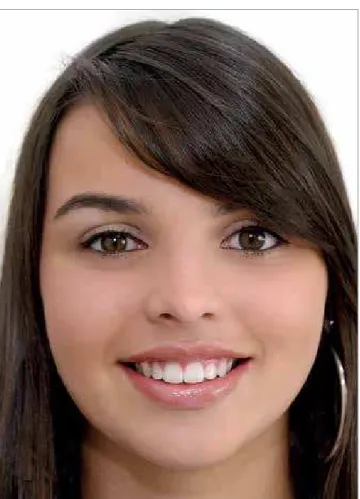
The photos were: A matrix photograph (Fig 1) and four manipulated photographs with images of all kinds of brackets and elastic ligature used (Fig 2).
Color prints with picture quality in size 15 x 20 cm were obtained and randomly grouped in an album. The evaluators were randomly selected and distributed in the following groups: 16 adoles-cents between 13 and 17 years old (8 males and 8 fe-males), 16 graduate adults between 25 and 50 years old (8 males and 8 females) and 16 orthodontists, aged 26-48 years old (8 males and 8 females).
Each evaluator received an album with five photos, an instruction sheet and five evaluation sheets with visual analogue scales (VAS)16 with
10 cm each and a sheet to collect data (age, school-ing level and address). On the left end of the scale was written “Very unpleasant” and on the right end “Very pleasant” (Fig 3).
The raters were instructed not to compare the smiles of the album. They had around 20 seconds to evaluate each photo. The VAS scale sheet was fulfilled in the researcher presence, without any
interference. After two weeks a second evaluation was performed similar to the first one, in order to evaluate the error of method.
Statistical analysis
Scores in both evaluations of each group (adoles-cents, adults and orthodontists) were submitted to
Figure 2 - Smile without brackets (NB).
Figure 1 - Visual Analogue Scale.
Very unpleasant Very pleasant
Photo # ___
Figure 3 - A) Smile with ceramic brackets (CB). B) Metal brackets + gray ligatures (MB + GY). C) Metal brackets + green ligatures (MB + GN). D) Metal brackets + red ligatures (MB + R).
A
C
B
an error analysis using of Wilcoxon signed-rank test. Multiple comparisons among groups were per-formed using Kruskal-Wallis test. All the statis-tics were performed using two-tailed distribution at p > 0.05.
ReSultS
Table 1 presents intra-group comparisons. It can be observed that all groups presented similar behaviors, scoring smiles with ceramic brackets as well as smiles without brackets as more esthetical.
The averages were tested between genders and presented on table 2. There was no significant dif-ference between genders, except on the MB+GN combination (metal bracket+ green ligature), where the female gender presented a smaller aver-age in comparison to the male evaluators (p < 0.05). The intergroup analysis showed that orthodon-tists presented higher esthetic levels especially to the combinations MB+R, MB+GN, NB. For the CB and CB+ GY the lay adolescent group showed to be as demanding as orthodontists. The lay adult group showed to be less demanding than the oth-er groups for all proposed combinations (Table 3, Fig 4), marking higher scores in general.
Figure 4 illustrates the scores behavior of all groups of evaluators. A clear similarity was found on the behavior of the curves, especially differing the lay adult’s scores, as well as the best grades for the smile without brackets or with ceramic brackets.
Table 1 - Descriptive data of the scores obtained by VAS.
Group Treatment Mean Standard
Deviation n
95% confidence interval
Lower Limit Upper Limit
Adolescents
CB 70.47 21.41 32 62.750 78.187
MB+GN 55.81 19.98 32 48.610 63.015
MB+R 61.56 14.84 32 56.213 66.912
MB+GY 60.28 17.26 32 54.060 66.503
NB 74.81 12.79 32 70.202 79.423
Adults
CB 80.56 13.46 32 75.709 85.416
MB+GN 64.72 21.07 32 57.123 72.314
MB+R 65.88 18.38 32 59.247 72.503
MB+GY 66.72 19.24 32 59.782 73.655
NB 78.63 15.01 32 73.214 84.036
Orthodontists
CB 70.34 16.30 32 64.468 76.219
MB+GN 50.72 19.21 32 43.793 57.645
MB+R 56.09 17.07 32 49.939 62.248
MB+GY 57.06 20.29 32 49.748 64.377
NM 66.50 19.84 32 59.348 73.652
Table 2 - Multiple comparison (Kruskal-Wallis) to the average comparison of the two genders for each combination.
* Averages on the columns with different letters are statistically different on the 5% level of significance (p value < 0.05).
Group Average Score Treatment
CB MB+GN MB+R MB+GY NB
Male 74.25a 61.29a 64.08a 62.35a 73.48a
Female 73.33a 52.87b 58.27a 60.35a 73.14a
Table 3 - Multiple comparison (Kruskal Wallis) between score averages for each group of evaluators.
* Averages on the columns with different letters are statistically different on the 5% level of significance (p value < 0.05).
Group Average score
CB MB+GN MB+R MB+GY NB
Adolescents 70.47a 55.81a 61.56a 60.28a 74.81a
Adults 80.56b 64.72b 65.88a 66.72a 78.63a
Orthodontists 70.34a 50.72a 56.09b 57.06b 66.50b
Figure 4 - Average scores for the three evaluators groups.
Adolescent 90
CB MB+GN MB+R MB+GY NB
70
50
30
10 80
60
40
20
0
value and an appearance question for patients.11,14
the appliances should be selected on the efficiency basis. In fact, less attractive appliances are most commonly used in orthodontic practice.21 It was
pointed that ceramic brackets could be less effi-cient than metallic in terms of fracture resistance and sliding quality.11,14 Furthermore, to date, it was
reported that clear aligners still need improve-ments to achieve clinical performance compared to conventional brackets.22
Although there was homogeneity in respect to smile esthetics, the orthodontic group showed to be more demanding for all proposed combinations, with smaller scores in general. Other perception studies showed similar judgment behavior between orthodontists and lay people.17-20
Many studies have evaluated characteristics of both dental and facial esthetics, rating photo-graphic records with a visual analog scale (VAS), which has been shown to be a valid method of as-sessing dental attractiveness.1,6,11,14,15,17-20,23 Two
evaluations with two weeks interval in this study showed no significant differences in all groups. When genders of evaluators were compared, me-tallic brackets with green ligation were the only significant different measurement found in fe-male group, who scored less attractive than fe-males. In this study, evaluators judged photographs of the whole face and not by limited dental frame-works of the smile. In this way smiles are evalu-ated as a part of the whole esthetics of the face. In photos with guidelines about the smile, there is overvaluing of certain characteristics of the smile in question, particularly negative characteris-tics.20 Despite of different evaluation methods, our
results agree with Rosvall et al11 and Ziuchkovski
et al14 where both orthodontists and lay people
classified the devices in a hierarchy where the at-tractiveness decreased with increasing amount of metal present. In opposite, Berto et al15 found that
lay people prefer metallic brackets than ceramic, however an extraction site was present in their photographs, which could affected perception.
It is suitable to say that in the present study all brackets were temporarily bonded, then photo-graphed and lately removed. This way, they were not allowed to pass through the environmental dISCuSSIOn
The adult demand for orthodontic treatment increased, inn most cases for esthetic reasons.3,10
Because of this, it would be reasonable to assume that patients, especially adults, would not only be concerned about the esthetics in the end of the treatment, but also during the whole process. Al-though this affirmation is confirmed for adults,12-15
no study had been conducted on adolescents’ at-tractiveness perception when using brackets, maybe because it is presumed that adolescents are used to a “metallic smile”.
Our results showed that adolescents recorded similar scores between the smiles with or with-out ceramic brackets. On the other hand, smiles with metal brackets, regardless of the ligature color used, were considered less pleasant. In fact, adolescents were more demanding in esthetic reasons than the adult evaluator group, contra-dicting the idea that adolescents tend to feel bet-ter with a “metallic smile”. This can suggest that the esthetic requirement is very updated, even in young patients and not only restricted to the adult public. Maybe this is due to the influence of the media, the increased number of patients under orthodontic treatment, or by cultural and socio-economic aspects.3,10,15
Considering that orthodontic treatment re-quires time to be accomplished, it would be ac-ceptable that, even adolescents would choose brackets that interfere the minimum possible on their appearance, being discrete or even non per-ceivable.10,11 Thus, orthodontists should concern
about the population requests. Although clear aligners, lingual and ceramic brackets are most commonly used in adults,12-15 we can expect an
in-creasing demand for these esthetic options among adolescents.
conditions caused by time and the actual orth-odontic treatment, which would be more signifi-cant, once they could change, mainly on the brack-et/ transparent ligature, which could affect their esthetic perception. This fact suggests that more studies should be conducted with the objective of evaluating the perception of the esthetic of these devices, in long-term.
COnCluSIOnS
» Considering the esthetic aspect, smiles with metal brackets presented smaller scores than smiles without brackets and with ceramic brackets.
» Adolescents, adults and orthodontists showed similar perceptions on the evaluation of the impact of brackets on smile esthetics.
1. Prahl-Andersen B, Boersma H, van der Linden FP, Moore AW. Perception of dentofacial morphology by laypersons, general dentists, and orthodontists. Am J Dent Assoc. 1979;98:209-12.
2. Giddon DB, Sconzo R, Kinchen JA, Evans CA. Quantitative comparison of computerized and animated profile preferences. Angle Orthod. 1996;66:441-8. 3. Reis SAB, Abrão J, Capelozza Filho L, Claro CAA. Análise facial subjetiva. Rev
Dental Press Ortodon Ortop Facial. 2006;11(5):159-72.
4. Khan RS, Morrocks EN. A study of adult orthodontic patients and their treatment. Br J Orthod. 1991 Aug;18(3):183-94.
5. Varela M, Garcia-Camba JE. Impact of orthodontics on the psychologic profile adult patients: a prospective study. Am J Orthod Dentofacial Orthop. 1995 Aug;108(2):142-8.
6. Shaw WC, Rees G, Dawe M, Charles CR. The influence of dentofacial appearance on the attractiveness of young adults. Am J Orthod. 1985 Jan;87(1):21-6.
7. York J, Holtzman J. Facial attractiveness and the aged. Spec Care Dentist. 1999 Mar-Apr;19(2):84-8.
8. Dong JK, Jin TH, Cho HW, Oh SC. The esthetics of the smile: a review of the recent studies. Int J Prosthodont. 1999 Jan-Feb;12(1):9-19.
9. van der Geld P, Oosterveld P, Van Heck G, Kuijpers-Jagtman AM. Smile attractiveness. Self-perception and influence on personality. Angle Orthod. 2007 Sep;77(5):759-65.
10. Maltagliati LA, Feres R, Figueiredo MA, Siqueira DF. Braquetes estéticos: considerações clínicas. Rev Clín Ortodon Dental Press. 2006;5(3):75-81. 11. Rosvall MD, Fields HW, Ziuchkovski J, Rosenstiel SF, Johnston WM.
Attractiveness, acceptability, and value of orthodontic appliances. Am J Orthod Dentofacial Orthop. 2009 Mar;135(3):276.e1-12; discussion 276-7.
12. Meier B, Wiemer KB, Miethke R. Invisalign—patient profiling. J Orofac Orthop. 2003 Sep;64(5):352-8.
REFERENCES
13. Bergström K, Halling A, Wilde B. Orthodontic care from the patients’ perspective: perceptions of 27-year-olds. Eur J Orthod. 1998;20(3):319-29.
14. Ziuchkovski JP, Fields HW, Johnston W, Lindsey D. Assessment of perceived orthodontic appliance attractiveness. Am J Orthod Dentofacial Orthop. 2008 Apr;133(4 Suppl):S68-78.
15. Berto PM, Lima CS, Lenza MA, Faber, J. Esthetic effect of orthodontics appliances on a smiling face with and without a missing maxillary first premolar. Am J Orthod Dentofacial Orthop. 2009 Apr;135(4 Suppl):S55-60.
16. Aitken RC. Measurement of feelings using visual analogue scale. Proc R Soc Med. 1969;62(10):989-93.
17. Anderson KM, Behrents RG, McKinney T, Buschang PH. Tooth shape preferences in an esthetic smile. Am J Orthod Dentofacial Orthop. 2005 Oct;128(4):458-65. 18. Parekh S, Fields H, Beck F, Rosenstiel S. The acceptability of variations in smile arc
and buccal corridor space. Orthod Craniofac Res. 2007 Feb;10(1):15-21. 19. Kokich VO, Kokich VG, Kiyak HA. Perceptions of dental professionals and
laypersons to altered dental esthetics: asymmetric and symmetric situations. Am J Orthod Dentofacial Orthop. 2006 Aug;130(2):141-51.
20. Flores-Mir C, Silva E, Barriga MI, Lagravere MO, Major PW. Lay person´s perception of smile aesthetic in dental and facial views. J Orthod. 2004 Sep;31(3):204-9; discussion 201.
21. Keim RG, Gottlieb EL, Nelson AH, Vogels DS 3rd. 2002 JCO study of orthodontic diagnosis and treatment procedures. Part 1. Results and trends. J Clin Orthod. 2002 Oct;36(10):553-68.
22. Djeu G, Shelton C, Maganzini A. Outcome assessment of Invisalign and traditional orthodontic treatment compared with the American Board of Orthodontics objective grading system. Am J Orthod Dentofacial Orthop. 2005 Sep;128(3):292-8; discussion 298.