In vivo color changes of esthetic orthodontic ligatures
Andréia Viana Martins da Silva1, Giselle Vasconcelos de Mattos2, Carlos Mario Kato3, David Normando4
Objective: To assess the color changes that occur in four commercial brands of esthetic orthodontic elastomeric ligatures after ex-posure to the oral environment. Methods: The four elastomeric ligatures manufacturers mostly mentioned by orthodontists were investigated: Morelli, Uniden, American Orthodontics (AO) and TP. The sample comprised 25 patients. The elastomeric ligatures were randomly distributed and arranged in the four dental quadrants of each patient, r for 30 days. After this period, two units of each brand were photographed in a standardized manner. Subsequently, color changes were visually evaluated and assigned a score (0, 1, 2 or 3) by a panel of four examiners. The mean scores assigned by the examiners were statistically analyzed by ANOVA and Tukey’s test (p < 0.05). Results: The mean pigmentation scores assigned to Morelli (1.80 ± 0.78) and Uniden (1.92 ± 0.66) elastomeric ligatures af-ter 30 days in the oral environment were not statistically different. However, these brands were significantly more pigmented afaf-ter 30 days in the oral environment (p < 0.01) compared to American Orthodontics (0.97 ± 0.6) and TP (0.83 ± 0.79). Conclusions: Although all four brands exhibited an undesirable pigmentation after 30 days in the oral environment, color change for American Orthodontics and TP Orthodontics ligatures was significantly lower than Morelli and Uniden products.
Keywords: Elastomeric ligatures. Pigmentation. Visual perception.
How to cite this article: Silva AVM, Mattos GV, Kato CM, Normando D. In vivo color changes of esthetic orthodontic ligatures. Dental Press J Orthod. 2012 Sept-Oct;17(5):76-80.
Submitted: August 08, 2010 - Revised and accepted: September 13, 2010
» The authors report no commercial, proprietary or financial interest in the products or companies described in this article.
Contact address: Andréia Viana Martins da Silva
Travessa Três de Maio, 1782, Apto 3002 – São Braz – Belém/PA – Brazil ZIP CODE: 66.063-390 – E-mail: [email protected] 1 DDS, Federal University of Pará (UFPA).
2 Specialist in Orthodontics, EAP/ABO-PA
3 Professor, Specialization Course in Orthodontics, ABO-PA.
4 Specialist in Orthodontics, PROFIS/Bauru, MSc in Clinical Dentistry, FOUSP. PhD in Orthodontics, UERJ. Assistant Professor, Department of Orthodontics, UFPA. Head Professor, Specialization Course in Orthodontics, ABO-PA.
Objetivo: avaliar as alterações de cor ocorridas em elastômeros estéticos de quatro marcas comerciais, quando expostos ao meio bu-cal. Métodos: foram examinadas as quatro marcas comerciais mais citadas por ortodontistas — Morelli, Uniden, American Ortho-dontics (AO) e TP —, em 25 pacientes consecutivos. Os elastômeros foram distribuídos de forma aleatória e ordenados nas quatro hemiarcadas de cada paciente, permanecendo no meio bucal por 30 dias. Após esse período, duas unidades de cada marca em todos os pacientes foram fotografadas de forma padronizada para, posteriormente, serem analisadas através de avaliação visual quanto à variação de cor, por escores (0, 1, 2, 3), por um painel de quatro examinadores. Os escores médios dos examinadores foram analisa-dos estatisticamente por meio da ANOVA e teste de Tukey, com p<0,05. Resultaanalisa-dos: os escores médios de pigmentação, após 30 dias no meio intrabucal, obtidos para os elastômeros Morelli (1,80±0,78) e Uniden (1,92±0,66) não foram estatisticamente diferentes entre si. Entretanto, essas marcas estavam significativamente mais pigmentadas após 30 dias no meio intrabucal (p<0,01) quando comparadas às marcas importadas, American Orthodontics (0,97±0,6) e TP (0,83±0,79). Conclusão: apesar de todas as quatro marcas apresentarem uma indesejável pigmentação após 30 dias no meio intrabucal, as marcas American Orthodontics e TP apresentaram alterações de cor menos significativas do que as marcas Morelli e Uniden.
INTRODUCTION
Advances in cosmetic dentistry and the increasing demand for orthodontic treatment for adult patients have compelled the industry to release increasingly esthetic and less conspicuous orthodontic appliances. Brackets bonded to the lingual surface of the teeth, clear aligning systems, esthetic brackets made from polycarbonate, composite, ceramics or sapphire, il-lustrate some of the products released by the industry in order to satisfy the esthetic needs of these patients.
Although the quality of these materials is thor-oughly tested before clinical use, clinical orthodon-tists have found that some of these products undergo a number of changes in their properties, especially changes in color due to staining by food or by contact with oral fluids. Concerns have been raised about the quality of these products and whether one particu-lar company might be superior to another in terms of efficiency or cost-effectiveness. Many studies have evaluated the effects of the oral cavity on the elastic properties of elastomeric ligatures, such as force de-cay, friction and dimensional changes.1-7 However,
researchers have shown little concern about the be-havior of orthodontic materials after exposure to the oral environment, especially the extent to which these changes interfere with esthetics.
Ceramic brackets have gained increased popular-ity in orthodontic treatment over the last decades mainly due to color stability. A frequent complaint of orthodontists and patients regards color changes in the elastomeric modules used to tie orthodontic arch-wires to ceramic brackets.
Prolonged exposure to cola soft drinks is a proven cause of color changes in restorative composites, while spices and seasonings can cause extrinsic stains to the teeth.8,9 In orthodontics, some laboratory studies have
shown that light-colored elastomeric ligatures show color changes after immersion in liquids with high pigmentation capacity.10-12 Since these studies were
conducted in vitro, they may not account for numer-ous other factors present in the oral environment that could contribute to color changes, such as the oral flo-ra, the mechanical effect of brushing, solid and semi-solid foods, which can also stain, among many others. Thus, it seems quite obvious that an in vivo study can yield a more realistic analysis of actual color changes taking place in orthodontic materials after clinical use.
OBJECTIVE
Analyze color changes in esthetic elastomeric liga-tures provided by four different manufacturers after a one-month exposure to the oral environment by a visual analysis.
MATERIAL AND METHODS
This study evaluated four brands of esthetic orth-odontic elastomeric ligatures: Morelli – Lot 1268512 (Sorocaba, Brazil), Uniden – Lot 040209-E1-4 (Soro-caba, Brazil), American Orthodontics – Lot 00182559 (Sheboygan, Wisconsin, USA) and TP – Lot 1419028 (La Porte, Indiana, USA). The elastomeric modules were used in 25 consecutive patients undergoing orthodontic treatment in the Specialization Course in Orthodontics, ABO-Pará State, Brazil. These brands were selected after a survey was conducted with 100 Brazilian orthodontists via e-mail. Forty-four dentists (44%) responded to the following qution: Which elastomeric ligature do you use on es-thetic brackets? Two respondents reported that they were not using esthetic brackets. Two Brazilian and two American manufacturers most cited by the re-maining 42 orthodontists were utilized. The brands cited in this research were:
» Morelli (Sorocaba, São Paulo, Brazil): 10. » Uniden (Sorocaba, São Paulo, Brazil): 2. » TP (La Porte, Indiana, USA): 8.
» American Orthodontics (Sheboygan, USA): 11. » GAC (Bohemia, NY, USA): 6.
» 3M Unitek (St. Paul, Minnesota, USA): 3. » Orthosource (North Hollywood, USA): 1. » Tecnident (Porto Alegre, RS, Brazil): 2.
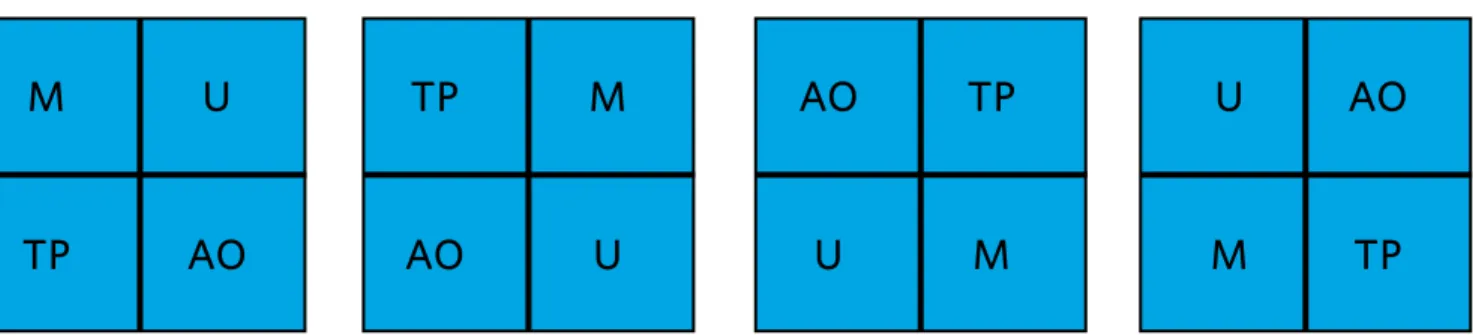
A split-mouth, randomized, triple blind study de-sign was employed. In each patient, the four brands were distributed by quadrant in random and ordered fashion (Fig 1), remaining in the oral environment for a period of 30 days.
The subjects participating in the research were not on any specific type of diet. After 30 days, the ligatures were removed from the oral environment, separated by quadrant, and the brands were identi-fied by numbers. Two ligatures — used on the anterior teeth of each quadrant — were selected for analysis.
M
M
M
M
U
U
U
U
AO
AO
AO
AO
TP
TP
TP
TP
10 megapixels resolution and color depth of 12 bits(Fig 2). All photographs were taken manually by a single operator, with 1/6 seconds speed, 22 diaphragm aperture, ISO 200, without flash, self-timer mode set to trigger after 10 seconds, images stored in JPEG for-mat. A Sigma DG 105 mm (Ronkonkoma, NY, USA), 2.8 macro lens was used in an environment with total ab-sence of daylight, lighted by two 110W halogen lamps, positioned at a fixed distance of 16 cm from each other, according to the method described previously.11
The photographs were evaluated at two times: Before use (T1) and after 30 days in the oral environment (T2). In order to carry out a visual analysis of the elas-tomeric ligatures, a PowerPoint presentation (Mi-crosoft, Redmond, WA, USA) was created comprising 25 original photographs and 17 duplicates, randomly arranged. The images were assessed independently by a panel of four orthodontists who rated the de-gree of pigmentation of the elastomeric ligatures in each quadrant using a numerical scale ranging from 0 (zero) to 3, where 0 was assigned to unpigmented
ligatures, 1 was assigned to slightly pigmented liga-tures, 2 to moderately pigmented ligaliga-tures, and 3 to heavily pigmented ligatures. All ligatures were ranked and grouped accordingly. The photographs of the liga-tures prior to use were presented to a single blinded examiner to determine the initial score.
Statistical analysis
The data obtained from the reproducibility test were tested using the Wilcoxon test. The brands were compared by means of statistical analysis using the mean scores of the four examiners for each brand, af-ter assessing the reproducibility of each examiner’s diagnosis. The data were statistically compared by ANOVA and Tukey’s test. All statistical analyses were examined at a significance level of 0.05 (5%).
RESULTS
The reproducibility test failed to reveal any signifi-cant differences for any of the examiners in the test-retest analyses (Table 1).
Figure 1 - Random, ordered distribution of brands by quadrant. (M = Morelli, U = Uniden, AO = American Orthodontics, TP = TP Orthodontics).
Figure 2 - Photographs of elastomeric
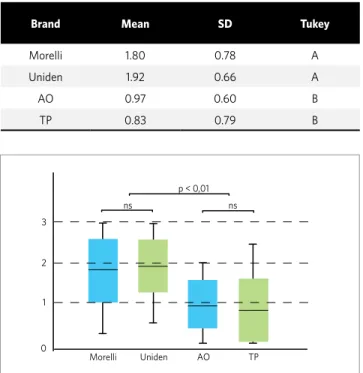
An analysis of the elastomeric ligatures before inser-tion in the mouth yielded a zero (0) score for all speci-mens examined (five in each group). Variance analysis showed that statistically significant differences were found between the commercial brands of elastomeric ligatures examined after 30 days of exposure to the oral environment (p < 0.0001). Tukey’s test showed that the Brazilian brands (Morelli and Uniden) were similar, but significantly more pigmented (Fig 3, Table 2) than the US brands (American Orthodontics and TP).
DISCUSSION
Changes in the color of orthodontic ligatures have been performed by in vitro laboratory studies,10-12
whereas the literature reports no in vivo analysis of
Table 1 - P values of reproducibility test (Wilcoxon) for the scores as-signed by the four examiners using the visual method for Morelli, Uniden, American Orthodontics (AO) and TP Orthodontics brands.
Brand p value p value p value p value Exam. 1 Exam. 2 Exam. 3 Exam. 4
Morelli 0.3173 1 0.3173 1
Uniden 0.593 1 0.3613 0.3173
AO 0.6858 0.6858 0.2367 0.593
TP 1 0.6858 1 1
Table 2 - Descriptive statistics and Tukey’s test comparing the commer-cial brands of elastomeric ligatures examined, F = 14.83, p < 0.0001 (dif-ferent letters, p < 0.01).
Brand Mean SD Tukey
Morelli 1.80 0.78 A
Uniden 1.92 0.66 A
AO 0.97 0.60 B
TP 0.83 0.79 B
Figure 3 - Comparison between the examined elastomeric commercial brands, F = 14.83, p < 0.0001.
such color changes. This study, therefore, provides results that are closer to reality by assessing color changes in elastomeric ligatures after exposure to the oral environment.
Assessments of the physical properties of elasto-meric ligatures have reported significant changes in the structure and composition of these materials af-ter exposure to the oral environment.1-7 Variations in
the friction force of elastomeric ligatures of different brands were observed after immersion in laboratory solutions in an attempt to reproduce the oral envi-ronment.3 After exposure to the oral environment
for 3 weeks and subsequent analysis by optical mi-croscopy and spectroscopy, the elastomeric ligatures exhibited precipitates of calcium and phosphorus with the formation of calcium phosphate on the sur-face. A significant change was found in the structure and composition of the surface of the elastomeric ligatures after exposure to the oral environment, in-dicative of the severity of changes that can occur in the properties of these materials.4
In assessing the color, laboratory investigations were performed in an attempt to find differences in the staining of these elastomeric ligatures after im-mersion in different solutions. In these investigations, the change in color was measured quantitatively by means of a visual analog scale12 or computational
anal-yses,10,11 The results indicated that certain substances
stain more than others, such as methylene blue and red pepper sauce.10,11
Although a visually perceptible color change value was reported,11 the equipment used in the research
features considerable optical sensitivity and can be influenced by luminance and color of the surface on which the elastomeric ligatures are examined. Fur-thermore, one cannot determine to what extent color variations can compromise the visual esthetic pleas-antness of an elastomeric ligature.
In the present study, a visual comparison between the four brands examined after 30 days in the oral environment was conducted by a group of four exam-iners using scores, disclosing significant differences between the brands tested (p < 0.01). Brazilian brands (Morelli and Uniden) had a similar, but poorer perfor-mance when compared to US brands (American Or-thodontics and TP) which,also showed similar stain-ing among each other (Table 2).
Morelli 0
1 2 3
p < 0,01
ns ns
The visual analysis developed in this study al-lowed a direct comparison of the four most used brands according to a questionnaire answered by e-mail prior to the study. The results addressed a very common issue among orthodontists, that is which brand ensures for the patient greater esthetic sta-bility during the period between two orthodontic maintenance visits. Previous attempts were made to examine the results with spectrometry (Minolta)10
and through an analysis of photographs with Adobe Photoshop software version 10.0 (Adobe System Inc., San Jose, California, USA).11 However, the results
showed a high variability in the test-retest exami-nation, especially spectrophotometry, due to limi-tations inherent in the technique, which requires a relatively large area for color analysis. Additionally, such analysis can be influenced by the curvature of elastomeric ligatures, as mentioned previously.11
Wide variations in the behavior of elastomeric ligatures of the same brand were observed in dif-ferent patients (Fig 1). This may be due to a differ-ent diet and/or differdiffer-ent oral hygiene habits , which
may have interfered with the degree of pigmentation exhibited by elastomeric ligatures during the experi-ment. Studies that correlate diet and elastomeric pigmentation between experimental groups could be conducted to determine the types of foods that con-tribute more significantly to the esthetic degradation of elastomeric ligatures.
Based on the results, manufacturers of orthodon-tic materials — Brazilian companies in parorthodon-ticular — should modify manufacturing methodology to en-hance the stability of light-colored elastomeric liga-tures used on ceramic brackets. This achievement would meet the needs of the adult population cur-rently seeking orthodontic treatment with increasing esthetic concerns.
CONCLUSIONS
The results revealed that all four brands exhibited an unwanted pigmentation after 30 days of exposure to the intraoral environment, although the US brands American Orthodontics and TP Orthodontics showed less pigmentation than Morelli and Uniden.
1. Baccetti T, Franchi L. Friction produced by types of elastomeric ligatures in treatment mechanics with the preadjusted appliance. Angle Orthod. 2006 Mar;76(2):211-6.
2. Baty DL, Volz JE, von Fraunhofer JA. Force delivery properties of colored elastomeric modules. Am J Orthod Dentofacial Orthop. 1994 Jul;106(1):40-6. 3. Dowling PA, Jones WB, Lagerstrom L, Sandham JA. An investigation into the
behavioural characteristics of orthodontic elastomeric modules. Br J Orthod. 1998 Aug;25(3):197-202.
4. Eliades T, Eliades G, Watts DC. Structural conformation of in vitro and in vivo aged orthodontic elastomeric modules. Eur J Orthod. 1999 Dec;21(6):649-58. 5. Eliades T, Eliades G, Silikas N, Watts DC. In vitro degradation of polyurethane
orthodontic elastomeric modules. J Oral Rehabil. 2005 Jan;32(1):72-7. 6. De Genova DC, McInnes-Ledoux P, Weinberg R, Shaye R. Force degradation of
orthodontic elastomeric chains a product comparison study. Am J Orthod. 1985 May;87(5):377-84.
REFERENCES
7. Taloumis LJ, Smith TM, Hondrum SO, Lorton L. Force decay and deformation of orthodontic elastomeric ligatures. Am J Orthod Dentofacial Orthop. 1997 Jan;111(1):1-11.
8. Fay RM, Servos T, Powers JM. Color of restorative materials after staining and bleaching. Oper Dent. 1999 Sept-Oct;24(5):292-6.
9. Abu-Bakr N, Han L, Okamoto A, Iwaku M. Color stability of compomer after immersion in various media. J Esthet Dent. 2000;12(5):258-63.
10. Ardeshna AP, Vaidyanathan TK. Colour changes of orthodontic elastomeric module materials exposed to in vitro dietary media. J Orthod. 2009 Sep;36(3):177-85. 11. Kim SH, Lee YK. Measurement of discolouration of orthodontic elastomeric
modules with a digital camera. Eur J Orthod. 2009 Oct;31(5):556-62. 12. Lew KK. Staining of clear elastomeric modules from certain foods. J Clin Orthod.