Francisco J. Ballesteros, Gorka Guardiola Muzquiz,
Katia Leal Algara, Enrique Soriano
Pedro de las Heras Quiros, Eva M. Castro,
Andres Leonardo, and Sergio Arevalo
Laboratorio de Sistemas
Universidad Rey Juan Carlos
Madrid, Spain.
[email protected]
Abstract
Nowadays computing environments are made of heterogeneous networked resources, but unlike envi-ronments used a decade ago, the current envienvi-ronments are highly dynamic. During a computing session, new resources are likely to appear and some are likely to go oine or to move to some other place. The operating system is supposed to hide most of the complexity of such environments and make it easy to write applica-tions using them. However, that is not the case with our current operating systems. Plan B is a new oper-ating system that attempts to allow the applications and their programmers select and use whatever re-sources are available without forcing them to deal with the problems created by their dynamic distributed and heterogeneous environments. It does so by using con-straints along with a new abstraction used to replace the traditionalle abstraction.
Keywords: Distributed systems, Operating
Sys-tems, Adaptability, Pervasive computing.
1 Introduction
The computing environment used to write this pa-per is made of three dierent network technologies (ethernet, wireless ethernet, and serial links) that in-terconnect a number of dierent devices including lap-tops, hand-held pocket PCs, desktop PCs and a le server. Some of these machines have large displays, some do not. The same happens with keyboards, au-dio devices, disks, and other resources. Furthermore,
This work nanced in part by Spanish MCYT TIC-2001-1586-C03-01 and URJC PPR-2003-40.
resources available to a human or an application using the system greatly vary upon time because the devices can move. Besides, other resources like printers, scan-ners, etc. should be used or not depending on the location of the user and their operational status (they go oine some times).
To pick up an example to illustrate the need of a new operating system, consider what a user or an ap-plication1 has to do for printing a le when using the
pocket-pc. We would like to be able to say just \copy this le to a printer" and let the system discover if there is a printer at hand willing to accept print jobs. If there are several printers available, we would like the system to choose any one that understands the format of the le to be printed. If no printer understands the le format but there is a program to convert the data to the printer format, we would like the system to run that program and then queue the result for printing. This is not the case with current operating systems. Furthermore, existing systems are likely to send the le from the le server to the pocket-pc (which can be connected through a very slow link) just to send it again to the printer. This means that once more the user has to make the job of the operating system by selecting a machine well-connected to the printer where to execute the print command.
We believe that we have enough technology to be able to do all this with just a single command like
cp /this/file /any/printer
but in the operating systems we use it turns out to be much more complex. This may be a symptom that existing operating systems are not supplying ap-propriate services to handle our computing resources.
1In what follows we use the term \user" to refer both to users and to applications using the system.
To dene the problem more clearly, we can say that existing operating systems are not helping much their users to select which resources to use. Note that this problem, which could be named the \resource selec-tion problem" is dierent from the problems of both locating and discovering resources, and is actually a simplied version of the problem of taking context into account while considering user requests.
This problem can be seen in plenty of dierent ex-amples, whenever the user is selecting a particular re-source among the ones available in the network. For example, we would like to say \execute a program" without taking care of which binaries are available for the program, which architectures they can execute on, and which processors of such architectures are avail-able. Programs like editors would like to ask the oper-ating system to \save data to a temporary le", and let the system discover whether to use a local le system (if any), or the department's le server (if available), or any nearby disk willing to accept requests for tem-porary storage from our machine (when available). If we are lucky, our operating system would allow us to use resources from the network but it would still leave up to the user the task of selecting which ones to use even when the choice is obvious.2
A dierent, but related, problem is that once the resources are selected, we may change our mind. For example, many of us have wanted to be able to use our mouse for a while to help a colleague sitting in the next desk, instead of having to stand up and use his/her mouse. We would also like to use a keyboard from a desktop machine to type on a networked pocket PC with no keyboard. Although the application con-sidered has already a mouse or a keyboard to receive events or characters, we may still want to make it use dierent devices for a while. Another instance of the same problem is that, due to changes in the net-work, an application using a network connection may be forced to switch to a dierent connection to stay connected (e.g. switching from a tcp stream to an in-frared connection). We refer to this problem as the \resource redirection problem".
The objective of this work is to provide a comput-ing system where applications could use the plethora of networked resources without dealing with the com-plexity of the environment by themselves; more pcisely, to build a system that addresses both the re-source selection and redirection problems on behalf of the applications. The system has been built and is
2It is a matter of taste, but for the author this case is when all machines involved run either Plan 9 or Inferno. Both operating systems exportallresources to the network using a le interface, which at least is more than other systems do.
named \Plan B".
In what follows, section 2 shows the main ideas be-hind Plan B. Sections 3 and 4 give an overview of the system and its main elements. Then we show how such elements are used to address the problems faced in sections 5 to 7. Sections 8 to 10 discuss how we address some important issues like heterogeneity, fail-ures, garbage collection, and protection. Section 11 shows some implementation details. Section 12 dis-cusses more examples to show how the system works. Section 13 explains the lessons we learned while build-ing and usbuild-ing the system. Sections 14 and 15 discuss related and future work.
2 Plan B
The main new idea in Plan B is the introduction of a new abstraction, the box [3], designed to let the ap-plication use networked resources in an easy way. But we believe that its main contribution is not any idea in particular, but how the combination of its design prin-ciples makes up an environment that is more simple to use for today and upcoming computing resources. These are the principles Plan B is built on:
All resources (processes, devices, etc.) are
per-ceived as a single abstraction, the box [3]. Boxes are typed data containers that are operated us-ing a copy operation (instead of the traditional
read/write interface used for les) and have con-straints that determine how they can be used to-gether. This lets Plan B know which resources are being requested to be used together (a bi-nary is copied to a processor, a le to the printer, etc.) and which constraints must be considered when using them (binaries must match the pro-cessor architecture, le formats must match those understood by the printers, etc.). The box ab-straction is further discussed in the next section. Note that traditional read and write operations can still be performed by copying into or out of on-demand created boxes that represent the applica-tion's memory. This is further illustrated later.
The system operates on both local and remote
boxes through the same protocol, called Op. Any server on the network implementing this protocol can provide boxes (i.e. services) to be used from a Plan B process.
Name spaces bind names to boxes. Each
boxes, as well as the order in which they should be searched. More than one box may be bound to the same name.
Box operations use names instead of
descrip-tors. Therefore, applications keep no connections to resources, they use the network to send self-contained requests. This is important to better tolerate changes in the network.
Boxes can be advertised to the network as they
become available. Applications can instruct their name spaces to automatically import (i.e. bind) new boxes as soon as their advertisements are re-ceived. Applications use this mechanism to learn of resource availability and to adapt the name space to the actual environment.
These principles lead to a simple system with just 14 system calls that includes all the functionality of a typical operating system. The complete list of system calls is as follows:
System call Purpose
cast Denes a type conversion change Changes the current box name chinfo Modies metadata for a box copy Copies one box to another delete Deletes a box
dot Retrieves the current box name forget Forgets about an imported box import Denes a new name for a box info Returns metadata for a box kind Returns the box type/constraints link Links one box to another
make Makes a box
selectors Returns inner box names uncast Forgets about a type conversion Plan B owes much to the design of Plan 9 [14], which also uses a single abstraction, the le, to export all resources to the network. But unlike les in Plan 9, boxes permit Plan B to take over the task of selecting and combining the resources needed by the user, at least most of the times.
3 The Box
A box [3] is an abstraction which is meant to re-place the more traditional le abstraction and tries to capture enough of high-level data semantics and rela-tionships to solve the problems faced.
A box contains data and may also contain inner boxes, leading to a tree structure. Boxes in the tree are named using path names similar to the ones used in le systems, with components separated by slashes. There is no dierence between boxes that contain inner boxes and those that do not. All boxes are operated with the same set of operations. Most of the Plan B system calls are just the box operations shown in this section.
There is no openoperation in Plan B. Box
opera-tions use box names, which means that a box name is likely to be resolved every time a box is used. Al-though this adds some performance penalty, this is crucial in that it allows Plan B to decide to which re-source the name should be resolved on each operation. The most important operations to handle boxes are
copyandlink. The rst one conceptually copies data
from a box to another. By supplyingcopyinstead of readandwrite, the interface permits the system to be
aware of which two resources are being combined. The second one, link, is used to tie two boxes together. Linkwas introduced because it is a convenient way to
express that a box should be like another one. The im-plementation of linkdetermines that the box linked
is either a reference or a replica of another box. The exact implementation (reference or replica) of link
depends on the boxes linked. References are useful to address the resource redirection problem, replicas are useful to maintain copies of resources at dierent locations so that the system could select among them. The operations are atomic with respect to other operations on the same box. This means that multiple operations on the same box do not overlap.
We have seen most of the box interface; other oper-ations aredelete, which removes a box,info, which
retrieves box metadata, chinfo, which updates box
metadata, andselectors, which asks for the names
of inner boxes to a given box. Since their names give a good approximation to what they do, they are not discussed on this paper.3
3.1 Box types and constraints
Boxes represent resources, and resources have prop-erties. To provide for a representation of resource properties, each box has an associated type and con-straint set. A box type is dened to Plan B by means of a string with the type name. A constraint set is dened by a sequence of values for each property of interest for the resource. Each value is a string. Val-ues for dierent properties are separated by the \!"
3The
character. The type and constraint set are specied together using a string of the form \a!b!c!...". For
example, the box containing a program binary to be run on a Plan B system on a PC may have the type and constraintsbin!386!wave. In this example the type is bin(i.e. \binary") and386!waveare the constraints.
Here, there are two constraint elements with values
386and wave. Constraint elements are positional so
that the rst value in any constraint set gives a value for the same constraint. The convention in our system is that the rst constraint refers to the architecture of the machine and the second refers to a network where the machine is attached (when the machine is attached to more than one network, the second constraint refers to the one used to reach the box).
The mechanism used by the kernel to select re-sources by means of constraints is a constraint reso-lution algorithm which is inspired by the unication mechanism of the Prolog programming language. The algorithm is as follows, although its meaning will be more clear when we discuss later how Plan B uses it to select resources.
/* Unifies two sets * of N and M constraints */
Unify(set1[1-n], set2[1-m]) { if for i = 1 to max(n,m)
unifyval(set1[i], set2[i])!=fail then
return
set of unifyval(set1[i], set2[i]) else
return fail }
/* Unifies two constraints */
Unifyval(v1, v2) { if v1 = "" or v2 = ""
return "" if v1 = "\%"
return v2 if v2 = "\%"
return v1 if v1 = v2
return v1 return fail }
The algorithm determines if two constraint sets can be unied or not. If they do, the algorithm returns a constraint that is the unied version of them, and we say that the constraints match.
We have to say that the kernel itself does not rely on which constraints are used. This means that re-source providers and system users can dene any set
of constraints desired. If a new property is considered of interest, a new position in the constraint set can be agreed upon to represent that property.
4 Name spaces and resources
The name space glues together the trees in the for-est of boxes that are of interfor-est for the application, i.e. the set of resources of interest. Plan B refers to names that have boxes bound to them asprexes; the
implementation of the name space is in fact a prex table [21]. The name space enables the automatic se-lection of resources by allowing multiple bindings to the same name. It also enables adaptation to envi-ronment changes by allowing automatic bindings of resources that show up in the network while the ap-plication runs. The next three sections show how this is done and how the problems discussed before are solved.
5 Handling the resource selection and
redirection problems
The lack ofopenintroduces an indirection that
per-mits applications to use dierent instances of a given resource at dierent points in time, depending on re-source availability. It also permits the application to be unaware of the actual location of the resource on the network, and permits changes in the name space to take immediate eect in all the applications using the names aected. For example, network connections in Plan B are handled by using boxes; the box name \/b/con/nautilus:80" represents a stream connection to the service named \80" at the machine named \nau-tilus". The application resolves the name each time the connection is used. By using the name space and binding appropriate resources (e.g. tcp connections or serial lines) to that name the application can stay connected despite changes in connectivity.
By using binary operations likecopyandlink
(in-stead ofreadandwrite), the system is aware of which
resources are to be combined. This is quite important since it permits the system to:
1. Transfer the data from the source to the desti-nation through the best path available. Unlike traditional le copying, acopyinterface permits
2. Select an appropriate pair of resources. This can be done only if the system knows both the source and the destination. The mechanism used in Plan B is the resolution of a set of constraints associ-ated with each resource and is discussed later. Regarding the rst point, the optimization of the path used to transfer the data may introduce signicant performance improvements. Since the implementation ofcopyasks the destination box to retrieve data from
the source, caching techniques can still be applied to avoid unnecessary data transfers. When the network connection between the machine executing the opera-tion and the rest of the system is poor, the use ofcopy
can make the dierence between being able to perform the copy and not being able to do it at all.
Regarding the second point, the selection of the re-sources involved in a system call is performed by unify-ing constraints on the set of boxes named in the system call arguments. System calls using a single box (e.g.
info, which retrieves metadata for boxes) unify the
constraints supplied by the user with the constraints of the boxes with the given name. The rst box found for which the constraints unify is the one used. On the other hand, system calls using two boxes together (e.g. copy, which copies a box to another) try to nd
a pair of boxes such that: the rst one unies with the constraints supplied for it by the user; the second one unies with the constraints supplied for it by the user; and the results of both unications unify.
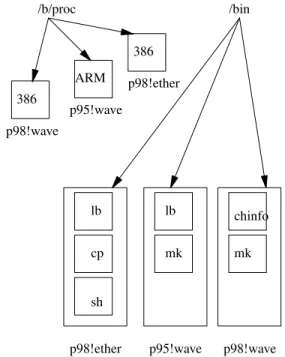
sh cp
lb lb
mk
chinfo
mk
p98!ether p95!wav e p98!wav e p98!wav e
p98!ether p95!wav e
/b/proc /bin
386
386 ARM
Figure 1: A network with processors and binaries
To show an example, gure 1 depicts a scenario where three dierent processors are bound to the name \/b/proc" and three dierent boxes containing in-ner boxes with program binaries are bound to the name \/bin". In this example, two boxes exist with name /bin/lb, one with constraints p98!ether and
the other with constraints p95!wave. The
conven-tion is that the rst constraint species the architec-ture of the machine involved and the second speci-es the network where the machine is attached at (or one of them if there are many). In this example,p98
andp95are two dierent architectures (i586/PC and
sa1110/iPaq). Ether means that the machine is
ex-porting the box through our fast ethernet and wave
means that it is exported through a radio ethernet. Now consider the system call
make("/b/proc/lb!\%!ether", "/bin/lb")
which requests the creation of a new box (a new process) named/b/proc/lbsuch that its constraints
match with those of a box named /bin/lb and also
match the constraints%!ether. The system searches
the name space for a pair of boxes named /b/proc
(since we are making a box, we search for a container where to create it) and /bin/lb. It may nd rst
the processor box bound to/b/proc with constraints p98!wave. Such constraint set does not unify with %!ether and therefore the system keeps on
search-ing until it nds the box bound to/b/procwith
con-straintsp98!ether. Since that unies with %!ether
the system has a candidate for/b/proc. The result of
the unication has the constraintsp98!ether.
Now the system searches for boxes bound to
/bin/lbsuch that its constraint set unies with that
given by the user and also with the result for other argument (p98!ether). Since the user said nothing
regarding constraints for/bin/lb, the rst box found
whose constraints match p98!ether is considered a
candidate for /bin/lb. In fact, there is a /bin/lb
box whose constraints are exactlyp98!ether. That is
the one used. In few words, the user asked the system to create a process to execute a program and the sys-tem searched for an appropriate processor and binary program pair.
We also need some means to ask the system to choose a dierent resource for a given resource name and application, i.e. to perform a \resource redirec-tion". In Plan B, this operation islink. Consider as
an example the redirection of \standard output" for a process. In Plan B each process is represented by a box (e.g. /b/proc/lb) and has an inner box named io1(e.g. /b/proc/lb/io1). The convention is that
to io1would make io1point to such box. The next
time the process copies something toio1data will be
sent to the linked box instead. The code needed for the application to redirect the output of our example process is quite simple:
link(/b/term/cons,/b/proc/lb/io1)
Note that the process executing the call might be at a dierent machine and that the process involved (/b/proc/lb) may be already running.
Linkalso helps to keep multiple resource instances
to let the system choose among them. This leads to the second meaning oflink,namely, to maintain replicas
of resources. A clear example is the design for stor-age boxes. A storstor-age box is roughly the equivalent of a traditional le system on secondary storage. A storage box considers links as a means to replicate data on dif-ferent storage areas, which is clearly dierent from the meaning of links under/b/proc. If the home for user
\nemo" is kept both at his laptop and at his depart-ment's le server, it is reasonable to link both boxes to let the system know. If both instances of \nemo's" are bound to the name \/usr/nemo", any path start-ing at \/usr/nemo" can be resolved to either of the instances depending on the state of the environment. The techniques needed to keep both copies coherent have been studied by systems like Coda [18].
6 Box conversion
Boxes must be of the same type to be operated (e.g. copied) together. All Plan B name spaces include a set of conversion denitions along with the prex ta-ble. The converter set is made of entries that specify a program that converts data of a particular type to a dierent type (a null program may be specied to de-ne subtypes and constraints can be given along with the program name to constraint where should it exe-cute). New entries can be added with thecastsystem
call, and removed later with the uncastsystem call.
The/b/sys/castsbox holds a textual representation
of the conversions dened, to let the user know. When the name space searches for compatible boxes it considers the set of conversions dened, and may cause the execution of the converter program on behalf of the user.
7 Adapting to changes
The name space can be instructed to pay attention to announces or advertisements in the network stating
that a particular resource is available. The system call used isimport, usually using the network addressany
(which means that we don't care about the resource location). For example,
import /b/proc any /proc proc!p98 b
arranges for a new prex /b/proc to be entered
in the name space below (b) existing ones. Initially,
there is no box bound to that prex. However, any box advertised in the network under the name/proc
with a constraint matching proc!p98 will be bound
to the name as soon as the advertisement is received. Plan B uses an advertisement protocol along with the
Opprotocol (which is used to operate on boxes across
the network).
When it is found that an advertised bounded box is no longer accessible, it is removed from the name space. Currently, this may only happen after an op-eration is attempted on the box. Although it has not been tested yet, constraints could be used to provide hints about the expected lease time for a new resource to stay. Besides, theforgetsystem call can be used
to forget about a previously imported box.
8 Heterogeneity
Heterogeneity of architectures and networks is dealt with by combining several tools:
1. Presenting all resources as a single abstraction and using conventions to organize the name spaces. This helps to deal with resources inde-pendently of their architecture and inner struc-ture, because at least the interface is always the same.
2. Using constraints to express restrictions and fea-tures of the resources. This helps to know which resources to import to the name space and which ones can be combined.
3. Using the converter set to automate data transla-tions between heterogeneous formats.
For example, the standard Plan B graphics device uses the Plan 9 image format for images. When an application uses a dierent format for output images, a conversion can be dened to let the application use dierent output devices. Furthermore, should the pro-gram used to convert the image format require a fast CPU, a constraint can be dened to determine if a
slow. Thus when the system tries to execute the con-verter, it will select a CPU considered as fast. Despite the simplicity of the constraints mechanism, this ex-ample illustrates how it can be used to deal with not so simple problems.
9 System and network failures
Plan B does not try at all to provide fault tolerance, since we believe that the user of a networked environ-ment would experienviron-ment failures anyway. For example, a user willing to use a friend's laptop to execute a process must be aware that such process could die if the friend leaves and shuts down the laptop. In Plan B the user is responsible for calling import,
supply-ing appropriate constraints, to instruct his/her name space about which kinds of resources are acceptable and which ones are not.
9.1 Network failures
Using boxes to represent network connections makes it easier to adapt to network failures. For exam-ple, a name space may have both a tcp protocol stack and an infrared protocol stack bound to the name
/b/con, which is the conventional prex for stream
links. An application may be sending data to ser-vice 20 at machinenautilus by copying data to a box
named/b/con/nautilus:20. That name is
meaning-ful to both stacks and the rst time used would issue a connection request to the remote machine. If the rst network fails, the second (also bound to/b/con) may
still take over.
One problem that may still happen is that out-standing messages going through a failing network would be lost despite the supposed reliability of the connection. In this case, the protocol used by the ap-plication over the network link is still required to pro-vide a means to keep the connection reliable (e.g. by using serial numbers on requests and/or retrying the requests). TheOpprotocol used to perform box
oper-ations does so, which means that applicoper-ations do not need to care about this issue when using boxes from the network. The implementation is greatly simplied because, if we ignore the possible error status in the result, box operations are idempotent in most cases. The lack of a \le oset" concept makes it easier to achieve this because updates are atomic and refer to an entire box, not to a part of a box.
9.2 Garbage collection
Box servers are almost stateless because box re-quests are self-contained. If a client crashes or gets disconnected from the system, outstanding requests are completed and the server forgets about that par-ticular client. However, the client might have created boxes to be used just during its life (e.g. windows, temporary storage, etc.) and the server should be able to delete them when the client can no longer use them due to a crash or a network disconnection.
In this case, garbage collection is done by means of alease permission bit. Clients that create boxes that
should be subject of garbage collection upon client fail-ure are supposed to set theleasepermission bit on such
boxes. Any box with that bit set would be deleted by the server if the client does not access the box during an interval of time specied by the server.
Another mechanism useful for garbage collection is the deldie (delete on die) permission bit. When set,
the box involved is removed by the creator process while it exits. This helps to delete resources no longer in use when a process crashes (but the machine where it runs must be alive and connected to perform the delete operation on the box).
9.3 Consistency
Thelinkoperation leads to data replication when
the resource implementation prefers to do so, for ex-ample, on storage boxes. This introduces the prob-lem of maintaining data consistent between the set of replicas. Since the system is built considering that disconnections are usual, dealing with consistency is more complex.
We assume that most of the time, the user es-tablishes links to replicate coarse grain data like a set of system binaries, a home box (what would be a home directory on other systems) and similar re-sources. Moreover, we assume that users are respon-sible for establishing a senrespon-sible set of links and that conicts due to concurrent updates on replicated boxes are rare. With this set of assumptions, we can borrow results from systems like Coda [18] to maintain the set of replicas.
10 Protection
Protection is based on authenticated access check-ing through access control lists. Plan B checks per-missions each time a box is used, which would prob-ably not happen on a system using le descriptors. Each box has a set of permission bits (matching the operations in the Op protocol) to determine which op-erations can be performed by the box owner and by others. There are no user groups in Plan B.
The authentication protocol is left out of the sys-tem and it is assumed that box clients and servers will be authenticated before speaking Op. This is the approach used by Plan 9 [14]. In fact, the current im-plementation has a very naive authentication protocol because we plan to borrow such protocol from Plan 9. Binary box operations likecopyandlink, that are
performed on the destination node on behalf of the client issuing the operation, require the destination node to be able to speak for the client regarding the operation being performed. This is achieved by issu-ing one-shot tickets from the client to the node that performs the operation. Such tickets are used just to authenticate the user, not to perform access checking (which is done with access control lists).
Box
server
Box
server
Box
server Op mux
Name space
Op
Figure 2: Overview of the Plan B architecture
11 Implementation
As of today, we have a complete implementation of Plan B, including a shell and utilities going from a \list boxes" (lb) program to a graphics program to
set the volume on the current audio box. We rewrote the utilities from their Plan 9 counterparts to use the system in a real setting, so we could exercise the sys-tem. We hope that the examples shown in this paper will illustrate what we learned using the system. The implementation, user manual, and system description are available for download at the Plan B web site [2].
Plan B is just a box multiplexor that allows appli-cations to build a name space for boxes in the network and tries to help them to select which of them to use on each case. The implementation follows the archi-tecture shown in gure 2. The kernel performs each system call by resolving the box names involved and is-suing Op RPCs to perform the appropriate operations on the boxes selected.
At the beginning of each system call, the kernel creates a Boxref structure for each box involved. Boxrefs are handles for local and remote boxes. A boxrefcarries the box name and constraints as
spec-ied by the user and keeps track of which part of the name (and constraints) are resolved and which part is yet to be resolved. During the system call, theboxref
may point to dierent boxes while the name space is being searched for a box that matches the user sup-plied name and constraints. Once a matching box is found, the boxref is said to be bound and will not
change any further. Once the system call has com-pleted, the boxrefs used are destroyed. We found
that this is important to make the system more re-liable to changes in the environment, since it makes system calls self-contained. Although it may look in-ecient, delays introduced are not appreciable for the Plan B user.
While bound, aboxrefcontains both the address
of the box server and the box name as known by the server. The format used to store the address is a string machine:service and corresponds to a name for a network connection (/b/con/machine:service). Since this name may also correspond to dierent net-work links/protocols depending on the environment state, the boxref switches to dierent connections
upon changes in the network (connections are estab-lished/terminated automatically by the implementa-tion of the /b/con/ boxes).
The most complex part of the implementation is the name space, due to the complexities added by the con-straint and type checking mechanisms. After a series of changes to our initial implementation of the name space, the current implementation performs searches by unifying constraints as said before in this paper. But the name space semantics was not obvious from the beginning and it required experience with the sys-tem to reach a satisfactory implementation state. For example, the constraints may refer to the box or to its container depending on the system call (e.g. make),
and the type should be checked or not depending on the system call (once more,makeis creating a box and
Furthermore, since a name space lookup might be retried several times during the search for boxes with matching constraints, it is necessary to undo the uni-cation of constraints before each attempt to nd a matching box. This also happens in Prolog while per-forming unication of expressions, and that was pre-cisely the reference used to reach a sensible implemen-tation.
Binary system calls (those using two box names) re-solve the names and constraints by following the code shown below, wherensselectresolves the prex and opselectbinds the handle to the box. Note that each
call tonsselect selects a dierent name space entry
where to try the binding. The code shown is a sim-plied version of the real one, which is 58 lines of C code.
// finds a pair that can be // operated.
// Returns the converter to // be used when needed.
// values for op
enum {COPY, LINK, CONVERT, MAKE};
char*
can(Boxref* sbp, Boxref* dbp, int op) {
nsreset(sbp); nsreset(dbp);
while(nsselect(sbp)){ if (!opselect(sbp))
continue;
while(nsselect(dbp)){ if (!opselect(dbp))
continue;
if (!unify(sbp, dbp)) continue;
if (same types) return found; if (has converter)
return converter; }
}
error(Nomatch); }
Below the name space stands the Op
multi-plexor. This multiplexor is in charge of implementing
opselectto resolve the sux of the name not
spec-ied by the name binding (i.e. the part of the name determined by the box hierarchy in the server). Be-sides, the Op multiplexor performs the RPC call to
the appropriate box server requesting the execution of the box operation. Most system calls issue RPCs not
just to perform the operation, but also to learn of the types and constraints of boxes named by the user.
The current implementation works hosted on top of Plan 9. The machine dependent part of the kernel uses Plan 9 processes and les (including network connec-tions and rio windows) to supply services to the ma-chine independent part. The current kernel supplies boxes for processes, les, network connections, mem-ory, graphics, sound and some other miscellaneous sys-tem boxes. A shell and several command line pro-grams have been implemented and used to exercise the system and gain experience with its interface.
Our experience with the system shows that the per-formance is reasonable, although no perper-formance tun-ing has been done yet. Since the merit of any perfor-mance numbers is of the underlying Plan 9 system, no measures have been made yet. A native port would be tried before. Nevertheless, measures made to the /net
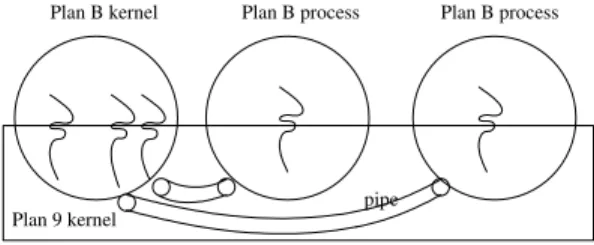
pipe
Plan B process Plan B process Plan B kernel
Plan 9 kernel
Figure 3: Implementation on top of Plan 9 framework of Plan B show that the overhead of the name space is 1second that corresponds to the lookup
of a name in the prex table. This overhead remains almost constant for reasonably sized name spaces, and has been measured on a 2.4GHz Pentium 4 PC run-ning Plan B hosted on a Plan 9 system. This is the price paid for the lack of binding. Of course, every time a box server fails, there is an overhead for the detection of the failure and the reconnection to the new server. This overhead depends on the particu-lar network protocol used and would be the same for any other operating system willing to switch from one server to another.
The approach used to implement Plan B (see g-ure 3) on a host environment like Plan 9 is to employ a separate plan 9 process for the Plan B kernel, and then one Plan 9 process per each Plan B process. More precisely, the Plan 9 process used for the Plan B ker-nel has one thread (one Plan 9 process actually) per Plan B process. Each thread services system calls for the corresponding Plan B process. System calls are made using RPCs through a pipe between the user and kernel processes.
code in C, and 7753 lines of portable code in the same language. Lines are counted usingwcon all C source
les under the/src/b/9and/src/b/portdirectories.
This is just a hint of the simplicity of the system but is not to be taken too literally because we must account for the fact that Plan 9 processes and other resources are being used to implement Plan B boxes.
11.1 The Op protocol
TheOp protocol leads to stateless box servers and
is simple enough to permit implementations with tiny memory and processor usage. The protocol denes an RPC for each box operation as well as two operations called getmemand putmem. The rst one is used to
retrieve memory contents from a box and the second is used to update memory in the box. Unlikereadand write, they transfer all the box contents since there
are no \le osets" in Plan B. When the maximum message size is not enough to perform the transfer of the box contents, a series ofgetmem/putmemmessages
is sent; the whole series is considered as a single opera-tion. Note that by avoiding \le osets" and updating the entire box contents at a time we reduce the prob-lems caused by using dierent replicas of resources as well as those introduced by the concurrent access from clients to network resources. A failure in the middle of a series of putmemRPCs for a single copyis handled
like a crash in the middle of an operation, i.e. servers should try to keep the old box contents intact until the series is completed. When this is not feasible due to the size of the box, the box will be left in an incon-sistent state (very much like when the system crashes in the middle of a singleputmem).
12 Other examples
Despite the lack of read and write, applications
can still copy data from their memory to the outside world and vice-versa. In Plan B each address space is a box that has inner boxes representing portions of the application's memory. For example, the equivalent of a traditionalwritewould be a copyfrom a memory
box to some other box, like in
copy("/vm/0xf1000:0xf2000", "/some/box");
The /vm box synthesizes inner boxes on demand
just for the system call that uses the inner box name. As a nal example, there is a usr box in Plan B
that represents a human user. Among other things, it contains a set of I/O devices preferred by a user. Con-ventionally, the shell links its I/O devices to those pre-ferred by the user who started the shell. Through this
simple mechanism, newly started processes canfollow
the user and use appropriate I/O devices depending on the state of the human using the system. Further-more, should the user change his mind, for example, to borrow a friend's keyboard for a while to type to an already started process, all the user has to do is to link a new set of I/O devices for the involved process.
13 Lessons learned
The constraint mechanism is very powerful when combined withcopy. On its own, constraints seem to
allow the application to select resources given a set of properties considered. However, by using the system we found most of the time that the set of properties desired for a resource depends heavily on the charac-teristics of another resource (e.g. we don't know which
/bin/lb binary we want without considering which
processors are available). Therefore, the combination withcopymakes a real dierence when compared with
name services that simply resolve a single name given a set of constraints or properties. We hope that the examples in the paper had illustrated this, and the experience of using Plan B.
The lack of connections and le descriptors seems to make garbage collection harder. However, we found that this is not exactly true because despite connec-tions, servers must still use either a leasing mechanism or a timeout based one to determine if a connection is just slow or the client at the other end is broken. Nevertheless, we found that this approach makes the system more resilient to failures.
Most of the times, we are more worried about per-formance than we should be. We always thought that the name space implementation would be the bottle-neck, but experience said otherwise. Humans using the system noticed no change when a hardwired im-plementation that did not use constraints nor searched the name space multiple times was used instead. The real performance problem was found in the initial ver-sion of theOpprotocol (not shown in this paper). This
version issued copy requests to the data source and
not to the data destination, which was preventing the use of data caches to avoid unnecessary data transfers. A \don't cache" permission bit was added to permit the user to request for a box to be transferred on all requests.
of time compared to our earlier experience of build-ing system kernels usbuild-ing a native environment; even though we built them using facilities supplied by the OSkit toolkit [7].
14 Related work
Plan 9 [14] is a distributed system that is built by exporting all resources as les and allowing those les to be accessed through the network. Plan B borrows many of the Plan 9 ideas. There are some important dierences though. Unlike Plan 9, Plan B uses boxes instead of les permitting data to ow without the con-trolling client intervention. This is important to per-mit clients with bad connectivity to control the trans-fer of huge amounts of information. Besides, along with the box abstraction comes the use of constraints (to determine box selection according to the expected usage for the resources), the lack of le descriptors (providing better tolerance of network failures), and the ability to listen for new resources in the network (to adapt to environment changes).
File systems using typed les like that of Nemesis [5] are obviously ancestors of the box abstraction. They do not consider how resources are used together in or-der to help with resource selection. Moreover, since their operating systems rely on les and le descrip-tors, they do not provide a means to perform resource redirection nor to adapt to environment changes.
This applies also to facilities like the BeOS le sys-tem [11], the Semantic File syssys-tem [8] and the name service in Globe [12]. They are able to select resources that present a set of properties by means of attributes. However, they consider resources on their own, with-out paying attention to how are they used together. Furthermore, such systems do not optimize the paths used for data transfers and it is not clear how they per-mit the application to automatically adapt to changes in the network.
Some systems permit exible access to network re-sources, such as Odissey [13] and Khazana [4]. Al-though some of them consider disconnected operation and adapt to changes in the connection status of the client machine, it is not clear how they adapt to other changes in the network, for example, changes in the links used by the servers. This is important since mo-bile devices are likely to be \servers" for I/O devices. The problem of considering context to improve ap-plications is addressed by systems like the Context Toolkit [17] and Gaia [15]. Although some of the prob-lems raised by the willingness to exploit context infor-mation during user requests can be addressed by using
constraints, Plan B is not designed as a system for ac-tive spaces.
Middleware systems like Globe [19] and WebOS [20] are targeted to solve a dierent problem. They are more concerned with scalability and interoperability of existing systems than they are with rethinking which services such systems could provide to make things easier.
Many mechanisms have been built (usually as mid-dleware) to address the problems we address on this paper. Resilient overlay networks [1] and Iceberg's au-tomatic path creation service [22] describe dierent means to let applications switch to dierent network links, which is a concrete example of what we named the resource redirection problem. The Placeless Doc-uments framework [6] provides a means to select in-stances of documents in the network and automate conversions between document format; PAST [16] pro-vides a le system that supports replication and per-mits selection of appropriate le replicas. Such mech-anisms are either designed for a concrete kind of appli-cation, or supply one of the multiple services that an operating system is expected to provide. Plan B dif-fers in that it provides a general purpose environment to build and execute applications.
Other systems, including Ninja [9] (whose archi-tecture for services is called SEDA) and One.world [10] are designed to provide services by interconnect-ing small special-purpose devices through the internet. Although Plan B considers that there might be many small devices exporting services, it has been built as a general purpose computing environment.
15 Future work
In the near future we will port more applications from Plan 9 to Plan B, to get a complete develop-ment environdevelop-ment. By using the system for daily work its shortcomings and strengths will be better noticed. Later, a native port to run on Intel based PCs will follow.
References
[2] Laboratorio de Sistemas. Plan B web site. At http://plan9.escet.urjc.es/who/nemo/Plan-B.html, 2001.
[3] F. J. Ballesteros and S. Arevalo. The Box: A replacement for les. Proceedings of HotOS-VII, IEEE Hot Topics on On Operating Systems. AZ, USA. 1999.
[4] J. Carter, A. Ranganathan and S. Susarla. Khaz-ana. An Infrastructure for Building Distributed Services. Proceedings of ICDCS'98, 1998. [5] S. Childs. Filing system interfaces to support
dis-tributed multimedia applications. Eighth ACM SIGOPS European Workshop Support for Com-posing Distributed Applications, 1998.
[6] P. Dourish, W. K. Edwards, A. LaMarca, J. Lamping, K. Petersen, M. Salisbury, D. B. Terry and J. Thornton. Extending Document Manage-ment Systems with User-Specic Active Proper-ties. ACM Transactions on Information Systems 18, 2 (1999).
[7] B. Ford, G. Back, G. Benson, J. Lepreau, A. Lin and O. Shivers. The Flux OS Toolkit: A Sub-strate for Kernel and Language Research. Pro-ceedings of the 16th Symp. on Operating System Prin., 1997.
[8] D. K. Giord, P. Jouvelot, M. A. Sheldon and J. W. O. Jr. Semantic File Systems. Proceedings of the 13th Symp. on Operating System Prin., 1991. [9] S. D. Gribble, M. Welsh, R. Behren, E. A. Brewer, D. E. Culler, N. Borisov, S. E. Czerwinski, R. Gummadi, J. R. Hill, A. D. Joseph, R. H. Katz, Z. M. Mao, S. Ross and B. Y. Zhao. The Ninja architecture for robust Internet-scale systems and services, Computer Networks. Special issue on Pervasive Computing. 35, 4 (2000), .
[10] R. Grimm and B. Bershad. Future directions: System Support for Pervasive Applications. Pro-ceedings of FuDiCo 2002, June 2002.
[11] B. Inc. The Be Book. California USA. 1997. [12] I. Kuz, M. Steen and H. J. Sips. The Globe
In-frastructure Directory Service. Computer Com-munications25, 9 (June 2002), .
[13] B. Noble, M. Satyanarayanan, D. Narayanan, T. J.E., J. Flinn and K. Walker. Agile Application-Aware Adaptation for Mobility. Proceedings of the 16th ACM Symp. on Operating System Prin., 1997.
[14] R. Pike, D. Presotto, K. Thompson and H. Trickey. Plan 9 from Bell Labs. EUUG Newsletter 10, 3 (Autumn 1990), 2-11.
[15] M. Roman, C. K. Hess, R. Cerqueira, K. Narhst-edt and R. H. Campbell. Gaia: A middleware infrastructure to enable active spaces Technical ReportUIUCDCS-R-2002-2265. University of Illi-nois at Urbana-Champaign, 2002.
[16] A. Rowston and P. Druschel. Storage Manage-ment and caching in PAST. A large-scale persis-tent peer-to-peer storage utility. Symp. on Oper-ating System Prin., 2001.
[17] D. Salber, A. K. Dey and G. D. Abowd The Con-text Toolkit: Aiding the Development of ConCon-text- Context-Enabled Applications. Proceedings of CHI'99. ACM Press., 1999.
[18] M. Satyanarayanan. Scalable, Secure, and Highly Available Distributed File Access. IEEE Com-puter23, 5 (May 1990).
[19] M. Steen, P. Homburg and A. S. Tanenbaum Globe: A Wide-Area Distributed System. IEEE Concurrency, Jan-Mar 1999.
[20] A. Vahdat, T. Anderson, M. Dahlin, D. Culler, E. Belani, P. Eastham and C. Yoshikawa WebOS: Operating System Services For Wide Area Appli-cations Proceedings of the Seventh Symposium on High Performance Distributed Computing, 1998. [21] B. B. Welsh and J. K. Ousterhout Prex tables:
A Simple Mechanism for Locating Files in a Dis-tributed System Proceedings of the 6th ICDCS, 1986.