Alessandra Gatti(a) Lucila Basto Camargo(b)
José Carlos Pettorossi Imparato(b) Fausto Medeiros Mendes(b) Daniela Prócida Raggio(b)
(a) Departamento de Odontopediatria, Faculdade de Odontologia, São Leopoldo Mandic, Campinas, SP, Brazil.
(b) Departamento de Ortodontia e Odontopediatria, Faculdade de
Odontologia, Universidade de São Paulo, São Paulo, SP, Brazil.
Corresponding author: Daniela Prócida Raggio E-mail: [email protected]
Received for publication on Mar 24, 2011 Accepted for publication on Sep 05, 2011
Combination effect of fluoride
dentifrices and varnish on deciduous
enamel demineralization
Abstract: The aim of this study was to evaluate the anticaries potential of 500 or 1100 ppm F dentifrices combined with luoride varnish using a pH-cycling regimen. Seventy primary canines were covered with nail polish, leaving a 4×4 mm window on their buccal surface, and randomly assigned into 7 groups (n = 10): S: sound enamel not submitted to the pH-cycling regimen or treatment; N: negative control, submitted to the pH-cycling regimen without any treatment; D1 and D2: subjected to the pH-cycling regimen and treated twice daily with 1100 or 500 ppm F den-tifrice, respectively; VF: luoride varnish (subjected to F-varnish before and in the middle of the pH-cycling regimen); and VF+D1 and VF+D2. After 10 days, the teeth were sectioned, and enamel demineralization was assessed by cross-sectional hardness at different distances from the den-tal surface. Data were analyzed using a two-way ANOVA followed by Tukey’s test. Dentifrice with 1100 ppm F and the combination of F-var-nish with the dentifrices signiicantly reduced enamel demineralization compared with the negative control (p < 0.05), but the isolated effects of F-varnish and dentifrice with low concentration were not signiicant (p > 0.05). The effect of combining F-varnish with the dentifrices was not greater than the effect of the dentifrices alone (p < 0.05). The data sug-gest that the combination of F-varnish with dentifrices containing 500 and 1100 ppm F is not more effective in reducing demineralization in pri-mary teeth than the isolated effect of dentifrice containing 1100 ppm F.
Descriptors: Demineralization; Dental Enamel; Dentifrices; Tooth, Deciduous.
Introduction
Topical luoride treatments have frequently been used to prevent den-tal caries for over three decades.1,2 The decline in the prevalence of caries
is greatly due to luoridated water supplies and professional topical appli-cation but is primarily due to the widespread use of luoride toothpaste.3
The regular use of luoridated dentifrice may be a beneicial preventa-tive measure, independent of the occurrence of caries3. However, Ögaard
et al.4 recommended that when the risk of caries is high, this measure
should be conducted with high concentration methods. The beneit of combining luoridated dentifrice with professional applications has not been clearly established, and more studies are necessary.5
Considering the relationship between the prevalence of dental
rosis and the use of luoride dentifrice, and because young children have not fully developed their swal-low relex and may therefore ingest large amounts of dentifrice during tooth brushing,6 several
preven-tative measures have been suggested.7 Some
recom-mendations have been made for tooth brushing in children younger than six years old:
• non-luoridated dentifrice,
• a small amount of dentifrice8 and
• dentifrice with reduced luoride concentrations.9
Therefore, it is necessary to assess if dentifrices with lower luoride concentrations (500 ppm F) that are targeted to children younger than six years old are effective against demineralization, and if this preventive effect is the same as those for 1100 ppm F dentifrices.
The present study aimed to assess the preven-tive effect of 500 ppm F and 1100 ppm F luoridated children’s dentifrices and luoride varnish in vitro,
either applied in combination or alone, on primary teeth enamel after a caries challenge.
Methodology
This research was approved by an Ethical Board. Seventy primary canines from the Human Tooth Bank were used. The samples were assessed by vi-sual inspection and were free of dental caries or enamel defects.
The root portion of all teeth was sealed with ep-oxy resin (Araldite, Brascola, Florianópolis, Brazil)
and then covered with red nail polish (Colorama, São Paulo, Brazil). A 4×4 mm window area on the buccal surface was left free of nail varnish. All teeth were previously cleaned with a detergent solution (Tergencal, Biodinâmica, Curitiba, Brazil) and
pumice powder using a low speed motor. The teeth were then left under running water for one minute to eliminate debris.
Teeth were submitted to the formation of arti-icial caries by pH cycling,10 keeping the teeth in
demineralizing solution (CaCl2 2.2 mM, NaH2PO4 2.2 mM and acetic acid 0.05 M; pH of 4.5, adjusted with KOH 1M;13 15 mL per tooth) for 3 hours and
in remineralizing solution (CaCl2 1.5 mM, NaHPO4 0.9 mM and KCl 0.15 mM; pH of 7.0; 15 mL per
tooth) for 21 hours. A total of 10 cycles were con-ducted. The teeth were briely washed in deionized water between solutions and placed in artiicial sa-liva for 30 minutes (CaCl2 [15 mg], MgCl2 [5 mg], KCl [0.1 g], KSCN [10 mg], Na2HPO4 [40 mg], so-dium carboxymethylcellulose [1.0 g], methylparaben [0.1 g] and water [1 L]; pH of 7.0). The deremineral-izing solutions were changed daily, and the artiicial saliva was changed at every treatment.
One of the groups was comprised of sound enam-el (S), was not submitted to pH cycling and had no treatment. Group S was kept in deionized water for a later hardness assessment.
The negative control (N) group had no treatment but was submitted to pH cycling. The remaining ive groups (VF, VF+D1, VF+D2, D1, D2) received topical luoride treatment. Groups VF, VF+D1 and VF+D2 were treated with the luoridated varnish Duraphat (Colgate-Palmolive, São Paulo, Brazil)
(22600 ppm F NaF and pH of 7.0) on the 5th and
10th day of the pH cycling. Duraphat was applied
to the delimited area (4×4 mm). The teeth were then stored in the remineralizing solution for 5 hours. The varnish was then carefully removed with ac-etone, and the teeth were washed with deionized water for one minute11 and again immersed in the
remineralizing solution. The varnish application was conducted within the 21 hours that the teeth were kept in the remineralizing solution.
During the pH cycling, the VF+D1 and VF+D2 groups were treated with the varnish as well as luoridated dentifrice, while the D1 and D2 groups were only treated with luoridated dentifrice. The VF+D1 and D1 groups were treated with the denti-frice Tandy (Colgate-Palmolive, São Paulo, Brazil)
(1100 ppm F in NaF, pH of 7.0), and the VF+D2 and D2 groups were treated with Colgate Baby Barney
(Colgate-Palmolive, São Paulo, Brazil) (500 ppm F in NaF, pH of 6.9). The dentifrices were applied twice daily on the enamel at 10 a.m. and 4 p.m. by manually brushing the surface for 1 minute before changing solutions. After every brushing period, the teeth were briely washed in deionized water.
To standardize the minimum amount of denti-frice used in the experiment, the lids of the Tandy
Col-gate Baby Barney (Colgate-Palmolive, São Paulo,
Brazil) were used. These lids close under pressure, and both have similar compartments for dentifrice dosage. According to Chedid and Cury,10 the
den-tifrice quantity accumulated in the lids is 0.16 g on average. The standardized technique is to press the brush once on the top of the lid. The penetration of the brush into the lid is limited by the depth of the lid.
The teeth were then immersed in orthophtalic resin and cut along the crown’s longitudinal axis through the middle of the window area to assess the hardness. The cut surface was polished in a rotating machine (Arotec Aropol 2V, São Paulo, Brazil) using sand paper with grits of 320, 600, and 1200. The 320 grit paper was used for 30 seconds, and the re-maining 2 grit papers were used for 60 seconds each under running water. The polished surface was veri-ied by visual inspection before using the next grit paper. For this procedure, the samples were held on top of the sandpaper by hand, with minimum pres-sure. The inal polish was conducted by felt disks and diamond paste (Diamond Excel, FGM, Flo-rianópolis, Brazil) at low speed. The samples were later washed and placed in the ultra-sound bath for 12 minutes to remove debris.
The cross sectional hardness measurements were made using a hardness tester (Pantec-Digital Micro-hardness tester HVS-1000, Panambra Ind. e
Téc-nica S/A, São Paulo, Brazil) with a Knoop indentor and static load of 25 g and with 5 seconds of dwell time.10
Three rows of 5 indentations each, separated by 100 µm, were made at 20, 40, 60, 80 and 100 µm from the outer dental surface of the exposed area. The mean hardness values (kg/mm²) of the 3 rows at each distance from the surface were then aver-aged and statistically analyzed within and between treatments. A Kolmogorov-Smirnov test was used to verify the sample distribution, and a two-way ANOVA with repeated measures (for distance) and
a post-hoc Tukey test were used to verify differences
in hardness between treatments and distances from the surface. The statistical analyses were conducted with the statistical software SPSS (IBM Corp, New York, USA) version 13.0, with a 5% signiicance level.
Results
Results reached statistical signiicance for the group and distance factors and the interaction be-tween group and distance, which indicates that the effect of the treatments was different, depending on the depth of the enamel surface.
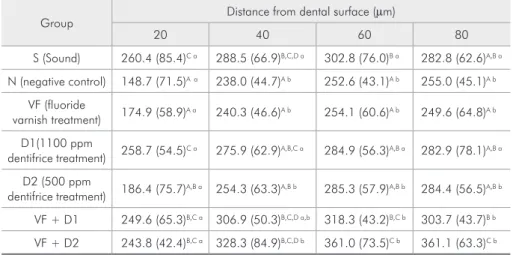
The demineralization data according to the dis-tance from the dental surface for the negative con-trol (N) group showed that the produced lesion was narrow because the statistical difference was only
Group Distance from dental surface (µm)
20 40 60 80
S (Sound) 260.4 (85.4)C a 288.5 (66.9)B,C,D a 302.8 (76.0)B a 282.8 (62.6)A,B a
N (negative control) 148.7 (71.5)Aa 238.0 (44.7)A b 252.6 (43.1)A b 255.0 (45.1)A b
VF (fluoride
varnish treatment) 174.9 (58.9)
A a 240.3 (46.6)A b 254.1 (60.6)A b 249.6 (64.8)A b
D1(1100 ppm
dentifrice treatment) 258.7 (54.5)C a 275.9 (62.9)A,B,C a 284.9 (56.3)A,B a 282.9 (78.1)A,B a
D2 (500 ppm
dentifrice treatment) 186.4 (75.7)
A,B a 254.3 (63.3)A,B b 285.3 (57.9)A,B b 284.4 (56.5)A,B b
VF + D1 249.6 (65.3)B,C a 306.9 (50.3)B,C,D a,b 318.3 (43.2)B,C b 303.7 (43.7)B b
VF + D2 243.8 (42.4)B,C a 328.3 (84.9)B,C,D b 361.0 (73.5)C b 361.1 (63.3)C b
Distinct capital letters show differences between groups at each distance (within columns), while distinct small letters show significant differences among distances for each group (in the lines) after a two-way ANOVA and Tukey’s test (p < 0.05). S = not subjected to the pH-cycling regimen or any treatment; N = subjected to the pH-cycling regimen without any treatment; VF, D1, D2, V+D1 and V+D2 = subjected to the pH-cycling regimen and respective treatments.
observed at a distance of 20 µm from the enamel surface (Table 1).
When the effect of the treatments was compared with the negative control group at each distance from the surface, the treatments with F-varnish (V) and 500 ppm F dentifrice (D2) were not effective (p > 0.05) in reducing enamel demineralization in all depths analyzed (Table 1). At 20 µm of depth, the dentifrice with 1100 ppm F (group D1) signiicantly reduced demineralization compared with group N (p > 0.05), but did not differ in the other distances (p > 0.05). The groups VF+D1 and VF+D2 did not signiicantly differ at any distance from the surface (p > 0.05). The combination of dentifrice and var-nish (groups VF+D1 and VF+D2) signiicantly re-duced demineralization compared with the N group at all distances evaluated (p < 0.05), but the combi-nation did not differ from the dentifrice groups at most distances from the surface (p > 0.05).
Discussion
The present study used the pH cycling sug-gested by Chedid and Cury,10 which is speciically
indicated for primary teeth. The daily 3-hour de-mineralization cycle is related to effects that result when the patient ingests cariogenic products and does not remove the bioilm. In relation to this in
vitro study, it was observed that there was a
gen-eral enhanced preventative effect from combining luoridated varnish with dentifrices (VF+D1 and VF+D2) compared with other groups. The preventa-tive effect of low-luoride dentifrice is still a concern in the literature. Winter et al.12 and Vilhena et al.9
demonstrated good performance in preventing new caries lesions in clinical trials using 550 ppm F and 500 ppm F toothpaste, respectively. However, Lima
et al.13 showed that in active caries in children, the
1100 ppm F performed better than the 500 ppm F. The low anticaries eficacy of 500 ppm F dentifrice compared with 1000-1100 ppm F dentifrice has been shown experimentally,14 and it has also been
supported by evidence.15
Our results suggest that the luoridated varnish alone was not effective in avoiding mineral loss. The results are consistent with the in vitro study con-ducted by Maia et al.11 Grodzka et al.16 found that
the best preventative effect may be achieved when luoridated varnish is combined with other forms of luoride supplements. Similarly, the present study demonstrated that lower mineral loss values were obtained in the VF+D2 and VF+D1 groups. How-ever, other studies2,11 have suggested that the
combi-nation of low (luoridated dentifrice) and high luo-ride concentration methods (luoridated varnish) do not have additional beneits in remineralization and luoride incorporation.
The professional cleaning was conducted to sim-ulate the effects of the oral environment. Although the acquired pellicle is permeable to small ions, it tends to act as a barrier to diffusion, and it reduc-es the possible mineral transportation between the tooth and the oral environment, thus promoting or interfering with the remineralization process. How-ever, Hellwig et al.17 reported that applying
luori-dated varnish on demineralized enamel covered by young bioilm only interfered in the formation of soluble luoride (CaF2). It did not impair the luoride ionic exchange or its incorporation into the enamel17
and reduced caries lesion progression if the luoride availability in the bioilm was high.14
Considering that only the varnish group had enamel cleaned with acetone to remove resin resi-due, this procedure might cause damage to the lu-oride product formed. Bruun and Givskov18 tested
this hypothesis and showed that acetone could not dissolve the CaF2 from the enamel treated with var-nish.
A comparison of the present study with other re-search is dificult to conduct due to differences in experimental design, pH-cycling models, the type of enamel used (primary, permanent or bovine), the trademark of the products used and the different concentrations of luoride. However, based on our results, some considerations can be extrapolated.
from the 1100 ppm F (D1) dentifrice, which showed greater hardness. The combination of luoride var-nish with 500 ppm F (VF+D2) and 1100 ppm F (VF+D1) dentifrices also did not show an advantage compared with the 1100 ppm F dentifrice (D1) used alone.
Delbem et al. (2006)19 veriied the pH inluence
(4.0, 5.0, 6.0 and 7.0) and the anti-cariogenic effect of 0.02%, 0.05% and 0.1% NaF solutions using a pH-cycle model in bovine enamel. The results show that the pH inluenced the percentage of surface mi-crohardness loss (% SMH) in the 0.02% and 0.05% NaF at a pH of 4.0. In such solutions, the mineral loss was lower when compared with a pH of 7.0 (p < 0.05). The authors concluded that the acidii-cation of solutions with low luoride concentrations reduced mineral loss. The availability of saliva was also determined in the low-luoride dentifriceswith lower pH values.20
However, it should be stated that these results were obtained in an in vitro study, without diluting the dentifrice after application and bioilm
forma-tion, among other factors, and the results can there-fore be different in vivo. More research, especially clinical trials, is necessary to conirm if the associa-tion of children’s luoride dentifrices and luoride varnish can provide an adequate preventative effect in primary enamel.
Nevertheless, our data using this pH-cycling model are consistent with two systematic reviews: one showing that there is evidence for an anticaries effect if the dentifrice concentration is higher than 1100 ppm F,15 and another concluding that the
pre-ventive effect of combining topical luorides (den-tifrice, mouth rinse or professional application) is modest compared with the isolated effect of luoride dentifrice.21
Conclusion
The indings suggest that the combination of F-varnish with dentifrices containing 500 or 1100 ppm F is not more effective in reducing demin-eralization in primary teeth than the isolated effect of dentifrice containing 1100 ppm.
References
1. Marinho VCC, Higgins JPT, Logan S, Sheiham A. Fluoride toothpastes for preventing dental caries in children and adoles-cents. Cochrane Database Syst Rev. In: The Cochrane Library, Issue 08, Art. No. CD002278. DOI: 10.1002/14651858. CD002278.pub1.
2. Marinho VCC, Higgins JPT, Logan S, Sheiham A. Fluoride varnishes for preventing dental caries in children and ado-lescents. Cochrane Database Syst Rev. In: The Cochrane Li-brary, Issue 08, Art. No. CD002279. DOI: 10.1002/14651858. CD002279.pub3.
3. Cury JA, Tenuta LM, Ribeiro CC, Paes Leme AF. The im-portance of fluoride dentifrices to the current dental caries prevalence in Brazil. Braz Dent J. 2004 Mar;15(3):167-74. 4. Ögaard B, Seppa L, Rolla G. Professional topical fluoride
aplications – clinical efficacy and mechanism of action. Adv Dent Res. 1994 Jul;8(2):190-201.
5. Zimmer S. Caries-preventive effects of fluoride products when used in conjunction with fluoride dentifrice. Caries Res. 2001 Jul;35(suppl 1):18-21.
6. Moraes SM, Pessan JP, Ramires I, Buzalaf MA. Fluoride in-take from regular and low fluoride dentifrices by 2-3-year-old. Braz Oral Res. 2007 Jul-Sep; 21 (3): 234-240.
7. Wong MC, Clarkson J, Glenny AM, Lo EC, Marinho VC, Tsang BW, Walsh T, Worthington HV. Cochrane Reviews on
the Benefits/Risks of Fluoride Toothpastes. J Dent Res. J Dent Res. 2011 May;90(5):573-9.
8. Villena RS. An investigation of the transverse technique of den-tifrice application to reduce the amount of fluoride denden-tifrice for young children. Pediatr Dent. 2000 Jul-Aug;22(4):312-7. 9. Vilhena FV, Olympio KP, Lauris JR, Delbem AC, Buzalaf MA.
Low-fluoride acidic dentifrice: a randomized clinical trial in a fluoridated area. Caries Res. 2010 Sep-Oct;44(5):478-84. 10. Chedid SJ, Cury JA. Effect of 0, 02% NaF solution on enamel
demineralization and fluoride uptake by deciduous teeth in vitro. Braz Oral Res. 2004 Jan-Mar;18(1):18-22.
11. Maia LC, Souza IPR, Cury JA. Effect of a combination of fluoride dentifrice and varnish on enamel surface rehardening and fluoride uptake in vitro. Eur J Oral Sci. 2003 Feb;111:68-72.
12. Winter GB, Holt RD, Willians BF. Clinical trial of low-fluoride toothpaste for young children. Int Dent J. 1989 Dec;39(4):227-35.
13. Lima TJ, Ribeiro CC, Tenuta LM, Cury JA. Low-fluoride dentifrice and caries lesion control in children with different caries experience: a randomized clinical trial. Caries Res. 2008 Jan-Feb;42(1):46-50.
demineralization under biofilm accumulation and sucrose exposure. Eur J Oral Sci. 2010 Aug;118(4):370-5.
15. Walsh T, Worthington HV, Glenny AM, Appelbe P, Marinho VC, Shi X. Fluoride toothpastes of different concentrations for preventing dental caries in children and adolescents. Cochrane Database Syst Rev. 2010 Jan 20;(1):CD007868.
16. Grodzka, K, Augustyniak L, Budny, J, Czarnocka K, Janicha J, Mlosek K, et al. Caries increment in primary teeth after application of Duraphat fluoride varnish. Community Dent Oral Epidemiol. 1982 Apr; 10(2):55-9.
17. Hellwig E, Klimek J, Schmidt HF, Egerer R. Fluoride uptake in plaque-covered enamel after treatment with the fluoride lacquer Duraphat. J Dent Res. 1985 Aug;64(8):1080-3. 18. Bruun C, Givskov H. Formation of CaF2 on sound enamel and
in caries – like enamel lesions after different forms of fluoride applications in vitro. Caries Res. 1991 Mar-Apr;25(2):96-100.
19. Delbem ACB, Tiano GC, Alves KMRP, Cunha RF. Anti-cariogenic potential of acidulate solutions with low fluoride concentration. J Appl Oral Sci. 2006 Jul-Aug;14(4): 233-7. 20. Olympio KP, Bardal PA, Cardoso VE, Oliveira RC, Bastos
JR, Buzalaf MA. Low-fluoride dentifrices with reduced pH: fluoride concentration in whole saliva and bioavailability. Caries Res. 2007 Sep-Oct;41(5):365-70.