The Relationship Between Board Interlocking and Income Smoothing
Practices*
Flávio Ribeiro
Universidade Federal do Paraná, Departamento de Ciências Contábeis, Curitiba, PR, Brazil
Romualdo Douglas Colauto
Universidade Federal do Paraná, Departamento de Ciências Contábeis, Curitiba, PR, Brazil
Received on 11.10.2014 – Desk Acceptance on 12.28.2014 – 3rd version accepted on 08.19.2015.
ABSTRACT
This study aims to investigate the influence of board interlocking in income smoothing practices in public companies with shares traded on the BM&FBOVESPA. To achieve this objective we adopted a sample comprised of 58 Brazilian companies included in the Bovespa index. The study is classified as empirical and analytical and uses as a proxy for income smoothing a metric called the “smoothing factor” (SF), obtained through the factor analysis technique using the metrics EM1 and EM3 from Leuz, Nanda and Wysocki (2003). As indepen-dent variables we employed indicators of social network analysis. From a theoretical point of view, the study is relevant and innovates in making the connection between the resource dependence theory, the agency theory and board interlocking. In practical terms, the study shows the effects of the constitutive elements of corporate social networks, arising from the board interlocking structure, on income smoothing accounting practices. Regression with panel data using fixed effects showed that the constituent elements of corporate social networks tend to influence the practice of smoothing in the sample used. The results of the study show that companies that share board members with other organizations which smooth their results tend to adopt this organizational practice more easily, which can be explai-ned by: (i) companies causing variations in performance due to operational decisions or financial reporting choices; and (ii) managers making use of discretionary practices in the reporting of profits.
Keywords: board interlocking, income smoothing, social network analysis.
1 INTRODUCTION
that aim to cause the smoothing of inancial results.
In the Brazilian stock market income smoothing has fre-quently been the subject of scientiic studies. Many of these endeavor to explain the practice of smoothing via diferent constructs: ADRs (Lopes & Tukamoto, 2007); risk and return (Martinez & Castro, 2008); cost of third-party capital and ca-pital structure (Castro & Martinez, 2009); levels of corporate governance (Lyra & Moreira, 2011); accounting conserva-tism (Almeida, Sarlo Neto, Bastianello, & Adoneque, 2012); and ratings agency classiications (Tonin, 2012).
With the aim of expanding the horizons of scientiic knowledge regarding income smoothing practices, this stu-dy proposes to investigate the relationship between such practices and the constitutive elements of corporate social networks originating from the board interlocking struc-ture. he objective is to address the following issue: What is the inluence of board interlocking on income smoo-thing practices in publicly traded companies listed on the BM&FBOVESPA? he study covers the years from 2009 to 2014. he underlying hypothesis is that the constitutive ele-ments of corporate social networks, represented by degree centrality, betweenness centrality, information centrality, size of board, and outsiders, tend to have a positive inluence in the practice of income smoothing.
he study helps to address shortcomings related to un-derstanding organizational aspects that tend to inluence in the spreading of results management corporate practices. Speciically, it is considered that the existence of board in-terlocking favors the adoption of income smoothing prac-tices related to (i) operational decisions and (ii) the adop-tion of discreadop-tionary practices in the reporting of proits. It should be mentioned that neither Brazilian nor international studies regarding the combination of these two issues (in-come smoothing and board interlocking) were found, thus allowing for the possibility of a fruitful discussion with a wide ranging theorical and empirical impact in the ield of accounting for external users. Considering that the studies are still at an early stage, this paper uses as a proxy a metric called “smoothing factor” (SF), obtained via factor analysis, which groups together the metrics EM1 e EM3 from Leuz et al. (2003) to represent a single factor for analysis. his ma-thematical route also represents one of the methodological contributions of this paper.
he agency theory (Fama & Jensen, 1983) and the re-source dependence theory (Pfefer, 1972; Johnson, Daily & Ellstrand, 1996) are theories that form the basis for studies concerning boards of directors. he agency theory assigns to the board of directors the role of controlling and monitoring the decisions taken by managers, in an attempt to minimize conlicts of interest between diferent parts of an organiza-tion (Fama & Jensen, 1983). he resource dependence the-ory helps in understanding boards of directors as facilitating mechanisms for accessing inancial resources from outside an organization.
Although the majority of studies concerning boards of di-rectors involve the agency theory (Hillman & Dalziel, 2003), the complexity of corporate environments limits the practi-cal application of this theory, since it is only able to explain some of the social phenomena related to boards of directors (Eisenhardt, 1989). Faced with this theorical shortcoming, the resource dependence theory highlights the importance of boards of directors in reducing uncertainties in the corpo-rate environment. Links with other companies allow board members to make use of their personal reputations in order to obtain the external resources that are necessary for com-pany development (Pfefer, 1972; Pfefer & Salancik, 1978).
he participation of members of boards of directors in more than one corporation characterizes the phenomenon known as board interlocking (Knowles, 1973). Board inter-locking encompasses, along with board members, directors responsible for links between companies (Mizruchi, 1996). Such ties are considered important in an organizational con-text (Fontes Filho, 2012), as it is thanks to these that com-panies are able to gain better access to commercial partners and can gain speciic and strategic knowledge concerning particular companies (Gales & Kesner, 1994). International studies (Davis, 1991; Haunschild, 1993; Haunschild & Beck-man, 1998) show that board interlocking is also considered an organizational information channel that inluences in the adoption of certain corporative practices. he logic is that companies are more inclined to adopt such organizational practices when they repeatedly share board members with other strategically-aligned companies. Connelly and Slyke (2012) found that, in the same way that board interlocking inluences in the adoption of constructive and positive prac-tices, it can also lead to the spread of discretionary practices
2 BOARD INTERLOCKING AND THE RESOURCE DEPENDENCE THEORY
The expressions “board interlocking” (Santos & Sil-veira, 2007; Mendes-da-Silva, 2010; Connelly & Slyke, 2012; Mindzak, 2013), “interlocking directorship” (Za-jac, 1988; Hung, 1998; Au, Peng, & Wang, 2000), “board network” (Battiston, Weisbuch, & Bonabeau, 2003; Kim, 2005), “director interlocks” (Haunschild & Beckman,
1998), and “interlocking directorates” (Dooley, 1969; Ornstein, 1982) have all been used in financial literature to define links between companies via boards of direc-tors.
inclu-sion of the same profesinclu-sional on their respective boards of directors (Fich & White, 2005). This professional can provide access to important resources that are essential to the company (Hung, 1998). In the United States, the participation of the same board member or executive in more than one company is quite common. Dooley (1969) found that, since the 1930s, 90% of the largest American organizations had at least one board member working at more than one company. Davis (1991) disco-vered corporate ties in 40 American organizations in the 1980s. On average, board members acted in seven large corporations.
In Canada, board interlocking is considered a com-mon phenomenon in the largest corporations. Ornstein (1982) found that, from 1946 to 1977, the 100 largest companies exhibited, approximately, 1600 corporate ties in the form of social networks. Au et al. (2000) identi-fied board interlocking in around 61% of the 200 largest companies in Hong Kong, in 1997. This percentage was a little lower than those found in England (69%) and in the United States (64%), in the same period. Cox and Ro-gerson (1985) investigated the 115 largest companies in South Africa and found that in 50% of them there were board members acting in more than one organization.
Santos and Silveira (2007) examined 320 companies with liquidity on the Brazilian capital market, betwe-en 2003 and 2005, and the results indicated that 74%, in 2003, and 68.8%, in 2005, had constitutive corpora-te social network ties. Moreover, in 2005, 50% of those professionals who acted as chairman of one board also simultaneously participated on the board of another company. Mendes-da-Silva (2010) studied 452 publicly traded companies, between 1997 and 2007, and showed that, on average, 60% of board members were connected to seven companies at the same time.
The main studies involving board interlocking are based on the resource dependence theory, which is used to explain the reasons for connections in established ne-tworks between companies (Hillman, Cannella, & Paet-zold, 2000). Pfeffer and Salancik (1978) state that when an organization appoints a professional onto its board of directors, it is expected that this board member provides resources that help the company to structure itself fi-nancially and to develop over time. They explain that an adoption of board interlocking provides various benefits to entities, including: (i) obtaining specific resources; (ii) receiving strategic support from important external agents; (iii) providing legitimacy to their organizations; and (iv) creating important communication channels between organizations.
The resource dependence theory understands bo-ards of directors as mechanisms for managing external resources (Pfeffer & Salancik, 1978), which act in redu-cing uncertainty (Pfeffer, 1972) and provide a reduction in transaction costs (Williamson, 1984). Therefore, from the point of view of the resource dependence theory, di-rectors act as connections between firms and the corpo-rate environment, minimizing the uncertainty of
contin-gency factors (Hillman et al., 2000).
The premise of the resource dependence theory is that organizations, however independent they may seem, cannot ignore the relevance of external resources to their development over time. In other words, no mat-ter how autonomous an organization is, it will always require third-party resources. Access to external resour-ces is facilitated when corporations establish links be-tween themselves through board members, as they tend to work in favor of common objectives (Zald, 1969). Consequently, board interlocking is regarded as a source of facilitation of access to external financial resources. Hence, companies look for board members who alrea-dy perform managerial roles in other organizations with the specific aim of increasing sources of third-party fi-nancial capital (Hillman et al., 2000).
Board interlocking also favors the insertion of com-panies into strategic social groups. The inclusion of bo-ard members belonging to social groups or movements helps to avoid conflicting actions with social organiza-tions that might potentially interfere with the structural plans of companies. Another benefit of board member networks involves companies’ reputations in the finan-cial market (Pfeffer & Salancik, 1978), since corporate reputation is closely related to the resource dependence theory (Hillman et al., 2000).
Analyses of social networks also contribute to un-derstanding the relationships between corporate prac-tices (Kosnik, 1987; Haunschild, 1993; Davis, 1991). Kosnik (1987) investigated the relationship between the use of private share rewards (greenmail) and board in-terlocking. The results indicated that companies were more likely to use private rewards when professionals on their boards of directors also acted in other companies. Haunschild (1993) studied 327 American companies, covering the years from 1981 to 1990, and found that mergers and acquisitions were directly associated with the presence of links between the boards of these com-panies.
Kim (2005) examined the relationship between bo-ard interlocking and performance using social networks in Korean companies and found evidence that the den-sity of corporate networks influenced company perfor-mance. The results suggest that moderately connected companies achieve better performance, whereas very close links destroy value. The study also highlighted that the level of education of board members is positively as-sociated with companies’ financial performance.
Normally, when board members act in various orga-nizations, they observe the actions of other board mem-bers and this leads to an important organizational lear-ning process, specifically concerlear-ning strategic practices. In the same way that these links can generate positive results, the opposite can also occur, such as in the mi-micking of the adoption of discretionary practices that lead to financial results management or to the adoption of ethically questionable behavior.
arise that require the attention of outsiders, especially when board members are connected with companies with distorted or troubled shares on the stock market (Connelly & Slyke, 2012). From this perspective, the study by Chiu, Theo and Tian (2012), involving the re-lationship between board interlocking and the discretio-nary practices of managers in 1500 American companies ranked by Standard & Poor’s (S&P 1500) found evidence that companies were inclined to adopt discretionary re-sults management practices when board members were
linked to other companies with ratings agency classifi-cations. On the other hand, Mindzak (2013) found that 120 Canadian companies minimized the adoption of discretionary accounting practices. Therefore, there is no consensus that board of director member networks really favor discretionary practices on the part of mana-gement. In this context, this study advances this discus-sion, in analyzing the relationship between board inter-locking and results management in the Brazilian stock market, via the income smoothing method.
3 CHARACTERIZATION AND METRICS OF INCOME SMOOTHING
Income smoothing as an intentional way of cushio-ning or floating around some level of return is currently considered as normal in company management (Beidle-man, 1973). In this way, it represents an attempt on the part of administration to reduce abnormal variations in profits. For Fudenberg and Tirole (1995), it consists of a process of manipulation of income or gains in order to make revenue streams less variable over the long run. For Michelson, Jordan-Wagner and Wootton (1988), in-come smoothing is a way in which managers select ac-counting practices in order to reduce fluctuations over financial accounting years, in accordance with generally accepted accounting principles.
Income smoothing is mainly characterized by a re-duction in the variability of profits. For Scott (2012), this is the most interesting form of results management for risk adverse managers. Studies concerning this me-thod show that accounting choices help managers to reduce variability in the compensation they receive, as well as identifying excessive fluctuations in company results over the long run. Understanding these aspects improves the accuracy of surveys carried out by market analysts.
In 1981, Norm Eckel published a paper titled “The Income Smoothing Hypotheses Revisited” in the journal Abacus, providing classifications for the different types of income smoothing (Belkaoui, 2003). For Eckel (1981), two types of smoothing exist: natural and intentional. Natural smoothing is presented as something inherent to a business and involves the result of actions taken by
management that are to the detriment of the profit gene-rating process (Belkaoui, 2003). Intentional smoothing arises from the willingness of managers to engage in cer-tain practices with the aim of obcer-taining results which are aligned with their interests (Castro & Martinez, 2009).
Ronen, Tzur and Yaari (2007) argue that intentional smoothing can be subdivided into real and artificial.
Real smoothing concerns economic choices that affect company cash flow. These stem from economic decisions taken by managers, such as reductions in trai-ning expenses, increases in advertising expenses, and sales of company assets (Martinez, 2001). Such practices are basically business conduct choices, which deliberate-ly alter cash flows and smooth out fluctuations in results (Belkaoui, 2003). Artificial smoothing occurs with the adoption of accounting practices that transfer expenses and revenues from one accounting period to another. Such practices do not directly affect companies’ current flows of profit, but do have an impact on future flows.
There are different metrics for capturing income smoothing practices. Among these, those proposed by Leuz et al. (2003) stand out. In order to meet the aims of this study, EM1 and EM3 were the only metrics used. The EM1 metric assumes that managers can disguise changes in company performance via accounting information re-porting choices (Leuz et al., 2003). Such choices can be measured by the ratio between the standard deviation in operating profit (OPr) and the standard deviation in cash flow from operations (CFO), both divided by the total assets of the former period.
In which,
EM1 = income smoothing metric no. 1;
δOPr = standard deviation in operating proit;
δCFO = standard deviation in cash low from
opera-tions.
he result of the ratio between the two variables ofers evidence of the inluence of the discretionary power of
managers to manipulate proit, via alterations in the com-ponents of inancial reports (Luiz, Nascimento & Pereira, 2008). he lower the scores obtained, the greater the smoo-thing practices, since the result reveals the level by which managers reduced proit variability.
Leuz et al.(2003) also argue that managers can use their discretionary powers to distort company economic
formance. he EM3 metric detects the use of discretionary practices in the reporting of inancial results. he scores are
obtained via the ratio between the average rate of total ac-cruals and the absolute value of cash lows from operations.
The population of this study encompassed publicly traded Brazilian companies, which constitute the Boves-pa Index (IBOV). The set of firms employed in the in-tentional sample is restricted to non-financial Brazilian companies that were components of the IBOV in May 2015 and feature the necessary information in order to estimate metrics no. 1 and no. 3 from Leuz et al.(2003),
over the six years from 2009 to 2014. The final sam-ple was composed of 58 companies, representing 88% of those that form the IBOV.
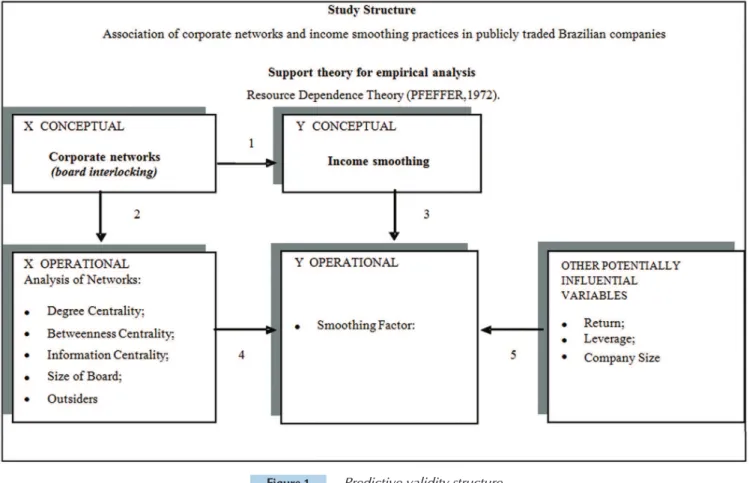
In Figure 1, the study’s predictive validation struc-ture is presented, covering the conceptual and operatio-nal definitions for the variables aoperatio-nalyzed, in accordance with the Libby, Bloomfield and Nelson (2002) model. In which,
EM3 = income smoothing metric no. 3;
|AT| = absolute value of total accruals in period t;
|CFO| = absolute value of cash low from operations in
period t.
he scores obtained in the EM3 metric identiied dis-cretionary practices that aimed to inluence company operational performance.
4 METHODOLOGICAL ROUTE
2
Based on the resource dependence theory (Pfeffer, 1972), the study proposes to explain, via network consti-tutive elements, the practice of income smoothing. This is measured by the smoothing factor variable, obtained by grouping the EM1 and EM3 metrics from Leuz et al. (2003), which capture types of income smoothing: EM1
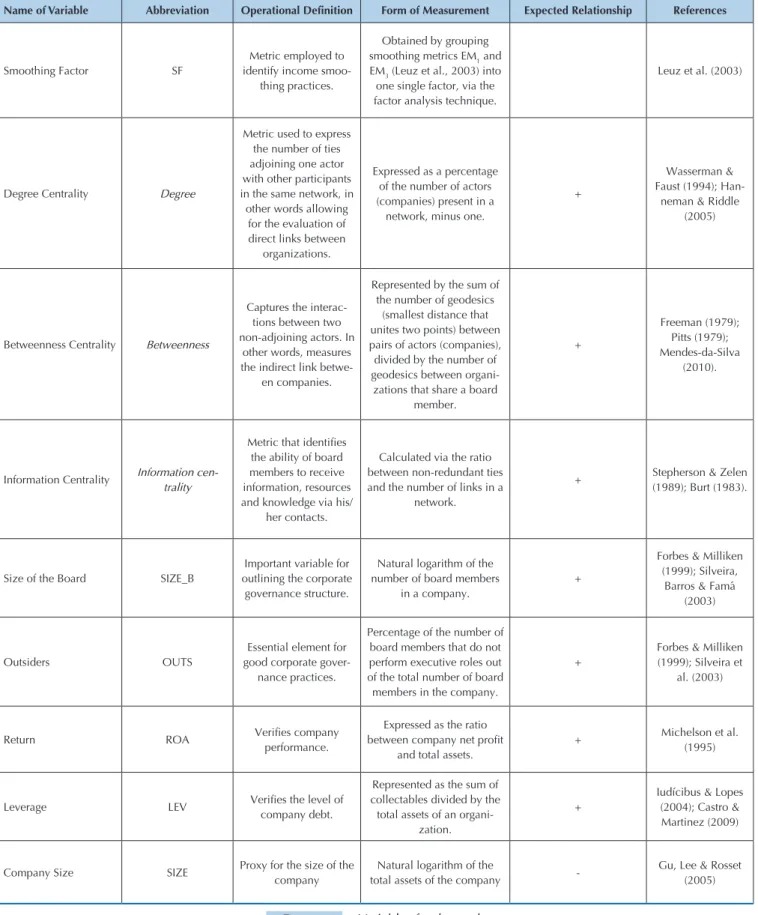
detects whether managers disguise changes in company performance via financial reporting choices; and EM3 detects whether managers use their discretionary po-wers to distort company economic performance. The variables for the study and their operational definitions are described in Figure 2.
Name of Variable Abbreviation Operational Definition Form of Measurement Expected Relationship References
Smoothing Factor SF
Metric employed to identify income
smoo-thing practices.
Obtained by grouping smoothing metrics EM1 and EM3 (Leuz et al., 2003) into one single factor, via the factor analysis technique.
Leuz et al. (2003)
Degree Centrality Degree
Metric used to express the number of ties adjoining one actor with other participants in the same network, in other words allowing
for the evaluation of direct links between
organizations.
Expressed as a percentage of the number of actors (companies) present in a
network, minus one.
+
Wasserman & Faust (1994);
Han-neman & Riddle (2005)
Betweenness Centrality Betweenness
Captures the interac-tions between two non-adjoining actors. In
other words, measures the indirect link
betwe-en companies.
Represented by the sum of the number of geodesics
(smallest distance that unites two points) between pairs of actors (companies), divided by the number of geodesics between organi-zations that share a board
member. + Freeman (1979); Pitts (1979); Mendes-da-Silva (2010).
Information Centrality Information
cen-trality
Metric that identiies the ability of board members to receive information, resources and knowledge via his/
her contacts.
Calculated via the ratio between non-redundant ties and the number of links in a
network.
+ Stepherson & Zelen
(1989); Burt (1983).
Size of the Board SIZE_B
Important variable for outlining the corporate
governance structure.
Natural logarithm of the number of board members
in a company.
+
Forbes & Milliken (1999); Silveira,
Barros & Famá (2003)
Outsiders OUTS
Essential element for good corporate
gover-nance practices.
Percentage of the number of board members that do not perform executive roles out of the total number of board members in the company.
+
Forbes & Milliken (1999); Silveira et
al. (2003)
Return ROA Veriies company
performance.
Expressed as the ratio between company net proit
and total assets.
+ Michelson et al.
(1995)
Leverage LEV Veriies the level of
company debt.
Represented as the sum of collectables divided by the
total assets of an organi-zation.
+
Iudícibus & Lopes (2004); Castro & Martinez (2009)
Company Size SIZE Proxy for the size of the
company
Natural logarithm of the
total assets of the company
-Gu, Lee & Rosset (2005)
In this study, the dependent variable is represented by the smoothing factor, obtained via factor analysis cons-tructed by grouping the EM1 and EM3 metrics from Leuz et al.(2003). he independent variables are: degree cen-trality, betweenness cencen-trality, information cencen-trality, size of the board, and outsiders. Return, leverage and com-pany size are employed as control variables.
he data was collected via two diferent means. In or-der to identify the data concerning boards of directors, the information contained in the reference forms availa-ble on the São Paulo Stock Exchange (BM&FBOVESPA) website was used. his information allowed for the ob-tainment of the variables and metrics employed in the social network analysis. Firstly, information about board members, such as full names and the companies in whi-ch they participated, was collected for eawhi-ch of the six ye-ars. Subsequently, with the help of the MS Excel sotware, square matrices that helped to identify the connections between companies were created. Following the creation
of these matrices, the Ucinet 6 and Net Miner 3.0 sotware programs were used to obtain the social network metrics.
In order to obtain the variables that were necessary for calculating the income smoothing metrics and the control variables, the Economática database was used. To handle the data, two types of analysis were employed: (i) factor analysis, and (ii) panel data regression analysis. Factor analysis was employed due to it being considered an im-portant statistical technique that aims to evaluate sets of variables, with the intention of unveiling existing structu-res that are not directly observable. Regstructu-ressions were used to test the efects of the constitution of corporate social networks on income smoothing, arising from changes in company performance via inancial information repor-ting choices (EM1); and the use of discretionary powers to distort company economic performance (EM3). Panel data regressions, in accordance with Adkins (2010), com-prise a combination of a cross sectional group of units that are observed over time.
5 DESCRIPTION AND ANALYSIS OF THE DATA
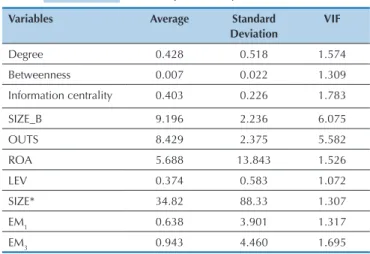
First, the results of the descriptive analysis of the analyzed variables are presented, as shown in Table 1.
Table 1 Descriptive analysis of variables
Variables Average Standard Deviation
VIF
Degree 0.428 0.518 1.574
Betweenness 0.007 0.022 1.309
Information centrality 0.403 0.226 1.783
SIZE_B 9.196 2.236 6.075
OUTS 8.429 2.375 5.582
ROA 5.688 13.843 1.526
LEV 0.374 0.583 1.072
SIZE* 34.82 88.33 1.307
EM1 0.638 3.901 1.317
EM3 0.943 4.460 1.695
The centrality variables (degree, betweenness and in-formation centrality) show that the companies analyzed exhibit, on average, a low level of direct (0.428) and in-direct (0.007) links, as well as 40% non-redundant ties. In the companies analyzed, the boards of directors are composed, on average, of nine professionals. This num-ber is much higher than the minimum of three memnum-bers established in Art. 140 of Law 6,404/76. This result is also higher than the number of board members found in studies by Mendes-da-Silva in 2010 (seven), Dooley in 1969 (one) and Davis in 1991 (seven). It can be inferred that the number of board members that participate in more than one company has grown over the years due to
a perception that they really do have potential to facili-tate access to external resources, just as is claimed by the resource dependence theory, which views boards of di-rectors as mechanisms for managing external resources (Pfeffer & Salancik, 1978), and acting to reduce uncer-tainty (Pfeffer, 1972). Considering that companies de-pend more and more on third-party resources, it seems suitable that directors act as connections between firms and the corporate environment, minimizing the uncer-tainty of contingence factors, as is argued by Hillman et al. (2000).
The control variables used in the study show that the companies exhibit, on average, a 5.69% return on total assets. Their capital structure is composed, predominan-tly, of own capital; third-party capital represents, on ave-rage, 37.4% of the sources of resources. It was also found that the companies had, on average, Total Assets of R$34 million. With regards to the VIF (variance inflation fac-tor), it was observed that all variables exhibited scores between 1 and 10, providing evidence of the inexistence of a colinearity problem.
Due to similar characteristics identified in the income smoothing variables captured by metrics EM1 and EM3, the use of factor analysis was chosen in order to compose a single smoothing factor. The aim behind this choice is to compose a representative income smoothing factor so that, subsequently, this variable can be inputted into the panel data regression. One of the requirements for factor analysis is a high correlation between the variables to be grouped into factors. A strong correlation was observed between the variables EM1 and EM3, of 66%, with a 1% degree of significance. This suggests a sharing of com-mon factors between the variables, which justifies the use of factor analysis. The KMO (Kaiser-Mayer-Olkin) *In million reais (R$).
Table 2 Description of factors from model
Table 3 Panel data tests
Component Auto-Value Total Extraction of Sum of Squares
Total Variance % Cumulative % Total Variance % Cumulative %
1 1.439 71.972 71.972
1.439 71.972 71.972
2 0.561 28.028 100.000
Tests p-value
Chow 0.032
Breusch-Pagan 0.040
Hausman 0.012
and Bartlett sphericity tests were employed with the aim of conirming the results of the correlation matrix.
he KMO test, which compares the magnitude of the relationship coeicients between the variables with the magnitude of the partial correlation coeicients, exhibi-ted a coeicient of 0.500, making it possible to apply fac-tor analysis. he Bartlett test exhibited a 0.00 degree of
signiicance. hus the null hypothesis that the correlation matrix is the identity matrix was rejected. It is therefore possible to show that a correlation between the variables exists, justifying the employment of factor analysis. Table 2 shows a description of the factors from the model and veriication of the variance explained by the number of factors to be used in the model.
The use of the two factors corresponds to a total ex-plained variance of 100%. However, it should be noted that using only one factor, the cumulative explained va-riance, it is approximately 72%. Therefore, factor analy-sis allowed for the grouping of variables EM1 and EM3 into one single factor that will be called the “smoothing factor” in the panel data regression.
In order to apply the panel data, firstly a pooled model (ordinary least squares – OLS) was used for the constitutive social network indicators, considered expla-natory variables, and the smoothing factor as the com-panies’ income smoothing proxy. From the results, the panel diagnostic tests were carried out, with the aim of identifying the most appropriate model for the regres-sion.
Initially, the Chow test was carried out, which veri-fies whether the pooled model is more appropriate, since the rejection of H0 means that the fixed effects model is more convenient. The second test, Breusch-Pagan, re-futed H0, confirming that the random effects model is more suitable for the pooled model. Finally, the Haus-man test was used for the option between fixed and ran-dom effects. In line with Gujurati (2006), the underlying null hypothesis to the Hausman test is that the estima-tors of the fixed effects model and of the error correc-tion model are not substantially different. Thus, if the null hypothesis (H0) is rejected, it shows that the random effects model is not appropriate given the inconsistence in the estimators, and that the employment of the fixed effects model is preferable.
Source: data from the study.
Source: data from the study.
From the results in Table 3, it was assumed that the use of the ixed efects model would be more consistent for
the sample studied. Table 4 shows the results of the panel data regression model with ixed efects for the variable.
Table 4 Smoothing factor: panel data with fixed effects
Significant Variables Coefficient Statistic t Expected sign Obtained sign
Degree 0.3592 2.455** + +
Betweenness 1.6506 0.3841 + +
Information centrality -0.1303 -0.5333 +
-SIZE_B 0.3703 0.6197 + +
OUTS -0.4149 -0.615 +
It was found that the presence of direct ties, identi-fied via the degree centrality metric, exhibits a positive and significant relationship (ß = 0.3592; p < 0.05) with the practice of income smoothing. This suggests that the creation of direct ties positively influences the proba-bility of an organization managing it results. A positive and significant relationship with return (ß = 0.0343; p < 0.01), and a negative relationship with the debt/equi-ty ratio (ß = -0.0011; p < 0.01) and company size (ß = -0.2167; p < 0.05), were also noted, indicating that re-turn, indebtedness and size of organization can have an influence in adopting the practice of income smoothing. The values found provide evidence that the
discretiona-ry powers of managers over operational decisions and reporting choices can be, on average, 22% explained by the presence of direct ties between the companies.
A positive relationship of the indirect ties (betwe-enness) and size of board (SIZE_B) coefficients, and a negative relationship of the presence of non-redundant links and outsiders, with the practice of income smoo-thing, was also observed. However, the absence of sig-nificance does not allow for it to be affirmed that such constitutive elements have an influence in the adoption of income smoothing practices. Table 5 shows the esti-mators for income smoothing, measured by the smoo-thing factor.
Table 4 Continued
LEV -0.0011 -4.286*** +
-SIZE -0.2167 -2.087** -
-Constant 0.0597 0.0513
R-squared Adjusted 21.83%
**Significant to a degree of 5%; *** Significant to a degree of 1% Source: data from the study.
Table 5 Smoothing factor: estimator parameters for income smoothing
Variables Regression 1 Regression 2 Regression 3 Regression 4 Regression 5
Degree
0.3175 0.3592
2.524** 2.455**
Betweenness 0.6440 1.6506
0.1640 0.3841
Information Centrality 0.2132 -0.1303
0.9783 -0.5333
SIZE_B 1.0728 0.3703
1.616 0.6197
OUTS -1.1982 -0.4149
-1.961* -0.615
ROA 0.0128 0.0352 0.0335 0.0129 0.0343
1.786* 3.289*** 3.041*** 1.839* 3.136***
LEV -0.0010 -0.0011 0.0007 -0.0009 -0.0011
-3.733*** -5.555*** -4.012*** -3.261*** -4.286***
SIZE
-0.2182 -0.2244 -0.2007 -0.2005 -0.2167
-2.545** -2.264** -2.043** -2.269** -2.087**
Constant -0.0960 -0.0311 -0.6433 0.1104 0.0597
-0.1117 -0.0305 -0.6430 -0.1128 0.0513
R-squared 33.20% 48.81% 47.20% 34.43% 49.04%
R-squared Adjusted 11.17% 23.43% 21.67% 11.84% 21.83%
**Significant to a degree of 5%; *** Significant to a degree of 1% Source: data from the study.
he estimated coeicients in regression 1 show that the control variables leverage and company size exhibited a negative and signiicant relationship with the practice of smoothing, indicating that larger companies and those
with a higher level of indebtedness are more inclined to adopt discretionary practices.
found that the degree variable (ß = 0.3175; p < 0.05) exhi-bits statistical signiicance, supporting the idea that a di-rect link between companies inluences in the adoption of income smoothing practices. Another factor that warrants mentioning are the values of the coeicients of determina-tion, R2, varying between 11.17% and 23.43%, indicating a considerable explanatory power in the independent varia-bles. It is worth highlighting that companies belonging to the Bovespa Index are more inclined to smooth their results when their board members participate in other companies
via social networks, as well as obtaining greater performan-ce and low levels of debt.
he characteristics of the Brazilian capital market lead to think that practices such as income smoothing may be inluenced by the presence of professionals acting simulta-neously in two or more companies. herefore, these conclu-sions point to the importance of boards of Directors, not only in controlling the decisions taken by executives, but also as important channels of resources for organizations, which is a characteristic supported by the resource dependence theory.
6 CONCLUSIONS
One of the methodological contributions of this study concerns the creation of an income smoothing variable (smoothing factor) based on the grouping of metrics for detecting smoothing arising from changes in company performance. his was obtained via inancial reporting choices (EM1) and the use of discretionary powers to dis-tort company economic performance (EM3), consistent with Leuz et al. (2003).
It was found that the companies analyzed have, on average, nine board members who participate in other boards of directors. his result for Brazilian companies shows that they have already understood the strategic importance in the coniguration of corporate social ne-tworks in obtaining third-party resources. his percep-tion is consistent with the assumppercep-tion of the resource dependence theory, which underscores the potential of board member social networks in the viability of external resources. Corporate networks, in this case, act as me-chanisms for managing external resources, contributing towards diminishing the uncertainties concerning the obtainment of inancial resources, and in the outlining of actions that are strategically relevant for the future of companies.
he results suggest that the direct links between or-ganizations via their board members have a positive in-luence in the probability of companies managing their inancial results via inancial information reporting choices and of the use of discretionary powers to dis-tort economic performance. In accordance with Davis (1991), a company’s position in the network inluences in the adoption of similar practices. It is therefore believed that companies that have connections with other irms have privileged access to a range of information, and this increases the possibility of learning new practices and applying them in the companies belonging to their ne-tworks. he results found are consistent with those from
Kosnik (1987), Davis (1991), Mizruchi (1996), Hauns-child (1993), Stearns and Mizruchi (1996), and Chiu et al. (2013), and would contradict the indings of Mindzak (2013). Regarding the links between organizations via professionals on boards of directors, it is concluded that they inluence in the adoption of corporate and accoun-ting practices in the sample analyzed.
Evidence of non-redundant ties (information cen-trality) was also found, and the presence of outsiders on boards tends to have a negative inluence on income smoothing practices. However, the absence of statistical signiicance does not allow for these facts to be conir-med. It was believed that the presence of professionals acting solely on boards of directors motivated the prac-tice of income smoothing, however this was not proven. One possible explanation could be the existence of a high number of professionals who act solely on boards, and that this is a common characteristic in the Brazilian stock market, thus making this variable of little inluence.
Adkins, L.C. (2010). Using Gretl for principles of econometrics.
Retrieved on April, 1, 2013, from http://www.learneconometrics. com/gretl/ebook.pdf.
Almeida, J.E.F., Sarlo Neto, A., Bastianello, R.F., & Adoneque, E.Z. (2012). Alguns aspectos das práticas de suavização de resultados no conservadorismo das companhias abertas listadas na BM&FBOVESPA. Revista Contabilidade & Finanças, 23(58), 65-75.
Au, K., Peng, M.W., & Wang, D. (2000). Interlocking directorates, firm strategies and performance in Hong Kong: towards a research agenda. Asia Pacific Journal of Management, 17, 29-47.
Battiston, S., Weisbuch, G., & Bonabeau, E. (2003). Decision spread in the corporate board network. Advances in Complex Systems, 6(4), 631-644.
Beidleman, C.R. (1973). Income smoothing: the role of management.
The Accounting Review, 98(4), 653-667.
Belkaoui, A.R. (2003). Accounting: by principle or design? London: Praeger.
Burt, R.S. (1983). Cooptive corporate actor networks: a
reconsideration of interlocking directorates involving American manufacturing. Administrative Science Quarterly, 25, 557-581. Castro, M.A.R., & Martinez, A.L. (2009). Income smoothing, custo
de capital de terceiros e estrutura de capital no Brasil. Revista de Administração Mackenzie, 10(6), 25-46.
Chiu, P.C., Teoh, S.H., & Tian, F. (2013). Board interlocks and earning management contagion. The Accounting Review, 88(3), 915-944. Connelly, B.L., & Slyke, E.J.V. (2012). The power and peril of board
interlocks. Organizational Performance, 55, 403-408. Cox, B.A., & Rogerson, C.M. (1985). The corporate power elite in
South Africa: interlocking directorships among large enterprises.
Political Geography Quarterly, 4(3), 219-234.
Davis, G.F. (1991). Agents without principles? The spread of the poison pill through the intercorporate network. Administrative Science Quarterly, 36, 583-613.
Dooley, P.C. (1969). The interlocking directorate. American Economic Review, 59, 314-323.
Eckel, N. (1981). The income smoothing hypothesis revisited. Abacus, 17(1), 28-40.
Eisenhardt, K.M. (1989). Agency theory: an assessment and review.
The Academy of Management Review, 14(1), 57-74.
Fama, E., & Jensen, M. (1983). Separation of ownership and control.
Journal of Law and Economics, 26, 301-325.
Fich, E.M., & White, L.J. (2005). Why do CEOs reciprocally sit on each other’s boards? Journal of Corporate Finance, 11, 175-195. Fontes Filho, J.R., & Leal, R.P.C. (2012). Governança corporativa:
discussões sobre os conselhos em empresas no Brasil. São Paulo: Saint Paul.
Forbes, D.P., & Milliken, F.J. (1999).Cognition and corporate governance: understanding boards of directors as strategic decision-making groups. Academy of Management Review, 24(3), 489-505.
Freeman, L.C. (1979). Centrality in social networks: conceptual clarification. Social Network, 1(3), 215-239.
Fudenberg, D., & Tirole, J. (1995). A theory of income and dividend Smoothing based on incumbency rents. Journal of Political Economy, 103(1), 75–93.
Gales, L., & Kesner, I. (1994). An analysis of board of director size and composition in bankrupt organizations. Journal of Business Research, 30(3), 271-282.
Gu, Z., Lee, C.W.J., & Rosset, J.G. (2005). What determines the variability of accounting accruals? Review of Quantitative Finance and Accounting, 24, 313-334.
Gujarati, D. (2006). Econometria básica (4a ed.). São Paulo: Elsevier. Hanneman, R.A., & Riddle, M. (2005). Introduction to social network
methods. Riverside: University of California.
Haunschild, P.R. (1993). Interorganizational imitation: the impact of interlocks on corporate acquisition activity. Administrative Science Quarterly, 38, 564-592.
Haunschild, P.R., & Beckman, C.M. (1998). When do interlocks matter? Alternate sources of information and interlock influence.
Administrative Science Quarterly, 43, 815-844.
Hillman, A., Cannella, A., & Paetzold, R. (2000).The resource dependence role of corporate directors: strategic adaptation of board composition in response to environmental change. Journal of Management Studies, 37, 235-256.
Hillman, A.J., & Dalziel, T. (2003). Boards of directors and firm
performance: integrating agency and resource dependence perspectives. Academy of Management Review, 28(3), 383-396. Hung, H. (1998). A typology of the theories of the roles of governing
boards. Corporate governance, 6(2), 101-111.
Iudicibus, S., & Lopes, A.B. (2004). Teoria Avançada da Contabilidade. São Paulo: Atlas.
Johnson, J., Daily, C., & Ellstrand, A. (1996). Boards of directors: a review and research agenda. Journal of Management, 22, 409-438. Kim, Y. (2005). Board network characteristics and firm performance
in Korea. Corporative Governance, 13(6), 800-808.
Knowles, J.C. (1973). The Rockefeller financial group. Andover Mass: Warner Modular Publications.
Kosnik, R.D. (1987). Greenmail: a study of board performance in corporate governance. Administrative Science Quarterly, 32(2), 163-185.
Leuz, C., Nanda, D., & Wysocki, P.D. (2003). Investor protection and earning management: an international comparison. Journal of Financial Economics, 69(3), 505-527.
Libby, R.; Bloomfield, R., & Nelson, M.W. (2002). Experimental Research in Financial Accounting. Accounting, Organizations and Society, 27(8), 775–810.
Lopes, A.B., & Tukamoto, Y.S. (2007). Contribuição ao estudo do “gerenciamento” de resultado: uma comparação entre as companhias abertas brasileiras emissoras de ADRs e não-emissoras de ADRs. Revista de Administração, 42(1), 86-96. Luiz, I.V., Nascimento, M., & Pereira, L.C.S. (2008, julho). Impacto
do gerenciamento de resultados no retorno anormal: estudo empírico dos resultados das empresas listadas na Bolsa de Valores de São Paulo – Bovespa. Anais do Congresso USP Controladoria e Contabilidade, São Paulo, SP, Brasil, 8.
Lyra, I.X.M., & Moreira, R.L. (2011). Alisamento de resultados nas empresas listadas nos níveis de governança corporativa da Bovespa. Revista Contabilidade e Controladoria, 3(2), 78-93. Martinez, A.L. (2001). Gerenciamento dos resultados contábeis: estudo
empírico das companhias abertas brasileiras. Tese de Doutorado, Faculdade de Economia, Administração e Contabilidade, Universidade de São Paulo, São Paulo, SP, Brasil.
Martinez, A.L., & Castro, M.A.O. (2008, junho). Income smoothing e o valor da firma. Anais do Congresso da Associação Nacional de Programas de Pós-graduação em Ciências Contábeis, Salvador, BA, Brasil, 2.
Martinez, A.L., & Castro, M.A.O. (2009, julho). Ratings, custo de capital de terceiros e alisamento de resultados no Brasil. Anais do Encontro Brasileiro de Finanças, São Leopoldo, RS, Brasil, 9. Mendes-da-Silva, W. (2010). Board Interlocking, desempenho financeiro
e valor das empresas brasileiras listadas na Bovespa: análise sob a ótica da teoria dos grafos e de redes sociais. Tese de Doutorado, Faculdade de Economia, Administração e Contabilidade, Universidade de São Paulo, São Paulo, SP, Brasil.
Michelson, S.E., Jordan-Wagner, J., & Wootton, C.W. (1995). A market based analysis of income smoothing. Journal of Business Finance & Accounting, 22(8), 1179–1193.
Mindzak, J. (2013, May). Interlocked Boards of Directors, Voluntary Disclosures and Earnings Quality. Proceedings of the Canadian Academic Accounting Association Annual Conference, Montreal, Quebec, Canada, 37.
Mizruchi, M.S. (1996). What do interlocks do? An analysis, critique, and assessment of research on interlocking directorates. Annual Review of Sociology, 22, 271-298.
Ornstein, M.D. (1982). Interlocking directorates in Canada: evidence from replacement patterns. Social Networks, 4, 3-25.
Pfeffer, J. (1972). Size and composition of corporate boards of directors: The organization and its environment. Administrative Science Quarterly, 17, 218-228.
Pfeffer, J., & Salancik, G.R. (1978). The external control of organizations: a resource dependence perspective. New York: Harper & Row.
Pitts, F.R. (1979). The medieval river trade network of Russia revisited. Social Networks, 1, 285-292.
Ronen, J., Tzur, J., & Yaari, V. (2007). Legal insider trading, CEO´s incentive, and quality of earnings. Corporate Governance and Control, 4, 210-219.
Scott, W.R. (2012). Financial accounting theory (6th ed.) Toronto: Pearson Canada.
Silveira, A.M., Barros, L.A.B.C., & Famá, R. (2003). Estrutura de governança e valor das companhias abertas brasileiras. Revista de
Correspondence Address:
Flávio Ribeiro
Departamento de Ciências Contábeis, Universidade Federal do Paraná Avenida Prefeito Lothário Meissner, 632 – Campus III – CEP: 80210-070 Jardim Botânico – Curitiba – PR
Email: [email protected]
Administração de Empresas, 43(3), 50-64.
Stearns, L., & Mizruchi, M. (1996). Board composition and corporate financing: the impact of financial institution representation on borrowing. Academy of Management Journal, 36, 603-618. Stephenson, K., & Zelen, M. (1989). Rethinking centrality: methods
and examples and applications. Social Networks, 11(1), 1-37. Tonin, J.M.F. (2012). Relação entre Income Smoothing e Ratings em
companhias brasileiras de capital aberto. Dissertação de Mestrado, Universidade Federal do Paraná, Curitiba, PR, Brasil.
Wasserman, S., & Faust, K. (1994). Social Network Analysis: Methods and Applications. Cambridge, Cambridge University Press. Williamson, O.E. (1984).The economic institutions of capitalism: firms,
markets, relational contracting. New York: Free Press.
Zajac, E.J. (1988). Interlocking directorates as an interorganizational strategy: a test of critical assumptions. The Academy of Management Journal, 31(2), 428-438.