OIL EFFECT ON WORLD ECONOMY
Mihaela NECULITA Daniela SARPE Vasile MAZILESCU
”Dunarea de Jos” University, Galati [email protected]
[email protected] [email protected]
The paper presents the macroeconomic effects of the oil trade on the world economy, taking into account a number of factors that characterise it: evolution of oil price, as well as dynamics of oil exports, economic increase based on oil of the producing and consuming countries, attempts to diversify their economies in order to get rid of the oil dependence, tendencies and length of these processes, co-operation and role of the countries that are involved in the exchange affairs that deal with this fundamental product called: “the blood of economy”.
Key words: Oil trade, production, oil consumption, effects, alternative energies
Introduction
The macroeconomic effects resulting from the oil trade can be classified in direct and indirect effects, which, in their turn, depending on the time of showing can be grouped into immediate effects (short term and medium term) and future effects (long-term effects), positive effects and negative effects (that must be identified and then worked out in the entire community involved in the international exchange affairs). Among the category of macroeconomic effects resulting from the oil marketing, the paper focuses on the following:
♦ Effects on the GDP, GNP
macroeconomic indicators: most of the economies of the exporting countries rely greatly on the income brought in by oil sales, examples in point are Saudi Arabia (40% of the GNP), Algeria ( 1/3 of GDP is brought in by oil sales), Iraq (30% of GNP), Kuwait (40% of GNP), Nigeria (30% of GNP), Venezuela (23% of GNP), E.A.U. (30% of GNP), Iran (15% of GNP), Angola (90% of GDP) etc. That is why the rise of oil price is an important factor regarding the increase as well as the decrease of GDP and GNP together with the increase of the contribution
from the income brought in by the oil sales or from the decrease of the savings-investments.
GDP = C (consumption) + I (investments) + + X (exports) + G (acquisitions of goods and
services)
When GDP is cut down by 2%, the unemployment rate of that economy increases by 1%1 which is a negative effect.
♦ Effects on the price level and evolution of the oil world market: namely the fluctuations shown which resulted from the interaction of the demand and supply provided by the oil world market. The disproportion that resulted on the oil world market between the oil demands and the existing supplies (for the first time it was mentioned the scarcity and the waste of the resources), brought about the energetic crisis and marked the beginning of the oil price instability on the international markets (from London, Dubai and New York). For 70 years the cost of barrel had not exceeded the small amount of 2 dollars, it was the “consumer monopoly” era, when the
national companies imposed the conditions requested by the countries under colonial regime. Currently, the oil price is greatly influenced by only a few factors, which are considered to be the most unstable and uncontrollable (like the increase of consumption at the same time with the increase of the world population) and namely: the increasing consumption estimated as being that of 2% annual increase, reduction of the production and of sales (due to reasons which are most often political and strategical), the issue of ensuring the security of world trade, restrictive policies of many oil importing countries, development of some sources of
energy meant to compensate the oil necessary for energy, surveying some new mineral oil fields and last but not least, the cost paid to extract and manufacture and oil, since the mineral oil fields that have been worked for a long time, are becoming increasingly more expensive as the oil deposits are becoming more difficult to be drawn out (taking into consideration the depth of the oil well which goes increasingly deeper).
♦ Effects on the production and oil world consumption: the diversity of the oil supplying resources adopted by the big oil companies to cut down the dependence on the Middle East area.
Figure 1
794
991
487
0 200 400 600 800 1000
oil consume oil reserves unexploited oil Mondial oil price
When the world oil supply decreases also decreases the world oil consumption. During the last few years this phenomenon characterises the countries whose oil resources are increasing or not, diminishing thus the chance to create future supplies to market it later at a higher price to yield higher income (like in United States as the main economic player on the world oil market with its Strategical Federal Reserves) and determining countries with the biggest oil reserves to increase production and supply to comply with the world oil demand.
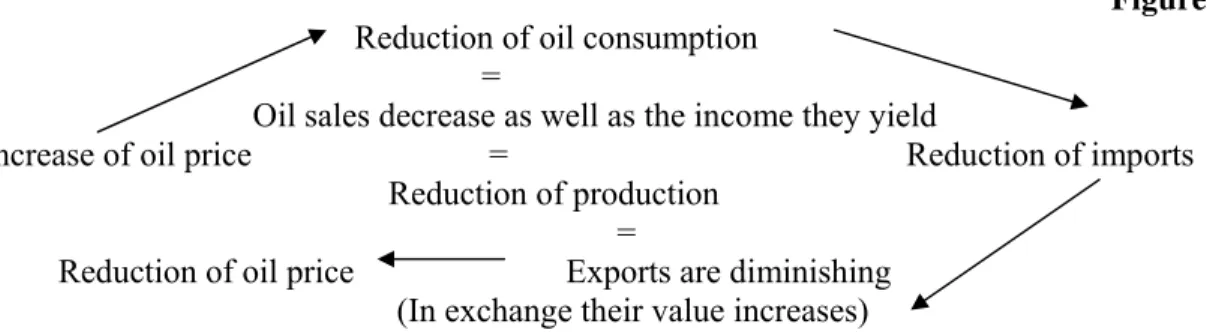
Because the world oil demand is not covered it leads to economic crises and significant stagnation, negatively influencing the entire world economy. The oil crises have also influenced to a great extent the world oil consumption, because at the same time with the increase of the oil price, it diminished the oil consumption. At the same time with the oil consumption, the production was cut down
simultaneously. However, at the same time with the production reduction, the income is also reduced as the exports diminish and simultaneously there take place reductions in imports in the dependent countries which make use of oil. It is an inter-conditioned process that leads to a single conclusion: once the oil price increased (and its products) a lot of disadvantages are created to the producers and exporters respectively, when the importing economies cannot adjust to the new market conditions.
Figure 2 Reduction of oil consumption
=
Oil sales decrease as well as the income they yield
Increase of oil price = Reduction of imports Reduction of production
=
Reduction of oil price Exports are diminishing (In exchange their value increases)
♦ Effects on the trade balance, on a country’s exports and imports: the more is a country dependent on the energetic resource import, (oil) the more emphasised is the transfer of the purchasing power and as a consequence, the deficit of the trade balance as well as the balance of payments. In the trade balance of most countries that export oil, deficits are not shown, the balance being determined to a great extent by the oil price variation, namely: when the price increases, the value of the exports increases as well and vice versa. That is why the exporting countries are interested in maintaining the price of oil and oil products as high as possible. The importing countries have often suffered because of the instability of oil price as it can be noticed in USA and Japan trade balance (at the end of the 90’s, last century), whose deficits are greatly influenced by the increase of the value of imports, thus diminishing their purchasing power. As a result, a new concept is born in economic science, regarding the exports that have always represented the purchasing power of imports of an economy, namely the newly created issue seems to imply the knowing of the corresponding ways and technologies of controlling the energy supply at a cost compatible with the economic life and activity.
♦ Effects of the inflationist type, consequences upon the unemployment: an increase of the oil price involves an automatic increase of the costs and also of the price of goods and services. At the same time with that price increase, the inflation increases as well, phenomenon hat was registered between 1979-1983 when the rhythm of annual increase was that of 9%. If we compare the oil price with the evolution of inflation (during the period of oil crises, but specific to any increase tendency of oil price), its real
oil, all the other products shown an increase of only 151% in that period. The inflation “governed” in the developed countries of the 70’s, thus emerging a new phenomenon called “stagflation”. It was characterised by a combination between the very slow economic development and price increase, situation in which numerous occidental economies were placed (particularly USA) at the end of the 70’s and the beginning of the 80’s. The first 8 trans-national oil companies (RDS, Exxon-Mobil, Chevron Texaco, British Petroleum-Amoco, Elf Aquitaine, Total Petrofina, Eni Group, Atlantic Richfield) have almost 350.000 employees abroad from a total of approximately 700.000, which would mean that, the reduction of the oil trade will have as a consequence the reduction of these companies activity and thus will affect on the world level their economy, cutting down the number of employees, sales and their trans-national index. These 8 oil companies are only the 8 most important in the world, without taking into consideration the big companies that transport oil like the British company Vitol, companies that refine oil, marketing companies, etc, which involve a great number of employees.
♦ Effects of the recession type: during the oil crises, but also when the oil price increases, the price of the other resources are influenced by the oil price, and the general increase of the goods and services price have negative effects on their level demand, thus creating an unbalance on the market of these goods and services.
For example, the price for wheat in :
1950: 36 litre2 of wheat = 1,91$ -- 1bbl of oil = 1,71$;
in 1974: 36 litre of wheat = 4,9$ -- 1bbl of oil = 9,76$;
in 2003: 1bbl of oil = 30$ -- 36 litre of wheat = 3,25$;
and also for the products provided by other industries and agricultural crops depending on the oil price.
♦ Effects on the level of energy demand variation: the ratio between the dynamics of the energy demand and that of the economic activity, namely beginning with the 70’s the direct link between the economic activity and the energy consumption continued to deteriorate as a result of a more rapid increase of the oil price and of some other sources of energy competitively with the evolution of some other economic costs. The economic activity diminished which manifested in the oil industry through the regress of the production, shipment and oil refining. Thus the investment decisions adopted in different economic sectors aimed particularly at the reduction of the expensive energy resources dependence and at their limitation in the economic sectors that made high use of energy. The economic activity of the ruling economies succeeded in developing economic increase abilities so great, unreachable even, but dependent on energy. Thus, once the main sources of energy were reduced in the world trade, it was also reduced the economic activity of these ruling economies. Being aware that these resources are inexhaustible and un-retrievable, determined the great economies to resort to the application and testing various energetic policies, one of these being even considered as the new paradox of world economy. The paradox of saving3: when the community wants to economize more, the effect might be actually the decrease not only of the income and production but also of the savings and investments. The production decreases, many times actually, until the income reaches a level that is low enough to bring in again the planned savings of the population equal to the planned investments. In conclusion economising oil resources regarding the extension of their use is not the best solution in a rational economy because once economised, the production decreases, triggering the income decrease and significant layoffs like those that took place in the USA at the beginning of the 80’s when
3 P.A.Samuelson, W.D.Nordhaus-Economics, Cap.24,
p.548-549.
millions of workers were made redundant4 from the industries blocked as a result of the economic crisis and of inappropriate saving policy (unemployment) but once the revenues are diminished the savings and investments planned previously diminished, thus influencing indirectly the GSP of that particular economy. This dilemma helped the USA economy to overcome a long recession period at the end of the 60’s and the middle and the end of the 70’s.
♦ Effects regarding the oil dependence of the economies of many countries (indirectly having serious consequences on the development and diversity of the service economy): immediately after the “Macroeconomic Malady”, of the 70’s last century, the world states reoriented their investments and savings towards industry, namely economic domains less intensive in energy and energy consuming materials. The group of the developed countries reoriented their economic development intention and the policies of economic development towards more creative and more cost-effective new horizons of “National Wealths”, as well as the tertiary and quaternary sectors have evolved during the last decades. Due to the oil trade new services have been developed in the oil economy domain, in work and even in oil field: in managerial services, marketing ones (that bring in substantial income nowadays as a result of the concluding franchise contracts between well-known companies and local, regional and sub-regional ones, from one state to another like: LukOil-ul and Petrom, in Republic of Moldavia – where over 675(L) and 850(P) of contracts of this type have been concluded or in Romania adding MOL, OMV, Agip, Shell), of insurance, transport for a better and more qualitative performing of the oil product distribution – which involves in their turn tens and hundreds of millions of people, as presently are in multiple economies: Greece – 75% of the economy relies on services (tourism especially) Switzerland 85% - 90% of the economy relies on services (banking and tourism) USA – that has recently reached amazing quotas in the tertiary sector, involving approximately 55% of the working population, namely 38% of the economy relies on this sector (especially banking, stock exchange, insurance,
4
service” activities of some other industries, branches of economy (machine building industry, computer industry, biotechnology industry, industry providing hotel services etc.), in the scientific sector are involved over 3 millions workers from the entire population, and other economies. Oil dependence has been cut down, both due to the oil trade reduction, including the reduction of world oil production and price increase and also to the economies
reorientation regarding the awareness of most consumers to resort to rational consumption methods. Thus, in the machine building industry, the petrol, crude oil and other oil products consumption was cut down, diminishing the oil dependence and of oil imports of the great consuming economies, the reduction ranging from 85% (1974) – to 51% (2003), result favorable to the trade balance of the particular states but also to their economies.
Figure 3
IMPORTED OIL % FROM TOTAL CONSUMPION OCDE
0% 10% 20% 30% 40% 50% 60% 70% 80% 1 974 1 975 1 976 1 977 1 978 1 979 1 980 1 981 1 982 1 983 1 984 1 985 1 986 1 987 1 988 1 989 1 990 1 991 1 992 1 993 1 994 1 995 1 996 1 997 1 998 1 999 2 000 2 001 2 002 2 003 2 004 2 005 0 5 10 15 20 25 30 35 40
import oil dependence oil price
♦ Effects on science and alternative energies (no conventional) development: an economic system based on qualitative and efficient technologies involves the existence of a developed scientific ground. The oil trade towards the end of the last century ended up being extremely necessary to be developed in its electronical version, which would save time and supplementary negotiating costs between the buyers and sellers. Another aspect of the macroeconomic effect on science refers to the inventions in the energetic industry - regarding the use of the regeneration sources, like the wind power stations ones: (The main wind power stations ones USA, Germany, Denmark, Sweden, Canada, Russia, Australia, New Zealand, China, India, Egypt, Holland )– the world wind electric potential is assessed at 26 tril. Kw/h annually, exceeding two times the world
at 17 tril. kWh annually, among which only 1 tril. kwh is currently used to produce electric power - nowadays the geothermal stations run in an impressive number of states: USA, New Zealand, Japan, Mexico, Russia, China, Indonesia, Philippine). In conclusion, at the same time with the reduction of the oil trade, the quantity of oil energetic sources was also
reduced, thus it was been intensified the necessity of covering the difference increasing the quality of non-traditional energetic sources from one year to another, as it is shown in the figure where that displays the increase of the capacity of non-conventional resources in the structure of world energy consumption.
Figure 4
0 10 20 30 40
eolian energy sun energy thermal enrgy geothermal bio hydro Average growth rate of SRE technology
• RSE = Regenerating Sources of Energy5
5
ENERO – The center for promoting the pure energy in Romania.
Conclusions
Although it is a naturally produced resource, oil represents an independent element and a determinant element in economy. Therefore this natural source and resource, due to its intensive use and marketing has brought about and generated numerous difficulties, crises, negative effects but also positive ones, has provided multiple opportunities and priorities, but also economic and political threats to the world economy. Oil has thus become a global economic issue due to its exhaustible and non-generating character but also to its irrational use for an entire century.
References
P.A.Samuelson, W .D
Nordhaus-Economics
Dijmărescu E., Ghibuţiu A., Criza
economică mondială, Ed. Ştiintifică,
Bucureşti 1998
ENERO – Centrul pentru Promovarea
Energiei Curate şi Eficiente în România,
2001
www.wtrg.com- A.F.Alhajji, J.L.Williams