Abstract
This paper implements the higher order Hamiltonian method to an-alyze an electrostatically actuated nonlinear micro beam-based mi-cro electro mechanical oscillator. First, second and third approxi-mate solutions are obtained, and the frequency responses of the sys-tem are compared with energy balance method solution and previ-ously solved Variational Approach (VA) and exact solution. After driving the equation of motion based on the Euler-Bernoulli beam theory, Galerkin method has been used to simplify the nonlinear equation of motion. Higher order Hamiltonian approach has been used to solve the problem and introduce a design strategy. Phase plane diagram of electrostatically actuated micro beam has plotted to show the stability of presented nonlinear system and natural fre-quencies are calculated to use for resonator design. According to the numerical results, the second approximate is more acceptable and results show that one could obtain a predesign strategy by predic-tion of effects of mechanical properties and electrical coefficients on the stability and free vibration of common electrostatically actuated micro beam.
Keywords
Higher order Hamiltonian, MEMS, Electrostatically actuated mi-cro beam, Free Vibrations, Euler-Bernoulli theory, Galerkin method.
Application of Higher Order Hamiltonian Approach to the
Nonlinear Vibration of Micro Electro Mechanical Systems
1 INTRODUCTION
Micro Electro Mechanical Systems (MEMS) are used in various engineering fields such as aerospace, optical and biomedical engineering and are enormously used in applications such as micro-switches, transistors, accelerometers, pressure sensors, micro-mirrors, micro-pumps, micro-grippers and bio-MEMS.(Davis, Green et al. 1998, Wang and Musameh 2003, Atashbar, Bejcek et al. 2004, Lin, Taylor et al. 2004, Gu, Elkin et al. 2005, Osiander, Darrin et al. 2005, Balasubramanian and Burghard 2006, Allen, Kichambare et al. 2007, Yogeswaran and Chen 2008, Yogeswaran, Thiagarajan et al. 2008,
S. Sadeghzadeh a A. Kabiri b
a Assistant Professor, Head of Smart Mi-cro/Nano Electro Mechanical Systems Lab (SMNEMS Lab), School of New Technologies, Iran University of Science and Technology, 16846-13114, Tehran, Iran, [email protected]
b School of Railway Engineering, Rolling Stock, Iran University of Science and Technology (IUST), 16846-13114, Teh-ran, ITeh-ran, [email protected]
http://dx.doi.org/10.1590/1679-78252557
Latin American Journal of Solids and Structures 13 (2016) 478-497 Jain and Goodson 2011). MEMS are merged devices that join electrical and mechanical components. The study of dynamic and static behavior of atomic force microscope (AFM) cantilevers and vibration control of AFM cantilevers are one of the challenges that coupled electrical and mechanical compo-nents (Korayem, Sadeghzadeh et al. 2011, Korayem, Sadeghzadeh et al. 2012, Korayem, Homayooni et al. 2013, Korayem, Karimi et al. 2014). Ghalambaz et al.(Ghalambaz, Ghalambaz et al. 2015)studied the effects of the van der Waals attractions, Casimir force, the small size, the fringing field, the mid-plane stretching, and the axial load on the oscillation frequency of resonators.
Intrinsic intricacy of nonlinear vibration problem of MEMS forces numerical solutions instead of
exact analytical responses. Shooting method(Abdel-Rahman, Younis et al. 2002), δ- perturbation
method(He 2003), differential quadrature method(Kuang and Chen 2004) , Lindstedt–Poincaré method(He 2002), integral equation method(Pouya 1997), homotopy analysis method (HAM)(Belén-dez, Beléndez et al. 2008), variational approach (VA) (He 2007), Max–Min approach (He 2008, Zeng 2009, Zeng and Lee 2009) and Energy Balance Method (He 2002)are some of the numerical and approximate analytical approaches could be addressed. Ganji, Azimi et al.(Ganji, Azimi et al. 2012) applied the Energy Balance Method (EBM) and Amplitude Frequency Formulation (AFF) to govern the approximate analytical solution for motion of two mechanical oscillators. They showed that in comparison with the fourth order Runge-Kutta method, their solution ismore comfortable and useful for solving strong non-linear oscillators. Ganji and Azimi. (Ganji and Azimi 2012) used the Max-Min Approach (MMA) and Amplitude Frequency Formulation (AFF) to derive the approximate analyti-cal solution for motion of nonlinear free vibration of conservative, single degree of freedom systems, and they concluded that both methods have the same results. The results showed these methods are very convenient for solving nonlinear equations and also can be utilized for a wide range of time and boundary conditions for nonlinear oscillators. Yildirim, Saadatnia et al(Yildirim, Saadatnia et al. 2011) applied the Hamiltonian approach to obtain the natural frequency of the Duffing oscillator, the nonlinear oscillator with discontinuity and the quantic nonlinear oscillator. Obtained results were completely inagreement with the approximate frequencies and the exact solution. H. Askari et al. (Askari 2013)utilized the higher order Hamiltonian approach to elicit approximate solutions for the model of buckling of a column and mass-spring system. Y. Khan and M. Akbarzade. (Khan and Akbarzade 2012) used variational approach, Hamiltonian approach, and amplitude-frequency formu-lation to analysis of nonlinear oscillator equation arising in double-sided clamped microbeam-based electromechanical resonator. Qian, Ren et al.(Qian, Ren et al. 2012)utilized the homotopy analysis method (HAM) to derive analytical approximate solutions for nonlinear vibration of an electrostati-cally actuated microbeam and for verifying the accuracy of this approach, they compared their method with other analytical and exact solutions.
Fu et al.(Fu, Zhang et al. 2011)applied the Energy Balance Method (EBM) to study a nonlinear oscillation problem in the micro beam model. They governed equation of free vibration of a micro beam, based on the Euler- Bernoulli hypothesis and also compared the results with fourth-order Runge-Kutta method.
Latin American Journal of Solids and Structures 13 (2016) 478-497
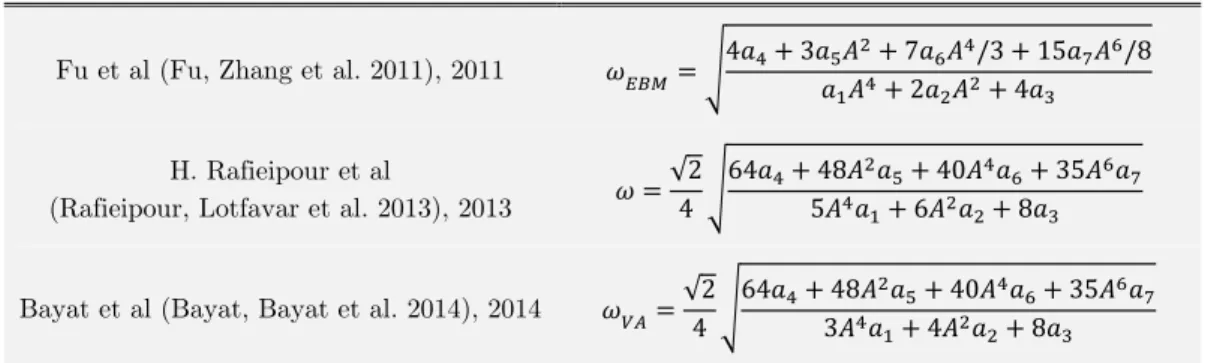
Bayat et al.(Bayat, Bayat et al. 2014) investigated He’s Variational Approach (VA) to solve nonlinear vibration of an electro statically actuated clamped- clamped micro beam that was equivalent to the first order of higher Hamiltonian method(Yildirim, Askari et al. 2012). They demonstrated that VA can be a good candidate for precise periodic solution of nonlinear systems. Final results of mentioned works are listed in table 1.
Fu et al (Fu, Zhang et al. 2011), 2011 / /
H. Rafieipour et al
(Rafieipour, Lotfavar et al. 2013), 2013
√
Bayat et al (Bayat, Bayat et al. 2014), 2014 √
Table 1: Comparison of natural frequency of a micro beam from recent related works.
This research investigated high order approximate solutions by using higher order Hamiltonian method(He 2010) for solving a non-linear dynamic problem, in order to have a highly accurate nu-merical approximation. Contrarily to some recent researches such as (Bayat, Bayat et al. 2014), we showed that the second order is extremely close to the EBM solution and exact solution. The meth-odology of the higher order Hamiltonian for solving an ordinary differential equation with strong power nonlinearity is presented. Numerical comparisons and results were carried out to confirm the rightness and accuracy of the applied method.
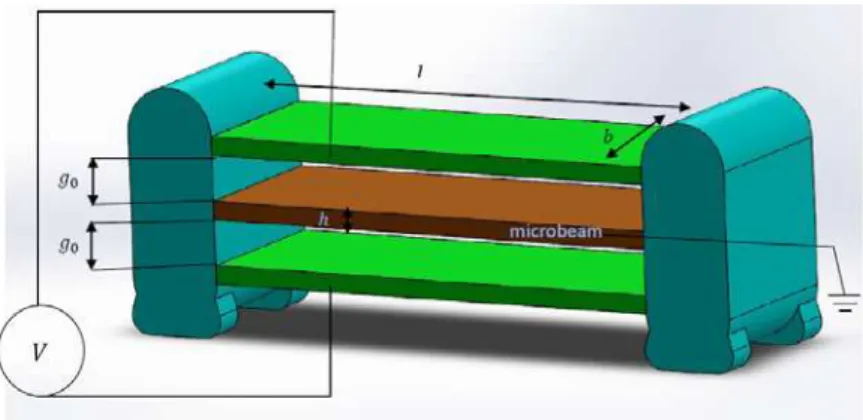
To use higher order Hamiltonian approach, a clamped-clamped micro beam is modeled that placed between two completely fixed electrodes. Deriving the dimensionless equation of motion and separa-tion with assumed mode method, first and higher order approximasepara-tion of Hamiltonian of system have proposed and then, natural frequency calculated for each case. Finally, we show the effects of various parameters on the frequency of electrostatically actuated micro beam, concluding Hamiltonian ap-proach is completely efficient and agreeable.
2 MATHEMATICAL MODEL
Figure 1 and 2 depict the clamped-clamped micro beam with length , width , constant thickness ‘b’,
initial gap and electrostatic applied voltage . The micro beam is doubly clamped and placed
Latin American Journal of Solids and Structures 13 (2016) 478-497 Figure 1: Schematics of clamped-free-clamped-free micro electromechanical resonator.
Figure 2: Schematics of deformed micro electromechanical resonator due to an electrostatic voltage.
Applying an AC electric field or a periodic mechanical load results in dynamic deflection and vibration of the micro beam (Younis and Nayfeh 2003). For more design options and facilities, com-putational studies are essential beside experiments. On the other hand, there are not exact (analytical) closed form solutions for all boundary conditions of mechanical systems. As a good alternative, by applying the Galerkin Method (GM) and utilizing the classical beam theory, the free vibration prob-lem of MEMS could be solved.
The nonlinear partial differential equation of the transverse motion regarding the effect of mid-plane deformation could be expressed as (Rao 2007):
, (1)
Where , is the transverse deflection, is the Young’s modulus, is the Poisson's ratio and is the effective modulus of the micro beam. The quantity of changes with different thicknesses of the micro beam as follows (Rafieipour, Lotfavar et al. 2013):
for wide micro beam
Latin American Journal of Solids and Structures 13 (2016) 478-497
symbolizes the tensile or compressive axial load and is related to the discrepancy of both thermal expansion coefficient and crystal lattice period between substrate and the micro beam.
, is normalized motivating force that derived from electrostatic excitation as(Pelesko and
Bernstein 2002):
,
, , (3)
Where . / is the dielectric constant of the interface. Boundary conditions are as
fol-lows;
, , (4)
, , (5)
The following dimensionless parameters are used to normalize equation (1);
, , , , , (6)
Then, dimensionless boundary conditions could be written as:
, , (7)
, , (8)
Based on presented formulas, dimensionless equation of motion could be implemented for MEMS resonators by the following equation;
(9)
By using the assumed modes method, dimensionless deflection solution of Eq. (9) could be intro-duced as;
, (10)
Where is the ith Eigen function of micro beam that fulfills the appropriate boundary con-ditions, is the ith time dependent deflection coordinate and is the supposed degrees of freedom of the micro beam.
To solve Eq. (9), we consider a single degree of freedom model and deflection function
, is assumed to be as:
Latin American Journal of Solids and Structures 13 (2016) 478-497 The trial function is
(12)
This function satisfies the boundary conditions.
Then by substitution of presented functions to the dimensionless equation of motion and inte-grating from 0 to 1, dimensionless equation of motion changes to (Fu, Zhang et al. 2011):
, (13)
Where
, , , ′′′′ ′′
′′′′ ′′ ′′ ′
′′′′ ′′ ′′ ′ (14)
3 SOLUTION PROCEDURE
For the following general oscillator
(15)
Where u and t are generalized dimensionless displacement and dimensionless time and is ampli-tude of oscillator. Based on the variational principle, by implementing the semi-inverse method(He 1997, He 2004) and He’s method(He 2007, Bayat and Pakar 2011), variation parameter could be written as;
(16)
Where / is period of the oscillator and . Thus, Hamiltonian of presented
prob-lem could be expressed as;
H u F u F A (17)
Then defining a new function as;
Latin American Journal of Solids and Structures 13 (2016) 478-497
By choosing any arbitrary point like / , and setting , an approximate
frequency–amplitude relationship could be obtained. Such approach is much simpler and has been widely used(Jamshidi and Ganji 2010). The accuracy of such location method, however, strongly depends upon the chosen location point. To overcome the shortcomings of the energy balance method, a new approach based on Hamiltonian has been suggested (He 2010) . Differentiating the Hamiltonian leads to natural frequency of the system;
(19)
For more convenience, a new function defined as;
/
(20)
And then for natural frequencies of the system, one could use the following relation;
or (21)
From Eq. (21)we can obtain approximate frequency–amplitude relationship of a nonlinear oscil-lator(Shou 2009, He 2010). For current special problem, we have following Hamiltonian equation:
/
(22)
3.1 First Order Hamiltonian Approach
With satisfying the initial conditions, utilizing cos as the trial function into equation
(22), we obtain;
cos cos sin
cos cos cos cos
(23)
That leads to;
sin cos cos
cos cos cos cos
(24)
Latin American Journal of Solids and Structures 13 (2016) 478-497
→ . a . a . a . a . a
. a . a
(25)
Therefore, after some approximations and simplifications, equation (25) could be solved and the natural frequency could be obtained as;
. a . a . a . a
. a . a . a (26)
That is approximately equal to;
√ a a a
a a a (27)
The variational approach (Bayat, Bayat et al. 2014) and analytical approximate solu-tion(Rafieipour, Lotfavar et al. 2013) resulted the same response for this problem.
3.2 Second Order Hamiltonian Approach
To improve the accuracy of this approach, a higher order periodic solution was assumed as time response function as;
cos cos (28)
Where the initial condition is
(29)
Substituting Eq. (29) into Eq. (22), we obtain:
cos cos cos cos sin sin
cos cos cos cos
cos cos cos cos
(30)
And then the frequency–amplitude relationship can be obtained from following equation;
. a . a . a . a . a . a . a
. a . a . a . a . a
. a . a . a . a
. a . a . a . a
. a . a . a . a
. a
Latin American Journal of Solids and Structures 13 (2016) 478-497
To obtain natural frequency, substituting equation (29) in (31) as , a second order
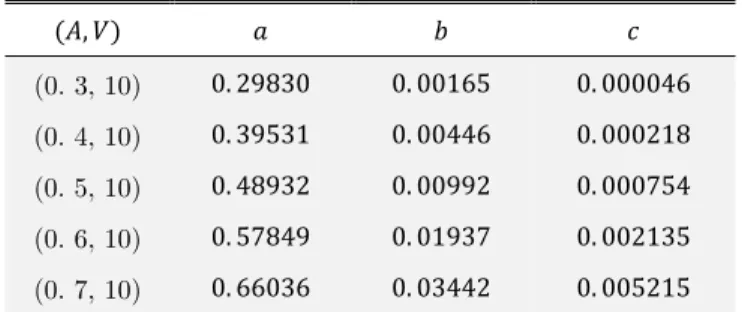
algebraic equation set will be ready to solve to get the natural frequency and values of ‘a’, ‘b’ for various values of and , some of the results are listed in table 2.
,
(0. 3, 10) . .
(0. 4, 10) . .
(0. 5, 10) . .
(0. 6, 10) . .
(0. 7, 10) . .
Table 2: , parameters for different and values ( , .
3.3 Third Order Hamiltonian Approach
One could use a third order time response for micro beam as;
cos cos cos (32)
Where the initial condition is
(33)
Same as the second order Hamiltonian approach, with some mathematical simplification, values
of , could be obtained for various values of A and V such as what listed in table 3.
,
(0. 3, 10) . . .
(0. 4, 10) . . .
(0. 5, 10) . . .
(0. 6, 10) . . .
(0. 7, 10) . . .
Table 3: , , parameters for some and ( ,
4 VALIDATIONS, RESULTS AND DISCUSSIONS
4.1 Computational Efficiency
Latin American Journal of Solids and Structures 13 (2016) 478-497
4.2 Validation
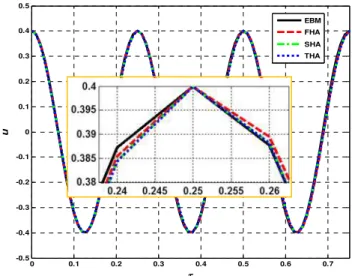
In comparison with previous works, where higher order approximations had not been used, more accurate dynamic response and natural frequencies are observed. Energy Balance Method (EBM) is the best criterion for comparisons. Figure 3 depicts comparison of the dynamic response of a micro
beam under an electric excitation (V=24 Volt), with parameters N , a and A . obtained
with the first, 2nd and 3rd order Hamiltonian approaches. Figure 4 repeated the comparisons with changing the A value to 0.5.
Figure 3: Comparison of dynamic response obtained with higher order Hamiltonian approaches
and EBM solution ( , , , . .
Figure 4: Comparison of dynamic response obtained with higher order Hamiltonian approaches
and EBM solution ( , , , . ).
0 0.1 0.2 0.3 0.4 0.5 0.6 0.7
-0.5 -0.4 -0.3 -0.2 -0.1 0 0.1 0.2 0.3 0.4 0.5
u
EBM FHA
SHA THA
0 0.1 0.2 0.3 0.4 0.5 0.6 0.7
-0.5 -0.4 -0.3 -0.2 -0.1 0 0.1 0.2 0.3 0.4 0.5
u
EBM
FHA
SHA
Latin American Journal of Solids and Structures 13 (2016) 478-497
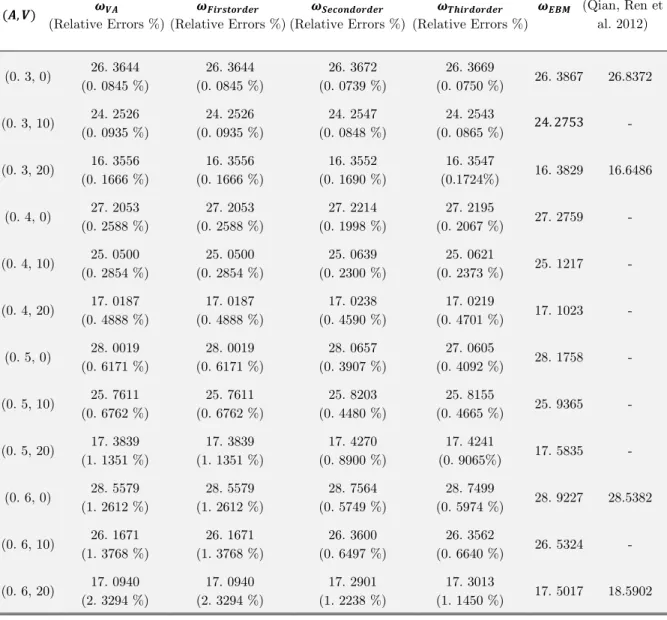
Table 4 compares frequency commensurate for different parameters of system, obtained from Hamiltonian method and energy balance method (EBM (Fu, Zhang et al. 2011)). The exact values for some cases are also reported. Accuracy increases with increasing the order of approximations. When the order increases more accurate results are achieved. Increasing applied voltage or initial amplitude leads to more errors. Thus, in the case of larger initial amplitude and applied voltage, higher order approximations would be more useful.
(Qian, Ren et al. 2012) (Relative Errors %)
(Relative Errors %) (Relative Errors %)
(Relative Errors %)
,
26.8372 26. 3867
26. 3669 (0. 0750 %) 26. 3672
(0. 0739 %) 26. 3644
(0. 0845 %) 26. 3644
(0. 0845 %) (0. 3, 0)
-
.
24. 2543 (0. 0865 %) 24. 2547
(0. 0848 %) 24. 2526
(0. 0935 %) 24. 2526
(0. 0935 %) (0. 3, 10)
16.6486 16. 3829
16. 3547 (0.1724%) 16. 3552
(0. 1690 %) 16. 3556
(0. 1666 %) 16. 3556
(0. 1666 %) (0. 3, 20)
- 27. 2759 27. 2195
(0. 2067 %) 27. 2214
(0. 1998 %) 27. 2053
(0. 2588 %) 27. 2053
(0. 2588 %) (0. 4, 0)
- 25. 1217 25. 0621
(0. 2373 %) 25. 0639
(0. 2300 %) 25. 0500
(0. 2854 %) 25. 0500
(0. 2854 %) (0. 4, 10)
- 17. 1023 17. 0219
(0. 4701 %) 17. 0238
(0. 4590 %) 17. 0187
(0. 4888 %) 17. 0187
(0. 4888 %) (0. 4, 20)
- 28. 1758 27. 0605
(0. 4092 %) 28. 0657
(0. 3907 %) 28. 0019
(0. 6171 %) 28. 0019
(0. 6171 %) (0. 5, 0)
- 25. 9365 25. 8155
(0. 4665 %) 25. 8203
(0. 4480 %) 25. 7611
(0. 6762 %) 25. 7611
(0. 6762 %) (0. 5, 10)
- 17. 5835 17. 4241
(0. 9065%) 17. 4270
(0. 8900 %) 17. 3839
(1. 1351 %) 17. 3839
(1. 1351 %) (0. 5, 20)
28.5382 28. 9227
28. 7499 (0. 5974 %) 28. 7564
(0. 5749 %) 28. 5579
(1. 2612 %) 28. 5579
(1. 2612 %) (0. 6, 0)
- 26. 5324 26. 3562
(0. 6640 %) 26. 3600
(0. 6497 %) 26. 1671
(1. 3768 %) 26. 1671
(1. 3768 %) (0. 6, 10)
18.5902 17. 5017
17. 3013 (1. 1450 %) 17. 2901
(1. 2238 %) 17. 0940
(2. 3294 %) 17. 0940
(2. 3294 %) (0. 6, 20)
Table 4: Comparison of natural frequencies (rad/s) and relative errors for various
parameters of system ( , .
Latin American Journal of Solids and Structures 13 (2016) 478-497 (Relative Errors %)
(Relative Errors %) (Relative Errors %)
(Relative Errors %) (A, V) 28. 6812 28. 5410 (0. 4888%) 28. 5188 (0. 5662%) 27. 9997 (2. 3761%) 27. 9997 (2. 3761%) (0. 7, 5)
22. 9459 22. 8612 (0. 3691%) 22. 8028 (0. 6236%) 22. 2646 (2. 9691%) 22. 2646 (2. 9691%) (0. 7, 15)
Table 5: Effect of increasing initial amplitude to natural frequencies obtained by using higher order Hamiltonian approaches
Dynamic response of micro beam is depicted in figure 4.By reduction of parameters a, b and c for each order, amplitude decreases and it decreases more by increasing the order of approximate solution. Furthermore, second and third order approximations have almost the same range of amplitudes.
4.3 Phase Diagram of Micro Beam
Simplifying the convolution of a nonlinear system to a linear wise model could provide a useful view on the stability and controllability of system. For example, assume that a nonlinear MEMS micro beam has a linear wise model as below that includes all nonlinearities on the second part of its dynamics;
Ψ , , (34)
Nonlinear term (Ψ x, t, u ) could contain a high level of nonlinearity because of including
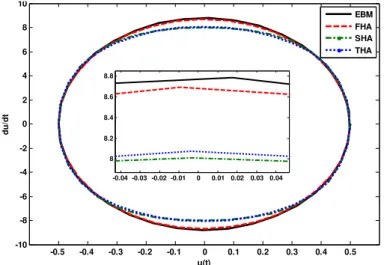
space variables, time and also inputs as operands. It could exert some amazing variations on the dynamics of system. For more clarity, phase diagram of electrostatically actuated micro beam has plotted to demonstrate the effects of nonlinear part of MEMS micro beam. Figures 5 and 6 show compares phase diagram of obtained values by the higher Hamiltonian approach with the energy balance method (EBM). These figures depict the effects of and parameters on the phase plan of the system in second order Hamiltonian method.
Figure 5: Comparison of phase diagram obtained from the higher order Hamiltonian method
with the EBM solution ( , , , . ).
-0.5 -0.4 -0.3 -0.2 -0.1 0 0.1 0.2 0.3 0.4 0.5
-10 -8 -6 -4 -2 0 2 4 6 8 10 u(t) du/ dt EBM FHA SHA THA
Latin American Journal of Solids and Structures 13 (2016) 478-497
Figure 6: Comparison of phase diagram obtained from the higher order Hamiltonian method
with the EBM solution ( , , , . ).
Figure 7 shows the effect of parameter Aon the phase plan of system for N , a , V
simulated by using the second order of Hamiltonian method. As it can be seen on the figure, by increase in the order of Hamiltonian approach, amplitude parameters (a, b, c) decreased, thus overall amplitude decreases too. When micro beam resonates near the zero point as the basal condition, a notable reduction in the velocity of resonator is observable. This phenomenon disappears immediately after passing from basal condition. This means that dynamics of this nonlinear system also depends on the position of the point that is being measured on the MEMS micro beam. Same analysis
figure 8, where shows the effect of V parameter on the phase plan of the system for N , a
, A . simulated by using the second order of Hamiltonian method.
Figure 7: Effect of on the phase plan of the system for , , simulated by using the second order of Hamiltonian.
-0.8 -0.6 -0.4 -0.2 0 0.2 0.4 0.6 0.8 -15
-10 -5 0 5 10 15
u(t)
du
/dt
A=0.3 A=0.4 A=0.5 A=0.6 A=0.7
-0.5 -0.4 -0.3 -0.2 -0.1 0 0.1 0.2 0.3 0.4 0.5 -10
-8 -6 -4 -2 0 2 4 6 8 10
u(t)
du/
dt
EBM FHA SHA THA
-0.04 -0.03 -0.02 -0.01 0 0.01 0.02 0.03 0.04
Latin American Journal of Solids and Structures 13 (2016) 478-497 Figure 8: Effect of parameter on the phase plan of the system for , , .
simulated by using the second order of Hamiltonian.
4.4 Free Vibration
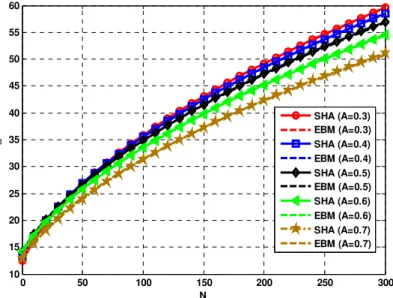
Figure 9 shows the effect of parameter on natural frequency. It can be observed that the frequency is proportional with N. However, it decreases when initial amplitude (A) increases. The second order Hamiltonian has nearly same response in comparison to the EBM solution, even for higher values of N and amplitudes.
Figure 9: Effect of parameter on the frequency of electrostatically actuated
micro beam with , and various values for A.
-0.8 -0.6 -0.4 -0.2 0 0.2 0.4 0.6 0.8
-15 -10 -5 0 5 10 15
u(t)
du
/dt
V=0 V=5 V=10 V=15 V=20
0 50 100 150 200 250 300
10 15 20 25 30 35 40 45 50 55 60
N
Latin American Journal of Solids and Structures 13 (2016) 478-497
Figure 10 depicts the effect of parameter on natural frequency of electrostatically actuated micro
beam with parameters , and various values for A. It can be observed that the frequency
increases with increasing . Obtained results by the second order Hamiltonian are close to the EBM
solution, especially for low amplitudes and values.
Figure 10: Effect of parameter on natural frequency of electrostatically actuated
micro beam with , and various values of A.
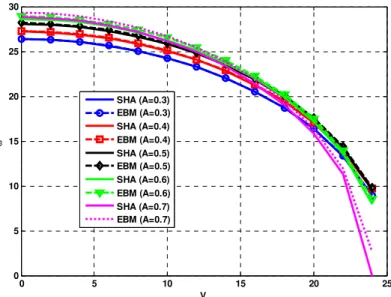
Figure 11 shows the effect of applied voltage on the natural frequency of electrostatically actuated micro beam. It can be seen that the frequency is decreased with increase in the voltage. Second order Hamiltonian is extremely close to EBM solution but they have considerable discrepancies in high amplitudes and voltages.
Figure 11: Effect of parameter on natural frequency of electrostatically actuated
micro beam with , and various values of A.
0 50 100 150 200 250 300
0 10 20 30 40 50 60 70
SHA (A=0.3) EBM (A=0.3) SHA (A=0.4) EBM (A=0.4) SHA (A=0.5) EBM (A=0.5) SHA (A=0.6) EBM (A=0.6) SHA (A=0.7) EBM (A=0.7)
0 5 10 15 20 25
0 5 10 15 20 25 30
V
Latin American Journal of Solids and Structures 13 (2016) 478-497 Nonlinear behavior of system leads to abrupt falling on high applied voltages. Natural frequency decreases dramatically on high voltages. On the other hand, natural frequency increases also with increasing the amplitude. This is due to the effect of more hardening the equivalent linear system of electrostatically actuated micro beam when initial amplitude increases. It is also observed that for higher amplitudes, discrepancy is less than lower values.
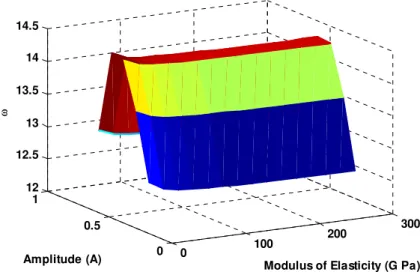
Figure 12 shows the effect of modulus of elasticity of electrostatically actuated micro beam on the natural frequency with various initial amplitudes. As demonstrated clearly, natural frequency in-creases with increasing the modulus of elasticity.
Figure 12: Variation of natural frequency due to initial amplitude (A) and modulus of elasticity (E).
Figure 13 shows the effect of thickness of electrostatically actuated micro beam on the natural frequency with various initial amplitudes. As demonstrated clearly, natural frequency decreases with increasing the thickness of micro beam.
Figure 13: Variation of natural frequency due to thickness of micro beam (H).
0 100
200 300
0 0.5
1 12 12.5 13 13.5 14 14.5
Modulus of Elasticity (G Pa) Amplitude (A)
0 20 40 60 80 100 120 140 160 180 200 12.968
12.969 12.97 12.971 12.972 12.973 12.974 12.975 12.976 12.977 12.978
Thickness (m)
Fr
e
que
nc
y
Latin American Journal of Solids and Structures 13 (2016) 478-497
Several simulations and plots could be introduced to consider the fundamental design rquirements before any manufacturing process. Based on the presented examples,the proposed nonlinear model based on Hamiltonian approach is completely efficient and acceptable to find the effects of parameters on the natural frequency and phase plane diagram of electrostatically actuated micro beam.
5 CONCLUSION
Applying the Hamiltonian approach to the nonlinear problem of electrostatically actuated micro beam, this paper studied the effect of various parameters on the dynamic response and phase diagram (stability) of the system. Due to the nonlinear manner of MEMS resonators on sensor design para-digms, this would be used in practical work for more efficient and low cost experiments. Utilized approximate solution converged to the exact solution and obviously demonstrated a good level of accuracy. It was presented that increasing the order of Hamiltonian approach, more agreeable results could be achieved. Briefly, presented approach resulted in below findings;
1. Time cost of presented approach was in an acceptable range (5 to 10 seconds, 30 to 40
seconds and 3.5 to 4 minutes for first, second and third order Hamiltonian approach, re-spectively).
2. In terms of accuracy and computational efficiency, second order solution was the best. 3. Increasing applied voltage or initial amplitude leads to more errors. Then, in the case of
larger initial amplitude and applied voltage, higher order approximations will be useful. 4. By increase in the order of Hamiltonian approach, amplitude parameters (a, b, c) decreased,
thus overall amplitude decreases too.
5. When micro beam resonates near the zero point as the basal condition, a few hardening
manner could be observed that removed immediately after passing from basal condition. This means that dynamics of this nonlinear system also depends on the position of the point that is being measured on the MEMS micro beam.
6. Natural frequency increases with external load increasing. However, it decreases with
in-creasing of initial amplitude (A). On the other hand, the second order Hamiltonian leads to extremely close response to the EBM solution, even for higher values of N and ampli-tudes.
7. Natural frequency increases with increasing .
8. Natural frequency is decreasing with increase in the voltage.
9. Nonlinear behavior of system leads to abrupt falling on high applied voltages. Natural fre-quency decreases dramatically on high voltages. On the other hand, natural frefre-quency in-creases also with increasing the amplitude. This is due to the effect of more hardening the equivalent linear system of electrostatically actuated micro beam when initial amplitude increases. It is also observed that for higher amplitudes, discrepancy is less than lower values.
10. Natural frequency increases with increasing the modulus of elasticity. 11. Natural frequency decreases with increasing the thickness of micro beam.
Latin American Journal of Solids and Structures 13 (2016) 478-497
References
Abdel-Rahman, E. M., M. I. Younis and A. H. Nayfeh (2002). "Characterization of the mechanical behavior of an electrically actuated microbeam." Journal of Micromechanics and Microengineering 12(6): 759.
Allen, B. L., P. D. Kichambare and A. Star (2007). "Carbon nanotube field‐effect‐transistor‐based biosensors." Ad-vanced Materials 19(11): 1439-1451.
Askari, H. (2013). "Application of higher order Hamiltonian approach to nonlinear vibrating systems." Journal of Theoretical and Applied Mechanics.
Atashbar, M. Z., B. Bejcek, S. Singamaneni and S. Santucci (2004). Carbon nanotube based biosensors. Sensors, 2004. Proceedings of IEEE, IEEE.
Balasubramanian, K. and M. Burghard (2006). "Biosensors based on carbon nanotubes." Analytical and bioanalytical chemistry 385(3): 452-468.
Bayat, M., M. Bayat and I. Pakar (2014). "Nonlinear vibration of an electrostatically actuated microbeam." Latin American Journal of Solids and Structures 11(3): 534-544.
Bayat, M. and I. Pakar (2011). "Application of He’s Energy Balance Method for nonlinear vibration of thin circular sector cylinder." Int. J. Phys. Sci 6(23): 5564-5570.
Beléndez, A., T. Beléndez, A. Márquez and C. Neipp (2008). "Application of He’s homotopy perturbation method to conservative truly nonlinear oscillators." Chaos, Solitons & Fractals 37(3): 770-780.
Davis, J. J., M. L. H. Green, H. Allen O. Hill, Y. C. Leung, P. J. Sadler, J. Sloan, A. V. Xavier and S. Chi Tsang (1998). "The immobilisation of proteins in carbon nanotubes." Inorganica Chimica Acta 272(1–2): 261-266.
Fu, Y., J. Zhang and L. Wan (2011). "Application of the energy balance method to a nonlinear oscillator arising in the microelectromechanical system (MEMS)." Current applied physics 11(3): 482-485.
Ganji, D. D. and M. Azimi (2012). "Application of max min approach and amplitude frequency formulation to non-linear oscillation systems." UPB Scientific Bulletin 74(3): 131-140.
Ganji, D. D., M. Azimi and M. Mostofi (2012). "Energy balance method and amplitude frequency formulation based simulation of strongly non-linear oscillators." Indian journal of Pure and Applied Physics 50(9): 670-675.
Ghalambaz, M., M. Ghalambaz and M. Edalatifar (2015). "Nonlinear oscillation of nanoelectro-mechanical resonators using energy balance method: considering the size effect and the van der Waals force." Applied Nanoscience: 1-9. Gu, L., T. Elkin, X. Jiang, H. Li, Y. Lin, L. Qu, T.-R. J. Tzeng, R. Joseph and Y.-P. Sun (2005). "Single-walled carbon nanotubes displaying multivalent ligands for capturing pathogens." Chemical Communications(7): 874-876.
He, J.-H. (1997). "Semi-inverse method of establishing generalized variational principles for fluid mechanics with em-phasis on turbomachinery aerodynamics." International Journal of Turbo and Jet Engines 14(1): 23-28.
He, J.-H. (2002). "Modified Lindstedt–Poincare methods for some strongly non-linear oscillations: Part I: expansion of a constant." International Journal of Non-Linear Mechanics 37(2): 309-314.
He, J.-H. (2002). "Preliminary report on the energy balance for nonlinear oscillations." Mechanics Research Commu-nications 29(2): 107-111.
He, J.-H. (2003). "Homotopy perturbation method: a new nonlinear analytical technique." Applied Mathematics and computation 135(1): 73-79.
He, J.-H. (2004). "Variational principles for some nonlinear partial differential equations with variable coefficients." Chaos, Solitons & Fractals 19(4): 847-851.
He, J.-H. (2007). "Variational approach for nonlinear oscillators." Chaos, Solitons & Fractals 34(5): 1430-1439. He, J.-H. (2008). "Max-min approach to nonlinear oscillators." International Journal of Nonlinear Sciences and Nu-merical Simulation 9(2): 207-210.
Latin American Journal of Solids and Structures 13 (2016) 478-497
Jain, A. and K. E. Goodson (2011). "Thermal microdevices for biological and biomedical applications." Journal of Thermal Biology 36(4): 209-218.
Jamshidi, N. and D. Ganji (2010). "Application of energy balance method and variational iteration method to an oscillation of a mass attached to a stretched elastic wire." Current Applied Physics 10(2): 484-486.
Khan, Y. and M. Akbarzade (2012). "Dynamic analysis of nonlinear oscillator equation arising in double-sided driven clamped microbeam-based electromechanical resonator." Zeitschrift für Naturforschung A 67(8-9): 435-440.
Korayem, M., A. Homayooni and S. Sadeghzadeh (2013). "Semi-analytic actuating and sensing in regular and irregular MEMs, single and assembled micro cantilevers." Applied Mathematical Modelling 37(7): 4717-4732.
Korayem, M., A. Karimi and S. Sadeghzadeh (2014). "GDQEM Analysis for Free Vibration of V-shaped Atomic Force Microscope Cantilevers." International Journal of Nanoscience and Nanotechnology 10(4): 205-214.
Korayem, M., S. Sadeghzadeh and A. Homayooni (2011). "Semi-analytical motion analysis of nano-steering devices, segmented piezotube scanners." International Journal of Mechanical Sciences 53(7): 536-548.
Korayem, M., S. Sadeghzadeh and A. Homayooni (2012). "Coupled dynamics of piezo-tube and microcantilever in scanning probe devices and sensitive samples imaging." Micro & Nano Letters, IET 7(9): 986-990.
Kuang, J.-H. and C.-J. Chen (2004). "Dynamic characteristics of shaped micro-actuators solved using the differential quadrature method." Journal of Micromechanics and Microengineering 14(4): 647.
Lin, Y., S. Taylor, H. Li, K. A. S. Fernando, L. Qu, W. Wang, L. Gu, B. Zhou and Y.-P. Sun (2004). "Advances toward bioapplications of carbon nanotubes." Journal of Materials Chemistry 14(4): 527-541.
Osiander, R., M. A. G. Darrin and J. L. Champion (2005). MEMS and microstructures in aerospace applications, CRC press.
Pelesko, J. A. and D. H. Bernstein (2002). Modeling Mems and Nems, CRC press.
Pouya, M. S. V. (1997). NUMERICAL ANALYSIS OF SECOND ORDER WAVE DIFFRACTION ON TWO-DI-MENSIONAL BODIES. The Seventh Asian Congress of Fluid Mechanics, Allied Publishers.
Qian, Y., D. Ren, S. Lai and S. Chen (2012). "Analytical approximations to nonlinear vibration of an electrostatically actuated microbeam." Communications in Nonlinear Science and Numerical Simulation 17(4): 1947-1955.
Rafieipour, H., A. Lotfavar and A. Masroori (2013). "ANALYTICAL APPROXIMATE SOLUTION FOR NONLIN-EAR VIBRATION OF MICROELECTROMECHANICAL SYSTEM USING HE'S FREQUENCY AMPLITUDE FORMULATION." IJST 37(M2): 83-90.
Rao, S. S. (2007). Vibration of continuous systems, John Wiley & Sons.
Shou, D.-H. (2009). "Variational approach for nonlinear oscillators with discontinuities." Computers & Mathematics with Applications 58(11): 2416-2419.
Wang, J. and M. Musameh (2003). "Carbon nanotube/teflon composite electrochemical sensors and biosensors." Ana-lytical chemistry 75(9): 2075-2079.
Yildirim, A., H. Askari, M. K. Yazdi and Y. Khan (2012). "A relationship between three analytical approaches to nonlinear problems." Applied Mathematics Letters 25(11): 1729-1733.
Yildirim, A., Z. Saadatnia, H. Askari, Y. Khan and M. KalamiYazdi (2011). "Higher order approximate periodic solutions for nonlinear oscillators with the Hamiltonian approach." Applied Mathematics Letters 24(12): 2042-2051. Yogeswaran, U. and S.-M. Chen (2008). "A Review on the Electrochemical Sensors and Biosensors Composed of Nanowires as Sensing Material." Sensors 8(1): 290.
Yogeswaran, U., S. Thiagarajan and S.-M. Chen (2008). "Recent Updates of DNA Incorporated in Carbon Nanotubes and Nanoparticles for Electrochemical Sensors and Biosensors." Sensors 8(11): 7191.
Latin American Journal of Solids and Structures 13 (2016) 478-497 Zeng, D.-Q. (2009). "Nonlinear oscillator with discontinuity by the max–min approach." Chaos, Solitons & Fractals 42(5): 2885-2889.