Article
J. Braz. Chem. Soc., Vol. 22, No. 7, 1346-1353, 2011. Printed in Brazil - ©2011 Sociedade Brasileira de Química 0103 - 5053 $6.00+0.00
A
*e-mail: [email protected]
Prenylindole Alkaloids from Raputia praetermissa (Rutaceae) and their
Chemosystematic Signiicance
Lisandra V. Rosas, Thiago André M. Veiga, João B. Fernandes, Paulo C. Vieira and M. Fátima das G. F. da Silva*
Departamento de Química, Universidade Federal de São Carlos, CP 676, 13565-905 São Carlos-SP, Brazil
O extrato diclorometano do caule de Raputia praetermissa levou ao isolamento de quatro compostos novos, 4-desóxi-raputindol C (1), raputimonoindol A-B (2, 3) e hexadecanil 2-hidróxi-4-metóxi-cinnamato (5), juntamente com os alcalóides 5-(4-metóxi-metilfuran-2-il)-1H-indol (raputimonoindol C), furoquinolinos maculosidine, robustine, evolitrine e dictamnine. O estudo do extrato hexano levou ao isolamento de N-metil-4-metóxi-quinolin-2(1H)-ona, skimmianina, cicloartenona, sitosterol, stigmasterol e sitostenona. Os alcalóides antranílicos isolados indicam que o gênero possui ainidade química relevante com aqueles da tribo Cusparieae, mas difere de Neoraputia devido à ausência de alcalóides prenilindois neste último, cujas espécies foram anteriormente incluídas em Raputia.
The dichloromethane extract from the stems of Raputia praetermissa afforded four new compounds, 4-deoxyraputindole C (1), raputimonoindole A-B (2, 3), and hexadecanyl 2-hydroxy-4-methoxy-cinnamate (5), besides the alkaloids 5-(4-methoxymethylfuran-2-yl)-1H-indole (raputimonoindole C), furoquinolines maculosidine, robustine, evolitrine and dictamnine. The hexane extract yielded N-methyl-4-methoxyquinolin-2(1H)-one, skimmianine, cycloartenone, sitosterol, stigmasterol and sitostenone. The anthranilate alkaloid content indicates that the genus is strongly related to those included in Cusparieae tribe, but differs from Neoraputia by the absence of prenylindole alkaloids in the late, whose species have previously been placed in Raputia.
Keywords: Raputia praetermissa, Neoraputia, Rutaceae, prenylindole alkaloids, chemosystematics
Introduction
The Raputia genus was established by Aublet in 1775,1 and based on morphological characteristics of
R. aromatica Aubl. Emmerich later dismembered this genus,1 placing most of the species into Neoraputia
Emmerich, Sigmatanthus Huber ex Emmerich, and Raputiarana Emmerich. Following the research of Kallunki and Pirani,2-5 a total of eleven species have now been included
in the Raputia genus: R. aromatica Aubl., R. maroana (R. S. Cowan) Kallunki, R. neblinensis (R. S. Cowan) Kallunki, R. ulei (K. Krause) Kallunki, R. brevipedunculata Kallunki, R. megalantha Kallunki, R. simulans Kallunki, R. amazonica (Huber) Kallunki (synonym: Ravenia amazonica Huber), R. szczerbanii (Steyerm.) Kallunki (synonym: Lubaria szczerbanii Steyerm.), R. hirsuta (Gereau) Kallunki and
R. praetermissa Pirani & Kallunki. Raputia and Neoraputia are assigned to the tribe Cusparieae and are distributed from Venezuela and French Guiana to Amazonian Colombia, Peru and Brazil.5
Previous investigations of Neoraputia reported the presence of eleven polymethoxylated flavonoids, six lavones, three 5,6-(2”,2”-dimethylpyrano)lavones, one 6,7-(2”,2”-dimethylpyrano)flavone and one flavanone from N. alba (Engler) Emmerich;6,7 ive polymethoxylated
flavones and two flavanones, 2’-hydroxy-3,4,4’,5,6’-pentamethoxychalcone, three 5’,6’-(2”,2”-dimethylpyrano)-polymethoxylated chalcones from N. magnifica var. magniica (Engler) Emmerich;8,9 ten polymethoxylated
lavonoids, six lavones, three 6,7-(2”,2”-dimethylpyrano) lavones and one 6-(3”-hydroxy,3”-methyl-trans -but-1”-enyl)lavone from N. paraensis.10,11 A reinvestigation of
Rosas et al. 1347 Vol. 22, No. 7, 2011
C-glycosyllavones were also reported from N. paraensis,13
which was cited as Raputia paraensis, but this species was transferred to Neoraputia by Emmerich.1
The irst investigation about the chemistry of Raputia reported the presence of cyclopentyl bisindole alkaloids raputiindoles A-D from R. simulans Kllunki.14
In this paper we report a phytochemical study on R. praetermissa Pirani & Kallunki, and the chemosystematic signiicance of isolated compounds is discussed in order to clarify the relationships between Raputia and Neoraputia.
Results and Discussion
The dichloromethane extract from the stems of Raputia praetermissa afforded four prenylindole alkaloids (1-4), a cinnamic acid derivative (5) (Figure 1), and furoquinoline alkaloids maculosidine, robustine, evolitrine15 and dictamnine.16 The hexane extract yielded
N-methyl-4-methoxyquinolin-2(1H)-one,17 skimmianine,17
cycloartenone,18 sitosterol, stigmasterol and sitostenone.
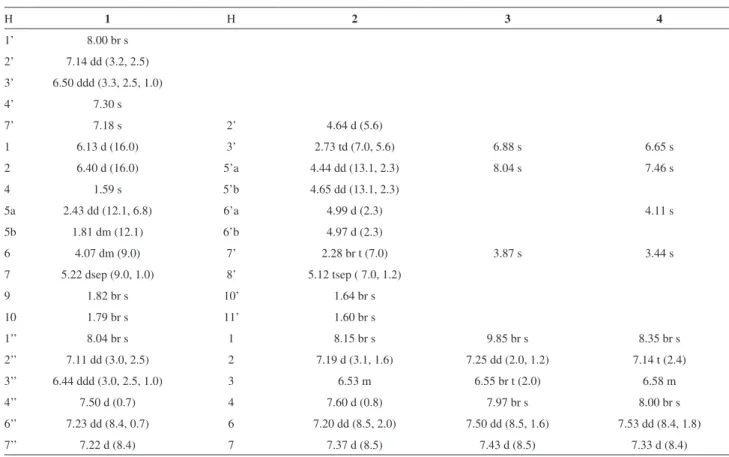
Compound 1,C26H26N2 (HREIMS), was identiied as a
bisindole alkaloid. The presence of two indole nucleus was suggested by an UV absorption maximum at 328 nm, an IR band at 3426 cm -1 (NH), and 1H NMR signals for N-H
protons at d8.00 and 8.04 (brs, no correlation in the HSQC spectrum) (Table 1), which in the COSY experiments showed cross peaks with the 1H signals at d
H 7.14 (dd, 3.2,
2.5 Hz), 6.50 (ddd, 3.2, 2.5, 1.0 Hz), 7.11 (dd, 3.0, 2.5 Hz) and 6.44 (ddd, 3.0, 2.5, 1.0 Hz), respectively. These signals were then assigned to 2N-H (d8.00 and 8.04), 2H-α (dH
7.14 and 7.11) and 2H-β (dH 6.50 and 6.44) of the indole
rings, respectively. HMBC cross peaks (Figure 2) between the signals H-4’ (dH 7.30)/C-3’ (dC 102.3), C-6’ (dC 144.3),
7’a (dC 135.5) and 40.7 (CH); H-7’ (dH 7.18)/C-3’a (dC
127.3), C-5’ (dC 139.4), and dC 48.5 (quaternary carbon)
led to the assignment of a 5’,6’-dialkylindole system. Moreover, the observed cross peaks between the 1H signals
at dH 4.07 (H-6), 2.43 (H-5a) and 1.81 (H-5b), and the 13C signals for C-5’, C-6’ and 48.5 (quaternary carbon,
C-3) suggested a 3,3,6-trisubstituted cyclopentyl fused to the indole ring at C-5’ and C-6’. An isobutene group was identiied from the 1H NMR signals at d
H 5.22 (dsep, 9.0,
1.0), 1.82 (br s, 3H), and 1.79 (br s, 3H), assigned to oleinic proton and methyl groups, respectively. This was supported by the HMBC experiments which showed correlations from the oleinic proton at dH 5.22 to the methyl carbons at dc
25.9 and 18.3. The isobutene group was connected at C-6 due to coupling of H-6 to the oleinic proton at dH 5.22. A
methyl group must be connected at C-3 due to the observed HMBC cross peaks between its 1H signal at d
3H 1.59 and
the 13C signals for C-6’ and C-3. This structural unit was
corroborated by the MS base-peak at m/z 223.13387 (100.0%) resulting from C-3-C-2 cleavage.
The 1H NMR spectrum also showed signals for three
hydrogens with ortho andmeta coupling constants, dH
7.50 (d, 0.7 Hz), 7.23 (dd, 8.4, 0.7 Hz) and 7.22 (d, 8.4 Hz), suggesting the second indole nucleus to be monosubstituted. In adition, the presence of a trans -disubstituted double bond was evidenced by two vinylic protons at dH 6.13 (dC 126.8) and 6.40 (d, 16.0 Hz; dC 136.0)
with a vicinal coupling constant of 16.0 Hz. From HMBC experiments the observed cross peak between the signal withmeta coupling constant at dH 7.50 and the
13C signal
for C-3’’ (dC 102.7), permited the assignment of the signal
at dH 7.50 to H-4’’ (C-4’’, dC 118.7). The metacoupling
constant for H-4’’indicated that C-5’’ was substituted. The
Prenylindole Alkaloids from Raputia praetermissa (Rutaceae) J. Braz. Chem. Soc. 1348
attachment of the ethylenyl bridge to C-3 and C-5’’ was evidenced from HMBC correlations H-1 (dH 6.13)/C-3,
C-4’’ and H-2 (dH 6.40)/C-3, C-6’. These spectral
characteristics are in agreement with those published for raputindole C (6, Figure 3), isolated from Raputia simulans.14 The main difference observed in the 1H and 13C NMR spectra (Tables 1 and 2) of compound 1, when
compared to those of 6, was the replacement of the signal for an oxymethylene by a methyl singlet (C-4, d3H 1.59, dC 27.1).
The relative stereochemistry of compound 1, named as 4-deoxyraputindole C, was determined from gNOESY experiments. The nOes of H-2, H-1, and H-5a, coming from H-6, indicated that H-6 and the ethylenylindole system are on the same side of the five-membered ring, whereas nOe between H-5b and CH3-4, required the methyl group to be anti(β) to H-6, andsyn to the isobutene chain.
Compounds 2-4 showed the spectral characteristic of a 5-substituted-1H-indole alkaloid (Tables 1, 2). The
13C NMR spectrum (Table 2) revealed resonances for C-2
to C-7a in close agreement with those for the corresponding carbons in the structural unit 5-substituted-1H-indole of compound 1, except for C-5 whose chemical shift was affected by a different substituent. Elemental analysis and
MS indicated the molecular formula to be C18H21NO for
compound 2, requiring the presence of an aliphatic chain of 10 carbons and one oxygen. A heterocyclic oxolane was identiied from the 1H NMR spectrum, which showed a
proton at dH 2.73 (td, 7.0, 5.6, H-3’; dC 51.6) coupled to a
proton attached to carbon adjacent to an oxygen atom (dH
4.64, d, 5.6, H-2’; dC 86.6), and two doublet of doublets
for an oxymethylene (dH 4.44, 4.65, J 13.1, 2.3, 2H-5’; dC
71.5). Observed HMBC cross peaks between the 1H signals
at dH 2.73 (H-3’) and 4.64 (H-2’) with the 13C signals at dC 132.7 (C-5) and 119.1 (C-4), respectively, as well as
those of H-5’a and H-5’b (dH 4.44 and 4.65) with C-3’
(dC 51.6), suggested the attachment of the heterocyclic
oxolane to C-5 of the indole nucleus. The presence of an isopentene group was deduced from the proton resonances at dH 5.12 (tsep, 7.0, 1.2, H-8’), 1.64 (br s, 3H-10’), 1.60
(br s, 3H-11’), 2.28 (br t, 7.0, 2H-7’), and corroborated by the HMBC correlation between the methyl and methylene protons with the oleinic carbons at dC 132.7 (C-9’) and
121.7 (C-8’). This was supported by the mass spectrum which showed fragment at m/z 211 [C18H21NO – C4H8]
+•.
The 1H-1H coupling between the methylene at d
H 2.28 and
H-3’ (dH 2.73) indicated the linkage of the isopentene chain
to C-3’. An exomethylene (dH 4.99, 4.97, J 2.3, 2H-6’; Table 1. 1H NMR data for 1-4
H 1 H 2 3 4
1’ 8.00 br s
2’ 7.14 dd (3.2, 2.5) 3’ 6.50 ddd (3.3, 2.5, 1.0)
4’ 7.30 s
7’ 7.18 s 2’ 4.64 d (5.6)
1 6.13 d (16.0) 3’ 2.73 td (7.0, 5.6) 6.88 s 6.65 s
2 6.40 d (16.0) 5’a 4.44 dd (13.1, 2.3) 8.04 s 7.46 s
4 1.59 s 5’b 4.65dd (13.1, 2.3)
5a 2.43 dd (12.1, 6.8) 6’a 4.99 d (2.3) 4.11 s
5b 1.81 dm(12.1) 6’b 4.97d (2.3)
6 4.07 dm (9.0) 7’ 2.28 br t (7.0) 3.87 s 3.44 s
7 5.22 dsep(9.0, 1.0) 8’ 5.12 tsep ( 7.0, 1.2)
9 1.82 br s 10’ 1.64 br s
10 1.79 br s 11’ 1.60 br s
1’’ 8.04 br s 1 8.15 br s 9.85 br s 8.35 br s
2’’ 7.11 dd (3.0, 2.5) 2 7.19 d(3.1, 1.6) 7.25 dd (2.0, 1.2) 7.14 t (2.4)
3’’ 6.44 ddd (3.0, 2.5, 1.0) 3 6.53 m 6.55 br t (2.0) 6.58 m
4’’ 7.50 d (0.7) 4 7.60 d (0.8) 7.97 br s 8.00 br s
6’’ 7.23 dd (8.4, 0.7) 6 7.20 dd (8.5, 2.0) 7.50 dd(8.5, 1.6) 7.53 dd (8.4, 1.8)
7’’ 7.22 d (8.4) 7 7.37 d (8.5) 7.43 d (8.5) 7.33 d (8.4)
1H NMR spectrum was acquired in CDCl
3 at 400 MHz. TMS was used as internal standard. Chemical shifts are shown in the d scale with J values (Hz)
Rosas et al. 1349 Vol. 22, No. 7, 2011
dC 103.6) must be connected at C-4’ of oxolane ring on the
basis of the observed cross peaks between the 1H signals at d2H 4.99/4.97 and the 13C signals for C-3’ (dC 51.6) and C-5’
(dC 71.5). As for compound 1,the relative stereochemistry
of 2 was deduced from gNOESY experiments. The nOes of the H-4 and H-6, coming from H-3’, indicated that H-3’ and the indolesystem must be on the same side of the oxolane ring. The above data conirmed the structure of 2, here named as raputimonoindole A.
As commented above compounds 2-4 showed the spectral characteristic of a 5-substituted-1H-indole alkaloid. Elemental analysis and MS indicated the molecular formula to be C14H11NO3 and C14H13NO2 for
compounds 3 and 4, respectively, requiring the presence of an aliphatic chain of 6 carbons (C6H5O3 and C6H7O2,
respectively) and indole nucleus (C8H6N). Their 1H NMR
resonances, when compared to those of 2, showed low ield shifts for the disubstituted furan ring potons. In Figure 2. Relevant HMBC and NOESY interactions observed for compounds 1-3 and 5.
Prenylindole Alkaloids from Raputia praetermissa (Rutaceae) J. Braz. Chem. Soc. 1350
compound 3, the existence of a cross peak between the
1H signal at d
H 6.88 assigned to H-3’, and the
13C signal
at dC 123.0 assigned to C-5, determined the position of
the furan ring at C-5 of the indole nucleus. The presence of a carbomethoxy group linked at C-4’ was indicated by HMBC cross peaks between the 1H signals at d
H 8.04
(H-5’, dC 146.3) and 3.87 (methyl protons) with the 13C
signal at dC 165.0 (C-6’). The structure of the new natural
product is therefore 5-(4-carbomethoxylfuran-2-yl)-1H -indole, here named as raputimonoindole B (3). However, compound 3 was puriied by column chromatography on Sephadex and eluted with MeOH-CH2Cl2, hence, 3 could
be an artifact.
The 1H NMR resonances for compound 4, when
compared to those of 2, showed low ield shifts for the disubstituted furan ring potons. In compound 4, the main difference observed in the 1H NMR, when compared with
3, was the replacement of the resonance for a carbomethoxy group by two 1H singlets at d
2H 4.11 (dC 66.0) and d3H
3.44 (dC 57.6) from a methoxymethylene group. This
was supported by the mass spectrum which showed a fragment at m/z 197 [C14H13NO2 – H2CO]+
•. These signals
together with the mass and 13C NMR spectral data are
consistent with 4 being 5-(4-methoxymethylfuran-2-yl)-1H-indole, which has previously been isolated from Raputia simulans Kallunki.19 However, the isolation of
5-(4-methoxymethylfuran-2-yl)-1H-indole was cited without spectroscopic data in an congress whose abstracts were published in Planta Medica Proceedings.19 Thus, its
spectroscopic data are cite here for the irst time, and it was named raputimonoindole C.
The cinnamic acid (5) derivative showed the spectral characteristic of a trans α,β-unsaturated carboxyl functional group (dHβ7.61, d, J 15.9, dCβ 144.5; dHα 6.29, d,
J 15.9, dCα 115.7; COOR 167.3). In addition, the 1H NMR
showed signals for one methoxyl group at dH 3.92 (s, 3H; dC
55.9), three aromatic hydrogens atdH 7.07 (dd, 8.1, 1.7 Hz),
7.03 (d, 1.7 Hz) and6.91 (d, 8.1 Hz), clearly indicating the aromatic ring to be 1,2,4-trisubstituted. From the HMBC experiments, the cross peaks observed between the signal of methoxyl group at d3H 3.92 with dC 146.7, and the
1H
signal at dH 7.61 (H-3’) with dC 147.9 but not withdC 146.7,
indicated the presence of a 2-hydroxy-4-methoxy-cinnamic acid derivative. The 13C NMR spectrum revealed resonances
for an aliphatic chain of sixteen carbons, one being attached to carboxylate as indicated by the HMBC cross peak between the 1H signal at d
H 4.18 and the
13C signal at d 167.3 (C-1’). The presence of a hexadecanyl chain was corroborated by the MS spectrum, which showed an ion at m/z 279 [HC≡C-COO-(CH2)14-CH2]+. The new compound
was therefore identified as hexadecanyl 2-hydroxy-4-methoxy-cinnamate (5). The structural assignment was also supported by comparison of its 13C NMR spectrum with
that of 4-hydroxy-2- methoxy-cinnamic acid.20
A number of 3,5- and 3,6-diprenylated indoles have been reported for the Annonaceae genera Isolona,21-23
Uvaria,22 Annonidium,24 Monodora,25 Hexalobus,26
Asteranthe,27 Greenwayodendron,28 and Polyalthia.29
However, there are only a few examples of 3-, 5-, 6- and 7- and 3,7-prenylated indoles reported in the Rutaceae genera Raputia,14 Esenbeckia,30,31Murraya,32-34Merrillia35
and Glycosmis.36,37 Four bisindoles (6-9; Figure 3)
similar to compound 1 have been isolated from Raputia simulans.14 One bisindole, yuehchukene, which may be
regarded as the product of Diels-Alder-type condensation of two 3-isopentenylindoles, occurs in Murraya species.32
While several bisindoles derived from 2-prenyltryptamine have been isolated from Flindersia species (Rutaceae),38 Table 2. 13C NMR data for 1-4, and 6
C 1 614 C 2 3 4
2’ 123.8 124.1 3’ 102.3 102.4 3’a 127.3 128.0 4’ 115.4 116.0 5’ 139.4 140.3 6’ 144.3 139.8 7’ 105.8 106.2 7’a 135.5 135.5
1 126.8 131.1 2’ 86.6 156.0 156.1 2 136.0 131.2 3’ 51.6 102.3 103.7
3 48.5 55.1 4’ 152.1 121.0 123.8
4 27.1 68.9 5’ 71.5 146.3 139.2
5 50.0 43.9 6’ 103.6 165.0 66.0
6 40.7 40.6 7’ 29.0 51.8 57.6
7 128.5 128.3 8’ 121.7
8 132.4 132.7 9’ 132.7
9 25.9 25.9 10’ 18.1
10 18.3 18.3 11’ 25.7
2’’ 124.4 123.9 2 124.4 125.5 124.9 3’’ 102.7 102.9 3 102.8 102.4 102.8 3’’a 127.3 128.1 3a 127.7 128.0 127.9 4’’ 118.7 119.0 4 119.1 116.6 116.1 5’’ 129.8 129.3 5 132.7 123.0 123.0 6’’ 120.4 120.5 6 121.0 118.6 118.7 7’’ 110.9 111.0 7 110.9 111.7 111.2 7’’a 135.1 135.4 7a 135.5 136.0 135.3
13C NMR spectrum was acquired in CDCl
3 at 100 MHz. Assignments
Rosas et al. 1351 Vol. 22, No. 7, 2011
pyrano[3,2-b]indole skeleton (koniamborine), a novel type of alkaloid was isolated from Boronella koniambiensis (Rutaceae).39
The anthranilate alkaloid content found in R. praetermissa indicates that the genus is strongly related to those included in Cusparieae tribe. As mentioned in the introduction, the polimethoxylated lavonoids form an extremely good marker for the Neoraputia. Their use in this context shows that R. praetermissa differs substantially from Neoraputia species, and reinforce its inclusion in Raputia genus. Furthermore, the prenylindole alkaloids have been reported only from Esenbeckia and Raputia in Cusparieae, thus suggesting an afinity of this tribe with subfamily Aurantioideae, where similar prenylindoles occur in Murraya,33-35 Merrillia36 and Glycosmis.37,38 It
is noteworthy that Neoraputia shares with Murraya and Citrus a propensity for producing polymethoxylated lavonoids,9,12,40,41 showing also chemical afinity with
Aurantioideae.
Experimental
General experimental procedures
Optical rotations were measured by using a Perkin Elmer 241 spectropolarimeter; NMR: Bruker DRX 400, with TMS as internal standard; high resolution EI-MS: Fisons VG Autospec; GC-EI-MS: low resolution on a HP-2576 instrument; IR: Bomen-FT/IR; UV: Hewlett Packard/8452A; Elemental analyses: on a EA 1108, CHNS-O (Fisons).
Plant material
Raputia praetermissa was collected in the Forest Reserve Adolpho Ducke, Amazonas, Brazil, and identiied by J. R. Pirani (Department of Botany, University of São Paulo). A voucher specimen (189865) is deposited in the Herbarium of the Instituto Nacional de Pesquisa da Amazônia (INPA), Manaus, AM (Brazil).
Extraction and isolation
Ground stems (4.4 kg) were extracted 3 times at room temperature using hexane, followed by CH2Cl2 and MeOH.
The concentrated hexane extract (13.3 g) was subjected to silica gel (230-400 mesh) column chromatography with successive elution with hexane, CH2Cl2, EtOAc and MeOH,
yielding 6 fractions. Fraction 2 was lash rechromatographed twice on silica gel with successive elution with hexane, CH2Cl2, EtOAc and MeOH, and then by preparative TLC
(silica gel; hexane-acetone 9:1), yielding cycloartenone (10 mg). Fraction 3 was flash rechromatographed twice as above, and then by gel permeation column chromatography (Sephadex LH 20, CH2Cl2-MeOH 2:8)
affording N-methyl-4-methoxyquinolin-2(1H)-one (30 mg). Fraction 4 was chromatographed on silica gel and Florisil (1:1) with hexane-EtOAc-MeOH gradient elution to give two fractions (A and B). Fraction A was subjected to column chromatography over silica gel and eluted with hexane-acetone gradient, yielding a mixture of sitosterol and stigmasterol. Fraction B was puriied by preparative TLC (silica gel; hexane-acetone 9:1), yielding sitostenone (60 mg). Fraction 5 was chromatographed on silica gel and Florisil (1:1) with hexane-EtOAc-MeOH gradient elution to give skimmianine (50 mg).
The concentrated dichloromethane extract (30.0 g) was subjected to column chromatography over silica gel (70-230 mesh) under vacuum. Elution with hexane, CH2Cl2,
EtOAc and MeOH yielded 4 fractions. Fraction 1 was lash rechromatographed on silica gel with hexane-EtOAc-MeOH gradient, yielding compound 1 (700 mg) and a new fraction C. Fraction C was lash rechromatographed twice as above, and then by preparative TLC (silica gel; hexane-acetone 6:1), yielding compound 5. Fraction 2 was chromatographed on silica gel and Florisil (1:1) with hexane-acetone-MeOH gradient elution to give new fractions D, E and F. Fractions D and E were rechromatographed over Sephadex LH 20 (MeOH) to give compounds 2 and 4, respectively. Fraction F was lash rechromatographed on silica gel with hexane-acetone-MeOH gradient elution, yielding robustine (50 mg). Fraction 3 was rechromatographed as above using hexane-CH2Cl2-MeOH gradient to yield two fractions. Both
fractions were rechromatographed over Sephadex LH 20 (MeOH-CH2Cl2 2:8) affording maculosidine (80 mg), and a
new fraction containing compound 3 which was puriied by preparative TLC (silica gel; hexane-acetone 5:1). Fraction 4 was rechromatographed on silica gel and Florisil (1:1) with hexane-acetone-MeOH gradient elution to give evolitrine (50 mg) and dictamnine 120 mg).
4-Deoxyraputindole C (1) Brown solid; [α]D
25 + 94 (CHCl
3; c 0.0012); UV
(acetone) λmax/nm: 230; IR (KBr) νmax/cm-1: 3425.7; 1H NMR
(400 MHz, CDCl3), see Table 1;
13C NMR (100 MHz,
CDCl3), see Table 2; HREI-MS, 366.20560 (37.5; calc. for
C26H26N2), 294.11201(10.0), 223.13387 (100), 167.07123
(20), 130.06388 (30).
Raputimonoindole A (2) Yellow solid; [α]D
25 - 41 (CHCl
Prenylindole Alkaloids from Raputia praetermissa (Rutaceae) J. Braz. Chem. Soc. 1352
(400 MHz, CDCl3), see Table 1; 13C NMR/DEPT (100 MHz,
CDCl3), see Table 2. Anal. found C 80.28%, H 7.80%, N
5.20%; calc. for C18H21NO, C 80.86%, H 7.92%, N 5.24%,
O 5.98 %; MS m/z 267 [M]+• (10), 252 (5), 211 (50), 144
(100), 107 (80), 79 (70).
Raputimonoindole B (3)
Yellow solid; UV (acetone) λmax/nm: 230; IR (KBr) νmax/cm-1: 3310.2, 1770.1; 1H NMR (400 MHz, CDCl3),
see Table 1; 13C NMR/DEPT (100 MHz, CDCl 3), see
Table 2. Anal.found C 69.76%, H 4.58%, N 5.80%; calc. for C14H11NO3, C 69.70%, H 4.60%, N 5.81%, O 19.90 %;
MS m/z 241 [M]+• (100), 226 [C
14H11NO3 – Me]+ (15), 210
[C14H11NO3 – OMe]
+ (10), 198 (10), 154 (30), 105 (40), 77 (50).
Raputimonoindole C (4)
Yellow solid; UV (acetone) λmax/nm: 232; IR (KBr) νmax/cm
-1: 3315.4; 1H NMR (400 MHz, CDCl
3), see Table 1; 13C NMR/DEPT (100 MHz, CDCl
3), see Table 2. Anal.
found C 73.90%, H 5.80%, N 6.15%; calc. for C14H13NO2,
C 73.99%, H 5.77%, N 6.16%, O 14.08 %; MS m/z 227 [M]+•
(100), 197 (80), 168 (70), 98 (30).
Hexadecanyl 2-hydroxy-4-methoxy-cinnamate (5) Amorphous white solid; 1H NMR (400 MHz, CDCl
3): d 7.61 (d, J 15.9 Hz, H-3’), 7.07 (dd, J 8.1, 1.7 Hz, H-5), 7.03 (d, J 1.7 Hz, H-3), 6.91 (d, J 8.1 Hz, H-6), 6.29 (d, J 15.9, H-2’), 3.92 (s, OMe),4.18 (t, J 6.8 Hz, H-1’’), 1.69 (quint, J 6.8 Hz, H-2’’), 1.25 (br s, 3’’-15’’) and 0.88 (t, J 6.6 Hz, H-16); 13C NMR (100 MHz, CDCl
3): d 167.3 (C-1’), 147.9
(C-2), 146.7 (C-4), 144.5 (C-3’), 127.0 (C-1), 123.0 (C-5), 115.7 (C-2’), 114.6 (C-6), 109.3 (C-3), 64.5 (C-1’’), 55.9 (OMe), 29.6-28.7 (C-3’’-C-15’’), 14.0 (C-16’’); MS m/z 418 [M]+• (5), 279 (10), 207 [279 – C
5H12]
+(10), 167 (50), 149
(100), 71 (40), 57 (45).
Note from the Editor
During the edition of the present paper, the spectroscopic data of compound 4 have been published online on March 7, 2011 by Planta Medica, in the entitled Letter “Simple Indole Alkaloids from the Neotropical Rutaceous Tree Raputia simulans” by K. Vougogiannopoulou, N. Fokialakis, N. Aligiannis, C. Cantrel, A-L Skaltsounis.
Supplementary Information
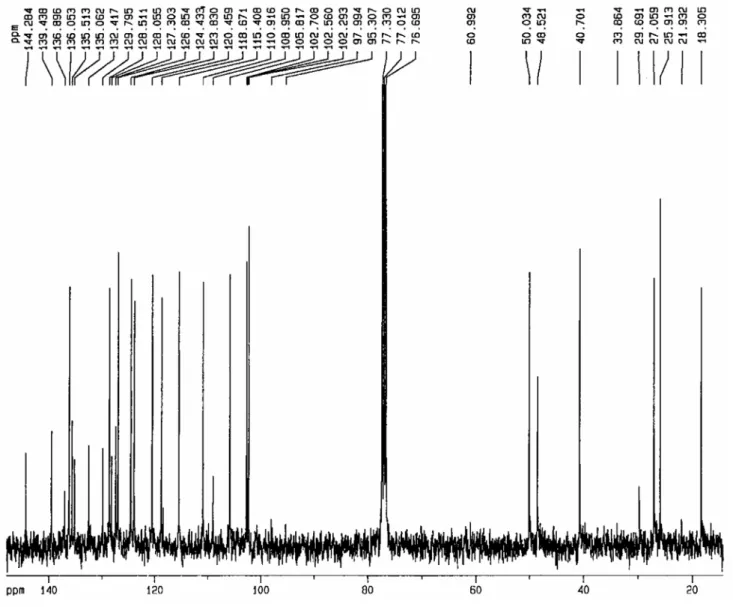
1H and 13C NMR spectra of compounds 1-5 are available
free of charge at http://jbcs.sbq.org.br as PDF ile.
Acknowledgments
The authors thank the Brazilian agencies, Institutos Nacionais de Ciência e Tecnologia - Conselho Nacional de Desenvolvimento Cientiico e Tecnológico (CNPq/MCT), Fundação de Amparo a Pesquisa do Estado de São Paulo (FAPESP), Coordenação de Aperfeiçoamento de Pessoal de Ensino Superior (CAPES) and Financiadora de Estudos e Projetos (FINEP) for their inancial support.
References
1. Aublet, J. B. C. F.; Histoire des Plantes de la Guiane Françoise, Vol. 2; P. E. Didot: London and Paris, 1775;Emmerich, M.; Rodriguesia 1978, 30, 223.
2. Kallunki, J. A.; Brittonia 1990, 42, 175. 3. Kallunki, J. A.; Brittonia 1994, 46, 279. 4. Kallunki, J. A.; Brittonia 2009, 61, 28. 5. Pirani, J. R.; Rodriguesia 2005, 56, 189.
6. Arruda, A. C.; Vieira, P. C.; Fernandes, J. B.; da Silva, M. F. G. F.; Francisco, R. H. P.; Rodrigues, A. M. G. D.; Lechat, J. R.; Phytochemistry 1991, 30, 3157.
7. Arruda, A. C.; Vieira, P. C.; Fernandes, J. B.; da Silva, M. F. G. F.; J. Braz. Chem. Soc. 1993, 4, 80.
8. Passador, E. A. P.; da Silva, M. F. G. F.; Rodrigues-Fo, E.; Fernandes, J. B.; Vieira, P. C.; Pirani, J. R.; Phytochemistry 1997, 45, 1533.
9. Tomazela, D. M.; Pupo, M. T.; Passador, E. A. P.; da Silva, M. F. G. F.; Vieira, P. C.; Fernandes, J. B.; Rodrigues-Fo, E.; Oliva, G.; Pirani, J. R.; Phytochemistry 2000, 55, 643.
10. Souza, J. P. I.; Arruda, A. C.; Arruda, M. S. P.; Fitoterapia 1995, 66, 465.
11. Souza, J. P. I.; Arruda, A. C.; Muñoz, G. D.; Arruda, M. S. P.; Müller, A. H.; Phytochemistry 1999, 52, 1705.
12. Moraes, V. R. S; Tomazela, D. M.; Ferracin, R. J.; Garcia, C. F.; Sannomiya, M.; Soriano, M. P. C.; da Silva, M. F. G. F.; Vieira, P. C.; Fernandes, J. B.; Rodrigues-Fo, E.; Magalhães, E. G.; Magalhães, A. F.; Pimenta, E. F.; de Souza, D. H. F.; Oliva, G.; J. Braz. Chem. Soc. 2003, 14, 380.
13. Bakhtiar, A.; Gleye, J.; Moulis, C.; Fouraste, I.; Phytochemistry 1991, 30, 3840.
14. Vougogiannopoulou, K.; Fokialakis, N.; Aligiannis, N.; Cantrell, C.; Skaltsounis, A.-L.; Org. Lett. 2010, 12, 1908.
15. Robertson, A. V.; Aust. J. Chem. 1963, 16, 451.
16. Cortez, L. E. R.; Cortez, D. A. G.; Ferreira, A. G.; Vieira, P. C.; da Silva, M. F. G. F.; Fernandes, J. B.; Braz. J. Pharmacogn. 2006, 16, 164.
17. Nayar, M. N. S.; Sutar, C. V.; Bhan, M. K.; Phytochemistry 1971, 10, 2843.
Rosas et al. 1353 Vol. 22, No. 7, 2011
19. Vougogiannopoulou, K.; Fokialakis, N.; Aligiannis, N.; Cantrell, C.; Skaltsounis, A.-L.; Planta Med. 2008, 74, 189.
20. Chen, H.; Jiang, H.; Morgan, J. A.; Phytochemistry 2007, 68, 306. 21. Makangara, J. J.; Henry, L.; Jonker, S. A.; Nkunya, M. H. H.;
Phytochemistry 2004, 65, 227.
22. Achenbach, H.; Raffelsberger, B.; Tetrahedron Lett. 1979, 28, 2571.
23. Achenbach, H.; Löwel, M.; Phytochemistry 1995, 40, 967. 24. Achenbach, H.; Renner, C.; Heterocycles 1985, 23, 2075. 25. Adeoye, A. O.; Oguntimein, B. O.; Clark, A. M.; Hufford, C.
D.; J. Nat. Prod. 1986, 49, 534.
26. Achenbach, H.; Renner, C.; Addae-Mensah, I.; Heterocycles 1984, 22, 2501.
27. Nkunya, M. H. H.; Jonker, S. A.; Mdee, L. K.; Waibel, R.; Achenbach, H.; Nat. Prod. Lett. 1996, 9, 71.
28. Yoo, H-D.; Cremin, P. A.; Zeng, L.; Garo, E.; Williams, C. T.; Lee, C. M.; Goering, M. G.; O’Neil-Johnson, M.; Eldridge, G. R.; Hu, J-F.; J. Nat. Prod. 2005, 68, 122.
29. Kunesch, N.; Cave, A.; Leboeuf, M.; Hocquemiller, R.; Dubois, G.; Guittet, E.; Lallemand, J. Y.; Tetrahedron Lett. 1985, 26, 4937.
30. Monache, F. D.; Monache, G. D.; Souza, M. A. M.; Cavalcanti, M. S.; Chiappeta, A.; Gazz. Chim. Ital. 1989, 119, 435. 31. Monache, F. D.; Benedito R. D.; Gazz. Chim. Ital. 1990, 120, 387. 32. Kinoshita, T.; Tatara, S.; Ho, F-G.; Sankawa, U.; Phytochemistry
1989, 28, 147.
33. Wu, T-S.; Liou, M-J.; Jong, T-T.; Chen, Y-J.; Lai, J-S.; Phytochemistry 1989, 28, 2873.
34. Wu, T-S.; Liou, M-J.; Lee, C-J.; Jong, T-T.; McPhail, A. T.; McPhail, D. R.; Lee, K-H.; Tetrahedron Lett. 1989, 30, 6649. 35. Kong, Y-C.; But, P. P-H; NG, K-H.; Cheng, K-F; Chang, K-L.; Wong, K. M.; Gray, A. I.; Waterman, P. G.; Biochem. Syst. Ecol. 1988, 16, 47.
36. Vajrodaya, S.; Bacher, M.; Greger, H.; Hofer, O.; Phytochemistry 1998, 48, 897.
37. Wang, J.; Zheng, Y.; Efferth, T.; Wang, R.; Shen, Y.; Hao, X.; Phytochemistry 2005, 66, 697.
38. Fernandez, L. S.; Buchanan, M. S.; Carroll, A. R.; Feng, Y. J.; Quinn, R. J.; Avery, V. M.; Org. Lett. 2009, 11, 329.
39. Grougnet, R.; Magiatis, P.; Fokialakis, N.; Mitaku, S.; Skaltsounis, A-L.; Tillequin F.; Sevenet, T.; Litaudon, M.; J. Nat. Prod. 2005, 68, 1083.
40. Ferracin, R. J.; da Silva, M. F. G. F.; Fernandes, J. B; Vieira, P. C.; Phytochemistry 1998, 47, 393.
41. Ribeiro, A. B.; Abdelnur, P. V.; Garcia, C. F.; Belini, A.; Severino, V. G. P.; da Silva, M. F. G. F.; Fernandes, J. B.; Vieira, P. C.; de Carvalho, S. A.; de Souza, A. A.; Machado, M. A.; J. Agric. Food Chem. 2008, 56, 7815.
Submitted: October 4, 2010 Published online: March 24, 2011
Supplementary Information
S
I
J. Braz. Chem. Soc., Vol. 22, No. 7, S1-S22, 2011. Printed in Brazil - ©2011 Sociedade Brasileira de Química 0103 - 5053 $6.00+0.00
*e-mail: [email protected]
Prenylindole Alkaloids from
Raputia praetermissa
(Rutaceae) and their
Chemosystematic Signiicance
Lisandra V. Rosas, Thiago André M. Veiga, João B. Fernandes, Paulo C. Vieira and M. Fátima das G. F. da Silva*
Departamento de Química, Universidade Federal de São Carlos, CP 676, 13565-905 São Carlos-SP, Brazil
Prenylindole Alkaloids from Raputia praetermissa (Rutaceae) J. Braz. Chem. Soc.
2
Rosas et al. 3 Vol. 22, No. 7, 2011
Prenylindole Alkaloids from Raputia praetermissa (Rutaceae) J. Braz. Chem. Soc.
4
Rosas et al. 5 Vol. 22, No. 7, 2011
Prenylindole Alkaloids from Raputia praetermissa (Rutaceae) J. Braz. Chem. Soc.
6
Rosas et al. 7 Vol. 22, No. 7, 2011
Prenylindole Alkaloids from Raputia praetermissa (Rutaceae) J. Braz. Chem. Soc.
8
Rosas et al. 9 Vol. 22, No. 7, 2011
Prenylindole Alkaloids from Raputia praetermissa (Rutaceae) J. Braz. Chem. Soc.
10
Rosas et al. 11 Vol. 22, No. 7, 2011
Prenylindole Alkaloids from Raputia praetermissa (Rutaceae) J. Braz. Chem. Soc.
12
Rosas et al. 13 Vol. 22, No. 7, 2011
Prenylindole Alkaloids from Raputia praetermissa (Rutaceae) J. Braz. Chem. Soc.
14
Rosas et al. 15 Vol. 22, No. 7, 2011
Prenylindole Alkaloids from Raputia praetermissa (Rutaceae) J. Braz. Chem. Soc.
16
Rosas et al. 17 Vol. 22, No. 7, 2011
Prenylindole Alkaloids from Raputia praetermissa (Rutaceae) J. Braz. Chem. Soc.
18
Rosas et al. 19 Vol. 22, No. 7, 2011
Prenylindole Alkaloids from Raputia praetermissa (Rutaceae) J. Braz. Chem. Soc.
20
Rosas et al. 21 Vol. 22, No. 7, 2011
Prenylindole Alkaloids from Raputia praetermissa (Rutaceae) J. Braz. Chem. Soc.
22