Artigo Original
Kilza Arruda de Lyra e Silva1 Juliana Granja Urosas2 Seisse Gabriela Gandolfi Sanches3 Renata Mota Mamede Carvallo3
Descritores
Audição Testes auditivos Recém-nascido Orelha média Testes de impedância acústica
Keywords
Hearing Hearing tests Newborn Ear, middle Acoustic impedance tests
Correspondence address:
Kilza Arruda Lyra e Silva
R. Cipotânea, 51, Cidade Universitária, São Paulo (SP), Brasil, CEP: 05360-160. E-mail: [email protected]
Received: 11/10/2011
Accepted: 9/11/2012
Study conducted at the Investigation Laboratory in Human Hearing, Department of Physical Therapy, Speech-Language Pathology and Audiology, and Occupational Therapy, School of Medicine, Universidade de São Paulo – USP – São Paulo (SP), Brazil.
(1) Graduate Program (PhD) in Rehabilitation Sciences, Department of Physical Therapy, Speech-Language Pathology and Audiology, and Occupational Therapy, School of Medicine, Universidade de São Paulo – USP – São Paulo (SP), Brazil; University Hospital Professor Alberto Antunes, Universidade Federal de Alagoas – UFAL – Maceió (AL), Brazil.
(2) Undergraduate Program in Speech-Language Pathology and Audiology, School of Medicine, Universidade de São Paulo – USP – São Paulo (SP), Brazil.
(3) Department of Physical Therapy, Speech-Language Pathology and Audiology, and Occupational Therapy, School of Medicine, Universidade de São Paulo – USP – São Paulo (SP), Brazil.
Conflict of interests: None
transient-evoked otoacoustic emissions
Reflectância de banda larga em recém-nascidos com
presença de emissões otoacústicas evocadas por transiente
ABSTRACT
Purpose: To characterize the normal values of acoustic energy reflectance obtained with pure-tone stimulation in neonates prior to hospital discharge. Methods: Seventy-seven infants (37 girls and 40 boys) were evaluated by measuring acoustic reflectance using pure-tone stimuli, transient-evoked otoacoustic emissions, and tym-panometric probe frequencies of 226 Hz and 1 kHz. Results: At low frequencies (258-750 Hz), greater energy reflectance was observed, while at medium frequencies (1-3 kHz), greater energy absorption was observed. There was no difference between ears or between genders. Conclusion: Normal energy reflectance values were obtained for the studied population. The data indicate a reflectance curve with a distinct configuration for the studied age.
RESUMO
INTRODUCTION
In the sound transmission process, under normal conditions, acoustic energy propagates through the external auditory canal and is transmitted through the middle ear system to the cochlea. The middle ear acts as an impedance transformer to increase the efficiency of sound transmission between the low impedance air of the canal and the high impedance fluids of the cochlea(1).
The magnitude and latency of acoustic energy reflected by the eardrum as a function of frequency is a useful indicator of the state of the middle ear, which can reveal the nature of an ab-normality(2). A middle-ear evaluation technique explored in the
last decade quantifies the sound energy absorbed and reflected in the external auditory canal. In the literature, various terms have been used to describe this technique, such as broadband reflectance(3-7), broadband energy measured in the middle ear(2),
and acoustic broadband transference functions(8-10). In this study,
the term broadband reflectance will be used.
Broadband reflectance measurements exhibit several ad-vantages over conventional single-frequency tympanometry: positioning of the probe in the external auditory canal is not as critical, especially at high frequencies; broadband reflectance covers a wide range of frequencies; and broadband reflectance does not require pressurization of the auditory canal. The time required to complete a full reflectance scan at a wide range of frequencies is less than the time required in multifrequency tympanometry. Broadband reflectance may be a more sensitive test to assess abnormalities in the middle ear and conductive hearing loss(11-14).
Energy reflectance is the ratio of energy reflected to the incident shown in the auditory canal using a probe. Energy reflectance reveals the amount of energy reflected by the tympanic membrane and the amount of energy absorbed by the middle ear(2, 15).
In adults, energy reflectance at ambient pressure is typically near 100% at low frequencies but decreases gradually with increasing frequencies to a minimum value near 4 kHz. At higher frequencies, the reflectance increases again. The area of low reflectance is observed in the region corresponding to the range of frequencies important for speech perception(11,15-17).
Low energy reflectance in the frequency range between 2 and 4 kHz is characteristic of a normal middle ear(16). In newborns,
reflectance at low frequencies is lower than in adults, but reflec-tance is similar at high frequencies(16). A study(10) conducted with
healthy infants in the first two days of life aimed to evaluate the performance of the broadband energy transfer function screenings and tympanometry with frequency of 1 kHz to predict the state of the sound conduction pathway. The results obtained for ears that passed hearing screenings performed with distortion product-evoked otoacoustic emissions (DPOEA) were compared to the results obtained for ears that did not pass the screenings. Reflectance measurements were shown to be helpful in detecting fluid in the ears of the newborn because of the superior ability to predict the outcome of the DPOAE compared with tympanometry using a 1-kHz probe. Similar results were described in the hearing screenings of neonates(6)
48 hours after birth.
The objective of this study was to assess the practical applications of reflectance measurements in newborns by characterizing the normal values of acoustic energy reflectan-ce obtained with pure-tone stimulation in neonates prior to hospital discharge.
METHODS
This study was approved by the Research Ethics Committee of the University Hospital of the Universidade de São Paulo – USP (Research protocol number 917/08).
The hearing tests were performed on 101 full-term new-borns aged between 27 and 78 hours (Mean=56.5 hours; SD=11.6 hours), and 77 of the newborns were included in the study (37 girls and 40 boys), providing a total of 144 ears. The participants were included according to the following inclu-sion criteria: no risk indicator for hearing loss according to the Joint Committee on Infant Hearing(18), presence of transient
otoacoustic emissions, tympanogram with curve type A, and informed consent signed by the person responsible for the new-born. The composition of the sample was formed according to the specifications of the nominal and statistical errors based on chirp stimulus reflectance values and pure tone at a frequency of 258 Hz (can be any frequency). The sample comprised 77 participants with a nominal error of ¼ of the standard devia-tion and a statistical error of 3%. Twenty-four newborns were excluded due to conditions that may contribute to performing imprecise measurements, inadequate sealing of the probe, lack of cooperation of the newborn, high ambient noise, and vernix in the external auditory canal.
All of the tests were conducted on newborns in natural sleep in a crib in a silent room. The initial choice of the left or right ear was conducted in accordance with the position of the baby in the crib. The transient-evoked otoacoustic emission test (TEOEA) was performed using Madsen® AccuScrenPRO Screening equipment with “pass” or “refer” configuration. Before the start of the test session, the probe was automati-cally calibrated performed with an appropriately sized eartip inserted in the external auditory canal. The following protocol was applied: nonlinear acoustic click stimulus with intensity between 70 to 85 dB peNPS and a frequency range of 1-4 kHz. Indices relating to artifacts (A) with a value less than 20% and stability of the stimulus (S) with a value greater than 80% were considered. The MEPA measurement system version 3.3 was used to measure reflectance with pure-tone stimuli. Before each test session reflectance, probe calibration was performed using four cavities (CC4-V). The size of the silicone eartip was the same in the test and in the calibration (ER10C-03: 4.3 mm), which is suitable for use with neonates. Data were collected on 248 frequencies between 211 Hz and 6 kHz at intervals of 23 Hz at an intensity of 60 dB SPL using a pure-tone stimulus with a duration of 0.1 to 10 seconds per point.
with the probe tone presented at 70 dB SPL (for both probe frequencies). The pressure was varied in the direction of +200 to -400 daPa at a speed 400 daPa/s. The newborns who failed the TEOAE test were referred for retesting and diagnostic audiology in the tertiary care clinic when necessary.
The results for the studied variables were submitted for descriptive analysis using central tendency measures and infe-rential analysis to compare gender using Student’s t-test. The significance level was 5%.
RESULTS
There was no significant difference in the energy reflectance measurements between genders either in the right ear (p=0.698) or the left ear (p=0.747).
Energy reflectance describes the amount of incident acoustic energy reflected back by the tympanic membrane. An energy reflectance measurement equal to 1 (or 100%) corresponds to a condition in which all acoustic energy is reflected. Reflectance equal to 0 (or 0%) corresponds to a condition in which all energy is absorbed by the tympanic membrane(2,15,19).
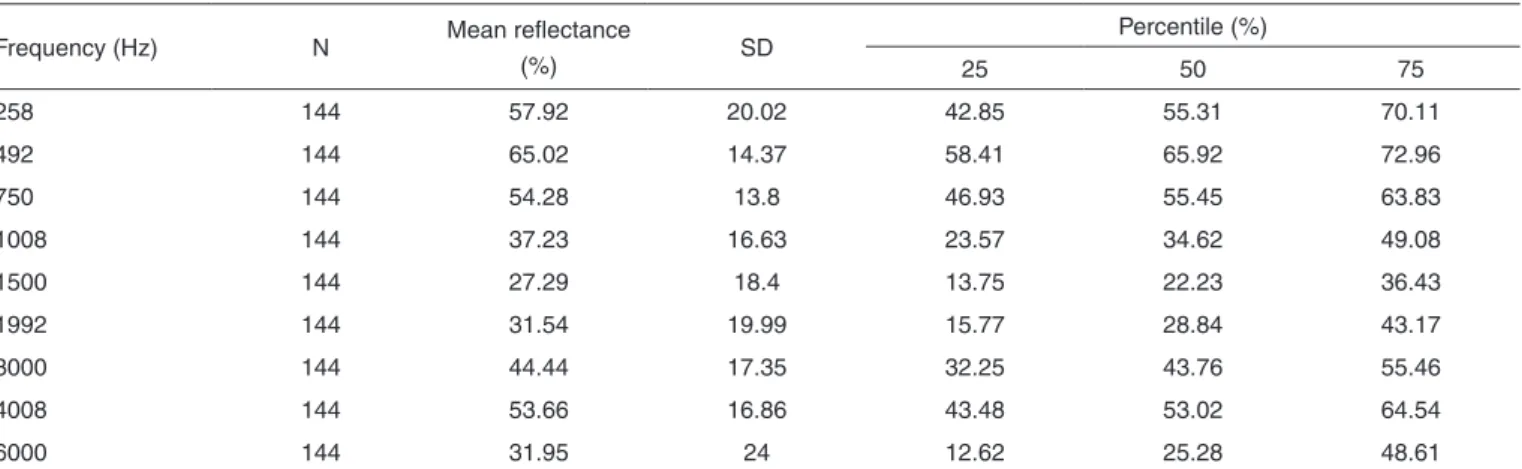
In Figure 1, the means and standard deviations are pre-sented for the energy reflectance of the 144 evaluated ears. The mean energy reflectance was approximately 1.0 (100%) at the lower frequencies (258 to 750 Hz), which indicates that nearly all the incident acoustic energy was reflected from the tympanic membrane with little energy absorption by the middle ear. The energy reflectance decreased at medium frequencies (1 to 3 kHz), which indicates the greatest amount of energy transmission to the structure behind the tympanic membrane. At a frequency of 4 kHz, an increase in energy reflectance was observed, which reached a value approximately equal to the low frequencies. As the frequency increased, a further reduction in the reflectance was observed at a frequency of 6 kHz, which was similar to the minimum acoustic energy absorption by the tympanic ossicular system.
The frequency of 1.5 kHz corresponded with the lowest mean reflectance value (27.29%), which indicates that appro-ximately 72% of the incident energy on the ear of the newborn was absorbed by the middle ear. Similar results were observed
at a frequency of 6 kHz, at which the 68% of the energy was absorbed by the tympanic ossicular system (Table 1).
DISCUSSION
The present study characterized the measured energy reflectance curve with pure-tone stimuli in newborns 27 and 78 hours after birth. The absence of a difference in the mean acoustic energy reflectance by frequency when considering gender and ear variables is consistent with a previous study(5).
In the specialized literature on this subject, little variability is typically observed concerning the reflectance measurement method and calibration. The method and calibration used in this study are identical to the method and calibration adopted by several researchers(5,15) but differ from those of other studies(8,16)
that characterize reflectance data.
Comparative analysis between the studies shows both si-milarities and differences. As observed in Figure 2, the energy reflectance curve obtained in this study follows a similar pat-tern to studies performed in similarly aged subjects(5,16). The Table 1. Descriptive statistic for reflectance with pure-tone stimuli in both ears for newborns aged between 27 and 78 hours without abnormalities in the middle ear
Frequency (Hz) N Mean reflectance
(%) SD
Percentile (%)
25 50 75
258 144 57.92 20.02 42.85 55.31 70.11
492 144 65.02 14.37 58.41 65.92 72.96
750 144 54.28 13.8 46.93 55.45 63.83
1008 144 37.23 16.63 23.57 34.62 49.08
1500 144 27.29 18.4 13.75 22.23 36.43
1992 144 31.54 19.99 15.77 28.84 43.17
3000 144 44.44 17.35 32.25 43.76 55.46
4008 144 53.66 16.86 43.48 53.02 64.54
6000 144 31.95 24 12.62 25.28 48.61
Note: SD = standard deviation
frequency with the lowest energy reflectance value (i.e., the frequency at which most of the incident energy was absorbed by the middle ear) was measured in the range of 1.5 to 3 kHz. The low reflectance in this area appears to reflect the normal characteristics of the middle ear.
A characteristic reflectance curve may be assembled for by combining the results observed in this study and a previous study(5). In this population, the reflectance of energy obtained
at a frequency of 4 kHz was higher than the reflectance obser-ved in a frequency range between 1.5 and 3 kHz. In infants, the reflectance value typically decreases sharply at higher frequencies. The decreases observed at higher frequencies do not occur in other age groups. In newborns over a month old(16)
and adults (13) without middle ear abnormalities, an inversion
occurs; the reflectance value decreases at a frequency of 4 kHz and increases at a frequency of 6 kHz. In newborns, the diffe-rence may occur due to structural diffediffe-rences of the external auditory canal or the possible presence of a small amount of amniotic fluid. The inversion can be observed as a sign of the developing structure. The resonant frequency of the middle ear in newborns up to 12 days of age is lower than the frequency in infants two to three months of age(20). The frequencies in
all infants are lower than the same measurements in adults, which indicates that the development of external and middle ear structures affects the resonance frequency measured in the external auditory canal. In this study, developing structures might also interfere with energy reflectance values , which are also measures of the external auditory canal.
There is no consensus in the literature regarding the compa-rison between reflectance values in newborns up to three days
and infants older than 30 days. A systematic study showed chan-ges in reflectance with increasing age of the infants(16). Another
study identified a significant age effect only at a frequency of 6 kHz(5). In a recent study (7), two groups were evaluated, including
a group with seven healthy newborns aged three to five days and a group with 11 infants aged between 28 to 34 days, to determine the difference in the broadband energy reflectance between the age groups. There was no difference between the two groups regarding the energy reflectance except at the higher frequency of 2 kHz. The causes of the slight difference between the broadband energy reflectance curves in newborns are not fully understood. However, several differences may be caused by the different characteristics of each device, calibration, population ages, probe seal, and other factors. Further studies are needed to characterize results in newborns.
Researchers have reported a high rate of neonatal hearing screening failure in the intensive care unit (ICU), even with the use of automated brainstem auditory evoked potential (AEP)(21).
Several studies(22,23) have suggested that external auditory canal
and middle ear factors, such as vernix and amniotic fluid, can influence the results of TAN performed using OAE and AEP. Even with the 1-kHz probe, which is recommended for this age group, difficulties in identifying middle ear abnormalities in the neonatal population may cause failures in OAE hearing screening tests. Conductive hearing loss does not exclude the presence of sensorineural loss. Therefore, It is necessary to identify conductive loss to allow accurate assessment of the inner ear such that appropriate medical treatments can be performed.
Broadband energy reflectance measurements represent a viable alternative as a new procedure to precisely identify middle ear abnormalities that might otherwise be overlooked in tympanometric evaluation and interfere with the results of otoacoustic emissions. However, further studies with middle ear abnormalities are necessary to demonstrate other patterns and determine the effectiveness of broadband energy reflectance.
CONCLUSION
This study demonstrated that broadband energy reflectance values are low at a frequency of 6 kHz in a population of new-borns. Knowledge of normal reflectance characteristics can assist in identifying middle ear abnormalities and differentiating between types of hearing loss.
ACKNOWLEDGMENTS
We thank the Fundação de Amparo à Pesquisa do Estado de São Paulo (São Paulo Research Foundation – FAPESP, process number 2009/06450-2) and the Conselho Nacional de Desenvolvimento Científico e Tecnológico (CNPq- 475797/2010-8) for their support.
* KALS was responsible for the research project, data collection, tabulation and analysis, and manuscript elaboration; JGU contributed with data collection, tabulation and analysis; SGGS contributed with the analysis and Figure 2. Mean energy reflectance measurements (pure-tone stimuli)
conclusion of the findings, and manuscript elaboration; RMMC planned the research, contributed with the data analysis, conclusion of the findings, and manuscript elaboration.
REFERENCES
1. Margolis RH, Hunter LL.Timpanometria: princípios básicos e aplicações clínicas. In: Musiek FE, Rintelmann WI (ed). Perspectivas atuais em avaliação auditiva. São Paulo: Manole; 2001. p.85-126.
2. Allen JB, Jeng PS, Levitt H. Evaluation of human middle ear function via an acoustic power assessment. J Rehabil Res Dev. 2005 Jul-Aug;42(4):63-77.
3. Keefe DH, Ling R, Bulen JC. Method to measure acoustic-impedance and reflection coefficient. J Acoust Soc Am. 1992 Jan;91(1):470-85. 4. Shahnaz, N. Wideband reflectance in neonatal intensive care Units. J Am
Acad Audiol. 2008 May;19(5):419-29.
5. Hunter LL, Tubaugh L, Jackson A, Propes S. Wideband middle ear power measurement in infants and children. J Am Acad Audiol. 2008 Apr;19(4):309-24.
6. Hunter LL, Feeney MP, Miller JAL, Jeng PS, Bohning S. Wideband reflectance in newborns: normative regions and relationship to hearing-screening results. Ear Hear. 2010 Oct;31(5):599-610.
7. Merchant GR, Horton NJ, Voss SE. Normative reflectance and transmittance measurements on healthy newborn and 1-month-old infants. Ear Hear. 2010 Dec;31(6):746-54.
8. Keefe DH, Folsom RC, Gorga MP, Vohr BR, Bulen JC, Norton SJ. Identification of neonatal hearing impairment: ear-canal measurements of acoustic admittance and reflectance in neonates. Ear Hear. 2000 Oct;21(5):443-61.
9. Vander Werff KR, Prieve BA, Georgantas LM. Test-retest reliability of wideband reflectance measures in infants under screening and diagnostic test conditions. Ear Hear. 2007 Sep;28(5):669-81.
10. Sanford C A, Keefe DH, Liu YW, Fitzpatrick D, McCreery RW, Lewis DE, et al. Sound-conduction effects on distortion-product otoacoustic emission screening outcomes in newborn infants: test performance of wideband acoustic transfer functions and 1-kHz tympanometry. Ear Hear. 2009 Dec;30:635-52.
11. Keefe DH, Levi E. Maturation of the middle and external ears: acoustic power-based responses and reflectance tympanometry. Ear Hear. 1996 Oct;17(5):361-73.
12. Piskorski P, Keefe DH, Simmons JL, Gorga MP. Prediction of conductive hearing loss based on acoustic ear canal response using a multivariate clinical decision theory. J Acoust Soc Am. 1999 Mar;105(3):1749-64. 13. Feeney MP, Grant IL, Marryott LP. Wideband energy reflectance
measurements in adults with middle-ear disorders. J Speech Lang Hear Res. 2003 Aug;46(4):901-11.
14. Keefe DH, Simmons JL. Energy transmittance predicts conductive hearing loss in older children and adults. J Acoust Soc Am. 2003 Dec;114(6):3217-38.
15. Voss SE, Allen JB. Measurement of acoustic impedance and reflectance in the human ear canal. J Acoust Soc Am. 1994;95(1):372-84. 16. Keefe DH, Bulen JC, Arehart KH, Burns EM. Ear-canal impedance and
reflection coefficient in human infants and adults. J Acoust Soc Am. 1993 Nov;94(5):2617-38.
17. Stinson MR. Revision of estimates of acoustic energy reflectance at the human eardrum. J Acoust Soc Am. 1990 Oct;88(4):1773-8.
18. Joint Committee on Infant Hearing. Year 2007 position statement: principles and guidelines for early hearing detection and intervention programs. Pediatrics. 2007 Oct;120(4):898-921.
19. Voss SE, Horton NJ, Woodbury RR, Sheffield KN. Sources of variability in reflectance measurements on normal cadaver ears. Ear Hear. 2008 Aug;29(4):651-65.
20. Andre KD, Sanches SGG, Carvallo RMM. Middle ear resonance in infants: age effects. Int Arch Otorhinolaryngol. 2012 Sep;16(3):353-7. 21. Lima GML, Marba STM, Santos MFC. Hearing screening in a neonatal
intensive care unit. J Pediatr. (Rio J.) 2006;82(2):110-4.
22. McKinley AM, Grose JH, Roush J. Multifrequency tympanometry and evoked otoacoustic emissions in neonates during the first 24 hours of life. J Am Acad Audiol. 1997;8(3):218-23.