J. Serb. Chem. Soc. 78 (8) 1213–1223 (2013) UDC 678.84–261+62–405.8:546.261.000.57+
JSCS–4492 536.421.5:539.24
Original scientific paper
Conversion of a wood flour–SiO
2–phenolic composite to a
porous SiC ceramic containing SiC whiskers
ZHONG LI1*, TIEJUN SHI2 and DEXIN TAN1
1School of Chemical Engineering, Anhui University of Science & Technology, Huainan 232001, China and 2School of Chemical Engineering, Hefei University of Technology,
Hefei 230009, China
(Received 1 December 2012, revised 5 February 2013)
Abstract: A novel wood flour–SiO2–phenolic composite was chosen for con-version into a porous SiC ceramic containing SiC whiskers via carbothermal reduction. At 1550 °C, the composite was converted into porous a SiC ceramic, with pore diameters of 10–40 μm, consisting of β-SiC located at the position of former wood cell walls. β-SiC wire-like whiskers of less than 50 nm in dia-meter and several tens to over 100 μm in length form within the pores. The surface of the resulting ceramic was coated with β-SiC necklace-like whiskers with diameters of 1–2 μm.
Keywords: porous silicon carbide; biocarbon; sintering; microstructure.
INTRODUCTION
In the past decades, conversion of wood to porous ceramics with peculiar microstructures has attracted much interest.1–4 The as-prepared high porosity
ceramics, inheriting the microstructure of the wood template, exhibit an inter-penetrating pore structure in the micrometer range, high internal surface area and respectable strength, which showed great potential applications in industrial catalysis, separation technology, membranes, sensors, and optical devices.5–7
Simultaneously, the development of a technology for the synthesis of porous ceramics with wood as the raw material and template was driven by environ-mental and economical issues, as wood serves as a renewable and relatively inexpensive carbon source.8,9
To date, different sorts of ceramic materials have been produced by the con-version of wood. Among them, porous SiC is particularly attractive because of its unique physical, mechanical and chemical properties. For example, Sieber et al.10 used pyrolyzed carbon preforms from different wood structures as templates
for infiltration with gaseous or liquid Si to form SiC- and SiSiC-ceramics. Ota et al.11 produced wood-like SiC by firing oak charcoal infiltrated with tetra-ethyl
orthosilicate (TEOS) at 1400 °C under Ar. Esposito et al.12 prepared porous SiC
by infiltration of pyrolyzed hard woods with Si at T > TSi melting. Shin et al.13
synthesized SiC ceramics consisting of crystalline SiC nanoparticles as well as some whiskers by carbothermal reduction of mineralized wood with silica at 1400 °C. Herzog et al.14 utilized the carbothermal reduction of the carbonized
based material and an infiltrated silica sol to produced porous wood-derived SiC. Qian et al.15 fabricated porous SiC ceramics by carbonizing and
sintering phenolic resin–charcoal–SiO2 composites at elevated temperatures, which were prepared by infiltrating a phenolic resin–SiO2 sol mixture into pine
charcoal via the vacuum/pressure impregnation procedure.
Generally, a two-step process is adopted for the conversion. That is, first, bulk wood is pyrolyzed to obtain a porous carbon preform and second, the preform is infiltrated by a Si source-containing reactant and sintered. Although bulk wood offers a highly aligned porosity and interconnected cell network, twist and shrinkage is inevitable during carbonization, and a perfectly infiltrated sample thickness is limited irrespective of the applied infiltration technique.14,16,17 To overcome these problems, a wood flour–SiO2–phenolic composite could offer
an alternative. For preparing a wood flour–SiO2–phenolic composite, wood flour
is obtained by grinding bulk wood that is subsequently infiltrated by a silicon-precursor and then integrated by a phenolic resin. Finally, a porous SiC ceramics is produced directly from the wood flour–SiO2–phenolic composite by the
car-bothermal reduction without a previous carbonization step. Simultaneously, SiC whiskers could be self-assembled within the space of the highly porous ceramics.
EXPERIMENTAL Material preparation
Fir wood (Cunninghamia lanceolata) was ground into flour of size ≈200 μm and dried at 105 °C for 24 h. To extend the pore volume and increase the inclusion of the Si precursor, the flour was treated with NaOH treatment. Thus, the wood flour was washed by 15 wt. % NaOH solution for 2 h at 30 °C and subsequently washed by distilled water until neutral. The silica precursor solution was prepared from tetra-ethyl orthosilicate (TEOS), ethanol (EtOH) and H2O (molar ratio = 1:4:4).
The wood flour–SiO2 composite (SiO2 content of 50 wt. %) was prepared by subjecting
8.0 g of NaOH-treated wood flour with 50 mL of silica precursor solution at 150 °C for 48 h in a self-made sealed infiltration vessel. Then after subsequent extraction, the infiltrated wood flower was dried in air at 130 °C overnight. Then, 10.0 g of wood flour–SiO2 composite was impregnated with 20.0 g of phenolic resin (solid content of 50 wt. %) for 12 h, dried and precured at 80 °C for 6 h, and further cured at 130–150 °C for 4 h under a molding pressure of 5 MPa to obtain the wood flour–SiO2–phenolic composite.
wt. % wood flour, 48 wt. % phenolic) in an alumina boat was placed in the middle of a furnace. Then the furnace was respectively heated up to 1350, 1450 and 1550 °C at a rate of 2 °C min-1 under a dynamic ultra-high purity N
2 atmosphere at a flow rate of ≈ 3 L h-1 and held
there for 2 h. Finally, the furnace was allowed to cool naturally to room temperature. In order to remove unreacted carbon, the products as-synthesized at 1550 °C were heated in air at 500 °C for 4 h to obtain the purified SiC ceramics coated by a large number of light-green whis-kers on the surface.
Characterization
The crystalline structures of the as-synthesized products were investigated by X-ray diffraction analysis using CuKα radiation (XRD, Rigaku, D/MAX-rB, Japan). The possible chemical composition was investigated by Fourier transform infrared spectroscopy (FTIR, PerkinElmer, Spectrum 100, USA) and field-emission scanning electron microscopy (FESEM, FEI Sirion 200, The Netherlands), with energy-dispersive X-ray spectroscopy (EDS). The samples for FESEM were pre-sputtered with a conducting layer of Au for 1 min at 10 kV. High-resolution field emission transmission electron microscopy (HRTEM, JEOL 2010, Japan) at an acceleration voltage of 200 kV was performed to observe the morphology and the crystal lattice of the samples.
RESULTS AND DISCUSSION
XRD Analysis
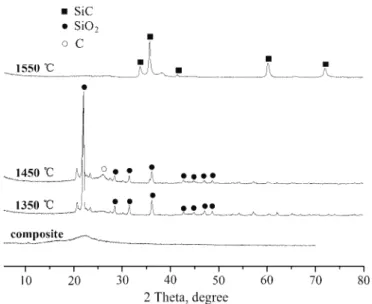
The XRD patterns of the wood flour–SiO2–phenolic composite and the
as-obtained products after sintering at different temperatures for 2 h are shown in Fig. 1. It can be seen that the broad peak centered at around 2θ = 23.4° is due to the overlap of the characteristic peak of cellulose centered at 2θ = 22.3° and the characteristic peak of amorphous SiO2 centered at 2θ = 23.8°.18 After thermal
treatment of wood flour–SiO2–phenolic composite at 1350 °C, no diffraction
peaks due to an SiC phase appeared, but many peaks of cristobalite were observed. Simultaneously, the high baseline suggests that a great deal of amor-phous carbon was present.15 After sintering at 1450 °C, the peak for graphite phases at 2θ = 26.4° was observed together with the peaks of cristobalite. On further increasing the sintering temperature to 1550 °C, the peaks of β-SiC at 2θ 35.3, 60.2 and 71.9° were observed in the diffraction pattern.19 In contrast, the
peaks due to cristobalite had nearly completely disappeared, indicating that the carbothermal reduction had occurred to form SiC.
FTIR Analysis
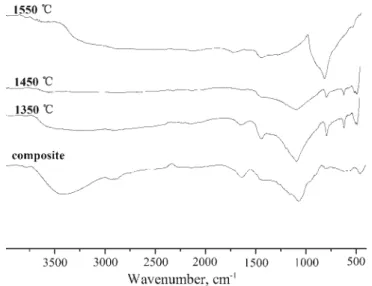
FTIR Spectra of the wood flour–SiO2–phenolic composite and its
corres-ponding products obtained at different sintering temperatures for 2 h are shown in Fig. 2. The absorption peak at 3420 cm−1 in the FTIR spectrum of wood flour–
–SiO2–phenolic composite is attributed to stretching vibrations of OH bonds in
the wood flour and the Si–OH bond in SiO2. The absorption bands at 2928 and
1636 cm–1 are attributed to the C–H stretching and C=C bending vibrations in
flour, respectively. The absorption band of stretching vibrations of C–O groups in the wood flour is at 1050 cm–1. The peaks at 1090, 790 and 460 cm−1 are
ascribed to the antisymmetric and symmetric stretching vibrations of Si–O–Si bond.20 When the composite was sintered at 1350 °C, the above-mentioned
peaks for wood significantly decreased or disappeared while the peaks ascribed to the Si–O–Si bond remained, suggesting that the wood was pyrolyzed to carbon, and condensation reaction in SiO2 was completed after sintering. After
sintering at 1450 °C, no new absorption peak appeared, indicating that carbo-thermal reduction still had not occurred. On further increasing the sintering tem-perature to 1550 °C, the peaks ascribed to Si–O bond disappeared and a new peak appeared at 820 cm−1, which is ascribed to the fundamental stretching vibrations of Si–C, suggesting that carbothermal reduction had occurred.21,22
FESEM Analysis
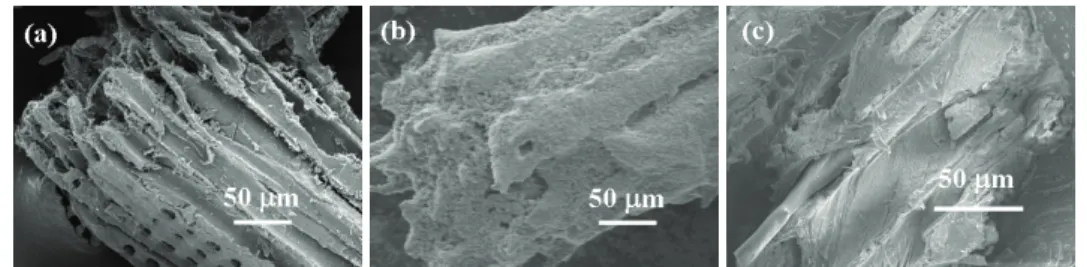
FESEM Images of the NaOH-treated wood flour and the wood flour–SiO2 composites are presented in Fig. 3. The fir wood, which is a softwood, is com-posed of unique cross-sectional constructed tracheid cells with bordered pits along their walls, which are channels to connect the different tracheid cells and enhance their connectivity. NaOH treatment can clean the surface of the flour, and enlarge the size of the pit pores. The highly uniform parallel tubular cellular structures and ordered arrays of bordered pits can be clearly observed in Fig. 3a. The pit pores at the tracheid walls are 10–15 μm in diameter. Such hierarchical structures can be maintained upon heating at an inert atmosphere due to the ordered semicrystalline cellulose networks. A wood flour–SiO2 composite was
formed on infiltration of the SiO2 precursor solution into the wood flour (Fig.
3b). It can be seen in Fig. 3b that the SiO2 covers the surface of flour and fills
almost all the pores of the tracheids and pits, suggesting that the SiO2 precursor solution penetrated the cell wall structures and condensed around the cellular tissues. As shown in Fig. 3c, the wood flour–SiO2–phenolic composite is
com-posed of a uniformly continuous matrix of phenolic resin and embedded wood flour–SiO2 composites, and the fine SiO2 fibers or rods appear in the tubular
pores of the wood flour.
Fig. 3. FESEM Micrographs of a) NaOH treated wood flour, b) wood flour–SiO2 composite
and c) wood flour–SiO2–phenolic composite.
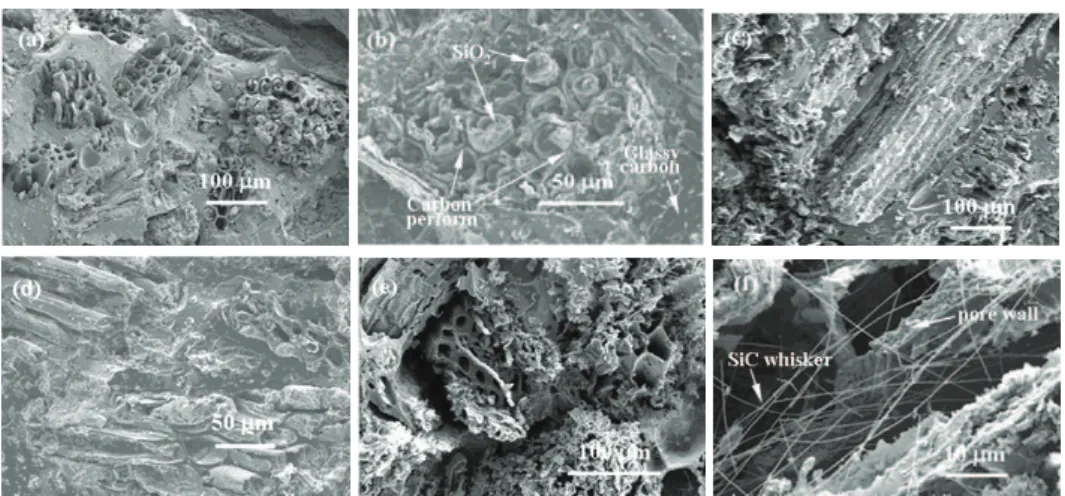
Fig. 4. FESEM Images of the products obtained by sintering the wood flour–SiO2–phenolic composite at 1350 (a and b), 1450 (c and d) and 1550 °C (e and f) for 2 h.
pores are completely and uniformly filled with SiO2 (Fig. 4b). By comparing
the wire-like whiskers.23,24 The selected-area electron diffraction (SAED) pat-tern shown in Fig. 6b indicates a high degree of crystallinity (β-SiC).25
Fig. 6. Typical transmission electron spectroscopy image of a) the SiC wire-like whisker in the pores of ceramics, b) the corresponding SAED pattern and c) the HRTEM image of the
wire-like whiskers.
Fig. 5. EDS Spectra of a) the SiC wire-like whisker in the pores of ceramics and b) the SiC necklace-like whiskers on the surface of ceramics (Au element arises from the conducting
The FESEM images of SiC whiskers grown on the surface of the porous SiC ceramics obtained at 1550 °C for 2 h are shown in Fig. 7. The low magnification SEM image shown in Fig. 7a displays that the most evident characteristic of the whiskers is the unique necklace-like morphology. As indicated by SEM images, most of the necklace-like whiskers are straight, hundreds of micrometers in length. Closer examination (Fig. 7b) of the whiskers indicates that the string of 1–2 μm in diameter is regularly decorated with numerous equally-sized beads. The uni-form beads are 3–5 μm in diameter. EDS analysis of the necklace-like whiskers indicated that the synthesized whiskers were composed of the elements Si and C in an atomic ratio close to 1:1, implying standard SiC (Fig. 5b). The structural details and the growth mechanism of the necklace-like SiC whiskers were inves-tigated in a previous study.26
Fig. 7. FESEM Images at different magnifications of the SiC necklace-like whiskers grown on the surface of the porous SiC ceramics obtained at 1550 °C for 2 h.
Mechanism of conversion of wood flour–SiO2–phenolic composites into SiC
ceramics and SiC whiskers
It is well known that the synthesis of β-SiC via the carbothermal reduction of silica (SiO2) is a vapor–solid (V–S) growth process, in which the following
reac-tion occurs:27,28
SiO2(s,l) + 3C(s) → SiC(s) + 2CO(g) (1)
The generally accepted mechanism for the overall reaction (1) is a multiple-step process that involves the formation of volatile SiO gas and its subsequent reduction to SiC.29,30
SiO2(s,l) + C(s) → SiO(g) + CO(g) (2)
SiO2(s) + CO(g) → SiO(g) + CO2(g) (3)
CO2(g) + C(s) → 2CO(g) (4)
SiO(g) + 2C(s) → SiC(s) + CO(g) (5)
The SiO gas obtained from reactions (2) and (3) reacts with C or CO to yield SiC through reactions (5) and (6). All these reactions can make a circle to con-tinue the synthesis process from the starting steps.
In the present work, at the reaction temperature, the SiO2 component is first
reduced by carbon from the wood flour and phenolic resin to generate gaseous SiO and CO according to reaction (2). Then the gaseous SiO reacts further with C to yield SiC nuclei heterogeneously on the surfaces of carbon through reaction (5). As the SiC nuclei are formed, SiC whiskers grow through the gas–gas reac-tion between SiO and CO according to reacreac-tion (6). In this work, the intercon-nected porous structures from wood flour after the initial carbothermal reduction could accelerate these reactions because these pores facilitate the diffusion of the formed gaseous SiO, CO and CO2. This suggests that, as the gaseous diffusion
path, the interpenetrating pores play an important role in the SiC synthesis pro-cess. As the reactions proceeds, the gaseous SiO molecules diffuse into carbo-naceous cell wall and react and the created SiC particles (reaction 5). Meanwhile, SiO and CO generate SiC whiskers in the free space through the gas–gas reaction (6). It should be noted that the wire-like whiskers grew in the pores of the porous SiC ceramics (Fig. 4f), and the necklace-like whiskers grew on the surface of the porous SiC ceramics (Fig. 7a). As is known, the vapor pressure inside the pores is higher than that on the outer surface of ceramic, suggesting that the vapor pres-sure affects the growth process of whiskers. Further work is required for a full understanding of the pressure effect.
CONCLUSIONS
A porous SiC ceramic with SiC whiskers was successfully synthesized by the carbothermal reduction at 1550 °C using a novel wood flour–SiO2–phenolic
composite as the precursor. The porous ceramic with pore diameters of 10–40 μm consisted of β-SiC located at the position of the former wood cell walls. The wire-like whiskers formed inside the pores showed highly ordered cubic SiC with a less than 50 nm diameter and several tens to over 100 μm in length. The neck-lace-like whiskers that grew on the surface with a length of up to hundreds of micrometers were composed of uniform β-SiC oriented in the (111) direction and stacking faults perpendicular to the [111] plane. The interconnected porous struc-tures from wood flour after initial carbothermal reduction play an important role in SiC synthesis process because those pores facilitate the diffusion of the gaseous SiO, CO and CO2.
И З В О Д
КОНВЕРЗИЈАФЕНОЛНОГКОМПОЗИТАДРВНИПРАХ–SiO2УПОРОЗНУ SiC
КЕРАМИКУСА SiC ВЛАКНИМА
HONG LI1, TIEJUN SHI2и DEXIN TAN1
1School of Chemical Engineering, Anhui University of Science & Technology, Huainan 232001, China и 2School of Chemical Engineering, Hefei University of Technology, Hefei 230009, China
Новифенолни композитдрвнипрах–SiO2 употребљенје за конверзијуупорозну
SiC керамику која садржи влакна SiC настала применом поступка карбо-термијске редукције. Натемпературиод 1550 °C композитјеконвертованупорозну SiC керамику са порамапречника 10–40 μm, гдеје SiC уположајуизворних зидова ћелија дрвета. Унутар пора се формирају β-SiC влакна облика жице мање од 50 nm у пречнику и дужине од неколико десетина до преко 100 µm. Површина добијене керамике је покривенавлакнимапречника 1–2 µm уобликуогрлице.
(Примљено 1. децембра 2012, ревидирано 5. фебруара 2013)
REFERENCES
1. P. Greil, T. Lifka, A. Kaindl, J. Eur. Ceram. Soc.18 (1998) 1961
2. T. Ota, M. Imaeda, H. Takase, M. Kobayashi, N. Kinoshita, T. Hirashita, H. Miyazaki, Y. Hikichi, J. Am. Ceram. Soc.83 (2000) 1521
3. A. Egelja, J. Gulicovski, A. Devecerski, B. Babić, M. Miljković, S. Bošković, B. Matović, J. Serb. Chem. Soc. 73 (2008) 745
4. G. Bantsis, M. Betsiou, A. Bourliva, T. Yioultsis, C. Sikalidis, Ceram. Int.38 (2012) 721 5. E. Vogli, J. Mukerji, C. Hoffman, R. Kladny, H. Sieber, P. Greil, J. Am. Ceram. Soc.84
(2001) 1236
6. B. H. Sun, T. X. Fan, D. Zhang, J. Porous Mater. 9 (2002) 275 7. Z. Li, T. Shi, L. Gao, J. Serb. Chem. Soc.75 (2010) 385
8. R. Dhiman, V. Petrunin, K. Rana, P. Morgen, Ceram. Int. 37 (2011) 3281
9. K. Vyshnyakova, G. Yushin, L. Pereselentseva, Y. Gogotsi, Int. J. Appl. Ceram. Technol. 3 (2006) 485
10. H. Sieber, C. Hoffmann, A. Kaindl, P. Greil, Adv. Eng. Mater.2 (2000) 105
11. T. Ota, M. Takahashi, T. Hibi, M. Ozawa, S. Suzuki, Y. Hikichi, H. Suzuki, J. Am. Ceram. Soc. 78 (1995) 3409
12. L. Esposito, D. Sciti, A. Piancastelli, A. Bellosi, J. Eur. Ceram. Soc.24 (2004) 533 13. Y. S. Shin, C. M. Wang, G. J. Exarhos, Adv. Mater.17 (2005) 73
14. A. Herzog, U. Vogt, O. Kaczmarek, R. Klingner, K. Richter, H. Thoemen, J. Am. Ceram. Soc. 89 (2006) 1499
15. J. M. Qian, Z. H. Jin, J. Eur. Ceram. Soc.26 (2006) 1311
16. R. Klingner, J. Sell, T. Zimmermann, A. Herzog, U. Vogt, T. Graule, O. Turner, F. Beckmann, B. Müller, Holzforschung57 (2003) 440
17. T. Hirose, B. Zhao, T. Okabe, M. Yoshimura, J. Mater. Sci.37 (2002) 3453 18. R. Dhiman, E. Johnson, P. Morgen
,
Ceram. Int.37 (2011) 375919. J. Locs, L. Berzina-Cimdina, A. Zhurinsh, D. Loca, J. Eur. Ceram. Soc.29 (2009) 1513 20. C.Martos, F. Rubio, J. Rubio, J. L. Oteo, J. Sol–Gel Sci. Technol.26 (2003) 511
21. S. Dhage, H. C. Lee, M. S. Hassan, M. S. Akhtar, C. Y. Kim, J. M. Sohn, K. J. Kim, H. S. Shin, O. B. Yang, Mater. Lett.63 (2009) 174
24. W. S. Seo, K. Koumoto, J. Am. Ceram. Soc.83 (2000) 2584 25. H. J. Choi, J. G. Lee, Ceram. Int.26 (2000) 7
26. Z. Li, T. Shi, D. Tan, J. Am. Ceram. Soc.93 (2010) 3499
27. A. Herzog, R. Klingner, U. Vogt, T. Graule, J. Am. Ceram. Soc. 87 (2004) 784 28. G. W. Meng, Z. Cui, L. D. Zhang, F. Phillipp, J. Cryst. Growth209 (2000) 801 29. J. M. Qian, J. P. Wang, Z. H. Jin, Mater. Sci. Eng., A371 (2004) 229