SOCIEDADE BRASILEIRA DE ORTOPEDIA E TRAUMATOLOGIA
w w w . r b o . o r g . b r
Original
Article
Translation
and
validation
of
the
new
version
of
the
Knee
Society
Score
–
The
2011
KS
Score
–
into
Brazilian
Portuguese
夽
Adriana
Lucia
Pastore
e
Silva
a,∗,
Alberto
Tesconi
Croci
b,
Riccardo
Gomes
Gobbi
a,
Betina
Bremer
Hinckel
a,
José
Ricardo
Pecora
a,
Marco
Kawamura
Demange
baUniversidadedeSãoPaulo,FaculdadedeMedicina,HospitaldasClínicas,InstitutodeOrtopediaeTraumatologia,SãoPaulo,SP,Brazil
bUniversidadedeSãoPaulo,FaculdadedeMedicina,DepartamentodeOrtopediaeTraumatologia,SãoPaulo,SP,Brazil
a
r
t
i
c
l
e
i
n
f
o
Articlehistory:
Received31July2016 Accepted4August2016 Availableonline6July2017
Keywords:
Knee
Kneearthroplasty Scale
Translation Questionnaires
a
b
s
t
r
a
c
t
Objective:Translation,culturaladaptation,andvalidationofthenewversionoftheKnee
SocietyScore–The2011KSScore–intoBrazilianPortugueseandverificationofits measure-mentproperties,reproducibility,andvalidity.In2012,thenewversionoftheKneeSociety Scorewasdevelopedandvalidated.Thisscalecomprisesfourseparatesubscales:(a) objec-tivekneescore(sevenitems:100points);(b)patientsatisfactionscore(fiveitems:40points); (c)patientexpectationsscore(threeitems:15points);and(d)functionalactivityscore(19 items:100points).
Method:Atotalof90patientsaged55–85yearswereevaluatedinaclinicalcross-sectional
study.Thepre-operativetranslatedversionwasappliedtopatientswithTKAreferral,and thepost-operativetranslatedversionwasappliedtopatientswhounderwentTKA.Each patientansweredthesamequestionnairetwiceandwasevaluatedbytwoexpertsin ortho-pedickneesurgery.Evaluationswereperformedpre-operativelyandthree,six,or12months post-operatively.Thereliabilityofthequestionnairewasevaluatedusingtheintraclass cor-relationcoefficient(ICC)betweenthetwoapplications.Internalconsistencywasevaluated usingCronbach’salpha.
Results:TheICCfoundnodifferencebetweenthemeansofthepre-operative,three-month,
andsix-monthpost-operativeevaluationsbetweensub-scaleitems.
Conclusion:TheBrazilianPortugueseversionofThe2011KSScoreisavalidandreliable
instrumentforobjectiveandsubjectiveevaluationofthefunctionalityofBrazilianpatients whoundergoTKAandrevisionTKA.
©2016SociedadeBrasileiradeOrtopediaeTraumatologia.PublishedbyElsevierEditora Ltda.ThisisanopenaccessarticleundertheCCBY-NC-NDlicense(http:// creativecommons.org/licenses/by-nc-nd/4.0/).
夽
StudyconductedatUniversidadedeSãoPaulo,FaculdadedeMedicina,HospitaldasClínicas,InstitutodeOrtopediaeTraumatologia, SãoPaulo,SP,Brazil.
∗ Correspondingauthor.
E-mail:[email protected](A.L.Silva).
http://dx.doi.org/10.1016/j.rboe.2016.08.020
Traduc¸ão
e
validac¸ão
da
nova
versão
da
escala
Knee
Society
Score
–
The
2011
KS
Score
–
para
a
língua
portuguesa
Palavras-chave:
Joelho
Artroplastiadojoelho Escala
Traduc¸ão Questionários
r
e
s
u
m
o
Objetivo:Traduzir,adaptarculturalmenteevalidaranovaversãodaescalaKneeSocietyScore
–The2011KSScore–paraalínguaportuguesaeverificarsuaspropriedadesdemedida,
reprodutibilidadeevalidade.Em2012,anovaversãodoKneeSocietyScorefoidesenvolvida evalidada,comquatrosubescalas:a)avaliac¸ãoobjetivadojoelho(seteitens:100pontos); b)satisfac¸ãodopaciente(cincoitens:40pontos);c)expectativadopaciente(trêsitens:15 pontos);ed)atividadefuncional(19itens:100pontos).
Método: Foramavaliados90pacientesentre55e85anosemestudoclínicotransversal.A
versãotraduzidapré-operatóriafoiaplicadaempacientescomindicac¸ãodeATJeaversão traduzidapós-operatóriafoiaplicadaempacientessubmetidosaATJ.Cadapaciente respon-deuomesmoquestionárioduasvezes,foramavaliadospordoisortopedistasespecialistas emcirurgiadojoelho.Foramfeitasavaliac¸õespré-operatóriascomtrês,seisou12meses depós-operatório.Aconfiabilidadedoquestionáriofoiavaliadaatravésdocoeficientede correlac¸ãointraclasse(CCI)entreasduasaplicac¸ões.Aconsistênciainternafoiavaliada atravésdoalfadeCronbach.
Resultados: Oíndicedocoeficientedecorrelac¸ãointraclassenãodetectoudiferenc¸aentre
asmédiasdasavaliac¸õesnopré-operatório,comtrêsmeseseseismesesdepós-operatório entreossubitensdaescala.
Conclusão: AversãobrasileiradoThe2011KSScoremostrou-seuminstrumentoválidoe
confiávelparaavaliac¸ãoobjetivaesubjetivadafunc¸ãodepacientesbrasileirossubmetidos aATJerevisãodeATJ.
©2016SociedadeBrasileiradeOrtopediaeTraumatologia.PublicadoporElsevier EditoraLtda.Este ´eumartigoOpenAccesssobumalicenc¸aCCBY-NC-ND(http:// creativecommons.org/licenses/by-nc-nd/4.0/).
Introduction
Inevidence-basedmedicine,itisnecessarytouse standard-izedandvalidatedscalestoassesstreatmentresults.Specific scaleshavebeendesignedforindividualswithkneeinjuries, allowingareproduciblestandardizedassessment.1
Theuseofquestionnairesasanassessmentparameteris useful,sinceitallowsthestandardizationandreproducibility oftheproposedmeasurements.2Thechoiceofanevaluation toolshouldprioritizethefollowingaspects:clearcomponents that allow simple application, ease of understanding, and properapplicationtime.3Whenaquestionnaireisprepared, itspropertiesneedtobetestedand validatedinagroupof patientssothattheycansubsequentlybeusedinpopulation groups.4
Thestandardization of translation and cultural adapta-tion methods allowed aninstrument developed foruse in one language and culture to also be used inanother lan-guageand culturalcontext,with adequate correspondence andreliability.5,6
Kneeosteoarthrosisisacommon pathology;in itslater stages,itcanbesurgicallytreatedwithtotalkneearthroplasty (TKA).7,8Duetothehighprevalenceofjointreplacement pro-cedures,variousevaluationsystemshavebeendevelopedto quantifytheresultsofsuchsurgeries.7
TheKneeSociety Scorecombines subjective and objec-tiveinformationandseparatesthekneescore(pain,stability, rangeofmotion)fromthepatient’sfunctionalscore(abilityto walkandclimbupanddownstairs).9
Recently,Scuderietal.10 developedandvalidatedanew versionoftheKneeSocietyScore,consistingoffourseparate subscales:(A)objectivekneescore(sevenitems:100points); (B)patientsatisfactionscore(fiveitems:40points);(C)patient expectationscore(threeitems:15points),and(D)functional activityscore(19items:100points).
Thisstudyaimedtotranslate,culturallyadapt,and vali-date the new version of the Knee Society Score (2011 KS Score) into Brazilian Portuguese and assess its measure-ment, reproduction, and validity properties, so it can be usedasaspecificinstrumentforpostoperativeassessmentof TKA.
Patients
and
methods
ThestudywasapprovedbytheResearchEthicsCommitteeof thisinstitution;allpatientsreceivedandsignedaninformed consentform.
Inacross-sectionalstudy,90patients(68womenand22 men)aged55–85yearsold(meanof64.65)wereassessed, fol-lowedbytheKneeSurgeryGroupwithanindicationforTKA orwhohadundergoneTKA.
Theinclusioncriteriawere:(a)agebetween55and85years; (b)bothgenders;(c)indicationforTKAorrevisionTKA;and (d)hadundergoneTKAorrevisionTKA.
TheKneeSociety,responsiblefortheoriginalscale, autho-rizedthetranslationandculturaladaptationofthescore.
ThenewversionoftheKSSconsistsofapatient classifi-cationsystemandfourseparatesubscales:(A)objectiveknee score(sevenitems:100points);(B)patientsatisfactionscore (fiveitems: 40 points); (C) patient expectation score (three items:15points)and(D)functionalactivityscore(19items: 100points).Theclassificationsystemseparatespatientsinto threecategories,dependingontheirmedicalstatus:(A) uni-lateralorbilateral(contralateralkneeoperatedsuccessfully); (B)unilateral–symptomaticcontralateralknee;(C)multiple arthritis.
ThenewversionoftheKSSwastranslatedinaccordance tothetranslation,culturaladaptation,andvalidationprotocol proposedbyGuilleminetal.:
1. Translation:TheitemsofthenewversionofKSSwere
ini-tiallytranslatedfromEnglishintoBrazilianPortugueseby two independent Brazilian sworn translators who were awareofthetranslation objectives;morethantheliteral translation,theconceptualtranslation was emphasized. Thetwotranslations were comparedby thetranslators, researchers,and researchadvisor,and aconsensuswas reachedonaBrazilianPortugueseversion.
2. Assessmentoftheinitialtranslation:theBrazilianPortuguese
version,called“EscoredaSociedadedoJoelho,”was back-translatedinto Englishby anative teacherwho did not participateinthetranslation;theresultwascomparedto theoriginalinstrumentbytheresearchparticipants.
3. Revision:thetranslationswerecomparedbya
multidisci-plinaryteamtoresolvethediscrepancies.
ThisprocessresultedinthefinalBrazilianPortuguese ver-sion.
4. Pre-test: Ten patients were submitted to the Brazilian
Portuguese questionnaire final version, followed by an interview with the evaluators, who asked the patients abouttheirsdoubtsduringthescoreassessment.Sample sizewascalculatedwith95%confidence,80%power,and 40%ofstandarddeviation.
5. Validation:thequestionnairewasappliedbytwo
indepen-dentevaluatorswithanintervalof30minbetweenthem; thedatawereanalyzedforinter-andintraobserver repro-ducibility.Theevaluationsweredonepreoperatively,and at3,6,or12monthspostoperatively.
ThenewversionoftheKSS(preoperative)wasappliedfor individualswithindicationforTKAorrevisionTKAby evalu-ator1and,after30min,byevaluator2.Thenewversionofthe KSS(postoperative)scalewasappliedinsubjectssubmitted toTKAorrevisionTKAafter3,6,or12monthsofthe surgi-calprocedureinthesamewaybythesameevaluators.The evaluatorsusedthemethoddescribedbyScuderietal.10
Theobserved values of the variables considered in the study were summarized in descriptive statistics as mean, standarddeviation(SD),minimum,median,andmaximum.
Thereproducibilityand interobserver agreementforthe objectivesubscaleandtheinterperiodforthesubjective sub-scales(symptoms,satisfaction,expectations,and activities) were assessed using the intraclass correlation coefficient (ICC).
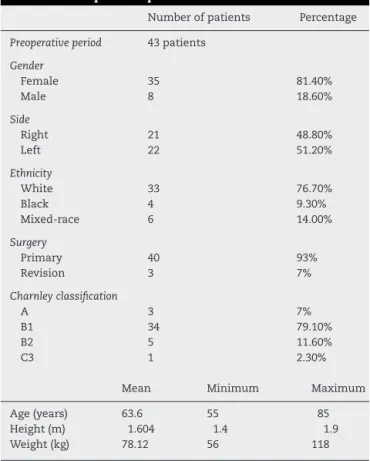
Table1–Preoperativepatientdata.
Numberofpatients Percentage
Preoperativeperiod 43patients
Gender
Female 35 81.40%
Male 8 18.60%
Side
Right 21 48.80%
Left 22 51.20%
Ethnicity
White 33 76.70%
Black 4 9.30%
Mixed-race 6 14.00%
Surgery
Primary 40 93%
Revision 3 7%
Charnleyclassification
A 3 7%
B1 34 79.10%
B2 5 11.60%
C3 1 2.30%
Mean Minimum Maximum
Age(years) 63.6 55 85
Height(m) 1.604 1.4 1.9
Weight(kg) 78.12 56 118
Theinternalconsistencybetweenthesubscaleswas eval-uatedusingCronbach’salphaindex.
Results
Table1presentsthedataregardinggender,side,ethnicity,type ofsurgery,Charnleyclassification,age,height,andweightof patientswithTKAindicationassessedusingthepreoperative versionofthescore.
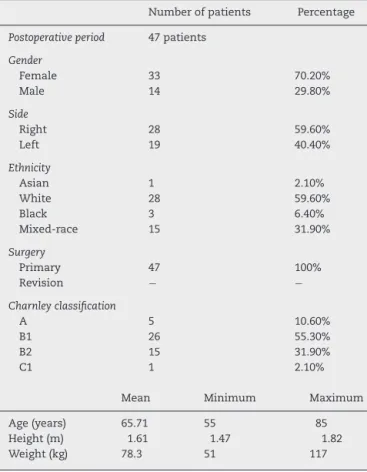
Table2presentsthedataregardinggender,side, ethnic-ity, typeofsurgery,Charnleyclassification,age,height,and weightofthepatientssubmittedtoTKAassessedbythe post-operativeversionofthescore.
Table3presentstheICCvaluesaccordingtotheevaluation periodandthesub-itemsofthescale(objective,symptoms, satisfaction,expectation,andactivities).
Table 4 shows the Cronbach’s alpha coefficient values according to the evaluation period and the sub-items of thescale(objective,symptoms,satisfaction,expectation,and activities).
Discussion
Table2–Datafrompatientsinthepostoperativegroup.
Numberofpatients Percentage
Postoperativeperiod 47patients
Gender
Female 33 70.20%
Male 14 29.80%
Side
Right 28 59.60%
Left 19 40.40%
Ethnicity
Asian 1 2.10%
White 28 59.60%
Black 3 6.40%
Mixed-race 15 31.90%
Surgery
Primary 47 100%
Revision − −
Charnleyclassification
A 5 10.60%
B1 26 55.30%
B2 15 31.90%
C1 1 2.10%
Mean Minimum Maximum
Age(years) 65.71 55 85
Height(m) 1.61 1.47 1.82
Weight(kg) 78.3 51 117
Table3–ICCresultsaccordingtotheevaluationperiod andthesub-itemsofthescale.
Preoperativeperiod Postoperativeperiod
Objective 0.931 0.839
(95%CI0.877–0.962) (95%CI0.729–0.907)
Symptoms 0.807 0.957
(95%CI0.672–0.891) (95%CI0.924–0.976)
Satisfation 0.879 0.967
(95%CI0.787–0.932) (95%CI0.941–0.981)
Expectation 0.949 0.906
(95%CI0.905–0.972) (95%CI0.838–0.946)
Activities 0.966 0.969
(95%CI0.937–0.981) (95%CI0.945–0.983)
Table4–ResultsofCronbach’salphacoefficient accordingtotheevaluationperiodandthesub-itemsof thescale.
Preoperative period
Postoperative period
Objective 0.663 0.435
Symptoms 0.312 0.762
Satisfaction 0.791 0.844
Expectation 0.728 0.854
Activity 0.508 0.78
results.1Oneofthemostwidelyusedscoreforthisevaluation istheKSS.
Thevalidation of the original KSS11 demonstrated how socio-culturaladaptationsare paramount, inorderto avail everyquestionofthetoolintheassessmentofTKA,tohelp monitor and treat post-operative conditions. Both the old
and new scoresattempt toquantifythe patient’s outcome after TKA surgery, through a score of 100 points forpain, alignment,stability,andrangeofmotion,andascoreof100 pointsforfunction.Themaindifferencesbetweenbothscores are the activitiesthat contributetothe functionscore, the weighting ofeach activity, and the new scales for patient expectationandsatisfaction.Thenewscoreisnotintended tobenumericallyrelatedtotheoldscore.Therefore,although thefirstversionofKSShadbeentranslatedandvalidated,the authorsconsidereditnecessarytovalidatethenewversion. Thisnewversion ofthescale hasalready beenadaptedto French.12
The translation process followed the guidelines recom-mended byGuilleminetal.,6 whichare widelyusedinthe process of translation and cultural adaptation of scores, includingtheearlierversionofKSS.Thismethodologymade theBrazilianPortugueseversionofthenewKSSfitforusein Brazilianpatientsandcanthusmeasureclinicaloutcomesand treatmentsinagivenmomentoralongfollow-up.
Regarding thesemanticvalidity,thetranslationand cul-tural adaptation of the new version of the KSS showed excellentsemanticandconceptualequivalenceaccordingto the resultsofthe interobserveranalysis;the entireprocess wasbasedonstudiesbyGuilleminetal.,6Duarteetal.,13Nigri etal.,14andCiconelli.15
Thepre-operativeandpostoperativeICC,0.931and0.839, respectively, demonstrate that the understanding of this subscale bythesurgeons wassimilar andadequate, there-fore being reproducible for other surgeons. The pre- and postoperative subjective subscales (symptoms,satisfaction, expectationsandactivities)alsoshowedagoodinter-period correlation,withlowestandhighestICCvaluesof0.807and 0.969,respectively.Thatis,patientshadasimilar understand-ingofthequestionnaireonthetwooccasionstheyanswered toit.
As observed in validation studies, it is important to perform,inadditiontothetranslation,asocio-cultural adap-tation(inthiscase,toBrazilianPortuguese),sothatthescale canbebetterevaluatedinthecountry.
InthetranslationandvalidationofthenewversionofKSS nochangesweremadeapartfromthetranslationitself.
Reliabilitywasassessedbyinternalconsistency,estimated byCronbach’salphacoefficient,foreachevaluationperiodand eachsub-itemofthescale.Thecontributionofeachitemtothe reliabilityofthedomainswasevaluated.Thisindexcanrange from0to1;thehigherthisvalue,thegreaterthereliabilityof thescale.16Allcorrelationsbetweentheitemsintheperiods werepositiveandsignificantlydifferentfromzero,which indi-catesthatitisreasonabletocomposeascalewiththeseitems becausetheymeasurethesameattribute:self-efficacy.
Theinter-observerreliabilityisshowninTable3,inwhich theapplicationsofthescalebythedifferentevaluatorswere compared. There is a clear indication that the correlation betweenthetwoobserverswashigh(>80%inallitems).
Conclusion
TheBrazilianversionofthe2011KSScorewasshowntobe aneasilyunderstoodandappliedtool,validandreliablefor objectiveandsubjectiveassessmentofthefunctionof Brazil-ianpatientsundergoingprimaryandrevisionTKA,aidingin bettermonitoringandevolutionofthissurgicalprocedure.
Conflicts
of
interest
Theauthorsdeclarenoconflictsofinterest.
Acknowledgments
TotheKneeSocietyforauthorizingthestudy.
r
e
f
e
r
e
n
c
e
s
1. DemirdjianAM,PetrieSG,GuancheCA,ThomasKA.The outcomesoftwokneescoringquestionnairesinanormal population.AmJSportsMed.1998;26(1):46–51.
2. LevineDW,SimmonsBP,KorisMJ,DaltroyLH,HohlGG,Fossel AH,etal.Aself-administeredquestionnaireforthe
assessmentofseverityofsymptomsandfunctionalstatusin carpaltunnelsyndrome.JBoneJointSurgAm.
1993;75(11):1585–92.
3. BellMJ,BombardierC,TugwellP.Measurementoffunctional status,qualityoflife,andutilityinrheumatoidarthritis. ArthritisRheum.1990;33(4):591–601.
4. deCamposCC,ManzanoGM,deAndradeLB,CasteloFilhoA, NóbregaJA.Translationandvalidationofaninstrumentfor evaluationofseverityofsymptomsandthefunctionalstatus incarpaltunnelsyndrome.ArqNeuropsiquiatr.
2003;61(1):51–5.
5.FernandesMI.Traduc¸ãoevalidac¸ãodoquestionáriode qualidadedevidaespecíficoparaosteoartroseWomacparaa línguaportuguesa.SãoPaulo:UniversidadeFederaldeSão Paulo;2003.Dissertac¸ão.
6.GuilleminF,BombardierC,BeatonD.Cross-cultural adaptationofhealth-relatedqualityoflifemeasures: literaturereviewandproposedguidelines.JClinEpidemiol. 1993;46(12):1417–32.
7.HeckDA,RobinsonRL,PartridgeCM,LubitzRM,FreundDA. Patientoutcomesafterkneereplacement.ClinOrthopRelat Res.1998;(356):93–110.
8.FortinPR,ClarkeAE,JosephL,LiangMH,TanzerM,FerlandD, etal.Outcomesoftotalhipandkneereplacement:
preoperativefunctionalstatuspredictsoutcomesatsix monthsaftersurgery.ArthritisRheum.1999;42(8):1722–8.
9.InsallJN,DorrLD,ScottRD,ScottWN.RationaleoftheKnee Societyclinicalratingsystem.ClinOrthopRelatRes. 1989;(248):13–4.
10.ScuderiGR,BourneRB,NoblePC,BenjaminJB,LonnerJH, ScottWN.ThenewKneeSocietyKneeScoringSystem.Clin OrthopRelatRes.2012;470(1):3–19.
11.SilvaALP,DemangeMK,GobbiRG,SilvaTFC,PecoraJR,Croci AT.Traduc¸ãoevalidac¸ãodaescalaKneeSocietyScore–KSS paraalínguaportuguesa.ActaOrtopBras.2012;20(1):25–30.
12.DebetteC,ParratteS,Maucort-BoulchD,BlancG,PaulyV, LustigS,etal.FrenchadaptationofthenewKneeSociety ScoringSystemfortotalkneearthroplasty.OrthopTraumatol SurgRes.2014;100(5):531–4.
13.DuarteOS,MiyazakiMCO,CiconelliRM,SessoR.Traduc¸ãoe adaptac¸ãoculturaldoinstrumentodeavaliac¸ãodequalidade devidaparapacientesrenaiscrônicos.RevAssocMedBras. 2003;49(4):375–81.
14.NigriPZ,PeccinMS,AlmeidaGJM,CohenM.Traduc¸ão, validac¸ãoeadaptac¸ãoculturaldaescaladeatividadedevida diária.ActaOrtopBras.2007;15(2):101–4.
15.CiconelliRM.Medidasdeavaliac¸ãodequalidadedevida.Rev BrasReumatol.2003;43:9–13.