Association between housework
overload and common mental
disorders in women
Associação entre sobrecarga
doméstica e transtornos mentais
comuns em mulheres
Paloma de Sousa Pinho
ITânia Maria de Araújo
III Universidade Federal do Recôncavo da Bahia
II Universidade Estadual de Feira de Santana
Financiamento: FAPESB - ET 71/ 2004 / Processo n. 1431040053314
Correspondência: Tânia Maria de Araújo. Universidade Estadual de Feira de Santana, Programa de Pós-Graduação em Saúde Coletiva, Núcleo de Epidemiologia, Km 03 - Br 116 - Campus Universitá-rio, CEP 44031-460 Feira de Santana, Bahia, Brasil. E-mail: [email protected]
Abstract
Introduction: Common mental disorders (CMD) are more frequent in women. Low reward and lack of visibility in performing housework are the determining factors for these psychological illnesses. Objectives: To evaluate the association between house-work overload and the occurrence of com-mon mental disorders in women living in the urban zone of the municipality of Feira de Santana, Bahia. Methods: cross-sectional epidemiological study that included 2,057 women aged 15 years or over selected by random sampling in clusters. The house-work overload indicator was created from the domestic activities of washing, ironing, cleaning and cooking, weighted according to the number of individuals living in the home. The common mental disorders were assessed using SRQ-20. Results: Women with a high housework overload had a high-er prevalence of CMD than women with a low overload (45.6% versus 36.2%). Multiple logistic regression analysis confirmed the association between housework overload and CMD (PR: 1.23; 95% CI: 1.05 – 1.44), adjusted for income, level of schooling and leisure activities. Conclusion: The findings support the hypothesis that high house-work overload is associated with mental disorders.
Resumo
Introdução: Os Transtornos Mentais Comuns (TMC) acometem mais frequent-emente as mulheres. A baixa gratificação e a falta de visibilidade na realização do trabalho doméstico constituem quadro determinante para esse adoecimento psíquico. Objetivos: Avaliar a associação entre sobrecarga doméstica e a ocorrên-cia de transtornos mentais comuns em mulheres da zona urbana do município de Feira de Santana - BA. Metodologia: Estudo epidemiológico de corte transver-sal incluindo 2.057 mulheres com 15 anos ou mais de idade, selecionadas através de amostragem aleatória por conglomerado. O indicador de sobrecarga doméstica foi criado a partir das atividades domésticas: lavar, passar, limpar e cozinhar, ponderadas pelo número de moradores do domicílio. Os transtornos mentais comuns foram avaliados através do SRQ-20. Resultados: Mulheres com alta sobrecarga doméstica apresentaram prevalência de TMC mais elevada do que as mulheres com baixa so-brecarga: 45,6% contra 36,2%. A análise de regressão logística múltipla confirmou as-sociação entre sobrecarga doméstica e TMC (RP: 1,23; IC95%: 1,05 – 1,44), ajustada pelas variáveis renda, escolaridade e atividades de lazer. Conclusão: Os achados sustentam a hipótese de que o trabalho doméstico, em elevada sobrecarga, está associado a trans-tornos mentais.
Palavras-chave: Trabalho doméstico.
Sobrecarga doméstica. Mulher. Transtorno mental comum. Saúde mental. SRQ-20.
Introduction
Studies indicate an increase in psycho-logical morbidity among the most diverse populations. Among all mental disorders, Common Mental Disorders (CMD) have become more noticeable, especially among women. Common Mental Disorders are characterized by symptoms such as fatigue, forgetfulness, insomnia, irritability, difficul-ty in concentrating, headaches and psycho-somatic complaints1. Such disorders affect
people´s regular functioning, by impairing their performance not only in their family, social and personal life, but also at work2.
Women have considerably shown more symptoms of psychological distress and depressive disorders than men do3,4,5,6.
Women´s most frequent nuisances are the ones related to symptoms of anxiety, depressive mood, sleeplessness, anorexia nervosa, and psychophysiological symp-toms. Men, on the other hand, have higher rates of behavioral disturbs like being anti-social, using drugs and overusing alcoholic beverages.
Women’s inclusion in the job market, unlike men’s, is limited by their domestic and family responsibilities, in a way that their job must be adapted to their other roles7. Hence, whether they are included or
not in the job market, in general, women are housewives and do chores which, despite being essential for everyone’s well-being and survival, are socially undervalued and disregarded.
In the 1970s and 1980s, studies to iden-tify chores done in the home environment began to be conducted. Such research aimed to characterize the amount of housework, especially the ones performed by women8. During this period of time,
in the private ambience. In this debate, it is questioned the statute of domestic tasks as economic inactivity and as an exclusively female responsibility, representing thus an inevitable overload9. In this sense, the
foundations of gender division in the work-place are also debated, through which men’s responsibility is productive (paid) work, whereas women’s is reproductive work, whose economic function is omitted.
Albeit this was such a heated debate in the 1970s and 1980s, it remained practically absent from the scientific production in the 1990s. In spite of the fact that this issue has been raised again in recent years, it is a little studied subject, especially with regards to the repercussions in the health of women – who keep being mostly responsible for household chores10.
Studies 3,11 are highlighted among the
researches on the relationship between domestic and professional work and men-tal health. In a study comparing maids and housewives, it was possible to observe that distinctive factors led to mental ill-ness and also rewards between these two sorts of occupations, although both groups experimented, on average, similar levels of depressive symptoms11.
Routinization, depreciation and con-stant interruptions of tasks stood out among the aspects concerning domestic work linked with depressive, anxious or psycho-somatic symptoms.
It is also pointed out that life cycle fac-tors like age, marital status and number of children, the head of the household and lei-sure as well as the heavy non-paid workload carried out by women such as the double shift and the work of looking after the family, associated with emotional components may intensify psychological distress among the female population.
The assessment of mental disorders in women is important for the adequate mea-surement and understanding of the factors associated with their occurrence, with an emphasis on housework. This present study aimed to examine the association between housework overload and the occurrence of
common mental disorders in women liv-ing in urban areas of the state of Bahia, in Brazil. The diagnosis originating from the assessment made in this study can provide relevant information to guide mental health intervention policies, thus contributing to the reduction or prevention of such health problems besides giving visibility to factors that, within the household chores, can con-tribute to women’s mental illness.
Materials and Methods
A cross-sectional epidemiological study was conducted in the urban area of the city of Feira de Santana, BA, Brazil, including a representative sample of women, from 15 years old on, selected by random cluster sampling and stratified by sub-district.
According to the IBGE (Brazilian Institute of Geography and Statistics)13, Feira de
Santana is subdivided into five sub-districts; each one divided into census tracts which include street clusters. Initially, a survey of population data from each sub-district was conducted, along with a geographical de-limitation of each area13. A random census
tract selection was subsequently performed in each sub-district. All households on the randomly selected streets were visited and all women at 15 years old or over were con-sidered to be eligible for this study.
In order to calculate the size of the sam-ple it taken into consideration an estimated prevalence of mental disorders of 24% in academic studies14, sample error of 3%,
of 35.2% in the non-exposed group, CMD frequency of 45.6% in the exposed group, reliability level of 95% and power of 90%, comprising thus, 1,086 women.
A total of 2,057 women have been as-sessed for the study of domestic overload and mental health. All of them live in the 1,479 houses previously selected for the study of five sub- districts in the urban area of the municipality of Feira de Santana. There was a seventy-two-percent-response rate.
Two instruments have been used at the moment of collecting data: a household record (including general information about the household) and an individual questionnaire (including information about socio-demographic aspects, living condi-tions, housework, professional work and mental health).
The “Household Overload” (HO) (inde-pendent variable) was measured by adding up household chores: washing, ironing, cleaning, cooking) weighed by the number of dwellers, except for the interview itself, through the formula: HO = (Σ washing+iro ning+cleaning+cooking) x (M-1)15.
For the purpose of analysis, the score of the variable “housework overload” was divided, at first, into three groups: high, average and low overload. Afterwards, the “housework overload” variable was dichoto-mized into two groups: high housework overload and low housework overload (it included women who did not perform do-mestic chores or did so moderately).
Mental Common Disorders (MCD) (de-pendent variable) have been assessed using the Self-Reporting Questionnaire (SRQ-20). The SRQ-20 is an instrument recommended by the World Health Organization (WHO)16
to be used in developing countries and it has been effective to track and detect common mental disorders.
A validation study of the SRQ-20 has been conducted in the population of this study, finding the cut-off point of best per-formance for women in 7 or more positive responses, which had a sensitivity of 68.0% and specificity of 70.7% . The area under the
ROC curve showed a value of 0.789 with a standard deviation of 0.48 and the 95% con-fidence interval ranging from 0.696 to 0.882 indicating, thus, a reasonable level of dis-crimination between cases and non-cases. The co-variable which have been ana-lyzed were: socio-demographic character-istics (neighborhood, age, schooling, migra-tion, skin color/ethnicity, marital status), professional work (occupation and working in double shift) and living conditions (in-come, head of the household, leisure time activities, housing conditions, infrastructure and ownership of durable goods).
The “housing condition” variable was assessed through an indicator that included data on the number of rooms in the house, number of rooms used for sleeping and the number of household residents. The infrastructure was studied taking into con-sideration access to tap water and electric light as well as “ownership of durable goods” according to the indicator built based on the addition of owning appliances like: stereo system radio, television, fridge and washing machine. Such indicators were grouped into three categories: good, average and poor.
The database was constructed with the statistical software called “Social Package for the Social Sciences – (SPSS)”, version 10.0. Epi Info software, version 6.0, and the “R” The R Foundation for Statistical Computing software, version 2.2.1, were also used in data analysis.
Initially, the analysis was done with the characterization of the population studied. Then stratified analysis was performed to identify possible effect modifiers and con-founders. When confirmed the existence of confounding, the effect measures were adjusted by the Mantel-Haenszel method.
Multiple logistic regression analysis (MLRA) was subsequently performed to simultaneously evaluate the variables studied. This approach is suitable to find the most appropriate model, parsimonious and biologically reasonable to describe the relationship between a dependent variable and a set of independent variables17.
according to the procedures recommended in studies18, and it included the following
stages: 1st) Selection of variables based on
the study objectives and studies review; 2nd) Verification of model assumptions; 3rd)
Pre-selection of variables to be included in the analysis with the verisimilitude ratio test by adopting a p value≤0.25; 4th) Analysis of
change in effect, with the introduction of product terms and the use of the maximum verisimilitude test to compare the complete model; 5th) Variables confounding
analy-sis (except for those confirmed as effect modifiers in the main model), comparing measures of association and respective confidence intervals of the complete model resulting from the removal of each potential confounder; 6th) MLRA, per se,
using the backward procedure, adopting a significance criterion of p<0.10 for variables to remain in the final model.
Considering the fact that the CMD prevalence in the population studied was high and further away from the estimated odds ratio (OR) parameters, researchers cal-culated the prevalence ratio (PR) estimates and their respective confidence levels of 95%, using the Delta method procedures (Oliveira et al., 1997).
This research project was submitted to the Hospital São Rafael (São Rafael Hospital) Research Ethics Committee in Salvador, BA, being subsequently approved (Research Project no. 17/01).
Results
Among the women studied (N=2,057), there was a prevalence of younger women aged between 15 and 30 years old (44.0%), married or in steady relationships (46.7%), with a low level of education (13.0% were illiterate and 44.2% had only completed their primary education) and low income (18.6% earned up to ½ a minimum wage and 39.2% earned up to one minimum wage). With regards to occupation, 28.9% were housewives, 11.6% were unemployed and approximately 30% reported having paid work. Among these women, 67.6% had an
informal working relationship (thus without any type of social security or labor law).
Approximately 90.0% performed house-work every day; A relevant number of women (45.1%) did not have any regular leisure time activities.
Housework overload assessment in women
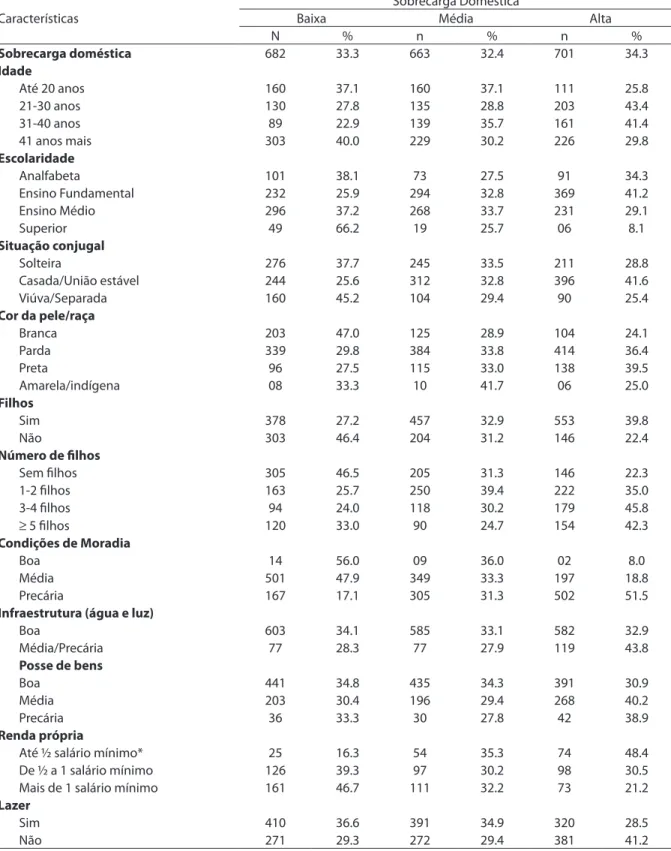
Heavy housework overload was found in 34.3% of the women studied.
Heavy domestic overload was substan-tially higher in women who were in the 21-to-30-year-old and in the 31-to-40-year age groups (43.4% and 41.4%, respectively), those who had a primary level of education (41.2%), among the married or in steady relationships (41.6%) and black women (39.5%). Among women who had children, 39.8% had heavy housework overload, com-pared to 22.4% of those who did not have children. This percentage increased with the rise in the number of children: 35.0% in women with up to two children and 45.8% in those with three or four children.
Housework overload increased with the worsening of housing conditions: among women who reported living in good hous-ing conditions, 56.0% had a low housework overload; and among those who lived in low housing conditions, 17.1% had a low work overload and 51.5% had a high house-work overload. Of all women who lived in homes with average or poor infrastructure, 43.8% reported having a high housework overload, compared to 32.9% of those who had good infrastructure.
Table 1– Distribution of housework overload according to sociodemographic characteristics and living conditions among women. Feira de Santana, 2002.
Tabela 1 – Distribuição da sobrecarga doméstica segundo características sociodemográicas e condições de vida das mulheres. Feira de Santana, 2002.
Características
Sobrecarga Doméstica
Baixa Média Alta
N % n % n %
Sobrecarga doméstica 682 33.3 663 32.4 701 34.3
Idade
Até 20 anos 160 37.1 160 37.1 111 25.8
21-30 anos 130 27.8 135 28.8 203 43.4
31-40 anos 89 22.9 139 35.7 161 41.4
41 anos mais 303 40.0 229 30.2 226 29.8
Escolaridade
Analfabeta 101 38.1 73 27.5 91 34.3
Ensino Fundamental 232 25.9 294 32.8 369 41.2
Ensino Médio 296 37.2 268 33.7 231 29.1
Superior 49 66.2 19 25.7 06 8.1
Situação conjugal
Solteira 276 37.7 245 33.5 211 28.8
Casada/União estável 244 25.6 312 32.8 396 41.6
Viúva/Separada 160 45.2 104 29.4 90 25.4
Cor da pele/raça
Branca 203 47.0 125 28.9 104 24.1
Parda 339 29.8 384 33.8 414 36.4
Preta 96 27.5 115 33.0 138 39.5
Amarela/indígena 08 33.3 10 41.7 06 25.0
Filhos
Sim 378 27.2 457 32.9 553 39.8
Não 303 46.4 204 31.2 146 22.4
Número de ilhos
Sem ilhos 305 46.5 205 31.3 146 22.3
1-2 ilhos 163 25.7 250 39.4 222 35.0
3-4 ilhos 94 24.0 118 30.2 179 45.8
≥ 5 ilhos 120 33.0 90 24.7 154 42.3
Condições de Moradia
Boa 14 56.0 09 36.0 02 8.0
Média 501 47.9 349 33.3 197 18.8
Precária 167 17.1 305 31.3 502 51.5
Infraestrutura (água e luz)
Boa 603 34.1 585 33.1 582 32.9
Média/Precária 77 28.3 77 27.9 119 43.8
Posse de bens
Boa 441 34.8 435 34.3 391 30.9
Média 203 30.4 196 29.4 268 40.2
Precária 36 33.3 30 27.8 42 38.9
Renda própria
Até ½ salário mínimo* 25 16.3 54 35.3 74 48.4
De ½ a 1 salário mínimo 126 39.3 97 30.2 98 30.5
Mais de 1 salário mínimo 161 46.7 111 32.2 73 21.2
Lazer
Sim 410 36.6 391 34.9 320 28.5
Não 271 29.3 272 29.4 381 41.2
activities, 36.6% had a low housework over-load, as opposed to 28.5% of those who did not practice any entertainment activities. The situation was reversed when women without regular leisure time activities were taken into consideration: 29.2% among women with a low housework overload and 41.2% among those with a high housework overload, revealing a decrease in these activities as the level of responsibility for domestic tasks increased.
Association among Housework Overload, and Common Mental Disorders
It was noticed a statistically significant positive linear association between house-work overload and common mental disor-ders (χ2=15.909; p<0.0001): the higher the
housework overload, the higher the CMD prevalence.
Sociodemographic characteristics (age, education, migration, skin color, marital status and having children) revealed no sta-tistical interaction with the main association evaluated here (OH and CMD). Nonetheless, some features of living conditions, domestic work and professional work showed statisti-cal interaction.
Among the variables related to living conditions, only the ownership of durable goods was an effect modifier of the main association investigated (TABLE 2).
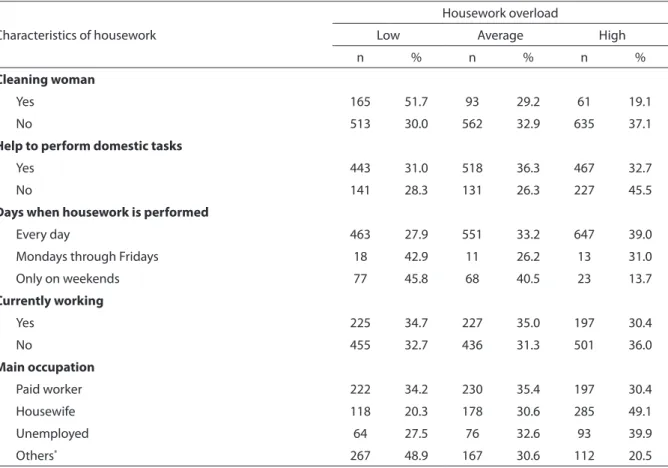
A few characteristics of household chores stressed the effect upon domestic overload regarding mental disorders: not receiving help to perform domestic tasks and having to do such chores from Monday
Table 2 – Distribution of housework overload according to characteristics of domestic and professional work among women. Feira de Santana, 2002.
Tabela 2 – Distribuição da sobrecarga doméstica segundo características do trabalho doméstico e proissional entre as mulheres. Feira de Santana, 2002.
Characteristics of housework
Housework overload
Low Average High
n % n % n %
Cleaning woman
Yes 165 51.7 93 29.2 61 19.1
No 513 30.0 562 32.9 635 37.1
Help to perform domestic tasks
Yes 443 31.0 518 36.3 467 32.7
No 141 28.3 131 26.3 227 45.5
Days when housework is performed
Every day 463 27.9 551 33.2 647 39.0
Mondays through Fridays 18 42.9 11 26.2 13 31.0
Only on weekends 77 45.8 68 40.5 23 13.7
Currently working
Yes 225 34.7 227 35.0 197 30.4
No 455 32.7 436 31.3 501 36.0
Main occupation
Paid worker 222 34.2 230 35.4 197 30.4
Housewife 118 20.3 178 30.6 285 49.1
Unemployed 64 27.5 76 32.6 93 39.9
Others* 267 48.9 167 30.6 112 20.5
* estudante, aposentada, afastada por motivo de doença ou vivendo de rendas
through Friday or every day, being, thus, effect modifiers of the main association (TABLE 3).
In relation to professional work, the job at the moment of the search was a modifying variable in the association between domes-tic overload and CMD.
All in all, the factors which showed sta-tistics interaction, in the stratified analysis, were: poor possession of durable goods, having no assistance when doing the chores, performing household activities from 5 up to 7 days a week and the type of occupation.
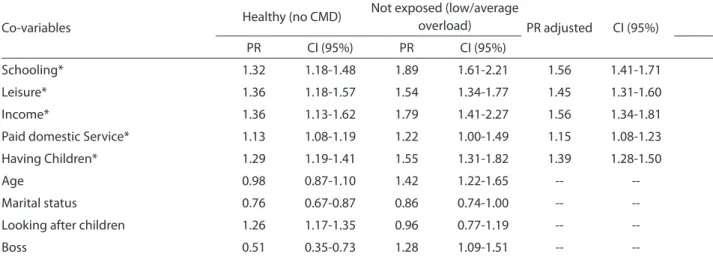
Thus, after removing the opportunity to interact with the other variables were analyzed for the presence of confounding in the main association. Potential confounders have been confirmed: education, leisure, income, paid domestic work and presence of children. (TABLE 4).
The adjustment for education, leisure, income, paid domestic work and having children, co-variables identified as con-founders, did not change the direction of the association under analysis: the association between domestic workload and common mental disorders remained positive at levels statistically significant (TABLE 4).
Logistic regression analysis enabled the simultaneous assessment of effect modifiers concerning housework overload and common mental disorders among women. However, the presence statistical
association has not confirmed in the mod-eling: the term-products assessed did not remain in the final model.
In addition to the main independent variable (housework overload), the follow-ing covariables remained in the final model: level of education, income and leisure time activities, revealing the relevance of these variables in CMD prevalence, simi-larly to what was observed with housework overload.
For analysis of confounding, with the removal of each co-variable selected, the effect on the main association investigated has been evaluated. Thus, the variables: schooling, monthly income and leisure were potential confounders for the asso-ciation between domestic workload and common mental disorders among women. The main association investigated remained at statistically significant levels, even after adjustment by all confounding co-variables (TABLE 4).
Afterwards, the calculation of prevalence ratios (PR) of the model variables was pro-ceeded. At the end, the analysis revealed that women exposed to high domestic work-load had a greater prevalence of common mental disorders (1.23 times) than women in situations of low to average domestic workload (TABLE 5).
The measure of association and the level of statistical significance obtained after
Graphic 1 – Prevalence (%) of CMD according to housework overload among women, Feira de Santana, 2002.
Table 3 – Stratiied analysis to assess efect modiiers for the association between housework overload and common mental disorders according to living conditions. Feira de Santana, 2002.
Tabela 3 – Análise estratiicada para avaliação de modiicadores de efeito para a associação entre sobrecarga doméstica e transtornos mentais comuns segundo condições de vida. Feira de Santana, 2002.
Co-variable N PR CI 95%
Not adjusted 2057 1.26 1.13-1.40
Housing conditions
Increased# 1076 1.13 0.88-1.69
Basic# 981 1.28 1.11-1.49
Ownership of durable goods*
Increased 1945 1.30 1.16-1.46
Basic 108 0.79 0.56-1.10
Infrastructure
Increased 2045 1.26 1.13-1.40
Basic 8 0.83 0.12-5.72
Leisure time activities
Yes 1129 1.23 1.03-1.47
No 927 1.17 1.02-1.33
Head of the household
Yes 331 1.26 0.99-1.62
No 1691 1.31 1.16-1.48
Income
Up to one minimum wage** 476 1.23 1.03-1.48
More than one minimum wage 347 1.30 0.88-1.91
* Interação estatística / * Statistical interaction
** salário mínimo U$ 87,00 / ** minimum wage of US$87.00
# Ampliada (boa/média)/Básica (precária) / # Expanded (good/average)/Basic (precarious)
Table 4 – Stratiied analysis on the association between housework overload and common mental disorders according to characteristics of domestic and professional work. Feira de Santana, 2002.
Tabela 4 – Análise estratiicada da associação entre sobrecarga doméstica e transtornos mentais comuns segundo características do trabalho doméstico e trabalho proissional. Feira de Santana, 2002.
Co-variable N PR CI 95%
Not adjusted 2057 1.26 1.13-1.40
Has a cleaning woman
Yes 319 1.12 0.76-1.66
No 1710 1.25 1.12-1.40
Cares for children
Yes 936 1.20 1.04-1.40
No 230 1.20 0.85-1.69
Receives help to perform housework
Yes 1428 1.37 1.20-1.57
No 499 1.05 0.88-1.27
Days when housework is performed
Only on weekends 168 1.23 1.10-1.38
From ive to seven days per week 1703 2.10 1.34-3.29
Occupation
Works out of the home 649 1.57 1.29-1.93
Others* 1360 1.12 0.98-1.27
simultaneous adjustment for all confound-ing co-variables in logistic regression analy-sis did not change, substantially, the main findings of the association when compared to the analysis without adjustment.
Once the final model was obtained, their goodness-of-fit to the data was analyzed through the Hosmer and Lemeshow17 test.
ROC curve and analysis of the patterns of the co-variables.
The hypothesis that the model did not provide a good fit to the data was rejected (the Hosmer-Lemeshow test showed a p value=0.497). The area of the ROC curve was 0.697.
In this way, the model provided good fit to the data. Co-variable pattern analysis was
subsequently conducted, assessing whether the extreme observations found were influ-ential. The comparison between the models with and without observations showed little influence, without significant changes in the coefficients obtained. Consequently, the model provided good fit to the data.
Discussion
This investigation revealed high overall prevalence of CMDs among women (ap-proximate ratio of 4 women affected out of 10 women studied), which reveals a serious health problem in the population studied, especially when compared to the estimate of the World Health Organization (2000)
Table 5 – Housework overload and common mental disorders according to confounding covariables and adjustments. Feira de Santana, 2002.
Tabela 5 – Sobrecarga doméstica e transtornos mentais comuns segundo co-variáveis confundidoras e seus respectivos ajustamentos. Feira de Santana, 2002.
Co-variables Healthy (no CMD)
Not exposed (low/average
overload) PR adjusted CI (95%)
PR CI (95%) PR CI (95%)
Schooling* 1.32 1.18-1.48 1.89 1.61-2.21 1.56 1.41-1.71
Leisure* 1.36 1.18-1.57 1.54 1.34-1.77 1.45 1.31-1.60
Income* 1.36 1.13-1.62 1.79 1.41-2.27 1.56 1.34-1.81
Paid domestic Service* 1.13 1.08-1.19 1.22 1.00-1.49 1.15 1.08-1.23
Having Children* 1.29 1.19-1.41 1.55 1.31-1.82 1.39 1.28-1.50
Age 0.98 0.87-1.10 1.42 1.22-1.65 --
--Marital status 0.76 0.67-0.87 0.86 0.74-1.00 --
--Looking after children 1.26 1.17-1.35 0.96 0.77-1.19 --
--Boss 0.51 0.35-0.73 1.28 1.09-1.51 --
--* Presença de confundimento / * Presence of confounding factor
Table 6–Adjusted prevalence ratios, conidence intervals (95%) and p value for the association between housework overload and common mental disorders (TMC), and for confounding covariables. Feira de Santana, 2002.
Tabela 6 - Razões de prevalência ajustada, intervalos de coniança (95%) e valor p para associação entre sobrecarga doméstica e transtornos mentais comuns (TMC) e para as co-variáveis
confundidoras. Feira de Santana, 2002.
Variable RP CI 95% P value
Housework overload 1.23 1.05-1.44 0.028
Level of education 1.58 1.34-1.88 0.000
Leisure time activities 1.53 1.31-1.78 0.000
which refers to an average prevalence of 24% in the population. Other Brazilian studies also found high prevalence of mental disor-ders among women ranged from 24.9% to 45.0%4,10,19-22. Likewise, internationally, the
prevalence ranged from 27.0% in Santiago (Chile) to 18.0% in Great Bretanha23. These
data indicate that women need special at-tention with regard to the promotion and protection of their mental health, encour-aging discussion about the inclusion in public social and policies in issues related to gender.
After statistical modeling, low educa-tion, low income and lack of regular leisure activities were characterized as potential confounders in the association between domestic workload and common mental disorders. It is worth noting in this inves-tigation that the care of children, empiri-cally considered to be a factor that worsens housework overload, did not reveal signifi-cant differences.
To explain these findings, an important question emerges: poverty and matters related to it. There is a complex and multi-dimensional relationship between poverty and mental health. Studies14 discuss this
relationship and shows that poverty, along with associated factors, such as: lack of health services, poor education, unemploy-ment and social inequalities can create in-surmountable barriers to health care, since the difference of treatment for most mental disorders, which is already high, actually shows really huge for the poorer people. Resources for mental health care are rarely available for the lower walks of life and few professionals are skilled and prepared to receive, recognize and treat such disorders. Findings of the present study reveal that women with a high housework overload who received up to one minimum wage per month had a higher prevalence of CMD, when compared to those who received more than one minimum wage. Low-income individuals have more financial concerns than those with a higher per capita income, which leads to anxiety and depression. Lack of money can lead to stress and insecurity;
monthly income22 provides different living
conditions, which can be exemplified by the ownership of durable goods such as a fridge, washing machine, freezer, dish washer and telephone.
According to other studies24, income
has several meanings for individuals: fam-ily support, debt payment and a source for the realization of projects, dreams and fantasies31. Several studies on mental health
emphasize the theory that the living condi-tions of the poorer classes would be deter-minants in the onset of mental disorders. In this way, the inverse relationship between mental disorders and socioeconomic class has been one of the most consistent results in population epidemiological studies.
Low level of education is also an im-portant factor of exposure to be associated in the analysis, due to its relationship with socioeconomic conditions. Access to school has a direct effect in psychological health, as it increases possible life choices and influ-ences self-esteem and the likelihood of an increase in household income, resulting in an improvement in personal and family quality of life6. The main consequence of
this condition has been the lack of oppor-tunity for individuals in these situations, causing their levels of social, cultural and economic exclusion to rise.
Common mental disorders were associ-ated with the lack of leisure time activities. The negative health effects resulting from the constraints of time for rest and leisure activities directed toward the realization of pleasurable activities that promote physi-cal and mental health, have been poorly described in studies.
Participating in leisure time activities contributes to the reduction in stress, an-guish and depression; yet, leisure cannot be isolated, it must lie in the social context involving pleasure, desire, freedom and creativity as an activity that only has mean-ing and reason in the available time, unlike professional, religious, domestic and social25
commitments.
high housework overload and mental disorders.
Housework is an essential activity for human existence, thus revealing the need to rethink it as a social practice and a type of work which is key in the production/re-production process, seeking healthier and more egalitarian forms to perform it. This is the same as including the relationship between the production and reproduction spheres in the analysis of female work, be-cause women’s life experience implies the coexistence of these two spheres that was observed in this study, whether based on harmonious relationships or conflicting/ overlapping roles8.
Therefore, it is of utmost relevance to make housework evident detaching it from its naturalization and social invisibility.
In this sense, it becomes evident that
investing in public and social policies aimed at the creation of a support network for the population is important, in terms of house-work and its repercussions in mental health. The reason for this is that the findings in the present study point to the need to discuss gender roles and relationships, emphasiz-ing the importance of cultural changes that modify the gender division of housework it-self, redefining the concepts of female work, productive work and economic inactivity.
The present study aimed to contribute to the reflection on work performed in the domestic environment, so that a new view of studies on health and professional work and housework, included in women’s routine, is taken into consideration. The purpose here is that this reality can be discussed, reconsidered and rebuilt.
References
1. Goldberg D, Huxley P. Common mental disorders: a
bio-social model. London: Tavistock; 1992.
2. World Health Organization. Expert Committee on Drug Dependence. 29th Report. Geneva; 1995. (WHO - Technical Report Series, 856).
3. Lennon MC. Work conditions as explanations for the relation between socioeconomic status, gender, and
psychological disorders. Epidemiol Rev 1995; 17: 120-7.
4. Costa JSD et al. Prevalência de distúrbios psiquiátricos
menores na cidade de Pelotas, RS. Rev Bras Epidemiol
2002; Falta inserir o número da revista: 164-73.
5. Ludermir AB, Lewis G. Links between social class and
common mental disorders in Northeast Brazil. Soc
Psychiatry and Psychiatr Epidemiol 2001; 36: 101-7.
6. Ludermir AB. Melo Filho DA. Condições de vida e estrutura ocupacional associadas a transtornos mentais
comuns. Rev Saúde Pública 2002; 36(2): 213-21.
7. Joshi HE. Changing roles of women in the British labour
market and the family. In: Deane P, Frontiers of Economic
Research, London: Macmillan; 1990. p. 101-28.
8. Bruschini C. Trabalho doméstico: inatividade
econômica ou trabalho não-remunerado? Rev Bras Est
Pop 2006; 23: 331-53.
9. Lima SCC. Trabalho doméstico: uma trajetória silenciosa
de mulheres. Rio de Janeiro: Virtual Científica; 2003.
10. Araújo, T.M., Aquino, E., Menezes, G., Santos, C.O., Aguiar, L. Aspectos psicossociais do trabalho e distúrbios psíquicos entre trabalhadoras de
enfermagem. Rev Saúde Pública 2003; 37: 424-33.
11. Lennon MC. Women, work and well-being: the
importance of work conditions. J Health Soc Behav 1994;
35: 235-47.
12. Castro MG, Lavinas L. Do feminino ao gênero: a construção de um objeto. In: Costa AO, Bruschini C.
Uma questão de gênero. Rio de Janeiro: Rosa dos Ventos,
1992.
13. Instituto Brasileiro de Geografia e Estatísticas (IBGE).
Anuário estatístico de Feira de Santana; 2000.
14. World Health Organization. The World Health Report - Mental Health: New Understanding. 1th Geneva: WHO; 2001. (WHO - Technical Report Series, 1211)
15. Aquino EML. Gênero, trabalho e hipertensão arterial:um
estudo de trabalhadoras de enfermagem em Salvador,
Bahia [tese de Doutorado]. Salvador: Universidade
Federal da Bahia; 1996.
16. Beusenberg M, Orley JA. Users Guide to the Self
Reporting Questionnaire (SRQ). World Health
Organisation, Geneva Who/MNH/PSF/1994; 94.8.
17. Hosmer DW. Lemeshow S. Applied Logistic Regression.
New York: John Wiley and Sons. 1989.
18. Kleinbaum D. Logistic Regression. A Self-learning Text.
19. Ludemir, A. B. Inserção Produtiva, Gênero e Saúde
mental. Cad Saúde Pública 2000; 3: 647-59.
20. Lopes CS, Faerstein E, Chor D. Eventos de vida produtores de estresse e transtornos mentais comuns:
resultados do estudo pró-saúde. Cad Saúde Pública
2003; Falta inserir o número da revista: 1713-20.
21. Ludemir AB. Associação dos transtornos mentais comuns com a informalidade das relações de trabalho.
J Bras Psiquiatr 2005; Falta inserir o número da
revista:198-204.
22. Maragno L, Goldbaum M, Ginini RJ, Novaes HMD, César CHG. Prevalência de transtornos mentais comuns em populações atendidas pelo programa Saúde da Família
(QUALIS) no município de São Paulo, Brasil. Cad Saúde
Pública 2006; 22: 1639-48.
23. Araya R, Rojas G, Fritsch R, Acuña J, Lewis G. Common
mental disorders in Santiago, Chile. Br J Psychiatry 2001;
178: 228-33.
24. Dejour C. A loucura do trabalho – estudo de
psicopatologia do trabalho. São Paulo: Oboré, 1987.
25. Almeida MMG et al. Atividades de lazer entre idosos,
Feira de Santana, Bahia. Rev Baiana Saúde Pública 2005;
2: 339-52.