Electrochemical Studies of Copper, Nickel and a Cu55/Ni45 Alloy in
Aqueous Sodium Acetate
Reinaldo Simões Gonçalves, Denise Schermann Azambuja*, Alzira Maria
Serpa Lucho, Marlisa Piovesan Reche, Annelise M. Schmidt
Instituto de Química, Universidade Federal do Rio Grande do Sul, 91501-970 Porto Alegre - RS, Brazil
Received: November 22, 2000; Revised: April 27, 2001
This paper discusses the electrochemical behavior of copper, nickel and a copper/nickel alloy in aerated aqueous 0.10 and 1.0 mol L-1 sodium acetate. The data obtained from different electro-chemical techniques were analyzed to determine the influence of Ni and Cu on the electroelectro-chemical processes of the alloy electrode. The shapes of the potentiodynamic I(E) curves of the alloy were found to be quite similar to those of the Ni voltamograms. Although the anodic current densities of Ni and the alloy increased with greater concentrations of acetate, the opposite effect occurred in Cu. The impedance measurements taken at the open circuit potential revealed that the polarization resistance (RP) of the electrodes decreased in the following order: Ni > Alloy > Cu. With increasing
concentrations of acetate, the RP of the alloy and the Cu increased while that of the Ni electrode
decreased.
Keywords: acetate, copper/nickel, corrosion
1. Introduction
The literature on the electrochemical behavior of cop-per in acidic and basic media is quite extensive, since many technological applications require knowledge of these processes. Copper and copper alloys are widely used in practical applications due to their corrosion resistance and antifouling properties. The most important groups of cop-per alloys are brasses, bronzes, aluminum bronzes and cupronickels. Copper-nickel alloys are widely used in ma-rine environments owing to their resistance to corrosion in saline solutions. Although the initial corrosion rate of cop-per and its alloys may be high, it decreases as protective product layers are formed. The corrosion resistance pro-vided by a layer of reaction product varies according to the alloy and the composition of the electrolytic solution, and the thickness and electrical properties of a passive film are dependent on this composition. Electrodissolution of cop-per is a highly complex process and the composition of anodically formed layers depends on the nature of the electrolyte, the potential disturbance program, anodization
time and mass transport1-4. Despite exhaustive studies de-voted to this subject with the purpose of elucidating the mechanism of passivity in sulphate5 and chloride6, very little information is available concerning the mechanism of copper dissolution in quasi-neutral aqueous solutions con-taining acetate anions. Despite the scarcity of available data on this subject, a comprehensive examination of the litera-ture uncovered findings to the effect that the presence of acetate enhances the corrosion rate of copper7 and that stress corrosion cracking can be induced in α-brass by sodium acetate8. The corrosion of a Cu10Ni alloy in 1 mol L-1 acetate buffer with pH 5.8 in the presence of benzotriazole (BTA) as a corrosion inhibitor9 was recently reported. The present study focuses on the electrochemical behavior of Cu, Ni and Cu55Ni45 alloy in aerated sodium acetate solutions with pH 5.0 using open circuit measure-ments, and voltametric and impedance techniques.
2. Experimental
Electrochemical experiments were carried out on a three-electrode electrochemical cell with a platinum
*e-mail: [email protected]
counter-electrode. The reference was a saturated calomel electrode (SCE) to which all the potentials mentioned herein are referred. The working electrodes were made from:
a) a 99.7% pure copper sheet (Merck) and 99.5% pure nickel foil (Carlo Erba); samples were cut off in rectangles; and
b) a copper/nickel (Cu55/Ni45) wire alloy (Goodfel-low).
All the electrodes were polished with aluminum oxide powder, degreased with carbon tetrachloride and dried. Details of the preparation of such electrodes are described elsewhere10.
The aqueous 0.10 mol L-1 and 1.0 mol L-1 sodium acetate solutions were prepared from an analytical grade compound and deionized water. All the experiments were made in aerated solutions. The temperature was kept at 25 °C, and pH was adjusted to 5.0 using glacial acetic acid. The electronic arrangement consisted of a PAR 366 bi-potentiostat and an X-Y RB400-ECB recorder. Imped-ance experiments were made with an Autolab/Echo Chemie - PGSTAT30, and galvanostatic tests with a TEC-TROL - TCH 1000-005 DC power source. Potentiometric studies under open-circuit conditions were carried out us-ing a digital MINIPA-ET2002 multimeter. The impedance measurements were taken in a frequency range of 100 kHz to 10 mHz, using a 10 mV amplitude of sinusoidal voltage.
3. Results and Discussion
3.1. Open circuit measurements
After polished with aluminum oxide powder, degreased with carbon tetrachloride and dried, the electrodes were immersed in the electrolytic solution and the electrode potential measured against the reference SCE. Figure 1 shows the variation of the open-circuit potential (Ecorr) with
time, for copper, nickel and copper/nickel alloy in aerated sodium acetate 1.0 mol L-1, pH = 5.0. The Ecorr of the Cu
electrode stabilized at a more positive value than did that of the other metals. On the other hand, the Ecorr of the Ni
electrode reached a more negative steady state than the other electrodes. The open-circuit potential of the cop-per/nickel alloy stabilized at a value close to that of the
nickel Ecorr, suggesting a preferential formation of nickel
oxide film on the metal surface.
3.2. Cyclic voltametry
The same pre-treatment was applied to the electrodes used in these experiments as the one described earlier. To improve the reproducibility of the data, a potential program was applied before each experiment, in the potential range at 0.050 Vs-1 up to the point of coincidence of the voltamo-grams.
Figure 2a shows the voltamograms of pure nickel in 1.0 and 0.1 mol L-1 sodium acetate solutions at 0.050 Vs-1. Cathodic currents associated with electroreduction proc-esses appear in the potential range of -0.6 V to 0.0 V. The current densities of the electrode electrooxidation are vis-ible between 0.25 V and 1.0 V.
Some authors suggest that anodic reactions in the last potential range begin with a direct interaction between the electroreduced nickel surface and water, yielding adsorbed OH on nickel, Ni(OH)ad, and protons as initial products11.
[Ni]k + H2O ↔ [Ni]k(H2O)ad ↔ [Ni]k-1Ni(OH)ad
+ H+aq + e
-Figure 1. Corrosion potential at open-circuit for a) copper; b) cop-per/nickel alloy and c) nickel, in aerated 1.0 mol L-1 a sodium acetate, under stirring.
The following electron transfer step, according to the authors(9), corresponds to the formation of the (NiOH)+ species, which plays a critical role in the formation of soluble Ni(II) species.
It is generally assumed that anions such as HSO4- and
ClO4- do not participate directly in the anodic dissolution
of nickel. However, all anions are assumed to participate in the formation of adsorbed intermediates12. In the active region, the order of effectiveness of a catalyst is probably:
Cl- > Br- > I- > SO4- > ClO4- > CH3COO
-The role of the CH3COO- anion in the reaction
mecha-nism is clearly evidenced in a comparison of the voltamo-grams. Anodic current densities increase as the acetate anion concentration increases, meaning that the dissolution of Ni increases proportionally to the acetate concentration. Figure 2c shows the influence of acetate in the copper’s cyclic voltamograms run from Ei = -0.6 V to Ef = 1.0 V
(SCE), at a 0.05 Vs-1 sweep rate, with a stationary electrode in 0.1 mol L-1 acetate (dashed line) and 1.0 mol L-1 (solid line) solutions. The anodic scan in 0.1 mol L-1 acetate displays four peaks followed by a sharp drop in the current at around 0.5 V. This potential was ascribed to the Flade potential (EF), similarly to what was previously reported13.
According to thermodynamic data14, these anodic proc-esses can be ascribed to a first oxidation process from Cu(0) to Cu(I), followed by a second stage yielding Cu(II), as already reported in the literature15. Two small cathodic peaks at -0.10 V and -0.40 V were observed in the reverse direction of the scan. We assume that these two peaks relate to the electroreduction of the copper oxide formed on the electrode surface. Upon increasing the concentration of acetate (solid line), the potential of the anodic peaks as well as EF shift toward more negative values, indicating that the
dissolution/precipitation processes were anticipated. Using more concentrated acetate solutions, a decrease in the cur-rent was observed for the first anodic peak. This effect may be caused by acetate adsorption on the electrode surface blocking the process of water adsorption, which is involved on the electrooxidation mechanism.
Figure 2b presents the I(E) curves for Cu/Ni alloy in aqueous sodium acetate solutions in two concentrations. The electrochemical behavior of the alloy is similar to that of pure nickel. Experimental evidence confirms that only alloys containing less than 30% of nickel have an electro-chemical behavior similar to that of copper itself16. These observations indicate that the presence of copper has little effect on the electrochemical behavior of the alloy studied here.
The slow sweep rates used in these experiments aimed to induce a quasi-steady state condition, which allows for calculation of the current density values taken from the voltamograms during cathodic and anodic polarization.
Figure 3 shows these data for copper in two sodium acetate concentrations as polarization curves close to the potential at which the current was null. The corrosion potential (Ecorr)
values were found to be dependent on the concentration of salt, i.e., around -170 mV(SCE) for 0.10 M and -110 mV(SCE) for 1.0 M sodium acetate. The corrosion current density (icorr) values were found to be lower in 0.10
M than in 1.0 M sodium acetate. The same dependence was observed in nickel and copper/nickel alloy, with an icorr
value ten times lower than that found for the copper data.
3.3. Impedance measurements
Impedance (EIS) measurements were taken at the open circuit potential (OCP) after 10 min and 60 min immersion time to assess the effect of the concentration of sodium acetate on the electrochemical behavior of nickel, copper and copper/nickel alloy in an aqueous solution.
Figure 4 shows the Nyquist plot for a copper electrode at the OCP in 0.1 and 1.0 mol L-1 acetate solutions after 60 min immersion. A greater concentration of acetate caused the polarization resistance to increase and a capacitive behavior was detected, suggesting that acetate anion ad-sorption occurs on the electrode, favoring the blockage of active sites on the metal surface.
The EIS experiments for pure nickel (Fig. 5) run at the OCP, after 60 min of immersion time, revealed that metal
Figure 3. Polarization curves of copper in aerated sodium acetate (o) 0.10 mol L-1 and ( ) 1.0 mol L-1, taken from the voltammograms.
electrodissolution in 0,1 mol L-1 acetate solution was under diffusion control, and a capacitive behavior was detected in 1 mol L-1. In this case, polarization resistance increased when the concentration of acetate was decreased.
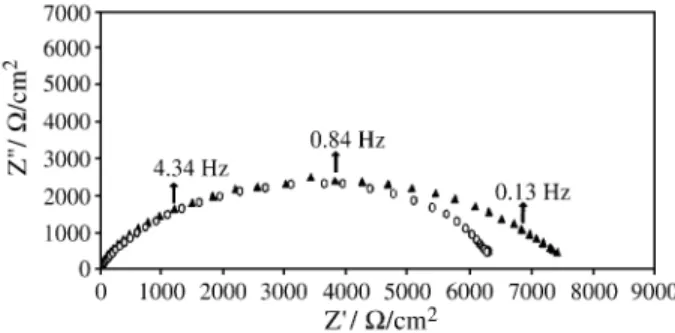
The Nyquist diagrams for the copper/nickel alloy elec-trode in an acetate solution were measured at the OCP after 60 min immersion time (Fig. 6). These diagrams were characterized by depressed capacitive loops, with the theo-retical center located below the real axis, reflecting a sur-face inhomogeneity of structural or interfacial origin, such as those found in the adsorption processes. These results are consistent with those reported in the literature17. Two time constants can be used to interpret these EIS plots. The high frequency constant corresponds to a porous layer, whereas the second constant represents a more resistant film. This behavior may have been caused by the formation of intermediate species adsorbed on the electrode surface18. Figure 7 shows the EIS diagrams for the alloy electrode after 10 min of immersion in 0.10 and 1.0 mol L-1 sodium acetate solutions. A comparison between the data of Figs. 6 and 7 shows that decreased immersion times heightened the film’s resistance. The electrical equivalent circuit (EEC) proposed to fit the experimental data, which is shown in the insert of Fig. 7, consists of the electrolytic resistance, RS, in a serial connection with two time
con-stants. The first constant, at a high frequency, corresponds to the external layer, with R1 representingthe resistance and
C1 the capacitance of this layer. The internal layer is
char-acterized by a resistance, R2, a capacitance, C2, and a
Warburg impedance element, W. The Warburg impedance, W, takes into account a diffusion process similar to those found in corroding systems19. The corresponding fitting parameters used are given in Table 1.
Figure 8 shows the Bode plots for copper, nickel and the alloy electrodes in a 0.1 mol L-1 acetate solution after 10 min of immersion. A comparison of the EIS diagrams indicates that the film layer formed on the alloy is similar to that of copper, but with an alloy corrosion resistance greater than that of copper. These results are evidence that acetate anions preferentially promote the dissolution of
Figure 5. Nyquist diagram for pure nickel, at OCP, after 60 min of immersion in aerated aqueous sodium acetate: (o) 0.10 mol L-1 and (▲) 1.0 mol L-1.
Figure 6. Nyquist diagram for copper/nickel alloy at OCP, after 60 min of immersion in aerated aqueous sodium acetate: (o) 0.10 mol L-1 and (▲) 1.0 mol L-1.
Figure 7. Nyquist diagram for copper/nickel alloy at OCP, after 10 min of immersion in aerated aqueous sodium acetate: (o) 0.10 mol L-1 and (▲) 1.0 mol L-1 . The inset: Electrical equivalent circuit used to fit the EIS
data.
Figure 8. Bode diagram for pure copper (•) , pure nickel (■) and copper/nickel alloy (▼) at OCP, after 10 min of immersion in aerated
1.0 mol L-1 sodium acetate aqueous solution.
Table 1. Fitting parameters used to simulate the EIS data for cop-per/nickel electrode in 0.1 mol L-1 and 1.0 mol L-1 acetate solution at open circuit potential, after 10 min immersion time.
Acetate solution 0.1 mol L-1 1.0 mol L-1
RS (Ω cm2) 20.07 16.6
R1 (Ω cm2) 11.9 52.5
C1 (µF cm-2) 5.2 10.1
R2 (kΩ cm2) 15.59 50.7
C2 (µF cm-2) 11 31.5
nickel rather than of copper. Thus, a copper-rich layer is formed at the electrode surface, and the resistance and capacitance of this layer are influenced by the concentra-tion of acetate.
4. Conclusions
The data obtained by open circuit measurements and voltametry confirmed that the electrochemical behavior of nickel and copper/nickel alloy were similar. In addition, preferential dissolution of the nickel component took place under anodic polarization. These results suggest that the presence of nickel in the alloy induces the electroactivity of the metal.
The film resistance formed on the copper and cop-per/nickel alloy at the open circuit potential increased with higher acetate concentrations. In contrast, the opposite behavior was detected in the nickel electrode. The corro-sion resistance of the alloy, at the open circuit potential, was higher than that of copper and lower than that of nickel. On the other hand, the data taken from different electro-chemical methods demonstrated that an adsorption process, which was influenced by the concentration of acetate, took place on the electrode surfaces.
Acknowledgements
The authors thanks to CAPES, CNPq and FAPERGS for financial support.
References
1. Souto R. M., Gonzalez S., Salvarezza A. J., Arvia A. J., Electrochim. Acta, v. 39, p. 2619 (1994).
2. Crundwell F. K., Electrochim. Acta, v. 37, p. 2707 (1992).
3. Lee H. P., Nobe K., Pearlstein J., J. Electrochem. Soc., v. 132, p. 1031 (1985).
4. Moreira A. H., Benedetti A. V., Sumodjo P. T. A., Electrochim. Acta, v. 38, p. 981 (1993).
5. Uhlig, H., Electrochim. Acta, v.16, p.1939 (1971). 6. Walton, M. E.; Brook, P. A., Corros. Sci., v. 17, p.317
(1977).
7. Dewald H. D., Parmananda P., Rollins R. W., J. Electroanal. Chem., v. 306, p. 297 (1991).
8. Parkins, R. N., Holroyd N. J. H., Corrosion, v. 38, p. 245 (1982).
9. Babic R., Metikos-Hukovic M., Loncar M., Electro-chim. Acta, v. 44, p. 2413 (1999).
10. Vendrame, Z. B., Gonçalves, R. S., J. Braz. Chem. Soc., v. 9, p. 441 (1998).
11. Barbosa, M. R., Real, S. G.; Vilche, J.R.; Arvia, A. J., J. Electrochem. Soc., v. 135, p. 1077 (1988).
12. Saraby-Reintjes, A., Electrochim. Acta, v. 30, p. 387 (1985).
13. Mostafa, S. N., Mourad, M. Y.; Seliman, S. A., J. Electroanal. Chem,. v. 130, p. 221 (1981).
14. Pourbaix, M. Atlas of Electrochemical Equilibria in Aqueous Solutions, NACE, Houston, 1974.
15. Kremer, E., Azambuja, D. S., J. Braz. Chem. Soc. v. 8, p. 165 (1997).
16. Saraby-Reintjes, A., Electrochim. Acta, v. 30, p. 403 (1985).
17. Hack, H.; Pickering, H., Electrochemical Impedance: Analysis and Interpretation, ASTM STP 1188, Scully, J.R., Silverman, D.D., Kendig, M.W., eds., pg. 220, 1993.
18. Jüttner, K. Electrochim. Acta, v. 35, p. 1501, 1990. 19. Bard,A.J.,Faulkner,L.R., Electrochemical