R e i s R e i s R e i s R e i s R e i s
Extended external hemipelvectomy for sigmoid adenocarcinoma treatment 379
Rev. Col. Bras. Cir. 2010; 37(5): 379-381
Case Report Case ReportCase Report Case Report Case Report
Extended external hemipelvectomy for sigmoid adenocarcinoma
Extended external hemipelvectomy for sigmoid adenocarcinoma
Extended external hemipelvectomy for sigmoid adenocarcinoma
Extended external hemipelvectomy for sigmoid adenocarcinoma
Extended external hemipelvectomy for sigmoid adenocarcinoma
treatment
treatment
treatment
treatment
treatment
Hemipelvectomia externa ampliada para tratar adenocarcinoma de sigmóide
Hemipelvectomia externa ampliada para tratar adenocarcinoma de sigmóide
Hemipelvectomia externa ampliada para tratar adenocarcinoma de sigmóide
Hemipelvectomia externa ampliada para tratar adenocarcinoma de sigmóide
Hemipelvectomia externa ampliada para tratar adenocarcinoma de sigmóide
RODRIGO RIBAS DIASDOS REIS, TCBC-SP1; LUCIANE SCHIAVINATTO2; MÁRIO LUIS TELLES3; ADRIANA ELIZA BRASIL MOREIRA4;
JOÃO PAULO AGUIAR JORDÃO MAINARDI5
Work done at the Santa Casa de Piracicaba – São Paulo, Brazil.
1. Oncologic Surgeon, Santa Casa de Piracicaba – São Paulo, Brazil; 2. Resident, Plastic Surgery PUC Campinas – São Paulo, Brazil; 3. Orthopedist, Santa Casa de Piracicaba – São Paulo, Brazil; 4. Head and Neck Surgeon, Santa Casa de Piracicaba – São Paulo, Brazil; 5. General and Thoracic Surgeon, Unicamp – São Paulo, Brazil.
INTRODUCTION
INTRODUCTION
INTRODUCTION
INTRODUCTION
INTRODUCTION
C
olorectal adenocarcinomas are primarily surgical tumors, for which expanded resections (ER) in patients with exclusively locally advanced disease are justifiable in terms of survival, provided they get clear margins. Due to the rapid unfavorable evolution and failure to clinically resolve a fistula and a transtumoral abscess, we felt motivated to attempt an extremely rare and curative resection. There are few reports in literature of such a radical operation to treat colorectal tumors.CASE REPORT
CASE REPORT
CASE REPORT
CASE REPORT
CASE REPORT
A male patient aged 68 was admitted by a supposed soft tissue abscess in the left flank, skin necrosis and large amounts of purulent material. He had sustained a weight loss of seven kilograms in two months.
He was prostrated, with flexion of the left thigh and severe edema of the left lower limb (LLL). Arterial pulses were normal. There was large,fixed, abdominal mass bulging the hypogastric wall, with 16 cm in length, with pain on palpation and negative rebound sign. There was a deterioration of the CBC (left shift) on the fifth day of hospitalization, despite the intravenous use of the antibiotics Clindamycin and Ceftriaxone. He rapidly developed necrotizing fasciitis (Fournier’s syndrome) on the seventh day.
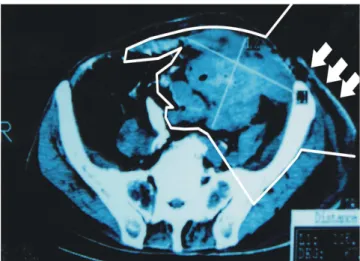
Total abdomen tomography showed a tumoral abdominal mass invading the left pelvic wall (bone intact) and the two rectus muscles in the lower third of the abdomen with subcutaneous emphysema, suggesting a locally advanced and fistulated recto-sigmoid tumor. There was no ascites, hepatic nodules or hydronephrosis. Rectosigmoidoscopy showed an exophytic, ulcerated lesion 38 cm from the anal verge. Directed biopsies demonstrated grade II sigmoid adenocarcinoma.
The patient authorized colostomy and/or left extended (extended external hemipelvectomy) interilium-abdominal amputation (IIAA). The intestinal preparation was not tolerated.
We carried out an exploratory laparotomy to define resectability, with left oblique incision suitable to be transformed, if necessary, into an external hemipelvectomy. We found a sigmoid tumor invading iliac vessels, proximal ileum, anterior and left pelvis, without peritoneal implants. The left ureter and bladder were free. We performed an en bloq resection of the rectosigmoid (Hartmann), 12 cm of small bowl, left common iliac vessels (divided below the aortic bifurcation), the whole left pelvis and inferior limb and skin, fistula and distal rectus abdominis muscles and peritoneum of left lower quadrant of the abdominal cavity. We then proceeded to the reconstruction with an IIAA classic fasciocutaneous gluteal muscle-flap together with peritoneum flap and omentum to isolate the bowel from the 25 x 15 cm polypropylene mesh. A latero-lateral entero-enteric anastomosis was made to reestablish small intestine transit, followed by left colostomy and tubular-laminar drainage.
The patient responded well, without blood transfusion during the procedure, which lasted seven hours. He did not require ICU admission. He accepted the diet early. He was discharged on the 16th postoperative day for social reasons. The pathological examination (pT4pNopMx, clinical stage II) confirmed adenocarcinoma with invasion of adjacent structures. Only 12 lymph nodes were found in the specimen, none involved by tumor. Neither there was perineural, lymphatic or vascular invasion. The margins were free.
380
Rev. Col. Bras. Cir. 2010; 37(5): 379-381
R e i s R e i s R e i s R e i s R e i s Extended external hemipelvectomy for sigmoid adenocarcinoma treatment
DISCUSSION
DISCUSSION
DISCUSSION
DISCUSSION
DISCUSSION
The external hemipelvectomy or interilium-abdominal amputation (IIAA) comprises the amputation of the one of lower limbs en bloc with the homolateral hemipelvis, which is sectioned near the sacroiliac joint. The procedure is classically used in the surgical treatment of large bone tumors or soft tissue sarcomas of the pelvis.
Articles that discuss survival in colorectal extended resections (ER) typically use the Dukes staging modified by Gunderson-Sosin1,2: B3 (T4No) and C3 (T4N1-2). In the past, en bloc ER was suggested by Moynihan in 1926, and its applicability was statistically proven by Sugarbacker2 in 1946 with 56% disease-free survival at five years.
Approximately 5 to 10% of colorectal cancers (CRC) are locally advanced and may require ER1-4. Curative ERs (B3 and C3) are safe, with survival rates similar to traditional resections (B2 = C2 = T3N0 and T3N1-2)1,4, the lymph node status being the major prognostic factor 2-4. Multi-visceral resection is a decision made intraoperatively as adhesions to surrounding organs or structures may be only inflammatory1-4. Dissection to divide tumor adhesions (even for frozen sections) is formally contraindicated and considered a poor prognostic factor, decreasing survival1-4. Invasion proved by pathology ranges from 50% to 75%2-4.
The first report of hemipelvectomy associated with resection of a colorectal tumor is of 19975.
The colonic segment that is most often associated with invasion of adjacent structures is the sigmoid1,2,4. The most commonly invaded structures are the small intestine and the abdominal wall3.
Morbidity and mortality in colorectal ERs are higher than in traditional resections, complications ranging
from 20% to 42%3,4 and mortality 5% to 10% after the eighties3,4. Rectal tumors treated with total pelvic exenterations can reach 50% morbidity and 11% mortality.
Data for five-year survival of colorectal ERs vary greatly due to the heterogeneity of stages and the use of adjuvant therapy. Overall survival at five years after complete colorectal ER for locally advanced tumors, when evaluated separately, is around 44% to 62% for B3 and 0% to 38% for C3 tumors1-3.
Studies are mostly retrospective1-3, with overall survival at five years around 50%4 and high rates of complications3. Therefore, ER in not recommended for palliative cases5, but a risk-benefit analysis is necessary to assess every case.
Figure 2 Figure 2Figure 2 Figure 2
Figure 2 - X-ray part-section of femur at the trochanter, with digital didactic outline of the ischium-pubic branch.
Figure 1 Figure 1 Figure 1 Figure 1
R e i s R e i s R e i s R e i s R e i s
Extended external hemipelvectomy for sigmoid adenocarcinoma treatment 381
Rev. Col. Bras. Cir. 2010; 37(5): 379-381
A B S T R A C T A B S T R A C TA B S T R A C T A B S T R A C TA B S T R A C T
Surgery is the most effective way of treating a locally advanced colorectal carcinoma and an extended en bloc resection is necessary to achieve the best overall survival rate. In this rare case, a multi-visceral resection was performed along with the entire lower left limb and left iliac bone for a sigmoid carcinoma. The T4N0M0 (B3) tumor involved the left iliac vessels, left pelvic wall, small bowel and both rectus muscles, besides presenting with a skin fistula. A Hartmann colostomy was also performed. Chemotheraphy was interrupted because of toxicity. The patient is free of disease after 38 months. There are very few cases that describe an extended hemipelvectomy as part of a colorectal carcinoma treatment.
Key words: Key words:Key words:
Key words:Key words: Colorectal neoplasms. Hemipelvectomy. Adenocarcinoma. Colon, sigmoid.
REFERENCES
REFERENCES
REFERENCES
REFERENCES
REFERENCES
1. Heslov SF, Frost DB. Extended resection for primary colorectal carcinoma involving adjacent organs or structures. Cancer 1988;62(8):1637-40.
2. Rowe VL, Frost DB, Huang S. Extended resection for locally advanced colorectal carcinoma. Ann Surg Oncol.1997;4(2):131-6. 3. Luna-Pérez P, Rodríguez-Ramírez SE, De la Barrera MG, Zeferino M, Labastida S. Multivisceral resection for colon cancer. J Surg Oncol. 2002;80(2):100-4
4. Lehnert T, Methner M, Pollok A, Schaible A, Hinz U, Herfarth C. Multivisceral resection for locally advanced primary colon and rectal cancer: an analysis of prognostic factors in 201 patients. Ann Surg. 2002;235(2):217-25.
5. Lopes A, Rossi BM, Ferreira FO. Internal hemipelvectomy in the treatment of recurrent carcinoma of the colon: report of a case. Dis Colon Rectum. 1997; 40(12):1504-7.
Received in 20/08/2006
Accepted for publication in 22/10/2006 Conflict of interest: none
Source of funding: none
How to cite this article: How to cite this article: How to cite this article: How to cite this article: How to cite this article:
Reis RRD, Schiavinatto L,Telles ML, Mainardi JPAJ. Extended external hemipelvectomy for sigmoid adenocarcinoma. Rev Col Bras Cir. [periódico na Internet] 2010; 37(5). Disponível em URL: http:// www.scielo.br/rcbc