www.biogeosciences.net/5/1681/2008/
© Author(s) 2008. This work is distributed under the Creative Commons Attribution 3.0 License.
Biogeosciences
Influence of CH
4
and H
2
S availability on symbiont distribution,
carbon assimilation and transfer in the dual symbiotic vent mussel
Bathymodiolus azoricus
V. Riou1,2, S. Halary3,4, S. Duperron3,4, S. Bouillon2,5,6, M. Elskens2, R. Bettencourt1, R. S. Santos1, F. Dehairs2, and A. Colac¸o1
1Department of Oceanography and Fisheries, IMAR-University of Azores, Horta, Portugal
2Department of Analytical and Environmental Chemistry, Vrije Universiteit Brussel, Brussels, Belgium 3UPMC Universit´e Paris 06, UMR 7138 SAE AMEX, Paris, France
4CNRS UMR 7138 SAE AMEX, Paris, France
5Netherlands Institute of Ecology, Centre for Estuarine and Marine Ecology, Yerseke, The Netherlands 6Department of Earth and Environmental Sciences, Katholieke Universiteit Leuven, Leuven, Belgium
Received: 7 April 2008 – Published in Biogeosciences Discuss.: 29 May 2008
Revised: 27 October 2008 – Accepted: 7 November 2008 – Published: 11 December 2008
Abstract.High densities of mussels of the genus Bathymodi-olusare present at hydrothermal vents of the Mid-Atlantic Ridge. It was previously proposed that the chemistry at vent sites would affect their sulphide- and methane-oxidizing en-dosymbionts’ abundance. In this study, we confirmed the latter assumption using fluorescence in situ hybridization onBathymodiolus azoricusspecimens maintained in a con-trolled laboratory environment at atmospheric pressure with one, both or none of the chemical substrates. A high level of symbiosis plasticity was observed, methane-oxidizers oc-cupying between 4 and 39% of total bacterial area and both symbionts developing according to the presence or absence of their substrates. Using H13CO−3 in the presence of sul-phide, or13CH4, we monitored carbon assimilation by the
endosymbionts and its translocation to symbiont-free mus-sel tissues. Carbon was incorporated from methane and sulphide-oxidized inorganic carbon at rates 3 to 10 times slower in the host muscle tissue than in the symbiont-containing gill tissue. Both symbionts thus contribute ac-tively toB. azoricusnutrition and adapt to the availability of their substrates. Further experiments with varying substrate concentrations using the same set-up should provide useful tools to study and even model the effects of changes in hy-drothermal fluids onB. azoricus’ chemosynthetic nutrition.
Correspondence to:V. Riou ([email protected])
1 Introduction
a bacteriocyte, quantified using 3D fluorescence in situ hy-bridization (FISH) technique, varies from vent site to vent site between B. azoricus specimens (Halary et al., 2008). However, although physiological activity of the symbionts was observed in gills of a hydrothermal vent Bathymodiolid from the Pacific (Fiala-M´edioni et al., 1986; Nelson et al. 1995), in the Southern MARB. puteoserpentis(Robinson et al., 1998) and in live specimens of the seep Bathymodiolid from the Gulf of Mexico (Childress et al., 1986; Fisher and Childress, 1992; Kochevar et al., 1992 and Lee and Chil-dress, 1995), it has to date not been demonstrated in live specimens ofB. azoricus.
Stable isotope studies on Bathymodiolids have indicated the presence of two isotopically (and hence, nutritionally) distinct groups of mussels at the MAR (Trask and Van Dover, 1999; Fiala-M´edioni et al., 2002 and Colac¸o et al., 2002a). A first group (bulk tissueδ13C∼−30‰) would depend mostly on SOB, while a group with heavier isotopic values of−20‰ suggests a larger reliance on MOB.B. azoricusis a complex organism which can derive its carbon and nitrogen from two different symbionts, from particulate organic matter and pos-sibly from dissolved organic matter. In such a case, the anal-ysis of stable isotopes at natural abundance in bulk tissue, which provides information about the “average” diet over a certain period of time, is insufficient to accurately delin-eate the contributions from the different food sources. Incu-bations with13C-enriched substrates are commonly used to study the activity of pure bacterial cultures as well as the ac-tivity of different complex bacterial communities in natural and artificial ecosystems and soils. Autotrophic SOB were already described performing such tracer experiments with
13C-labelled bicarbonate (Knief et al., 2003a), as were
com-munities of physiologically active MOB using13CH4(Knief
et al., 2003b). In the present study, we investigated symbiont populations and mussel nutrition in specimens ofB. azori-cuscollected from the MAR and kept under various condi-tions in a controlled laboratory environment (LabHorta fa-cility in the Azores, Colac¸o and Santos, 2002b). Stable iso-tope tracer experiments were performed with13C-enriched bicarbonate or methane, followed by analysis of13C incor-poration in mussel tissues. Densities of symbionts were es-timated from FISH images using symbiont-specific probes. Results indicate that the symbionts develop in response to the presence or absence of their substrates, and that inorganic carbon and C1substrates are assimilated and further
translo-cated into symbiont-free mussel tissues.
2 Material and methods
2.1 Study site and sampling
Acoustically retrievable cages were moored in August 2006 during the MOMARETO cruise (R/V Pourquoi Pas? Ifre-mer). They were positioned on diffuse venting areas at the
Mid-Atlantic Ridge (MAR) hydrothermal vent fieldMenez Gwen(MG: 37◦51′N, 32◦31′W, 817 m) where mussel pop-ulations are very dense and cover virtually all available rock surfaces. Cages were filled with approximately 400 mus-sels using the Ifremer ROV VICTOR 6000. Our experi-ments were performed on adult mussels (53.6–74.1 mm shell length, mean 65.5±3.7 mm) from two cages recovered by the Portuguese vessel R/V Arquip´elago in January and May 2007. After a 20 min surfacing time, the cage was lifted on-board and mussels were transferred to fresh cooled seawater for a 14 h transit to Faial Island (Azores). Some wild spec-imens were dissected on-board. At the Azorean LabHorta facility, mussels were scrubbed clean of visible adhering ma-terial, rinsed in chilled seawater and transferred to the hy-drothermal vent laboratory set up. They were kept in main-tenance conditions (see Sect. 2.2) until the start of tracer ex-periments (in Sect. 2.3). Maintenance and tracer exex-periments in LabHorta were monitored daily for CH4and H2S
concen-trations, O2saturation, pH and temperature.
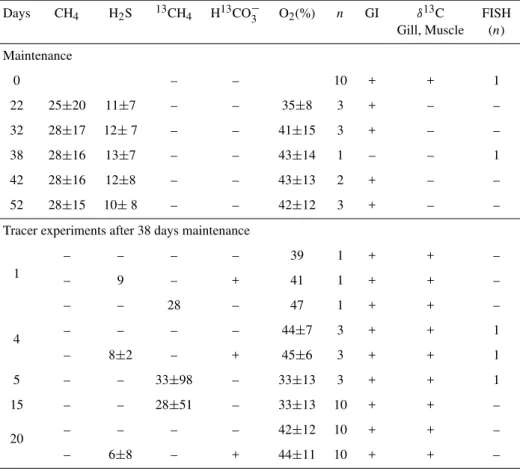
A first experiment was performed with the mussels col-lected in January and left to acclimate during 5 days (Ta-ble 1), with the aim to describe the effect of sulphide on the incorporation of bicarbonate. Experiments with May mussels were designed to observe (i)B. azoricus’ response to prolonged maintenance in the laboratory (Table 2, upper part) and (ii) the evolution of symbiotic populations and car-bon incorporation in mussel tissues in response to exposure to only methane, only sulphide or in the absence of stimula-tion (Table 2, bottom part). Specimens showing the highest
13C incorporation after 4 or 5 days enrichment in the
pres-ence of sulphide or methane, respectively, were selected for FISH analyses in Sect. (2.6).
Dissected tissues were frozen and lyophilized, except for the gill parts analysed for FISH. Gill indexes (GI) were cal-culated from the specimens’ gill tissue and rest of body dry weights (total soft tissue dry weight – gill dry weight) ac-cording to the following formula:
GI= [gill tissue dry weight(g)/rest of body dry weight(g)] ×100(1) 2.2 Maintenance in LabHorta
Mussels were placed in 40 L tanks containing 7.5–10◦C sea-water (warmer sea-water was found to inactivate methane ox-idizers in B. childressi; Kochevar et al., 1992). Seawater was oxygenated using compressed air and replaced every second day (pH 7.5–9). Methane and sulphide were sup-plied to support the presence of endosymbionts. A sul-phide solution (20 mmol L−1 Na2S in filtered seawater, pH
Table 1. January experimental design, with median CH4and H2S concentrations (µM) in the presence or absence of 10% H13CO−3, and O2saturation (±SD) experienced by the sampled mussels over the duration of the acclimation and of the labelling experiment (days). “n”
represents the number of specimens analysed for their gill index (GI), bulk tissue and/or phospholipid fatty acids (PLFA) carbon isotopic signature (δ13C).
CH4 H2S O2(%) H13CO−3 n GI
δ13C Gill, Mantle, Muscle, Rest
δ13C Gill PLFA
Acclimation
(d)
13
C
labelling
(d)
Wild – – – – – – 10 + + –
Acclimated 5 – 11±50 5±23 57±27 – 3 + – –
13C+H
2S 5 15 – 4±4 84±10 + 3 – + + 13C no H
2S 5 15 – – 87±13 + 3 – + +
H2S no13C 5 15 – 6±3 88±10 – 3 – – +
Table 2.May experimental design, with median(13)CH4and H2S concentrations (µM) in the presence or absence of 16.3% H13CO−3, and
O2saturation (±SD) experienced by the sampled mussels over the duration of the experiment (days). “n” represents the number of specimens
analysed for their gill index (GI), bulk tissue carbon isotopic signature (δ13C) and/or observed by fluorescence in situ hybridisation (FISH).
Days CH4 H2S 13CH4 H13CO−3 O2(%) n GI δ13C FISH
Gill, Muscle (n)
Maintenance
0 – – 10 + + 1
22 25±20 11±7 – – 35±8 3 + – –
32 28±17 12±7 – – 41±15 3 + – –
38 28±16 13±7 – – 43±14 1 – – 1
42 28±16 12±8 – – 43±13 2 + – –
52 28±15 10±8 – – 42±12 3 + – –
Tracer experiments after 38 days maintenance
1
– – – – 39 1 + + –
– 9 – + 41 1 + + –
– – 28 – 47 1 + + –
4 – – – – 44±7 3 + + 1
– 8±2 – + 45±6 3 + + 1
5 – – 33±98 – 33±13 3 + + 1
15 – – 28±51 – 33±13 10 + + –
20 – – – – 42±12 10 + + –
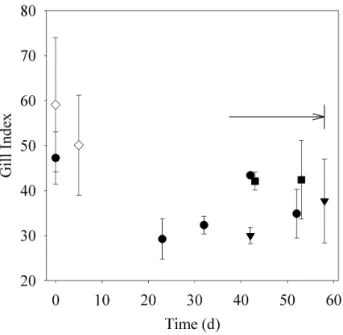
Fig. 1. Variations in gill index with time spent in aquarium in the presence of CH4and/or H2S (mean±SD). Open diamonds:
Jan-uary wild (n=10) and aquarium (n=3) mussels. Filled symbols stand for May specimens and an arrow indicates the start and end of tracer experiments. Circles: wild (n=10) and aquarium mussels maintained with H2S+CH4(22 days:n=3, 32 days:n=3, 42 days:
n=2, 52 days: n=3). Triangles: NaH13CO3+H2S tracer mussels
(enrichment day 4: n=3, day 20: n=10). Squares: 13CH4tracer mussels (enrichment day 5:n=3, day 15:n=10).
MAR vent sites (Sarradin et al., 1998). Methane was bub-bled continuously in seawater and dissolved methane con-centration was monitored by sampling 60 mL seawater in a 300 mL bottle which was rolled for 20 min before measur-ing the headspace CH4concentration with a Gasurveyor 524.
Since high methane concentrations above 300µmol L−1
were found inhibitory for symbionts ofB. childressi exhibit-ing high methane consumption rates (Kochevar et al., 1992), we tried to maintain CH4concentration below this level (8–
92µmol L−1). The effect of the imposed laboratory
con-ditions on the mussels was assessed by statistical Mann-Whitney U test and Kruskal-Wallis non-parametric analyses. 2.3 Stable isotope tracer experiments
All stable isotope enriched chemicals were purchased from Campro Scientific (The Netherlands). January tracer ex-periments (Table 1) were performed for 15 days in ar-tificial seawater (425 mmol L−1 NaCl, 9 mmol L−1 KCl, 9.3 mmol L−1CaCl2, 25.5 mmol L−1MgSO4, 23 mmol L−1
MgCl2, 2 mmol L−1total NaHCO3; adjusted to pH 8) filtered
on a 0.2µm membrane and replaced every second day (pH 8.0–8.5; 9.3–10.7◦C). Enrichment was obtained by replacing 10% of natural abundance sodium bicarbonate by NaH13CO3
(99% 13C). Monitored sulphide concentrations were in the
range of 2–14µmol L−1. May experiments (Table 2) were
performed in 0.2µm-filtered natural seawater replaced ev-ery second day (pH 7.5–8.5; 7.9–9.8◦C) supplemented (or not) with methane (14–200µmol L−1 25% 13C) or hydro-gen sulphide with bicarbonate (H2S 0–32µmol L−1
supple-mented with NaH13CO3 99% to obtain a concentration of
2.85 mmol L−116.3%13C), for 15 and 20 days, respectively. At each sampling, mussels were opened and rinsed in dis-tilled water to discard unincorporated tracers.
2.4 Fatty acids extraction
Lyophilized gill tissues were ground to a fine powder using a mortar and pestle. All glassware was decontaminated for 4 h at 450◦C prior to use. Lipids were extracted using a mod-ified version of the Bligh and Dyer method (White et al., 1979) using chloroform/methanol/phosphate buffer pH 7.4 in 1:1:0.9 final volume proportions to form a biphasic system. Total lipids retrieved in the chloroform phase were applied onto activated silicic acid columns and partitioned into apo-lar, neutral and polar lipids by sequential elution with chlo-roform, acetone, and methanol, respectively. Lipid fractions were dried under nitrogen flux and immediately resuspended in 2 mL of a fresh solution of methanol/hydrochloric acid 37%/chloroform (10:1:1 volume) to form fatty acid methyl esters (FAMEs) by trans-methylation reaction (60 min at 90◦C).
2.5 Stable isotope analyses
FAME extracts were transferred to tin capsules for liquids (previously decontaminated with acetone) and chloroform was evaporated under mild conditions (37◦C, to avoid the loss of the most volatile FAMEs).
Aliquots of lyophilized tissue powder were weighed into silver cups (previously decontaminated for 4 h at 450◦C) and acidified with a few drops of dilute HCl (5%) before analysis, to remove any possible trace of carbonates. Tissues were re-dried overnight at 60◦C.
δ13C analyses were performed on a Flash1112 elemen-tal analyzer, coupled to a Delta V via a Conflo III interface (Thermo Finnigan). All carbon stable isotope ratios are ex-pressed relative to the conventional reference (VPDB lime-stone) asδvalues, defined as:
δ13C= [(Rsample−Rstandard)/Rstandard] ×103[‰]where R=13C/12C (2)
Or as Atom percent values, defined as:
Net carbon incorporation in the mussel tissues (Cinc, in
µmol C g tissue−1)was calculated using the following
for-mula:
Cinc= [(Aexp−Acontrol)×Ctissue]/(Asubstrate−Acontrol)(4)
Where Aexp is the13C atom percent measured in the mussel
after the tracer experiment, Acontrol is the13C atom percent
measured in the control mussel, Ctissueis the carbon content
of the tissue analyzed (µmol C g tissue−1)and Asubstrate the 13C atom percent of the substrate used in the experiment (i.e.,
25% for CH4, as given by the supplier, or 16.3% for NaHCO3
and 22.2% for CH3OH, as calculated from the preparation).
2.6 Fluorescence In Situ Hybridization (FISH)
FISH was performed according to the protocol devel-oped by Halary et al. (2008) with a few modifica-tions. Upon recovery of selected mussel specimens, the most anterior part of their left gill was fixed in 2% formaldehyde (2–4 h, 4◦C), rinsed twice with filtered sea-water, and stored at −20◦C in 1:1 ethanol/filtered seawa-ter. In the lab, gill tissue was embedded in polyester wax and 10µm-thick sections were cut using a microtome (JUNG, Heidelberg, Germany), collected on Superfrost® Plus slides (Roth, Germany), and hybridized as previ-ously described (Halary et al., 2008) using the ATTO488-labelled ImedM probe (5’-ACCAGGTTGTCCCCCACTAA-3’, Duperron et al., 2008) specific for the methane-oxidizing symbiont and the Cy5-labelled BangT-642 probe (5’-CCTATACTCTAGCTTGCCAG-3’, Duperron et al., 2005) specific for the sulphide-oxidizing symbiont. Images were acquired using a BX61 microscope (Olympus Optical Co., Tokyo, Japan) under a 10× objective (NA 1.30). The green channel corresponding to the ImedM probe (methane-oxidizers) and the blue channel corresponding to the BangT probe (sulphide-oxidizers) were binarized by applying a lu-minosity threshold to distinguish between background fluo-rescence and probe signal, and numbers of pixels belonging to each type of symbiont were computed using the ImageJ software (Abramoff, 2001). Total area occupied by bacteria and respective proportions of each phylotype were computed for the whole image (one image per specimen, around 20 gill filaments per image). For an inter-comparison between im-ages, bacterial areas were normalized by dividing areas by the total length of filaments visible and measured on each picture.
3 Results
3.1 Effect of the maintenance in aquarium on mussel con-dition
Mussels collected in January were allowed to recover from the decompression stress during 5 days at atmospheric pres-sure (transport followed by LabHorta) with CH4 and H2S
to ensure the survival of endosymbionts (“Acclimated”, Ta-ble 1). A quick drop of their gill index (GI) could be no-ticed over this short period (although not statistically signif-icant, Mann-Whitney U test p=0.237, Fig. 1). This drop was also observed for May mussels kept in the presence of H2S and CH4 (see concentrations in Table 2) up to 38
days before starting the tracer experiments (aquarium mean GI=33.7,n=7; wild animals mean GI=47.3,n=10, Kruskal-Wallisp=0.006, Fig. 1). Subsequent to this rapid loss in gill weight, no further significant changes in GI were observed between individuals collected at different moments during the maintenance period (from day 23 to 52, Kruskal-Wallis p=0.115). When compared to mussels kept in maintenance conditions, the GIs of specimens from the tracer experiments did not decrease significantly and rather increased slightly in the13CH4experiment (Fig. 1, Kruskal-Wallis,n=22: CH4
p=0.041, H2Sp=0.598, controlp=0.262).
3.2 Endosymbiont populations’ response to experimental treatments
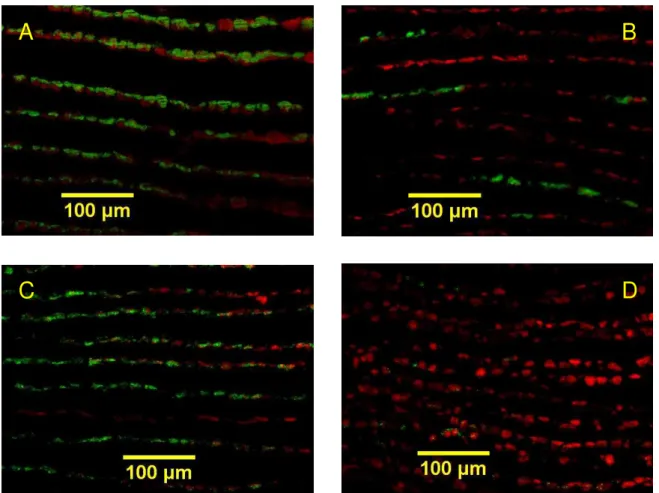
Gill filaments from May mussels were observed using FISH to assess the effects of the maintenance period in Lab-Horta and of the tracer experiments on symbiont populations (Fig. 2). Estimates of symbiont areas and proportions for a wild specimen, for a specimen collected at the start of the experiments (after the maintenance period) and others after 4 to 5 days in the absence or presence of either CH4or H2S
are displayed in Table 3. Gill filaments of aquarium spec-imens appeared narrower than the ones from a wild mus-sel dissected immediately after the cage recovery and car-ried much less bacteria (Fig. 2A–B). The sections observed showed a decrease in area covered by bacteria by a factor of 4 (from 16.7 to 3.7µm2/µm filament), and indicated a shift in symbiont relative areas, with methane-oxidizing bac-teria (MOB) representing 14% of the total area occupied by bacteria in acclimated specimens, versus 24% in fresh spec-imens (Table 3). At the beginning of the tracer experiments, bacterial densities appear low. A mussel kept four days in filtered seawater devoid of CH4 and H2S also displayed a
lower total area occupied by bacteria of 2.1µm2/µm
fila-ments. The exclusive presence of 86.9±98.0µmol L−1CH 4
seemed to favour MOB which represented 39% of total bac-terial area (Fig. 2C). Four days enrichment with exclusively 7.7±1.6µmol L−1 H
2S resulted in higher overall bacterial
areas with a high proportion of SOB representing 96% of to-tal bacterial area (Fig. 2D).
3.3 Sulphide induced CO2incorporation
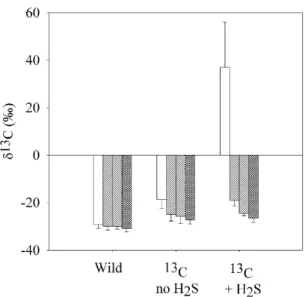
A low incorporation of 13C from HCO−3 was observed in the absence of H2S, which increased considerably when
B. azoricuswas supplied with H2S (Fig. 3). Highest
Table 3.Results from FISH image processing. The CH4/H2S ratio of 1.2 reported for fresh mussels, is a mean from end-member fluids at Menez Gwen (0.67–1.75, Desbruy`eres et al., 2000), which might not be representative of the situation in their immediate environment.
CH4/ Surf Symbµm2/ % % MOB
H2S Fil lengthµm MOB SOB /SOB Fresh 1.2 16.7 24 76 0.32
38 days H2S+CH4 2.2 3.7 14 86 0.17
+4 days Nothing (–) 2.1 29 71 0.41
+4 days H2S 100% H2S 5.1 4 96 0.04
+5 days CH4 100% CH4 3.1 39 61 0.64
A
B
C
D
Fig. 2.FISH observations of transverse sections of gill filaments, displaying methane- (green) and sulphide-oxidisers (red) in May mussels.
A–B: gills from a fresh specimen(A)and a specimen maintained 38 days(B)in LabHorta with H2S+CH4. C–D: specimens observed after
5 days with13CH4(C)or 4 days with H2S+NaH13CO3(D).
much lower incorporations. The analyses of gill tissue phos-pholipid fatty acid methyl esters (PLFA) also showed a cou-pling between enriched inorganic carbon incorporation and the presence of H2S (Fig. 4). δ13C analysis of fatty acid
methyl esters (FAMEs) from gill lipid fractions of mussel A (the mussel specimen displaying the highestδ13C values
3.4 CO2and CH4incorporation rates
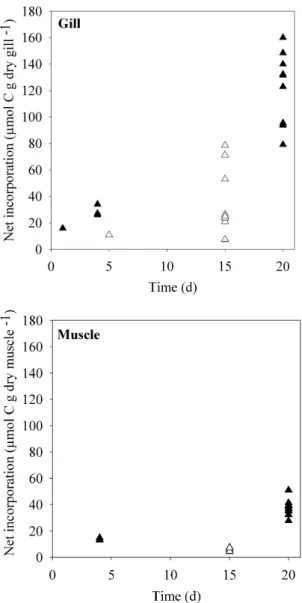
After 4 and 5 days of exposure to 13C-labelled HCO−3 (in the presence of H2S) or CH4, B. azoricus gill tissue
al-ready showed13C abundances significantly higher than back-ground levels (Kruskal-Wallisp=0.049 for both treatments). At each sampling time, δ13C values tended to be higher in gill than in muscle tissue. Labelling of the gill tissue appeared uniform between the different mussel specimens after 4 days in H2S. However, strong differences in δ13C
between individuals were observed after 15 days with en-riched CH4and 20 days with H2S and H13CO−3 (Fig. 5, left
panel). In the gill tissue, carbon incorporation rates varied from 151 to 323 nmol C g dry tissue−1h−1after 20 days in the H2S+H13CO−3 experiment (sulphide concentration: 0–
32µmol L−1), and from 56 to 228 nmol C g dry tissue−1h−1 with13CH
4(14–200µmol L−1). Muscle tissues net
incorpo-ration rates ranged from 52 to 104 nmol C g dry tissue−1h−1
in the H2S+H13CO−3 experiment, and from 11 to 21 nmol C g
dry tissue−1h−1 in the 13CH
4 experiment (Fig. 5, right
panel).
4 Discussion
Because of its capacity to recover and survive in aquaria for several months after the post-retrieval decompression stress, increasing data is being obtained from liveBathymodiolus azoricusmaintained in aquaria at atmospheric pressure in the presence or absence of CH4and H2S for the endosymbionts.
Immune responses (Bettencourt et al., 2007), biochemical re-sponses to recovery stress (Dixon et al., 2004) and to metal exposure (Company et al., 2008) have been investigated us-ing such settus-ings. Dixon et al. (2004) saw higher levels of DNA damage in mussels kept in the presence of methane and sulphide than in some kept without any “food supplement”. In a recent study, Bettencourt et al. (2008) investigated the physiological state of mussels during acclimatization to at-mospheric pressure in the absence of dissolved gases over the course of several months post-capture and concluded that our laboratory set up was a suitable system to study phys-iological reactions. Response of symbionts to the experi-mental conditions was barely examined. A preliminary study on sulphide-oxidizing bacterial symbionts (SOB) showed, on transmission electron micrographs, the loss and potential re-acquisition of SOB (Kadar et al., 2005).
In the present study we tried to gain insight on the sym-biont distributions, physiology and impact on the nutrition of B. azoricus. Gill indexes and fluorescence in situ hy-bridisation observations of gill filaments indicate that de-spite a strong post-collection initial stress, with a marked decrease in total symbiont abundances and gill dry weight, both bacterial populations can be maintained in the gill tissue of mussels kept in aquaria. Furthermore, incubation experi-ments suggest that the presence of either sulphide or methane
Fig. 3. January mussels’ tissuesδ13C values (bars from left to
right: gill, rest, muscle and mantle). Wild (n=10, mean±SD) or after 5 days acclimatization at atmospheric pressure followed by 15 days in the presence of 10%13C enriched bicarbonate with (13C+H2S, n=3, mean±SD) or without sulphide (13C no H2S,
n=3, mean±SD).
Fig. 4.δ13C values of FAMEs (uncorrected for the additional
car-bon from the methylation) from polar lipids extracted from January tracer mussels’ gills (white bars,n=3, mean±SD). For mussel A from the13C+H2S incubation, polar, neutral and apolar fatty acids were measured (bars from left to right, respectively).
Fig. 5. Carbon net incorporation through time in gill (left panel) and muscle (right panel) tissues from each specimen of May tracer experiments (filled triangles: NaH13CO3+H2S, empty triangles: 13CH
4).
methane, and thus optimize the use of available compounds as suggested by previous authors (Trask and Van Dover, 1999; Colac¸o et al., 2002a; Salerno et al., 2005; Duperron et al., 2007). The range of variation observed in symbiont rel-ative abundances, with MOB occupying between 4 and 39% of total bacterial area in specimens of this study (Table 3), confirms the high level of plasticity of the dual symbiosis. Although our data must be interpreted with caution as only one individual per experimental condition was analyzed, the fact that observations qualitatively agree with expected re-sults is a strong indication that our set-up is appropriate for the enrichment of each endosymbiont. Recently, a 3D-FISH technique was employed to quantify the effect of a sulphide pulse in a similar experimental set-up, on the volume and rel-ative abundance of symbionts in mussel gills (Halary et al.,
2008). We herein provide a first indication that MOB also respond to a methane pulse.
Stable isotope tracer experiments demonstrate that H2S
stimulates the assimilation of inorganic carbon, most prob-ably by SOB endosymbionts. Indeed, SOB carry out chemolithoautotrophic organic production via the Calvin-Benson cycle, whereby energy for CO2 fixation by the
en-zyme RuBisCO derives from sulphide oxidation (Fisher, 1990). Our experiments show that most of the incorporated tracer is found in the gill tissue that hosts high densities of bacteria, as opposed with mantle, muscle or other tissues (Fig. 3). The analysis of13C enrichment in fatty acids from the different fractions of gill extracted lipids (Fig. 4) reveals that for mussels exposed to H2S, the polar fraction
(consist-ing in phosphoglycerolipids) is the most13C-enriched frac-tion in terms of fatty acids, while the apolar fracfrac-tion shows almost no enrichment. Apolar lipids consist mainly in acyl-glycerols, free fatty acids, hydrocarbons, pigments, sterols and waxes. Bacteria do not generally synthesise sterols de novo (except for some methylotrophs, Pearson et al., 2003) and do not store acylglycerols as in plant or animal cells. The fact that inorganic carbon is first incorporated in the main components of Gram-negative bacterial membranes (phos-pholipids, Kates, 1964) and not in apolar lipids originating from the host tissues is an additional indication that CO2was
fixed by SOB. However, we also see a low level of13C
assim-ilation in mussel tissues in the absence of H2S (Fig. 3), which
was also observed in an earlier study using radio-active bicar-bonate withB. thermophilusgill homogenates (Belkin et al., 1986). Various mechanisms can be invoked to explain this inorganic carbon fixation in the absence of H2S:
i) Mussels encountered severe hypoxia (more than 6 h), during prolonged closing of their valves probably in reac-tion to physical stress (light or vibrareac-tions in the LabHorta container, for example). In such conditions, stored glyco-gen (which can reach 10% of the dry mass in B. ther-mophilus, Smith, 1985) becomes the major energy source for the mussel, and the Embden-Merehof-Parnas glycogenoly-sis pathway deviates from its normal aerobic route, to car-boxylate phosphoenolpyruvate (PEP), producing oxaloac-etate (Grieshaber et al., 1994). PEP carboxykinase could thus incorporate13C-enriched inorganic carbon entrapped in the valve cavity into oxaloacteate and subsequent end-products such as succinate (as seen inMytilus edulis, de Zwaan et al., 1983) or other organic acids. However, the effect of any en-hanced glycogenolysis would probably result in all tissues displaying the same level of label incorporation, whereas we observe13C incorporation mainly in gill tissue, and only to a lesser extent in other tissues. Other mechanisms must there-fore be involved;
ii) CO2 is fixed by one or both symbiont types via
iii) Sulphur or thiosulfate reserves are present in the gill tissue and anaerobic sulphide production occurs after pro-longed valve closing (see Arndt et al., 2001 and Pruski et al., 2002, who reports that a large fraction of the sulphur in gills ofB. azoricusspecimens is present in the zero oxidation state);
iv) MOB harbour a RubisCO activity as observed in type X-methane oxidizers (Baxter et al., 2002) and in Bathymodi-olussp. (Elsaied et al., 2006) and would also incorporate inorganic carbon by chemoorganoautotrophy (using formate as a growth substrate, Baxter et al., 2002). More experi-ments and biochemical analyses would be needed to under-stand the processes involved in inorganic carbon fixation in the absence of stimulation with sulphide, and at this stage we cannot eliminate any of the abovementioned hypotheses.
Distribution of labelled carbon in the different mussel tis-sues suggests that in the case of carbon uptake by SOB, inor-ganic carbon is first incorporated by bacteria, then transferred to the rest of the tissues including the digestive system and vital organs, muscle and mantle tissues being the last ones to get this carbon. Carbon transfer from the gills to symbiont-free tissue was observed earlier in the MOB-housing seep
Bathymodiolussp. by Fisher and Childress (1992) who de-tected an increase of radiolabel coming from 14CH4 in
symbiont-free tissues during a chase period. Evidence for in-tracellular digestion of symbionts in the same mussel species was provided later by Streams et al. (1997). Partially de-graded bacteria in bacteriocyte bodies with lysosomal activ-ity were also observed inB. azoricus (Fiala-M´edioni et al., 2002), indicating that this could be the mode of carbon trans-fer from the symbiont to the host. The slow transtrans-fer of13C from either CH4 or HCO−3 (in the presence of H2S) to the
muscle tissue relative to the gill (Fig. 5) may reflect differ-ences in tissue turnover: gill tissue hosts the bacteria that continuously incorporate the tracer, and hence show a13C abundance more like that of the symbionts; muscle tissue, in contrast, contains exclusively C accumulated through the en-tire life of the mussel, and its13C abundance, therefore, is less responsive to recently ingested food. Our calculations based on the results of May tracer experiments thus indicate 3 and 5–10 times slower carbon incorporation rates in mus-cle tissue than in symbiont-containing gill tissue for SOB and MOB, respectively (Fig. 5).
We finally measured a median incorporation rate of 0.28±0.06µmol C g−1 dry gill h−1 in adult B. azoricus
(n=13, mussels collected after 4 and 20 days, median shell length=65.8±4.7 mm) with enriched bicarbonate in the presence of sulphide at concentrations close to the ones measured over mussel beds at Menez Gwen and Lucky Strike vents (Table 2). In contrast, mussels kept for up to 15 days with 28µmol L−1 enriched CH4
(me-dian concentration) displayed slow carbon incorporation rates (0.07±0.07µmol C g−1 dry gill h−1, n=10, shell length=62.2±1.8 mm, medians±SD). The high standard de-viations in carbon incorporation rates measured for both
ex-periments could be the result of differential valve opening haviour or of differences in initial symbiont abundances be-tween specimens following the maintenance period. Mussels maintained in LabHorta for 38 days before labelling showed a quick drop in symbiont abundance compared to wild mus-sels, which could explain part of the very low carbon incor-poration from enriched methane. Kochevar et al. (1992) de-scribed in more details the characteristics inherent to MOB from a seep Bathymodiolid in a study using14CH4. They
showed that about 70% of the consumed methane was porated as organic compounds. The highest net carbon incor-poration rate (5µmoles C g−1wet mussel h−1) was obtained
at 250µmol L−1dissolved methane. Our rate estimates
can-not really be compared to the rates obtained by Kochevar et al. (1992), as they are reported per dry gill weight as opposed to wet whole mussel soft tissue weight, plus our experiments were performed with a 9 times lower median methane con-centration with mussels maintained in aquarium. However, we provide the first experimental data on carbon fixation in “acclimated”Bathymodiolus azoricus.
Although working at atmospheric pressure, the LabHorta aquarium setting can thus be employed to study the dynam-ics of symbiont populations. In the future, pulses of vary-ing intensities and durations or parallel measurements of rates of symbiont digestion by the host should be foreseen. Together with the identification of biomarkers for the en-dosymbionts following tracer experiments, such experiments should provide useful tools to study the effects of changes in hydrothermal fluids on the chemosynthetic nutrition of the Mid-Atlantic Ridge mussel and gain insight in the extent to which the mussel beds interact with and impact their sur-roundings.
Acknowledgements. We thank C. Leal, V. Costa, M. Korntheuer, M. Laranjo, H. Lopez and L. Pires for the experimental support, and P. Dando and P. Bodelier for helpful advice. Our acknowl-edgements also go to the Victor 6000 team, crews of “R/V Arquip´elago” and “Pourquoi Pas?” and chief scientists of the MoMARETO cruise J. Sarrazin and P. M. Sarradin. Financial support for this research was provided by the EU Framework Contract No EVK3-CT1999-00003 (VENTOX, cage system), the Azorean DRCT (Portugal) and the Portuguese FCT (LabHorta and IMAR-DOP/UAc¸ Research Unit #531 and Associate Laboratory #9 lab work and SFRH/BPD/35808/2007, grant RB), and by the EU research training network MoMARnet-FP6-RTN/2003/505026 (grant VR), the EU network of excellence REX-3DEM (CT 502828, grant SH) and FWO-Vlaanderen (G.0632.06) and PRODESA/Feder. We are finally grateful to the reviewers, who considerably helped improving this manuscript. This is publication 4438 of the Netherlands Institute of Ecology (NIOO-KNAW).
References
Abramoff, M. D., Magelhaes, P. J., and Ram, S. J. : Image process-ing with ImageJ, Biophotonics Int., 11, 36–42, 2004.
Arndt, C., Gaill, F., and Felbeck, H.: Anaerobic sulfur metabolism in thiotrophic symbioses, J. Exp. Biol., 204, 741–750. 2001. Baxter, J., Hirt, R., Bodrossy, L., Kovacs, K., Embley, T., Prosser,
J., and Murrell, J.: The ribulose-1,5-bisphosphate carboxy-lase/oxygenase gene cluster ofMethylococcus capsulatus(Bath), Arch. Microbiol., 177, 279–289, 2002.
Belkin, S., Nelson, D. C., and Jannasch, H. W.: Symbiotic assim-ilation of CO2 in two hydrothermal vent animals, the mussel
Bathymodiolus thermophilusand the tube wormRiftia pachyp-tila, Biol. Bull., 170, 110–121, 1986.
Bettencourt, R., Roch, P., Stefanni, S., Rosa, D., Colac¸o, A., and Santos, R. S.: Deep sea immunity: unveiling immune constituents from the hydrothermal vent musselBathymodiolus azoricus, Mar. Environ. Res., 64(2), 108–127, 2007.
Bettencourt, R., Dando, P., Rosa, D., Riou, V., Colac¸o, A., Sar-razin, J., Sarradin, P. M., and Santos, R. S.: Changes of gill and hemocyte- related bio-indicators during long term maintenance of the vent musselBathymodiolus azoricusheld in aquaria at at-mospheric pressure, Comp. Biochem. Physiol., Part A, 150(1), 1–7, 2008.
Cavanaugh, C. M., Levering, P. R., Maki, J. S., Mitchell, R., and Lidstrom, M. E.: Symbiosis of methylotrophic bacteria and deep-sea mussels, Nature, 325, 346–347, 1987.
Cavanaugh, C. M., Wirsen, C. O., and Jannasch, H. W.: Evidence for methanotrophic symbionts in a hydrothermal vent mussel (Bivalvia: Mytilidae) from the Mid-Atlantic Ridge, Appl. En-viron. Microb., 58, 3799–3803, 1992.
Childress, J. J., Fisher, C. R., Brooks, J. M., Kennicutt, M. C., Bidi-gare, R., and Andreson, A. E. : A methanotrophic marine mol-luscan (Bivalvia, Mytilidae) symbiosis: mussels fueled by gas, Science, 233(4770), 1306–1308, 1986.
Colac¸o, A., Dehairs, F., Desbruy`eres, D., Le Bris, N., and Sar-radin, P. M.:δ13C signature of hydrothermal mussels is related with the end-member fluid concentration of H2S and CH4at the
Mid-Atlantic Ridge hydrothermal vent fields, Cah. Biol. Mar., 43, 259–262, 2002a.
Colac¸o, A. and Santos, R. S.: LABHORTA, A Land-based labora-tory for vent studies, in Towards Planning of Sea-floor Observa-tory Programs for the MAR region (Proceedings of the II Mo-MAR Workshop), Arquip´elago, Life and Marine Sciences, Sup-plement 3, XII, edited by: Santos, R. S., Escartin, J., Colac¸o, A., and Adamczewska, A., 36, 2002b.
Company, R., Serafim, A., Cosson, R. P., Fiala-M´edioni, A., Ca-mus, L., Colac¸o, A., Santos, R. S., and Bebianno, M. J.: An-tioxidant biochemical responses to long-term copper exposure in
Bathymodiolus azoricusfrom Menez-Gwen hydrothermal vent, Sci. Total Environ., 389(2–3), 407–417, 2008.
Desbruy`eres, D., Almeida, A., Biscoito, M., Comtet, T., Khri-pounoff, A., Le Bris, N., Sarradin, P. M., and Segonzac, M.: A review of the distribution of hydrothermal vent communities along the northern Mid-Atlantic Ridge: dispersal vs. environ-mental controls, Hydrobiologia, 440, 201–216, 2000.
de Zwaan, A., de Bont, A. M. T., and Hemelraad, J.: The role of phosphoenolpyruvate carboxykinase in the anaerobic metabolism of the sea musselMytilus edulis, J. Comp. Physiol., 153B, 267–274, 1983.
Dixon, D. R., Pruski A. M., and Dixon, L. R. J.: The effects of hy-drostatic pressure change on DNA integrity in the hydrothermal-vent mussel Bathymodiolus azoricus: implications for future deep-sea mutagenicity studies, Mutat. Res., 552, 235–246, 2004. Duperron, S., Nadalig, T., Caprais, J. C., Sibuet, M., Fiala-M´edioni, A., Amann, R., and Dubilier, N.: Dual symbiosis in a Bathymodi-olussp. mussel from a methane seep on the Gabon continental margin (Southeast Atlantic): 16S rRNA phylogeny and distri-bution of the symbionts in gills, Appl. Environ. Microb., 71(4), 1694–1700, 2005.
Duperron, S., Bergin, C., Zielinski, F., Blazejak, A., Pernthaler, A., McKiness, Z. P., DeChaine, E., Cavanaugh, C. M., and Dubilier, N.: A dual symbiosis shared by two mussel species, Bathymodio-lus azoricusandBathymodiolus puteoserpentis(Bivalvia: Mytil-idae), from hydrothermal vents along the northern Mid-Atlantic Ridge, Environ. Microbiol., 8, 1441–1447, 2006.
Duperron, S., Sibuet, M., MacGregor, B. J., Kuypers, M. M. M., Fisher, C. R., and Dubilier, N.: Diversity, relative abundance and metabolic potential of bacterial endosymbionts in three Bathy-modiolusmussel species from cold seeps in the Gulf of Mexico, Environ. Microbiol., 9, 1423–1438, 2007.
Duperron, S., Laurent, M. C. Z., Gaill, F., and Gros, O.: Sulphur-oxidizing extracellular bacteria in the gills ofMytilidae associ-ated with wood falls, FEMS Microbiol. Ecol., 63(3), 338–349, 2008.
Elsaied, H. E., Kaneko, R., and Naganuma, T.: Molecular char-acterization of a deep-sea methanotrophic mussel symbiont that carries a RuBisCO Gene, Mar. Biotechnol., 8, 511–520, 2006. Fiala-M´edioni, A., Alayse, A. M., and Cahet, G.: Evidence of in
situ uptake and incorporation of bicarbonate and amino acids by a hydrothermal vent mussel, J. Exp. Mar. Biol. Ecol., 96, 191– 198, 1986.
Fiala-M´edioni, A., McKiness, Z. P., Dando, P., Boulegue, J., Mari-otti, A., Alayse-Danet, A. M., Robinson, J. J., and Cavanaugh, C. M.: Ultrastructural, biochemical, and immunological character-ization of two populations of the mytilid musselBathymodiolus azoricusfrom the Mid-Atlantic Ridge: evidence for a dual sym-biosis, Mar. Biol., 141, 1035–1043, 2002.
Fisher, C. R.: Chemoautotropic and methanotrophic symbioses in marine invertebrates, Crit. Rev. Aquat. Sci., 2, 399–436, 1990. Fisher, C. R. and Childress, J. J.: Organic carbon transfer from
methanotrophic symbionts to the host hydrocarbon-seep mussel, Symbiosis, 12, 221–235, 1992.
Fisher, C. R., Brooks, J. M., Vodenichar, J. S., Zande, J. M., Chil-dress, J. J., and Burke Jr., R. A. : The co-occurrence of methan-otrophic and chemoautmethan-otrophic sulfur oxidizing bacterial sym-bionts in a deep-sea mussel, Mar. Ecol., 14, 277–289, 1993. Glover, H. E.: Measurement of chemoautotrophic CO2assimilation
in marine nitrifying bacteria: an enzymatic approach, Mar. Biol., 74, 295–300, 1983.
Grieshaber, M. K., Hardewig I., Kreutzer, U., and P¨ortner, H. O.: Physiological and metabolical responses to hypoxia in inverte-brates, Rev. Physiol. Bioch. P., 125, 43–147, 1994.
Halary, S., Riou, V., Gaill, F., Boudier, T., and Duperron, S.: 3D FISH for the quantification of methane- and sulphur-oxidizing endosymbionts in bacteriocytes of the hydrothermal vent mussel
Bathymodiolus azoricus, ISME J., 2(3), 284–292, 2008. Kadar, E., Bettencourt, R., Costa, V., Santos, R. S., Lobo-da-Cunha,
and re-acquirement in the hydrothermal vent bivalve Bathymodi-olus azoricus, J. Exp. Mar. Biol. Ecol., 318, 99–110, 2005. Kates, M.: Bacterial lipids, Adv. Lipid Res., 2, 17–90, 1964. Knief, C., Altendorf, K., and Lipski, A.: Linking autotrophic
ac-tivity in environmental samples with specific bacterial taxa by detection of13C-labelled fatty acids, Environ. Microbiol., 5(11), 1155–1167, 2003a.
Knief, C., Lipski, A., and Dunfield, P. F.: Diversity and activity of methanotrophic bacteria in different upland soils, Appl. Environ. Microb., 69(11), 6703–6714, 2003b.
Kochevar, R. E., Childress, J. J., Fisher, C. R., and Minnich, E.: The methane mussel: Roles of symbiont and host in the metabolic utilization of methane, Mar. Biol., 112, 389–401, 1992. Lee, R. W. and Childress, J. J.: Assimilation of inorganic
nitro-gen by seep mytilid Ia, an undescribed deep-sea mussel contain-ing methanotrophic endosymbionts: Fate of assimilated nitrogen and the relation between methane and nitrogen assimilation, Mar. Ecol. Prog. Ser., 123, 137–148, 1995.
M¨uller-Kraft, G., Uhlenhut, J., and Babel, W.: Heterotrophic car-bon dioxide fixation by a methylotrophicAncylobacterspecies, J. Basic Microb., 31 (4), 317–319, 1991.
Nelson, D. C., Hagen, K. D., and Edwards, D. B.: The gill symbiont of the hydrothermal vent musselBathymodiolus thermophilusis a psychrophilic, chemoautotrophic, sulfur bacterium, Mar. Biol., 121, 487–495, 1995.
Pearson, A., Brocks, J. J., and Budin, M.: Phylogenetic and bio-chemical evidence for sterol biosynthesis in the bacterium Gem-mata obscuriglobus, P. Natl. Acad. Sci. USA, 100(26), 15 352– 15 357, 2003.
Pruski, A. M., Rousse, N., Fiala-M´edioni, A., and Boul`egue, J.: Sulphur signature in the hydrothermal vent mussel Bathymodi-olus azoricusfrom the mid-Atlantic Ridge, J. Mar. Biol. Assoc. UK, 82(3), 463–468, 2002.
Robinson, J. J., Polz, M. F., Fiala-M´edioni, A., and Cavanaugh, C. M.: Physiological and immunological evidence for two distinct pathways in Bathymodiolus puteoserpentis (Bivalvia: Mytili-dae), a dual endosymbiotic mussel from the Mid-Atlantic Ridge, Mar. Biol., 132, 625–633, 1998.
Salerno, J., Macko, S. A., Hallam, S. J., Bright, M., Won, Y.-J., McKiness, Z., and Van Dover, C. L.: Characterization of Symbiont Populations in Life-History Stages of Mussels From Chemosynthetic Environments, Biol. Bull., 208, 145–155, 2005. Sarradin, P. M., Caprais, J. C., Riso, R., Comtet, T., and Aminot, A.: Brief account of the chemical environment at hydrothermal vent mussel beds on the MAR, Cah. Biol. Mar., 39, 253–254, 1998. Sibuet, M. and Olu, K.: Biogeography, biodiversity and fluid
depen-dence of deep sea cold seep communities at active and passive margins, Deep-Sea Res. Part II, 45, 517–567, 1998.
Schobert, P. and Bowien, B.: Unusual C3 and C4 metabolism in the chemoautotrophAlcaligenes eutrophus, J. Bacteriol., 159(1), 167–172, 1984.
Smith, K. L. J.: Deep-sea hydrothermal vent mussels: nutritional state and distribution at the Galapagos rift, Ecology, 66, 1067– 1080, 1985.
Streams, M. E., Fisher, C. R., and Fiala-M´edioni, A.: Methan-otrophic symbiont location and fate of carbon incorporated from methane in a hydrocarbon seep mussel, Mar. Biol., 129(3), 465– 476, 1997.
Trask, J. L. and Van Dover, C. L.: Site-specific and ontogenetic variations in nutrition of mussels (Bathymodiolussp.) from the Lucky Strike hydrothermal vent field, Mid-Atlantic Ridge, Lim-nol. Oceanogr., 44, 334–343, 1999.
Van Dover, C. L.: The ecology of deep-sea hydrothermal vents, Princeton University Press, Princeton, N. J., 192–194, 2000. White, D. C., Davis, W. M., Nickels, J. S., King, J. D., and Bobbie,
R. J.: Determination of the sedimentary microbial biomass by extractable lipid phosphate, Oecologia, 40, 51–62, 1979. Won, Y. J., Hallam, S. J., O’Mullan, G. D., Pan, I. L., Buck,
K. R., and Vrijenhoek, R. C.: Environmental Acquisition of Thiotrophic Endosymbionts by Deep-Sea Mussels of the Genus