Computer-Aided Prediction of Long-Term
Prognosis of Patients with Ulcerative Colitis
after Cytoapheresis Therapy
Tetsuro Takayama1,2,3,4, Susumu Okamoto5, Tadakazu Hisamatsu1, Makoto Naganuma6, Katsuyoshi Matsuoka7, Shinta Mizuno1,8, Rieko Bessho1, Toshifumi Hibi9,
Takanori Kanai1*
1Division of Gastroenterology and Hepatology, Department of Internal Medicine, Keio University School of Medicine, Shinjuku-ku, Tokyo, Japan,2Predictive Medicine Institute, Minato-ku, Tokyo, Japan,3Tokai University School of Medicine, Isehara-shi, Kanagawa, Japan,4Wata Clinic, Katsushika-ku, Tokyo, Japan,
5Department of General Medicine, Kyorin University School of Medicine, Mitaka-shi, Tokyo, Japan,
6Center for Diagnostic and Therapeutic Endoscopy, Keio University School of Medicine, Shinjuku-ku, Tokyo, Japan,7Department of Advanced Therapeutics for Gastrointestinal Diseases, Graduate School, Tokyo Medical and Dental University, Bunkyo-ku, Tokyo, Japan,8Department of Internal Medicine, Saiseikai Central Hospital, Minato-ku, Tokyo, Japan,9Center for Advanced IBD Research and Treatment, Kitasato Institute Hospital, Kitasato University,Minato-ku, Tokyo, Japan
Abstract
Cytoapheresis (CAP) therapy is widely used in ulcerative colitis (UC) patients with moderate to severe activity in Japan. The aim of this study is to predict the need of operation after CAP therapy of UC patients on an individual level using an artificial neural network system (ANN). Ninety UC patients with moderate to severe activity were treated with CAP. Data on the patients’demographics, medication, clinical activity index (CAI) and efficacy of CAP were collected. Clinical data were divided into training data group and validation data group and analyzed using ANN to predict individual outcomes. The sensitivity and specificity of predictive expression by ANN were 0.96 and 0.97, respectively. Events of admission, oper-ation, and use of immunomodulator, and efficacy of CAP were significantly correlated to the outcome. Requirement of operation after CAP therapy was successfully predicted by using ANN. This newly established ANN strategy would be used as powerful support of physi-cians in the clinical practice.
Introduction
Ulcerative colitis (UC) is a chronic and recurrent inflammatory disease of the colon. Most these patients are controlled with medication, but some are required total colectomy and fre-quent admissions. These remarkably disturb the quality of life (QOL) remarkably in many cases.
It is well known that UC is often associated with the increase of peripheral blood granulo-cytes and monogranulo-cytes [1]. Accordingly, cytoapheresis therapy is widely used in UC patients
a11111
OPEN ACCESS
Citation:Takayama T, Okamoto S, Hisamatsu T, Naganuma M, Matsuoka K, Mizuno S, et al. (2015) Computer-Aided Prediction of Long-Term Prognosis of Patients with Ulcerative Colitis after Cytoapheresis Therapy. PLoS ONE 10(6): e0131197. doi:10.1371/ journal.pone.0131197
Editor:Emiko Mizoguchi, Massachusetts General Hospital, UNITED STATES
Received:February 19, 2015
Accepted:May 29, 2015
Published:June 25, 2015
Copyright:© 2015 Takayama et al. This is an open access article distributed under the terms of the Creative Commons Attribution License, which permits unrestricted use, distribution, and reproduction in any medium, provided the original author and source are credited.
Data Availability Statement:All relevant data are within the paper and its Supporting Information files.
Funding:This work was supported all by a KORP project grant from Otsuka Pharmaceutical, Inc. (to TK). The funders had no role in study design, data collection and analysis, decision to publish, or preparation of the manuscript.
with moderate to severe activity in Japan [2]. In this regard, several studies have shown the effect and safety of CAP [2–12]. Most of those studies showed that approximately 60% of patients have clinical response to CAP therapy [2–12].
Our previous study revealed that 1) long-term prognosis of UC patients who achieved remission by CAP therapy is favourable, 2) recurrent patients who previously showed efficacy with the first course of CAP successfully respond to the second course of CAP, and 3) the com-bination use of immunomodulators (IM) was effective to avoid operation and/or re-admission [13]. As the limitation of the study, we still could not have any suggestion which patients should be treated with IM.
According to the improvement of computer technology, computer-aided therapy is ready to be used in several areas of clinical practice [14–18]. If available computer-aided tool, which predict the outcome and/or prognosis of UC patients after CAP therapy with high accuracy from accumulating data, it is possible to prospectively simulate the patients by editing the each parameters before CAP therapy.
As for the system, we chose artificial neural network (ANN) system, which is a learning sys-tem based on a computational technique and has been previously used to simulate the neuro-logical processing ability of the human brain [19]. ANN systems are widely used in various fields, such as the control of operation of the motor at constant speed, and air-conditioners’
controls. ANNs recognise complex patterns between inputs and outputs via the learning pro-cess. Once the hidden relationship between input and output has been learned, an ANN can correctly predict output from a given input [14,15]. Notably, ANN systems use a non-linear expression in formulating the predictive value, therefore they do not suffer from the assessment of a non-linear relation [18]. Since recent study demonstrated that the kinetics of most phe-nomena in living organisms are non-linear [18], and ANNs can solve those relations, we chose ANNs for the generating the predictive expression. Recent reports showed the superiority of ANN to classical linear methods to solve several clinical problems such as in the prediction of effect of IFN-alpha and ribavirin combination therapy in patients with chronic hepatitis C infection [16,17,20–25], survival after percutaneous gastrostomy [26], incidence of metabolic syndrome [27], selection of lung cancer biomarkers [28], mortality risk in burn injury [29], dia-betes complications [30] and post-operative bleeding risk [31]. The aims of this study are to develop a new tool that can support daily clinic by predicting the operation after CAP therapy by using clinical data and ANNs.
Results
Response rate and patient backgrounds
Ninety UC patients with moderate to severe activity (55 men and 35 women; mean age, 385
years; range of age, 14–77 years) received CAP therapy (Table 1). Of the 90 patients, 44 patients (48.8%) achieved remission, 14 patients (15.6%) had effect, and 32 patients (35.6%) had no effect. According to this result, we decided input and outcomes (Table 2). We divided the entire data in to training data set for generating predictive expressions and validation data set as detailed in method, generated the predictive expressions to predict the requirement of opera-tion after CAP therapy from 13 input factors.
Sensitivity and specificity
Past history of admission and operation non-linearly correlated to the
outcome
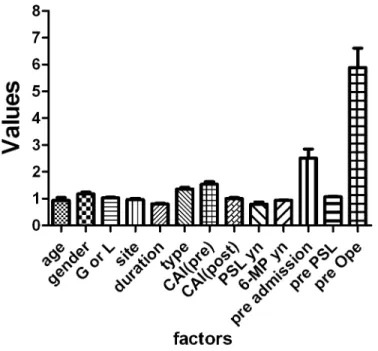
We next attempted to identify factors that critically correlate to the outcome in ANN by using the relative weights of input factors analysis (Fig 1andS1 Table). This analysis involves deter-mining how the result changes when the test factor (Xtest) is excluded. AnXtestvalue greater
than 1 indicates that it improves the expression, and a value less than 1 indicates that it does not improve the expression. We analysed all expressions and determined the corresponding means and standard deviations. As shown inFig 1,X13(history of operation) andX11(history
of admission) were defined as significant predictive factors in every trial.
Independent four factors were the key factors to predict prospective
operation
Given the evidence that events of operation and admission are significant as predictive fac-tors, we deleted those two factors and generated the networks. As shown inTable 4, both
Table 1. Characteristics of patients.
Total n = 90
Age (years) 385±158 (14–77)
Gender Male 55, Female 35
Type of CAP GCAP 63, LCAP 27
Disease extent Proctosigmoiditis 5, Left-sided colitis 26, Pancolitis 55, Others 4 Disease duration (years) 76±71 (0–32)
Clinical Type One-attack 6, relapsing-remitting 79, chronic continuous 5
CAI (before CAP) 92±35
CAI (after CAP) 53±41
Medication
PSL Yes 59, No 31
Immunomodurator (IM) Yes 14, No 76 History of use of PSL Yes 21, No 69 History of admission Yes 20, No 70 History of operation Yes 8, No 62
Continuous data are expressed as mean with range or number in parentheses. CAI: Clinical activity index, CAP: Cytoapheresis, PSL: Prednisolone
doi:10.1371/journal.pone.0131197.t001
Table 2. Factors and outcome used to predict individual patient outcome.
Factors Outcome
X1: Age X8: CAI (after CAP) Operation after CAP 0 = no, 1 = yes
X2: 1 = Male, 2 = Female
X9: Use of PSL before CAP 1 = yes, 2 = no
X3: 1 = GCAP, 2 = LCAP
X10:Use of 6-MP/AZA before CAP 1 = yes, 2 = no
X4: Disease extent X11:History of admission
X5: Duration (year) X12:History of PSL 1 = yes, 2 = no X6: Clinical type X13:History of operation 1 = yes, 2 = no X7: CAI (before CAP)
sensitivity and specificity were decreased into 0.87 and 0.75 respectively by deleting those fac-tors. Since we have previously reported the importance of use of IM and the effect of CAP to the requirement of operation after CAP therapy [13], we also assessed the predictive value without those 4 factors. Both sensitivity and specificity were dramatically decreased into 0.60 and 0.71, respectively, by deleting 4 factors, suggesting those 4 factors were critically related to the outcome.
Discussion
In this study we successfully predicted the requirement of operation after CAP with high sensi-tivity and specificity (0.96 and 0.97 respectively). Since we use the non-linear analysis, we could not know the factor which correlate to outcome in linear way. However, using relative weights of input factors analysis, history of operation and history of admission were defined as impor-tant factors that influence to the prediction (Fig 1andS1 Table). Moreover, gathering to our previous report, we defined two more factors which dramatically influence the outcome; use of IM and the effect of CAP.
In this study we set the simple factors as input. Moreover, use of IM were defined as impor-tant factor for the outcome, we can easily simulate and know the necessity of use of IM in indi-vidual patients from the simulated result.
Patients with UC suffer from repeated remissions and recurrences in refractory course. Especially, surgeon severely impairs the QOL. Accumulating reveal their pathology, new
Fig 1. Relative weights of input factors for ANNs.Data are expressed as the mean±SD for member networks.
doi:10.1371/journal.pone.0131197.g001
Table 3. The sensitivity and specificity provided by ANN.
Sensitivity 96%
Specificity 97%
treatments and the effects, though, there are few reports, which show the prediction about prognosis. One of the difficulties in prediction of effect of treatment and/or prognosis is possi-bly existence of non-linear relation in several factors and the outcome. Most reports in clinical fields use classical linear approach, which could not solve non-linear relations. In contrast, ANNs can identify relationships within a patient’s clinical data that may be overlooked when classical linear approaches are used [18]. Because ANNs are trained using existing data, they are more capable of providing correct answers for individual patients. ANN can predict both linear and non-linear phenomena and can analyse relationships between many variables at dif-ferent levels [23].
To avoid the bias as much as possible, in this study we randomly divided the all data into training data and validation data for 4 more times and evaluated the accuracy with same way. In all trials, both sensitivity and specificity were similar (S2 Table). We note that, although the ANN is a useful model, there is several limitations. First, the network logic of prediction cannot be broken down into simple elements because ANNs process data in a non-linear way [14,18,
23,32]. We used relative weights of input factors analysis to address this issue. Second, ANNs have over-fitting problems that occurs by convergence of expressions. The automatic ANN designer of the software we used avoid this issue by checking on progress of the algorithm using the independent selection set which randomly selected from entire data set.
Both physicians and patients express concern about the risks associated with treatment because it is difficult to predict the outcome at the time decisions are made. Since the increased demand for individualised treatment necessitates new statistics that can be applied in conjunc-tion with ethical and clinical evidence at the individual level, ANNs may have potential eco-nomic benefits in that they reduce unnecessary medical treatment. Although our predictive expression does not predict responses completely, our results show that ANN is a valid method for devising individual treatment regimens in the clinical situation. It is well known that 100% prediction accuracy is impossible to achieve because of random error and multiple biases. Also we believe that it is very important to use various methods (including MLR, ANN and/or newly developed techniques [30]) to uncover the relation between multiple factors and multi-ple outcomes of diseases to realize the tailor-made medicine. As the outcome of CAP treatment and rate of operation may be affected by multiple unknown factors, it is important not only to update data continuously and to acquire clinical data such as the patient’s demographics, medi-cal history, result of endoscopic examination, and laboratory test results, but also to demon-strate that the use of trained ANNs in routine medical practice increases the quality of medical care and reduces costs.
Methods
Patients
One hundred fourteen active UC patients who treated with CAP (granulocytapheresis; GCAP and/or leucocytaphereis; LCAP), and who could be followed-up more than 3 years were histor-ically collected and data from 90 out of the patients were used for further analysis including background, medication and long-term prognosis. For long-term prognosis, we evaluated the
Table 4. The sensitivity and specificity provided by ANN.
All factors Without 2 factors Without 4 factors
Sensitivity 96% 87% 60%
Specificity 97% 75% 71%
rates of operation, re-admission, and use or dose-up of steroid. Clinical efficacy was evaluated by Clinical Activity Index (CAI).
This historical cohort study was conducted at the Keio university hospital. All patients’data who underwent leukocyte apheresis for active UC from 2001 to 2006 were enrolled. 114 patients with clinically active ulcerative colitis treated with GCAP and/or LCAP once or twice a week. 90 patients’data which could be followed the long time prognosis with full clinical data (55 men, 35 women; mean age, 36.4 years) were used for analysis. Average observation time was 4.59 years. Clinical efficacy was evaluated by Clinical Activity Index (CAI) according to the Rachmilewitz’s criteria with questionnaire to the patients [33]. We defined CAI less than 4 as remission, and more than 4 points decrease of CAI as effective according to previous reports [34]. This historical cohort study was conducted at Keio University Hospital and the study was approved by the Keio University School of Medicine review board and the permission was obtained. All patients who underwent CAP for UC with moderate to severe activity between 2001 and 2006 were enrolled. Written or oral informed consent was obtained from all patients and/or the parents of patients younger than 20 years of age.
A questionnaire was designed to review the demographic data, including age, gender, weight, height, either GCAP or LCAP, frequency of CAP therapy (once or twice per week), dis-ease extent, duration, clinical type, CAI of pre 1stcourse of CAP, and medication (use of PSL and/or IM). Outcomes (rates of operation, re-admission, and use or dose-up of steroid) were obtained from the hospital medical records.
Inclusion criteria
Patients inclusion criteria: age between 14 and 77; had endoscopic and histologic diagnosis of UC, not indeterminate colitis; with colonic involvement, had a CAI score more than 5;
Exclusion criteria
Exclusion criteria were patients with evidence of toxic megacolon; with malignancy, with seri-ous concomitant cerebral, pulmonary, cardiac, hepatic or renal disease, and with a history of hypersensitivity reaction during an apheresis.
Cyteapheresis therapy
Patients with moderately active disease were treated in our outpatient clinic, while those with severe disease were treated as in patients. Each patient received five or ten GCAP or LCAP once or twice per week. One GCAP session was 60min at 30ml/min and one LCAP session was 60min at 30–50ml/min. In patients who were receiving corticosteroids at entry, the dose of ste-roids was to be tapered or discontinued in line with clinical improvement during the CAP.
ANN
Training data set and validation data set
We randomly divided the entire dataset into a training dataset (n = 54, for generation of pre-dictive expressions) and validation data set (n = 36). Validation data set was divided into selec-tion set for internal validaselec-tion and test set for external validaselec-tion according to manufacturer’s instruction. We used same training data set for generating the predictive expression by using MLR and ANN, and used validation data set to evaluate the accuracy of the expression gener-ated using training data set.
Input factors and outcome
We used the clinical data to determine input factorsX1–X13, which were used to predict the
outcomes of individual patients using ANN analysis (Table 2).X1andX2represented the
patient’s age and gender, respectively.X3represented the type of CAP andX4–X6represented
the disease extent, duration and clinical type, respectively.X7andX8represented the CAI
before and after CAP respectively.X9andX10represented medication (PSL and 6-MP/AZA,
respectively).X11–X13represented the history of admission, PSL, operation, respectively. The
outcome was requirement of operation after CAP therapy.
Relative weights of input factors analysis
The detail of relative weights of input factors analysis were described elsewhere [25,36]. In brief, we analysed relative weights of input factors using a leave-one-input-factor-out (LOFO) in turn with a missing values substitution procedure, which enables predictions to be made in the absence of values for each causal factor, and then assessed effects upon ANN response error. Root mean square error (RMSE) is an estimate of the typical difference between the pre-dicted and actual values of outcomes. The smaller RMSE is the better prediction accuracy of the models. The network original error was accumulated as RMSEoriginaland the network was
again used with LOFO data and the error RMSELOFOwas estimated. Then, the relative weights
of input factors was calculated as RMSELOFO/RMSEoriginal.
Data analysis
Multiple logistic analysis was performed using JMP version 7.0.1 software (SAS Institute Japan, Co., Ltd, Tokyo, Japan) and ANN was analysed using Statistica version 06J software (StatSoft Japan, Co., Ltd, Tokyo Japan).
Supporting Information
S1 Table. Values of relative weight of input factors analysis. (DOCX)
S2 Table. Sensitivity and specificity of 4 other trials. (DOCX)
Acknowledgments
Author Contributions
Conceived and designed the experiments: TT SO TK. Performed the experiments: TT. Ana-lyzed the data: TT. Contributed reagents/materials/analysis tools: TT SO T. Hisamatsu MN KM SM RB T. Hibi. Wrote the paper: TT TK.
References
1. Saniabadi AR, Hanai H, Fukunaga K, Sawada K, Shima C, Bjarnason I, et al. Therapeutic leukocyta-pheresis for inflammatory bowel disease. Transfus Apher Sci. 2007; 37: 191–200. PMID:17974479 2. Hanai H, Watanabe F, Yamada M, Sato Y, Takeuchi K, Iida T, et al. Adsorptive granulocyte and
mono-cyte apheresis versus prednisolone in patients with corticosteroid-dependent moderately severe ulcer-ative colitis. Digestion. 2004; 70: 36–44. PMID:15297776
3. Hanai H, Watanabe F, Takeuchi K, Iida T, Yamada M, Iwaoka Y, et al. Leukocyte adsorptive apheresis for the treatment of active ulcerative colitis: a prospective, uncontrolled, pilot study. Clin Gastroenterol Hepatol. 2003; 1: 28–35. PMID:15017514
4. Suzuki Y, Yoshimura N, Saniabadi AR, Saito Y. Selective granulocyte and monocyte adsorptive aphe-resis as a first-line treatment for steroid naïve patients with active ulcerative colitis: a prospective uncon-trolled study. Dig Dis Sci. 2004; 49: 565–571. PMID:15185858
5. Naganuma M, Funakoshi S, Sakuraba A, Takagi H, Inoue N, Ogata H, et al. Granulocytapheresis is useful as an alternative therapy in patients with steroid-refractory or-dependent ulcerative colitis. Inflamm Bowel Dis. 2004; 10: 251–257. PMID:15290920
6. Yamamoto T, Umegae S, Kitagawa T, Yasuda Y, Yamada Y, Takahashi D, et al. Granulocyte and monocyte adsorptive apheresis in the treatment of active distal ulcerative colitis: a prospective, pilot study. Aliment Pharmacol Ther. 2004; 20: 783–792. PMID:15379839
7. Kanke K, Nakano M, Hiraishi H, Terano A. Clinical evaluation of granulocyte/monocyte apheresis ther-apy for active ulcerative colitis. Dig Liver Dis. 2004; 36: 811–817. PMID:15646427
8. Yamamoto T, Saniabadi AR, Umegae S, Matsumoto K. Impact of selective leukocytapheresis on muco-sal inflammation and ulcerative colitis: cytokine profiles and endoscopic findings. Inflamm Bowel Dis. 2006; 12: 719–726. PMID:16917227
9. Yamamoto T, Saniabadi AR, Maruyama Y, Umegae S, Matsumoto K. Factors affecting clinical and endoscopic efficacies of selective leucocytapheresis for ulcerative colitis. Dig Liver Dis. 2007; 39: 626–
633. PMID:17532273
10. Sakuraba A, Motoya S, Watanabe K, Nishishita M, Kanke K, Matsui T, et al. An open-label prospective randomized multicenter study shows very rapid remission of ulcerative colitis by intensive granulocyte and monocyte adsorptive apheresis as compared with routine weekly treatment. Am J Gastroenterol. 2009; 104: 2990–2995. doi:10.1038/ajg.2009.453PMID:19724269
11. Sands BE, Sandborn WJ, Feagan B, Lofberg R, Hibi T, Wang T, et al. A randomized, double-blind, sham-controlled study of granulocyte/monocyte apheresis for active ulcerative colitis. Gastroenterol-ogy. 2008; 135: 400–409. doi:10.1053/j.gastro.2008.04.023PMID:18602921
12. Hibi T, Sameshima Y, Sekiguchi Y, Hisatome Y, Maruyama F, Moriwaki K, et al. Treating ulcerative coli-tis by Adacolumn therapeutic leucocytapheresis: clinical efficacy and safety based on surveillance of 656 patients in 53 centres in Japan. Dig Liver Dis. 2009; 41: 570–577. doi:10.1016/j.dld.2008.11.020 PMID:19211314
13. Takayama T, Kanai T, Matsuoka K, Okamoto S, Sujino T, Mikami Y, et al. Long-term prognosis of patients with ulcerative colitis treated with cytapheresis therapy. J Crohns Colitis. 2013; 7: e49–54. doi: 10.1016/j.crohns.2012.05.005PMID:22633997
14. Baxt WG. Application of artificial neural networks to clinical medicine. Lancet. 1995; 346: 1135–1138. PMID:7475607
15. Cross SS, Harrison RF, Kennedy RL. Introduction to neural networks. Lancet. 1995; 346: 1075–1079. PMID:7564791
16. Grossi E, Mancini A, Buscema M. International experience on the use of artificial neural networks in gastroenterology. Dig Liver Dis. 2007; 39: 278–285. PMID:17275425
17. Pace F, Savarino V. The use of artificial neural network in gastroenterology: the experience of the first 10 years. Eur J Gastroenterol Hepatol. 2007; 19: 1043–1045. PMID:17998826
18. Grossi E, Buscema M. Introduction to artificial neural networks. Eur J Gastroenterol Hepatol. 2007; 19: 1046–1054. PMID:17998827
20. Haydon GH, Flegg PJ, Blair CS, Brettle RP, Burns SM, Hayes PC. The impact of chronic hepatitis C virus infection on HIV disease and progression in intravenous drug users. Eur J Gastroenterol Hepatol. 1998; 10: 485–489. PMID:9855064
21. Maiellaro PA, Cozzolongo R, Marino P. Artificial neural networks for the prediction of response to inter-feron plus ribavirin treatment in patients with chronic hepatitis C. Curr Pharm Des. 2004; 10: 2101–
2109. PMID:15279549
22. Das A, Wong RC. Prediction of outcome in acute lower gastrointestinal hemorrhage: role of artificial neural network. Eur J Gastroenterol Hepatol. 2007; 19: 1064–1069. PMID:17998830
23. Das A, Ben-Menachem T, Cooper GS, Chak A, Sivak MV Jr., Gonet JA, et al. Prediction of outcome in acute lower-gastrointestinal haemorrhage based on an artificial neural network: internal and external validation of a predictive model. Lancet. 2003; 362: 1261–1266. PMID:14575969
24. Haydon GH, Jalan R, Ala-Korpela M, Hiltunen Y, Hanley J, Jarvis LM, et al. Prediction of cirrhosis in patients with chronic hepatitis C infection by artificial neural network analysis of virus and clinical fac-tors. J Viral Hepat. 1998; 5: 255–264. PMID:9751012
25. Takayama T, Ebinuma H, Tada S, Yamagishi Y, Wakabayashi K, Ojiro K, et al. (2011) Prediction of effect of pegylated interferon alpha-2b plus ribavirin combination therapy in patients with chronic hepati-tis C infection. PLoS One. 2011 Dec 2. 6(12): e27223. doi:10.1371/journal.pone.0027223PMID: 22164207
26. Takayama T, Takayama K, Inoue N, Funakoshi S, Serizawa H, Watanabe N, et al. Prediction of survival and complications after percutaneous endoscopic gastrostomy in an individual by using clinical factors with an artificial neural network system. Eur J Gastroenterol Hepatol. 2009; 21: 1279–1285. doi:10. 1097/MEG.0b013e32832a4eaePMID:19478677
27. Hirose H, Takayama T, Hozawa S, Hibi T, Saito I. Prediction of metabolic syndrome by using artificial neural network system based on clinical data including insulin resistance index and serum adiponectin level. Comp Biol Med. 2011; 41: 1051–1056.
28. Ligor T, PaterŁ, Buszewski B. Application of an artificial neural network model for selection of potential lung cancer biomarkers. J Breath Res. 2015; 9: 027106. doi:10.1088/1752-7155/9/2/027106PMID: 25944812
29. Stylianou N, Akbarov A, Kontopantelis E, Buchan I, Dunn KW. Mortality risk prediction in burn injury: Comparison of logistic regression with machine learning approaches. Burns. 2015 Apr 27. pii: S0305-4179(15)00095-9. doi:10.1016/j.burns.2015.03.016
30. Sangi M, Win KT, Shirvani F, Namazi-Rad MR, Shukla N. Applying a novel combination of techniques to develop a predictive model for diabetes complications. PLoS One. 2015 Apr 22; 10(4):e0121569. doi:10.1371/journal.pone.0121569PMID:25902317
31. Huang RS, Nedelcu E, Bai Y, Wahed A, Klein K, Tint H, et al. Post-operative bleeding risk stratification in cardiac pulmonary bypass patients using artificial neural network. Ann Clin Lab Sci. 2015; 45: 181–
186. PMID:25887872
32. Baxt WG. Use of an artificial neural network for the diagnosis of myocardial infarction. Ann Intern Med. 1991; 115: 843–848. PMID:1952470
33. Rachmilewitz D. Coated mesalazine (5-aminosalicylic acid) versus sulphasalazine in the treatment of active ulcerative colitis: a randomised trial. BMJ. 1989; 298: 82–86. PMID:2563951
34. Ogata H, Matsui T, Nakamura M, Iida M, Takazoe M, Suzuki Y, et al. A randomised dose finding study of oral tacrolimus (FK506) therapy in refractory ulcerative colitis. Gut. 2006; 55: 1255–1262. PMID: 16484504
35. Takayama K, Morva A, Fujikawa M, Hattori Y, Obata Y, Nagai T. Formula optimization of theophylline controlled-release tablet based on artificial neural networks. J Control Release. 2000; 68: 175–186. PMID:10925126