www.atmos-chem-phys.net/14/12983/2014/ doi:10.5194/acp-14-12983-2014
© Author(s) 2014. CC Attribution 3.0 License.
Effect of different emission inventories on modeled ozone and
carbon monoxide in Southeast Asia
T. Amnuaylojaroen1,2, M. C. Barth2, L. K. Emmons2, G. R. Carmichael3, J. Kreasuwun1,4, S. Prasitwattanaseree5, and S. Chantara1
1Environmental Science Program and the Center for Environmental Health, Toxicology and Management of Chemical, Chiang Mai University, Faculty of Science, Chiang Mai, Thailand 2Atmospheric Chemistry Division (ACD), National Center for Atmospheric Research (NCAR), Boulder, CO, USA
3Center for Global and Regional Environmental Research, The University of Iowa, Iowa City, IA, USA 4Department of Physics and Materials Science, Faculty of Science, Chiang Mai University, Chiang Mai, Thailand
5Department of Statistics, Faculty of Science, Chiang Mai University, Chiang Mai, Thailand Correspondence to:T. Amnuaylojaroen ([email protected]) and M. C. Barth ([email protected]) Received: 5 March 2014 – Published in Atmos. Chem. Phys. Discuss.: 7 April 2014
Revised: 17 September 2014 – Accepted: 8 October 2014 – Published: 8 December 2014
Abstract.In order to improve our understanding of air qual-ity in Southeast Asia, the anthropogenic emissions inven-tory must be well represented. In this work, we apply differ-ent anthropogenic emission invdiffer-entories in the Weather Re-search and Forecasting Model with Chemistry (WRF-Chem) version 3.3 using Model for Ozone and Related Chem-ical Tracers (MOZART) gas-phase chemistry and Global Ozone Chemistry Aerosol Radiation and Transport (GO-CART) aerosols to examine the differences in predicted car-bon monoxide (CO) and ozone (O3) surface mixing ra-tios for Southeast Asia in March and December 2008. The anthropogenic emission inventories include the Reanaly-sis of the TROpospheric chemical composition (RETRO), the Intercontinental Chemical Transport Experiment-Phase B (INTEX-B), the MACCity emissions (adapted from the Monitoring Atmospheric Composition and Climate and megacity Zoom for the Environment projects), the Southeast Asia Composition, Cloud, Climate Coupling Regional Study (SEAC4RS) emissions, and a combination of MACCity and SEAC4RS emissions. Biomass-burning emissions are from the Fire Inventory from the National Center for Atmospheric Research (NCAR) (FINNv1) model. WRF-Chem reasonably predicts the 2 m temperature, 10 m wind, and precipitation. In general, surface CO is underpredicted by WRF-Chem while surface O3 is overpredicted. The NO2tropospheric column
predicted by WRF-Chem has the same magnitude as obser-vations, but tends to underpredict the NO2 column over the equatorial ocean and near Indonesia. Simulations using dif-ferent anthropogenic emissions produce only a slight vari-ability of O3and CO mixing ratios, while biomass-burning emissions add more variability. The different anthropogenic emissions differ by up to 30 % in CO emissions, but O3and CO mixing ratios averaged over the land areas of the model domain differ by∼4.5 % and∼8 %, respectively, among the
simulations. Biomass-burning emissions create a substantial increase for both O3and CO by∼29 % and∼16 %, respec-tively, when comparing the March biomass-burning period to the December period with low biomass-burning emissions. The simulations show that none of the anthropogenic emis-sion inventories are better than the others for predicting O3 surface mixing ratios. However, the simulations with differ-ent anthropogenic emission invdiffer-entories do differ in their pre-dictions of CO surface mixing ratios producing variations of
12984 T. Amnuaylojaroen et al.: Effect of different emission inventories 1 Introduction
Southeast Asia, which includes the Indochina peninsula and the Indonesian archipelago, can have significant air qual-ity problems. Understanding the contribution of different sources of tropospheric ozone (O3)and its precursors, carbon monoxide (CO) and nitrogen oxides (NOx=NO+NO2), for Southeast Asia provides valuable information on maintaining good air quality for both human well being and ecosystems. Previous studies examining air pollutants and their sources via regional model simulations have focused primarily on China (e.g., Wang et al., 2005; Geng et al., 2011), eastern Asia (Han et al., 2008; Tanimoto et al., 2009), and India (Ad-hikary et al., 2007; Kumar et al., 2012; Ghude et al., 2013). Here, we examine the effect of different emission inventories on modeled surface O3and CO for Southeast Asia, a region generally ignored in previous studies.
Previous studies have indicated that both local anthro-pogenic and biomass-burning emissions, as well as emissions upstream are important for local O3 air quality in Asia. In eastern Asia, Tanimoto et al. (2009) noted relatively small changes in decadal O3trends at sites near the Japanese coast, but a larger increase in measured O3at a remote mountain-ous site in Japan. Using a regional chemistry transport model, Tanimoto et al. (2009) attributed half of the observed in-crease at the mountainous site to increasing anthropogenic emissions in Asia. The results from this study suggested that the actual growth in emissions between 1998 and 2007 was significantly underestimated. Using a nested eastern Asia do-main within a global chemistry transport model, Wang et al. (2011) found that local sources of O3precursors produced much of the O3in the region; however, O3transported from Europe, North America, India, and Southeast Asia also im-pacted O3concentrations in eastern China depending on the season. Liu et al. (2008), using a regional air quality model, determined that fossil fuel and biomass-burning emissions from eastern Asia increased surface CO and O3in Taiwan by 70–150 % and 50–100 %, respectively, compared to model results that excluded background emissions. They attributed up to 20 % of the surface CO and O3in Taiwan to biomass-burning emissions from eastern China. Both the aerosol opti-cal depth and O3concentrations in the Pearl River delta were also found to be affected by biomass-burning emissions oc-curring upstream in Southeast Asia (Deng et al., 2008).
Southeast Asia is subject to the outflow of pollution from the main continent, yet the region itself is rapidly grow-ing and has increasgrow-ing anthropogenic and biomass-burngrow-ing emissions, which are especially high during the dry sea-son (November–April). To simulate O3production and con-centrations in Southeast Asia, realistic estimates of emis-sions from both local and regional sources, including fos-sil fuel use, other anthropogenic activities, and biomass burning, must be available. Emission inventories for Asia have been developed by several groups (e.g., Akimoto and Narita, 1994; Streets et al., 2003; Ohara et al., 2007; Zhang
et al., 2009; Kurokawa et al., 2013) for both chemistry– climate and air quality studies. For example, the REanal-ysis of the TROpospheric chemical composition (RETRO) and the Emission Database for Global Atmospheric Research (EDGAR) emissions inventories (Olivier et al., 2005; Schultz et al., 2007) are global emissions inventories developed for chemistry–climate studies. Streets et al. (2003) developed a 2001 emission inventory for the ACE-Asia (Asian Pacific Re-gional Aerosol Characterization Experiment) and TRACE-P (Transport and Chemical Evolution over the TRACE-Pacific) field campaigns which took place in the eastern Asian and west-ern Pacific region during spring 2001. Zhang et al. (2009) developed a 2006 emissions inventory for Asia to support the Intercontinental Chemical Transport Experiment-Phase B (INTEX-B) field campaign. The INTEX-B field campaign emphasized China emissions because they dominate the Asia pollutant outflow to the Pacific. Ohara et al. (2007) devel-oped the Regional Emission inventory in Asia (REAS) for 1980–2020 in order to conduct air quality studies for re-cent past, present-day, and near-future time periods. More recently, Kurokawa et al. (2013) released REAS version 2.1, providing updated emissions for each year from 2000 to 2008 for Asian countries east of ∼55◦E. The MACCity
(adapted from the Monitoring Atmospheric Composition and Climate and megacity Zoom for the Environment projects) emissions inventory (Granier et al., 2011), which is an out-come from two European Commission projects (MACC and CityZen), is a 1980–2010 global emissions inventory for chemistry–climate studies. Most recently the Southeast Asia Composition, Cloud, Climate Coupling by Regional Study (SEAC4RS) emissions inventory (Lu and Streets, 2012) for 2012 emissions has been released for field campaign sup-port. Four emission inventories, RETRO, INTEX-B, MACC-ity, and SEAC4RS, will be described in more detail in Sect. 3. While previous studies (e.g., Ohara et al., 2007) have com-pared different emission inventories, a comparison of simu-lated surface CO and O3mixing ratios resulting from differ-ent emission invdiffer-entories, yet using the same model frame-work, has not been done. Here, the Weather and Forecasting Model coupled with Chemistry (WRF-Chem) is used to ex-amine the variability of predicted O3and CO surface mixing ratios when five different anthropogenic emission inventories (RETRO, INTEX-B, MACCity, SEAC4RS and a modified SEAC4RS) are used as inputs. By conducting this compari-son using the same model, differences in results due to model meteorology are mitigated. We focus this study on Southeast Asia, an area that has received little attention, yet has sub-stantial anthropogenic and biomass-burning emissions. As part of our study, we examine the effect of biomass-burning emissions on surface O3and CO by the contrasting results from a low biomass-burning period (December) with a high biomass-burning period (March).
(Sect. 4) with available data sets. In Sect. 5, we compare the surface O3and CO predictions among the different simula-tions in order to quantify the variability produced by the dif-ferent emission inventories.
2 Model description and configuration
We use the Weather Research Forecasting Model (Ska-marock et al., 2008) coupled with Chemistry (WRF-Chem version 3.3) to investigate the variation of O3and CO pre-dictions among different anthropogenic emissions invento-ries for Southeast Asia. The WRF-Chem model is a new-generation regional air quality model (Grell et al., 2005; Fast et al., 2006) that shares the meteorology and chem-istry routines, the same land surface schemes, time-transport schemes, vertical mixing parameterizations, and time steps for transport and vertical mixing.
For this study, one model domain was configured to cover the entire area of Southeast Asia and a part of China and India (Fig. 1). The model was run with a horizontal grid spacing of 36 km and 51 vertical levels from the surface to 10 hPa. The vertical grid spacing stretched from∼60 m near the surface
to ∼700 m near the tropopause. The initial and boundary
conditions were from National Centers for Environmental Prediction (NCEP) final analysis (FNL) 1◦×1◦data for
me-teorological variables, which include winds, potential tem-perature, pressure, and water vapor. These variables and con-densed water (i.e., cloud particles) and chemistry species were integrated forward in time using a Runge–Kutta integra-tion method. The moisture variables and chemistry species were advected using a monotonic scheme (Wang et al., 2009). Grid nudging (Stauffer and Seaman, 1990) was em-ployed for the horizontal wind, temperature, and water vapor for all vertical levels to ensure the accuracy of the large-scale meteorology during the month of simulation. The nudging coefficients for all variables were set to be 0.0003 s−1, and nudging was performed every 6 hours, consistent with the timing of the FNL data.
The model setup used the following modules and parame-terizations. Cloud physics was represented by the Thompson et al. (2004) parameterization, which predicts the mass mix-ing ratio for rain, snow, and graupel and mass and number of cloud water and cloud ice. The Grell-3 scheme, based on the Grell and Devenyi (2002) scheme, was used for the pa-rameterization of sub-grid convection. The planetary bound-ary layer was parameterized with the Mellor–Yamada–Janjic (MYJ) scheme (Janjic, 2002), and the Noah land surface model (Chen and Dudhia, 2001) was used to provide heat and moisture fluxes over land. For heating rates, the Goddard scheme (Chou and Suarez, 1994) was used for shortwave ra-diation and the Rapid Radiative Transfer Model (Mlawer et al., 1997) was used for long-wave radiation. Feedbacks be-tween aerosols and the radiation scheme were not included in any simulations.
The model is integrated for a 6 1/2 week period. The first 2 weeks are for spinning up the model from the initial con-ditions to a state that is primarily affected by the emissions. Initial and boundary conditions for the chemical species were provided by the global chemistry Model for Ozone and Re-lated Chemical Tracers, version 4 (MOZART4; Emmons et al., 2010) 6-hourly output. MOZART4 includes 84 gas-phase species, 12 bulk aerosol compounds, 39 photolysis, and 127 phase reactions. In our WRF-Chem simulations, gas-phase chemistry was represented by the MOZART chemistry mechanism and aerosols by the GOCART representation (Chin et al., 2000). A kinetic pre-processor and Rosenbrock solver (Sandu et al., 2006) were applied. The photolysis rates were computed using fast-TUV ( tropospheric ultraviolet– visible) (Tie et al., 2003), which modifies the photolysis rates based on the presence of aerosols and clouds in each model grid cell. Dry deposition of gases and aerosols followed the Wesely (1989) resistance method. Wet deposition of soluble gases was calculated using the method described by Neu and Prather (2012).
Emissions from biomass burning, undisturbed vegetation, and anthropogenic sources were included in the simulations. The Fire Inventory from the National Center for Atmospheric Research (NCAR) (FINN) model (Wiedinmyer et al., 2010) provided daily, 1 km resolution, global estimates of trace gas and particulate emissions from open burning including wild-fires, agricultural wild-fires, and prescribed burning for all the simulations conducted. Biofuel use and trash burning were not included in the FINN emission estimates. Biogenic emis-sions were computed online by the Model of Emisemis-sions of Gases and Aerosols from Nature (MEGAN) version 2.04 (Guenther et al., 2006), which uses WRF-predicted temper-ature and downward radiation for its calculations. The an-thropogenic emission inventories used as inputs to the WRF-Chem simulations are described in Sect. 3.1.
3 Emissions
predic-12986 T. Amnuaylojaroen et al.: Effect of different emission inventories
Figure 1.CO emissions for March 2008 from different emission inventories:(a)MACCity–SEAC4RS,(b)biomass burning,(c)RETRO - MACCity–SEAC4RS, (d) INTEX-B - MACCity–SEAC4RS, (e) MACCity - MACCity–SEAC4RS, and (f) SEAC4RS - MACCity– SEAC4RS.
tions with monitoring station observations and (2) determine the extent to which the model predictions are limited by vari-ations in the emissions inventories.
3.1 Description of the anthropogenic emission inventories
The RETRO project aimed at analyzing the long-term changes in the atmospheric budget of trace gases and aerosols over the time period from 1960 to 2000. The RETRO anthro-pogenic emissions (Schultz et al., 2007) are derived from a
Figure 2. CO emissions for December 2008 from different emission inventories: (a)MACCity–SEAC4RS, (b) biomass burning, (c) RETRO - MACCity–SEAC4RS,(d)INTEX-B - MACCity–SEAC4RS,(e)MACCity - MACCity–SEAC4RS, and(f)SEAC4RS - MACCity– SEAC4RS.
weekly and diurnal profiles of emissions. For the Southeast Asia region the RETRO seasonal cycle is based on the Long Term Ozone Simulation and European Operational Smog (LOTOS-EUROS) European monthly pattern (Schaap et al., 2005; which is derived from a critical review of the monthly variation by emission sector), but has a reduced amplitude. Kurokawa et al. (2013) show that there is very little sea-sonal cycle for anthropogenic emissions of NOx and black carbon over India, which is a region similar to Southeast Asia in terms of climate. The RETRO inventory provided regional information for the emissions of a variety of
non-methane volatile organic compounds (NMVOCs) including ethane, propane, butanes, pentanes, hexanes and higher alka-nes, ethene, propene, ethyne, other alkenes and alkyalka-nes, ben-zene, toluene, xylene, trimethyl benzenes and other aromat-ics, organic alcohols, esters, ethers, chlorinated hydrocar-bons, formaldehyde and other aldehydes, ketones, organic acids, and other VOCs.
cam-12988 T. Amnuaylojaroen et al.: Effect of different emission inventories
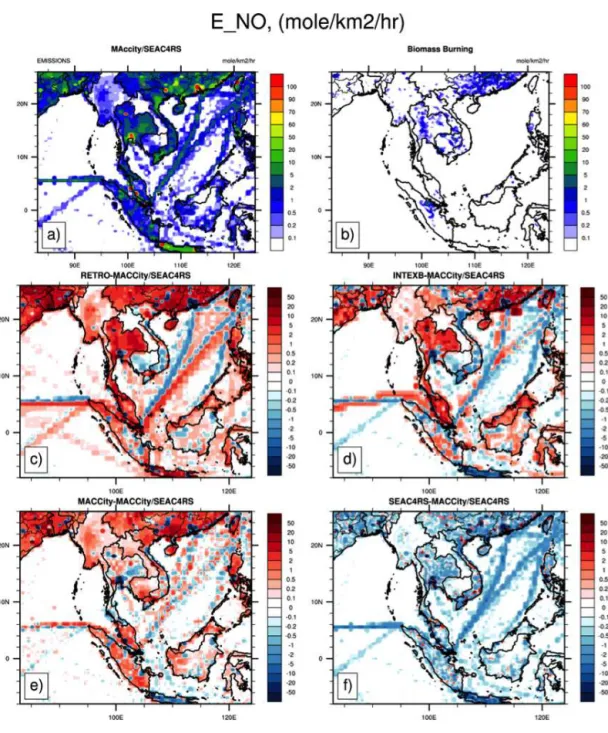
Figure 3.Nitrogen oxides emissions for March 2008 from different emission inventories:(a)MACCity–SEAC4RS,(b)biomass burning,(c) RETRO - MACCity–SEAC4RS,(d)INTEX-B - MACCity–SEAC4RS,(e)MACCity - MACCity–SEAC4RS, and(f)SEAC4RS - MACCity– SEAC4RS.
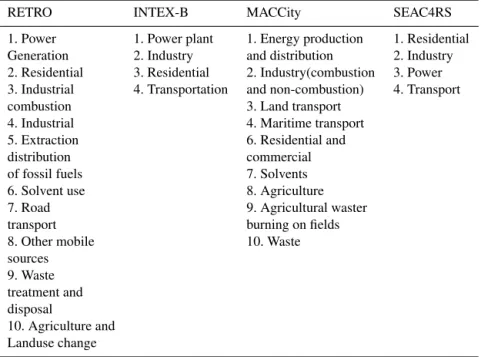
paign (Zhang et al., 2009). The emissions are estimated for eight major chemical species, sulfur dioxide (SO2), NOx, CO, NMVOCs, PM10, PM2.5, black carbon (BC) and or-ganic carbon (OC), with a spatial resolution of 0.5◦×0.5◦. To represent the individual VOCs represented in the MOZART mechanism, the NMVOC emissions are speciated based on the ratios of the individual VOC to the total NMVOCs de-rived from the RETRO inventory; that is, the individual VOC fraction from the RETRO inventory is multiplied with the total INTEX-B NMVOC to get the individual VOC emis-sions. The INTEX-B emissions contain four major sectors
(Table 1): power generation, industry, residential, and trans-portation. The uncertainty of the INTEX-B emissions for the Southeast Asian countries is estimated to be similar to the TRACE-P emissions uncertainty (Zhang et al., 2009), e.g.,±37 % for NOx emissions and±185 % for CO
emis-sions. The INTEX-B emissions uncertainties for China are smaller (±31 % for NOxand±70 % for CO).
At-Figure 4.Nitrogen oxides emissions for December 2008 from different emission inventories:(a)MACCity–SEAC4RS,(b)biomass burn-ing,(c)RETRO - MACCity–SEAC4RS,(d)INTEX-B - MACCity–SEAC4RS,(e)MACCity - MACCity–SEAC4RS, and(f)SEAC4RS -MACCity–SEAC4RS.
mospheric Chemistry and Climate Model Intercomparison Project (ACCMIP) historical emissions data set (Lamarque et al., 2010). The goal of the MACCity emissions inven-tory is to support the IPCC-AR5 (Intergovernmental Panel for Climate Change Assessment Report 5), providing histor-ical emissions from a variety of emission sectors (Table 1) on a decadal basis from 1960 to 2020, as well as for future emissions scenarios based on RCPs (Representation Concen-tration Pathways; van Vuuren et al., 2011). Anthropogenic emissions have been interpolated on a yearly basis between
12990 T. Amnuaylojaroen et al.: Effect of different emission inventories
Table 1.Emission sectors used in the model simulations from each emission inventory.
RETRO INTEX-B MACCity SEAC4RS
1. Power 1. Power plant 1. Energy production 1. Residential Generation 2. Industry and distribution 2. Industry 2. Residential 3. Residential 2. Industry(combustion 3. Power 3. Industrial 4. Transportation and non-combustion) 4. Transport combustion 3. Land transport
4. Industrial 4. Maritime transport 5. Extraction 6. Residential and
distribution commercial
of fossil fuels 7. Solvents 6. Solvent use 8. Agriculture
7. Road 9. Agricultural waster
transport burning on fields
8. Other mobile 10. Waste sources
9. Waste treatment and disposal
10. Agriculture and Landuse change
by Lamarque et al. (2010) who did not find significant biases in their comparison of 2000 MACCity emissions with pub-lished emission estimates (e.g., RETRO and EDGAR). How-ever, they estimate that these emissions have an uncertainty of about a factor of 2 based on Bond et al. (2004, 2007) and Smith et al. (2010). The uncertainty of the 2010 emissions was not reported. In this study, we use the 2010 emissions estimates from MACCity, which are based on the RCP8.5 scenario.
The SEAC4RS emissions inventory (Lu and Streets, 2012), a regional anthropogenic emission data set prepared for the NASA SEAC4RS field campaign and for the Asia region, represents an update of the TRACE-P emissions (Streets et al., 2003). These emissions are appropriate for year 2012 and include four emissions sectors: residential, industry, power, and transportation (Table 1). There are 10 major chemical species, CH4, CO, NOx, NMVOC, CO2, SO2, PM10, PM2.5, BC, and OC, with spatial resolution of 0.1◦×0.1◦ . Not only does this emissions inventory pro-vide a finer resolution than the other inventories applied in this study, the SEAC4RS emissions data include an up-date of the Asia emission estimates using new energy use data and updated emission factors (both reflecting the year 2012), as well as the development of a new emission inven-tory for Southeast Asia using a technology-based methodol-ogy, which is the first detailed emission update for the re-gion since TRACE-P. Similar to the INTEX-B inventory de-scribed above, the total NMVOC emissions were speciated to the individual VOC species of the MOZART-4 mechanism using fractions derived from the RETRO inventory.
In addition to the four inventories described above, we have conducted a simulation with a combined MACCity– SEAC4RS emissions inventory, which replaces MACCity with the SEAC4RS emissions over Asia yet includes the MACCity ship emissions, which include international ship-ping, domestic shipship-ping, and fishing. Note, that in the RETRO and INTEX-B inventories, ship emissions repre-sent only international shipping. The ship emissions for RETRO, INTEX-B, and MACCity are listed in Table 2. In the MACCity emissions inventory, ship emissions ac-count for 15 % of the NO emissions and 0.8 % of the CO emissions. To ensure consistency in the MACCity– SEAC4RS simulation, the SEAC4RS emissions have been regridded from 0.1◦×0.1◦resolution to 0.5◦×0.5◦. This re-gridding causes differences between the SEAC4RS-only and MACCity–SEAC4RS emissions outside the shipping regions in the model domain.
12992 T. Amnuaylojaroen et al.: Effect of different emission inventories
Figure 6. Accumulated precipitation (mm)(a)GPCC, March, (b)TRMM, March,(c)WRF, March(d) GPCC, December(e)TRMM, December,(f)WRF, December.
each month (FracMonthly) was calculated from the ratio of the RETRO monthly emissions (RETROMonthly) to the RETRO annual emissions (RETROAnnual). The monthly fraction was then multiplied by the annual emissions of both the INTEX-B and SEAC4RS inventories to estimate the monthly emis-sions. This procedure is described by the following equa-tions:
RETROAnnual= 12 X
i=1
RETROMonthly, (1)
FracMonthly(i)=
RETROMonthly(i) RETROAnnual
, (2)
EmissionMonthly(i)=FracMonthly(i)×EmissionAnnual, (3) where the EmissionMonthlyis the monthly emissions for the INTEX or SEAC4RS inventory and EmissionAnnualis the an-nual emissions from the INTEX or SEAC4RS inventory. 3.2 Emission comparison
The monthly emissions from the five different anthropogenic emissions inventories and the biomass-burning emissions calculated by the FINN model for CO and NOxare compared
for both March and December in Fig. 1–4. The sum of these emissions over the entire model domain is listed in Table 2. In March, the biomass-burning sources dominate the emis-sions of CO. The biomass burning occurs primarily over the Indochina peninsula and Southeast China where CO biomass emissions dominate the inventory. In March in Southeast Asia,∼70 % of the total CO emissions is from biomass
burn-ing and only∼30 % is from anthropogenic emissions. This
partitioning is true for all the emission inventories applied in this study. In December, the biomass-burning emissions are much smaller.
Anthropogenic emissions of CO vary between emissions inventories, with RETRO and MACCity emissions having higher values, particularly in northeast India and South-east China. Over the entire domain, the anthropogenic NOxemissions are quite similar between RETRO, INTEX-B, MACCity, and MACCity–SEAC4RS emissions, but are much smaller in the SEAC4RS inventory, since this inven-tory alone does not include ship emissions. By comparing RETRO emissions to MACCity–SEAC4RS emissions, the total anthropogenic emissions in Southeast Asia decreased by∼30 % for CO and ∼13 % for NO between 2000 and
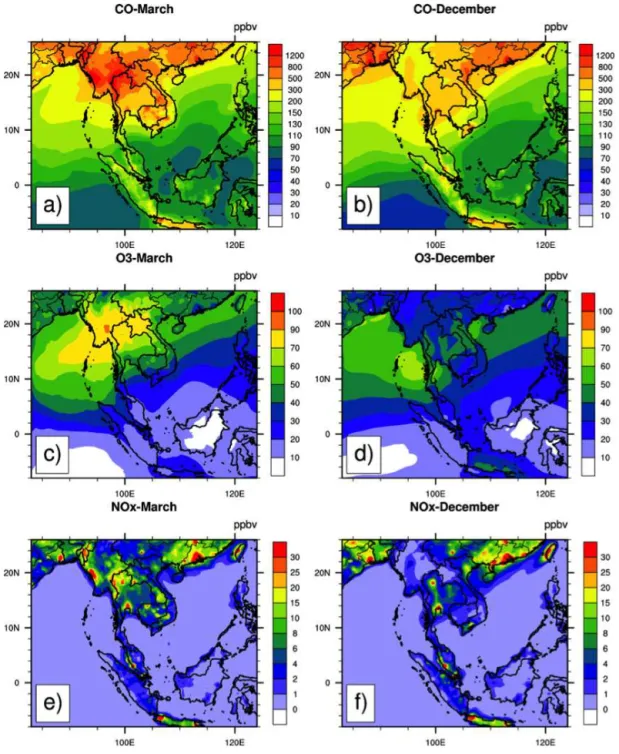
Figure 7.Monthly mean, surface mixing ratios for(a)and(b)CO,(c)and(d)O3(e)and(f)NOxpredicted by WRF-Chem using the average from five emission inventories for March (left) and December (right panels) 2008.
Comparison of the total CO emissions from the various inventories across Southeast Asia (Table 2) shows that in March, the RETRO inventory is within±5 % of the
INTEX-B and MACCity inventories, but is∼20 % greater than the
MACCity–SEAC4RS and SEAC4RS inventories. In Decem-ber, the CO MACCity–SEAC4RS inventory is 35 % lower than the RETRO emissions inventory. The SEAC4RS NO emissions are substantially less (∼45 %) than the other
in-ventories in both March and December because of the lack
of ship emissions in the SEAC4RS inventory. NO emissions in the INTEX-B and MACCity inventories are similar to each other and∼10 % lower than the RETRO emissions. In
De-cember, the INTEX-B, MACCity, and MACCity–SEAC4RS NO emissions are similar and are ∼25 % lower than the
RETRO inventory.
12994 T. Amnuaylojaroen et al.: Effect of different emission inventories
Figure 8.Variations of surface mixing ratios for(a)and(b)CO,(c)and(d)O3(e)and(f)NOxpredicted by WRF-Chem using the averaged from five emission inventories for March (left) and December (right panels) 2008.
Table 2 comes from the Emissions of atmospheric Com-pounds and Compilation of Ancillary Data (ECCAD) web site (http://eccad.sedoo.fr) to obtain emission estimates for the same region as our model domain, which encompasses small regions of India and China that are not included in the Southeast Asia region denoted by Ohara et al. (2007). For our model domain the REAS v1 annual emissions are 91.4 Tg yr−1 for CO and 4.81 Tg yr−1 for NOx. For the Southeast Asia region, Ohara et al. (2007) report in their Table 6 annual CO and NOx emissions of 54.5 and 3.77 Tg yr−1, respectively, but these exclude international aviation, international shipping, and open biomass
Figure 9.Scatterplots of 6-hourly daytime CO from WRF-Chem using different emissions inventories (red dots are RETRO emissions, teal dots are SEAC4RS, orange dots MACCity, green dots INTEX-B, and blue dots are combined MACCity and SEAC4RS) and ground-based observations for March and December.
4 Data used for the model evaluation
To evaluate the ability of the WRF-Chem model to represent the meteorology and chemical composition over Southeast
12996 T. Amnuaylojaroen et al.: Effect of different emission inventories
Table 2.Summation of CO emissions and NO emissions (mole km−2h−1)from all grids in the model domain for each month.
Emission Inventory E_CO (mole km−2h−1) E_NO (mole km−2h−1)
March December March December
RETRO–2000 410 840 496 860 30 590 39 320 INTEX-B–2006 396 170 406 240 27 410 29 640 MACCity–2010 436 750 454 250 27 440 28 280 MACCity–SEAC4RS 319 420 320 310 29 810 30 910 SEAC4RS–2012 305 542 300 369 16 610 17 290 Biomass Burning–2008 717 940 58 780 10 220 700
RETRO-Ship 3404 3364 5097 5186
INTEX-B-Ship 5888 5785 3273 3301
MACCity-Ship 3569 3717 3980 5138
REAS v1a– 2000 282 120 13 828
aREAS v1 emissions are from the ECCAD web site (http://eccad.sedoo.fr) and are the annual emissions converted to hourly emissions assuming constant emissions for the year over the WRF-Chem model domain.
4.1 Meteorology data description
The predicted meteorology from the WRF simulations, which is the same for all model simulations, was evaluated by comparing 2 m temperature, 10 m winds, and precipita-tion with existing observaprecipita-tions. The observaprecipita-tions used for this evaluation include the Modern-Era Retrospective Anal-ysis For Research And Applications (MERRA) products, the Tropical Rainfall Measuring Mission (TRMM) satellite data, and data from the Global Precipitation Climatology Center (GPCC).
The MERRA product (Rienecker et al., 2011) is gener-ated using version 5.2.0 of the GEOS-5 DAS (Goddard Earth Observing System Model Data Assimilation System) with the model and analysis each at about 0.5◦×0.6◦resolution. MERRA has complete analysis of over 30 years (from 1979 to present) of data. The 2 m temperature and 10 m winds pro-duced by the MERRA analysis system are hourly. However, the provided monthly averaged data were used here to evalu-ate the WRF results.
The main objective of the TRMM satellite (Huffman et al., 1997), which is a joint mission between NASA and Japan Aerospace Exploration Agency (JAXA), is to monitor rain-fall in the tropics. We compare the WRF-Chem monthly sur-face rainfall to the TRMM product that is a combination of instruments, including the precipitation radar and TRMM microwave imager, allowing us to compare model results with the high-resolution data from the precipitation radar filled in by data from the TRMM Microwave Imager. The precipitation gauge analysis is used to correct any biases in the satellite data (Huffman and Bolvin, 2012).
Monthly precipitation from the GPCC data set (Rudolf et al., 2005a,b) is obtained from global station data that is grid-ded onto a 1◦×1◦global domain. The GPCC monthly
precip-itation product is based on anomalies from the climatological mean at each station. The anomalies are spatially interpolated by using a modified version of the robust empirical
interpola-tion method SPHEREMAP. The method constitutes a spher-ical adaptation (Willmott et al., 1985) of Shepard’s empirspher-ical weighting scheme (Shepard, 1968; Schneider et al., 2011). 4.2 Chemistry data description
Observations from four measurement platforms are used to evaluate the WRF-Chem predictions of CO, O3, and NO2: a ground-based monitoring network in Thailand, ozoneson-des in the Southeast Asia region, version 6 Measurement of Pollution In the Troposphere (MOPITT) satellite instru-ment, and the Ozone Monitoring Instrument (OMI) satel-lite instrument. The ground-based chemistry observations in Thailand are provided by the Thai Pollution Control De-partment (PCD). The Thai PCD monitors the hourly sur-face concentrations of five chemical species: O3, CO, NO2, SO2, and PM10 at six locations (Fig. 5g). The measure-ment sites in Thailand are located in urban areas and there-fore are dominated by urban (especially motor vehicles) emissions. These data are measured by using the refer-ence method or equivalent methods. Almost all O3 obser-vation instruments are from Teledyne Advanced Pollution Instrumentation Model 400 (http://www.teledyne-api.com/ products/400e.asp). The instrument has a lower detection limit of 0.6 ppbv and a precision of 1 %. Almost all CO observation instruments are from Teledyne Advanced Pol-lution Instrumentation Model 300 (http://www.teledyne-api. com/products/300e.asp), which has a lower detection limit of 40 ppbv and a precision of 0.5 %. The PCD measurements periodically have missing data, but the missing data are only
∼15 % of the time.
Figure 10.Carbon monoxide from WRF-Chem and MOPITT in March(a)MOPITT(b)WRF-Chem simulation with RETRO emission inventory,(c)WRF-Chem simulation with INTEX-B emission inventory,(d)WRF-Chem simulation with MACCity emission inventory,(e) WRF-Chem simulation with SEAC4RS emission inventory,(f)WRF-Chem simulation with MACCity–SEAC4RS emission inventory.
concentration cell (ECC) O3 detectors flown with standard radiosondes. It is estimated that the accuracy and precision of the O3measurement is 5 %, but biases can be found with individual stations. Ozonesondes from three stations (Kuala Lumpur, Malaysia; Hanoi, Vietnam; and Watukosek, Java)
12998 T. Amnuaylojaroen et al.: Effect of different emission inventories
Figure 11.Same as Fig. 10 but for December.
Satellite observations are quite valuable for model evalu-ation, but require careful interpretation to be used quantita-tively. In many cases (as in MOPITT CO and OMI NO2)the retrieved mixing ratios or column densities can be expressed as a linear combination of the true atmospheric profile (x)
and a priori information (xa), balanced according to the
av-eraging kernels (A) (I is the identity matrix):
xret=Ax+(I−A)xa. (4)
13000 T. Amnuaylojaroen et al.: Effect of different emission inventories
Figure 13.O3vertical profiles from WRF-Chem, MOZART4, and ozonesondes at three SHADOZ ozonesonde locations for(a) Watukosek-Java, Indonesia in March,(b)Watukosek-Java, Indonesia in December,(c)Kuala Lumpur, Malaysia in March,(d)Kuala Lumpur, Malaysia in December, and(e)Hanoi, Vietnam in March. Note that there are no SHADOZ data at Hanoi during December 2008.
contrast between air and surface temperatures, the concentra-tion profile, and surface emissivity.
re-trievals over version 4. The V6 MOPITT uses both near-infrared and thermal-near-infrared observations simultaneously to enhance the retrieval sensitivity of CO in the lower tropo-sphere. This feature is important to air quality analyses and studies of CO sources. The V5 MOPITT surface-level CO validation shows biases on the order of a few percent, and V6 is very similar (Deeter et al., 2012).
The OMI Level-3 Global Gridded NO2 data product, archived at the NASA Goddard Earth Sciences Data and In-formation Service Center (GES DISC), has a spatial resolu-tion of about 13 km×24 km at nadir in normal operational
mode. OMI measures the backscattered radiation over the 0.27–0.5 µm wavelength range to obtain the total column of trace species, such as NO2, O3, formaldehyde, SO2and aerosols. The tropospheric NO2 column retrieval algorithm follows Bucsela et al. (2006) who use the DOAS (differential optical absorption spectroscopy) methodology, air mass fac-tors, and typical NO2profiles from chemical transport mod-els to obtain the vertical column density. The OMI tropo-spheric NO2 column data have been shown to have a good correlation with INTEX-B aircraft measurements (Boersma et al., 2008). Good agreement of OMI tropospheric NO2 column has also been found with MAX-DOAS (multi-axis differential optical absorption spectroscopy) ground-based measurements (Kramer et al., 2008). However, some recent studies have suggested that the OMI retrieval has a positive bias of 0–30 % (e.g., Boersma et al., 2009; Zhou et al., 2009). To evaluate NO2from model results, we compare the tropo-spheric column of NO2from the OMI Level-3 Global Grid-ded NO2data product with WRF-Chem NO2 columns that have been adjusted using the averaging kernel and a priori information (following Eq. 4) provided with the data product (e.g., Emmons et al., 2004).
5 Model results and evaluation 5.1 Meteorology evaluation
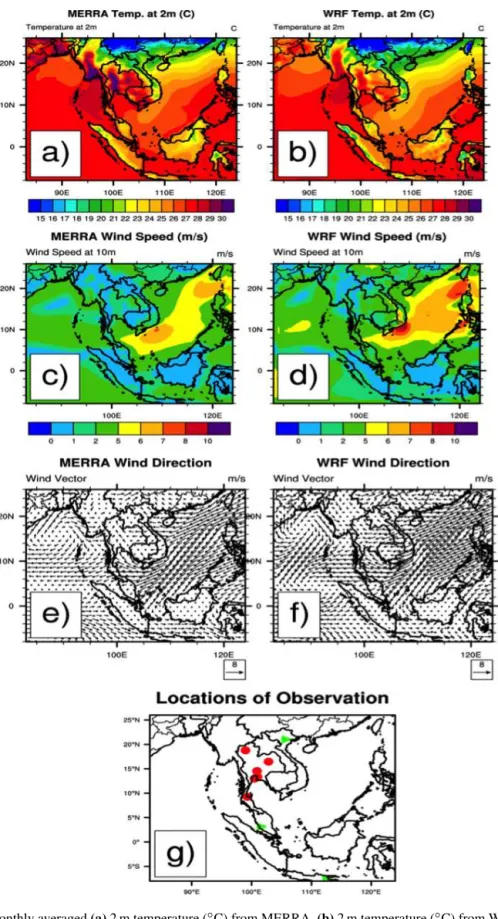
Monthly averaged 2 m temperature, wind speed and direc-tion are compared to the MERRA reanalysis data set. In general, the model-predicted temperature agrees well with the MERRA output (Fig. 5) for the March 2008 simulation, although some regions, e.g., Indochina peninsula, have 2– 3◦C lower temperatures than the monthly averaged reanaly-sis output. The WRF-predicted wind speed pattern is similar to the MERRA output for March. However, the wind speed is overpredicted in the South China Sea by∼2 m s−1. The wind direction agrees quite well with MERRA output (Fig. 5e, f). For December 2008 (not shown), the simulated 2 m temper-ature, 10 m wind speed and wind direction, in general, also agree well with the MERRA output; however, the tempera-ture is slightly underpredicted over land and the wind speed is overpredicted over the South China Sea. The low bias in temperature and high bias in wind speed can impact the
prediction of chemical species mixing ratios. For example, the chemical reactions likely will proceed at a slightly lower rate (because of their dependence on temperature) resulting in formation of products further away from the source. Ad-ditionally, biogenic emissions may be underpredicted, since these emissions increase with increasing temperatures and a low bias in temperature can lead to lower emissions.
WRF reasonably predicts the precipitation pattern in March (Fig. 6a–c) when compared to TRMM and GPCC data. Low precipitation is observed over the coast of Burma, the northern part of the South China Sea, and the tip of the Indochina peninsula, and high precipitation is predicted near the equator over the oceans, Malaysian peninsula, and In-donesia. However, the WRF results overestimate precipita-tion near the equator by 10 to 100 mm for March. In De-cember (Fig. 6d–f), WRF also overpredicts the magnitude of precipitation over the water, but shows reasonable agree-ment north of 10◦N especially over land. The precipitation in this region is dominated by rain from convection, which is controlled by mesoscale processes. The WRF simulations presented here have a 36 km horizontal resolution, and at this resolution, the model relies on a cumulus parameterization to produce the rain. Due to the coarse model resolution for a re-gion with plenty of tropical convection, a situation which is notoriously difficult to represent in models, the poor predic-tion of precipitapredic-tion near the equator is not unexpected. Koo and Hong (2010) also found oceanic convection to be over-predicted by the WRF model. However, over land, where the chemical predictions of this study are evaluated, the WRF precipitation has better agreement with observations. As a consequence of the higher precipitation predicted by WRF, WRF-Chem may overpredict the removal of soluble trace gases (e.g., nitric acid), thereby affecting the photochemistry in the region.
5.2 Evaluation of chemistry
5.2.1 Ensemble surface means and variations
13002 T. Amnuaylojaroen et al.: Effect of different emission inventories
Figure 14.March 2008 monthly NO2total column(a)OMI,(b)WRF-Chem+RETRO,(c)WRF-Chem+INTEX-B,(d)WRF-Chem+ MACCity,(e)WRF-Chem+SEAC4RS, and(f)WRF-Chem+MACCity-SEAC4RS
shorter lifetime, high NOx mixing ratios of 4–30 ppbv are confined to regions close to the NOxsources.
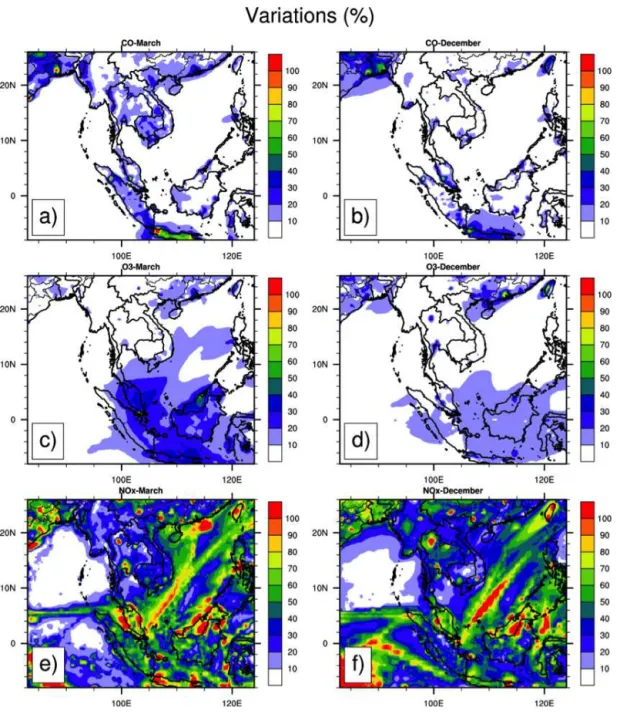
The variation, which is defined as the standard deviation of the five simulations, in the predicted monthly averaged sur-face mixing ratios of CO, O3, and NOxacross the five sim-ulations is highlighted in Fig. 8. Because we conducted each simulation with the same meteorology and biomass-burning emissions, the primary cause for the variations are the differ-ences in the anthropogenic emissions. CO mixing ratios vary
across simulations by < 20 %, but variations of ∼30–60 %
Figure 15.Same as Fig. 19 but for December.
as seen by the locally high values in Fig. 8e and f, due to different emission strengths in each inventory and to miss-ing emission sectors in some inventories (e.g., shippmiss-ing emis-sions in the SEAC4RS inventory).
5.2.2 CO evaluation
The 6-hourly daytime (00:00, 06:00, 12:00 UTC) CO mix-ing ratios from WRF-Chem with each of the five inventories are compared to observations from the six ground-site mea-surements: Chiang Mai (CM) in northwest Thailand, Khon
13004 T. Amnuaylojaroen et al.: Effect of different emission inventories Table 3.Monthly-average correlation coefficients (r) of daytime (00:00, 06:00, 12:00 UTC) CO.
Emission
Inventories CM KK SRB NTB CBR SRT
Mar Dec Mar Dec Mar Dec Mar Dec Mar Dec Mar Dec
RETRO 0.49 0.13 0.35 0.10 0.27 0.15 0.40 0.31 0.48 0.15 0.52 0.03 INTEX-B 0.51 0.14 0.42 0.20 0.17 0.17 0.33 0.38 0.44 0.17 0.58 0.03 MACCity 0.50 0.14 0.45 0.10 0.11 0.19 0.26 0.33 0.43 0.19 0.55 0.003 SEAC4RS 0.48 0.15 0.42 0.04 0.09 0.18 0.21 0.33 0.42 0.18 0.52 0.01 MACCity/ 0.48 0.15 0.41 0.07 0.12 0.14 0.26 0.33 0.44 0.14 0.54 0.004 SEAC4RS
Table 4.Monthly-average biases of daytime (00:00, 06:00, 12:00 UTC) carbon monoxide.
Emission
Inventories CM KK SRB NTB CBR SRT
Mar Dec Mar Dec Mar Dec Mar Dec Mar Dec Mar Dec
RETRO −104 −147 −396 −581 −219 −314 −721 −770 −253 23 −267 −89 INTEX-B −16 −114 −316 −529 −150 −283 −662 −747 −203 46 −234 −109 MACCity −18 −112 −292 −530 −116 −263 −636 −733 −195 60 −238 −112 SEAC4RS −22 −107 −324 −548 −129 −267 −645 −734 −197 58 −234 −120 MACCity/ −47 −157 −35 −601 −165 −328 −674 −785 −218 10 −243 −93 SEAC4RS
Chonburi in southeast Thailand (Fig. 9), with moderate cor-relation coefficients (Table 3) ofr2=0.48 to 0.51. However, WRF-Chem generally underpredicts CO at the other stations, especially Nonthaburi. In December, the predicted 6-hourly daytime surface CO for all simulations is much less than the observations, with the exception of the Chonburi site. The large underprediction is reflected by the bias calculation (Ta-ble 4). Part of the underprediction is a result of the coarse model resolution (36 km), which cannot capture the highly variable emissions and high CO concentrations in an ur-ban setting where the measurement site is located. However, the underprediction of CO could also be due to low anthro-pogenic emissions (discussed further in Section 5), a high planetary boundary layer height, which would cause dilu-tion of surface mixing ratios, and/or missing chemistry in the model such as heterogeneous chemistry. Mao et al. (2013) suggest uptake of HO2 to aerosols undergo reaction with transition metal ions to convert HO2to H2O, removing hy-drogen oxides from the atmosphere. They show that this pro-posed mechanism decreases OH at the surface, as simulated by the GEOS-Chem model, and consequently increases CO mixing ratios by 20–30 ppbv. While a 20–30 ppbv increase in CO over Thailand will not remove the high CO bias in our simulation, this heterogeneous chemistry may explain some of the underprediction of CO. When comparing the CO con-centrations from the different WRF-Chem simulations with the measurements in Thailand, we find the different WRF-Chem results to be quite similar. An examination of the
cor-relation coefficients (Table 3) reveals that these values are quite similar from simulation to simulation. This can be due in part to the fact that none of the emission inventories are specific to the modeled time period. However, a paired dif-ference test (Kruskal and Wallis, 1952) shows that there are statistical differences for CO among the different emission inventories at Khon Kaen, Saraburi, Nonthaburi, and Chon-buri for both March and December and for Chiang Mai for December. The variability in the biases of the modeled CO mixing ratios (Table 4) also suggests that the different emis-sion inventories are causing the different CO mixing ratios between the model simulations. Because the simulation us-ing RETRO emissions, especially for March, has larger bi-ases than the other simulations, the more recent CO emission inventories either better represent the emissions in general or are more similar to what the emissions were for 2008.
Figure 16.March monthly averaged CO vertical profiles at Yangon, Burma. WRF-Chem results with the plumerise feature of biomass-burning emissions are given for the MACCity–SEAC4RS emissions case (blue line), SEAC4RS emissions (dark green line), MACCity emissions (red line), INTEX-B emissions (green line), and RETRO emissions (dark red line). The MOZART global model results are shown as the gold line. WRF-Chem results without the plumerise feature (i.e., biomass-burning emissions injected into the lowest model level) are shown as the purple line.
location of biomass burning, indicating the FINN fire emis-sions are too high in this region. The predicted CO mixing ra-tios are similar in magnitude to MOPITT over the Malay and southern Indochina peninsulas. For December when biomass burning is less important, the general spatial pattern of CO is represented by WRF-Chem for all the simulations (Fig. 11). The modeled CO in December is generally higher than MO-PITT, particularly in the regions of the highest mixing ratios in southern China and easternmost India.
5.2.3 O3evaluation
Scatterplots of the 6-hourly daytime O3mixing ratios com-pared to the measurements at the six ground sites show that O3is generally overpredicted for each of the different emis-sion inventories for both March and December (Fig. 12) by up to 100 ppbv. Locations that showed good agreement for CO (e.g., Chiang Mai in March) have very poor agree-ment for O3. Despite the large scatter of model results for O3 (Fig. 12), the correlation coefficients are generally 0.5 and higher (Table 5) indicating that the model captures the O3 trend well, but has a high bias. WRF-Chem O3 bi-ases (Table 6) range from -1 to 40 ppbv with MACCity and MACCity–SEAC4RS having the highest bias at Chiang Mai. In December (Fig. 12), the model–observation agreement is
13006 T. Amnuaylojaroen et al.: Effect of different emission inventories Table 5.Monthly-average correlation coefficients of daytime (00:00, 06:00, 12:00 UTC) O3.
Emission
Inventories CM KK SRB NTB CBR SRT
Mar Dec Mar Dec Mar Dec Mar Dec Mar Dec Mar Dec
RETRO 0.69 0.84 0.68 0.34 0.56 0.50 0.47 0.71 0.11 0.52 0.49 0.16 INTEX-B 0.74 0.89 0.72 0.33 0.70 0.48 0.45 0.72 0.05 0.56 0.44 0.09 MACCity 0.68 0.78 0.71 0.33 0.69 0.48 0.44 0.68 0.02 0.55 0.43 0.08 SEAC4RS 0.70 0.79 0.73 0.42 0.75 0.56 0.41 0.71 0.001 0.49 0.45 0.14 MACCity/ 0.70 0.78 0.73 0.37 0.76 0.52 0.48 0.78 0.02 0.54 0.45 0.08 SEAC4RS
Table 6.Monthly-average biases of daytime (00:00, 06:00, 12:00 UTC) O3.
Emission
Inventories CM KK SRB NTB CBR SRT
Mar Dec Mar Dec Mar Dec Mar Dec Mar Dec Mar Dec
RETRO 36.48 8.28 23.83 19.36 7.77 13.58 12.15 3.07 17.82 6.96 9.52 31.29 INTEX-B 37.76 4.05 32.62 18.26 15.31 12.42 18.54 2.67 23.64 5.58 14.57 29.56 MACCity 39.67 6.19 30.24 15.68 14.62 8.69 18.53 −1.34 24.88 3.04 15.76 30.36 SEAC4RS 38.53 3.75 31.45 20.14 17.29 13.98 27.90 4.61 24.38 6.33 11.26 29.15 MACCity/ 39.72 5.31 32.45 19.92 16.59 13.37 18.19 −0.25 24.95 5.52 15.38 32.22 SEAC4RS
This difference could be because the SEAC4RS emissions inventory lacks ship emissions. When the SEAC4RS emis-sions are combined with MACCity emisemis-sions, the O3mixing ratios are more similar to the other simulations.
5.2.4 NO2evaluation
The spatial distribution of the WRF-Chem and OMI tropo-spheric column NO2are shown in Figs. 14 and 15 for March and December, respectively. In general, the WRF-Chem sim-ulation is able to capture the NO2pattern well over land in March with high NO2 columns over China, Burma, Viet-nam, Laos, and Thailand and low values over the south-ern and southeast region of the model domain. The WRF-Chem NO2column is generally less than the OMI NO2 col-umn. In March, the OMI NO2column values over land are > 2×10¹⁵ molecules cm−2 with peak values of∼5×10¹⁵
molecules cm−2 over the Pearl River delta, while WRF-Chem predicts 1×10¹⁵ molecules NO2cm−2 or more. The WRF-Chem peaks of ∼5×10¹⁵ occur in northern Thai-land and Burma and not over the Pearl River delta. On the other hand, the WRF-Chem model underpredicts NO2 col-umn in the southeastern region of the model domain. For March, the WRF-Chem NO2 column mostly reflects the biomass-burning emissions pattern (Fig. 3), while for De-cember WRF-Chem is more similar to the anthropogenic emissions (Fig. 4). The OMI NO2 column does not show the high NO2over northern Thailand and Burma where the model has high biomass-burning emissions in March. To
ex-plain this difference, WRF-Chem fire emissions could be too high, or OMI may miss the high NO2because of clouds in-terfering with the instrument’s view. In situ measurements would allow us to evaluate better the performance of the model.
The largest variation among the model simulations is in the region near Indonesia and is a result of both low NO2 mixing ratios from the MOZART boundary conditions and different estimates for shipping emissions among the differ-ent invdiffer-entories (Table 2, Figs. 3 and 4). Both the RETRO ship emissions, which are 75–80 % smaller than INTEX-B and MACCity ship emissions, and the SEAC4RS only sim-ulation, which does not have ship emissions, contribute to the variation. When the MACCity ship emissions are com-bined with the SEAC4RS emissions (MACCity–SEAC4RS), the agreement with OMI NO2 column is much better than the SEAC4RS only simulation. For example, the MACCity– SEAC4RS simulation agrees better with OMI NO2 col-umn than the SEAC4RS only simulation. The NO2 col-umn model-observation comparison for December (Fig. 15) shows that WRF-Chem slightly underpredicts the NO2 col-umn, especially over the mainland. All five simulations pre-dict relatively low NO2 column over Burma with values of
∼1×10¹⁴molecules cm−2while OMI NO
6 Discussion
There are several aspects of the simulations that contribute to the underprediction of CO at the surface and the overpre-diction of O3at the surface. One is that the model simula-tion is for 2008 while the emission inventories are appropri-ate for other years (RETRO for 2000, INTEX-B for 2006, MACCity for 2010, and SEAC4RS for 2012). While the grid spacing of 36 km is better than global chemistry transport models, it is likely that small-scale features, e.g., urban re-gions and orography are not adequately represented in this simulation. For example, Chiang Mai is in a mountain val-ley where pollutants can easily accumulate. Another pos-sible error could arise from the fire emissions. One issue with coarse resolution modeling of biomass-burning emis-sions is that multiple fires in one model grid cell are aggre-gated into a single, bigger fire area. This aggreaggre-gated informa-tion is used by the plumerise model in WRF-Chem, which may erroneously apply too much thermal buoyancy associ-ated with the fires, resulting in emissions placed too high above the ground. For example, WRF-Chem results without the plumerise feature of biomass-burning emissions, as illus-trated by the March monthly averaged CO vertical profiles at Yangon, Burma (Fig. 16), show that injection into the low-est model level gives vertical profiles more consistent with MOZART results, which injects fire emissions into the low-est model level. Thus, in the simulations with the plumerise feature, O3 precursor species (NMVOCs and NOx) may be placed in an environment where O3production is more pro-ductive than if the precursors were placed near the surface. While these results indicate a substantial difference in CO mixing ratios in the lowest 500 hPa of the atmosphere, obser-vations of CO vertical profiles are needed to help evaluate the model predictions. In addition, trash burning emissions are not included in this study, yet have been shown to have a sig-nificant contribution to the air quality (Hodzic et al., 2012). In reality, Southeast Asia has complex emission sources that not only include biomass burning and anthropogenic activ-ities, but also biofuel and trash burning. To improve simu-lations of CO in the future, these other emissions should be included.
Another possible cause of the CO underprediction and O3 overprediction at the surface is that the anthropogenic emis-sions are too low. Global estimates of CO sources (Kopacz et al., 2010) based on satellite, aircraft, and surface observa-tions suggest that CO emissions over Southeast Asia are un-derestimated by nearly a factor of 2. For the INTEX-B emis-sions, Zhang et al. (2009) reported an uncertainty of 185 % and 37 % for CO and NO emissions, respectively. We con-ducted sensitivity simulations with higher CO emissions by a factor of 2 and higher NO emissions by 40 %. Additional sensitivity simulations were performed with only CO emis-sions greater by a factor of 2 (NO emisemis-sions remained the same as the original inventory). The sensitivity simulations were performed for March when biomass burning is a major
contribution to the results. The results were compared to the six ground sites shown in Fig. 5g. The higher emissions im-prove agreement for both O3and CO concentrations at the six monitoring sites. For example, the O3prediction from the in-creased emission simulations, on average, improved the cor-relation term by∼18 % and reduced the bias from 24 ppbv
to 8 ppbv. The high emissions simulations decreased, on av-erage, the correlation for CO surface mixing ratios by 23– 34 %, but reduced the average bias from 250–264 ppbv to 184–224 ppbv. Interestingly, the high emissions simulations produced too much CO at Chiang Mai by over 400 ppbv, yet the O3 bias at Chiang Mai was reduced to 2–4 ppbv (from 38 to 40 ppbv). This suggests that either the CO emissions from biomass burning are too high, or co-emitted VOCs should have higher emissions. The Saraburi site, downwind of Bangkok, went from too little CO (bias= −150 ppbv for INTEX-B) to too much CO (bias=173 ppbv for INTEX-B high emissions simulations) with only a 2 ppbv decrease in bias of O3. CO at Surat Thani changed very little, be-cause Surat Thani is located away from urban and biomass-burning regions. At the same time, Khon Kaen, Nonthaburi, and Chonburi all have a better correspondence to observa-tions as shown by the decreased bias. However, WRF-Chem still underpredicts CO at these sites. The higher emissions slightly improved the prediction of NO2 mixing ratios in-creasing the correlation coefficient by 18 % but not chang-ing the bias on average. By comparchang-ing the simulation with increased CO and NO emissions to the simulation with only increase CO emissions, the results for O3and CO are very similar indicating that increased CO emissions caused the de-crease in O3concentrations.
Our WRF-Chem simulations did not include heteroge-neous chemistry, which can affect OH concentrations (Mao et al., 2013) and therefore CO oxidation. Kumar et al. (2014) also found decreased OH and O3 mixing ratios when het-erogeneous chemistry was included for a simulation of a dust event over India. For this high dust-loading example of the effect of heterogeneous chemistry, O3decreased by 10– 20 ppbv.
The underprediction of NO2 in all the WRF-Chem sim-ulations suggests that the anthropogenic NOxemissions are underestimated over the Southeast Asia. These errors in an-thropogenic emission estimates are likely due to uncertain-ties in including all the CO or NOxsources from the differ-ent emission sectors and estimating the emission factors from the different sources. The variation in NO shipping emis-sions, as seen by the comparison of the simulation using only the SEAC4RS emissions without shipping emissions with the simulation using MACCity-SEAC4RS emissions, does pro-duce substantial variation among model predictions of NO2 (Fig. 14) and O3 (Fig. 13). Therefore, it is important to in-clude the shipping sector as part of the emissions inventory.
13008 T. Amnuaylojaroen et al.: Effect of different emission inventories Table 7.Monthly-average surface ozone and carbon monoxide
mix-ing ratios at land-based grid points in Southeast Asia.
Emission Inventories CO (ppb) O3(ppb)
Mar Dec Mar Dec
RETRO 571 596 146 122
INTEX-B 575 497 156 119
MACCity 574 495 160 122
SEAC4RS 574 494 159 122
MACCity/SEAC4RS 575 495 154 115
et al., 2009) emission inventories for years 2000 and 2006, respectively. The REAS v2.1 NOx emissions are also sim-ilar to the TRACE-P emissions inventory for 2000, but are lower than the INTEX-B inventory for year 2006 (Kurakawa et al., 2013). We would then expect the REAS v2.1 inventory to produce similar results for CO surface mixing ratios as the INTEX-B emissions inventory did, but have lower NOx mixing ratios, if the year 2006 REAS inventory is used. The 2008 REAS v2.1 emissions are 10–20 % greater than their 2006 emissions. These increased emissions would likely give results for CO and O3surface mixing ratios that are < 10 % greater than the mixing ratios simulated in this study. To con-firm this, additional WRF-Chem simulations should be done with the REAS emissions inventory.
The goal of this paper is to examine the differences in predicted CO and O3mixing ratios at the surface when dif-ferent anthropogenic emission inventories are used. Table 6 lists monthly average O3and CO mixing ratios on land for March and December for all of simulation cases. During the biomass-burning season (March), the average CO differs by less than 5 ppbv (< 1 % difference) among the different emission inventories, while average O3 ranges from 146 to 160 ppbv (9 % difference) among the different emission in-ventories. In December when anthropogenic emissions are greater than biomass-burning emissions, the differences in average CO and O3among the different emission inventories is very small (2 ppbv for CO and 7 ppbv for O3). These small variations, which are also seen in the mean bias calculations for the ground-based sites (Tables 3 and 5), suggest that the choice of the emission inventory does not have a substantial effect on CO and O3surface concentrations, despite the dif-ferent emission inventories having a∼30 % variation for CO and 10 % variation for NO emissions.
By comparing the March average mixing ratios to the De-cember average mixing ratios (Table 7), the importance of biomass-burning emissions on O3 and CO variability is re-vealed. In March, CO is 16 % greater than CO in Decem-ber for all simulations except that with RETRO emissions. The average O3in March is∼30 % greater than average O3 in December. These differences are much greater than those induced by the anthropogenic emissions in Southeast Asia. Thus, biomass-burning emissions produce more variability
in WRF-Chem simulation results than the different anthro-pogenic emission inventories.
7 Conclusions
This study presents WRF-Chem results to show the vari-ability of emissions on surface O3 and CO mixing ratios in Southeast Asia. The predicted meteorological fields are evaluated with reanalysis output (MERRA), satellite data (TRMM) and ground-based observations (GPCC) for 2 m temperature, wind, and precipitation. Surface CO and O3 mixing ratios are compared to ground-based monitoring ob-servations in Thailand. Surface CO is also compared to MO-PITT satellite data. O3 vertical profiles are compared with SHADOZ ozonesonde data, and the NO2 tropospheric col-umn is evaluated with OMI satellite data.
In general, the temperature and winds showed good agree-ment with MERRA output, although there was a slight un-derestimate of temperature and slight overestimate of wind speed. Precipitation was reasonably predicted for regions north of 10◦N in comparison to TRMM and GPCC data, but was overestimated near the equator. By using a grid spac-ing of 36 km, the precipitation was generated mostly by the cumulus parameterization in the model resulting in a less re-liable prediction of rain and convective mass fluxes between the boundary layer and mid- to upper troposphere. Surface O3mixing ratios were generally higher than observations and surface CO mixing ratios were lower than observations. Al-though the emission inventories were for years other than that simulated here, the differences in surface O3and CO mixing ratios among the simulations with different inventories were small. Thus, the model biases are likely not the result of the emission inventory trends used here, but more likely caused by the omission of sources such as trash burning and bio-fuel use and uncertainties not fully captured in the current emission inventories. Sensitivity simulations with doubled CO emissions showed that the model-observation agreement improved substantially for CO and O3. Thus, further study of the role of different emission sectors on CO and O3can help elucidate where the major weaknesses are in the emis-sion inventories. In addition, analysis of the contribution of CO, NOx, O3, and VOCs from outside the Southeast Asia re-gion on the rere-gion’s air quality should be compared with the contribution of the local emissions.
Simulations using different anthropogenic emissions cre-ated only a slight variability of O3 and CO mixing ratios, while biomass-burning emissions added more variability. The different anthropogenic emissions have up to 30 % dif-ference in CO emissions but only a small change of O3and CO mixing ratios of∼4.5 % and∼8 %, respectively, among
March. By comparing March (when biomass burning is at its peak) surface mixing ratios to December values, it is found that biomass-burning emissions substantially increase both O3and CO mixing ratios by∼30 % and∼16 %.
Southeast Asia is a region with complex terrain and emis-sion sources at small scales. Thus, one important test to im-prove the regional-scale simulations of air quality in South-east Asia would be to use model grid spacing of the order of 10 km or less. A higher grid resolution should also re-duce errors in the injection height of biomass-burning sions. However, a high-resolution simulation needs emis-sion inventories at equally high resolution. Incluemis-sion of other types of emissions, e.g., trash emissions, in the current in-ventories could also improve the representation of the atmo-spheric chemistry in Southeast Asia. Lastly, particulate mat-ter (aerosols) was not addressed in this study. Not only should their contribution to air quality be evaluated, but their impact on gas-phase photochemistry should be addressed.
Acknowledgements. The authors would like to thank the National Center for Atmospheric Research (NCAR) Advanced Study Pro-gram (ASP) for the scholarship to visit the Atmospheric Chemistry Division (ACD), the Center for Environmental Health, Toxicology and Management of Chemical, Chiang Mai University, Faculty of Science, Chiang Mai, Thailand for Ph.D. scholarship, and the Graduate School Chiang Mai University for partial support. The study was partially supported by NSF CHEM award 1049058. We are thankful for the Thai Pollution Control Department (PCD) providing their O3and CO observation data. We also acknowledge the Global Modeling and Assimilation Office (GMAO) and the GES DISC for the dissemination of MERRA, the NASA Goddard Space Flight Center for providing SHADOZ data, and the NASA Langley Research Center Atmospheric Science Data Center for providing MOPITT data. Analyses and visualizations used in this paper were produced with the Giovanni online data system, developed and maintained by the NASA GES DISC. We acknowledge Gabriele Pfister and Sachin Ghude for their assistance with WRF-Chem simulations. The comments from the anonymous reviewers, Christine Wiedinmyer and Rajesh Kumar are greatly appreciated. NCAR is operated by the University Corporation for Atmospheric Research (UCAR) under sponsorship of the National Science Foundation.
Edited by: H. Su
References
Adhikary, B., Carmichael, G. R., Tang, Y., Leung, L. R., Qian, Y., Schauer, J. J., Stone, E. A., Ramanathan, V., and Ramana, M. V.: Characterization of South Asian Aerosols during the ABC-Post Monsoon Experiment (ABC-APMEX): a regional-scale modeling analysis, J. Geophys. Res., 112, D22S22, doi:10.1029/2006JD008143, 2007.
Akimoto, H. and Narita, H.: Distribution of SO2, NOx, and CO2 emissions from fuel combustion and industrial activities in Asia with 1◦×1◦resolution, Atmos. Environ., 28, 213–225, 1994. Amnuaylojaroen, T. and Kreasuwun, J.: Investigation of fine and
coarse particulate matter from burning areas in Chiang Mai, Thailand using the WRF/CALPUFF, Chiang Mai, J. Sci., 39, 1– 16, 2012.
Boersma, K. F., Jacob, D. J., Eskes, H. J., Pinder, R. W., Wand, J., and Vander A, R. J.: Intercomparison of SCIAMACHY and OMI tropospheric NO2 columns: observing the diurnal evolution of chemistry and emissions from space, J. Geophys. Res., 113, D16S26, doi:10.1029/2007JD008816, 2008.
Boersma, K. F., Jacob, D. J., Trainic, M., Rudich, Y., DeSmedt, I., Dirksen, R., and Eskes, H. J.: Validation of urban NO2 concen-trations and their diurnal and seasonal variations observed from the SCIAMACHY and OMI sensors using in situ surface mea-surements in Israeli cities, Atmos. Chem. Phys., 9, 3867–3879, doi:10.5194/acp-9-3867-2009, 2009.
Bucsela, E. J., Celarier, E. A., Wening, M. O., Gleason, J. F., Veefkind, J. P., Boersma, K. F., and Brinksma, E. J.: Algorithm for NO2vertical column retrieval from the Ozone Monitoring Instrument, IEEE T. Geosci. Remote, 44, 1245–1258, 2006. Chen, F. and Dudhia, J.: Coupling an advanced
land-surface/hydrology model with the Penn State/NCAR MM5 modeling system, Part 1: Model description and implementation, Mon. Weather. Rev., 129, 569–585, 2001.
Chin, M., Rood, R. B., Lin, S.-J., Muller, J. F., and Thomp-son, A. M.: Atmospheric sulfur cycle in the global model GO-CART: model description and global properties, J. Geophys. Res., 105, 24671–24687, 2000.
Chou, M.-D. and Suarez, M. J.: An efficient thermal infrared ra-diation parameterization for use in general circulation models, NASA Tech. Memo. 104606, 3, 85 pp., NASA/GSFC, Greenbelt, MD, 1994.
Deeter, M. N.: MOPITT (Measurement of Pollution in the Troposphere) Version6 Product User’sGuide, available at: http://www2.acd.ucar.edu/sites/default/files/mopitt/v6_users_ guide_201309.pdf (last access: 12 September 2014), 2013. Deeter, M. N., Worden, H. M., Gille, J. C., Edwards, D. P., Mao,
D., and Drummond, J. R.: MOPITT multispectral CO retrievals: Origins and effects of geophysical radiance errors, J. Geophys. Res.,116, D15303, doi:10.1029/2011JD015703, 2011.
Deeter, M. N., Worden, H. M., Edwards, D. P., Gille, J. C., and Andrews, A. E.: Evaluation of MOPITT retrievals of lower-tropospheric carbon monoxide over the United States, J. Geo-phys. Res., 117, D13306, doi:10.1029/2012JD017553, 2012. Deeter, M. N., Martinez-Alonso, S., Edwards, D. P., Emmons, L. K.,
Gille, J. C., Worden, H. M., Pittman, J. V., Daube, B. C., and Wofsy, S. C.: Validation of MOPITT version 5 thermal-infrared, near-thermal-infrared, and multispectral carbon monoxide pro-file retrievals for 2000–2011, J. Geophys. Res., 118, 6710–6725, doi:10.1002/jgrd.50272, 2013.
Deng, X., Tie, X., and Zhou, X.: Effects of Southeast Asia biomass burning on aerosols and ozone concentrations over the Pearl River Delta (PRD) region, Atmos. Environ., 42, 8493–8501, doi:10.1016/j.atmosenv.2008.08.013, 2008.
13010 T. Amnuaylojaroen et al.: Effect of different emission inventories
Drummond, J., Novelli, P., Sachse, G., Coffey, M.., Hannigan, J. W., Gerbig, C., Kawakami, S., Kondo, Y., Takegawa, N., Schlager, H., Baehr, J., and Ziereis, H.: Validation of Measure-ments of Pollution in the Troposphere (MOPITT) CO retrievals with aircraft in situ profiles, J. Geophys. Res., 109, D03309, doi:10.1029/2003JD004101, 2004.
Emmons, L. K., Pfister, G. G., Edwards, D. P., Gille, J. C., Sachse, G., Blake, D., Wofsy, S., Gerbig, C., Matross, D., and Nedelec, P.: Measurements of Pollution in the Troposphere (MOPITT) validation exercises during summer 2004 field cam-paigns over North America, J. Geophys. Res., 112, D12S02, doi:10.1029/2006JD007833, 2007.
Emmons, L. K., Edwards, D. P., Deeter, M. N., Gille, J. C., Cam-pos, T., Nédélec, P., Novelli, P., and Sachse, G.: Measurements of Pollution In The Troposphere (MOPITT) validation through 2006, Atmos. Chem. Phys., 9, 1795–1803, doi:10.5194/acp-9-1795-2009, 2009.
Emmons, L. K., Walters, S., Hess, P. G., Lamarque, J.-F., Pfister, G. G., Fillmore, D., Granier, C., Guenther, A., Kinnison, D., Laepple, t., Orlando, J., Tie, X., Tyndall, G., Wiedinmyer, C., Baughcum, S. L., and Kloser, S.: Description and evaluation of the Model for Ozone and Related chemical Tracers, version 4 (MOZART4), Geosci. Model. Dev., 3, 43–67, 2010.
Fast, J. D., Gustafson Jr, W. I., Easter, R. C., Zaveri, R. A., Barnard, J. C., Chapman, E. G., and Grell, G. A.: Evolu-tion of ozone, particulates, and aerosol direct forcing in an urban area using a new fully-coupled meteorology, chem-istry, and aerosol model, J. Geophys. Res., 111, D21305, doi:10.1029/2005JD006721, 2006.
Geng, F., Tie, X., Guenther, A., Li, G., Cao, J., and Harley, P.: Effect of isoprene emissions from major forests on ozone formation in the city of Shanghai, China, Atmos. Chem. Phys., 11, 10449– 10459, doi:10.5194/acp-11-10449-2011, 2011.
Ghude, S. D., Pfister, G. G., Jena, C. K., Van der A, R. J., Em-mons, L. K., and Kumar, R.: Satellite constraints of nitrogen oxide (NOx) emissions from India based on OMI observa-tions and WRF-Chem simulaobserva-tions, Geophys. Res. Lett., 40, 1–6, doi:10.1029/2012GL053926, 2013.
Granier, C., Bessagnet, B., Bond, T., Angiola, A. D., Van Der Gon, H. D.., Frost, G. J., Heil, A., Kaiser, J. W., Kinne, S., Klimont, Z., Kloster, S., Lamarque, J. -F., Liousse, C., Masui, T., Meleux, F., Mieville, A., Ohara, T., Raut, J.-C., Riahi, K., Schultz, M. G., Smith, S. J., Thompson, A., Aardenne, J. V., Vander Werf, G. R., and Van Vuuren, D. P.: Evolution of anthro-pogenic and biomass burning emission of air pollutants at global and regional scales during the 1980–2010 period, Clim. Change, 109, 163–190, 2011.
Grell, G. A. and Devenyi, D.: A generalized approach to parameterizing convection combining ensemble and data assimilation techniques, Geophys. Res. Lett., 29, 1693, doi:10.1029/2002GL015311, 2002.
Grell, G. A., Peckham, S. E., Schmitz, R., McKeen, S. A., Frost, G., Skamarock, W. C., and Eder, B.: Fully coupled “online” chem-istry within the WRF model, Atmos. Environ., 29, 6957–6975, 2005.
Guenther, A., Karl, T., Harley, P., Wiedinmyer, C., Palmer, P. I., and Geron, C.: Estimates of global terrestrial isoprene emissions using MEGAN (Model of Emissions of Gases and Aerosols from
Nature), Atmos. Chem. Phys., 6, 3181–3210, doi:10.5194/acp-6-3181-2006, 2006.
Han, Z., Sakurai, T., Ueda, H., Matsuda, K., Hozumi, Y., Carmichael, G. R., Streets, D. G., Park, S. U., Fung, C., Chang, A., Kajino, M., Thongboonchoo, N., Engardt, M., Ben-net, C., Hayami, H., Sartelet, K., Holloway, T., Wang, Z., and Amann, M.: Model intercomparison and evaluation of ozone and relevant species – MICS-Asia phase II study, Atmos. Environ., 42, 3491–3509, 2008.
Hodzic, A., Wiedinmyer, C., Salcedo, D., and Jimenez, J. L.: Im-pact of trash burning on air quality in Mexico City, Environ. Sci. Technol., 46, 4950–4957, doi:10.1021/es203954r, 2012. Hollingsworth, A., Engelen, R. J., Textor, C., Benedetti, A.,
Boucher, O., Chevallier, F., Dethof, A., Elbern, H., Eskes, H., Flemming, J., Granier, C., Morcrette, J. J., Rayner, P., Peuch, V.-H., Rouil, L., Schultz, M., and Simmons, A. J.: Toward a mon-itoring and forecasting system for atmospheric composition: the GEMS project, B. Am. Meteorol. Soc., 89, 1147–1164, doi:10.1175/2008BAMS2355.1, 2008.
Huffman, G. J. and Bolvin, D. T.: TRMM and Other Data Precipita-tion Data Set Document, available at: ftp://precip.gsfc.nasa.gov/ pub/trmmdocs/3B42_3B43_doc.pdf (last access: 14 September 2014), 2012
Huffman, G. J., Adler, R. F., Arkin, P., Chang, A., Ferraro, R., Gru-ber, A., Janowiak, J., McNab, A., Rudolph, B., and Schneide, U.: The Global Precipitation Climatology Project (GPCP) combined precipitation dataset, B. Am. Meteorol. Soc., 78, 5–20, 1997. Janjic, Z. I.: Nonsingular Implementation of the Mellor–Yamada
Level 2.5 Scheme in the NCEP Meso model, National Oceanic and Atmospheric Administration Science Center, Camp Springs, MD, NCEP Office Note, No. 437, 61, 2002.
Koo, M.-S. and Hong, S.-Y.: Diurnal variations of simulated pre-cipitation over East Asia in two regional climate models, J. Geo-phys. Res., 115, D05105, doi:10.1029/2009JD012574, 2010. Kopacz, M., Jacob, D. J., Fisher, J. A., Logan, J. A., Zhang, L.,
Megretskaia, I. A., Yantosca, R. M., Singh, K., Henze, D. K., Burrows, J. P., Buchwitz, M., Khlystova, I., McMillan, W. W., Gille, J. C., Edwards, D. P., Eldering, A., Thouret, V., and Nedelec, P.: Global estimates of CO sources with high resolu-tion by adjoint inversion of multiple satellite datasets (MOPITT, AIRS, SCIAMACHY, TES), Atmos. Chem. Phys., 10, 855–876, doi:10.5194/acp-10-855-2010, 2010.
Kramer, L. J., Leigh, R. J., Remedios, J. J., and Monks, P. S.: Com-parison of OMI and ground-based in situ and MAX-DOAS mea-surements of tropospheric nitrogen dioxide in an urban area, J. Geophys. Res., 113, D16S39, doi:10.1029/2007jd009168, 2008. Kruskal, W. H. and Wallis, W. A.: Use of ranks in one-criterion variance analysis, J. Am. Statist. Assoc., 47, 583–621, doi:10.1080/01621459.1952.10483441, 1952.
Kumar, R., Naja, M., Pfister, G. G., Barth, M. C., and Brasseur, G. P.: Source attribution of carbon monoxide in In-dia and surrounding regions during wintertime, J. Geophys. Res., 118, 1981–1995, doi:10.1002/jgrd.50134, 2013.