Nº 501
ISSN 0104-8910
A family of autoregressive conditional duration models
Marcelo Fernandes
Joachim Grammig
A Family of Autoregressive Conditional
Duration Models
Marcelo Fernandes
Graduate School of Economics, Getulio Vargas Foundation
Praia de Botafogo, 190, 22250-900 Rio de Janeiro, Brazil
E-mail: [email protected]
Joachim Grammig
Department of Economics, University of T¨ubingen
Mohlstr. 36, D-72074 T¨ubingen, Germany
E-mail: [email protected]
Abstract: This paper develops a family of autoregressive conditional
dura-tion (ACD) models that encompasses most specificadura-tions in the literature.
The nesting relies on a Box-Cox transformation with shape parameterλto the conditional duration process and a possibly asymmetric shocks impact
curve. We establish conditions for the existence of higher-order moments,
strict stationarity, geometric ergodicity and β-mixing property with
expo-nential decay. We next derive moment recursion relations and the
autoco-variance function of the powerλof the duration process. Finally, we assess the practical usefulness of our family of ACD models using NYSE
trans-actions data, with special attention to IBM price durations. The results
warrant the extra flexibility provided either by the Box-Cox transformation
or by the asymmetric response to shocks.
JEL Classification: C22, C41.
Keywords: Asymmetry, Box-Cox transformation, mixing property, price
duration, shocks impact curve, stationarity.
Acknowledgements: We are grateful to the anonymous referee, Valentina
Corradi and David Veredas, as well as many seminar participants, for helpful
comments. The authors thank the financial support from CNPq-Brazil and
1
Introduction
The seminal work of Engle and Russell (1998) hoisted a great interest in
the implications of price and trade durations in empirical finance. For
in-stance, the modeling of price duration processes hinges the approaches to
option pricing and intraday risk management recently proposed by Prigent,
Renault and Scaillet (2001) and Giot (2000), respectively. Although Engle
and Russell’s (1998) autoregressive conditional duration (ACD) model is the
starting point of such analyses, the literature carries several extensions.
Bauwens and Giot (2000) work with a logarithmic version of the ACD
model that avoids the nonnegativeness constraints implied by the original
specification so as to facilitate the testing of market microstructure
hy-potheses. Bauwens and Veredas (1999) propose the stochastic conditional
duration process, leaning upon a latent stochastic factor to capture the
un-observed random flow of information in the market. Ghysels, Gouri´eroux
and Jasiak (2003) introduce the stochastic volatility duration model to cope
with higher order dynamics in the duration process. Zhang, Russell and
Tsay (2001) argue for a nonlinear version based on self-exciting threshold
autoregressive processes.
This paper develops a family of ACD models encompassing most of the
existing models in the literature, such as the nonlinear ACD specifications
recently put forward by Dufour and Engle (2000). For that purpose, we
exploit the common features shared by the ACD and GARCH processes
and follow a similar approach taken by Hentschel (1995) to build a family of
asymmetric GARCH models. The nesting relies on a Box and Cox’s (1964)
transformation with shape parameter λ ≥ 0 to the conditional duration
latter stems from Engle and Russell (1998), who show that standard ACD
models applied to financial data tend to overpredict after extreme (very long
or very short) durations.
We establish sufficient conditions for the existence of higher order
mo-ments, strict stationarity, geometric ergodicity andβ-mixing property with
exponential decay in this class of augmented ACD models. Although there
are no general analytical solutions for the autocorrelation function and
mo-ments of the duration process, we show that it is possible to derive the
autocovariance function and moment recursion relations for the powerλ of
the duration process. Alternatively, one must restrict attention to particular
subclasses, e.g. λ→ 0 and λ= 1, in order to work out expressions for any
arbitrary moment and the autocovariance function.
We then demonstrate the practical usefulness of our ACD family
model-ing IBM price durations and other financial durations from stocks actively
trading on NYSE. Our findings clearly reject the restrictions imposed by the
existing models in the literature. Further, we show that allowing for a
con-cave shocks impact curve is paramount, because it mitigates the problem of
overpredicting short durations. It is thus no wonder that we find some sort
of substitutability between the Box-Cox transformation and the asymmetric
effects given that both may lead to concavity of the shocks impact curve.
The remainder of the paper is organized as follows. Section 2 outlines the
statistical properties of the family of augmented ACD processes. Section 3
collects the findings of the empirical application to NYSE transactions data,
focusing on IBM price durations. Section 4 summarizes the main results and
2
The augmented ACD model
Letxi =ti−ti−1denote the time spell between two events occurring at times
ti and ti−1. For example, price durations correspond to the time interval
needed to observe a certain cumulative change in the stock price, whereas
trade durations stand for the time elapsed between two consecutive
trans-actions. To account for the serial dependence that is common to financial
duration data, Engle and Russell (1998) formulate the accelerated time
pro-cess xi = ψiǫi, where the conditional duration process ψi =E(xi|Ωi−1) is
stochastically independent of the iid sequence formed by ǫi and Ωi−1 is the
set including all information available at timeti−1. As in Hentschel (1995),
we generalize the ACD processes by applying a Box-Cox transformation with
parameterλ≥0 to the conditional duration process ψi, giving way to
ψiλ−1
λ =ω∗+α∗ψ
λ i−1
h
|ǫi−1−b| −c(ǫi−1−b) iυ
+βψ
λ i−1−1
λ . (1)
The shape parameterλdetermines whether the Box-Cox transformation is
concave (λ≤1) or convex (λ≥1).
The augmented autoregressive conditional duration (AACD) model then
ensues by rewriting (1) as
ψiλ =ω+α ψλi−1 h
|ǫi−1−b|+c(ǫi−1−b) iυ
+β ψiλ−1, (2)
where ω = λω∗ −β+ 1 and α = λα∗. The AACD model provides a
flex-ible functional form that permits the conditional duration process {ψi} to
respond in distinct manners to small and large shocks. The shocks impact
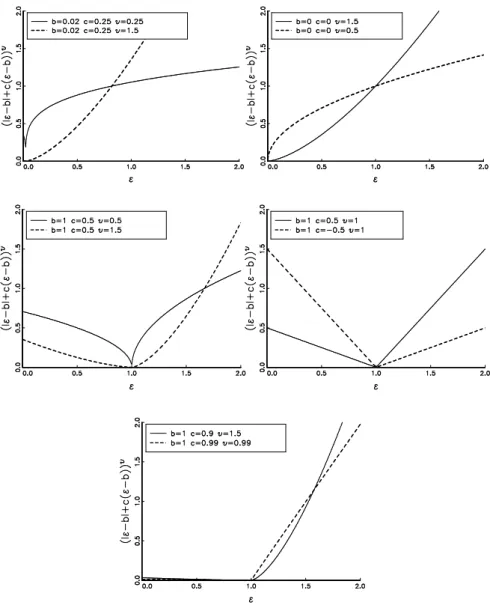
curveg(ǫi) = [|ǫi−b|+c(ǫi−b)]υ incorporates such asymmetric responses
through the shift and rotation parametersband c, respectively.
Because durations are nonnegative, the shift parameter b is key to the
curve. In turn, the parameter c determines whether rotation is clockwise
(c < 0) or counterclockwise (c > 0). Interestingly, it is not necessarily the
case that shift and rotation reinforce each other. Indeed, the shift parameter
affects mostly small shocks, whereas rotation is dominant for large shocks.
The shape parameter υ plays a similar role to λ, inducing either concavity
(υ≤1) or convexity (υ≥1) to the shocks impact curve. Figure 1 illustrates
the behavior of the shocks impact curveg(·) according to the values of the
shift, rotation and shape parameters.
Figure 1
The original ACD model of Engle and Russell (1998) is recovered by
imposing λ= υ = 1 and b =c = 0, whereas letting λ→ 0 and b= c = 0
renders the Box-Cox ACD specification put forward by Dufour and Engle
(2000). Further, (1) reduces to Bauwens and Giot’s (2000) logarithmic ACD
models either if λ → 0, υ = 1 and b = c = 0 (Type I) or if λ, υ → 0 and
b = c = 0 (Type II). Following the GARCH literature, one may build
other conditional duration models by imposing restrictions on (1). The
examples we consider in the sequel include the asymmetric logarithmic ACD
(λ → 0 and υ = 1), asymmetric power ACD (λ = υ), asymmetric ACD
(λ = υ = 1), and power ACD (λ = υ and b = c = 0). Dufour and Engle
(2000) independently propose a version of the asymmetric logarithmic ACD
model with b = 1 under the name of exponential ACD model. We keep
our notation because the linear ACD model with exponential distribution is
sometimes referred to as the exponential ACD model. Table 1 summarizes
the typology of ACD models under consideration.
2.1 Properties
In this section, we build heavily on Carrasco and Chen’s (2002) general
re-sults to establish sufficient conditions that ensureβ-mixing and finite higher
order moments for (conditional) duration processes belonging to the
aug-mented ACD family. The first step consists in casting (2) into a generalized
polynomial random coefficient autoregressive model
Xi+1=A(ei)Xi+B(ei), i= 0,1,2, . . . (3)
where{ei}forms an iid sequence. Next, we apply Mokkadem’s (1990) result
for polynomial autoregressive models to derive the mixing properties of{ψi}.
For the duration process {xi}, we take advantage of Carrasco and Chen’s
result on the mixing properties of a processYi =Xi+εi, where Xi is a β
-mixing homogeneous Markov process andεiis an iid noise with a continuous
density. These two results are collected in Propositions 2 and 4 of Carrasco
and Chen (2002), respectively.
Proposition 1: Let xi =ψiǫi, where ψi satisfies (2) and ǫi is an iid
ran-dom variable that is stochastically independent of ψi. Assume further that
the probability distribution of ǫi is absolutely continuous with respect to the
Lebesgue measure on (0,∞) and such that the density is positive almost
everywhere. Suppose that |β|<1 and
E|β+α[|ǫi−b|+c(ǫi−b)]υ|m<1, (4)
for some integer m > 1. Then, {ψi} is a geometrically ergodic Markov
process and, if initialized from its ergodic distribution, is also strictly
sta-tionary and β-mixing with exponential decay. Further, E¡
ψiλm¢
< ∞ and
E¡
xλm i
¢
<∞. Condition (4) with m= 2 is also necessary to entail
geomet-ric ergodicity of{ψi}andE¡ψ2iλ ¢
distribution,{xi}is strictly stationary andβ-mixing with exponential decay.
Proof: The first two results follow immediately from Carrasco and Chen’s
Proposition 2 with Xi = ψλi, A(ei) = β +α[|ǫi −b|+c(ǫi −b)]υ, and
B(ei) =ω, where ei= (|ǫi−b|, ǫi)
′
. The need for condition (4) withm= 2
stems from Lemma 2 of Pham (1986). The last result follows from Carrasco
and Chen’s Proposition 4 withYi= logxi,Xi = logψi, and εi = logǫi. ¥
If the interest were only in deriving sufficient conditions for the
dura-tion processes xi to be nondegenerate and covariance stationary, one could
alternatively use the tools provided by Nelson (1990, Theorems 1 to 3) as
in Hentschel (1995). Actually, for most of the models in the family spanned
by the augmented ACD process, the conditions in the proposition above
are both necessary and sufficient. The exceptions are formed by the models
that ascertain a positive conditional duration even when at least one of the
following restrictions are violated: ω > 0, α > 0, β > 0, and |c| ≤ 1 for
some odd integerυ. For instance, lettingλ→0 ensures nonnegativeness of
the duration process without imposing further restrictions.
For the sake of completeness, we establish similar properties for the ACD
models belonging to the family of augmented ACD processes. At first glance,
it seems that it suffices to consider the parametric restrictions implied by
each model in condition (4) to extract the corresponding result. That is
not the case, though. To derive (4), one must impose restrictions on A(·)
and B(·), which vary according to the specification of the model. More
specifically, Carrasco and Chen’s (2002) results require that|A(0)|<1 and
that, for some integerm≥1,E|A(ei)|m <1 andE|B(ei)|m <∞.
The generalized polynomial random coefficient autoregressive
A(ei) = β, and B(ei) = ω +α[|ǫi −b|+c(ǫi −b)], implying that
con-dition (4) becomes E(ǫm
i ) < ∞. For the asymmetric power ACD model,
A(ei) =β+α[|ǫi−b|+c(ǫi−b)]λandB(ei) =ω, so that it suffices to impose
that E
¯ ¯
¯β+α[|ǫi−b|+c(ǫi−b)] λ¯¯
¯ m
<1. The latter condition also holds
for the asymmetric ACD model withλ= 1 and for the power ACD
specifica-tion withb=c= 0. While the Box-Cox ACD process asks forE(ǫυmi )<∞,
the logarithmic ACD models of Bauwens and Giot (2000) require either that
E(ǫmi ) exists (Type I) or that |α+β|<1 and E|logǫi|m <∞ (Type II).
As advanced by Carrasco and Chen (2002), in the linear ACD model,
condi-tion (4) reduces toE|β+αǫi|m<1, which is equivalent to assuming that
α+β <[E(ǫm i )]
−1/m
is finite.
2.2 Higher-order moments and autocovariance function
In general, there is no analytical solution for the moments and
autocorrela-tion funcautocorrela-tion of duraautocorrela-tion processes belonging to the augmented ACD family.
Nonetheless, it is possible to derive moment recursion relations and the
au-tocovariance function of the power λ of the duration process by extension
of He and Ter¨asvirta’s (1999) results for the family of GARCH models.
To derive theλm-th momentµλmof the duration process, we write (2) in
its generalized polynomial random coefficient autoregressive representation
ψiλ =Ai−1ψiλ−1+B, (5)
whereB =ω and Ai =β+α g(ǫi). Raising both sides to the power m >0
and then applying recursions give
ψiλm=³Ai−1ψλi−1+B ´m
=Ami−1ψ
λm i−1+
m X j=1 µ m j 
BjAm−j
i−1 ψ
λ(m−j)
=ψimλ−n
n Y
k=1
Ami−k+
m X j=1 µ m j ¶ n X k=1
BjAm−j
i−k ψ
λ(m−j)
i−k
k−1 Y
ℓ=1
Ami−ℓ. (6)
We are now ready to state the next proposition that documents moment
recursion relations for the augmented ACD class of processes.
Proposition 2: Let xi = ψiǫi, where ψi satisfies (5) with 0 < EAmi < 1
and{ǫi}is an iid process stochastically independent of{ψi}. Assume further
that the process started at some finite value infinitely many periods ago. It
then follows that
µλm=
Eǫλm i
1−EAmi
m X j=1 µ m j 
BjEAm−j
i
Eǫλi(m−j) µλ(m−j) (7)
for some integer m≥1 and µ0= 1.
Proof: Because the process started at some finite value infinitely many
periods ago, we can letn→ ∞in (6) and take expectations, resulting in
Eψiλm=Eψimλ(EAmi )n+
m X j=1 µ m j 
BjEAmi −jEψiλ(m−j)
n X
k=1
(EAmi )k−1
= 1
1−EAm i m X j=1 µ m j 
BjEAmi −jEψiλ(m−j).
To complete the proof, it suffices to observe thatψi andǫi are stochastically
independent, and henceµλm=Eǫλmi Eψiλm. ¥
Before moving to the autocovariance function of the powerλof the
dura-tion process, two remarks are in order. First, assuming that 0< EAm i <1 is
analogous to imposing condition (4) in Proposition 1. Second, the moment
recursion relation in (7) involves moments that are possibly of fractional
order. Unfortunately, it is not possible to derive expressions for a moment
of an arbitrary order for such a general family of processes without
restrict-ing the shape parameterλof the Box-Cox transformation of the conditional
a recursion relation involving moments of any integer order. Alternatively,
one could also consider the subclass of conditional duration processes
deter-mined by the limiting caseλ→0. We follow the latter approach in the end
of this section in view that the log-transformation of the duration process is
quite convenient for avoiding nonnegativeness constraints.
Proposition 3: Letxi=ψiǫi, whereψi satisfies (5) with 0< EAmi <1for
some integer m≥2. Let ǫi form an iid sequence stochastically independent
of {ψi} such that EAiǫλi is finite. It then follows that the autocovariance
functionγλ,n=Exλixλi−n−µ2λ of order n≥1 reads
γλ,n=
B2Eǫλ i
1−EAi
n−1 X
j=0
(EAi)j+
(EAi)n−1EAiǫλi(1 +EAi)
1−EA2
i
− Eǫ λ i
1−EAi
. (8)
Proof: Multiplying both sides of (5) by ψiλ−n yields
ψiλψλi−n= ³
Ai−1ψλi−1+B ´
ψiλ−n
=hAi−1 ³
Ai−2ψλi−2+B ´
+Biψiλ−n
=
B+B n X
j=2
j−1 Y
k=1
Ai−k+
n Y
k=1
Ai−kψiλ−n
ψλi−n.
Multiplying now both sides by ǫiǫi−n and then taking expectations give
Exλixλi−n=Eǫ
λ iB
1 + n X
j=2
(EAi)j−1
Eψiλ+Eǫλi(EAi)n −1
EAiǫλiEψ2iλ
=Eǫλi
B Eψλi n−1 X
j=0
(EAi)j+ (EAi)n−1EAiǫλiEψi2λ
.
The result then ensues from the fact that equation (6) implies that the
first and second moments of ψλ
i are respectively Eψiλ =B/(1−EAi) and
Eψi2λ =B2(1 +EAi)/[(1−EAi)(1−EA2i)], whereas the moment recursion
As an example, consider the linear ACD process with an exponential
noise introduced by Engle and Russell (1998), which results from λ = 1,
Ai =β+αǫi andB =ω. Proposition 2 then implies that
µm=
Γ(m+ 1) 1−E(β+αǫi)m
m X j=1 µ m j 
E(β+αǫi)m−j
Γ(m−j) ω
jµ m−j
provided thatα+β <1. Solving for m= 1 and m= 2 yields the first two
moments as derived in Engle and Russell (1998). In turn, it follows from
Proposition 3 that the autocovariance function of ordernreads
γn=ω2 ½
1−(α+β)n 1−(α+β) +
(α+β)n−1
(1 +α+β)(2α+β) [1−(α+β)] [1−(α+β)2−α2]
¾
.
This expression provides a sharper result than Bauwens and Giot’s (2000)
recursive formula for computing the autocovariance function of a linear ACD
process with exponential errors.
We now focus on a particular subclass of the augmented ACD family
that permits working out expressions for any arbitrary moment as well as
the autocorrelation function. This subclass is determined by shrinking the
Box-Cox shape parameter to zero (λ→0), yielding
logψi =ω+α g(ǫi−1) +β logψi−1. (9)
This subclass is particularly interesting for ensuring that the duration
pro-cess is always positive regardless of the sign and magnitude of the
pa-rameters. In particular, it nests the asymmetric logarithmic ACD model,
Bauwens and Giot’s (2000) logarithmic ACD specifications, and the Box-Cox
ACD process put forward by Dufour and Engle (2000). He, Ter¨asvirta and
Malmsten (2002) derive analogous results for a class of exponential GARCH
models.
To derive the m-th moment µm = Exmi of the duration process, it is
to the power m >0 and then applying recursions give
ψim= exp [m ω+m α g(ǫi−1)]ψm βi−1
= exp
Ã
m ω
n−1 X k=0 βk ! n Y k=1
exphm α βk−1
g(ǫi−k) i
ψim β−nn.
Assuming thatE{exp [κ g(ǫi)]}<∞forκ∈(0,∞) and that|β|<1, yields
Eψim = exp
µ
m ω 1 +β
n
1−β
¶ n Y
k=1
Enexphm αβk−1
g(ǫi) io
Eψim βn. (10)
We are now ready to state the next result that reports them-th moment of
the duration process defined in (9).
Corollary 1: Let xi =ψiǫi, where ψi satisfies (9) with |β|<1 and {ǫi} is
an iid process stochastically independent of {ψi}. Assume that the process
started at some finite value infinitely many periods ago. If both Eǫmi and
E{exp [m α g(ǫi)]} are finite for some integer m≥1, it then follows that
µm=Eǫmi exp £
m ω(1−β)−1¤ ∞ Y
k=1
Eexpnhm αβk−1
g(ǫi) io
. (11)
Proof: Because the process started at some finite value infinitely many
periods ago, we can letn→ ∞in (10), resulting in
Eψim= exp£
m ω(1−β)−1¤ ∞ Y
k=1
Enexphm αβk−1
g(ǫi) io
.
The result then follows from the fact that ψi and ǫi are stochastically
independent. ¥
Next we move to the autocovariance function of duration processes in
the (λ→0)-subclass of augmented ACD models. As before, the exponential
form of (9) facilitates the task.
Corollary 2: Let xi = ψiǫi, where ψi satisfies (9) with |β| < 1 and is
E{exp [α g(ǫi)]} and E{ǫiexp [α g(ǫi)]} are finite. It then follows that the
autocovariance function γn=Exixi−n−µ21 of order n≥1 reads
γn=EǫiE©ǫiexp£αβn−1g(ǫi)¤ª n−1
Y
k=1
Enexphαβk−1
g(ǫi) io
× ∞ Y
k=1
Enexphα(1 +βn)βk−1
g(ǫi) io
exp
µ
2ω
1−β

−µ21. (12)
Proof: Consider the exponential form of the conditional duration process
(9), then
ψiψi−n= exp Ã
ω
n−1 X k=0 βk ! n Y k=1
exphαβk−1
g(ǫi−k) i
ψβi−nn+1,
which means that
xixi−n=ǫiǫi−nexp Ã
ω
n−1 X k=0 βk ! n Y k=1
exphαβk−1
g(ǫi−k) i
ψβi−nn+1.
Taking expectations in both sides yields (12). ¥
3
Empirical application
In this section, we estimate different ACD specifications using IBM price
durations at the New York Stock Exchange (NYSE) from September to
November 1996. Data were kindly provided by Luc Bauwens and Pierre
Giot, who have formed a broad data set using the NYSE’s Trade and Quote
database. We define price duration as the time interval needed to observe a
cumulative change in the mid-price of at least $0.125 as suggested by Giot
(2000). Price durations are closely tied to the instantaneous volatility of
the mid-quote price process (Engle and Russell, 1997 and 1998); hence it
is not surprising that they may have serious implications to option pricing
(Prigent et al., 2001) and intra-day risk management (Giot, 2000).
Apart from an opening auction, NYSE trading is continuous from 9:30 to
the regular opening hours of the NYSE, are removed. As documented by
Giot (2000), durations feature a strong time-of-day effect. We therefore
consider diurnally adjusted durations xi =Di/̺(ti), where Di is the plain
duration in seconds and̺(·) denotes the diurnal factor determined by first
averaging the durations over thirty minutes intervals for each day of the
week and then fitting a cubic spline with nodes at each half hour. The
resulting (diurnally adjusted) durations serve as input for the remainder of
the analysis.
Table 2
Table 2 describes the main statistical properties of the IBM price
du-rations. We compute descriptive statistics for both plain and diurnally
ad-justed data. It takes on average 4.4 minutes for a cumulative price change of
$0.125 to take place, though the median waiting time is much lesser than 2
minutes. Overdispersion is robust to the time-of-day effect, thus it is not an
artifact due to data seasonality. Sample autocorrelations reveal that
persis-tence is slightly changed if one accounts for the diurnal factor. Altogether,
the combination of overdispersion and autocorrelation in the price durations
warrants the estimation of autoregressive conditional duration models.
We then estimate by maximum likelihood the ACD models listed in
Table 1 assuming thatǫi is iid with Burr density
fB(ǫi; θB) =
κ µκ B,1ǫκ
−1
i ³
1 +γ µκ B,1ǫκi
´1+1/γ, (13)
whereκ > γ >0 and
µB,m≡
Γ(1 +m/κ) Γ(1/γ−m/κ)
denotes the m-th moment, which exists for m < κ/γ. The Burr family
encompasses both the Weibull (γ →0), exponential (γ →0 andκ= 1), and
log-logistic (γ →1) distributions.
Table 3
Tables 3 and 4 report respectively the estimation results for the existing
models in the literature and the novel specifications. Asymptotic standard
errors are based on the outer-product-of-the-gradient (OPG) estimator of
the information matrix since the absolute value function in the shocks impact
curve makes Hessian-based estimates tricky to compute due to numerical
problems.
Table 4
It is interesting to observe that the estimates of the Burr parameters κ
andγ are quite robust regardless of the specification of the duration process.
They imply that the baseline hazard rate function is nonmonotonic and that
there are at most three finite moments in view that ˆκ/γˆ ∈[2.7173,3.0438].
The parameter estimates of the linear and logarithmic ACD models are very
much in line with the previous results in the literature (see columns ACD,
LACD I and LACD II, respectively). Interestingly, the log-likelihood value
of the logarithmic ACD Type I model substantially differs from the values
of the linear and logarithmic ACD Type II specifications. The
asymmet-ric logarithmic ACD model with b = 1 introduced by Dufour and Engle
(2000) palpably increases the log-likelihood value (-4,920.5 versus -4,950.5),
suggesting that asymmetry may play a role (see column EXACD). The last
column BCACD shows however that letting the powerυofǫi−1 free to vary
value than introducing asymmetric effects. Indeed, in the Box-Cox ACD
model, ˆυ is significantly different from both zero and one, lending some
support against the logarithmic ACD Type I and II models, respectively.
In the power ACD specification, we notice that the shape parameterλof
the Box-Cox transformation is also significantly different from both zero and
one (see column PACD). This indicates that the restrictions imposed by the
linear and the logarithmic ACD Type I models seem inconsistent with the
data, even though the latter is only marginally inferior to the power ACD
model in terms of log-likelihood value. Introducing an asymmetric effect to
the power ACD specification ameliorates only marginally the fit of the model
(see column A-PACD). Despite the fact thatbis significantly different from
zero, the standard error ofc is quite large, showing that the shocks impact
curve features no rotation. Although both shift and rotation parameters
are significant in the asymmetric ACD specification (see column A-ACD), it
violates the constraints usually imposed to ensure the nonnegativeness of the
duration process, namelyα > 0 and|c|<1. The A-LACD column shows
that all parameters are significantly different from zero in the asymmetric
logarithmic ACD model. In particular, given that ˆα is negative, the shift
and rotation effects are such that the shocks impact curve is concave.
The figures displayed in the column AACD demonstrate that the
dou-ble Box-Cox transformation (λ6=υ) brings about further improvements as
indicated by the value of the log-likelihood of the augmented ACD model.
The difference between ˆυ and ˆλis striking. Indeed, there is strong evidence
supporting that λ converges to zero (i.e. the log transformation), whereas
0.1310<υ <ˆ 0.5178 with 99% of confidence. The fact that ˆλis close to zero
From equations (1) and (2), it happens thatα=α∗λonly ifλ >0, whileα
and α∗ are equivalent in the limiting case λ→ 0. Table 4 reports ˆα = ˆα∗λˆ
and the corresponding standard error as computed by the delta method. It
is therefore straightforward to retrieve the estimate of α∗ from the figures
in Table 4: Indeed, ˆα∗ = 0.3898 with standard error equal to 0.1839.
To have a better idea about the fit of the models, we undertake an
infor-mal log-likelihood comparison that accounts for overparameterization. We
do not pursuit a formal analysis based on log-likelihood ratio tests because,
due to the presence of inequality constraints in the parameter space, the
limiting distribution of the test statistic is a mixing of chi-square
distribu-tions with probability weights depending on the variance of the parameter
estimates (Wolak, 1991). Accordingly, it is extremely difficult to obtain
empirically implementable asymptotically exact critical values. As an
alter-native, Wolak suggests applying asymptotic bounds tests. However, bounds
are in most instances quite slack, often yielding inconclusive results.
We compute the Akaike information criterion, AIC≡ −2(logL −k)/T,
where logLdenotes the value of the log-likelihood,kthe number of
param-eters andT the number of observations. In terms of AIC values, the horse
race winners are augmented ACD, the Box-Cox ACD, the asymmetric power
ACD, and the asymmetric logarithmic ACD models.1 The rewards of the
extra flexibility granted by these specifications are in contrast to the poor
performance of the linear and logarithmic ACD Type II models. Further,
letting λ free to vary and accounting for asymmetric effects seem to
oper-ate as substitute sources of flexibility. For instance, it is very rewarding to
1
introduce asymmetric responses to shocks in specifications with fixedλ.
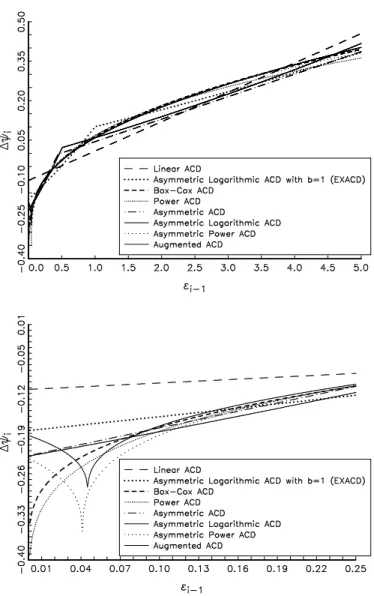
Figure 2
Figure 2 portrays the effective shocks impact curves of each specification
by depicting the variation of the conditional duration ∆ψi ≡ ψi−ψi−1 in
response to a shockǫi−1at timeti−1. We fix the conditional duration process
ψi−1 at time ti−1 to one, while we vary the shock ǫi−1 from zero to five.2
It is striking that, in all instances, ∆ψi reacts in a very similar fashion to
the shock. In particular, it seems that the concavity of the shocks impact
curve is the most important feature to account for when modeling IBM price
durations, alleviating the problem of overpredicting short durations. In the
sequel, we argue that the apparently substitutability between the Box-Cox
transformation and the asymmetric effects is chiefly caused by the need to
achieve concavity of the shocks impact curve.
The asymmetric linear and logarithmic ACD’s shocks impact curves are
concave only for certain values of the shift and rotation parameters, namely
b >0 andc <−1. From this perspective, the parameter estimates reported
in the column EXACD in Table 3 and columns A-ACD and A-LACD in
Ta-ble 4 are not surprising. The estimates of the shift and rotation parameters
are significantly different from zero and inferior to minus one, respectively.
In contrast, if the shape parameter υ is inferior to one, both the Box-Cox
and augmented ACD models produce concave shocks impact curves. In the
case of the AACD, this holds regardless of the shift and rotation
parame-ters, hence it comes with no wonder that the corresponding estimates are
not jointly significant in the AACD specification. As the power ACD model
2
imposes λ = υ, the estimate of ˆλ sets in towards the estimates of υ in
the Box-Cox and augmented ACD models so as to entail a concave shocks
impact curve. The same happens with the asymmetric power ACD model,
despite the fact that, at first glance, one could also induce concavity through
the shift and rotation parameters. It turns out, however, that to ensure a
concave shocks impact curve the absolute value of the rotation parameter
must exceed one, running counter to the nonnegativeness constraint.3
In-deed, the augmented ACD model avoids this problem by lettingλconverge
to zero, thereby mimicking the asymmetric logarithmic ACD specification.
All in all, Figure 2 illustrates some of the pitfalls from the specific to
gen-eral modeling approach: There are various ways to achieve a concave shocks
impact curve that the data call for and failing to start from a sufficiently
general specification may point to quite misleading directions.
We now infer about the statistical properties of the duration processes by
checking whether they satisfy the sufficient conditions for strict stationarity
derived in Proposition 1. The aim is to illustrate how to use Proposition 1
for testing purposes. Maximum likelihood requires strict stationary of the
duration process to ensure consistency, hence estimates that violate either
|β| < 1 or (4) are not very reliable. In the linear ACD model, this is
equivalent to verifying whether|α+β|< µ−B,m1/m<∞ for some integerm >
1. The second inequality poses no problem as µB,m exists form < κ/ˆ ˆγ =
3.0139. However, ˆα+ ˆβ = 0.9915, whereas m= 2 yields ˆµ−B,12/2 = 0.4348. In
contrast, all other specifications seem to satisfy the sufficient conditions put
forth in Proposition 1. For both versions of the logarithmic ACD model,
3
condition (4) holds in view that |αˆ+ ˆβ| < 1 in Type I and |βˆ| < 1 in
Type II. Further, |βˆ| < 1 guarantees that both restricted (EXACD) and
unrestricted (A-LACD) versions of the asymmetric logarithmic ACD model
as well as the Box-Cox ACD process are strictly stationary. The power ACD
model requires thatE|β+α ǫλi|2 <1 for some integerm >1, which reduces
to|α+β|< µB,−12/λ2 form= 2. The latter inequality is empirically satisfied
as the parameter estimates are such that 0.9738 = ˆα+ ˆβ <µˆ−1/2
B,2ˆλ = 1.0058.
Numerical results based on 10,000 Monte Carlo simulations also show that
(4) holds for the asymmetric ACD and asymmetric power ACD models. As
λ → 0 in the augmented ACD model, strict stationarity follows from the
fact that|βˆ|<1.
To check for misspecification, we first inspect whether the standardized
durations display any serial correlation by looking at the sample
autocorre-lation function of n-th order with n varying from 1 to 60. Tables 3 and 4
document that there is no sample autocorrelation greater than 0.05 (in
mag-nitude) irrespective of the specification of the conditional duration process.
Moreover, the Ljung-Box statistics also show no evidence of serial
correla-tion in the residuals.4 We therefore conclude that the conditional duration
models are doing a great job of accounting for the serial dependence in the
IBM price durations.
Next, we apply Fernandes and Grammig’s (2003) D-test to gauge the
closeness between the parametric and nonparametric estimates of the
den-sity function of the residuals. Under the correct specification of the
condi-tional duration process, both the parametric and kernel density estimates
4
of the residuals ˆǫi = ψψˆiiǫi converge to the true Burr density. In contrast,
misspecification gives rise to a mixture of Burr distributions since the
fac-tor ψi
ˆ
ψi
does not converge to one in probability. The kernel density estimate
will then converge to this mixture of Burr densities, whereas the parametric
estimate always belongs to the Burr family. The test statistic is thus
pre-sumably close to zero under the null, whereas it should be large under the
alternative. The motivation to apply the D-test is twofold. First, although
it is slightly conservative, the D-test entails excellent power against both
fixed and local alternatives. Second, it is nuisance parameter free in that
there is no asymptotic cost in replacing errors with estimated residuals.
To avoid boundary effects in the kernel density estimates due to the
non-negativeness of standardized durations, we work with log-residuals rather
than plain residuals. All nonparametric density estimates use a Gaussian
kernel, whereas the bandwidths are chosen according to an adjusted-version
of Silverman’s (1986) rule of thumb. The adjustment is necessary because
the asymptotic theory of the D-test requires a slight degree of
undersmooth-ing so as to avoid additional bias terms (see Fernandes and Grammig, 2003).
Despite the fact that the p-values of the D-test seem to decrease with the
degree of smoothing, the results are qualitatively robust to minor variations
in the bandwidth value.
The D-test results illustrate the rewards of the extra flexibility provided
by the AACD family. There is no standard specification that performs well
as seen in Table 3. At the 1% level of significance, we soundly reject the
linear and logarithmic Type I ACD models, whereas we find a borderline
result for the asymmetric logarithmic ACD model with b = 1 proposed by
ACD model, while rejecting the logarithmic ACD Type II specification is
somewhat arguable given that the p-value is very close to 0.05. The figures
in Table 4 are much rosier: There is indeed no clear rejection, though we find
a borderline result for the asymmetric ACD model at the 5% significance
level. The D-test results also indicate that the asymmetric logarithmic ACD
specification is the most successful model, achieving a quite large p-value.
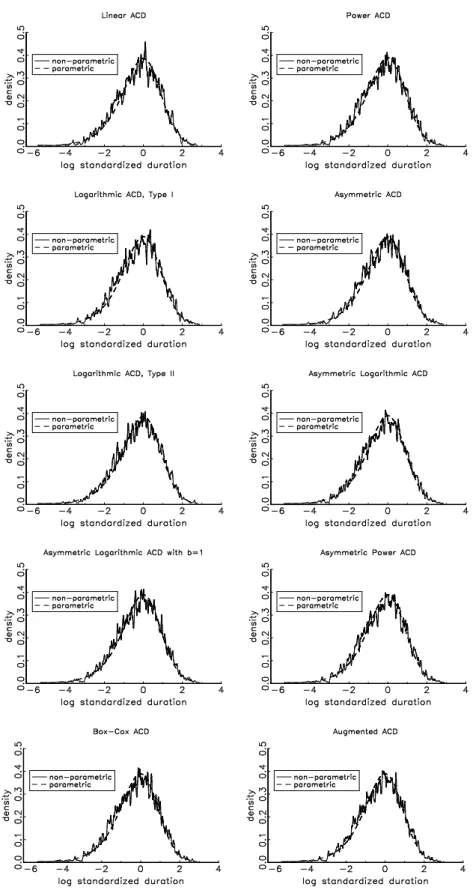
Figure 3 illustrates this pattern by plotting the kernel and parametric density
estimates of the log-residuals for the two groups of models in the first and
second column, respectively. While there are striking discrepancies in the
first column, the nonparametric density estimates nicely oscillate around the
parametric density estimates of the log-residuals in the second column.
Figure 3
To provide further empirical evidence, we consider price duration data,
from September to November 1996, relating to four actively traded stocks
on NYSE: Boeing, Coca-Cola, Disney, and Exxon. We also examine volume
and trade durations referring to the above stocks and IBM. Trade durations
measure the time between two successive transactions, whereas volume
du-rations denote the time interval needed to observe a cumulative trading
volume of 25,000 shares. We deal with intraday seasonality in the same
fashion as before. As expected, all durations keep featuring autocorrelation
and overdispersion even after adjusting for the time-of-day effect.
Tables 5 to 7
Tables 5 to 7 respectively summarize the results for price, volume and
trade durations. We report the Akaike information criterion (AIC) and the
Restricting attention to the models that are not rejected by the specification
tests, the horse race winners (according to the information criterion) belong
to the subclass of logarithmic ACD processes given by (9). In particular, we
select the LACD Type I model for the Boeing and Disney price durations as
well as for the Exxon volume duration data. Furthermore, the asymmetric
logarithmic ACD specifications (EXACD and A-LACD) perform well not
only for the Coke price and volume durations, but also for the Boeing
vol-ume duration. In contrast, we find no suitable ACD specification to model
either the IBM volume duration or any trade duration. The rejections are
mainly due to the residual serial dependence. We therefore deem that
fur-ther research must pay more attention to the logarithmic subclass of the
AACD family given that it is quite flexible and easy to manipulate in the
context of higher order autoregressive structures.
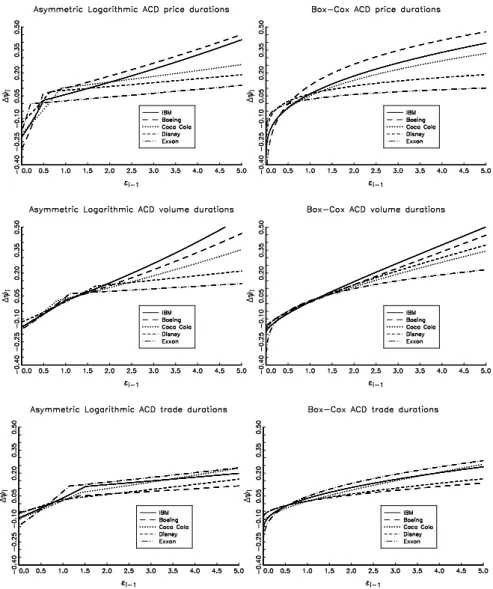
Figure 4
Lastly, the concavity of the shocks impact curve appears to be a quite
general feature of financial duration data. Figure 4 displays the shocks
im-pact curves for the models with best overall performance. Although it seems
more pronounced for price durations, concavity shows up in all instances.
4
Conclusion
This paper introduces a family of augmented ACD models that
encom-passes most specifications in the literature. The nesting leans upon a
Box-Cox transformation to the conditional duration process and an
asymmet-ric shocks impact curve. The motivation for the latter stems from Engle
tends to overpredict after either very long or very short durations. We
de-rive sufficient conditions for the existence of higher-order moments, strict
stationarity, geometric ergodicity and β-mixing property with exponential
decay in this class of ACD models.
Our empirical results on IBM price durations show that the restrictions
imposed by the existing models in the literature are incompatible with the
data, warranting the extra flexibility granted by the augmented ACD
mod-els. Actually, inspecting the parameter estimates of the different
specifica-tions reveals that imposing concavity in the shocks impact curve is pivot.
The Box-Cox transformation and the asymmetric response to shocks indeed
work, to some extent, as substitutes. In particular, the power ACD and
asymmetric logarithmic ACD models produce the best fit.
Further empirical investigation reveals that the concavity of the shocks
impact curve is not a specific feature of the IBM price durations. Our
findings evince the same concave pattern using other financial duration data,
References
Bauwens, L., Giot, P., 2000, The logarithmic ACD model: An application to
the bid-ask quote process of three NYSE stocks, Annales d’Economie
et de Statistique 60, 117–150.
Bauwens, L., Veredas, D., 1999, The stochastic conditional duration model:
A latent factor model for the analysis of financial durations,
forthcom-ing in Journal of Econometrics.
Box, G. E. P., Cox, D. R., 1964, An analysis of transformations, Journal of
the Royal Statistical Society B 26, 211–243.
Carrasco, M., Chen, X., 2002, Mixing and moment properties of various
GARCH and stochastic volatility models, Econometric Theory 18, 17–
39.
Dufour, A., Engle, R. F., 2000, The ACD model: Predictibility of the time
between consecutive trades, University of Reading and University of
California at San Diego.
Engle, R. F., Russell, J. R., 1997, Forecasting the frequency of changes
in quoted foreign exchange prices with the autoregressive conditional
duration model, Journal of Empirical Finance 4, 187–212.
Engle, R. F., Russell, J. R., 1998, Autoregressive conditional duration:
A new model for irregularly-spaced transaction data, Econometrica
66, 1127–1162.
Fernandes, M., Grammig, J., 2003, Nonparametric specification tests for
conditional duration models, Graduate School of Economics, Getulio
Vargas Foundation.
Ghysels, E., Gouri´eroux, C., Jasiak, J., 2003, Stochastic volatility duration
models, forthcoming in Journal of Econometrics.
Giot, P., 2000, Time transformations, intraday data and volatility models,
He, C., Ter¨asvirta, T., 1999, Properties of moments of a family of GARCH
processes, Journal of Econometrics 92, 173–192.
He, C., Ter¨asvirta, T., Malmsten, H., 2002, Moment structure of a family of
first-order exponential GARCH models, Econometric Theory 18, 868–
885.
Hentschel, L., 1995, All in the family: Nesting symmetric and asymmetric
GARCH models, Journal of Financial Economics 39, 71–104.
Mokkadem, A., 1990, Propri´et´es de m´elange des mod`eles autoregressifs
poly-nomiaux, Annales de l’Institut Henri Poincar´e 26, 219–260.
Nelson, D. B., 1990, Stationary and persistence in the GARCH(1,1) model,
Econometric Theory 6, 318–334.
Pham, D. T., 1986, The mixing property of bilinear and generalised
ran-dom coefficient autoregressive models, Stochastic Processes and Their
Applications 23, 291–300.
Prigent, J.-L., Renault, O., Scaillet, O., 2001, An autoregressive
condi-tional binomial option pricing model, in: H. Geman D. Madan S. Pliska
T. Vorst (eds), Selected Papers from the First World Congress of the
Bachelier Finance Society, Springer Verlag, Heidelberg.
Silverman, B. W., 1986, Density Estimation for Statistics and Data Analysis,
Chapman and Hall, London.
Wolak, F. A., 1991, The local nature of hypothesis tests involving inquality
constraints in nonlinear models, Econometrica 59, 981–995.
Zhang, M. Y., Russell, J. R., Tsay, R. S., 2001, A nonlinear autoregressive
conditional duration model with applications to financial transaction
Table 1
Typology of ACD models
Augmented ACD
ψiλ=ω+α ψiλ−1 h
|ǫi−1−b|+c(ǫi−1−b) iυ
+β ψλi−1
Asymmetric Power ACD (λ=υ)
ψλ
i =ω+α ψiλ−1 h
|ǫi−1−b|+c(ǫi−1−b) iλ
+β ψλ i−1
Asymmetric Logarithmic ACD (λ→0 andυ= 1)
logψi =ω+α h
|ǫi−1−b|+c(ǫi−1−b) i
+β logψi−1
Asymmetric ACD (λ=υ= 1)
ψi =ω+α ψi−1 h
|ǫi−1−b|+c(ǫi−1−b) i
+β ψi−1
Power ACD (λ=υ and b=c= 0)
ψiλ=ω+α xλi−1+β ψ
λ i−1
Box-Cox ACD (λ→0 andb=c= 0)
logψi =ω+α ǫυi−1+β logψi−1
Logarithmic ACD Type I (λ, υ→0 and b=c= 0)
logψi =ω+α logxi−1+β logψi−1
Logarithmic ACD Type II (λ→0,υ= 1 and b=c= 0)
logψi =ω+α ǫi−1+β logψi−1
Linear ACD (λ=υ= 1 and b=c= 0)
Table 2
Descriptive statistics
IBM price durations plain adjusted
sample size 4,484 4,484
mean 262.55 1.239
median 128 0.714
maximum 7170 29.121
minimum 1 0.004
overdispersion 1.610 1.330
n-th order sample autocorrelation
n= 1 0.256 0.179
n= 2 0.231 0.184
n= 3 0.240 0.166
n= 4 0.168 0.121
n= 8 0.127 0.106
n= 12 0.095 0.099
n= 16 0.061 0.072
n= 20 0.018 0.062
n= 24 0.021 0.073
n= 28 0.000 0.050
n= 32 -0.008 0.047
Table 3
Estimation results for the AACD family of models IBM price durations ($0.125 mid-price change)
parameter ACD LACD I LACD II EXACD BCACD
ω 0.0171 0.0774 -0.0865 -0.0964 -0.5230
(0.0038) (0.0069) (0.0063) (0.0131) (0.1708)
α 0.1116 0.1250 0.0912 -0.1157 0.5843
(0.0088) (0.0083) (0.0067) (0.0152) (0.1768)
β 0.8799 0.8327 0.9759 0.9614 0.9616
(0.0089) (0.0127) (0.0042) (0.0064) (0.0067)
υ 0.2371
(0.0772)
c -1.4927
(0.1288)
κ 1.2616 1.3036 1.2592 1.2892 1.2954
(0.0318) (0.0331) (0.0318) (0.0327) (0.0330)
γ 0.4186 0.4808 0.4137 0.4519 0.4635
(0.0471) (0.0487) (0.0469) (0.0478) (0.0486)
logL -4,952.4 -4,924.8 -4,950.5 -4,924.5 -4,920.5
AIC 1.6836 1.6742 1.6830 1.6741 1.6728
D-test 0.0029 0.0025 0.0488 0.0140 0.0266
Q(4) 0.1965 0.0845 0.1152 0.5821 0.4990
Q(8) 0.0898 0.1433 0.1136 0.2410 0.2327
Q(16) 0.0836 0.0534 0.1569 0.1956 0.1891
Q(24) 0.0496 0.0897 0.1084 0.2853 0.2698
max ACF 0.0326 0.0403 0.0344 0.0370 0.0378
min ACF -0.0282 -0.0264 -0.0259 -0.0310 -0.0320
Table 4
Estimation results for the AACD family of models IBM price durations ($0.125 mid-price change)
parameter PACD A-ACD A-LACD A-PACD AACD
ω 0.0378 0.0208 0.0217 0.0378 0.0361
(0.0067) (0.0049) (0.0147) (0.0061) (0.0064)
α 0.1352 -0.1990 -0.2294 0.1270 0.00001
(0.0110) (0.0452) (0.0448) (0.0268) (0.1022)
β 0.8386 0.9760 0.9639 0.8468 0.9639
(0.0123) (0.0168) (0.0062) (0.0116) (0.0891)
λ 0.1751 0.2573 0.00003
(0.0848) (0.0681) (0.2621)
υ 0.3244
(0.0747)
b 0.4456 0.5066 0.0411 0.0451
(0.0741) (0.0680) (0.0019) (0.0015)
c -1.4294 -1.3172 0.2326 0.1117
(0.1099) (0.0724) (0.9446) (1.1718)
κ 1.2976 1.2882 1.2926 1.2979 1.2935
(0.0331) (0.0328) (0.0329) (0.0330) (0.0329)
γ 0.4688 0.4556 0.4589 0.4685 0.4588
(0.0487) (0.0484) (0.0485) (0.0482) (0.0483)
logL -4,922.7 -4,930.1 -4,921.1 -4,921.0 -4,918.4
AIC 1.6735 1.6760 1.6730 1.6729 1.6721
D-test 0.0955 0.0494 0.4039 0.1353 0.1370
Q(4) 0.3011 0.1794 0.4259 0.3866 0.5031
Q(8) 0.2085 0.0600 0.1182 0.2100 0.1840
Q(16) 0.1447 0.0719 0.1124 0.1447 0.1726
Q(24) 0.2224 0.1085 0.1536 0.2262 0.2594
max ACF 0.0378 0.0351 0.0352 0.0386 0.0381
min ACF -0.0301 -0.0341 -0.0370 -0.0316 -0.0331
Table 5
Estimation results for price durations ($0.125 mid-price change)
ACD LACD I LACD II EXACD BCACD PACD A-ACD A-LACD A-PACD AACD
Boeing sample size: 1,746 observations
AIC 1.9989 1.9759 2.0030 1.9890 1.9770 1.9771 1.9945 1.9815 1.9789 1.9800
Q(1) 0.551 0.734 0.210 0.539 0.732 0.708 0.754 0.585 0.736 0.679
Q(12) 0.320 0.219 0.460 0.353 0.220 0.221 0.484 0.417 0.214 0.225
D-test 0.103 0.173 0.006 0.283 0.157 0.160 0.113 0.140 0.121 0.097
Coke sample size: 1,072 observations
AIC 1.8885 1.8823 1.8909 1.8811 1.8833 1.8833 1.8923 1.8827 1.8863 1.8882
Q(1) 0.138 0.233 0.224 0.232 0.132 0.137 0.139 0.206 0.131 0.135
Q(12) 0.502 0.482 0.608 0.501 0.436 0.435 0.506 0.494 0.430 0.434
D-test 0.615 0.059 0.733 0.270 0.250 0.250 0.624 0.184 0.360 0.369
Disney sample size: 1,439 observations
AIC 2.2148 2.2104 2.2146 2.2127 2.2118 2.2118 2.2176 2.2130 2.2145 2.2159
Q(1) 0.926 0.869 0.874 0.877 0.866 0.856 0.889 0.836 0.833 0.848
Q(12) 0.685 0.500 0.673 0.543 0.524 0.512 0.670 0.430 0.514 0.519
D-test 0.133 0.271 0.213 0.371 0.295 0.281 0.188 0.087 0.295 0.303
Exxon sample size: 1,810 observations
AIC 1.9556 1.9521 1.9554 1.9549 1.9532 1.9533 1.9536 1.9529 1.9535 1.9545
Q(1) 0.219 0.241 0.267 0.232 0.234 0.267 0.149 0.231 0.304 0.304
Q(12) 0.228 0.265 0.251 0.224 0.250 0.258 0.208 0.308 0.272 0.272
D-test 0.099 0.006 0.136 0.043 0.029 0.033 0.091 0.017 0.012 0.012
Table 6
Estimation results for volume durations (cumulative trading volume: 25,000 shares)
ACD LACD I LACD II EXACD BCACD PACD A-ACD A-LACD A-PACD AACD
Boeing sample size: 1,050 observations
AIC 1.8016 1.8054 1.7990 1.7983 1.8000 1.8021 1.8046 1.7999 1.8044 1.8063
Q(1) 0.964 0.762 0.831 0.772 0.802 0.935 0.898 0.724 0.850 0.849
Q(12) 0.537 0.367 0.586 0.516 0.542 0.510 0.551 0.503 0.515 0.516
D-test 0.573 0.478 0.767 0.781 0.703 0.567 0.507 0.790 0.610 0.607
Coke sample size: 2,014 observations
AIC 1.8031 1.8060 1.8022 1.7993 1.8009 1.8018 1.8014 1.7994 1.8023 1.8033
Q(1) 0.033 0.029 0.031 0.064 0.057 0.053 0.072 0.091 0.062 0.060
Q(12) 0.096 0.006 0.096 0.059 0.066 0.065 0.054 0.052 0.052 0.053
D-test 0.390 0.834 0.137 0.499 0.634 0.658 0.696 0.691 0.636 0.631
Disney sample size: 1,184 observations
AIC 1.8913 1.8967 1.8924 1.8915 1.8918 1.8918 1.8941 1.8907 1.8943 1.8960
Q(1) 0.364 0.130 0.284 0.329 0.358 0.364 0.352 0.330 0.368 0.367
Q(12) 0.524 0.297 0.524 0.463 0.493 0.494 0.526 0.517 0.483 0.493
D-test 0.000 0.010 0.000 0.002 0.000 0.000 0.000 0.000 0.000 0.000
Exxon sample size: 1,362 observations
AIC 1.6471 1.6400 1.6486 1.6404 1.6413 1.6413 1.6435 1.6416 1.6438 1.6453
Q(1) 0.732 0.456 0.947 0.486 0.446 0.446 0.526 0.535 0.417 0.435
Q(12) 0.575 0.572 0.587 0.593 0.573 0.572 0.598 0.598 0.563 0.593
D-test 0.886 0.989 0.818 0.961 0.964 0.964 0.909 0.987 0.962 0.962
IBM sample size: 2,869 observations
AIC 1.8300 1.8393 1.8282 1.8264 1.8259 1.8286 1.8311 1.8271 1.8274 1.8280
Q(1) 0.000 0.000 0.001 0.001 0.001 0.000 0.000 0.001 0.000 0.000
Q(12) 0.000 0.000 0.000 0.000 0.000 0.000 0.000 0.000 0.000 0.000
D-test 0.811 0.894 0.941 0.856 0.580 0.866 0.812 0.860 0.664 0.649
Table 7
Estimation results for trade durations
ACD LACD I LACD II EXACD BCACD PACD A-ACD A-LACD A-PACD AACD
Boeing sample size: 15,952 observations
AIC 2.0765 2.0754 2.0762 2.0730 2.0733 2.0736 2.0738 2.0730 2.0733 2.0735
Q(1) 0.000 0.000 0.000 0.000 0.000 0.000 0.000 0.000 0.000 0.000
Q(12) 0.001 0.000 0.001 0.000 0.000 0.000 0.000 0.000 0.000 0.000
D-test 0.000 0.000 0.000 0.000 0.000 0.000 0.000 0.000 0.000 0.000
Coke sample size: 26,414 observations
AIC 1.8109 1.8142 1.8111 1.8083 1.8086 1.8091 1.8110 1.8082 1.8084 1.8085
Q(1) 0.267 0.000 0.150 0.298 0.289 0.165 0.268 0.270 0.225 0.224
Q(12) 0.007 0.000 0.009 0.034 0.022 0.016 0.007 0.028 0.033 0.033
D-test 0.000 0.000 0.000 0.000 0.000 0.000 0.000 0.000 0.000 0.000
Disney sample size: 21,880 observations
AIC 2.1042 2.1051 2.1042 2.1027 2.1028 2.1029 2.1044 2.1028 2.1029 2.1030
Q(1) 0.011 0.000 0.007 0.023 0.024 0.019 0.011 0.025 0.018 0.019
Q(12) 0.027 0.000 0.025 0.043 0.040 0.037 0.028 0.046 0.034 0.035
D-test 0.000 0.000 0.000 0.000 0.000 0.000 0.000 0.000 0.000 0.000
Exxon sample size: 18,913 observations
AIC 1.9689 1.9641 1.9695 1.9629 1.9633 1.9635 1.9639 1.9629 1.9632 1.9632
Q(1) 0.619 0.094 0.062 0.644 0.779 0.589 0.362 0.641 0.812 0.770
Q(12) 0.031 0.107 0.025 0.115 0.095 0.116 0.133 0.113 0.106 0.095
D-test 0.000 0.000 0.000 0.000 0.000 0.000 0.000 0.000 0.000 0.000
IBM sample size: 40,302 observations
AIC 2.0749 2.0705 2.0745 2.0680 2.0682 2.0687 2.0750 2.0677 2.0680 2.0681
Q(1) 0.000 0.000 0.000 0.000 0.000 0.000 0.000 0.000 0.000 0.000
Q(12) 0.000 0.000 0.000 0.000 0.000 0.000 0.000 0.000 0.000 0.000
D-test 0.000 0.000 0.000 0.000 0.000 0.000 0.000 0.000 0.000 0.000