MALBER NATHAN NOBRE PALMA
EVALUATION OF ACID DIGESTION PROCEDURES TO ESTIMATE MINERAL CONTENTS IN MATERIALS FROM ANIMAL TRIALS
Dissertação apresentada à Universidade Federal de Viçosa, como parte das exigências do Programa de Pós-Graduação em Zootecnia, para obtenção do título de Magister Scientiae.
VIÇOSA
Ficha catalográfica preparada pela Biblioteca Central da Universidade Federal de Viçosa - Câmpus Viçosa
T
Palma, Malber Nathan Nobre, 1990-P171e
2015
Evaluation of acid digestion procedures to estimate mineral contents in materials from animal trials / Malber Nathan Nobre Palma. – Viçosa, MG, 2015.
ix, 34f. : il. ; 29 cm.
Orientador: Edênio Detmann.
Dissertação (mestrado) - Universidade Federal de Viçosa. Inclui bibliografia.
1. Minerais na nutrição animal. 2. Digestibilidade. 3. Espectrofotometria. I. Universidade Federal de Viçosa. Departamento de Zootecnia. Programa de Pós-graduação em Zootecnia. II. Título.
MALBER NATHAN NOBRE PALMA
EVALUATION OF ACID DIGESTION PROCEDURES TO ESTIMATE MINERAL CONTENTS IN MATERIALS FROM ANIMAL TRIALS
Dissertação apresentada à Universidade Federal de Viçosa, como parte das exigências do Programa de Pós-Graduação em Zootecnia, para obtenção do título de Magister Scientiae.
APROVADA: 23 de fevereiro de 2015.
_________________________________ __________________________________ Cláudia Batista Sampaio Kelly da Silva Coutinho Detmann
_________________________________ Sebastião de Campos Valadares Filho
(Coorientador)
_________________________________ Edenio Detmann
ii Aos meus pais, por não medirem esforços para minha formação,
Pelo exemplo de luta e amor incondicional
iii
AGRADECIMENTOS
À Universidade Federal de Viçosa e ao Departamento de Zootecnia, por tornar
possível a realização deste trabalho.
Ao CNPq, pela concessão da bolsa de estudos e pelo financiamento do
experimento.
À FAPEMIG e ao INCT Ciência Animal, pelo apoio para a realização deste
trabalho.
Ao professor Edenio Detmann, pelo tempo e empenho dedicado à minha
formação acadêmica. Exemplo de postura ética e profissional.
Aos funcionários do Laboratório de Nutrição Animal, os quais auxiliaram na execução das tarefas.
Ao Gabriel Rocha, pelas sugestões e pelo apoio técnico sem o qual teria sido
impossível a realização deste trabalho.
Aos colegas do Laboratório de Nutrição Animal, William, Marcelo, Érick, Márcia, Luana e Tadeu.
A todos meus familiares e amigos, pelas palavras de incentivo.
Aos membros da banca, por aceitarem contribuir com este trabalho.
Por fim, a todos que de alguma forma ajudaram na realização deste trabalho e
iv
BIOGRAFIA
Malber Nathan Nobre Palma, filho de Antonio de Sales Palma e Zilma Maria
Nobre Batista Palma, nasceu dia 25 de dezembro de 1990 em Bonfinópolis de Minas,
Minas Gerais.
Em agosto de 2008 iniciou o curso de graduação em Zootecnia na Universidade
Estadual de Montes de Claros, concluindo em julho de 2013. Em agosto deste mesmo
ano iniciou o curso de mestrado em Zootecnia pela Universidade Federal de Viçosa,
concentrando seus estudos na área de Avaliação de Alimentos para Ruminantes,
v
ÍNDICE
RESUMO ... vi
ABSTRACT ... viii
INTRODUCTION ... 1
REFERENCES ... 3
Evaluation of acid digestion techniques to estimate chromium contents in cattle feces Abstract ... 5
Resumo ... 6
Introduction ... 7
Material and Methods ... 8
Results ... 12
Discussion ... 13
Conclusion ... 15
References ... 15
Evaluation of acid digestion procedures to estimate mineral contents in materials from animal trials Abstract ... 20
Introduction ... 23
Material and Methods ... 24
Location and Samples ... 24
Digestion Procedures ... 24
Quantification of Minerals Contents ... 25
Statistical Analysis ... 26
Conclusion ... 29
vi RESUMO
PALMA, Malber Nathan Nobre, M. Sc., Universidade Federal de Viçosa, fevereiro de 2015. Avaliação de procedimentos de digestão ácida para estimar o conteúdo de minerais em materiais de experimentação animal. Orientador: Edenio Detmann. Coorientadores: Sebastião de Campos Valadares Filho e Mário Fonseca Paulino.
A presente dissertação foi elaborada com base em dois experimentos para avaliação do teor de minerais em diferentes materiais oriundos de experimentos com animais. No primeiro experimento avaliou-se a acurácia das concentrações de cromo em fezes de bovinos, utilizando-se técnicas de digestão com diferentes razões de ácido nítrico e
perclórico em um ou dois passos de digestão. As técnicas avaliadas foram: razão ácido
nítrico e perclórico 2:1, 3:1, e 4:1 v/vem um ou dois passos de digestão; e ácido nítrico
e perclórico 3:1 v/vsem sódio molibdato em um passo de digestão. A quantificação de
cromo foi realizada por espectrofotometria de absorção atômica. A acurácia das técnicas
foi avaliada através de amostras-padrão com conteúdo conhecido de cromo (0, 2, 4, 6, 8
e 10 g de cromo por kg de fezes), produzidos a partir de fezes de cinco animais, pelo
ajuste de um modelo de regressão linear simples dos valores estimados sobre os valores
reais de cromo. A melhor recuperação de cromo foi obtida usando a razão 3:1 v/v, com
uma etapa de digestão e molibdato de sódio como catalisador. O uso de molibdato de
sódio como catalisador deve ser visto como obrigatório. Conclui-se que a concentração
de cromo nas fezes de bovino é quantificada com acurácia pela técnica de digestão com
ácidos nítrico e perclórico na razão de 3:1 v/v em um passo de digestão com molibdato
de sódio como catalisador. No segundo experimento seis técnicas de digestão ácida
foram avaliadas utilizando diferentes relações de ácido nítrico e perclórico (2:1, 3:1 e
4:1 v/v) em uma ou duas etapas de digestão para estimar a concentração de cálcio,
fósforo, magnésio e zinco em amostras de carcaça, osso, excreta, concentrado, forragem
e fezes. Não houve efeito direto ou interação da relação ácido nítrico e perclórico e
número de etapas de digestão na concentração de magnésio e zinco. Houve interação
significativa entre o tipo de amostra e a relação ácido nítrico e perclórico para
concentração de cálcio e fósforo. Houve maior recuperação de cálcio e fósforo nas
amostras de ossos utilizando-se solução de digestão de 2:1 v/v em comparação a 3:1 e
4:1 v/v. A relação entre os ácidos não influenciou a concentração de cálcio e fósforo na
carcaça, excreta, concentrado, forragem e fezes. O número de etapas de digestão não
vii em carcaça, excreta, concentrado, forragens e fezes pode ser estimada utilizando-se
solução com relação entre ácido nítrico e perclórico 4:1 v/v em uma etapa de digestão.
No entanto, para as amostras de ossos, solução com relação entre ácido nítrico e
viii ABSTRACT
PALMA, Malber Nathan Nobre, M. Sc., Universidade Federal de Viçosa, February 2015.Evaluation of acid digestion procedures for estimating the mineral content in materials from animal trials. Adviser: Edenio Detmann. Co-Advisers: Sebastião de Campos Valadares Filho and Mário Fonseca Paulino.
This dissertation was based on two experiments which were carried out to evaluate
mineral contents in different materials from animal trials. In the first one, it was
evaluated the accuracy of chromium contents in cattle feces using digestion techniques
with different nitric to perchloric acid ratios and one or two digestion steps. The
following techniques were evaluated: ratio of nitric to perchloric acid 2:1, 3:1, and 4:1
v/ v in a one- or two-step digestion; and nitric to perchloric acid 3:1 v/v without sodium
molybdate in a one-step digestion. The chromium quantifications were carried out using
atomic absorption spectrophotometry. The accuracy of the estimates was evaluated
through standard samples containing known chromium contents (0, 2, 4, 6, 8 and 10 g
of chromium per kg of feces) which were produced from feces obtained from five
animals. Accuracy evaluation was performed by adjusting a simple linear regression
equation of estimated chromium concentrations on actual concentrations. The chromium
recovery closest to unity was obtained using the ratio 3:1 v/v, with one-step digestion
and sodium molybdate as catalyst. The utilization of sodium molybdate as catalyst was
found mandatory. It could be concluded that the chromium content in cattle feces is
accurately evaluated using digestion procedures based on nitric to perchloric acids ratio
of 3:1 v/v in a one-step digestion with sodium molybdate as catalyst. In the second
experiment, acid digestion procedures were evaluated using different nitric to perchloric
acid ratios and one- or two-step digestion to estimate the concentration of calcium,
phosphorus, magnesium, and zinc in samples of carcass, bone, excreta, concentrate,
forage, and feces. Six procedures were evaluated: ratio of nitric to perchloric acid at 2:1,
3:1, and 4:1 v/v in a one- or two-step digestion. There were no direct or interaction
effects of nitric to perchloric acid ratio or number of digestion steps on magnesium and
zinc contents. Calcium and phosphorus contents presented a significant interaction
between sample type and nitric to perchloric acid ratio. Digestion solution of 2:1 v/v
provided greater recovery of calcium and phosphorus from bone samples than 3:1 and
4:1 v/v ratio. Different acid ratios do not affect calcium or phosphorus contents in
ix mineral content. Estimated concentration of calcium, phosphorus, magnesium, and Zn
in carcass, excreta, concentrated, forage, and feces samples can be performed using
digestion solution of nitric to perchloric acid 4:1 v/v in a one-step digestion. However,
for bone samples, digestion solution of nitric to perchloric acid 2:1 v/v in a one-step
1 Introduction
Chromic oxide is the most commonly external marker used in digestion assays
with animals. There are several techniques to estimate fecal chromium concentration,
and, theoretically, they should converge to the same final result. However,
disagreements between techniques in the quantification of fecal chromium have been demonstrated (Saha & Gilbreath, 1991; Kozloski et al., 1998; Souza et al., 2013). Such analytical constraints can indirectly affect the fecal recovery of this marker.
Several aspects of the procedures for chromium quantification in excreta or feces
samples have been investigated, including time and temperature of heating, the acid
combinations, and the quantification techniques (Kimura & Miller, 1957; Fenton &
Fenton, 1979; Kozloski et al., 1998; Souza et al., 2013). The main objective of those
investigations was to obtain the best combination of procedures to ensure accuracy of
the estimates of fecal concentration and, as a consequence, of the estimates of fecal
excretion or digesta flow. However, some constraints to the complete chromium
recovery in feces have been associated with acid digestion process (Saha & Gilbreath,
1991).
On the other hand, accurate chemical analysis of feed ingredients is mandatory
for precise formulation of diets. Unfortunately, some analysis results can vary among
laboratories (Cromwell et al., 2000). It has been demonstrated that analytical variability
of a common diet among laboratories is large for Ca and Zn, representing twofold or
more in the extremes, and considered intermediate for P (Cromwell et al., 2003).
Therefore, to minimize these possible biases, an accurate and standardized analytical
2 In minerals analyses, the digestion process is the limiting factor as to how much
time the entire procedure takes and also concerning the efficiency of recovering the
actual amount of mineral present in the sample (McCarthy & Ellis, 1990). Considering
that the interactions of minerals with organic matrices may vary depending on the
material nature (e.g., bones, feces, forages), there could be peculiar demands for each
material with respect to digestion procedures.
In this way, studies have been carried out to verify the accuracy of different
sample digestion techniques in order to define the most appropriate digestion procedure
and quantification technique. The digestion technique using nitric and perchloric acids
has been recommended for chromium and different minerals (Kimura & Miller, 1957;
AOAC, 2002; Souza et al., 2013). However, it has not been investigated either the best
ratio of nitric to perchloric acid or the optimal number of steps in the digestion
procedures.
Therefore, the objectives of this dissertation were:
1. to evaluate the accuracy of acid digestion techniques through atomic absorption
spectrophotometry using different nitric to perchloric acid ratio and one or two
steps for digestion on the accuracy of chromium content estimates in cattle
feces; and
2. to evaluate acid digestion procedures using different nitric to perchloric acid
ratios and one- or two-steps digestion to estimate the concentration of different
3 References
ASSOCIATION OF OFFICIAL ANALYTICAL CHEMISTS – AOAC. Official
methods of analysis. 17 ed. Gaithersburg: AOAC International, 2000. paginação
descontínua.
CROMWELL, G.L.; CLINE, T.R.; CRENSHAW, J.D.; CRENSHAW, T.D.; EASTER,
R.A.; EWAN, R.C.; HAMILTON, C.R.; HILL, G.M.; LEWIS A.J.; MAHAN, D.C.;
NELSSEN, J.L.; PETTIGREW, J.E.; VEUM, T.L.; YEN J.T.Variability among sources
and laboratories in analyses of wheat middlings. Journal of Animal Science, v.78,
p.2653-2658, 2000.
CROMWELL, G.L.; BRENDEMUHL, J.H.; CHIBA, L.I.; CLINE, T.R.; CRENSHAW,
T.D.; DOVE, C.R.; EASTER, R.A.; EWAN, R.C.; FERRELL, K.C.; HAMILTON,
C.R.; HILL, G.M.; HITCHCOCK, J.D.; KNABE, D.A.; KORNEGAY, E.T.; LEWIS,
A.J.; LIBAL, G.W.; LINDEMANN, M.D.; MAHAN, D.C.; MAXWELL, C.V.;
MCCONNELL, J.C.; NELSSEN, J.L.; PETTIGREW, J.E.; SOUTHERN, L.L.; VEUM,
T.L.; YEN J.T. Variability in mixing efficiency and laboratory analyses of a common
diet mixed at 25 experiment stations. Journal of Animal Science, v.81, p.484-491,
2003.
FENTON, T.W.; FENTON, M. An improved procedure for the determination of chromic oxide in feed and feces. Canadian Journal of Animal Scicence, v.59, p.631-634, 1979.
4 KOZLOSKI, G.V.; FLORES, E.M.M.; MARTINS, A.F. Use of chromium oxide in digestibility studies: variations of the results as a function of the measurement method. Journal of the Science of Food and Agriculture, v.76 p.373-376, 1998.
McCARTHY, H.T.; ELLIS, P.C. Comparison of microwave digestion with conventional wet ashing and dry ashing digestion for analysis of lead, cadmium, chromium, copper, and zinc in shellfish by flame atomic absorption spectroscopy. Journal of Association of Official Analytical Chemists, v.74, p.566-569, 1990.
SAHA, D.C.; GILBREATH, R.L. Analytical recovery of chromium from diet and faeces determined by colorimetry and atomic absorption spectrophotometry. Journal of the Science of Food and Agriculture, v.55, p.433-446, 1991.
5 Evaluation of acid digestion techniques to estimate chromium contents in cattle
feces1
Abstract – It was evaluated the accuracy of chromium contents in cattle feces using digestion techniques with different nitric to perchloric acid ratios and one or two
digestion steps. The following techniques were evaluated: ratio of nitric to perchloric
acid 2:1, 3:1, and 4:1 v v-1 in a one- or two-step digestion; and nitric to perchloric acid
3:1 v v-1 without sodium molybdate in a one-step digestion. The chromium
quantifications were carried out using atomic absorption spectrophotometry. The
accuracy of the estimates was evaluated through standard samples containing known
chromium contents (0, 2, 4, 6, 8 and 10 g of chromium per kg of feces) which were
produced from feces obtained from five animals. Accuracy evaluation was performed
by adjusting a simple linear regression equation of estimated chromium concentrations
on actual concentrations. The chromium recovery closest to unity was obtained using
the ratio 3:1 v v-1, with one-step digestion and sodium molybdate as catalyst. The
utilization of sodium molybdate as catalyst was found mandatory. It could be concluded
that the chromium content in cattle feces is accurately evaluated using digestion
procedures based on nitric to perchloric acids ratio of 3:1 v v-1 in a one-step digestion
with sodium molybdate as catalyst.
Index terms: chromic oxide, chromium recovery, laboratory analysis.
1 Artigo publicado no periódico Pesquisa Agropecuária Brasileira, v.50, p.92-95, 2015, sob o formato de
6 Avaliação de técnicas de digestão ácida para estimar teores de cromo em fezes de
bovinos
Resumo – Avaliou-se a acurácia das concentrações de cromo em fezes de bovinos, utilizando-se técnicas de digestão com diferentes razões de acido nítrico e perclórico em
um ou dois passos de digestão. As técnicas avaliadas foram: razão ácido nítrico e
perclórico 2:1, 3:1, e 4:1 v v-1 em um ou dois passos de digestão; e ácido nítrico e
perclórico 3:1 v v-1 sem sódio molibdato em um passo de digestão. A quantificação de
cromo foi realizada por espectrofotometria de absorção atômica. A acurácia das
estimativas foi avaliada através de amostras-padrão com conteúdo conhecido de cromo
(0, 2, 4, 6, 8 e 10 g de cromo por kg de fezes), produzidos a partir de fezes de cinco
animais, pelo ajuste de um modelo de regressão linear simples dos valores estimados
sobre os valores reais de cromo. A melhor recuperação de cromo foi obtida usando a
razão 3:1 v v-1, com uma etapa de digestão e molibdato de sódio como catalisador. O
uso de molibdato de sódio como catalisador deve ser visto como obrigatório. Conclui-se
que a concentração de cromo nas fezes de bovino é quantificada com acurácia pela
técnica de digestão com ácidos nítrico e perclórico na razão de 3:1 v v-1 em um passo de
digestão com molibdato de sódio como catalisador.
7 Introduction
The recovery of a marker used in a digestion assay can be defined as its quantity
collected from the total collection of feces expressed as a proportion of its dietary dose.
The recovery is the most important indicator of the efficiency of a marker. Ideally the
recovery value should be 1.00 or, at least, a constant value which would allow using a
correction factor in the calculation of digestibility (Jagger et al., 1992; Detmann et al.,
2004).
Chromic oxide is the most commonly external marker used in digestion assays
with animals. There are several techniques to estimate fecal chromium concentration,
and, theoretically, they should converge to the same final result. However,
disagreements between techniques in the quantification of fecal chromium have been demonstrated (Saha & Gilbreath, 1991; Kozloski et al., 1998; Souza et al., 2013). Such analytical constraints can indirectly affect the fecal recovery of this marker.
Several aspects of the procedures for chromium quantification in excreta or feces
samples have been investigated, including time and temperature of heating, the acid
combinations, wavelengths and the quantification techniques (Kimura & Miller, 1957;
Fenton & Fenton, 1979; Kozloski et al., 1998; Souza et al., 2013). The main objective
of those investigations was to obtain the best combination of procedures to ensure
accuracy of the estimates of fecal concentration and, as a consequence, of the estimates
of fecal excretion or digesta flow.
Some constraints to the complete chromium recovery in feces have been
associated with acid digestion process (Saha & Gilbreath, 1991). In this way, studies
have been carried out to verify the accuracy of different sample digestion techniques in
order to define the most appropriate digestion procedure and quantification technique.
8 been recommended (Kimura & Miller, 1957). Recently, digestion of organic matter
with nitric and perchloric acid was confirmed to be better than either sulfuric and
perchloric acids or phosphoric acid and the quantification of chromium using atomic
absorption spectrophotometry was found to be most appropriated (Souza et al., 2013).
However, those authors have not investigated the best ratio of nitric to perchloric acid or
compared the possibility to work with one step for digestion instead of two.
The objective of this study was to evaluate the accuracy of acid digestion
techniques through atomic absorption spectrophotometry using different nitric to
perchloric acid ratios and one or two steps for digestion on the accuracy of chromium
content estimates in cattle feces.
Material and Methods
Seven digestion techniques using nitric (HNO3; 65% P.A.; Vetec 191) and
perchloric (HClO4; 70% P.A. ACS; Vetec 909) acids were evaluated: digestion using a
ratio of nitric to perchloric acid 2:1 v v-1 in a one-step digestion, nitric to perchloric acid
2:1 v v-1 in a two-step digestion, nitric to perchloric acid 3:1 v v-1 in a one-step
digestion, nitric to perchloric acid 3:1 v v-1 in a two-step digestion, nitric to perchloric
acid 4:1 v v-1 in a one-step digestion and nitric to perchloric acid 4:1 v v-1 in a two-step
digestion. All those cited procedures were done using sodium molybdate
(Na2MoO4.2H2O; ≥99% ACS; Sigma-Aldrich 331058) as a catalyst. The seventh
technique was a digestion using nitric and perchloric acid at the ratio of 3:1 v v-1
without sodium molybdate in a one-step digestion. The spectrophotometric
9 Several fecal standards containing known chromium contents were produced
using cattle feces (organic matrix) obtained from five different animals (one calf, one
growing heifer, one bull, one non-lactating dairy cow, and one lactating dairy cow) to
evaluate the accuracy of the different techniques. The animals were fed with corn
silage-based diets containing different forage:concentrate ratios and none of them had
received chromium neither as mineral supplement nor as external marker. The fecal
samples were collected on the same day, oven-dried (60°C) and processed in a knife
mill (1-mm). From each organic matrix, six different standards were produced
containing 0, 2, 4, 6, 8 and 10 g of chromium per kg of feces, totalizing 30 fecal
standards. The standard concentrations were produced on as-is basis in order to avoid
the accumulation of error from the estimation of the total dry matter content (Mertens,
2003). Pure chromic oxide (Cr2O3; 99.9% trace metals basis; Sigma-Aldrich 203068)
was employed to produce the standards.
To perform the one-step digestion procedures, approximately 250 mg of the
fecal standards were poured into glass tubes. After that, 5 mL of the digestion solution
(a mixture of nitric and perchloric acid at the ratio of 2:1, 3:1 or 4:1 v v-1) were added.
When necessary, sodium molybdate was added at 1 g L-1 of digestion solution. The use
of sodium molybdate serves as catalyst for helping the acid digestion to convert Cr+3
into Cr+6, the quantifiable form of chromium (Kimura & Miller, 1957). The tubes were
then heated at 200°C until the appearance of a yellowish/orangish color and a brownish
smoke stops to be released, which indicated the complete digestion of the organic
matter and the change of chromium valence from Cr+3 (sesquioxide) to Cr+6
(dichromate). The tubes were allowed to cool at room temperature. After that, the
digested samples were quantitatively transferred to 50 mL volumetric flasks. The
10 of the solutions was made up to 50 mL using de-ionized water. Aliquot of the solutions
were transferred to polyethylene flasks and kept cooled (4°C).
The same amount of sample was used to perform the two-step digestions
procedures. After pouring the samples in the tubes, the nitric acid was added at 3.3, 3.7
and 4.0 mL/tube which correspond to the amount of acid for the 2:1, 3:1 and 4:1 ratios,
respectively. Sodium molybdate was added to the nitric acid in order to provide 1 g L-1
of final digestion solution. The tubes were then heated at 200°C until acid was half
gone. After cool at room temperature, perchloric acid was added at 1.7, 1.3 and 1.0
mL/tube, corresponding to 2:1, 3:1 and 4:1 ratios, respectively. After that, the tubes
were heated again at 200°C. The end of digestion point, the quantitative transference
and sample storage followed the same procedures described for the one-step digestion.
To performed atomic absorption spectrophotometry procedures, standard
solutions containing 0, 2, 4, 6, 8, and 10 ppm of chromium were used to produce the
standard curve. Those solutions were produced from a stock solution containing 1000
ppm of chromium (Merk 1.09948 Tritisol®). The samples were evaluated in the
spectrophotometer GBC Avanta Σ, using a hollow-cathode lamp (357.9 nm) and a
nitrous oxide-acetylene flame.
The accuracy of techniques was evaluated by adjusting a simple linear
regression equation of chromium concentrations estimated by each technique
(dependent variable) on the actual concentrations of chromium in the fecal standards
(independent variable). The statistical analysis was performed under the hypotheses:
H0 : β0 = 0 vs. Ha : β0≠ 0 (1),
H0 : β1 = 1 vs. Ha : β1≠ 1 (2).
The slope of the adjusted function must be interpreted as the recovery of
11 some kind of interference in the medium which could be originated from chemical
interferences, reagents impurity, as well as incomplete digestion. Accordingly, the
estimated concentrations of chromium were considered to be accurate when both null
hypotheses were not rejected. The different organic matrixes were included as a random
effect during the adjustment of the models and also for estimating the standard errors of
the parameter estimates.
The acid digestion technique that was found accurate and presented the greatest
recovery was then compared with the digestion technique adopted by National Institute
of Science and Technology in Animal Science (INCT-CA; method M-005/1; Detmann
et al., 2012) by evaluating the chromium concentration in 104 feces samples obtained
from grazing calves (n = 20) and lactating dairy cows (n = 84) which received 10 to 20
g of Cr2O3 per day.
The feces samples were oven-dried (60°C) and processed in a knife mill (1-mm).
After that, all samples were evaluated to chromium content.
The estimates of chromium content obtained by the accurate technique which
presented the best recovery were compared to those values obtained by INCT-CA
method by adjusting a simple linear regression equation, considering both null
hypotheses previously presented. The techniques were considered to be similar when
both null hypotheses were not rejected. The effect of animal category (calves or cows)
was included as a random effect in the model.
All statistical procedures were carried out using the MIXED procedure of SAS
12 Results
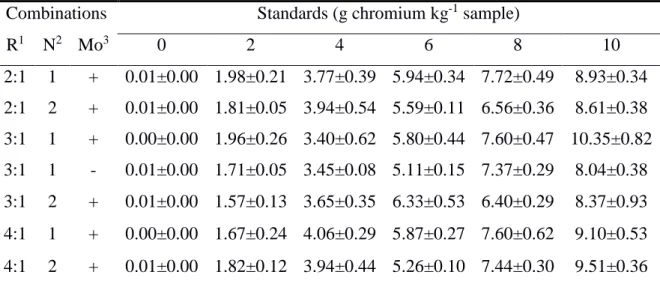
There were no interferences from the medium for any technique combinations.
This can be affirmed because the contents obtained for the standard 0 g kg-1 were very
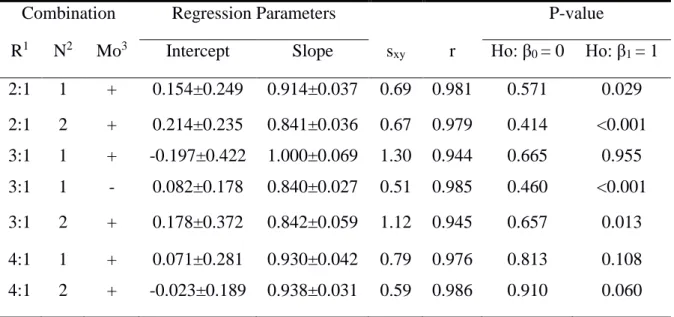
close or equal to zero (Table 1) and none of the intercept estimates were found to be
different from zero (P>0.05; Table 2). The chromium recovery was found complete
(P>0.05) when the ratio 3:1 v v-1 (nitric to perchloric acids), using sodium molybdate
and one-step digestion was used as well as 4:1 v v-1 regardless the number of digestion
steps. However, the chromium recovery was found incomplete when other techniques
were used (P<0.05).
Considering the acid digestion ratio of 3:1 v v-1 in a one-step digestion, the use
of sodium molybdate as catalyst increased the chromium recovery and influence the
accuracy of the estimates (Tables 1 and 2). Working with two digestions steps did not
improved the chromium recovery of none of technique used. Moreover, recovery was
found incomplete (P<0.05) when the 2:1 and 3:1 v v-1 ratios and two-step digestion
were used.
Considering that a one-step digestion should be used to decrease the labor of the
analytical procedures, both 3:1 v v-1 and 4:1 v v-1 ratios produced accurate results (Table
1). However, the nitric to perchloric ratio of 3:1 v v-1 with sodium molybdate in a
one-step digestion presented the recovery closest to unity (Table 2) and the lower mean
prediction error compared to 4:1 v v-1 ratio (-0.195 vs. -0.282 g kg-1, respectively). From
these results, the fecal samples obtained from the digestion trials were compared using
the digestion techniques based on nitric and perchloric acids ratio of 2:1 and 3:1 v v-1
both with sodium molybdate in a one-step digestion. The first one corresponds to the
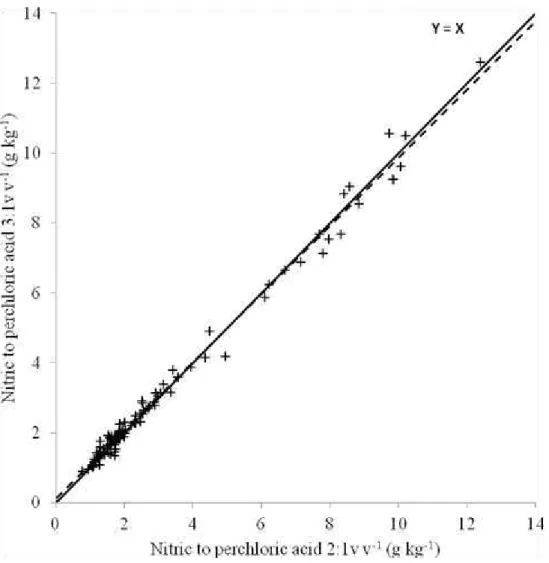
13 Considering this, it was verified that both technique combinations provided similar
results (P>0.05) and were strongly correlated (r = 0.996; P<0.05; Figure 1).
Discussion
According to Kozloski et al. (1998), the atomic absorption spectrophotometry is
the more precise and sensible method for chromium analysis. Recently the accuracy of
atomic absorption spectrophotometry was also confirmed by Souza et al. (2013), who
compared this method to the colorimetric evaluation using different acid combinations
in the digestion procedure. These authors also suggest that the use of nitric and
perchloric acid instead of sulfuric and perchloric or phosphoric acid is the most
appropriated due to the greater accuracy, lower time and labor consuming. Currently,
the 2:1 v v-1 nitric to perchloric acid digestion has been suggested in Brazil by the
INCT-CA (Detmann et al., 2012).
In the present study, the estimation of chromium was considered to be accurate
when the nitric to perchloric ratio of 3:1 v v-1 with sodium molybdate in a one-step
digestion and 4:1 v v-1 ratio regardless the number of step digestions were used. The
greatest chromium recovery of the nitric to perchloric ratio of 3:1 v v-1 with sodium
molybdate in a one-step digestion suggested that it was more accurate to estimate the
chromium contents.
The use of predigesting step with nitric acid showed to be unnecessary once
none of the digestion techniques were improved by the use of two digestion steps.
Moreover, the use of a predigesting step makes the technique more labor and time
consuming. Long time analyses make the technique tedious and more steps make it
14 manipulation. In view of these, a unique step-digestion with a mixture of nitric acid and
perchloric acid is recommended.
According to Kimura & Miller (1957), the use of sodium molybdate serves as
catalyst for the acid digestion to convert Cr+3 into Cr+6, the quantifiable form of
chromium. In the present study the importance of this reagent was confirmed because
the digestion technique based on 3:1 v v-1 ratio without sodium molybdate provided
incomplete recovery of the fecal chromium presenting the lowest slope while the same
procedure with sodium molybdate provided the best recovery amongst all techniques
(Table 2). From this, the utilization of sodium molybdate must be assumed as
mandatory to correctly perform chromium analysis.
Interestingly, in the present study independent of the step numbers the acid ratio
of 2:1 v v-1 did not present accurate results. This is not in agreement with Kimura &
Miller (1957) and Souza et al. (2013) who worked with the nitric to perchloric ratio of
2:1 v v-1 in two- or one-step digestion, respectively. Perhaps the biggest problem is the
balance in the action of different acids on the conversion of the chromium valence. The
difference between the estimates of concentration and the actual concentration values of
the standards increases as the chromium concentration increases when the 2:1 ratio was
used (Table 1). This indicate that the function of nitric acid is most important in the
conversion of Cr+3 to Cr+6, which could explains the low recovery when using the 2:1 v
v-1 ratio.
The digestion techniques based on nitric and perchloric acids ratio of 2:1 and 3:1
v v-1 both with sodium molybdate in a one-step digestion were found similar each other
(Figure 1) although just the last one was found accurate (Table 2). Besides the accurate
15
the advantage over the 2:1 v v-1 due to lower cost of the nitric acid compared to
perchloric acid.
Frequent testing of large numbers of samples requires a technique that
additionally to be accurate should be rapid and cost effective (McCarthy & Ellis, 1990).
In accordance, the findings of the present study indicate that chromium estimation
should be done using a nitric to perchloric acids ratio of 3:1 v v-1 with sodium
molybdate in a one-step digestion by atomic absorption spectrophotometry.
Conclusion
The chromium contents in cattle feces are accurately evaluated through atomic
absorption spectrophotometry using digestion procedures based on nitric to perchloric
acids ratio of 3:1 v v-1 in a one-step digestion with sodium molybdate as catalyst.
References
DETMANN, E.; VALADARES FILHO, S.C.; PAULINO, M.F.; ZERVOUDAKIS,
J.T.; CABRAL, L.S. Avaliação da técnica dos indicadores na estimação do consumo
por ruminantes em pastejo. Cadernos Técnicos de Veterinária e Zootecnia, v.46,
p.40-57, 2004.
DETMANN, E.; SOUZA, M.A.; VALADARES FILHO, S.C.; QUEIROZ, A.C.;
BERCHIELLI, T.T.; SALIBA, E.O.S.; CABRAL, L.S.; PINA, D.S.; LADEIRA, M.M.;
AZEVEDO, J.A.G. (Eds.) Métodos para análise de alimentos - Instituto Nacional de
Ciência e Tecnologia em Ciência Animal, Visconde do Rio Branco: Suprema, 2012.
16 FENTON, T.W.; FENTON, M. An improved procedure for the determination of
chromic oxide in feed and feces. Canadian Journal of Animal Scicence, v.59,
p.631-634, 1979.
JAGGER, S.; WISEMAN, J.; COLE, D.J.A.; CRAIGON, J. Evaluation of inert markers
for the determination of ileal and faecal apparent digestibility values in the pig. British
Journal of Nutrition, v.68, p.729-739, 1992.
KIMURA, F.T.; MILLER, V.L. Improved determination of chromic oxide in cow feed
and feces. Journal of Agricultural and Food Chemistry, v.5, p.216-216, 1957.
KOZLOSKI, G.V.; FLORES, E.M.M.; MARTINS, A.F. Use of chromium oxide in
digestibility studies: variations of the results as a function of the measurement method.
Journal of the Science of Food and Agriculture, v.76 p.373-376, 1998.
McCARTHY, H.T.; ELLIS, P.C. Comparison of microwave digestion with
conventional wet ashing and dry ashing digestion for analysis of lead, cadmium,
chromium, copper, and zinc in shellfish by flame atomic absorption spectroscopy.
Journal ofAssociation of Official Analytical Chemists, v.74, p.566-569, 1990.
MERTENS, D. R. Challenges in measuring insoluble dietary fiber. Jounal of Animal
Science, v.81, p.3233-3249, 2003.
SAHA, D.C.; GILBREATH, R.L. Analytical recovery of chromium from diet and
faeces determined by colorimetry and atomic absorption spectrophotometry. Journal of
the Science of Food and Agriculture, v.55, p.433-446, 1991.
17
Table 1. Means and standard errors for the chromium contents in the standard samples
obtained by different combinations of techniques.
Combinations Standards (g chromium kg-1 sample)
R1 N2 Mo3 0 2 4 6 8 10
2:1 1 + 0.01±0.00 1.98±0.21 3.77±0.39 5.94±0.34 7.72±0.49 8.93±0.34
2:1 2 + 0.01±0.00 1.81±0.05 3.94±0.54 5.59±0.11 6.56±0.36 8.61±0.38
3:1 1 + 0.00±0.00 1.96±0.26 3.40±0.62 5.80±0.44 7.60±0.47 10.35±0.82
3:1 1 - 0.01±0.00 1.71±0.05 3.45±0.08 5.11±0.15 7.37±0.29 8.04±0.38
3:1 2 + 0.01±0.00 1.57±0.13 3.65±0.35 6.33±0.53 6.40±0.29 8.37±0.93
4:1 1 + 0.00±0.00 1.67±0.24 4.06±0.29 5.87±0.27 7.60±0.62 9.10±0.53
4:1 2 + 0.01±0.00 1.82±0.12 3.94±0.44 5.26±0.10 7.44±0.30 9.51±0.36
1R, ratio of nitric to perchloric acids. 2N, number of digestion steps. 3Mo, sodium
18
Table 2. Estimates of linear regression parameters for the chromium concentration in
the fecal standards obtained by different technique combinations.
Combination Regression Parameters P-value
R1 N2 Mo3 Intercept Slope sxy r Ho: β0 = 0 Ho: β1 = 1
2:1 1 + 0.154±0.249 0.914±0.037 0.69 0.981 0.571 0.029
2:1 2 + 0.214±0.235 0.841±0.036 0.67 0.979 0.414 <0.001
3:1 1 + -0.197±0.422 1.000±0.069 1.30 0.944 0.665 0.955
3:1 1 - 0.082±0.178 0.840±0.027 0.51 0.985 0.460 <0.001
3:1 2 + 0.178±0.372 0.842±0.059 1.12 0.945 0.657 0.013
4:1 1 + 0.071±0.281 0.930±0.042 0.79 0.976 0.813 0.108
4:1 2 + -0.023±0.189 0.938±0.031 0.59 0.986 0.910 0.060
1R, ratio of nitric to perchloric acids. 2N, number of digestion steps. 3Mo, sodium
19
Figure 1. Relationship between the fecal chromium concentrations obtained with the
digestion technique using nitric to perchloric acids at the ratios of 2:1 and 3:1v v-1, both
using sodium molybdate as catalyst (Ŷ = -0.1527 + 1.0367 × X; r = 0.996; n = 104; the
20 EVALUATION OF ACID DIGESTION PROCEDURES TO ESTIMATE
MINERAL CONTENTS IN MATERIALS FROM ANIMAL TRIALS Avaliação de técnicas de digestão ácida para estimar a concentração de minerais
em materiais de experimentação animal
ABSTRACT
Rigorously standardized laboratory protocols are essential for meaningful
comparison of data from multiple laboratories. Considering that interactions of minerals
with organic matrices may vary depending on the analyzed material, there could be
peculiar demands for each material with respect to digestion procedures. Acid digestion
procedures were evaluated using different nitric to perchloric acid ratios and one- or
two-step digestion to estimate the concentration of calcium, phosphorus, magnesium,
and zinc in samples of carcass, bone, excreta, concentrate, forage, and feces. Six
procedures were evaluated: ratio of nitric to perchloric acid at 2:1, 3:1, and 4:1 v/v in a
one- or two-step digestion. There were no direct or interaction effects of nitric to
perchloric acid ratio or number of digestion steps on magnesium and zinc contents.
Calcium and phosphorus contents presented a significant interaction between sample
type and nitric to perchloric acid ratio. Digestion solution of 2:1 v/v provided greater
recovery of calcium and phosphorus from bone samples than 3:1 and 4:1 v/v ratio.
Different acid ratios did not affect calcium or phosphorus contents in carcass, excreta,
concentrate, forage, and feces. Number of digestion steps did not affect mineral
contents. Evaluation of calcium, phosphorus, magnesium, and Zn contents in carcass,
excreta, concentrated, forage, and feces samples can be performed using digestion
solution of nitric to perchloric acid 4:1 v/v in a one-step digestion. However, for bone
samples, digestion solution of nitric to perchloric acid 2:1 v/v in a one-step digestion is
recommended.
21
RESUMO
Protocolos rigorosos são essenciais para comparação de dados entre diferentes
laboratórios. Considerando-se que as interações de minerais com as matrizes orgânicas
podem variar dependendo da natureza do material, poderia haver especificidades para
cada um dos materiais em relação aos procedimentos de digestão ácida. Seis técnicas de
digestão ácida foram avaliadas utilizando diferentes relações de ácido nítrico e
perclórico (2:1, 3:1 e 4:1 v/v) em uma ou duas etapas de digestão para estimar a
concentração de cálcio, fósforo, magnésio e zinco em amostras de carcaça, osso,
excreta, concentrado, forragem e fezes. Não houve efeito direto ou interação da relação
entre ácido nítrico e perclórico e número de etapas de digestão na concentração de
magnésio e zinco. Houve interação significativa entre o tipo de amostra e a relação entre
ácido nítrico e perclórico para concentração de cálcio e fósforo. Houve maior
recuperação de cálcio e fósforo nas amostras de ossos utilizando-se solução de digestão
de 2:1 v/v em comparação a 3:1 e 4:1 v/v. A relação entre os ácidos não influenciou a
concentração de cálcio e fósforo em amostra de carcaça, excreta, concentrado, forragem
e fezes. O número de etapas de digestão não afetou as concentrações de nenhum
mineral. A concentração de cálcio, fósforo, magnésio e zinco em amostra de carcaça,
excreta, concentrado, forragens e fezes pode ser estimada utilizando-se solução com
relação entre ácido nítrico e perclórico 4:1 v/v em uma etapa de digestão. No entanto,
para as amostras de ossos, solução com relação entre ácido nítrico e perclórico 2:1 v/v
em uma etapa de digestão é recomendada.
Termos para indexação: análise de alimentos, análise química, cinzas,
23 INTRODUCTION
The ash content is a measure of the total amount of minerals present within a
sample, whereas the mineral content is a measure of the amount of specific inorganic
components, such as calcium (Ca), phosphorus (P), magnesium (Mg), and zinc (Zn),
present within a sample. Wet ashing is primarily used in the preparation of samples for
subsequent analysis of specific minerals. It breaks down and removes the organic matrix
surrounding the minerals through the use of both heat and acids, so that minerals are left
in an aqueous solution.
Accurate chemical analysis of feed ingredients is mandatory for precise
formulation of diets. Unfortunately, some analysis results can vary among laboratories
(Cromwell et al., 2000). It has been demonstrated that analytical variability of a
common diet among laboratories is large for Ca and Zn, representing twofold or more in
the extremes, and considered intermediate for P (Cromwell et al., 2003). Therefore, to
minimize this possible bias, an accurate and standardized procedure should be used by
different laboratories.
Rigorously standardized laboratory protocols are essential for meaningful
comparison of data from multiple laboratories. Currently, mineral analyses have been
performed using as a digesting solution based on nitric and perchloric acid in a ratio
ranging from 2:1 to 4:1 v/v and with two digestion steps (AOAC, 2002; Detmann et al.,
2012). Standardizing the ratio of acids used in the digestion of samples could increase
the reliability of either information or comparison of results between different
laboratories, while a decrease in the number of digestion steps would make the
procedure more simpler, faster, and less susceptible to errors.
In minerals analyses, the digestion process is the limiting factor as to how much
24 actual amount of mineral present in the sample (McCarthy & Ellis, 1990). Considering
that the interactions of minerals with organic matrices may vary depending on the
analyzed material (e.g., bones, feces, forages), there could be peculiar demands for each
material with respect to digestion procedures.
Thus, the objective of this study was to evaluate acid digestion procedures using
different nitric to perchloric acid ratios and one- or two-step digestion to estimate the
concentration of Ca, P, Mg, and Zn in samples of carcass, bone, excreta, concentrate,
forages, and feces.
MATERIAL AND METHODS
Location and Samples
This experiment was carried out at the Animal Nutrition Laboratory, Animal
Science Department, Universidade Federal de Viçosa, Viçosa, MG, Brazil. Samples of
cattle feces (n = 10), forages (n = 10), concentrates (n = 10), cattle bones (n = 10), cattle
carcasses (n = 10), and poultry excreta (n = 10) were used. The fecal, carcass, and bone
samples were obtained from animals involved in a feedlot cattle trial. The forage
samples were fresh tropical grasses and legumes, and the feed concentrate samples were
composed of grains and meals. Excreta samples were collected from a poultry trial. The
range of sample types aimed to propitiate a greater representation and better
comparative evaluation between the digestion procedures.
Samples with high moisture contents were freeze-dried, according to the method
suggested by the Brazilian Institute of Science and Technology in Animal Science
(INCT-CA, method G-002/1, Detmann et al., 2012). After that, all samples were
processed in a knife mill using a 1-mm screen sieve.
25
Six digestion procedures using nitric acid (HNO3; 65%, P.A., Vetec 191) and
perchloric acid (HClO4; 70%, P.A., ACS, Vetec 909) were evaluated. This six-part
experimental design included a one-step digestion process, using nitric to perchloric
acid at a ratio of 2:1, 3:1 or 4:1 v/v; and a two-step digestion process, using nitric to
perchloric acid at a ratio of 2:1, 3:1 or 4:1 v/v.
To perform the one-step digestion procedures, approximately 250 mg of sample
were poured into glass tubes. After that, 5 mL of the digestion solution (a mixture of
nitric and perchloric acid at the ratio of 2:1, 3:1 or 4:1 v/v) were added. The tubes were
then heated at 200°C until the solution became translucent and a brownish smoke
stopped being released, which indicated the complete digestion of the organic matter.
The tubes were allowed to cool at room temperature. After that, the digested samples
were quantitatively transferred to 50 mL volumetric flasks. The transfer was
accomplished using ash-free quantitative filter paper (Whatman #41). The volume of the
solutions was made up to 50 mL using de-ionized water. Aliquots of the solutions were
transferred to polyethylene flasks and kept cooled (4°C).
The same amount of sample was used to perform the two-step digestion
procedures. After pouring the samples in the tubes, the nitric acid was added at 3.3, 3.7
and 4.0 mL/tube which corresponded to the amount of acid for the 2:1, 3:1 and 4:1
ratios, respectively. The tubes were then heated at 200°C until the acid was half gone.
After cooling at room temperature, perchloric acid was added at 1.7, 1.3 and 1.0
mL/tube, corresponding to 2:1, 3:1 and 4:1 ratios, respectively. After that, the tubes
were heated again to 200°C. The end of digestion, the quantitative transference, and
sample storage followed the same procedures described for the one-step digestion
process.
26 The P contents were evaluated based on colorimetric reaction with sodium
molybdate (Fiske & Subbarow, 1925). The colorimetric evaluations were carried out at
725 nm in a spectrophotometer UV/Visible BEL Photonics 2000 UV. Phosphorus standard solutions were previously prepared using monopotassium phosphate (KH2PO4, P.A., ACS, Vetec 1361).
The contents of Ca, Mg and Zn were evaluated in an atomic absorption spectrophotometer (GBC Avanta Σ), using hollow-cathode lamps (422.7, 285.2, and 213.9 nm for Ca, Mg, and Zn), an air-acetylene flame for Ca analysis, and a nitrous oxide-acetylene flame for Mg and Zn analysis. Different standard solutions were produced from pure stock solutions containing 1000 ppm of the elements (Merk 1.09943 Tritisol®, Merk 1.09949 Tritisol®, and Merk 1.09953 Tritisol® for Ca, Mg, and Zn). In the Ca analysis, a strontium chloride solution (Merk 1.07865, 50 g/L) was used as a releasing agent.
Statistical Analysis
The statistical evaluation was performed for each mineral according to a
completely randomized design following the model:
ijkl ikl kl il ik l k j i i
ijkl T S R N TR TN RN TRN
Y ()
where: Ti is the effect of the ith type of sample (fixed effect); S(ij) is the effect of the jth
sample within the ith type (random effect); Rk is the effect of kth nitric to perchloric acid
ratio (fixed effect); Nl is the effect of the lth number of steps in digestion (fixed effect);
TRik, TNil, RNkl, and TRNikl are the interactions (fixed effects); and εijkl is the random
error.
All statistical procedures were carried out using the MIXED procedure of SAS
9.2 and adopting 0.01 as the critical limit for type I error. When necessary, average
27
RESULTS AND DISCUSSION
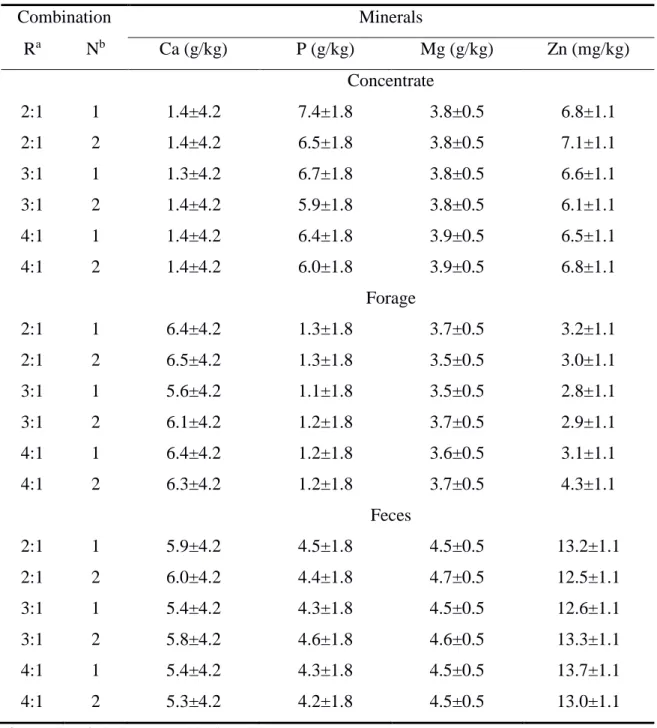
The average contents of Ca, P, Mg, and Zn in samples of carcass, bone, excreta,
concentrate, forage, and feces obtained by the different procedures are presented in
Tables 1 and 2.
There were no direct or interaction effects (P>0.01) of nitric to perchloric acids
ratio or number of digestion steps on Mg and Zn contents (Table 3).
On the other hand, both Ca and P contents presented a significant interaction
between type of sample and nitric to perchloric acids ratio (P<0.01; Table 3). The
evaluation of this effect brought into evidence that using different acid ratios does not
affect either Ca or P contents in carcass, excreta, concentrate, forage, and feces samples
(P>0.01; Table 4). Despite this, when bone samples were evaluated, it was observed that
the digestion solution of 2:1 v/v (nitric to perchloric) provided greater recovery of Ca
and P than the 3:1 and 4:1 v/v ratio (P<0.01; Table 4).
It should be highlighted that the number of digestion steps did not affect any
mineral content (P>0.01).
A multitude of procedures exist to remove the organic matrix of the sample
surrounding the minerals for mineral analysis. The standardization of analytical
procedures among laboratories allows obtaining more reliable and comparable estimates
of mineral contents. For the analyses of specific minerals, wet ashing digestion is
preferred to dry ashing. The main constraints of the dry ashing procedure include low
micro-minerals recovery and the possibility of volatilization losses due to high
temperature ashing (Jones Jr. & Case, 1990). In the present study, different procedures
using wet ashing digestion were evaluated and a wide range of sample types were used
aiming to identify a method that could be applicable to the differing materials evaluated
28 The estimated contents of Ca, P, Mg, and Zn in carcass, excreta, concentrate,
forage, and feces samples were not affected either by acid ratios or number of digestion
steps. The AOAC recommendation for mineral analyses (method 935.13, AOAC, 2002)
is based on a nitric to perchloric acid ratio ranging from 2 to 3:1 v/v, whereas the
official Brazilian method of INCT-CA (method M-003/1, Detmann et al., 2012)
recommends a ratio of 4:1 v/v. Both methods are performed using two digestion steps.
First, a predigestion with nitric acid and then a digestion with perchloric acid. The
results presented here are in agreement with those methods (except for bone samples),
but they further demonstrated that working with one- or two-step digestion leads to
similar results.
Clearly, working with one-step digestion could be a preferable procedure
because it is simpler, faster and less susceptible to errors, due to less manipulation of the
samples. On the other hand, using a 4:1 v/v nitric to perchloric acid ratio, rather than 2
or 3:1 v/v, could be more advantageous due to the lower cost of nitric acid when
compared to perchloric acid. Therefore, the digestion procedure based on 4:1 v/v, in a
one-step digestion process seems to be the most appropriate procedure to quantify
minerals in samples of carcass, excreta, concentrate, forage, and feces. These findings
are useful once the same procedure can be made applicable to samples of a wide range
of materials, including animal and vegetable.
Despite this, for Ca and P in bone samples, the 2:1 v/v nitric to perchloric acid
ratio provided greater recovery regardless the number of steps. The lower recovery
obtained by using the 3:1 and 4:1 v/v ratios indicated an incomplete liberation of
minerals during digestion. The difference when compared to other types of samples
could be associated either with the greater contents of Ca and P in bones or the different
29 solution would be necessary to analyze minerals in bones, in this case represented by an
increased proportion of perchloric acid in the digestion solution.
On the other hand, the estimation of Mg and Zn in bones samples provided the
same result regardless of the digestion procedure. However, in this case, it is
recommended that one use the digestion procedure based on 2:1 v/v in a one-step
digestion process, following the same procedure used for Ca and P.
It is significant that regardless of sample or solution ratio, one-step digestion can
be used for all the minerals. Previous work in our laboratory showed a similar pattern
for chromium analysis (Rocha et al., 2015).
CONCLUSION
The quantification of mineral contents in samples of carcass, excreta,
concentrated, forage and feces can be performed using a digestion solution of nitric to
perchloric acid 4:1 v/v in a one-step digestion. However, for bone samples, a digestion
solution of nitric to perchloric acid 2:1 v/v in a one-step digestion is recommended.
REFERENCES
ASSOCIATION OF OFFICIAL ANALYTICAL CHEMISTS – AOAC. Official
methods of analysis. 17 ed. Gaithersburg: AOAC International, 2000. paginação
descontínua.
CROMWELL, G.L.; CLINE, T.R.; CRENSHAW, J.D.; CRENSHAW, T.D.; EASTER,
R.A.; EWAN, R.C.; HAMILTON, C.R.; HILL, G.M.; LEWIS A.J.; MAHAN, D.C.;
NELSSEN, J.L.; PETTIGREW, J.E.; VEUM, T.L.; YEN J.T.Variability among sources
and laboratories in analyses of wheat middlings. Journal of Animal Science, v.78,
30 CROMWELL, G.L.; BRENDEMUHL, J.H.; CHIBA, L.I.; CLINE, T.R.; CRENSHAW,
T.D.; DOVE, C.R.; EASTER, R.A.; EWAN, R.C.; FERRELL, K.C.; HAMILTON,
C.R.; HILL, G.M.; HITCHCOCK, J.D.; KNABE, D.A.; KORNEGAY, E.T.; LEWIS,
A.J.; LIBAL, G.W.; LINDEMANN, M.D.; MAHAN, D.C.; MAXWELL, C.V.;
MCCONNELL, J.C.; NELSSEN, J.L.; PETTIGREW, J.E.; SOUTHERN, L.L.; VEUM,
T.L.; YEN J.T. Variability in mixing efficiency and laboratory analyses of a common
diet mixed at 25 experiment stations. Journal of Animal Science, v.81, p.484-491,
2003.
DETMANN, E.; SOUZA, M.A.; VALADARES FILHO, S.C.; QUEIROZ, A.C.; BERCHIELLI, T.T.; SALIBA, E.O.S; CABRAL, L.S.; PINA, D.S.; LADEIRA, M.M.; AZEVEDO, J.A.G. Métodos para análise de alimentos - INCT - Ciência Animal. Suprema Editions, Visconde do Rio Branco, 2012. 214p.
FISKE, C.H.; SUBBAROW, Y. The colorimetric determination of phosphorus. The
Journal of Biological Chemistry, v.66, p.375–400, 1925.
JONES Jr., J.B.; CASE, V.W. Soil testing and plant analysis. In Westerman, R. L.
(Ed). ampling, handling, and analyzing plant tissue samples. SSSA, Inc., Madison, WI,
1990. p.389-427.
McCARTHY, H.T.; ELLIS, P.C. Comparison of microwave digestion with
conventional wet ashing and dry ashing digestion for analysis of lead, cadmium,
chromium, copper, and zinc in shellfish by flame atomic absorption spectroscopy.
Journal of Association of Official Analytical Chemists, v.74, p.566-569, 1990.
ROCHA, G.C.; PALMA, M.N.N.; DETMANN, E.; VALADARES FILHO, S.C.
Evaluation of acid digestion techniques to estimate chromium contents in cattle feces.
31 Table 1 - Average contents of Ca, P, Mg, and Zn in carcass, bone, and excreta samples
according to the different nitric to perchloric acid ratios and the number of digestion
steps
Combination Minerals
Ra Nb Ca (g/kg) P (g/kg) Mg (g/kg) Zn (mg/kg)
Carcass
2:1 1 47.3±4.2 32.7±1.8 1.7±0.5 14.5±1.1
2:1 2 49.4±4.2 31.3±1.8 1.7±0.5 14.5±1.1
3:1 1 47.6±4.2 32.0±1.8 1.6±0.5 14.6±1.1
3:1 2 52.7±4.2 37.5±1.8 1.8±0.5 14.4±1.1
4:1 1 43.0±4.2 30.4±1.8 1.6±0.5 14.4±1.1
4:1 2 54.0±4.2 36.4±1.8 1.8±0.5 15.1±1.1
Bone
2:1 1 185.6±4.2 94.3±1.8 3.9±0.5 9.9±1.1
2:1 2 182.2±4.2 95.0±1.8 3.7±0.5 10.8±1.1
3:1 1 172.5±4.2 85.4±1.8 3.8±0.5 9.7±1.1
3:1 2 173.2±4.2 90.7±1.8 3.9±0.5 9.5±1.1
4:1 1 172.6±4.2 87.5±1.8 4.3±0.5 9.9±1.1
4:1 2 173.0±4.2 89.3±1.8 3.9±0.5 10.6±1.1
Excreta
2:1 1 9.4±4.2 9.5±1.8 6.1±0.5 25.6±1.1
2:1 2 11.6±4.2 10.0±1.8 6.2±0.5 26.2±1.1
3:1 1 9.3±4.2 8.3±1.8 6.4±0.5 26.4±1.1
3:1 2 10.3±4.2 9.4±1.8 6.3±0.5 25.1±1.1
4:1 1 9.4±4.2 8.9±1.8 6.1±0.5 24.9±1.1
4:1 2 10.3±4.2 9.1±1.8 6.4±0.5 25.8±1.1
a R, ratio of nitric to perchloric acids.
32
Table 2 – Average contents of Ca, P, Mg, and Zn in concentrate, forage, and feces
samples, according to the different nitric to perchloric acid ratios and the number of
digestion steps
Combination Minerals
Ra Nb Ca (g/kg) P (g/kg) Mg (g/kg) Zn (mg/kg)
Concentrate
2:1 1 1.4±4.2 7.4±1.8 3.8±0.5 6.8±1.1
2:1 2 1.4±4.2 6.5±1.8 3.8±0.5 7.1±1.1
3:1 1 1.3±4.2 6.7±1.8 3.8±0.5 6.6±1.1
3:1 2 1.4±4.2 5.9±1.8 3.8±0.5 6.1±1.1
4:1 1 1.4±4.2 6.4±1.8 3.9±0.5 6.5±1.1
4:1 2 1.4±4.2 6.0±1.8 3.9±0.5 6.8±1.1
Forage
2:1 1 6.4±4.2 1.3±1.8 3.7±0.5 3.2±1.1
2:1 2 6.5±4.2 1.3±1.8 3.5±0.5 3.0±1.1
3:1 1 5.6±4.2 1.1±1.8 3.5±0.5 2.8±1.1
3:1 2 6.1±4.2 1.2±1.8 3.7±0.5 2.9±1.1
4:1 1 6.4±4.2 1.2±1.8 3.6±0.5 3.1±1.1
4:1 2 6.3±4.2 1.2±1.8 3.7±0.5 4.3±1.1
Feces
2:1 1 5.9±4.2 4.5±1.8 4.5±0.5 13.2±1.1
2:1 2 6.0±4.2 4.4±1.8 4.7±0.5 12.5±1.1
3:1 1 5.4±4.2 4.3±1.8 4.5±0.5 12.6±1.1
3:1 2 5.8±4.2 4.6±1.8 4.6±0.5 13.3±1.1
4:1 1 5.4±4.2 4.3±1.8 4.5±0.5 13.7±1.1
4:1 2 5.3±4.2 4.2±1.8 4.5±0.5 13.0±1.1
a R, ratio of nitric to perchloric acids.
33 Table 3 - Descriptive levels of probability for type I error taken from analyses of
variance of the Ca, P, Mg, and Zn contents
Effect Mineral
Ca P Mg Zn
Type (T)a <0.001 <0.001 <0.001 <0.001
Ratio (R)b 0.046 0.064 0.429 0.032
Steps (N)c 0.064 0.019 0.666 0.910
T×R 0.003 <0.001 0.132 0.033
T×N 0.461 0.028 0.355 0.599
R×N 0.201 0.113 0.539 0.754
T×R×N 0.467 0.402 0.217 0.335
RSDd 11.2 3.92 0.31 0.14
a Type of sample.
b R, ratio of nitric to perchloric acids.
c N, number of digestion steps.
34 Table 4 - Least squares means of Ca and P contents in bone samples (g/kg) according to
the nitric to perchloric acids ratio used in digestion procedures
Type Ratio P value
2:1 3:1 4:1
Ca (g/kg)
Carcass 48.3 50.2 48.5 0.853
Bone 183.9a 172.8b 163.4c <0.001
Excreta 10.5 9.82 9.85 0.977
Concentrate 1.40 1.32 1.37 >0.999
Forage 6.47 5.81 6.34 0.980
Feces 5.97 5.58 53.5 0.984
P (g/kg)
Carcass 32.0 34.7 33.4 0.088
Bone 94.6a 88.0b 88.4b <0.001
Excreta 9.8 8.9 9.0 0.732
Concentrate 6.9 6.3 6.2 0.804
Forage 1.3 1.2 1.2 0.993
Feces 4.5 4.4 4.3 0.981