ISSN 1557-4989
© 2011 Science Publications
Corresponding Author: J. Shamshuddin, Department of Land Management, Faculty of Agriculture, University Putra Malaysia, 43400 Serdang, Selangor, Malaysia Tel: +603-89466985 Fax: +603-89434419
324
Root Elongation, Root Surface Area and Organic Acid
by Rice Seedling Under Al
3+and/or H
+Stress
A. Elisa Azura, J. Shamshuddin and C.I. Fauziah
Department of Land Management, Faculty of Agriculture,
University Putra Malaysia, 43400 Serdang, Selangor, Malaysia
Abstract:Problem statement: Under acidic condition, Al3+ is the most common species in solution.
An experiment was conducted to study the effects of Al and/or pH on rice seed germination, root morphology and organic acids release. This study was conducted at ambient temperature in Malaysia.
Approach: Two experiments were conducted: (1) Rice seeds undergoing germination were exposed to
0.5 mM CaCl2 solutions containing various concentration of Al (10, 20, 30, 40-50 µM) and (2) The
seeds were soaked in water taken from an acid sulfate soil area in Malaysia for which the pH was adjusted to a range of values using 0.01 M HCl or NaOH. Results: Root length decreased with increasing Al concentration, while the opposite was true for pH. The trend for the change of root surface area with Al concentration and pH is the same as that of root length. The critical Al concentration for rice growth is 15 µM. This means that rice variety MR 219 grown on 90% of the granary areas in Malaysia is relatively less tolerant compared to other rice varieties. At low pH and high Al concentration, the rice roots secreted citrate and/or oxalate which subsequently formed Al-citrate and Al-oxalate, respectively. This, to a certain extent, had reduced Al toxicity. This is the mechanism of rice tolerance to Al toxicity. Conclusion: Acid sulfate soils in Malaysia allocated for rice production should be limed to increase water pH in the paddy field to 5.0. Then, rice can grow without Al3+ and/or H+ stress.
Key words: Acid sulfate soil, organic acid, rice root length, acidic condition, paddy field, root
elongation, root surface area
INTRODUCTION
Aluminum is an important component of the earth’s crust, making it the third most abundant element after oxygen and silicon. Plant roots are, therefore, almost always exposed to Al in some form or other. Fortunately, most of this Al occurs as harmless oxides and alumino-silicates. However, when soils become acidic as a result of natural processes or due to human intervention, Al is solubilized into the toxic trivalent cation, Al3+. This form of Al is the most common species under acidic condition (Shamshuddin et al., 2010). Kochian et al. (2005) found that in soils with pH value below 5, toxic forms of Al are solubilized into soil solution, inhibiting root growth. Aluminum toxicity has been recognized as a major threat to crop production in the tropics, such as corn (Shamshuddin et al., 1991; Ismail et al., 1993), cocoa (Shamshuddin et al., 2004b) and oil palm (Auxtero and Shamshuddin, 1991) which are grown on moderately and very acidic soils in Malaysia.
Al3+ is toxic to many plants even at micro-molar concentration (Shamshuddin et al., 1991; Muhrizal et
al., 2003; Shamshuddin et al., 2004a). A range of plant species has evolved mechanisms to enable them to grow satisfactorily on acidic soils that have toxic concentrations of Al3+ which can hinder crop growth. Organic acids play a central role in these aluminum tolerance mechanisms. Some plants detoxify aluminum in the rhizosphere by releasing organic acids that chelate aluminum, rendering it unavailable to the growing crops. Citrate and malate can be present in the root tips. Root exudates organic acids to reduce the effects of Al toxicity, for example by forming Al-citrate or Al-malate. Among gramineous crops, rice (Oryza sativa L.) exhibits the highest level of Al-tolerance, despite of its quite low efflux capacity for organic acids under Al-stress (Ma et al., 2002).
In Malaysia, acid sulfate soils which are dominated by pyrite (FeS2) are abundant, occurring almost
produced, leading to release of high amount of Al into the soil environment (Shamshuddin et al., 2004a), killing plants and aquatic life. Some of these soils are cropped to rice, variety MR 219, which is not known to be tolerant to Al toxicity. The yield of this rice variety grown on such acid soils is low, far below the national average of 3.80 t/ha. Because of this some of the paddy fields in the area are abandoned by the farmers (Enio Kang et al., 2011). The acid sulfate soil infertility can be ameliorated by the application of lime, basalt, organic fertilizer and/or their combinations at appropriate rate (Suswanto et al., 2007; Shazana et al., 2011).
As the Malaysian government is now thinking of increasing self-sufficiency in rice consumption from 73 to 86%, areas under acid sulfate are targeted for future development, to grow rice. However, the pH of water in the paddy fields of acid sulfate soils is low (Shamshuddin and Auxtero, 1991; Auxtero and Shamshuddin, 1991; Shamshuddin et al., 2004a) and Al concentration is above the known toxic level for rice growth of 74 µM (Dent, 1986). The high Al concentration in the water from the paddy fields on acid sulfate soils would cause much problem to the farming community. The elongation of rice root is limited by the presence of excess amount of Al in the water. Al3+ is attracted to the root due to the negatively-charged cells wall. This phenomenon would affect rice growth and eventually the yield. The infertility of these soils needs to be alleviated using appropriate amendments.
For cultivation of rice in Malaysia, direct seeding is often practiced by the farmers. If the rice seeds come into contact with the toxic water in the paddy fields on acid sulfate soils, germination and growth of the rice will be affected. A study was, therefore, conducted to determine the effects of high Al concentration and low pH on seed germination, root morphology and organic acids release. This would hopefully help mitigate acid sulfate soil infertility for rice cultivation.
MATERIALS AND METHODS
Location, material and experimental: This study was
carried out at the Faculty of Agriculture, Universiti Putra Malaysia, Serdang, Malaysia. In this study two short-term experiments were conducted in the laboratory:
• This was a seed germination experiment conducted in a laboratory at the ambient temperature. Seeds of rice (variety MR 219) were soaked with a hormone-based chemical (Zappa™) for 24 h,
rinsed twice with distilled water so as to sterilize the outer cover of the seeds and then left in the dark place for 24 hours. This rice variety is commonly grown in Malaysia, planted on about 90% of the area allocated to rice. The pre-soaked seeds were then transferred into test tubes containing 0.5 mM CaCl2 solution with various
concentrations of AlCl3 (10, 20, 30, 40, 50 µM).
Every tube contained 3 seeds (seedlings)
• This was also seed germination experiment, except that it used acid water containing high concentration of Al taken from paddy field in Merbok, Kedah, Malaysia. The paddy field was located on a soil classified an acid sulfate soils (Sulfaquepts). This area was once under mangrove and was reclaimed for rice cultivation in 1964 (Chaang et al., 1993). The pH of the water was determined by a pH meter, while Al concentration in the water was determined by atomic absorption spectrophotometer (AAS). The same variety of rice seeds was used in this experiment. The pre-soaked seeds were exposed to 100 mL of the acid water. For this experiment, the pH of the water was adjusted to various levels (3, 4, 5, 6-7) using 0.01 M HCl or 0.01 M NaOH. The number of seeds in the tube was also three
The experiments were laid out in Completely Randomized Design (CRD), replicated 4 times. The seeds were allowed to germinate and grow into seedlings for 7 days. No fertilizers were added to promote the growth as there would be enough nutrients in the seeds to have healthy growth of rice seedlings during the experimental period.
Determination of root morphology: At harvest, root
length (cm) and root surface area (cm2) were measured using a root scanner, model Win RHIZO 2008a.
Determination of organic acids in the root: After 7
days, the rice plants were harvested from the tubes and the solution in each tube was filtered using 0.45 µ m Milipores® filter. These solutions were analyzed for the presence of organic acids by HPLC, using Aminex HPX-87H column. Filtrate samples (100 µL) were injected into the HPLC using a glass syringe and eluted isocratically with 0.008 N H2SO4 at a constant flow rate
326
Statistical analysis: Data from the experiment were
analyzed statistically using analysis of variance (ANOVA) and the Tukey's multiple range tests was employed to determine the significance of the differences between treatments. The statistical package used was SAS statistical software package (Version 9.1)
RESULTS
Chemical properties of water from the field: The
soils (acid sulfate soils) from where the acid water was taken for this experiment were classified as Sulfaquepts (Soil Survey Staff, 2010). For this study, we had taken water from a soil pits dug for profile description in order to characterize and classify the soils. Results from our analysis showed that the pH of the water was 3.70. The concentration of Al in the water was 878 µM.
Effects of Al and pH on root length: In this study, it
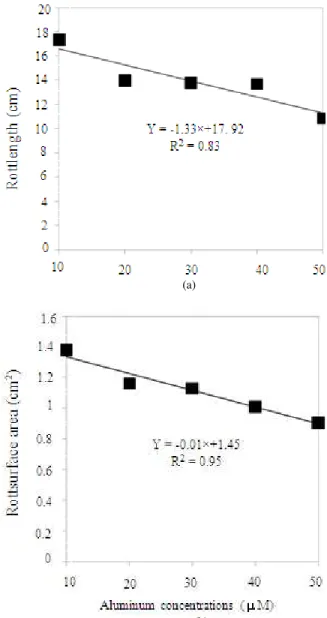
was observed that the root length of rice seedling was affected by the presence of high concentration of Al (Fig. 1). Root length is negatively and highly correlated with Al concentration (Fig. 1A). The relationship is presented by the equation Y = - 1.33x + 17.92 (R2 = 0.83).
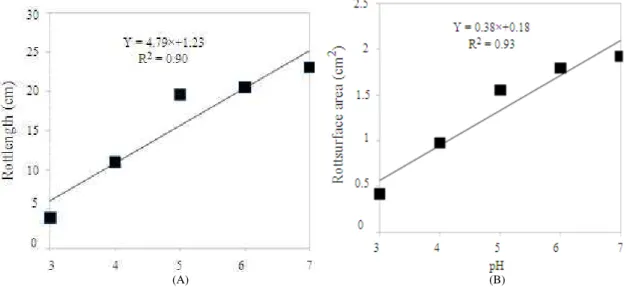
Like the case of Al, root length of rice was affected by low pH. Figure 2 shows that rice root length is positively and highly correlated with pH. The equation representing the relationship is given by Y = 4.79x + 1.23 (R2 = 0.90) (Fig. 2A).
Figure 3A and 3B show the relationship between relative root length and Al concentration and between relative root length and pH, respectively. Relative root length is negatively related with Al concentration, with equation representing the relationship given by Y = 171.88x- 0.24 (R2 = 0.82) (Fig. 3a).
Relative root length of rice seedlings is positively correlated with pH (Fig. 3B). The relationship between relative root length and pH is given by the equation Y = 100.88 ln(x)-90.39 (R2 = 0.96).
Effects of Al and pH on root surface area: Root
surface area was determined in this study. It was observed root surface area of rice seedling was affected by Al (Fig. 1). The root surface area of rice seedling is negatively and highly correlated with Al concentration and the equation representing the relationship is given by Y = -0.11x + 1.45 (R2 = 0.95) (Fig. 1B).
Root surface area of rice seedling increased with increasing pH (Fig. 2). Root surface area of rice seedling was positively and highly correlated with pH, with equation representing the relationship given by Y = 0.38x + 0.18 (R2 = 0.93) (Fig. 2B).
Exudation of organic acids: Table 1 gives data on the
exudation of organic acids as affected by Al. It shows that the amount of oxalic acid released by the 3 seedlings was not significantly different among the treatments. Nevertheless, it shows that higher oxalic acid was released at 50 µM of Al concentration. The trend in the release of citric and malic acids is the same as that of the oxalic acid. Rice seedlings grown under the condition of Al concentration of 50 µM had released about 0.1300, 0.0806-0.0766 µM, oxalic, citric and malic acids, respectively.
(a)
(b)
(A) (B)
Fig. 2: Relationship between root length and pH (A) and root surface area and pH (B)
(A) (B)
Fig. 3: The relationship between relative root length and Al (A) and pH (B)
Table 1: Exudation of organic acids by rice roots as affected by Al. Aluminum
concentration Oxalate Citrate Malate (µM) ---µM--- 10 0.0008a 0.0645a 0.0077a 20 0.0012a 0.0005a 0.0112a 30 0.0019a 0.0103a 0.0215a 40 0.0021a 0.0051a 0.0029a 50 0.3100a 0.0806a 0.0766a
We found that rice root released more organic acids at low pH than at high pH (Table 2). At the pH of 3, the seedlings released oxalate, citrate and malate at 0.0088, 0.0066-0.0577 µM, respectively.
Table 2: Exudation of organic acids by rice roots as affected by pH Oxalate Citrate Malate pH ---µM--- 3 0.0088a 0.0066a 0.0577a 4 0.0006a 0.0211a 0.0005a 5 0.0023a 0.0168a 0.0316a 6 0.0028a 0.0079a 0.0072a 7 0.0010a 0.0061a 0.0073a Means followed by the same letter within a column are not significantly different (HSD P<0.05)
DISCUSSION
Chemical properties of water from the field:
328 reclaimed from mangrove swamp in 1964 for rice cultivation. Up until now, the soils are very acidic (pH <3.5) even after many years of lime application. The average rice yield in the areas of acid sulfate soils in Malaysia using farmer’s practice is less than 2 t/ha/season. The Al concentration is far above the critical toxic level of 74 µM for rice growth as suggested by Dent (1986). Hence, rice planted on a soil with this water condition is expected to suffer from H+ stress (Zhu et al., 2009). According to these authors, H+ activity at pH 3.0 is more than 3000-fold higher than at pH 6.5. Rice grown on soils at Merbok would suffer from H+ stress if the soils are not ameliorated with amendments. Hence, rice grown in the area would suffer from Al toxicity (Kochian et al., 2005) and eventually the yield will be reduced.
Aluminum toxicity symptoms in plants: Barker and
Pilbeam (2007) stated that there were several symptoms of Al toxicity that occur within a few hours of Al exposure, such as inhibition of root elongation, disruption of root cap processes, lignin deposition and decline in cell division. This is consistent with the finding of Horst et al. (2009) who said that Al inhibited plant root elongation. It is believed that reduced root length results in decreased nutrient uptake and multiple nutrient deficiencies. Ridolfi and Garrec (2000) reported that the concentration of calcium and magnesium in beech leaf was reduced by Tan and Keljens (1995). Furthermore, Ryan et al. (1993) reported that roots of an aluminum-sensitive corn cultivar BR 201F was inhibited after 30 min of exposure to aluminum. This is because Al affects the growth of cells in the elongation zone of roots (Sasaki et al., 1997).
The rice seedlings grow better under the condition of high pH than that of low pH. The pH of water in the area covered by acid sulfate soils in Malaysia is usually less than 3.5. That means rice growing on these soils is suffering from H+ stress. This is consistent with the study of Zhu et al. (2009) who found that H+ activity at low pH is much higher than at high pH. Hence, the root of rice growing in acid sulfate soils is affected by H+ stress.
The Al concentration equivalent to 90% relative yield is 15 µM. This value is considered as the critical level of Al concentration, above which the growth of rice seedlings will be affected. It seems that variety MR 219 is less tolerant to Al toxicity than that reported by Dent (1986). Under normal circumstances, Al concentration of water in acid sulfate area cropped to rice (after lime is applied) is above that value. That is the reason why rice yield using farmer’s practice is below the national average.
The critical pH value is 6. Under condition prevailing in acid sulfate soils, this level of pH can only be achieved by applying lime at high rate. Shamshuddin (2006) wrote that for these soils applying ground magnesium at 4 t/ha before rice planting only managed to raise the pH to about 4.5. Liming at higher rate than this is uneconomical and not sustainable in the long run. Again, it shows that growing rice on acid sulfate soils is difficult. Liming alone will not solve the problem of Al toxicity and H+ stress in these soils. We have to use other means such as application of organic matter that can chelate Al to a certain extent.
The pKa value of Al is 5. So when the solution pH is raised above 5, Al will be precipitated as inert Al-hydroxides according to the following equation:
Al3+ + 3OH- Al (OH3)
If this happens, rice growth stress would have been gradually diminishing, depending on how high the increase in pH is. We know for sure that when pH is raised to 5.2, Al concentration in the solution is minimal (Ismail et al., 1993), no longer becoming a threat to the growth of crop like rice.
Inhibition of root growth: The decrease in root
surface area due to high Al concentration can be similarly explained by deficiency of calcium and magnesium as reported by Ridolfi and Garrec (2000); Godbold et al. (1988) and Tan and Keltjens (1995). Arp and Strucel (1989) reported that water uptake of 1-year-old black spruce was reduced by exposure to high concentration of Al. Therefore, the presence of Al is really creating havoc in the growth of rice seedlings under the field conditions.
For better absorption of nutrients, the root surface area of rice seedling needs to be increased. In real situation in the field, this can be done by increasing solution pH using lime.
Mechanism of Al tolerance: Under real situation in the
Fig. 4: Mechanism of aluminum tolerance in rice plant
In common bean, however, Al resistance is related to the sustained release of citrate from the root apices (Horst et al., 2009). According to Ma et al. (2001), Al3+ was immobilized by organic acids that prevent it from entering the root cells. Under Al stress, it is known that root secretes citrate, forming Al-citrate that results in the reduction of Al toxicity. The same mechanism can be used to explain the slight tolerance of rice variety MR 219 to Al toxicity in this study. Detailed explanation of this mechanism is provided by Fig. 4. We think that organic acids had been exuded in order to detoxify the aluminum in the rhizophere. The exudation of oxalic, citric and malic acids by rice root has been discussed earlier (Table 1-2). When these acids were released into the rhizopheres, they would effectively chelate Al3+ and prevented its entry into the root as explained by Lopez-Bucio et al. (2000). Furthermore, Ma et al. (2002) reported that the root apex of plant is particularly sensitive to Al and therefore, only the cations that immediately surround the apical root need to be detoxified.
As depicted in Fig. 4, the cell wall of rice root is negatively-charged. Hence, the positively-charged Al is attracted to the root surface. As soon as it touches the cell wall, the root takes immediate action by releasing oxalate, citrate and malate. These ligands, in turn, bind Al, forming oxalate, citrate or Al-malate. The result of these reactions is reduction of Al in the solution that causes toxicity to the rice seedlings. The amount of organic acids released differs from plant species to species. Miyasaka et al. (1991) found that aluminum-tolerant cultivar exuded many times more citrate than aluminum-sensitive cultivar in the presence
of aluminum and that oxalate appeared to be exuded less as compared to citrate. This is not consistent with the findings of this study where rice roots had released less citrate than oxalate.
CONCLUSION
Rice variety MR 219 is affected by low pH and high Al concentration of the water in the paddy fields. If it is grown on acid sulfate soils in the country with water pH of < 3.5 and Al concentration exceeding 15 µM, the growth of rice will be curtailed and eventually the rice yield will be reduced. The water pH for optimal rice growth is 6. However, liming at the rate to achieve pH up to this level is costly, ordinary farmers cannot afford it. For this rice variety, in order to reduce the negative effects of Al3+ the root of the plant has to secrete organic acids, the most important of which is citric acid. The Al3+ in the solution will be partly chelated by the acid, forming Al-citrate, rendering it less available to the rice roots.
ACKNOWLEDGEMENT
We like to thank University Putra Malaysia for the technical support during the conduct of the research and Ministry of Science, Technology and Innovation, Malaysia, for financial support through grant No. 05-01-04-SF-1094.
REFERENCES
Arp, P.A. and I. Strucel, 1989. Water uptake by black spruce seedlings from rooting media (solution, sand, peat) treated with inorganic and oxalated aluminum. Water Air Soil Poll., 44: 57-70. DOI: 10.1007/BF00228778
Auxtero, E.A. and J. Shamshuddin, 1991. Growth of oil palm (Elaeis guineensis) seedlings on acid sulfate soils as affected by water regime and aluminum. Plant Soil., 137: 243-257. DOI: 10.1007/BF00011203
Barker, A.V. and D.J. Pilbeam, 2007. Handbook of Plant Nutrition. 1st Edn., CRC/Taylor and Francis, London, ISBN: 9780824759049, pp: 613.
Chaang, T.C., R.B. Saari, H. Diemont, A.B. Yusoff, 1993. The Development of an Acid Sulfate Area in Former Mangroves in Merbok Kedah Malaysia. Proceedings of the Ho Chi Minh City Symposium on Acid Sulfate Soils, Van Mensvoort MEF Wageningen, The Netherlands, pp: 95-101.
330 Dent, D., 1986. Acid Sulphate Soils: A Baseline for
Research and Development. International Institute Land Reclamation Improvement, Wageningen. http://www2.alterra.wur.nl/Internet/webdocs/ilri-publicaties/publicaties/Pub39/pub39-h1.0.pdf Enio Kang, M.S., J. Shamshuddin, C.I. Fauziah and
M.H.A. Husni, 2011. Pyritization of the coastal sediments in the Kelantan plains in the Malay peninsula during the Holocene. Am. J. Agri. Biol. Sci. Godbold, D.L., E. Fritz and A. Huttermann, 1988. Aluminum toxicity and forest decline. Proc. Natl.
Acad. Sci., 85: 3888-3892.
http://www.pnas.org/content/85/11/3888.full.pdf+h tml
Horst, W.J., A.F. Rangel., D. Eticha, M. Ischitani and I.M. Rao, 2009. Aluminum toxicity and resistance in Phaseolus vulgaris L.-hysiology drives molecular biology. Proceedings of the 7th International Symposium on Plant-Soil at Low pH. South China University of Technology Press, pp:
53-54.
http://ciat-library.ciat.cgiar.org/Articulos_Ciat/Horst_et_al_P roceedings_Paper_2009.pdf
Ismail, H., J. Shamshuddin and S.R. Syed Omar, 1993. Alleviation of soil acidity in ultisol and oxisol for corn growth. Plan. Soil., 151: 55-65. DOI: 10.1007/BF00010786
Kochian, L.V., 1995. Cellular mechanisms of aluminum toxicity and resistance in plants. Ann. Rev. Plan. Phys. Plan. Mol. Biol., 46: 237-260. DOI: 10.1146/annurev.pp.46.060195.001321 Kochian, L.V., M.A. Pineros and O.A. Hoekenga,
2005. The physiology, genetics and molecular biology of plant aluminum resistance and toxicity. Plan. Soil, 274: 175-195. DOI: 10.1007/s11104-004-1158-7
Lopez-Bucio, J., M.F. Nieto-Jacobo, V. Ramirez-Rodriguez and L. Herrera-Estrella, 2000. Organic acid metabolism in plants: From adaptive physiology to transgenic varieties for cultivation in extreme soils. Plan. Sci, 160: 1-13. DOI: 10.1016/S0168-9452(00)00347-2
Ma, J.F., P.R. Ryan and E. Delhaize, 2001. Aluminum tolerance in plant and the complexing role of organic acids. Trend. Plan. Sci., 6: 273-278. DOI: 10.1016/S1360-1385(01)01961-6
Ma, J.F., R. Shen, Z. Zhou, M. Misawa and Y. Takeuchi et al., 2002. Response of rice to aluminum stress and identification of quantitative trait loci for aluminum tolerance. Plan. Cel. Phys., 43: 652-659. DOI: 10.1093/pcp/pcf081
Miyasaka, S.C., J.G. Buta, R.K. Howell and C.D. Foy, 1991. Mechanism of aluminum tolerance in snapbeans: Root exudation of citric acid. Plan. Phys., 96: 737-743. DOI: 10.1104/pp.96.3.737
Muhrizal, S., J. Shamshuddin, I. Fauziah and M.H.A Husni, 2006. Changes in an iron-poor acid sulfate soil upon submergence. Geoderma, 131: 110-122. DOI: 10.1016/j.geoderma.2005.03.006
Muhrizal, S., J. Shamshuddin, M.H.A. Husni and I. Fauziah, 2003. Alleviation of aluminum toxicity in an acid sulfate soil in Malaysia using organic materials. Comm. Soil. Sci. Plan. Anal., 34: 2993-3012. DOI: 10.1081/CSS-120025221
Ridolfi, M. and J.P. Garrec, 2000. Consequences of the excess al and a deficiency in ca and mg for stomatal functioning and net carbon assimilation of beech leaves. Ann. Sci., 57: 209-218. DOI: 10.1051/forest: 2000112
Ryan, P.R., J.M. Ditomaso and L.V. Kochian, 1993. Aluminum toxicity in roots: An investigation of spatial sensitivity and the role of the root cap. J. Exp. Bot., 44: 437-446. DOI: 10.1093/jxb/44.2.437 Sasaki, M., Y. Yamamoto, J.F. Ma and H. Matsumoto, 1997. Early events induced by aluminum stress in elongating cells of wheat root. Soil Sci. Plant
Nutr., 43: 1009-1014.
http://ci.nii.ac.jp/els/110001718209.pdf?id=ART00 01860466&type=pdf&lang=en&host=cinii&order_ no=&ppv_type=0&lang_sw=&no=1307867283&c p=
Shamshuddin, J. and E.A. Auxtero, 1991. Soil solution composition and mineralogy of some active acid sulfate soil as affected by laboratory incubation with lime. Soil Sci., 152: 365-376. http://journals.lww.com/soilsci/Abstract/1991/1100 0/Soil_Solution_Compositions_and_Mineralogy_o f_Some.8.aspx
Shamshuddin, J., 2006. Acid Sulfate Soils in Malaysia. 1st Edn., UPM Press, Serdang, ISBN: 9832871875, pp: 127.
Shamshuddin, J., H.A.H. Sharifuddin, I. Che Fauziah, D.G. Adwards and L.C. Bell, 2010. Temporal changes in chemical properties of acid soil profiles treated with magnesium limestone and gypsum. Pertan. J. Trop. Agric. Sci., 33: 277-295. http://www.pertanika2.upm.edu.my/jpertanika/Pert anika%20PAPERS/JTAS%20Vol.%2033%20(2)% 20Aug%202010/14.pdf
Shamshuddin, J., I. Che Fauziah and H.A.H. Sharifuddin, 1991. Effect of limestone and gypsum application to a Malaysian ultisol on soil solution composition and yields of maize and groundnuts. Plant Soil, 134: 45-52. DOI: 10.1007/BF00010716 Shamshuddin, J., I. Jamilah and J.A. Ogunwale, 1995.
Shamshuddin, J., S. Muhrizal, I. Fauziah and E. Van Ranst, 2004a. A laboratory study of pyrite oxidation in an acid sulfate soils. Commu. Soil. Sci. Plan. Anal., 35: 117-129. DOI: 10.1081/CSS-120027638
Shamshuddin, J., S. Muhrizal, I. Fauziah and M.H.A. Husni, 2004b. Effects of adding organic materials to an acid sulfate soil on growth of cocoa (Theobroma cacao L). Sci. Total Environ., 323: 33-45. DOI: 10.1016/j.scitotenv.2003.10.003 Shazana, M.A.R.S., J. Shamshuddin, C.I Fauziah and
S.R. Syed Omar, 2011. Alleviating the infertility of an acid sulphate soil by using ground basalt with or without lime and organic fertilizer under submerged condition. Lan. Degradat. Dev. DOI: 10.1002/ldr.1111
Soil Survey Staff, 2010. Keys to Soil Taxonomy. 11th Edn., USDA-Natural Resources Conservation
Service, Washington, DC.
http://soils.usda.gov/technical/classification/tax_ke ys/
Suswanto, T., J. Shamshuddin, S.R. Syed Omar, P. Mat and C.B.S. Teh, 2007. Alleviating an acid sulfate soil cultivated to rice (Oryza sativa) using ground magnesium limestone and organic fertilizer. J.
Tanah Lingkungan., 9: 1-9.
http://repository.ipb.ac.id/bitstream/handle/123456 789/43761/Totok%20Suswanto.pdf?sequence=1 Tan, K. and W.G. Keltjens, 1995. Analysis of acid soil
stress in sorghum genotypes with emphasis on aluminum and magnesium interactions. Plan. Soil., 171: 147-150 DOI: 10.1007/BF00009578