A METHOD BASED ON NAMING SIMILARITY
JOHNATAN ALVES DE. OLIVEIRA
A METHOD BASED ON NAMING SIMILARITY
TO IDENTIFY REUSE OPPORTUNITIES
Dissertação apresentada ao Programa de Pós-Graduação em Ciência da Computação do Instituto de Ciências Exatas da Univer-sidade Federal de Minas Gerais como req-uisito parcial para a obtenção do grau de Mestre em Ciência da Computação.
Orientador: Eduardo Magno Lages Figueiredo
Belo Horizonte
JOHNATAN ALVES DE. OLIVEIRA
A METHOD BASED ON NAMING SIMILARITY
TO IDENTIFY REUSE OPPORTUNITIES
Dissertation presented to the Graduate Program in Ciência da Computação of the Universidade Federal de Minas Gerais in partial fulfillment of the requirements for the degree of Master in Ciência da Com-putação.
Advisor: Eduardo Magno Lages Figueiredo
Belo Horizonte
c
2016, Johnatan Alves de. Oliveira. Todos os direitos reservados.
Oliveira, Johnatan Alves de.
O48m A Method Based on Naming Similarity to Identify Reuse Opportunities / Johnatan Alves de. Oliveira. — Belo Horizonte, 2016
xxii, 58 f. : il. ; 29cm
Dissertação (mestrado) — Universidade Federal de Minas Gerais
Orientador: Eduardo Magno Lages Figueiredo
1. Computação –Teses. 2. Software- Reutilização. 3. Software – Desenvolvimento. 4. Sistemas de recomendação I. Orientador. II. Título.
Acknowledgments
A realização desta dissertação marca o fim de uma importante etapa da minha vida. Gostaria de agradecer a todos aqueles que contribuíram de forma decisiva para a sua concretização
A Deus, que todos os dias de minha vida me deu forças para nunca desistir. Aos meus pais pelos ensinamentos concedidos a mim, trabalhando incansavel-mente para me proporcionar ensino de qualidade. Desta forma, a educação que mim disponibilizaram, não se pode comprar nem vender. Além disso, pela coragem e apoio que mim asseguraram em busca dos meus sonhos. Agradeço também a minha irmã pelo apoio e incentivo nas tomadas de decisões, me proporcionando coragem e forças para alcançar os meus sonhos.
Agradeço eternamente ao professor Eduardo Figueiredo, pela confiança aplicada sobre mim, desde o início dessa “empreitada”. O professor foi mais do que um orientador nessa jornada. Registro aqui, a profunda admiração e respeito que tenho por ele, pude perceber o grande profissional que é durante a nossa convivência no mestrado.
Agradeço aos colegas de laboratório de pesquisa (Labsoft) pelas dicas e suporte ao longo de todos os seminários e etapas para alcançar essa conquista. Embora seja um trabalho individual, esta dissertação recebeu contribuições diretas e indiretas para sua realização. Cabe aqui agradecer o apoio dos “co-autores” dos artigos publicados e aos alunos de iniciação científica. Estes, me auxiliaram a enfrentar diversas dificuldades e por essa razão, quero lhes expressar meus agradecimentos sinceros.
Agradeço ao Programa de Pós-Graduação em Ciência da Computação (PPGCC) pela oportunidade de realizar um curso de alto nível de excelência. A todos os profes-sores do mestrado que de alguma forma contribuíram para a minha formação.
Agradeço ainda à CAPES pelo período em que financiou minhas pesquisas. Enfim, agradeço a todos que contribuíram, de forma direta ou indireta para que eu alcançasse este título.
“É muito melhor lançar-se em busca de conquistas grandiosas, mesmo expondo-se ao fracasso, do que alinhar-se com os pobres de espírito, que nem gozam muito nem sofrem muito, porque vivem numa penumbra cinzenta, onde não conhecem nem vitória, nem derrota”
(Theodore Roosevelt)
Resumo
Reutilização de software é uma estratégia de desenvolvimento em que os componentes de software existentes são utilizados no desenvolvimento de novos sistemas de software. Há muitas vantagens da reutilização no desenvolvimento de software, como a minimiza-ção dos esforços de desenvolvimento e melhoria da qualidade de software. Nesta dis-sertação, é proposto um método para a identificação de oportunidades de reutilização baseados na similaridade dos nomes de dois tipos de entidades orientadas a objetos: classes e métodos. O método desenvolvido, chamado JReuse, computa por meio de uma função de similaridade com o objetivo de identificar classes e métodos de nomes semelhantes, a partir de um conjunto de sistemas de software de um mesmo domínio. Essas classes e métodos compõem um repositório com oportunidades de reutilização. Além disso, apresentamos uma ferramenta protótipo para apoiar o método proposto. O método e a ferramenta foram aplicados em 72 sistemas de software minerados do GitHub, em 4 domínios diferentes: contabilidade, hospital, restaurante e e-commerce. No total, esses sistemas possuem 1.567.337 linhas de código, 57.017 métodos e 12.598
classes. Depois da sua aplicação, JReuse foi avaliada através de uma pesquisa com
32 desenvolvedores do GitHub nos domínios avaliados. Como resultado, foi possível obervar que JReuse é capaz de identificar as principais classes e métodos que são mais frequentes em cada domínio selecionado.
Palavras-chave: Reuso de Software, reuso, artefatos reutilizáveis, oportunidades de reuso, estratégia de extração.
Abstract
Software reuse is a development strategy in which existing software components are used in the development of new software systems. There are many advantages of reuse in software development, such as minimization of development efforts and improvement of software quality. Few methods have been proposed in literature for recommendation of reuse opportunities. In this dissertation, we propose a method for identification of reuse opportunities based on naming similarity of two types of object-oriented entities: classes and methods. Our method, called JReuse, computes a similarity function to identify similarly named classes and methods from a set of software systems from a domain. These classes and methods compose a repository with reuse opportunities. We also present a prototype tool to support the proposed method. We applied the method and tool to72software systems mined from GitHub, in 4 different domains: accounting, hospital, restaurant, and e-commerce. In total, these systems have 1,567,337 lines of code, 57,017 methods, and 12,598 classes. After its application, we evaluated JReuse through a survey with 32 developers from GitHub in the evaluated domains. As a result, we observe that JReuse is able to identify the main classes and methods that are frequent in each selected domain.
Keywords: Software reuse, ad-hoc software reuse, reusable assets, reuse opportunities, naming similarity, recommendation systems.
List of Figures
3.1 Steps to Identify Common Entities . . . 13
3.2 Steps of the Method called JReuse . . . 14
3.3 Architecture of the tool . . . 16
3.4 User interface of JReuse . . . 17
4.1 LOC of Sytems per Domain . . . 22
4.2 NOC of Sytems per Domain . . . 23
4.3 NOM of Sytems per Domain . . . 24
4.4 Designed an Exploratory Study . . . 25
4.5 Scale of relevance to entity identified as reuse opportunity . . . 27
4.6 Distribution of frequent classes through accounting systems . . . 29
4.7 Distribution of frequent classes through restaurant systems . . . 30
4.8 Distribution of frequent classes through hospital systems . . . 32
4.9 Distribution of frequent classes through e-commerce systems . . . 33
5.1 Background of Participants . . . 46
5.2 Accuracy of the method JReuse compared with participants . . . 47
List of Tables
3.1 Similarity Evaluation . . . 12
4.1 Filters that were applied to the data set . . . 21
4.2 Software metrics for systems from each domain . . . 26
4.3 Classes with at least 15% occurrences in the accounting domain . . . 28
4.4 Classes with at least 15% occurrences in the restaurant domain . . . 29
4.5 Classes with at least 15% occurrences in the hospital domain . . . 31
4.6 Classes with at least 15% occurrences in the e-commerce domain . . . 32
4.7 Methods most often identified from of most common classes among the accounting domain systems. . . 35
4.8 Methods most often identified from of most common classes among the restaurant domain systems. . . 36
4.9 Methods most often identified from of most common classes among the hospital domain systems. . . 37
4.10 Methods most often identified from of most common classes among the e-commerce domain systems . . . 38
5.1 Survey Settings . . . 44
5.2 Population Sampling Distribution . . . 45
Contents
Acknowledgments ix
Resumo xiii
Abstract xv
List of Figures xvii
List of Tables xix
1 Introduction 1
1.1 Motivation . . . 1
1.2 Proposed Work . . . 2
1.3 Publications . . . 3
1.4 Outline of the Dissertation . . . 4
2 Background and Related Work 5 2.1 Recommendation Systems in Software Engineering . . . 5
2.2 Software Reuse . . . 6
2.3 Analysis of Similarity . . . 7
2.4 Related Work . . . 8
2.5 Final Remarks . . . 9
3 Proposed Method 11 3.1 Identifying Similarity . . . 11
3.2 The Method Steps . . . 12
3.3 Tool Support . . . 15
3.4 Final Remarks . . . 18
4 Method Evaluation 19
4.1 Goal and Research Questions . . . 19 4.2 Data Set . . . 20 4.3 Evaluation Steps . . . 25 4.4 Results of Frequent Classes . . . 26 4.5 Results of Frequent Methods . . . 33 4.6 Lessons Learned . . . 39 4.7 Threats to Validity . . . 40 4.8 Final Remarks . . . 41
5 Survey with Developers 43
5.1 Survey Settings . . . 43 5.2 Participant Background . . . 45 5.3 Results . . . 47 5.4 Threats to Validity . . . 48 5.5 Final Remarks . . . 49
6 Conclusion 51
6.1 Contributions . . . 51 6.2 Future Work . . . 52
Bibliography 53
Chapter 1
Introduction
The increasing demand for larger and more complex software systems requires the use of existing software artifacts (Pohl et al., 2005). In this context, software reuse is a development technique in which previously implemented software components, are used in the development of new software systems (Krueger, 1992). Reuse has been studied and indicated as an alternative to the traditional software development aiming to increase software quality and decrease development efforts by using existing, and sometimes tested, software components (Mohagheghi and Conradi, 2007; Morisio et al., 2002; Ravichandran and Rothenberger, 2003).
Methods for identification of reuse opportunities are essential to support the building of repositories of reuse opportunities (Guo and Luqi, 2000). These methods may be used in different contexts related to software developement, including the sup-port of feature identification for a software product line (Lee et al., 2004), for instance. Many methods have been proposed in the literature to support the identification of reuse opportunities from software systems (Caldiera and Basili, 1991; Kawaguchi et al., 2004; Kuhn et al., 2007; Maarek et al., 1991; Ye and Fischer, 2005). However, to the best of our knowledge, we did not find a method able to identify reuse opportunities from several systems, considering most frequent entities such as classes and methods from systems of a single domain.
1.1
Motivation
To support software reuse, developers need first to find the relevant source code frag-ments to be reused. For instance, a code fragment may be relevant as a reuse opportu-nity because of its efficient in terms of performance. Other reason to reuse a fragment is it quality because, in general, existing code have been submitted to spection and
2 Chapter 1. Introduction
testing. Finally, by reusing existing fragments, developers may decrease development efforts and, then, increase their productivity.
Since software systems have been increasing and evolving along the years, to identify frequent source code fragments with a particular functionality may be diffi-cult. That is, because of significant number of classes, methods, and lines of code in these systems, the identification of reuse opportunities is a hard task. In this context, automated analysis and identification of reuse opportunities are useful to minimize costs (Ye and Fischer, 2002).
In addition, one of the current drawbacks in the software reuse process is the classification of the most frequent reuse opportunities from a set of software systems. Since many opportunities may be identified, it is important to recommend the most appropriate for reuse to developers, given a domain. For this purpose, some studies have proposed supporting techniques (Caldiera and Basili, 1991; Ye and Fischer, 2005). Previous work in literature proposed methods to support the identification of reuse opportunities in software systems. These methods apply different techniques for source code analysis, such as natural-language processing (Maarek et al., 1991), formal specifications (Caldiera and Basili, 1991), machine learning (Kawaguchi et al., 2004), and other Information Retrieval techniques (Kuhn et al., 2007; Ye and Fischer, 2005). However, to the best of our knowledge, we did not find a method able to: (i) identify reuse opportunities, (ii) recommend the reuse opportunities identified, and (iii) show the name and the location of the main entities identified as reuse opportunities, given a set of systems (design partial).
1.2
Proposed Work
During the software development, the reuse of existing artifacts is an attractive way to reduce development costs and time-to-market and improve the software quality (Mo-hagheghi and Conradi, 2007). Source code is the artifact most commonly reused in software development (Morisio et al., 2002). However, to identify the reuse opportuni-ties in large systems, and even in small systems, is a far from trivial task.
1.3. Publications 3
reuse opportunities. This list may guide developers in the use of existing entities that are common in systems from a given domain.
JReuse performs the identification of reuse opportunities in two well-defined steps. First, given a set of systems from the same domain, the proposed method analyzes similarly named classes to identity the most frequent classes. Second, from the classes identified in the previous step, JReuse analyzes similarly named methods to identify the most frequent ones. Our method has been designed to analyze object-oriented software systems, independent of size, and applicable to different domains. The pro-posed method can be used to provide support to identify opportunities of software reuse. In addition, the method was built to guide users through partial design in the development of new software systems, showing the most frequent entities.
We conducted an evaluation of our method in two steps. First, we performed an empirical study conducted in controlled environment with 72 software systems. These systems were collected from GitHub and belong to four different software domains: accounting, restaurant, hospital, and e-commerce. Second, we conducted a survey with experienced developers from two of the four domains, namely e-commerce and hospital. We evaluated only these two domains because of the low percentage of responses for the other domains. With respect to the first evaluation, we observed that JReuse is able to identify reuse opportunities using naming similarity analysis for classes and methods. Regarding the second evaluation, participants from the survey agree that JReuse provides classes for the analyzed domains as reuse opportunities.
1.3
Publications
This dissertation generated the following publications and, therefore, it contains re-sources from them.
• Oliveira, J., Fernandes, E., Souza, M., and Figueiredo, E. (2016). A method based on naming similarity to identify reuse opportunities. In Proceedings of the XII Brazilian Symposium on Information Systems (SBSI), pages 305–312 (best
paper)
• Oliveira, J. and Figueiredo, E. (2016). A recommendation system of reuse op-portunities based on lexical analysis. In Proceedings of the IX Workshop Thesis and Dissertations in Information Systems (WTDSI), pages 49–51
4 Chapter 1. Introduction
Workshop on Software Visualization, Evolution and Maintenance (VEM), pages 49–56
1.4
Outline of the Dissertation
While this chapter introduced this dissertation, the remainder of this document is organized as follow.
Chapter 2 presents background information to support the comprehension of this dissertation. It includes the main concepts related to the study, such as software reuse and reuse techniques. We also discuss related work.
Chapter 3 describes JReuse, a method proposed for identification of reuse opportu-nities using lexical analysis. We presents the similarity analysis computation used by our method, the method steps, and a supporting tool that implements the method.
Chapter 4provides an evaluation of the proposed method. This evaluation consists of an empirical study conducted in controlled environment. We present the study design and the main results we obtained by analyzing 72 systems from four different domains: accounting, restaurant, hospital, and e-commerce.
Chapter 5presents a survey conducted with experienced software developers for two of the four domains analyzed in Chapter 4. We discuss the main obtained results.
Chapter 2
Background and Related Work
In order to speed up software development with quality and low cost, we can apply software reuse techniques. Such techniques consist of using existing software artifacts in the development of new systems, with minimization of efforts. Even in an ad hoc
approach, the reuse of source code fragments is a recurrent activity in development settings (Ajila et al., 2012; Wang et al., 2012; Xue, 2011). However, by reusing code fragments in many parts of the system, developers may cause code clones (Fowler, 2009; Marcus and Maletic, 2001; Patil et al., 2015). To support reuse, methods and supporting tools for identification of reuse opportunities are required.
This chapter presents background information and work related to this disserta-tion. Section 2.1 presents an overview on recommendation systems because our method is based on recommendation system principles. Section 2.2 presents the concepts about software reuse and discusses the advantages and drawbacks of each type of reuse. Sec-tion 2.3 shows some examples of the use of similarity analysis to identify opportunities of reuse and code clone. Section 2.4 presents previous work in the area of identification of reuse opportunities from source code. Lastly, Section 2.5 concludes this chapter with some final remarks.
2.1
Recommendation Systems in Software
Engineering
Along the years, the availability of data regarding software systems has been increasing in terms of volume and complexity (Herlocker et al., 2004). In the context, Recommen-dation Systems for Software Engineering (RSSEs) are tools to support developers in many tasks, such as decision-making with respect to the data and recommendation of
6 Chapter 2. Background and Related Work
reuse opportunities (Cubranic and Murphy, 2003). These tools aim to analyze the de-velopers’ needs and preferences, indicated implicitly or explicitly through the tool, and then to recommend artifacts to the developer (Robillard et al., 2010). Such artifacts may be source code fragments, for instance (Holmes et al., 2006).
In general, software developers spend significant efforts to find software artifacts in source code repositories (Begel et al., 2010). For example, considering large-sized systems, it may be difficult for developers to find software components to reuse (Ko et al., 2006). Therefore, to extract reuse opportunities is a task that impacts nega-tively on the productivity of developers (Begel et al., 2010). In this context, a RSSE may support developers in the process for identification of reuse opportunity by recom-mending source code in an automatic fashion (Holmes et al., 2006). Some examples of studies that propose RSSEs for reuse opportunities are CodeBroker (Ye and Fischer, 2005) and Strathcona (Holmes et al., 2006). CodeBroker aims to identify similar class library elements using a text-based analysis, to support developers in the used of APIs. Strathcona is a Recommendation system to assist developers in finding fragments of code, or examples, of an API’s use.
2.2
Software Reuse
In software reuse, previously implemented software components are used to support the development of new software (Krueger, 1992). The main goal of reuse is the im-provement of software quality aspects followed by an increasing development efficiency with low cost (Ravichandran and Rothenberger, 2003). There are many approaches to support reuse in software development. Krueger (1992) presents an extensive study regarding definitions and application of software reuse.
There are two types of software reuse: ad hoc and systematic reuse (Mohagheghi and Conradi, 2007). Ad hoc, reuse is applied in an opportunistic way, without planning, taking as an example the reuse of random software code snippets from the Web (Sojer and Henkel, 2011). In turn, systematic software reuse follows specific protocols and processes to provide the use of existing software components when developing new systems (Mohagheghi and Conradi, 2007).
2.3. Analysis of Similarity 7
Some studies investigated advantages and drawbacks of systematic software reuse (Mohagheghi and Conradi, 2007; Mohagheghi et al., 2004). Mohagheghi et al. (2004) studied the impacts of reuse on software quality through an empirical study on large-scale system components. They concluded that reuse provides software compo-nents with lower defect-density and higher stability when compared with non-reused components. Mohagheghi and Conradi (2007) conducted a literature review to inves-tigate the impact of software reuse in industrial development context. They identified flaw decreasing, reduction of development efforts, and increasing of productivity as the main advantages of reuse.
Many strategies are proposed in literature, based on techniques such as: natural-language processing, formal specifications, architecture style, and machine learning. In natural language processing, lexical inspection of source code elements is conducted to identify reuse opportunities (Maarek et al., 1991). In formal specifications, the reusable components are extracted with support of software models and metrics analy-sis (Caldiera and Basili, 1991). In architectural style (Monroe and Garlan, 1996), where software reuse is supported by the analysis of interacting components in a high-level abstraction, such as software design and modeling, different analyzes are conducted to extract reuse opportunities, such as automated semantic categorization of software components (Kawaguchi et al., 2004).
2.3
Analysis of Similarity
Some studies proposed and discussed in literature (Kukich, 1992; Navarro, 2001; Fluri et al., 2007) investigating the analysis of similarity and their applications. For example, the analysis of similarity utilized in this dissertation is Levenshtein Distance. The Levenshtein Distance denotes the minimum number of operations needed to transform one string into the other (Levenshtein, 1966). The operations are: (i) insert a character, (ii) delete a character, or (iii) substitute a character. Algorithm is based on the problem of the longest common subsequence (Levenshtein, 1966). A larger distance means that the strings are less similar, that is, that more operations are necessary to transform one string into another, whereas a distance of 0 operations denotes that the strings are equal (Fluri et al., 2007). The runtime-complexity is O(n.m), where n is the number of characters in stringa and m instringb.
8 Chapter 2. Background and Related Work
(2016) present a study that applies similarity analysis techniques to support the iden-tification of reuse opportunities. They present a method for ideniden-tification of similar implementations of Android mobile application. The proposed method aims to provide the identification of families of applications. For this purpose, they compute a similar-ity function based on the number of similar methods and the total number of methods in two different systems under comparison.
Li et al. (2006) propose a tool called Miner for code clone detection. CP-Miner relies on data mining techniques and targets on copy-paste occurrences of code clone. The method parses source code to compute hash values for sentences. After, the tool analyzes source code to find frequent subsequence that may present clones, using a mining algorithm.
2.4
Related Work
Previous work investigates the identification of reuse opportunities from software sys-tems (Inoue et al., 2005; Koziolek et al., 2013; Li et al., 2005; Mende et al., 2009; Michail and Notkin, 1999; Oliveira et al., 2007; Ye and Fischer, 2005). Inoue et al. (2005) propose a graph-based technique to support the extraction of frequently used components in a given software component repository. The proposed technique relies on ranking components based on their usage by other components from the repository. The authors also present a supporting tool called SPARS-J, for analysis of Java classes. Koziolek et al. (2013) present a technique for identification of reuse opportunities based on domain analysis. The proposed technique aims to support the assessment of potential SPL by organizations. This technique encompasses feature modeling of the domain, comparison of systems in architectural level, and the extraction of reusable components. Li et al. (2005) present an approach for identification of reusable com-ponents from legacy systems. The proposed approach aims to support reengineering tasks; that is, the implementation of new systems based on existing source code. For this purpose, the authors propose the generation of the Abstract Syntax Tree (AST) for analysis and extraction of modules and components as candidate for reuse. Therefore, we may consider this approach as a recommendation system.
2.5. Final Remarks 9
CodeWeb, to support the comparison of software libraries in terms of components (i.e., classes and methods) provided by these libraries. For this purpose, the tool performs naming similarity computations to identify similar classes and methods from a set of libraries. We consider the proposed tool as a recommendation system, since it provides the identification of the appropriate libraries for reuse.
Oliveira et al. (2007) propose a method and a supporting tool for recommendation of reusable software components. The proposed tool applies a technique for software reuse and identification of candidates for reuse called Automatic Identification of Soft-ware Components (AISC). The tool, called Digital Assets Discoverer, performs static analysis of code to identify reuse opportunities. The tool also provides an interactive graphic interface and exports feature using a metadata representation model.
Ye and Fischer (2005) present a supporting tool called CodeBroker to support runtime identification of reusable software components. The proposed tool relies on information retrieval techniques for identification of reuse candidates. Since the tool executes in runtime, it provides recommendation of source code components in pro-duction environment. For this purpose, CodeBroker is based on search engines and Javadoc artifacts for code analysis.
In turn, our reuse opportunities identification method and supporting tool aim to identify candidates for reuse in software systems from an specific domain, using lexical analysis. Unlike other approaches presented, our method can be used for two purposes. First, provide support to identify reuse opportunities in software. Second, guide users through partial design in developing new software systems, showing the most frequent entities. Our method also ranks software entities identified as reuse opportunities by frequency in which the appear in different systems from the same domain. We expect this approach to be helpful in reuse recommendation by suggesting methods and classes that are the most used in software systems given a specific domain.
2.5
Final Remarks
This chapter provided the background information necessary to fully understand the approach proposed in this dissertation. It discussed the concepts of recommendation systems, software reuse, and techniques for identify reuse opportunities. These concepts are essentials since our approach is a recommendation system that aims to achieve a better software design by recommending reuse opportunities.
10 Chapter 2. Background and Related Work
Chapter 3
Proposed Method
Strategies for identifying reuse opportunities are essential to support the building of reuse opportunity repositories. Software systems have been increasing and evolve. Therefore, to identify reuse opportunities is difficult. For this purpose, developers need supporting methods and automated tools. In this context, we propose a method for identification of reuse opportunities. This chapter explains in detail the proposed method for identification of reuse opportunities. Section 3.1 discusses each step of the similarity-based identification process used in our method. Section 3.2 describes the proposed method for reuse opportunity identification. Section 3.3 presents a supporting tool that implements our method. Finally, Section 3.4 concludes the chapter with final remarks.
3.1
Identifying Similarity
Some studies in the literature investigated the textual similarity identification (Tian et al., 2014; Zhen et al., 2008). There are many applications for similarity analysis, such as comparison of dialects, spell check, and plagiarism detection (Liu and Lu, 2008). The proposed method called JReuse relies on static code analysis techniques to identify reuse opportunities. We conducted an ad hoc review in order to select algorithms that compute the similarity between strings to be utilized in this work. Furthermore, this study aimed at identifying the most utilized algorithms in the literature, appropriate for this study purposes. In order to achieve these purposes, we selected the Levenshtein’s algorithm. Levenshtein’s algorithm (Yujian and Bo, 2007) is used to compute the lexical similarity of classes and methods by name. In short terms, given two strings A and B, this similarity function computes the number of changes required to turn A intoB.
12 Chapter 3. Proposed Method
To identify similarly named classes, we adopted a threshold of, at least, 75% similarity between two entities. In addition, to identify similarly named methods, we adopted the same threshold used to identify classes. These thresholds were derived empirically by the author of this dissertation. This threshold was chosen because we observed that some well-known naming conventions for classes and methods may lead to similarly named entities that clearly represents different purposes . We also considered some well-known naming conventions for classes and methods to define this threshold. For instance, the similarity computed forCostumerand CostumerDAO, that are commonly named classes in e-commerce systems, is 72%. However, intuitively these classes implement different functions (i.e., DAO classes implement data base persistence).
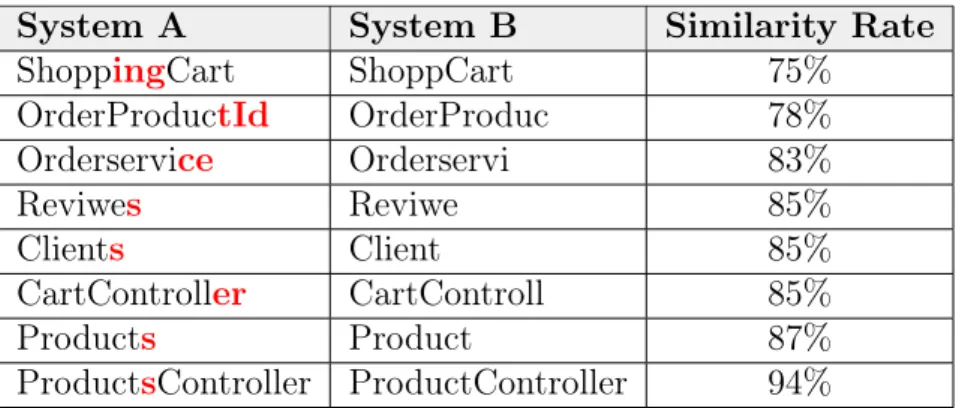
An example of similarity analysis is shown in Table 3.1. In this example, we present eight matches between names of classes from two software systems. In this example, classes from System A and System B has at least 75% similarity rate with class names. The adopted thresholds covers, for instance, the similarity between names that vary from singular to plural (e.g.,Client and Clients).
Table 3.1. Similarity Evaluation
System A System B Similarity Rate
ShoppingCart ShoppCart 75%
OrderProductId OrderProduc 78%
Orderservice Orderservi 83%
Reviwes Reviwe 85%
Clients Client 85%
CartController CartControll 85%
Products Product 87%
ProductsController ProductController 94%
3.2
The Method Steps
3.2. The Method Steps 13
Considering this scenario, our study proposes a method called JReuse for identifi-cation of reuse opportunities from software systems based on naming lexical similarity of two object-oriented code elements: classes and methods. Considering software sys-tems from a specific domain, the method compares names of classes and methods in order to identify common elements among different systems. We believe that recurring names of classes may indicate reuse opportunities in a given domain. Furthermore, frequent names of methods in these classes may indicate common behaviors and re-quirements in such entities (Cybulski and Reed, 2000). Regarding the identification of methods, we adopted two rules. First, JReuse excludes all get and set methods. Second, JReuse analyzes the return type of each method. For instance, if the pair of methods has the same return type, they are considered as reuse opportunities. Other-wise, the methods are considered as different functions.
In general, only the similarity rate is not enough for electing a class as a possible reuse opportunities. We also consider the classes that are more frequent among the systems (e.g., a name of class with matches in 10 different systems is more frequent than a name of class that matches in only 2 systems). We believe that recurring names of classes may indicate reuse opportunities in a given domain. Furthermore, frequent names of methods in these classes may indicate common behaviors and requirements in such entities (Cybulski and Reed, 2000).
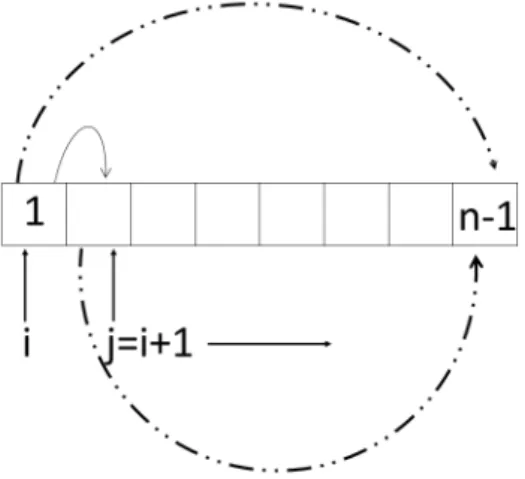
Our method compares different elements as illustrated in Figure 3.1 and described as follows. First, JReuse compares all classes from the set of systems to identify the similarly named classes, JReuse has not synonymous analysis. Therefore, entities such as Client and Customer are considered as different entities. Second, considering only classes pointed as reuse opportunities in the previous step, JReuse compares pairs of methods by name to identify similarly named methods.
14 Chapter 3. Proposed Method
For both steps, the same process is performed as illustrated in Figure 3.1. Con-siderarray[1..n]an array of names of elements (classes or methods) and two pointers i={1, .., n−1}andj ={2, .., n−1}. For eachi, we comparearray[i]witharray[j] forj ={i+ 1, .., n−1}. If array[i]is similar toarray[j] with a minimum similarity rate of 75%, then the method registers a reuse opportunity.
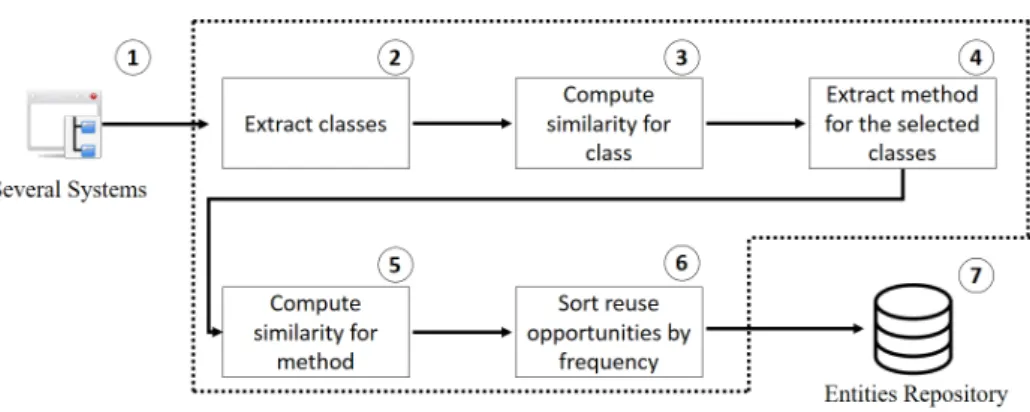
Seven steps are required by the JReuse to identify reuse opportunities as presented in Figure 3.2. The steps are described as follows.
Figure 3.2. Steps of the Method called JReuse
1. In this step, the method receives as input software systems from the data set provided by the user. These systems are supposed to belong to the same do-main. Then, the method collects all classes, filters out files that are not Java and eliminates all system projects that are Android.
2. In this step, the method identifies the class to compute the similarity between the classes entities of other systems. The method does not compare classes of the same system.
3. In this step, the JReuse compares names of classes in pairs to identify class names with at least 75% of similarity. Classes with similar names (matches) are gathered and each class name receives a score that is the number of systems in which the class occurs. The higher the score, the higher the class seems to be relevant for the analyzed domain.
3.3. Tool Support 15
5. From of each class group identified as reuse opportunities, their methods are an-alyzed with the same threshold (with at least 75%) adopted for classes. However, for a method to be considered a candidate for reuse opportunity, it is necessary that the return types of both methods are the same. The similarity calculation is performed between different systems; the method does not evaluate the similarity between the entities of a single software system.
6. After the identification of entities (classes and methods) and calculation of sim-ilarity, JReuse sortes in decreasing order by frequency of the identified reuse opportunities when necessary.
7. Finally, in this step the method JReuse builds a repository of entities as reuse opportunities. Thus, it is possible, to use the entities previously identified.
3.3
Tool Support
To automate the proposed method, we developed a prototype tool that implements JReuse for Java software systems. We selected Java because (i) it is one of the most popular programming languages, (ii) there is an available Java parser to support source code analysis by the generation of an Abstract Syntax Tree (AST), (iii) many studies have been investigating software reuse in Java systems. Through the Java parser, it is possible to access the structure of the source code, JavaDoc, and comments. It is also possible to change the AST nodes or create new ones to modify the source code, and (iv) it is one of the most popular programming languages1. In addition, to support the identification of similarly named entities (classes and methods), we used the Eclipse Java Development Tools (JDT) parser.
As input, our tool receives a set of software systems from the same domain. Second, the tool ignores all files that are not Java and all files present in test packages. Third, we discarded methods named main, since this type of method is essential in any Java system. Note that, given a system, all classes may contain a main method. In general, this method is responsible for starting the system (Rountev, 2004). Then, JReuse processes classes and methods to identify similarly named entities according to the proposed method.
JReuse provides an abstraction for the design organization of a system given a domain. In other words, the reuse opportunities identified by JReuse may be used to compose a partial design for any system that belongs to the analyzed domain in terms
16 Chapter 3. Proposed Method
of frequent classes and methods. For this purpose, the tool outputs oneCSV file. Each line of the file has (i) the name of a class identified as reuse opportunity, (ii) a method from the respective class also identified as reuse opportunity, and (iii) the absolute path of the class. The output file is sorted in decreasing order by frequency of the identified reuse opportunities.
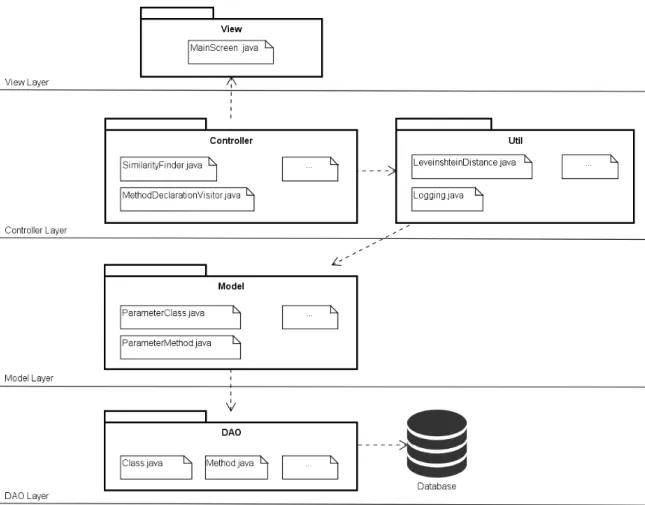
Tool Architecture: The architectural design of our tool is presented in Figure 3.3. JReuse is a plug-in for Eclipse IDE. Therefore, it shares common features from the Eclipse source code. In this figure, we present each layer of the JReuse code. TheView Layer encompasses the implementation of the graphical user interface. The Controller
Layer is responsible to manage the tool and provide the similarity computation for classes and methods. The Model Layer provides the modeling of the data base. Finally, the DAO Layer implements data persistence.
3.3. Tool Support 17
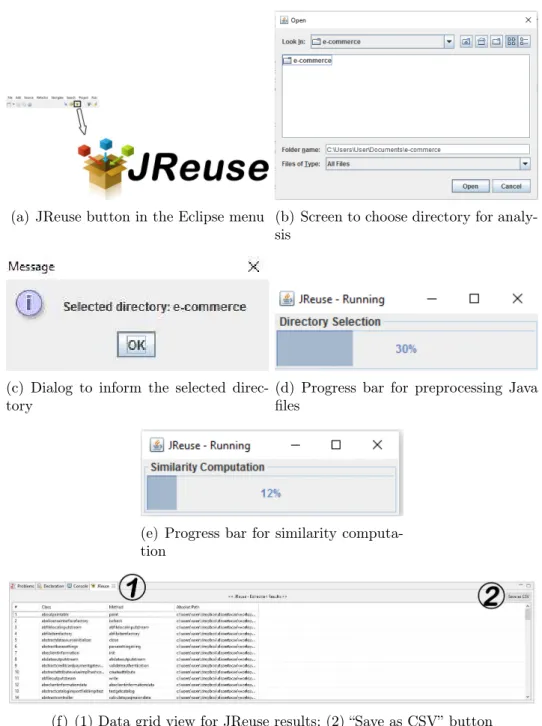
(a) JReuse button in the Eclipse menu (b) Screen to choose directory for analy-sis
(c) Dialog to inform the selected direc-tory
(d) Progress bar for preprocessing Java files
(e) Progress bar for similarity computa-tion
(f) (1) Data grid view for JReuse results; (2) “Save as CSV” button
Figure 3.4. User interface of JReuse
18 Chapter 3. Proposed Method
pointed as candidates to reuse opportunities. Finally, Figure 3.4(f) presents the data grid view to display the JReuse results of analysis.
3.4
Final Remarks
This chapter presented our method to identify and extract reuse opportunities, through the similarity analysis. The proposed method consists of two phases. First, it computes similarity between classes and methods in different software projects. Second, the method sorts the extracted reuse opportunities (classes and methods) in decreasing order of occurrence. In addition, we described the thresholds derived empirically to support the identification of similar classes and methods.
We also present, an Eclipse plug-in that implements our identification method, by describing the design and main functionalities of the method. Our tool allows developers to obtain recommendations of reuse opportunities, which can be applied in the development of new software systems.
Chapter 4
Method Evaluation
This chapter describes an evaluation adopted for analyzed the method proposed and presented in Chapter 3. We conducted an empirical evaluation through study ex-ploratory conducted in environment controlled. To perform the evaluation, we adopted the guidelines based on Wohlin et al. (2012), for this type of evaluation in Software En-gineering. The focus of our method is identify the main reuse opportunities in systems of software. Therefore, evaluation consists in analyze the reuse opportunities identified by our method JReuse.
We organized the remainder of this chapter as follows. Section 4.1 presents the study goal and the research questions we designed to guide our study. Section 4.2 describes the data set used to evaluate our method and the prototype tool, both called JReuse. Section 4.3 presents the steps adopted in the evaluation. Section 4.4 presents the results of the evaluation of the classes identified as reuse opportunities. Section 4.5 presents the results of the evaluation of the methods identified as reuse opportunities from the classs identified previously. Section 4.6 provides an overview and discusses the main lessons learned. Section 4.7 presents threats to the validity of our study. Finally, Section 4.8 concludes this chapter with final remarks.
4.1
Goal and Research Questions
In this study, we aim to assess whether JReuse is able to identify frequent classes and methods in a specific software domain. We are also interested in assessing the relevance of the results provided by our method. For this purpose, we chose four domains to be evaluated: accounting, hospital, restaurant, and e-commerce. We also formulated the two research questions (RQs) to guide our study.
20 Chapter 4. Method Evaluation
RQ1 What are the most frequent classes in software systems for each selected domain? And how are they distributed through systems?
RQ2 What are the most frequent methods in the classes identified by the method? And how are they distributed through these classes?
Through RQ1 and RQ2 , we are interested in investigating whether the most frequent identified classes and methods are indicated for software systems for the re-spective domain. We expect that JReuse is able to provide a list of classes and methods whose recommendations for reuse are relevant for the respective domains.
4.2
Data Set
To evaluate our method, we chose only systems from the domain of accounting, hospital, restaurant, and e-commerce, for several reasons. First, software systems from these domains encompass several business features, such as user personnel, financial, product, and service management. Second, there is a significant number of domain systems available for download in GitHub1. Third, from the viewpoint of the authors, the four domains we chose are well-defined in terms of requirements and we believe that it would be possible to find reuse opportunities among systems of these domains.
The systems that compose our data set were extracted from GitHub repositories. We performed the selection of systems for the e-commerce domain in January 2015 and in May 2016 for the other domains. We selected software systems are based on the ranking of starred systems and system length in terms of storage space. In GitHub, stars are a meaningful measure for repository popularity among the platform users, and may be used to support the selection of systems.
There is a diverse terminology to represent a same software domain. For instance, we may refer to thee-commerce domain as ecommerce, without hyphenation. In order to support the collection of software systems to compose our data set, we developed an algorithm to clone GitHub repositories individually, with the respective systems, based on a well-defined search string for each domain under analysis in this study. Since the goal of our study is to identify reuse opportunities from different software systems, given large system sets per domain, we defined the following search strings.
For e-commerce: e-commerce ORecommerce OR electronic commerce
For restaurant: restaurant OReatery ORrestaurants
4.2. Data Set 21
For hospital: hospital ORinfirmary OR lazaretto
For accountancy: accountancy ORaccounting
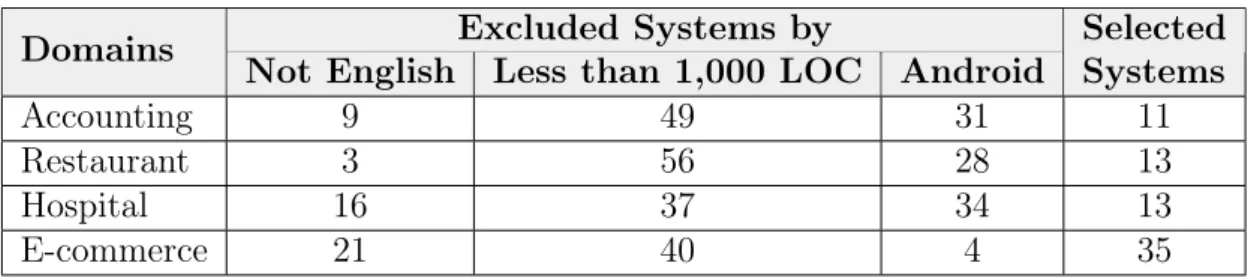
Table 4.1 presents the exclusion criteria applied in the selected systems. First, we collected 400 Java systems from GitHub, 100 for each domain in order descending sorted by stars. Then, we discarded systems according to the following exclusion criteria: (i) non-Java software systems, since GitHub do not verify automatically the main programming languages of the systems, (ii) Java projects developed for Android platform, because Android systems tend to have a different architectural design and code implementation when compared with traditional Java systems, (iii) systems with less than 1,000 lines of code (LOC), and (iv) systems written in other languages rather than English, since our method relies on a lexical similarity technique and, then, natural language may impact significantly the results provided by our method.
Table 4.1. Filters that were applied to the data set Excluded Systems by
Domains
Not English Less than 1,000 LOC Android
Selected Systems
Accounting 9 49 31 11
Restaurant 3 56 28 13
Hospital 16 37 34 13
E-commerce 21 40 4 35
For each selected system, we considered only the last release. This process was necessary to discard different versions of the same system, which probably contain lots of similarly named classes and methods. Finally, we obtained in 72 Java systems for evaluation of the JReuse method.
To better characterize systems in the four domains, Figures 4.1, 4.2, and 4.3 presents software metrics for systems per domain: lines of code (LOC), number of classes (NOC), and number of methods (NOM), respectively. We plotted twelve box-plots, one for each metric. However, because of the heterogeneity of the sample of our data set, we decided to eliminate ”outliers” for each metric. Therefore, all boxplots presented a brief overview of each analyzed domain.
22 Chapter 4. Method Evaluation
domain, the mean is 4,964 and the median is 2,534 of LOC. Although these values are smaller than the obtained values for the other domains, it remains significant for the study. Finally, with respect to the e-commerce domain, we observe a mean LOC of 46,100 and a median of 3,730. In general, systems from this domain have the highest numbers of LOC and, therefore, they may have several reuse opportunities.
Figure 4.1. LOC of Sytems per Domain
Let us consider Figure 4.2 in the following analysis of NOC. With respect to the accounting domain, note that the mean of NOC for the systems is 35.73. Furthermore, the median is 18, i.e., half of the accounting systems has at least 18 classes. This number is significant for analysis because we are interested in finding similarly named classes within a pairwise comparison. Therefore, we expect a comparison of 18∗18 = 324
4.2. Data Set 23
NOC is 37.23. In addition, the median is 40. Again, we conclude that these systems have a significant NOC for analysis. For the hospital domain, the mean is 33.85 and the median is 25 of NOC. Finally, with respect to the e-commerce domain, we observe a mean NOC of 368.9 and a median of 45.5. In general, systems from this domain has the highest numbers of NOC and, therefore, there is a significant possibility of identifying reuse opportunities.
Figure 4.2. NOC of Sytems per Domain
24 Chapter 4. Method Evaluation
a comparison of196∗196 = 38,416pairs that may be identified as reuse opportunities. Considering the restaurant domain, the mean of NOM is 162.4 and the median is 159. Again, we conclude that these system have a significant NOM for analysis. For the hospital domain, the mean is 192.2 and the median is 90 methods. At last, with respect to the e-commerce domain, we observe a mean NOM of 1,683 and a median of 175.5. That is, the highest number of methods for analysis considering the four selected domains.
4.3. Evaluation Steps 25
4.3
Evaluation Steps
Figure 4.4 presents the three study steps we followed to investigate the research ques-tions described in Section 4.1. Each step is described as below.
Figure 4.4. Designed an Exploratory Study
Step 1: Automated Search – By using the search strings described in Section 4.2, we cloned from GitHub several software systems, belonging to different domains. We intended to identify appropriate domains to be analyzed in our exploratory study. For this purpose, we considered a domain as appropriate when, from our viewpoint, systems from the given domain contain a significant number of classes and methods for analysis. After performing the search for systems, with support of our algorithm, we obtained 400 software systems from four distinct domains: accounting, restaurant, hospital, and e-commerce.
Step 2: Exclusion Criteria – By applying a set of exclusion criteria defined by the authors, we select the systems according to with the following requirements: (i) software systems written only in English, (ii) software systems with more than 1,000 lines of source code, and (iii) traditional Java software systems, i.e, software that are not exclusive to the Android platform. After applying the exclusion criteria, 72 different software systems remained for analysis.
Step 3: Detection of Similarly Named Classes – We executed the JReuse prototype tool for the 72 collected systems. Per domain, the respective systems were submitted to JReuse for extraction of reuse opportunities. After the automated analysis for each domain, JReuse provided a list with the most frequent classes that occur in the given domain.
26 Chapter 4. Method Evaluation
classes, sorted by relevance, with the main classes identified as reuse opportunities. In this step, JReuse complements such list with methods identified as reuse opportunities. That is, the previously obtained list of reuse opportunities is completed with the most frequent methods for the identified classes.
4.4
Results of Frequent Classes
This section presents and discusses the study results aiming to answer our first research question. For this question, we discuss the results obtained with respect to the four domains under analysis: accounting, restaurant, hospital, and e-commerce.
RQ1 What are the most frequent classes in software systems for each selected domain? And how are they distributed through systems?
In this study, we analyzed the frequency of similarly named classes for the systems of each domain. Table 4.2 presents software metrics for systems per domain: lines of code (LOC), number of classes (NOC), and number of methods (NOM). This table categorizes NOC and NOM in two types: (i) analyzed, i.e., the number of entities analyzed by the tool and (ii) recommended, that is, entities identified by the tool as reuse opportunities.
In general, from Table 4.2 we observe that JReuse identified a smaller number of methods than classes as reuse opportunities. For instance, for domain e-commerce, JReuse identified 75 classes and 28 methods as reuse opportunities. One of the reasons for this results is that the similarity computation of JReuse for methods is more strict than for classes. Thus, the proposed method aims to avoid the recommendation of methods with similar names but different responsibilities. For this purpose, JReuse compares the return type of similarly named methods. As an example, if a pair of similar methods has the same return type, then they are considered as the same reuse opportunities. Otherwise, both methods are considered different.
Table 4.2. Software metrics for systems from each domain
NOC NOM
Domains Systems LOC
Analyzed mendedRecom- Analyzed mended
Recom-Accounting 11 95,588 493 25 2,900 21
Restaurant 13 44,813 484 17 2,111 20
Hospital 13 65,297 446 21 2,516 20
E-commerce 35 1,567.337 12,598 75 57,017 28
4.4. Results of Frequent Classes 27
we discarded classes that occur in a maximum of two different systems. This decision was taken because our method compares classes in pairs and, then, 3 occurrences may not be significant to a reuse recommendation. We selected the top-ten most frequent classes of each domain, as presented in Figures 4.3, 4.4, 4.5, and 4.6. We submitted the list of most frequent entities to a group of 4 researchers at Software Engineering Laboratory (LabSoft) from Federal University of Minas Gerais (UFMG), for validation of the entities with respect to relevance.
Tables 4.3, 4.4, 4.5, and 4.6 present classes identified as reuse opportunities for e-commerce, accounting, restaurant, and hospital, respectively. We selected only the classes with at least 15% 2 occurrences in the systems of the respective domain. Each table has a “Domain-Specific” field. This field indicates the viewpoint of the focal group regarding a given entity to be specific for the analyzed domain. The focal group’s viewpoint is represented by three symbols in table: (i) the (X) symbol indicates that
the focal group agreed that the class is specific for the domain under analysis, (ii) the (✗) symbol indicates that the focal group disagreed that the class is indicated for the domain, and (iii) blank field (Unconfirmed) indicates that the focal group did not converge to a specific opinion on the class. Moreover, each table has a “Labels” filed to inform the level of relevance of the entity identified by JReuse as reuse opportunity.
Scale to Indicate the Level of Relevance of the Entities Identified. To support the identification of the most recommended classes and methods for each domain, Figure 4.5 shows a scale from 0% to 100% that represents the level of relevance to recommend an entity based on frequency of classes and methods identified as reuse opportunity. The thresholds 0% and 50% determine two labels for level of relevance, namely weak and strong. The weak label (from 0% to 50%) indicates that the class is weakly or moderately recommended as reuse given a domain. Finally, the strong label (from 50% to 100%) indicates that the class is highly recommended as reuse.
Figure 4.5. Scale of relevance to entity identified as reuse opportunity
2The percentage is arbitrary, i.e. can be adapted for domains with more or with less systems for
28 Chapter 4. Method Evaluation
With respect to the accounting domain, presented in Table 4.3. For this domain, the classes from Usersto TransactionManager belong to thestrong label and, there-fore, they are the highly recommended classes for accounting systems. Note that, in the other hand, the focal group did not consider the classesUsers, DatabaseConnection, and Util as specific classes for the accounting domain. In addition, the classes from AddFinancialsAction to RawMaterial belong to the weak label. The remainder classes have exactly 2 or 3 occurrences in different systems from the accounting domain. Therefore, they are weakly recommended and were omitted from this table.
Table 4.3. Classes with at least 15% occurrences in the accounting domain
Labels Classes Frequency % of systems DomainSpecific
Users 13 100% ✗
DatabaseConnection 13 100% ✗
CashFlow 11 85% X
Util 10 77% ✗
BalancesAssets 9 69% X
CashBanks 9 69% X
ShareholderEquity 9 69% X
BalancesLiabilities 8 62% X
ChartAccounts 8 62% X
AccountingMovement 8 62% X
AccountsReceivable 8 62% X
AccountsPayable 6 46% X
Transactions 7 54% X
Log 7 54% ✗
FinancialReportsPoeHelper 7 54% ✗
InventoryManager 7 54% X
Strong
TransactionManager 7 54% X
AddFinancialsAction 6 46% X
Accounts 6 46% X
FeaturesAnalysis 6 46% X
Weak
RawMaterial 6 46% X
Key: Agree (X) and Disagree (✗)
4.4. Results of Frequent Classes 29
Figure 4.6. Distribution of frequent classes through accounting systems
With respect to the restaurant domain, let us consider Table 4.4. The classes LoginandUserbelong to thestrong label. Note that they are not considered as specific classes from the given domain considering the focal group’s viewpoint. However, they are relevant in restaurant systems. In addition, the classes fromClienttoOrderbelong to the strong label and are relevants for this domain, considering the focal group’s viewpoint. Many of them were pointed as reuse opportunities for restaurant systems by the focal group, such as RestaurantMenu, Delivery, andCustomes. Moreover, this entities belong to the weak
Table 4.4. Classes with at least 15% occurrences in the restaurant domain
Labels Classes Frequency % of systems DomainSpecific
Login 10 77% ✗
User 10 77% ✗
ConnectionManager 9 70% ✗
Client 9 70% X
Table 8 62% X
PaymentType 8 62% X
Dish 8 62% X
Employee 7 54% X
Strong
Order 7 54% X
RestaurantMenu 6 47% X
Delivery 6 47% X
ItemOrdered 6 47% X
Weak
Customer 4 31% X
30 Chapter 4. Method Evaluation
Regarding the analysis of the restaurant domain, Figure 4.7 presents the top-ten classes with higher occurrence, namelyLogin,User,ConnectionManager,Client, Table, PaymentType, Dish, Employee, Order, and RestaurantMenu. These classes have an high to medium level for recommendation according to the scale from Fig-ure 4.5. The classes with the highest occurrences in this domain areLogin and User, respectively. Both are present in 77% of the analyzed information systems. Neverthe-less, they are not specific classes of restaurant systems. However, JReuse identified some frequent classes such asClient,Table, PaymentType, and Dish.
Figure 4.7. Distribution of frequent classes through restaurant systems
4.4. Results of Frequent Classes 31
Table 4.5. Classes with at least 15% occurrences in the hospital domain
Label Classes Frequency % of systems DomainSpecific
Patient 13 100% X
Doctor 13 100% X
Disease 11 85% X
User 10 77% ✗
Login 9 69% ✗
Diagnose 9 69% X
Symptoms 9 69% X
PatientDisease 8 62% X
HealthPlan 8 62% X
Immunology 8 62% X
Haematology 8 62% X
Medication 7 54% X
Surgery 7 54% X
MedicalRecords 7 54% X
TypePayment 7 54%
Strong
Microbiology 7 54% X
PatientCondition 6 46% X
LaboratoryExams 6 46% X
Log 6 46% ✗
HistoPathology 6 46% X
Connection 6 46% ✗
Paycash 5 38%
Util 5 38% ✗
Weak
OperationsWithCards 3 23%
Key: Agree (X), Disagree (✗), and Unconfirmed (field blank)
Figure 4.8 presents the most frequent classes identified for the hospital domain, in decreasing order of frequency. For the 13 systems we collected from this domain, JReuse extracted some relevant entities, such as Patient, Doctor, and Disease, from the focal group’s point of view. The classes presented in this figure belong to the
32 Chapter 4. Method Evaluation
Figure 4.8. Distribution of frequent classes through hospital systems
Let us consider Table 4.6 regarding the e-commerce domain in the following dis-cussion. Note that the classes Product to ClientDao belong to the strong label, ac-cording to Figure 4.5. That is, they are highly recommended classes for e-commerce systems, because they are present in more than 50% of the analyzed systems. In addi-tion, the classes Item toShoppingCartService are the weakly recommended classes. As aforementioned, classes with less than 15% of the occurrences were omitted.
Table 4.6. Classes with at least 15% occurrences in the e-commerce domain
Labels Classes Frequency % of systems Domain Specific
Product 28 80% X
PaymentType 24 69% X
Client 20 58% X
ProductDao 18 52% X
Strong
ClientDao 18 52% X
Item 17 49% X
ShoppingCart 17 49% X
User 17 49% ✗
Customer 14 40% X
Category 12 35% X
Weak
ProductService 10 29% X
Order 9 26% X
LoginController 7 20% ✗
UserDao 6 18% X
ProductServiceImpl 6 18% X
ShoppingCartController 6 18% X
OrderedProduct 5 15% X
ShoppingCartService 5 15% X
4.5. Results of Frequent Methods 33
Finally, Figure 4.9 presents the top-ten most frequent classes for e-commerce systems. We sorted the classes in decreasing order of frequency. The most frequent entities are, respectively, Product, PaymentType, Client, ProductDao, ClientDao, Item, ShoppingCart, User, Customer, and Category. Note that, according to the focal group the classes Product, Payment, ShoppingCart, Customer, and Client are elementary entities to be expected in an e-commerce system. In turn, although User is one of the most frequent classes identified by JReuse (49% of the systems contain this class), User is not specific of the e-commerce domain. However, this entity is meaningful for information systems in general.
Figure 4.9. Distribution of frequent classes through e-commerce systems
4.5
Results of Frequent Methods
This section presents and discusses the results for of the methods identified from of top-ten most frequent classes, presented in first research question.
RQ2 What are the most frequent methods considering the similarly named classes iden-tified by the method? And how are they distributed through these classes?
34 Chapter 4. Method Evaluation
present the principal methods of each domain, we adopted the following exclusion criteria. We discarded methods that does not appear in more than 2 classes from different systems. We discarded also methods namedmain, because this type of method is essential in any Java system (Rountev, 2004).
To support a discussion of RQ2 for each domain under analysis, Tables 4.10, 4.7, 4.8, and 4.9 present the most frequent methods for the top-ten most frequent classes with respect to the accounting, restaurant, hospital, and e-commerce domain, respectively. To support the identification of the most frequent methods for each domain, we use the same labels presented in Section 4.4. Each table is signed with two symbols: (i) the (X) symbol that indicates the focus group agreed that the method
should belong to a given class and (ii) the (✗) symbol that indicates the focus group disagree that a method belongs to a given class.
Considering the accounting domain for analysis, Table 4.7 presents the methods identified as reuse opportunity for the top-ten most frequent classes. The classes with at least 10 methods identified as reuse opportunities are AccountingMoviment and BalancesLiability. They contain 13 and 12 identified methods, respectively. We observe that both are relevant in the accounting domain, from the viewpoint of the focal group. Through Table 4.7, we may observe methods that may be strongly recommended as reuse opportunities (see Figure 4.5). As as example,calculatePayment appears in
4.5. Results of Frequent Methods 35
Table 4.7. Methods most often identified from of most common classes among the accounting domain systems.
Methods Classes A ccoun tingMo v emen t
BalancesLiabilities BalancesAssets CashBanks CashFlo
w ChartA cco un ts Util ShareHolderEquit y Users DatabaseConnection
execute 29%✗ 50%✗ 19%✗ 89%X
calculatePayment 100%X 67%✗
addTrans 100%X 50%✗ 58%X 58%✗ 50%X 37%✗ 23%✗
calcDuplicates 50%X 34%X 58%X 58%X 63%X 67%✗ 50%X
update 50%X 67%X 72%X 50%X
generateReport 34%X 34%X 29%X 63%X
deleteById 67%X 50%X 72%X 43%X 38%X 50%✗
convertToCsv 63%X
findByName 67%X 67%X 43%X 43%X 38%X 50%✗ 34%X 28%X
othersValues 50%✗ 50%✗ 43%✗ 58%✗ 38%✗ 34%✗
checkPayment 50%X 34%✗ 50%X
generateXls 34%X 29%X 50%X 34%X
makePay 67%X 34%✗ 58%X
salesValues 50%X 67%X
validateInput 50%X 50%X 29%X 43%X 50%X 50%✗ 25%X 67%✗ 19%X 34%✗
inventoryUtil 34%✗ 50%X
printFile 34%✗ 50%X
print 38%X
validateCheckPayment 50%X
parseDateToString 43%✗
printCustDebt 25%✗
Key: Agree (X) and Disagree (✗)
36 Chapter 4. Method Evaluation
Table 4.8. Methods most often identified from of most common classes among the restaurant domain systems.
Methods
Classes
T
able
Order Dish Pa
ymen tT yp e Restauran tMen u User Clien t Login Emplo y ee ConnectionManager
search 75%X 43%X 75%X 75%X 100%X 70%X 100%X 70%✗ 100%X 67%✗ insert 38%X 86%X 38%X 100%X 34%X 70%X 100%X 100%X remove 100%X 86%X 75%X 38%X 67%X 60%X 78%X 70%X 100%X
login 80%X
calculate 63%✗ 88%✗
validationUser 70%X 50%X
insertFood 63%X 100%X 100%X
disableUser 70%✗
editReserve 63%X 86%X deleteTable 75%X
generateBills 75%X 58%X 63%✗ 75%X
consultCode 25%✗ 72%✗ 63%X 100%X
updatePosition 63%X 72%✗
cancelReservation 63%X 29%✗ 25%✗ reserveTable 63%X 43%✗
removeObservation 50%✗ 72%✗ 63%✗ 38%✗ 40%✗ 56%✗
updateMenu 58%✗ 84%X
insertRequest 58%X
calculateAll 50%X 50%X
lastOrder 25%X 29%✗
Key: Agree (X) and Disagree (✗)
Table 4.9 presents the methods obtained from the top-ten most frequent classes from hospital domain. The classes with at least 10 types methods identified as reuse opportunities are Patient, Diagnose, Disease, and PatientDisease. They have16,
11, 10, and 10 identified methods, respectively. Methods such as verifyPathology, findPatient, andvalidatePatient are relevant for the given context, from the view-point of the focal group. For instance, the method verifyPathoogy is present in
4.5. Results of Frequent Methods 37
Table 4.9. Methods most often identified from of most common classes among the hospital domain systems.
Methods
Classes
P
atien
t
Diagnose Disease Patien
tDisease HealthPlan Do cto r Symptoms Imm un o lo gy User Login
deleteData 47%X 78%X 37%X 88%X 75%X 54%X 78%X 63%X 80%X 34%✗ verifyPathology 39%✗ 45%X 73%X 75%X 67%X
findPatient 54%✗ 63%✗ 31%X
registerDisease 24%✗ 56%✗ 64%X 50%X 63%✗ 31%X 38%✗ insertPatient 54%✗
anamnesis 54%✗ 38%✗
saveData 47%X 56%X 37%X 75%X 88%X 39%X 67%X 63%X 50%X 34%✗ updateData 47%X 78%X 37%X 75%X 88%X 39%X 67%X 63%X 70%X 34%✗
symptoms 16%✗ 56%X 55%X 38%X 78%X
diagnosisPerformed 55%✗ 31%X
bloodGroup 47%X 45%✗ 50%✗
sonography 16%✗ 23%✗ 28%✗ 38%✗ 75%✗ 24%X
patientProfile 39%X 38%✗
insertCoagulation 39%✗ 34%✗ 25%✗ 23%✗
fetchDetail 16%✗ 23%X 19%X 50%X 63%✗ 23%✗ 25%X
authorizeUser 40%✗
scheduling 31%X
insertBlood 34%✗ 37%✗ 25%✗
sons 24%X 38%✗
validatePatient 24%X
Key: Agree (X) and Disagree (✗)
Given the e-commerce domain, let us consider Table 4.10 for analyze the meth-ods obtained from the top-ten most frequent classes. The classes with at least 10
types methods identified as reuse opportunities are Product,Customer, Item, Client PaymentType, User, and ShoppingCart, respectively. They have 15, 12, 12, 12, 11,
38 Chapter 4. Method Evaluation
Table 4.10. Methods most often identified from of most common classes among the e-commerce domain systems
Methods
Classes
Pro
duct
Customer Item Clien
t P a ymen tT yp e
User ShoppingCart Pro
ductDao Clien tD a o Category
addCustomerAddress 36%X
alter 61%X 58%X 100%X80%X 63%X 30%X 48%X 89%X 89%X 59%X
buy 10%X 67%X
calculateSubtotal 8%✗ 18%✗ 25%X
calculateTotal 22%✗ 12%✗ 50%✗ 48%X 12%✗
changePassword 59%X
changeStock 68%✗ 46%✗ 65%X 45%✗
checkout 15%✗ 77%X
cities 25%✗
delete 68%X 79%X 95%X 65%X 59%X 83%X 71%X 89%X 78%X 59%X
findByCategory 29%✗ 62%X 67%✗
findByEmail 50%✗ 15%✗
login 50%X 100%X
moveitemToCart 11%✗ 48%✗ 30%X
moveListToCart 8%✗ 42%✗
password 15%X 100%✗ 62%X
processRegister 40%✗ 53%✗ 30%X 39%✗
processUpdateAccount 29%✗ 10%✗ 53%X
productList 72%✗ 55%✗ 62%✗
register 61%X 86%X 89%X 100%X71%X 77%X 53%X 95%X 78%X 67%X removeCustomerAddress 36%X
resetPassword 89%X
reviewItem 48%X
save 29%X 36%X 83%X 25%X 25%X 77%X 65%X 45%X 39%X 75%X
shoppingCartItem 11%✗ 71%✗ 89%X
update 58%X 79%X 71%X 65%X 55%X 95%X 48%X 34%X 17%X 75%X
validateAddress 15%X 20%X 12%✗
validatePobox 43%X 25%X
Key: Agree (X) and Disagree (✗)
The method productList, for example, appears in 72% of the Product classes (i.e., a strong level of recommendation, according to Figure 4.5), against 55% and