Int J Anat Res 2014, 2(2):431-33. ISSN 2321-4287 431 Case Report
ELONGATED STYLOID PROCESS: A REPORT OF TW O CADAVERIC
CASES
Komala Nanjundaiah *
1, Radhika. P.M
2, Veena Vidya Shankar
3, Prathap K J
4.
ABSTRACT
Address for Correspondence: Dr Kom ala N, Associat e Professor, Depart m ent of Anat omy, M .S.Ramaiah M edical College, M .S.R.I.T Post , Bangalore, Karnataka, India - 560054.
Phone: 9480259177, 080-23421593. E-M ail: [email protected]
Access this Article online
Quick Response code Web site:
* 1 Associate Professor, 2 Assistant Professor, 3 Associate Professor, 4 Assistant Professor.
Depart ment of Anat omy, M .S.Ramaiah M edical College, Bangalore. Karnataka, India.
Int roduction:St yloid process is a part of t em poral bone. It m easures 2 t o 3 cm s in lengt h and lies ant ero-m edial t o t he m ast oid process. An elongat ed st yloid process can com press t he vital vessels and nerves close t o it . This can lead t o pain, foreign body sensat ion in t he pharyngeal region and can also cause dysphagia.
Observation: During rout ine dissect ion, w e encount ered elongat ed st yloid process in t w o cadavers. In one it w as unilat eral and in anot her it w as bilat eral. The m easurem ent s of t he elongat ed st yloid process w ere taken using digital Vernier slide calipers.
Conclusion:The aw areness of t he em bryological cause and t he clinical im plicat ions of an elongat ed st yloid process are im por tant for accurat e diagnosis and t reat m ent
KEYW ORDS:Elongat ed st yloid process, Com pression, Dysphagia, Cervical pain, Eagle’s syndrom e.
INTRODUCTION
Int ernat ional Journal of Anatomy and Research, Int J Anat Res 2014, Vol 2(2):431-33. ISSN 2321- 4287
Received: 04 June 2014
Peer Review : 04 June 2014 Published (O):30 June 2014 Accepted: 18 June 2014 Published (P):30 June 2014 Internat ional Journal of Anat omy and Research
ISSN 2321-4287 w w w.ijmhr.org/ ijar.ht m
St yloid process of temporal bone is a slender project ion measuring 2 t o 3 cms in lengt h w hich lies antero-medial t o t he mast oid process. The t ip of the styloid process is of surgical importance because vital st ruct ures such as external carot id ar t er y, i n t er n al j u gu lar v ei n, f aci al n er ve, glossopharyngeal ner ve, t he accessor y and vagus nerves are in m edial relat ion w it h t he st yloid process. The st ruct ures attached t o it are st y l o ph ar yn geus, st y l ohyo id , st y l ogl o ssu s m u scl es; st y l o hyo i d an d st y lo m and i b ul ar ligament s. The process is covered by the parot id gland laterally [1]. The elongated st yloid process can be accom panied by calcificat ion of t he st ylohyoid and st ylomandibular ligament s. This can lead t o sym pt om s such as dysphagia, odynophagia, facial pain, ear pain, headache,
t innit us and t rism us. This set of sym pt om s associated w it h t he elongated st yloid process is called Eagle’s syndrome. The clinical feat ures of t he elo n gat ed st y lo i d p r o cess w er e f i rst described by Eagle. Later he described t he t w o dist inct syndromes associated w it h anomalous grow th of the st yloid process: t he st yloid process sy nd r o m e and t he caro t i d ar t er y syndrome[2,3,4].
Int J Anat Res 2014, 2(2):431-33. ISSN 2321-4287 432
Komala Nanjundaiah et al., ELONGATED STYLOID PROCESS: A REPORT OF TWO CADAVERIC CASES.
OBSERVATIONS
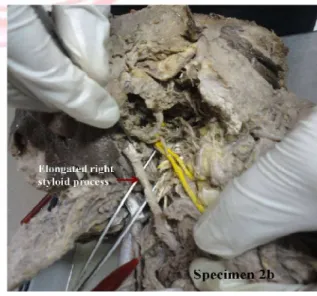
Dur ing rout ine dissect ion, w e encount ered elongated st yloid process in t w o cadavers aged around 55 – 60 years. One was a male cadaver (Specimen 1) in w hich t he elongat ion was found on t he right side. The st yloid process on t he left side was normal. In anot her cadaver w hich was a female, (Specimen 2a, 2b) t he elongated styloid process w as seen bilaterally. The lengt h and t hickness of t he elongat ed st yloid processess w ere m easured using a digit al Ver nier slide calipers and t he same w ere tabulated.(Table -1)
Table 1:M easurem ent s of t he elongat ed st yloid process. Specimen 1: unilat eral elongat ed st yloid process on t he
right side. The probe is at t he t ip of t he st yloid process.
Specimen 2a, 2b: Bi lat eral elongat ed st yloid process.. The probe is at t he t ip of t he st yloid process.
In a study of 2000 cases, t here were only 11 cases (0.55%) of st yloid process having lengt h of more t han 4 cm[12]. Harma gives an incidence of 4-7% of elongated st yloid process[13].
Reichert ’s cart ilage of second branchial arch gives r ise t o t he st yloid process, st ylohyoid ligament, the lesser cornu and upper half of body o f t h e hyo id b on e. Em b r yo l o gi call y, t h e st ylohyoid chain extends bet w een t he temporal bone and t he hyoid bone. It can be divided int o t ympanohyal, st ylohyal, cerat ohyal, hypophyal part s. Tympanohyal and st ylohyal part s form t he st ylo hyo id pr ocess. Cerat ohyal- f or m s t he st ylohyoid ligament and Hypophyal forms t he lesser cornu horn of t he hyoid bone[14].
Elongat ion of st yloid process can be congenital in origin. The mechanical st resses w hich occur during t he fetal development causes st retching o f t h e seco n d b r anch i al arch (Rei ch er t ’s cart ilage) w hich leads t o t he elongat ion[15].
St yloid ligament has a potent ial for ossificat ion. Varying degrees of ossificat ion of t he st ylohyoid cart ilage causeselongat ion of st yloid process. DISCUSSION
The lengt h of st yloid process in various st udies ranged from 0.7 cm t o 4 cm. [5,6,7,8,9] Jung et al su ggest ed t h at t h e st y lo i d p r o cess i s elongated, w hen it s lengt h exceeds 45 mm[10]. Keur et al stated t hat , if t he lengt h of t he process or t he mineralised part of ligament s as seen in radiographs was 30 mm or more can be called an elongated st yloid process[11].
Base M idway between base and tip Tip
Specimen 1
(M ale) Right side 45.28mm 4.08mm 4.05mm 1.78mm
Specimen 2b
(Female)
Specimen Side Length
Thickness at
Left side 58mm 6.44mm 3.99mm 2.84mm
Specimen 2a
(Female)
Int J Anat Res 2014, 2(2):431-33. ISSN 2321-4287 433
Komala Nanjundaiah et al., ELONGATED STYLOID PROCESS: A REPORT OF TWO CADAVERIC CASES.
Trauma can cause ossificat ion at t he end of t he styloid process dow n t he length of t he st ylohyoid ligament . An abnormal healing after t he t rauma can also init iate t he calcificat ion process. Even i n t h e ab sen ce o f reco gn i sab l e t r aum a, ossification and elongat ion of the st yloid process can exist as an anat omical variant [16].
The increase in t he lengt h of t he st yloid process has clinical significance. Thot et al st ressed t hat elongat ion of st yloid process alone may not be a risk fact or, but deviat ion of t he elongat ed process ant er ior ly and m edially causes t he sympt oms of Eagle’s syndrome [6]. M ost of t he pat ient s have classical sym pt om s of Eagle’s syndrome but some pat ient s may have localized pain or pain radiat ing t o jaw and ear w hich sim u l at es p ai n o f d en t al or i gin [ 15] . Th e neurological sympt oms seen in Eagle’s syndrome can b e d u e t o t h e ap p r oxi m at i o n o f t h e glossopharyngeal nerve w it h t he st ylohyoid ligament [17]. Elongated st yloid process can also cause t r an si en t i shaem ic at t ack d u e t o compression of internal carot id artery[18].It has been reported that elongated styloid process can also cause difficult y during int ubat ion[19].
If digital palpat ion of t he st yloid process in t he t onsillar fossae increase t he pain and inject ion of an anaest het ic agent int o t he t onsillar fossae provides relief of pain, it is suggest ive of Eagle’s syndrome. The t reat ment for Eagle’s syndrome is surgical rem o val of t he calcif ied st yl oid process[20].
CONCLUSION
The awareness of the incidence of t he elongated st yloid process is essent ial for a surgeon, t o evaluate a pat ient w it h hist ory of cervical pain. The know ledge of t he embryology of t he st yloid apparat us and t he st ruct ures related t o it helps in proper diagnosis and t reat ment of Eagle’s syndrome. In addit ion t o clinical diagnosis t he presence of elongated st yloid process can also be confirmed by radiographs.
Conflicts of Interests: None
REFERENCES
[ 2 ] . Eagle W W. El o n gat ed st ylo id p r o cess: f u r t h er o bser vat io ns and a new syndro m e. Ar ch Ot o lar yn go l 1948; 47:630-40.
[3]. Baddo ur HM , M cAnear JT, Tilso n HB. Eagle’s syndrom e. Re p o r t o f a case . Or al Su r g Or al M ed Or al Pat h o l 1978;46:486–494.
[4]. W inkler S, Sam m art ino FJ Sr, Sam m art ino FJ Jr, M o nari JH. St ylo hyo id syndrom e. Repo rt of a case. Oral Surg Oral M ed Oral Pat hol 1981; 51(2):215–217.
[5]. Kauf m an SM , Elzay RP, Irish EF. St yloid process variat io n. Radio lo gic and clin ical st u dy. Arch Ot o lar yngo l 1 970; 91:460–463.
[ 6 ] . Th o t B, Re vel S, M o h an d as R, Rao AV, Ku m ar A. Eagle’syndrom e. Anat omy of t he st yloid process. Indian J Dent Res 2000; 11(2):65-70.
[ 7] . Chand ler JR. Anat o m ical var iat io n s o f t he st ylo hyo id co m plex and t heir clinical signiûcance. The Lar yngosco pe 1977; 87(10):1692–1701.
[ 8] . Fer rar io VF, Sigurt a D, Daddo na A, Dallo ca L, M iani A, Ta f u r o F, Sf o r za C. Ca lci û ca t io n o f t h e st ylo hyo id li gam e n t : in cid e n ce an d m o r p h o q u a n t i t at i ve evalu at io n s. Or al Su r g Or al M ed Or al Pat h o l 1 9 9 0 ; 69:524–9.
[9]. Zaki H S, Gr eco C M , Rudy T E, Kubinski J A. Elo ngat ed st yloid process in a t em po rom andibular diso rder sam ple: p r eva len ce a n d t r ea t m e n t o u t co m e . J Pr o st h et Dent 1996;75(4):399–405.
[ 10]. Jung T, Tschenit schek H, Hippen H, Schneider, Borchers L. Elo ngat ed st yloid process: when is it really elongat ed?. Dent om axillo facial Radiol 2004; 33:119-24.
[11]. Keur JJ, Cam pbell JP, M cCar t hy JF, Ralph WJ. The clinical signif icance o f t he elo ngat ed st ylo id pro cess.Oral Surg Oral M ed Oral Pat hol 1986;61(4):399-404.
[ 12 ] . M assey EW, W ayne, Bet h esd a. Facial p ain f ro m an elongat ed st yloid process. (Eagles syndrom e). Sout h M ed J.1978; 7 1(9): 1156–1158.
[13]. Harm a R. St ylalgia: clinical experiences o f 52 cases. Act a Ot olar yngol. 1966; 224: 149.
[ 1 4 ] . M ago t r a R, Ra zd a n S. Elo n gat ed St yl o id Pr o cess: Anat o m ical Var iat io ns. JK Science: Jo ur nal o f M edical Educat ion & Research. 2008; 20: 203–5.
[15]. Das S, Suhaim i FH, Ot hm an F, Lat iff AA. Anom alous st ylo id p r o cess a n d it s cl in ical im p lica t io n s. Br at isl Lek List y.2008; 109(1)31-33.
[ 1 6 ] . St ein m an n EP. St y lo id syn d r o m e in ab sen ce o f an elongat ed process. Act a Ot o lar yngol 1968; 66:347-56. [17]. So h K B. The glo ssophar yngeal ner ve, glo ssophar yngeal
neuralgia and t he Eagle’s syndrom e — cur rent co ncept s and m anagem ent . Singapo re M ed J 1999; 40(10):659-65.
[ 18] . Chuang W C, Sho rt JH, M cKinney AM , Anker L, Knoll B, M cKin n ey ZJ. Rever sib le lef t h em isp h e r ic isch em ia secondar y t o caro t id co m pr essio n in Eagle syndro m e: su rgical and CT angio graphic co r r elat io n. AJNR Am J Neuroradio l. 2007; 28(1):143-45.
[19]. Kawai T, Shim ozat o K, Ochiai S. Elo ngat ed st yloid process as a cause o f difficult int ubat io n. J Oral M axillo fac Surg. 1990;48(11):1225-8.
[ 20] . Eagle WW. The sym pt o m s, diagno sis and t reat m ent o f t he elo ngat ed st yloid pro cess. Am Surg. 1962; 28:1-5.
[ 1] . W illiam s PL. Gray’s Anat o m y. 38t h Ed., Lo ndo n, ELBS wit h Churchill Livingst o ne. 1999; 592.