Article
J. Braz. Chem. Soc., Vol. 22, No. 5, 950-954, 2011. Printed in Brazil - ©2011 Sociedade Brasileira de Química 0103 - 5053 $6.00+0.00
A
*e-mail: [email protected]
Theoretical Determination of the Properties of Methanesulfinic and
Methanesulfonic Acids
Nathália F. Carvalho, Simão P. Silva and Stella M. Resende*
Departamento de Ciências Naturais, Universidade Federal de São João del Rei, 36301-160 São João del Rei-MG, Brazil
As propriedades estruturais, espectroscópicas e termodinâmicas de duas espécies de enxofre de interesse atmosférico, ácidos metanosulfínico (CH3S(O)OH, MSIA) e metanosulfônico
(CH3S(O)2OH, MSA) foram determinadas no nível de CCSD(T)/CBS (coupled-cluster with single
and double and perturbative triple excitations/complete basis set) de teoria. Duas conformações
foram encontradas para o ácido metanosulfínico e o valor médio determinado para a entalpia de formação foi –337,2 kJ mol-1. Para o ácido metanosulfônico, o resultado para a entalpia de
formação foi 566,2 kJ mol-1. Escolhendo cuidadosamente as reações químicas e considerando a
existência de duas conformações de MSIA, esta investigação reporta os valores mais precisos de
∆Hf disponíveis até agora para estas espécies.
The structural, spectroscopic and thermochemical properties of two sulfur species of atmospheric interest, methanesulinic (CH3S(O)OH, MSIA) and methanesulfonic (CH3S(O)2OH,
MSA) acids, were determined at the CCSD(T)/CBS (coupled-cluster with single and double and perturbative triple excitations/complete basis set) level of theory. Two stable conformers were found to the methanesulinic acid, and the determined average value for the enthalpy of formation (∆H
f) was –337.2 kJ mol
-1. For methanesulfonic acid, the determined enthalpy of formation was
566.2 kJ mol-1. By carefully choosing of the chemical reactions and considering the existence of
two MSIA conformers, this investigation reports the most accurate ∆Hf values available to date
for these species.
Keywords: dimethyl sulide, enthalpy of formation, CCSD(T)/CBS theory
Introduction
Dimethyl sulide (DMS), generated in the ocean by phytoplankton, is an important natural source of sulfur in the atmosphere.1 The main inal products of its atmospheric decomposition are sulfuric acid and sulfate ions, which are key species in the climate regulation, due to the fact that they are precursors of aerosols. Sulfur aerosols act in the global warming producing a negative radiative forcing, dispersing the solar radiation and increasing the albedo.2 Besides, due to the low gas pressure and polarity, these species can act as cloud condensation nuclei (CCN), condensing water molecules.3,4
Several experimental and theoretical investigations of the oxidation of DMS in gas phase were conducted5-7 and studies for OH-initiated reaction had revealed methanesulfonic acid (CH3S(O)2OH, MSA)8 and methanesulinic acid (CH
3S(O)
OH, MSIA)9 as two key intermediates. In general, there are some dificulties in the characterization of the products, and the values of product yields reported can differ signiicantly. It is generally accepted that MSA is produced from the OH addition to DMS, in a mechanism highly dependent on temperature and O2 partial pressure. On the other hand, the presence of MSIA in the atmospheric decomposition of DMS was proposed by Yin et al.,10 as a second-generation product of the DMS oxidation. However, the mechanism and the yields of MSIA formation were reasons of great discussions in the literature.9,11,12
in aqueous solution, where MSA is one of the products. There are not experimental results about the thermochemical and spectroscopic properties of MSIA. Wang and Zhang16 have determined theoretically the enthalpy of formation of the MSA and MSIA using the G3 theory (Gaussian-3 method) with MP2/cc-pVTZ and B3LYP/6-31G(d) levels (optimized geometries) of theory for the optimizations. However, it is a consensus that molecules with second row atoms as sulfur need to be investigated with basis sets that treats the dissociation more accurately,17 and today it is possible to include the electronic correlation in a more precise way. In this context, these theoretical calculations may not be accurate. Besides, it is important to characterize accurately these two important atmospheric species in their structural, spectroscopic and thermodynamical aspects. So, our aim in this work is to conduct an extensive characterization of these species using more conident ab initio methods.
Methodology
All calculations were conducted with the Gaussian 03 package of programs.18 The optimization of the stationary points and the harmonic frequencies calculations were performed at the UMP2/cc-pV(T+d)Z level of calculation. The tight d-augmented correlation consistent basis sets,19 cc-pV(n+d)Z, were developed to correct errors found in extrapolating dissociation energies calculated with the standard correlation consistent basis sets (cc-pVnZ) to the complete basis set limit for molecules containing second row atoms. Single point calculations with the cc-pV(D+d)Z and cc-pV(Q+d)Z basis set, at the UMP2 level were done at the optimized UMP2/cc-pV(T+d)Z geometry in order to obtain the complete basis set limit (CBS), according the approximation of Dunning et al.19 The best level of electronic correlation was achieved through the additivity approximation,20,21 using a single point calculation at the CCSD(T)/cc-pV(T+d)Z level of theory. In this way, our best level of calculation for the electronic energy is CCSD(T)/CBS.
The enthalpy and Gibbs free energy for all species considered in this work were determined through the statistical thermodynamics, considering the vibrational, rotational and translational modes determined to the optimized geometries. The values for ∆H and ∆G were
calculated, respectively, by the differences among enthalpies and Gibbs free energies for products and reactants.
Results and Discussion
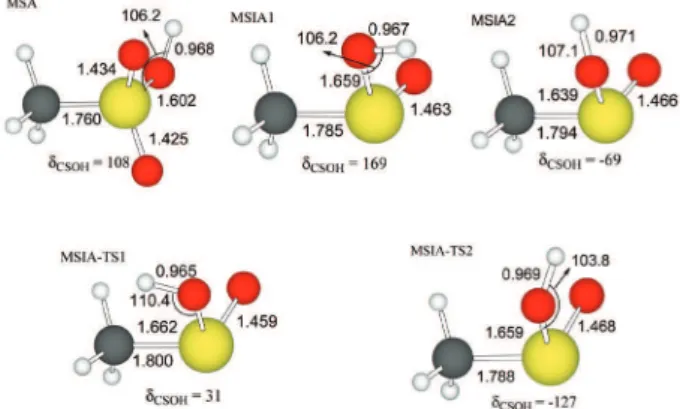
Initially, a detailed conformation analysis was done for the two species in this study. For MSA, there is only one stable conformation, which is represented
in Figure 1. In this species, there are two S=O double bonds and one S–O single bond. On the other hand, MSIA has two stable conformers that differ in the position of the hydrogen bond to the oxygen. The most stable conformer (MSIA1) has a HOSC dihedral angle equal to 169o, while in the other conformer (MSIA2), this dihedral angle amounts to –69o. These two species are also depicted in the Figure 1, along with the main geometrical parameters. MSIA1 is more stable than MSIA2 by 3.2 kJ mol-1. Two transition states were found connecting these two conformers, with dihedral angles of 31o and –127o, respectively, identiied here by MSIA-TS1 and MSIA-TS2, which are also depicted in Figure 1. The imaginary frequencies of MSIA-TS1 and MSIA-TS2 are 304,9i and 333,9i, respectively.
The electronic energy barriers for interconvertion were calculated to be 7.5 and 23.8 kJ mol-1, in relation to MSIA-TS1 and MSIA-TS2, respectively, which indicate that this rotation is almost barrierless. The reaction free energy to interconvertion of MSIA1 into MSIA2 was determined to be 2.13 kJ mol-1, and this value was used to calculate the distribution of these two conformers at the equilibrium, using the following equation:
N2
––– = e–∆G21/RT N1
where N1 and N2 are the amount of MSIA1 and MSIA2 conformers, respectively; and ∆G
21 is the reaction free energy for MSIA1 → MSIA2 interconversion. The
proportion of each conformer in the equilibrium was determined to be 70% to MSIA1 and 30% to MSIA2, and the equilibrium constant to MSIA1 to MSIA2 interconversion was calculated to be 0.43.
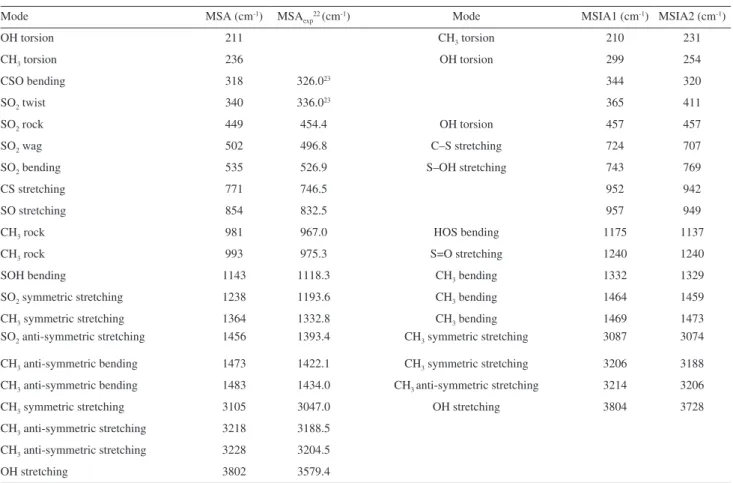
The calculated harmonic frequencies of MSA, MSIA1 and MSIA2 are listed in Table 1, along with the experimental
values available in the literature for MSA.22,23 The present values are in very good agreement with the experimental results, with a average error of 2%. For MSIA, there are not experimental results in the literature. From these data, there are spectroscopic differences between the two MSIA conformers. The OH, S–OH and S=O stretching modes, and the HOS bending mode are the main frequencies of MSIA1, while in MSIA2 the intensity of the S=O stretching and the HOS bending is very small. This can be used to identify the conformers in experimental measurements.
After the structural and spectroscopic characterization of these two species, the calculations of the thermodynamical properties were done. For the determination of the enthalpy of formation (∆H
f
o) of these compounds, three isodesmic
reactions were used:
CH3S(O)CH3 + SO3 + H2SO4 → 2 CH3S(O)2OH + SO2 (1)
CH3SO2 + H2SO4 → CH3S(O)2OH + HOSO2 (2)
CH3S(O)CH3 + CH3S(O)OH→ CH3SCH3 + CH3S(O)2OH (3)
Reactions 1 and 2 were used to determine the ∆H fo
for MSA at 298.15 K and 1 atm. Reaction 3 was used to MSIA at the same conditions. The choice of these reactions is due to the fact that they involve reactants and products whose thermochemistry is relatively well established. The enthalpies of formation of CH3S(O)CH3 (DMSO), CH3SCH3 (DMS), SO3, SO2, H2SO4 and HOSO2 used in this work were –150.5,24 –37.5,25 –395.77,26 –296.84,26 –735.13,26 and –373 kJ mol-1,27 respectively. The ∆H
f
o for CH 3SO2 is the one obtained in a previous high level theoretical study, –218.4 kJ mol-1.28,29 The values for the calculated reaction enthalpies are collected in the irst column of Table 2. The average value obtained for MSA is –566.2 kJ mol-1. This value can be compared with the one reported by Guthrie and Gallant,15 using calorimetric measurements, which are 562.41 ± 9.58 kJ mol-1. The agreement is very good.
Reaction 3 was used to determine the ∆H
f° of the MSIA1 and MSIA2 conformers, considering the value for ∆H
f° of MSA determined in this work. The values obtained were also listed in Table 2. Considering the atmospheric proportion of MSIA1 and MSIA2 of 70 and 30% determined above, the ∆H
f° of MSIA was calculated as a weighted average. The value obtained is –337.2 kJ mol-1.
Table 1. Harmonic vibrational frequencies (cm-1) calculated and experimental22 for MSA and for the two MSIA conformers (MSIA1 and MSIA2), calculated at the UMP2/cc-pV(T+d)Z level of theory
Mode MSA (cm-1) MSA
exp22 (cm-1) Mode MSIA1 (cm-1) MSIA2 (cm-1)
OH torsion 211 CH3 torsion 210 231
CH3 torsion 236 OH torsion 299 254
CSO bending 318 326.023 344 320
SO2 twist 340 336.023 365 411
SO2 rock 449 454.4 OH torsion 457 457
SO2 wag 502 496.8 C–S stretching 724 707
SO2 bending 535 526.9 S–OH stretching 743 769
CS stretching 771 746.5 952 942
SO stretching 854 832.5 957 949
CH3 rock 981 967.0 HOS bending 1175 1137
CH3 rock 993 975.3 S=O stretching 1240 1240
SOH bending 1143 1118.3 CH3 bending 1332 1329
SO2 symmetric stretching 1238 1193.6 CH3 bending 1464 1459 CH3 symmetric stretching 1364 1332.8 CH3 bending 1469 1473 SO2 anti-symmetric stretching 1456 1393.4 CH3 symmetric stretching 3087 3074
CH3 anti-symmetric bending 1473 1422.1 CH3 symmetric stretching 3206 3188 CH3 anti-symmetric bending 1483 1434.0 CH3 anti-symmetric stretching 3214 3206 CH3 symmetric stretching 3105 3047.0 OH stretching 3804 3728 CH3 anti-symmetric stretching 3218 3188.5
CH3 anti-symmetric stretching 3228 3204.5
Concerning the theoretical calculations of Wang and Zhang,16 the values obtained for ∆H
f° of MSA and MSIA are –563 and –331 kJ mol-1, respectively. It is a reasonable agreement. However, we can emphasize that the present calculations are conducted in a better level of theory and results represent the irst theoretical determination of this quantity considering the existence of two MSIA conformers.
Conclusions
The structural and spectroscopic properties of methanesulfinic (MSIA) and methanesulfonic (MSA) acids were theoretically investigated. Extensive theoretical conformation analysis was conducted in order to identify the minimum energy for these two species. The geometry optimizations were conducted at the UMP2/cc-pV(T+d)Z level of calculation, and single points calculations were added to reach the CCSD(T)/CBS level of accuracy. There is only one stable MSA conformer and two MSIA conformers. Using these results and thermochemical data from the literature, the enthalpy of formation was determined for these two important atmospheric species, working with a set of isodesmic reactions. For the methanesulinic acid, the average value for the enthalpy of formation was determined to be –337.2 kJ mol-1, taking into account the proportion of the two conformers in the equilibrium. For methanesulfonic acid, the enthalpy of formation was obtained as being –566.2 kJ mol-1. These values are in good agreement with the available previous experimental and theoretical results. Since the present calculations were conducted at a high level of theory, and it is the only study where the two MSIA conformers were considered, these results are the most conident thermochemical data presented up to date.
Acknowledgments
T h e a u t h o r s t h a n k C o n s e l h o N a c i o n a l d e Desenvolvimento Cientíico e Tecnológico (CNPq, Process 473761/2008-4) and Fundação de Amparo à Pesquisa do Estado de Minas Gerais (FAPEMIG, Process CEX APQ-0558-5.02/07) for support and research grants.
References
1. Pham, M.; Müller, J.-F.; Brasseur, G. P.; Granier, C.; Mégie, G.; J. Geophys. Res.1995, 100, 26061.
2. Coakley, J. A.; Bernstein, R. L.; Durkee, P. A.; Science1987,
237, 1020.
3. Charlson, R. J.; Lovelock, J. E.; Andreae, M. O.; Warren, S. G.;
Nature1987, 326, 655.
4. Bates, T. S.; Charlson, R. J.; Gammon, R. H.; Nature1987, 329, 319.
5. Librando, V.; Tringali, G.; Hjorth, J.; Coluccia, S.; Environ. Poll.2004, 127, 403.
6. von Glasow, R.; Crutzen, P. J.; Atmos. Chem. Phys.2004, 4, 589.
7. Resende, S. M.; De Almeida, W. B.; J. Phys. Chem. A1997,
101, 9738.
8. Hatakeyama, S.; Okuda, M.; Akimoto, H.; Geophys. Res. Lett.
1982, 9, 583.
9. Arsene, C.; Barnes, I.; Becker, K. H.; Schneider, W. F.; Wallington, T. J.; Mihalopoulos, N.; Patroescu-Klotz, I. V.; Env. Sci. Tech.2002, 36, 5155.
10. Yin, F.; Grosjean, D.; Seinfeld, J. H.; J. Atmos. Chem.1990,
11, 309.
11. Sorensen, S.; Falbe-Hansen, H.; Mangoni, M.; Hjorth, J.; Jensen, N. R.; J. Atmos. Chem.1996, 24, 299.
12. Urbanski, S. P.; Stickel, R. E.; Wine, P. H.; J. Phys. Chem. A
1998, 102, 10522.
13. Tian, Y.; Tian, Z. M.; Wei, W. M.; He, T. J.; Chen, D. M.; Liu, F. C.; Chem. Phys.2007, 335, 133.
14. Gonzalez-Garcia, N.; Gonzalez-Lafont, A.; Lluch, J. M.;
J. Phys. Chem. A2007, 111, 7825.
15. Guthrie, J. P.; Gallant, R. T.; Can. J. Chem.2000, 78, 1295. 16. Wang, L. M.; Zhang, J. S.; J. Mol. Struct.-Theochem2002, 581,
129.
17. Wilson, A. K.; Dunning, T. H.; J. Phys. Chem. A2004, 108, 3129.
18. Frisch, M. J.; Trucks, G. W.; Schlegel, H. B.; Scuseria, G. E.; Robb, M. A.; Cheeseman, J. R.; Montgomery, J. A., Jr.; Vreven, T.; Kudin, K. N.; Burant, J. C.; Millam, J. M.; Iyengar, S. S.; Tomasi, J.; Barone, V.; Mennucci, B.; Cossi, M.; Scalmani, G.; Rega, N.; Petersson, G. A.; Nakatsuji, H.; Hada, M.; Ehara, M.; Toyota, K.; Fukuda, R.; Hasegawa, J.; Ishida, M.; Nakajima, T.; Honda, Y.; Kitao, O.; Nakai, H.; Klene, M.; Li, X.; Knox, J. E.; Hratchian, H. P.; Cross, J. B.; Bakken, V.; Adamo, C.; Jaramillo, J.; Gomperts, R.; Stratmann, R. E.; Yazyev, O.; Austin, A. J.; Cammi, R.; Pomelli, C.; Ochterski, J.; Ayala, P. Y.; Morokuma, K.; Voth, G. A.; Salvador, P.; Dannenberg, J. J.; Zakrzewski, V. G.; Dapprich, S.; Daniels, A. D.; Strain, M. C.; Farkas, O.; Malick, D. K.; Rabuck, A. D.; Raghavachari, K.; Foresman, J. B.; Ortiz, J. V.; Cui, Q.; Baboul, A. G.; Clifford, S.; Cioslowski, J.; Stefanov, B. B.; Liu, G.; Liashenko, A.; Komaromi, I.;
Table 2. Reaction enthalpies (∆H
r°) for the three reactions studied and enthalpies of formation (∆H
f°)determined for MSA and for the two MSIA conformers in kJ mol-1
∆H
Martin, R. L.; Fox, D. J.; Al-Laham, M. A.; Nanayakkara, A.; Challacombe, M.; Gill, P. M. W.; Johnson, B.; Pople, J. A.;
Gaussian 03, Revision D.01, Gaussian Inc., Wallingford, CT, 2004.
19. Dunning, T. H.; Peterson, K. A.; Wilson, A. K.; J. Chem. Phys.
2001, 114, 9244.
20. Curtiss, L. A.; Raghavachari, K.; Trucks, G. W.; Pople, J. A.;
J. Chem. Phys.1991, 94, 7221.
21. Nobes, R. H.; Bouma, W. J.; Radom, L.; Chem. Phys. Lett.
1982, 89, 497.
22. Givan, A.; Loewenschuss, A.; Nielsen, C. J.; J. Mol. Struct.
2005, 748, 77.
23. Durig, J. R.; Zhou, L.; Schwartz, T.; Gounev, T.; J. Raman Spectrosc.2000, 31, 193.
24. Masuda, N.; Nagano, Y.; Sakiyama, M.; J. Chem. Thermod.
1994, 26, 971.
25. Voronkov, M. G.; Klyuchnikov, V. A.; Kolabin, S. N.; Shvets, G. N.; Varusin, P. I.; Deryagina, E. N.; Korchevn, N. A.; Tsvetnitskaya, S. I.; Dokl. Phys. Chem.1989, 307, 650. 26. Chase Jr., M. W.; NIST-JANAF Thermochemical Tables, 4th ed.,
J. Phys. Chem. Ref. Data, 1998, Monograph 9, 1-1951. 27. Somnitz, H.; Phys. Chem. Chem. Phys.2004, 6, 3844. 28. Resende, S. M.; Ornellas, F. R.; Chem. Phys. Lett.2003, 367,
489.
29. Resende, S. M.; Ornellas, F. R.; J. Braz. Chem. Soc.2002, 13, 565.