Rise and Fall of Pentaquarks in the QCD Sum Rules Approach
R. D. Matheus, F. S. Navarra, and M. Nielsen
Instituto de F´ısica, Universidade de S˜ao Paulo, C.P. 66318, 05315-970 S˜ao Paulo, SP, Brazil
Received on 18 March, 2006
We review the existing mass and decay width determinations of pentaquarks with QCD Sum Rules (QCDSR). We give special attention to the intermediate assumptions and choices which we are obliged to do in this ap-proach. As an example, we present the full calculation of the pentaquark mass with Borel sum rules and also with Finite Energy Sum Rules (FESR). We also work out the calculation of theΘdecay width. We take the opportunity to comment our publications on this subject and include new and unpublished material.
Keywords: Mass and decay; Pentaquarks; QCD Sum Rules
I. INTRODUCTION
From june 2003 to august 2005 there was an intense the-oretical activity devoted to understand the structure of a new family of baryons: the pentaquarks. The interest for this sub-ject was triggered by the announcement made by the LEPS collaboration [1] reporting the observation of theΘ+(1540). Since then, a flurry of theoretical [2] and experimental [3] papers brought the pentaquarks to the main stage of hadron physics.
The subsequent experimental searches, carried out in dozens of different machines with different energies, differ-ent beam and targets and differdiffer-ent detection methods turned out to be inconclusive, half of the experiments observing the Θ+(1540)and the other half not observing it. This puzzling situation began to change when, in the beginning of 2005 some groups which had previously found the pentaquark state could not see it anymore in a second round of much more careful experiments [4, 5]. Very fastly the community started not to believe in the existence of the pentaquark. In august 2005, a statement made by Ted Barnes at the HADRON05 meeting, in Rio de Janeiro, reflected this new consensus [6]. He said: “the pentaquark is dead !”. Much experimental work on the subject is still needed, not only to confirm the negative result, but also to understand what was wrong before. In spite of some isolated claims that the state really exists, today it seems very likely that the final conclusion will give support to the “death sentence” pronounced by Barnes. As for explain-ing the previous positive results, some steps along this direc-tion have been taken by Meier, Dzierba and Szczepaniak, who tried to demonstrate that the signal observed by the CLAS col-laboration at JLAB is a consequence, among other things, of kinematical reflections [7].
On the theoretical side the situation became equally confus-ing. The method able to give the best answers, lattice QCD, was used by several groups to look for the pentaquark [8–10]. These “theoretical searches”, in the same way as the initial experimental ones, turned out to be inconclusive, half of the groups finding a signal and half not finding it. Quark models were also extensively used in this context but they may give answer to different questions. Due to their very nature, they have to assume that a particle exists and then they may predict, for example, its spatial and color configuration.
Between lattice QCD and quark models, in an
intermedi-ate position in the theoretical scenario, we have QCD sum rules (QCDSR) [11–13], which, in principle are pure theory. However, due to the option of keeping the calculation ana-lytic and avoiding the “brute force” numerical work; due to the option of trading a simulation of the QCD vacuum by the phenomenological parameters known as condensates, the re-sults start to depend on certain assumptions (like, for exam-ple, the factorization hypothesis for higher dimension conden-sates) which are made during the calculations. The first works on Θ+(1540)with QCDSR [14–17] addressed the mass of the state and could all obtain a reasonable value for the mass. Later, a more careful analysis [18–20] revealed some prob-lems with the previous calculations. In the mean time other pentaquarks were observed: theΞ−−and theΘc. These were also studied with QCDSR [18, 21]. This time, with more rig-orous criteria it was more difficult to reproduce the experimen-tal data, i.e., the masses of the states (especially theΞ−−).
Fi-nally, attempts to describe the extremely narrow decay width pushed the method to the limit and the conclusion was that it is very difficult to understand this decay in QCDSR [22].
If, in the near future, the non-existence of pentaquarks is confirmed, the community might address to the QCDSR prac-titioners the following justified and embarrassing question: “how could you so nicely calculate the correct mass of some-thing that does not exist?”
In this work we present a critical review of these QCDSR calculations commenting their strong and weak points. In reviewing these topics we present new material, which was never published before.
The text is organized as follows. In the next section we briefly mention some interesting facts and main ideas about pentaquarks. In section 3 we present the main formulas of QCDSR, show one complete calculation of a pentaquark mass with all the inputs and assumptions. In section 4 we enumerate the requirements that must be satisfied for a QCDSR calcula-tion to be reliable and check whether this is case for the results discussed in the preceding section. In section 5 we introduce the finite energy sum rules (FESR) and present the results for mΘandmΞobtained with this method. In section 6 we move
II. THE PENTAQUARK STRUCTURE
Probably the most interesting physical question related to pentaquarks is: how are these five quarks organized? The ex-otic baryon with theK+nquantum numbers, theΘ+(1540), first observed in [1], could not be a three quark state and its minimal quark content had to be uudds. These quarks could be in one of the following configurations: a) uncorre-lated quarks inside a bag [23]; b) a K−N molecule bound by a van-der Waals force [24]; c) a “K−N” bound state in which uud andus are not separately in color singlet states [14]; d) a diquark-triquark(ud)−(uds)bound state [25] and e) a diquark-diquark-antiquark state [26]. This last possibility has been by far the most explored, also in the QCD sum rules framework.
According to Jaffe and Wilczek (JW), each diquark should have spin zero and should be in the ¯3representation of SU(3), in color and flavor. The two diquark would then combine in a P-wave orbital angular momentum to form a3state in color, spin S=0, and ¯6 in flavor. The resulting state would then be combined with the antiquark to form a flavor antidecuplet
¯
10f and octet8f, with spinS=1/2. TheΘ+would be at the top of the antidecuplet ¯10f and would have an isospinI=0. JW have also interpreted the lightest particle in the octet8f,
[ud]2d¯, as the Roper resonance, since it has the same quantum numbers of the nucleon. The Roper resonance would be thus identical to theΘ+except for the substitution of the strange antiquark by a down antiquark. This would explain why the mass difference betweenΘ+(1540)andN(1440)is so close to the strange quark mass.
Understanding the organization of matter at the quark level is of extreme importance. This can be done with the help of lattice QCD and, to some extent, with QCDSR. In the follow-ing section we describe the calculation of a pentaquark mass with QCDSR.
III. CORRELATION FUNCTION, CURRENTS AND MASSES
The purpose of this section is mainly to show the QCDSR machinery at work, giving emphasis to the aspects which may be potential sources of uncertainties.
In the QCDSR approach [12, 13], the short range pertur-bative QCD is extended by an operator product expansion (OPE) of the correlators, which results in a series in powers of the squared momentum with Wilson coefficients. The conver-gence at low momentum is improved by using a Borel trans-form. The expansion involves universal quark and gluon con-densates. The quark-based calculation of a given correlator is equated to the same correlator, calculated using hadronic degrees of freedom via a dispersion relation, providing sum rules from which a hadronic quantity can be estimated. The QCDSR calculation of hadronic masses centers around the two-point correlation function given by
Π(q)≡i
d4x eiq·x<0|Tη(x)η(0)|0> (1)
whereη(x)is an interpolating field (a current) with the quan-tum numbers of the hadron we want to study.
In the next subsections we discuss the evaluation of (1) for the cases of theΞ−−and of theΘ+.
The basic ingredients in the particle mass determinations from QCD spectral sum rules [11, 12] as well as from lat-tice QCD calculations are the interpolating currents used to describe the particle states. Contrary to the ordinary mesons, where the form of the current is unique, there are different choices of the pentaquark currents in the literature. We shall list below some possible operators describing the isoscalar I=0 andJ=1/2 channel which would correspond to the experimental candidateΘ(1540).
A. TheΘ(1540)currents
Defining the pseudoscalar (ps) and scalar (s) diquark interpo-lating fields as:
Qabps(x) = uaT(x)Cdb(x)
,
Qsab(x) = uTa(x)Cγ5db(x)
, (2)
wherea, b, care color indices andCdenotes the charge con-jugation matrix, the lowest dimension current built by two di-quarks and one anti-quark describing theΘas aI=0, JP=
1/2+S-wave resonance is [16]: ηΘI =εabcεde fεc f gQ
ps abQ
s
deCs¯Tg , (3) and the one with one diquark and three quarks is [14]:
ηΘII= 1 √
2ε abcQs
ab{ues¯eiγ5dc−(u↔d)} . (4) This later choice can be interesting if the instanton repulsive force arguments [27] against the existence of a pseudoscalar diquark bound state apply. Alternatively, a description of the Θas aI=0,JP=1/2+P-wave resonance has been proposed by [26] and used by [17] in the sum rule analysis:
ηΘIII=
εabdδce+εabcδde[Qs
ab(DµQscd)−
(DµQsab)Qscd]γ5γµCs¯Te . (5) This current can be generalized by considering its mixing with the following one having the same dimension and quantum numbers:
ηΘIV =εabcεde fεc f gQ ps abQ
s
deγµ(DµCs¯Tg). (6) The evaluation of (1) with (6) revealed that [19], to leading order inαs and in the chiral limit mq→0, the contribution to the correlator vanishes. This result justifies a posteriori the unique choiceof operator for theP-wave state used in [17].
B. TheΞ(1862)currents
numbers ofΞ−−(I=3/2,JP=1/2−): η1(x) =
1 √
2εabc(d T
a(x)Cγ5sb(x))[dTc(x)Cγ5se(x)
+ sTe(x)Cγ5dc(x)]Cu¯Te(x) (7)
η2(x) = 1 √
2εabc(d T
a(x)Csb(x))[dTc(x)Cse(x)
+ sTe(x)Cdc(x)]Cu¯Te(x) (8) wherea, b, c ande are color indices andC=−CT is the charge conjugation operator.
As in the nucleon case, where one also has two independent currents with the nucleon quantum numbers [28, 29], the most general current forΞ−−is a linear combination of the currents given above:
ηΞI(x) = [tη1(x) +η2(x)], (9) withtbeing an arbitrary parameter. In the case of the nucleon, the interpolating field witht=−1 is known as Ioffe’s current [28]. With this choice fort, this current maximizes the over-lap with the nucleon as compared with the excited states, and minimizes the contribution of higher dimension condensates. In the present case it is not clear a priori which is the best choice fort.
We also employ the following interpolating field operator for the pentaquarkΞ−−[10, 16] :
ηΞII(x) = εabcεde fεc f gsTa(x)Cdb(x)
× sTd(x)Cγ5de(x)Cu¯Tg(x) (10) It is easy to confirm that this operator produces a baryon with J = 1/2, I =3/2 and strangeness −2. The parts, Sc(x) =εabcsT
a(x)Cγ5db(x)andPc(x) =εabcsTa(x)Cdb(x), give the scalar S (0+) and the pseudoscalar P (0−) sd diquarks, respectively. They both belong to the anti-triplet representa-tion of the color SU(3). The scalar diquark corresponds to the I=1/2sddiquark with zero angular momentum. It is known that a gluon exchange force as well as the instanton mediated force commonly used in the quark model spectroscopy give significant attraction between the quarks in this channel.
C. TheΞmass
Inserting Eq. (9) into the integrand of Eq. (1) we obtain
<0|Tη(x)η(0)|0> = t2Π11(x) +tΠ12(x)
+ tΠ21(x) +Π22(x) (11) CallingΓ1=γ5andΓ2=1 we get
Πi j(x) = <0|Tηi(x)ηj(0)|0>
= εabcεa′b′c′CSe′eT(−x)C
−Tr[ΓiSsbb′(x)ΓjCSTaa′(x)C]
× Tr[ΓiSsee′(x)ΓjCSTcc′(x)C] +... (12)
whereSab(x)andSsab(x)are the light and strange quark prop-agators respectively. The above expression was included just to show the ingredients of the calculation. The full version of (12) can be found in [18].
In order to evaluate the correlation functionΠ(q) at the quark level, we first need to determine the quark propagator in the presence of quark and gluon condensates. Keeping track of the terms linear in the quark mass and taking into account quark and gluon condensates, we get [30]
Sab(x) = 0|T[qa(x)qb(0)]|0
= iδab
2π2x4/x− mqδab 4π2x2
− i
32π2x2t A
abgsGAµν(xσ/ µν+σµν/x)
− δab 12qq − mq
32π2t A
abgsGAµνσµνln(−x2)
+ iδab
48 mqqq/x− x2δab
26×3gsqσ·
G
q+ ix
2δab
27×32mqgsqσ·
G
q/x− x
4δab
210×33qqg 2
sG2 (13)
where we have used the factorization approximation for the multi-quark condensates, and we have used the fixed-point gauge [30].
Inserting (13) into (12) we obtain a set of diagrams which contribute to the OPE side of the correlation function.
Lorentz covariance, parity and time reversal imply that the two-point correlation function in Eq. (1) has the form
Π(q) =Π1(q2) +Πq(q2)q/ . (14) A sum rule for each scalar invariant functionΠ1andΠq, can be obtained. In [18] the chirality even structureΠq(q2)was used to obtain the final results.
The phenomenological side is described, as usual, as a sum of pole and continuum, the latter being approximated by the OPE spectral density. In order to suppress the condensates of higher dimension and at the same time reduce the influence of higher resonances we perform a standard Borel transform [12]:
Π(M2)≡ lim n,Q2→∞
1 n!(Q
2)n+1
−dQd2
n
Π(Q2) (15)
(Q2=−q2) with the squared Borel mass scale M2=Q2/n kept fixed in the limit.
For current II we repeat the steps mentioned above, substi-tuting (10) into (1), making use of the expansion (13), picking up the terms multiplying the structureq/ and finally perform-ing a Borel transform (15).
following sum rule at orderms:
λ2
Ξe−
m2Ξ
M2 =
s0 0
e−Ms2ρq
i(s)ds. (16) wherei(=I,II)refers to the current employed and the spectral densities, up to order 6 are given by:
ρqI(s) = c1 s5
5!5!2127π8+c3 s3
5!210π6ms<ss¯ > − c4
s3
5!28π6ms<qq¯ >+c2 s3 5!3!213π6 <
αs π G
2>
+ 7c4 s2
216π6ms<qg¯ sσ.Gq>
+ c2
s2
32211π4 <ss¯ >
2+<qq¯ >2
+ c4
s2
3!28π4 <ss¯ ><qq¯ > − c5
s2
4!3!211π6ms<sg¯ sσ.Gs> − 3c4
s2
4!3!212π6ms<qg¯ sσ.Gq> ×
6 ln( s
Λ2 QCD
)−43 2
,
(17)
withc1=5t2+2t+5,c2= (1−t)2,c3= (t+1)2,c4=t2−1, c5=t2+22t+1,ΛQCD=110 MeV and
ρqII(s) = s
5
5!5!2107π8+ s3
5!3!27π6ms<ss¯ >
+ s
3
5!3!210π6< αs
πG 2>
+ s
2
4!3!29π6ms<sg¯ sσ.Gs> . (18) To extract the Ξ−− mass, mΞ, we take the derivative of
Eq. (16) with respect toM−2and divide it by Eq. (16). Re-peating the same steps leading to (16), (17) and (18) for the chirality odd structureΠ1(q2)we arrive at
λ2
ΞmΞe−
m2Ξ
M2 =
s0 0
e−Ms2ρ1
i(s)ds. (19) where
ρ1I(s) = −c1 s4
5!4!210π6<qq¯ >
+ c1
s3
4!3!212π6<qg¯ sσ.Gq> (20) and
ρ1
II(s) = − s4
5!4!27π6<qq¯ >
+ s
3
4!3!29π6<qg¯ sσ.Gq> (21)
In the numerical analysis of the sum rules, the values used for the condensates are:qq=−(0.23)3GeV3,ss= 0.8qq, <sg¯ sσ.Gs >=m20ss¯ with m20 =0.8 GeV2 and g2sG2=0.5 GeV4. The gluon condensate has a large error of about a factor 2, but its influence on the analysis is relatively small. We define the continuum threshold as:
s0= (1.86+∆)2 GeV2 (22) In the complete theory, the mass extracted from the sum rule should be independent of the Borel massM2. However, in a truncated treatment there will always be some dependence left. Therefore, one has to work in a region where the approx-imations made are acceptable and where the result depends only moderately on the Borel variables.
A comparison between results obtained with different cur-rents is more meaningful when they describe the same phys-ical state, i.e., those with the same quantum numbers. Con-cerning spin, all currents considered in our work have the same spin (= 1/2). Concerning the parity, the situation is more complicated. In QCD sum rules, when we construct the cur-rent, it has a definite parity. Current (9) has parityP=−1 and current (10) has parityP= +1. However, currents can couple to physical states of different parities. As well discussed in [21], in order to know the parity of the state in QCDSR, we have to analyze the chiral-odd sum rule. If the r.h.s of this sum rule (containing the spectral density coming from QCD) is positive, then the parity of the corresponding physical state is the same as the parity of the current. If it is negative the parity is the opposite of the parity of the current. Perform-ing this analysis we might determine in both cases the parity of the state. However it turns out that for both currents, in the chiral-odd sum rule the OPE does not have good conver-gence, i.e., terms containing higher order operators are not suppressed with respect to the lowest order ones. This sum rule is thus ill defined and nothing can be said about the parity of the state. The comparative study of the currents is still valid because we can compare other properties of these currents. A possible outcome of this study might be that one current has defects, which are so severe that we are forced to abandon it. If this turns out to be case, the determination of the parity of the associated states becomes irrelevant.
IV. RELIABILITY OF A QCD SUM RULE CALCULATION
Having presented the main formulas in the last section, the next step is be to introduce numerical values for the masses and condensates, choose reasonable values for the free (or partially constrained) parameters, which are the continuum threshold, the Borel mass at which the mass sum rule is evaluated and, in the case of current (9), the value oft. As a result we obtain values formΞ. In doing these calculations we
must remember thatit is not enough to obtain a pentaquark mass consistent with the experimental number. There is a list of requirements that must be fulfilled:
ii) the right hand side (RHS) of the sum rules (16) and (19) must be positive, since the left hand side (LHS) is manifestly positive.
iii) the operator product expansion (OPE) must be convergent, i.e., the terms appearing in (17) and (18) must decrease with the increasing order of the operator.
iv) the pole contribution must be dominant, i.e., the integral in (16) and in (19) must be at least 50 % of the integral over the complete domain of invariant masses (s0→∞).
v) the threshold parameter s0 must be compatible with the energy corresponding to the first excitation of an usual baryon.
A. current (9)
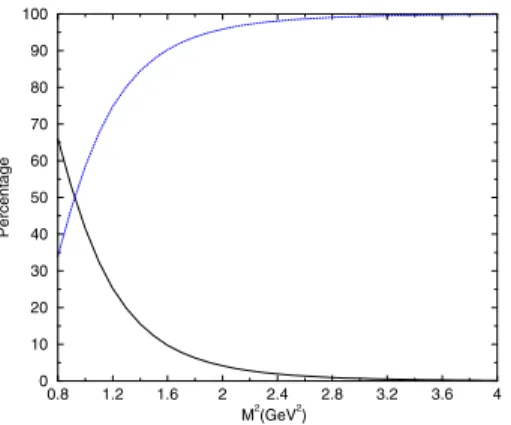
After an extensive search for best values of parameters and optimal Borel window, we have realized that it is extremely difficult to satisfy simultanously the conditions i)-v) given above. In particular, when we have a very good OPE con-vergence, the strength of the pole is very weak and vice versa. We have to look for a compromise.
In order to illustrate these results, we consider ms=0.10 GeV and∆=0.44 GeV, and contruct, Figs. 1, 2 and 3, show-ing the Borel mass dependence ofmΞ, of the OPE terms (in
absolute value) and of the percentage of the pole contribution respectively. For these choices the value of the current-state overlap is:
λqI ≃5.4×10⁻⁹ GeV13 (23)
Restricting ourselves to the parameter combinations which satisfy the requirements i) - v) and taking the average we ob-tain:
mΞ=1.85±0.05 GeV (24)
We have also used a current composed by scalar diquarks only, i.e.,η1. The motivation for studying this current is to verify if it gives a smaller mass for the pentaquark than those obtained with other currents. According to the instanton de-scription of diquark dynamics, this should be the case. We observe that, for same choices formsand∆, the masses found with scalar diquark currents are only slightly smaller than the others. This means either that instanton dynamics was not captured by our choice of currents and diagrams or that the in-teraction between the pseudoscalar diquarks (included in the mixed currents) is more attractive than expected.
B. current (10)
Using the same numerical inputs quoted in the last subsec-tion we evaluate now the sum rules obtained with current(10). The same comments made in the previous subsection apply here. Choosingms=0.10 GeV and∆=0.24 GeV, we present in Figs. 4, 5 and 6 the Borel mass dependence ofmΞ, of the
OPE terms and of the percentage of the pole respectively. As it
can be seen, with current(10) we tend to overestimatemΞ,
un-less very low threshold parameters or quark masses are used. Besides, the pole contribution is always smaller than 40 %. On the other hand, the Borel stability seen in Fig. 4 is re-markable. This suggests that we could choose a lower value for the Borel mass, thereby increasing the pole contribution without significantly changingmΞ. The average over the best
parameter choices leads to:
mΞ=1.88±0.04 GeV (25) Finally, for these parameters the current-state overlap is:
λqII ≃1.3×10⁻⁹ GeV13 (26)
Comparing (23) and (26) we observe that the coupling of current I to the theΞstate is four times larger than the coupling of current II to this state. This speaks in favor of current I.
1 1.4 1.8 2.2 2.6 3 3.4 3.8
M2(GeV)2 1
1.2 1.4 1.6 1.8 2 2.2 2.4
mΞ
(GeV)
FIG. 1:Ξmass with current I.ms=0.10 GeV,t=1 and∆=0.44 GeV.
1 1.4 1.8 2.2 2.6 3 3.4 3.8
M2
(GeV)2
0 0.4 0.8 1.2 1.6 2 2.4 2.8 3.2 3.6
RHS of the sum rule(10
−9GeV 13)
0.8 1.2 1.6 2 2.4 2.8 3.2 3.6 4 M2(GeV2)
0 10 20 30 40 50 60 70 80 90 100
Percentage
FIG. 3: Relative strength of the pole (solid line) and the continuum (dotted line) as a function of the Borel mass squared with current I.
ms=0.10 GeV,t=1 and∆=0.44 GeV.
1 1.4 1.8 2.2 2.6 3 3.4 3.8
M2(GeV)2 1
1.2 1.4 1.6 1.8 2 2.2 2.4
mΞ
(GeV)
FIG. 4:Ξmass with current II.ms=0.10 GeV and∆=0.24 GeV.
V. FINITE ENERGY SUM RULES
As we have seen, the description of the phenomenological side of the sum rules requires the definition of the spectral densityρ, which is written as a sum of pole and continuum contribution. The energy gap separating the ground state from the first excited state (∆) or, equivalently, the squared mass of the first excitation,s0, when not previously known from ex-periment, must be guessed. This can be considered as a weak point in the Borel sum rules. A way to reduce this arbitrariness is to work in the large Borel mass limit and try to completely determines0. This variant of QCDSR is called Finite Energy Sum Rules (FESR) [11, 32, 33].
We start from the general form taken by the QCDSR for any two point correlator:
λ2e−m 2
M2 =
s0 0
e−Ms2ρ(s)ds. (27) Taking the limit M12 →0 we get:
∑
n
(−m)2nλ2
1 M2
n
=
∑
n s0
0 (− s)n
1 M2
n
ρ(s)ds. (28)
1 1.4 1.8 2.2 2.6 3 3.4 3.8
M2
(GeV)2
0 0.8 1.6 2.4 3.2 4 4.8
RHS of the sum rule(10
−10
GeV
13)
FIG. 5: Leading terms of the R.H.S of (16) with current II.ms= 0.10 GeV and∆=0.24 GeV. Solid line: perturbative term; dotted line: operators of dimension 4; dashed line:operators of dimension 6.
0.8 1.2 1.6 2 2.4 2.8 3.2 3.6 4
M2 (GeV2
) 0
10 20 30 40 50 60 70 80 90 100
Percentage
FIG. 6: Relative strength of the pole (solid line) and the continuum (dotted line) as a function of the Borel mass squared with current II.
ms=0.10 GeV,t=1 and∆=0.24 GeV.
Equating the coefficients of the polynomial inM12 we get sim-ply:
m2nλ2=
s0 0
snρ(s)ds, n=0,1,2... (29) The mass can be easily obtained by dividing two of such equa-tions with subsequent values ofn:
m2=
s0
0 sn+1ρ(s)ds s0
0 snρ(s)ds
, n=0,1,2... (30)
In contrast to the method discussed in the previous sections, the FESR have the advantage of giving correlations between the mass (and alsoλ) and the QCD continuum thresholds0, avoiding inconsistencies in the values of these parameters. Ideally, we can find a stability in the functionm(s0)thus hav-ing a good criterion for fixhav-ing boths0andm.
2,0 2,5 3,0 3,5 4,0 4,5 5,0 5,5 6,0 1,4
1,5 1,6 1,7 1,8 1,9 2,0 2,1
1.99
1.63
1.51 1.47
η Ι
Θ
up do dimension 5
η ΙΘ up do dimension 9
η ΙΙΘ
up to dimension 5
η ΙΙΙΘ up do dimension 5
MΘ
(G
e
V
)
s0 (GeV
2 )
FIG. 7: mΘobtained with the FESR for various currents up to
di-mension 5 condensates and up to didi-mension 9 in the case ofηΘ
I. The values at the stability regions are indicated on the left.
A. TheΘ+(1540) mass
We proceed by applying the FESR to the currents in Eqs. (3), (4) and (5). This has been done fully forηΘI andηΘIII in [19]. So we are going to omit the analytical expressions for these and concentrate in the FESR forηΘ
II, which are new. The FESR results for all three currents are presented here for the sake of comparison.
Performing the FESR analysis for theΠq(q2)structure, we notice that, at the approximation where the OPE is known (di-mension≤6), we do not have stability ins0for any of the cur-rents. Therefore, we used theΠ1(q2)structure for the FESR.
To get the FESR for current (4) we start with the OPE ex-pansion given in [14] and make M12 →0. We get:
s0 0 ρ
ˆ1
II(s)ds =
mss60 1415577600π8−
ss¯s50 29491200π6
− 7qq¯ s 5 0 14745600π6+
sgσGs¯ s40 4718592π6
+ 7qgσGq¯ s
4 0
2359296π6 (31)
s0 0 sρ
ˆ1
II(s)ds =
mss70 1651507200π8−
ss¯s60 35389440π6
− 7qq¯ s 6 0 17694720π6+
sgσGs¯ s5 0 5898240π6
+ 7qgσGq¯ s
5 0
2949120π6 (32)
The mass is obtained dividing eq. (32) by eq.(31). The results are shown on figure 7 together with the results for cur-rents (3) and (5) [19].
We can see in figure 7 thatηΘI has the best agreement with the experimental candidate mass. The result fromηΘIIis a lit-tle high but still compatible with the experiments. The mass obtained withηΘIII is so high that we are led to think that this current couples to an angular excitation [19]. This interpreta-tion is reinforced by the derivatives in eq.(5). We should also note thatηΘI stabilizes for very low values ofs0, especially when calculated in dimension 9, case in which∆s0 is very close to zero.
Summing up the results we have (the errors have been esti-mated forηΘ
I andηΘIIIin [19], here we assume an error of the same magnitude forηΘ
II):
mΘI = (1.51±0.11)GeV (33)
mΘII= (1.63±0.16)GeV (34)
mΘIII= (1.99±0.19)GeV (35)
B. TheΞ−−(1862) mass
In this subsection we repeat the steps above using the cur-rents given by Eq.(9) and Eq.(10). As before, we have stability only in the structureΠ1(q2). ForηΞI we obtain:
s0 0 ρ
ˆ1
I(s)ds=−
c1qq¯ s50 14745600π6+
c1qgσGq¯ s40
2359296π6 . (36) s0
0
sρIˆ1(s)ds=−
c1qq¯ s60 17694720π6+
c1qgσGq¯ s50
2949120π6 , (37) wherec1=5t2+2t+5. ForηΞII:
s0 0 ρ
ˆ1
II(s)ds=−
qq¯ s50 1843200π6+
qgσGq¯ s4 0
294912π6 (38) s0
0 sρ ˆ1
II(s)ds=−
qq¯ s60 2211840π6+
qgσGq¯ s50
368640π6 (39) Once again the masses are obtained dividing (37) by (36) and (39) by (38). The results are show in figure 8.
The figure shows clearly that both currents give the same re-sults in this aproximation of the OPE, and both are bellow the candidate mass. It should be noted that this result may change a lot forηΞI if we add higher dimension condensates. In this aproximation both contributions had the same polynomial in t (c1) thus eliminating the dependence int. This coincidence will hardly be repeated in higher dimensions.
2,4 2,6 2,8 3,0 3,2 3,4 3,6 3,8 4,0 4,2 4,4 4,6 1,40
1,42 1,44 1,46 1,48 1,50 1,52 1,54 1,56 1,58 1,60 1,62 1,64 1,66 1,68 1,70
1,63
η Ι Ξ
η ΙΙ Ξ
mΞ
(G
e
V
)
s0 (GeV2)
FIG. 8:mΞobtained with the FESR up to dimension 5 condensates.
The values at the stability regions are indicated on the left.
VI. ΘDECAY
We turn now to the pentaquark decay Θ−→nK+. One of the most puzzling characteristics of the pentaquark is its extremely small width (much) below 10 MeV which poses a serious challenge to all theoretical models. Many explanations for this narrow width have been advanced [3]. In this section we review the calculation of theΘdecay with QCDSR.
As we have seen in the preceding sections, a common prob-lem of all QCDSR pentaquark mass determinations is the large continuum contribution which has its origin in the high dimension of the interpolating currents and results in a strong dependence on the continuum threshold. Another problem is the irregular behavior of the operator product expansion (OPE), which is dominated by higher dimension operators and not by the perturbative term as it should be.
Here we review the sum rule determination [22] for the decay width based on a three-point function for the decay Θ→nK+. In this way it is possible to extract the coupling gΘnK, which is directly related to the pentaquark width. The pentaquark is treated as a diquark-diquark-antiquark with one scalar and one pseudoscalar diquark in a relative S-wave.
In [19, 31] it has been argued that such a small decay width can only be explained if the pentaquark is a genuine 5-quark state, i.e., it contains no color singlet meson-baryon contribu-tions and thus color exchange is necessary for the decay. The analysis presented both in [19] and in [31] is only qualitative. The narrowness of the pentaquark width can then be attributed to the non-trivial color structure of the pentaquark which re-quires the exchange of, at least, one gluon. In [22] we have done a quantitative test of the conjecture advanced in [19] and [31].
A. The three- point functions
The investigation of the pentaquark decay width requires a three-point function which we define as
Γ(p,p,) =
d4x d4y e−iqyeip,xΓ(x,y),
Γ(x,y) = 0|T{ηN(x)jK(y)η¯Θ(0)}|0, (40)
whereηN, jK andηΘ are the interpolating fields associated
with neutron, kaon andΘ, respectively [22].
We next consider the expression (40) in terms of hadronic degrees of freedom and write the phenomenological side of the sum rule. Treating the kaon as a pseudoscalar particle, the interaction between the three hadrons is described by the following Lagrangian density:
L
= igΘnKΘγ¯ 5Kn forP= +L
= igΘnKΘKn¯ forP=− (41)Writing the correlation function (40) in momentum space and inserting complete sets of hadronic states we obtain an expres-sion which depends on the following matrix elements:
−iV(p,p′) = <n(p′,s′)|Θ(p,s)K(q)> , 0|ηN|n(p′,s′) = λNus′(p′),
K(q)|jK|0 = λK,
Θ(p,s)|η¯Θ|0 = λΘu¯s(p) forP= +
Θ(p,s)|η¯Θ|0 = −λΘu¯s(p)γ5 forP=− (42) Using the simple Feynman rules derived from (41) we can rewriteV(p,p′)as
V(p,p′) = −gΘnKu¯s
′
(p′)γ5us(p) P= + V(p,p′) = −gΘnKu¯s
′
(p′)us(p) P=− (43)
The coupling constantsλNandλΘcan be determined from the
QCD sum rules of the corresponding two-point functions.λK is related to the kaon decay constant through
λK= fKm
2 K mu+ms
. (44)
Combining the expressions above we arrive at
Γphen = −gΘnKλΘλNλK (p′2−m2
N)(q2−m2K+)(p2−m 2
Θ)
× ΓE +continuum (45)
with
ΓE = σµνγ5qµp′ν−imNqγ5
+ i(mN∓mΘ)p′γ5
+ iγ5(p′2∓mΘmN−qp′) (46)
We have worked with the σµνγ
5qµp′ν structure because, as
less sensitive to the coupling scheme on the phenomenologi-cal side, i.e., to the choice of a pseudosphenomenologi-calar or pseudovector coupling between the kaon and the baryons.
Coming back to (40) we write the interpolating fields in terms of quark degrees of freedom as
jK(y) = s¯(y)iγ5u(y), ηN(x) = εabc(dT
a(x)Cγµdb(x))γ5γµuc(x), ¯
ηΘ(0) = −εabcεde fεc f gsTg(0)C
× [d¯e(0)γ5Cu¯Td(0)][d¯b(0)Cu¯Ta(0)]. (47) The pentaquark current above (proposed in [16]) contains a pseudoscalar and a scalar diquark. With these diquarks the two point function might receive a significant contribution from instantons. In [35] we have studied a situation in which these instanton contributions affected the two-point function but gave a negligible contribution to the three-point function. Moreover, in [36] we have observed that instantons give a neg-ligible contribution to heavy baryon weak decays. Motivated by these results, in this first calculation we have neglected in-stantons.
Inserting the currents into (40), the resulting expression involves the quark propagator in the presence of quark and gluon condensates (13). Using it we arrive at a final com-plicated expression for the correlator, which is represented schematically by the sum of the diagrams of Fig. 9.
Let us consider the phenomenological side (45) and, fol-lowing [37], rewrite it generically as:
Γ(q2,p2,p′2) = Γpp+Γpc1+Γpc2+Γcc (48) whereΓpp(q2,p2,p′2)stands for the pole-pole part and reads
Γpp= −gΘnK≪ (p2−m2
Θ)(p′2−mN2)(q2−m2K)
(49)
The continuum-continuum termΓcccan be obtained as usual, with the assumption of quark-hadron duality [22].
The pole-continuum transition terms are contained inΓpc1 andΓpc2. They can be explicitly written as a double dispersion integral:
Γpc1 = ∞
m2
K∗
b1(u,p2)du
(m2N−p′2)(u−q2), Γpc2 =
∞
m2
N∗
b2(s,p2)ds
(m2K−q2)(s−p′2). (50) Since there is no theoretical tool to calculate the unknown functionsb1(u,p2)andb2(s,p2)explicitly, one has to employ a parametrization for these terms. We will use two different parametrizations: one with a continuous function for the Θ and one where the pole term is singled out.
We assume here that the functionsb1andb2have the fol-lowing form:
b1(u,p2) = b1(u) ∞
m2 Θ
dωb1(ω) ω−p2 b2(s,p2) = b2(s)
∞
m2Θ
dωb2(ω)
ω−p2 (51)
with continuous functionsb1,2(w), starting fromm2Θ. This is
ourparametrization A. The functionsb1(u) andb2(s) de-scribe the excitation spectra of the kaon and the nucleon, re-spectively. After Borel transform, the pole-continuum term contains one unknown constant factor which can be deter-mined from the sum rules.
In order to investigate the role played by theΘcontinuum, we explicitly force the phenomenological side to contain only the pole part of theΘ, both in the pole-pole term and in the pole-continuum terms. This can formally be done by choosing b1(ω) =b2(ω) =δ(ω−m2Θ)in (51) and the functions then read:
b1(u,p2) =
b1(u) m2
Θ−p2
,
b2(s,p2) =
b2(s)
m2Θ−p2. (52) This is ourparametrization B. In this case we have the Θ in the ground state. Again, in the final expressions this gives additional constants which can be calculated.
B. Decay sum rules
The sum rule may be written identifying the phenomeno-logical and theoretical descriptions of the correlation func-tion. As mentioned above, we work with theσµνγ
5qµp′ν
struc-ture. In the case of the three-point function considered here, there are two independent momenta and we may perform ei-ther a single or a double Borel transform. We first consider the choice:
(I) q2=0 p2=p′2 (53)
and perform a single Borel transform: p2 =−P2andP2→ M2. In this case we takem2K≃0 and single out the 1/q2-terms. The second choice is:
(II) q2=0 p2= p′2. (54) Here we perform two Borel transforms: p2 = −P2 and P2→M2and alsoq2 =−Q2andQ2→M′2. We have also considered the choice q2 = p2 = p′2 =−P2, performing one single Borel transform (P2→M2). However, we were not able to find a stable sum rule. Introducing the notation G=−gΘnKλΘλNλK and using (I) and (II) we obtain the
fol-lowing sum rules:
Method I:
Γpp(M2) +Γpc2(M2) = s0
0
dsρth(s)e−s/M2 (55) with
Γpp(M2) =Ge
−m2
Θ/M2−e−m2N/M2
m2
Θ−m2N
and for the pole-continuum part we obtain
Γpc2(M2) = A e−m 2
N∗/M
2
param. A Γpc2(M2) = A e−m
2
Θ/M2 param. B (57) In both parametrizations the termΓpc1is exponentially sup-pressed and, as discussed in [37], has been neglected. Ais an unknown constant and can be determined from the sum rules.
Method II
Γpp(M2,M′2) +Γpc2(M2,M
′2
) = (58)
u0 0
du s0
0
dsρth(s,u)e−s/M2e−u/M′2 (59) with
Γpp=G e−m2K/M
′2e−m
2
Θ/M2−e−m2N/M2
m2
Θ−m2N
(60)
and with
Γpc2=A e−m 2
K/M
′2
e−m2N∗/M
2
(61)
for parametrization A and
Γpc2=A e−m 2
K/M
′2
e−m2Θ/M2 (62) for parametrization B. Also in this caseΓpc1is exponentially suppressed. In the above expressionsρthis the double discon-tinuity computed directly from the theoretical (OPE) descrip-tion of the correladescrip-tion funcdescrip-tion (see [22] for details and also [38]) ands0is the continuum threshold of the nucleon defined ass0= (mN+∆N)2.
C. Decay width
The hadronic masses aremN=938 MeV,mN∗=1440 MeV, mK =493 MeV andmΘ=1540 MeV. For each of the sum
rules above (Eqs. (55) and (58)) we can take the derivative with respect to 1/M2 and in this way obtain a second sum rule. In each case we have thus a system of two equations and two unknowns (GandA) which can then be easily solved.
The couplings constantsλNandλΘare taken from the
cor-responding two-point functions:
λN= (2.4±0.2)×10−2GeV3 (63)
λΘ= (2.4±0.3)×10−5GeV6 (64)
The couplingλK is obtained from (44) with fK=160 MeV, ms=100 MeV andmu=5 MeV:
λK=0.37 GeV2. (65)
In Fig. 9, among these OPE diagrams there are two dis-tinct subsets. In the first two lines of the figure there is no
gluon line connecting the “petals” and therefore no color ex-change. A diagram of this type we call color-disconnected. In the second subset of diagrams, in the third line of the figure, we have color exchange. If there is no color exchange, the final state containing two color singlets was already present in the initial state, before the decay, as noticed in [20]. In this case the pentaquark had a component similar to aK−n molecule. In the second case the pentaquark was a genuine 5-quark state with a non-trivial color structure. We may call this type of diagram a color-connected (CC) one. In our analy-sis we write sum rules for both cases: all diagrams and only color-connected. The former case is standard in QCDSR cal-culations and therefore we omit details and present only the results. The latter case implies that the pentaquark is a gen-uine 5-quark state and the evaluation ofgΘnK is thus based only on the CC diagrams. We work in the Borel window given by 1 GeV2≤M2(M′2)≤1.5 GeV2. Since the strange mass is small, the dominating diagram is Fig. 9b of dimension three with one quark condensate. In the range considered, the di-mension 5 condensates are substantially suppressed compared to this term.
(a) (b) (c)
(d) (e) (f) (g)
(h) (i) (J)
FIG. 9: The main diagrams which contribute to the theoretical side of the sum rule in the relevant structure. a) - g) are the color-disconnected diagrams, whereas h) - j) are the color-connected di-agrams. The cross indicates the insertion of the strange mass.
We have found out that the contribution from the pole-continuum part is of a similar size as the pole part. For lower values ofM2around 1 GeV2, the pole contribution dominates, however, for larger values ofM2the importance of the pole-continuum contribution grows and eventually becomes larger than the pole part. This is an additional reason to restrict the analysis to small values for the Borel parameters.
1 1.2 1.4 1.6 1.8 2 M2(GeV2)
0.5 0.6 0.7 0.8 0.9 1
gΘ
nk
FIG. 10:|gΘnK|in case I A with three different continuum threshold parameters. Solid line: ∆N=0.5 GeV, dotted line:∆N=0.4 GeV, dash-dotted line:∆N=0.6 GeV.
1 1.2 1.4 1.6 1.8 2
M2 (GeV2
) 0.5
0.6 0.7 0.8 0.9 1
gΘ
nk
FIG. 11:|gΘnK|in case II A. Solid line:∆N=0.5 GeV. Dotted line: ∆N=0.4 GeV. Dashed line:∆N=0.6 GeV.M′2=1 GeV2.
different values of the continuum threshold∆N. As it can be seen,gΘnKis remarkably stable with respect to variations both inM2and in∆N. In Fig. 11 we show the coupling obtained with the sum rule II A (58). We find again fairly stable results which are very weakly dependent on the continuum threshold. In Fig. 12 we show the results of the sum rule I B. In Fig. 13 we present the result of the sum rule II B. The meaning of the different lines is the same as in the previous figures. The results are similar to the cases before.
TABLE I: Table I:gΘnKfor various casesgΘnKfor various cases
case |gΘnK|(CC) |gΘnK|(all diagrams)
I A 0.71 2.59
II A 0.82 3.59
I B 0.84 3.24
II B 0.96 4.48
1 1.2 1.4 1.6 1.8 2
M2(GeV2) 0.5
0.6 0.7 0.8 0.9 1
gΘ
nk
FIG. 12:|gΘnK|in case I B with three different continuum threshold parameters. Solid line: ∆N=0.5 GeV, dotted line:∆N=0.4 GeV, dash-dotted line:∆N=0.6 GeV.
1 1.2 1.4 1.6 1.8 2
M2 (GeV2
) 0.5
0.6 0.7 0.8 0.9 1 1.1
gΘ
nk
FIG. 13:|gΘnK|in case II B. Solid line:∆N=0.5 GeV. Dotted line: ∆N=0.4 GeV. Dashed line:∆N=0.6 GeV.M′2=1 GeV2.
In Table I we present a summary of our results forgΘnK giving emphasis to the difference between the results obtained with all diagrams and with only the color-connected ones. For the continuum thresholds we have employed∆N =∆K =0.5 GeV.
For our final value ofgΘnK we take an average of the sum rules I A - II B. It is interesting to observe that the influence of the continuum threshold is relatively small, especially when compared to the corresponding two-point functions.
Considering the uncertainties in the continuum thresholds, in the coupling constantsλK,N,Θand in the quark condensate
we get an uncertainty of about 50%. Our final result then reads:
|gΘnK|(all diagrams) = 3.48±1.8,
|gΘnK|(CC) = 0.83±0.42. (66) Including all diagrams, the prediction forΓΘ is then 13 MeV
here) and in the Kp channel.
To summarize: we have presented a QCD sum rule study of the decay of theΘ+pentaquark using a diquark-diquark-antiquark scheme with one scalar and one pseudoscalar di-quark. Based on the evaluation of the relevant three-point function, we have computed the coupling constantgΘnK. In the operator product expansion we have included all diagrams up to dimension 5. In this particular type of sum rule a com-plication arises from the pole-continuum transitions which are not exponentially suppressed after Borel transformation and must be explicitly included. The analysis was made for two different pole-continuum parametrizations and in two dif-ferent evaluation schemes. The results are consistent with each other. In addition, we have tested the ideas presented in [19, 31] by including only diagrams with color exchange. Our final results are given in eq. (66). We conclude that for a positive parity pentaquark a width much smaller than 10 MeV would indicate a pentaquark which contains no color-singlet meson-baryon contribution. For a negative parity pentaquark, even under the assumption that it is a genuine 5-quark state, we could not explain the narrow width of theΘ.
VII. CONCLUSION
In this review we have discussed only our works on pen-taquarks in a somewhat critical perspective. Most of the other calculations, most of them quoted here, have the same suc-cesses and difficulties as ours. Looking back and taking dis-tance, we might say that the work done over the last two years has undergone continuous improvements in quality. At the very beginning, in the heat of the discovery hours, some works were done in rush and with a certain negligence in various as-pects. For example, in the very first paper [14] reproducing the Θ mass, no analysis of the OPE convergence was pre-sented and neither an estimate of the continuum contribution was performed. The second round of calculations went much deeper in the details of QCDSR procedures. However it was not just a matter of “doing better” what we already knew how to do. The method had to face new challenges. For example:
in the pentaquark study, for the first time, we were dealing with a system that could be composed by independent sub-systems, like two non-interacting hadrons. In [20] this con-figuration was dubbed “two-hadron reducible” component. It has been a subject of debate how to disentangle and subtract this component from the final results. Also, the more quarks we have, the less unique is the definition of the interpolating current. Increasing the number of lines introduces new tech-nical complications for the evaluation of the OPE. The efforts of the community to overcome all these problems were very productive. All in all, we can say that pentaquarks have done more for QCDSR than these have done for pentaquarks.
To conclude we come back to the question raised in the in-troduction.”How could we calculate the correct mass of some-thing that does not exist?” In the light of the discussion pre-sented in the last sections, a sober answer would be: although we started reproducing unfounded experimental results, it was just a matter of time until we would reach a situation where, reproducing these data would be so artificial as it was to use the notion of “aether” in the years of the birth of special rela-tivity. At some point we would be obliged to push and twist the method so far, that some more audacious groups would be brave enough to go against the “experimental evidence” and put doubts on the experiments. This attitude was already taken by some phenomenologists [7, 39], by some experimentalists [40] and by lattice theorists.
The final feeling is that all this work was fruitful and there is nothing to be regretted.
VIII. ACKNOWLEDGEMENTS
We are grateful to FAPESP and to CNPq for financial support. Discussions with Markus Eidem¨uller, Rˆomulo Ro-drigues da Silva and Stephan Narison are gratefully acknowl-edged.
[1] T. Nakano et al., LEPS Coll., Phys. Rev. Lett. 91, 012002 (2003).
[2] F. Close, Nature435, 287 (2005); M. Ostrick, Prog. Part. Nucl. Phys.55, 337 (2005); D. Barna, Acta Phys. Hung. A22, 187 (2005); M. Danilov, hep-ex/0509012. K. Hicks, AIP Conf.Proc. 756, 195 (2005).
[3] For recent reviews see: M. Karliner, Int. J. Mod. Phys. A20, 199 (2005); Shi-Lin Zhu, Int. J. Mod. Phys. A20, 1548 (2005); M. Oka, J. Sugiyama, and T. Doi, Nucl. Phys. A 755, 391 (2005); A. Hosaka, hep-ph/0506138; S. H. Lee, H. Kim, and Y. s. Oh, J. Korean Phys. Soc.46, 774 (2005).
[4] M. Battaglieri, R. De Vita, and V. Kubarovsky [CLAS Collab-oration], AIP Conf. Proc.806, 48 (2006).
[5] M. Battaglieri, R. De Vita, V. Kubarovsky, and P. Stoler [CLAS Collaboration], JLAB-PHY-06-09Contributed to 25th Interna-tional Symposium on Physics in Collision (PIC 05), Prague,
Czech Republic, 6-9 Jul 2005
[6] T. Barnes, hep-ph/0510365.
[7] A. R. Dzierba, C. A. Meyer, and A. P. Szczepaniak, J. Phys. Conf. Ser.9, 192 (2005). hep-ex/0412077.
[8] F. Csikor, Z. Fodor, S. D. Katz, and T. G. Kovacs, Int. J. Mod. Phys. A20, 4562 (2005) and references therein.
[9] F. Csikoret al., JHEP0311, 70 (2003); T.W. Shiu, T.H. Hsieh, hep-ph/0403020; N. Maturet al., hep-ph/0406196.
[10] S. Sasaki, hep-lat/0310014.
[11] For a review and references to original works, see e.g., S. Nar-ison,QCD as a theory of hadrons, Cambridge Monogr. Part. Phys. Nucl. Phys. Cosmol.17, 1 (2002); QCD spectral sum rules , World Sci. Lect. Notes Phys.26, 1 (1989); Acta Phys. Pol.26, 687 (1995); Riv. Nuov. Cim.10N2, 1 (1987); Phys. Rep.84, 1 (1982).
B147, 385 (1979).
[13] L.J. Reinders, H. Rubinstein, and S. Yazaki, Phys. Rep.127, 1 (1985).
[14] S.-L. Zhu, Phys. Rev. Lett.91, 232002 (2003).
[15] R.D. Matheus, F.S. Navarra, M. Nielsen, R. Rodrigues da Silva, and S.H. Lee, Phys. Lett. B578, 323 (2004).
[16] J. Sugiyama, T. Doi, and M. Oka, Phys. Lett. B581, 167 (2004). [17] M. Eidem¨uller, Phys. Lett. B597, 314 (2004).
[18] R.D. Matheus, F.S. Navarra, M. Nielsen, and R. Rodrigues da Silva, Phys. Lett. B602, 185 (2004).
[19] R.D. Matheus, S. Narison, hep-ph/0412063.
[20] Y. Kondo, O. Morimatsu, and T. Nishikawa, Phys. Lett. B611, 93 (2005); Y. Kwon, A. Hosaka, and S. H. Lee, hep-ph/0505040.
[21] Hungchong Kim, Su Houng Lee, Phys. Lett. B595, 293 (2004). [22] M. Eidem¨uller, F. S. Navarra, M. Nielsen, and R. Rodrigues da
Silva, Phys. Rev. D72, 034003 (2005). [23] D. Strottman, Phys. Rev. D20, 748 (1979).
[24] This configuration was considered in the case of auudcc¯state in: S.J. Brodsky, I. Schmidt, and G. F. de Teramond, Phys. Rev. Lett.64, 1011 (1990).
[25] M. Karliner and H. Lipkin, hep-ph/0307243.
[26] R. Jaffe and F. Wilczek, Phys. Rev. Lett.91, 232003 (2003). [27] E. Shuryak and I. Zahed, Phys. Lett. B589, 21 (2004). [28] B. L. Ioffe, Nucl. Phys. B188, 317 (1981); B191, 591(E)
(1981).
[29] Y. Chung, H. G. Dosch, M. Kremer, and D. Schall, Phys. Lett. B102, 175 (1981); Nucl. Phys. B197, 55 (1982).
[30] K.-C. Yanget al., Phys. Rev. D47, 3001 (1993).
[31] B. L. Ioffe and A. G. Oganesian, JETP Lett.80, 386 (2004); A. G. Oganesian, hep-ph/0410335.
[32] R. A. Bertlmann, C.A. Dominguez, G. Launer, and E. de Rafael, Nucl. Phys. B250, 61 (1985); R. A. Bertlmann, G. Launer, and E. de Rafael, Z. Phys. C39, 231 (1988).
[33] K. Chetyrkin, N.V. Krasnikov, and A.N. Tavkhelidze, Phys. Lett. B76, 83 (1978); N.V. Krasnikov, A.A. Pivovarov, and A.N. Tavkhelidze, Z. Phys. C19, 301 (1983).
[34] H. Kim, S.H. Lee, and M. Oka, Phys. Lett. B453, 199 (1999); Phys. Rev. D60, 034007 (1999); M.E. Bracco, F.S. Navarra, and M. Nielsen, Phys. Lett. B454, 346 (1999).
[35] H. G. Dosch, E. M. Ferreira, F. S. Navarra, and M. Nielsen, Phys. Rev. D65, 114002 (2002).
[36] R. S. Marques de Carvalho, F. S. Navarra, M. Nielsen, E. Fer-reira, and H. G. Dosch, Phys. Rev. D60, 034009 (1999). [37] B. Ioffe and A. Smilga, Nucl. Phys. B232, 109 (1984). [38] M. E. Bracco, M. Chiapparini, A. Lozea, F. S. Navarra, and
M. Nielsen, Phys. Lett. B521, 1 (2001).