1388 Brazilian Journal of Physics, vol. 36, no. 4B, December, 2006
Measurement of Sr/Ca Ratio in Bones as a Temperature Indicator
P. R. dos Santos, N. Added, M. A. Rizzutto, J. H. Aburaya, and M. D. L. Barbosa Departamento de F´ısica Nuclear, Instituto de F´ısica, Universidade de S˜ao Paulo,
Caixa Postal 66318, CEP 05315-970, S ˜ao Paulo, SP, Brazil
Received on 18 March, 2006
The purpose of this work is to correlate Sr/Ca ratio with internal body temperature from teeth and bones. Results obtained in exploratory measurements using human, bovine and swine teeth indicated some relation between temperature and Sr/Ca ratio, but no other parameters, as feeding habits that certainly has some influence over Sr/Ca ratio, were controlled. In this work, to eliminate feeding effects, we decided to compare Sr/Ca ratio of bones from some individual. The first bones irradiated were from a crocodile (Caiman Yacare), which regulates the internal body temperature by the temperature of its surroundings. The pieces irradiated were from the crocodile’s tail, vertebral column and leg. To quantify Sr and Ca a 2.4 MeV proton beam was used in PIXE beam line at LAMFI - USP. Emitted X-rays were collected using a Si(Li) detector (150eV @ 6.4 KeV). First results show that the bones closer to the heart have a lower Sr/Ca ratio.
Keywords: Sr/Ca ratio; Internal body temperature; Teeth and bones
I. INTRODUCTION
Analysis of the Sr/Ca ratio in aragonite (CaCO3) from sea
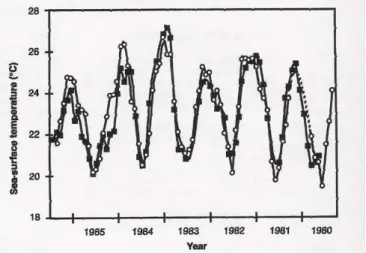
shells and coral skeletons was used for precise measurement of sea water temperature [1, 2]. Coral skeletons grows in the same way as trees and the difference in Sr/Ca ratio along the growing direction is related to the temperature of the water surroundings at the respective time ( Fig. 1).
FIG. 1: Sr/Ca relation of coral skeletons against sea temperature. Fig. from [1].
In this way, Sr/Ca ratio from sea shells and coral skeletons can be used as historical data of sea water temperature. The results show great agreement if compared to satellite data, Fig. (2).
So, the initial idea of our studies was to relate Sr/Ca ratio of human, bovine and swine teeth with body respective temper-ature. Teeth, as bones, are mainly composed by another cal-cium crystal called hydroxiapatite (Ca10(PO4)6(OH)2). Each
FIG. 2: Sea water temperature from Sr/Ca ratio from coral sketeton results and satellite data along the years. Fig. from [2].
species has a different body temperature. For humans, its a-verage is 36,9(6)◦C [3], for bovine, temperature average is
39,0(5)◦Cand for swine, its average is 39,0(10)◦C[4]. The
average values for Sr/Ca resulted of irradiation of 30 samples (enamel and dentine) can be seen in Figs. 3 and 4.
It can be observed that the angular coefficient from data prescuted in Sr/Ca×T plots from Figs. 1, 3 and 4 have
oppo-site signs. These results show that probably strontium quantity in hydroxyapatite is dependent of some other parameters that can hide temperature effects.
One of these parameters is feeding habits [5, 6], that wasn’t controlled in our samples. To eliminate feeding effects it was decided to compare Sr/Ca of bones from the same individual. For every vertebrate, independent of its thermoregulation pattern (endothermic or ectothermic), there is a variation of temperature along the body. Usually the warmest parts are the parts closer to the heart and to the brain, and the coldest are the extremities, as feet [7].
P. R. dos Santos et al. 1389
FIG. 3: Average of Sr/Ca (×10−3) ratio for dentine irradiation against body temperature. Human data is represented by a circle, bovine data by a square and swine data by a triangle.
35 36 37 38 39 40 41 0,0
0,2 0,4 0,6 0,8 1,0 1,2 1,4 1,6
Sr/Ca ( x10
-3 )
Temperature (˚C)
FIG. 4: Average of Sr/Ca (×10−3) ratio for enamel irradiation against body temperature. Human data is represented by a circle, bovine data by a square and swine data by a triangle.
Yacare), which specie regulates its body temperature uptaken heat from the environment (ectothermy) and probably has a bigger range between the warmest and the coldest parts of the body than an endothermic animal.
II. EXPERIMENTAL FACILITY
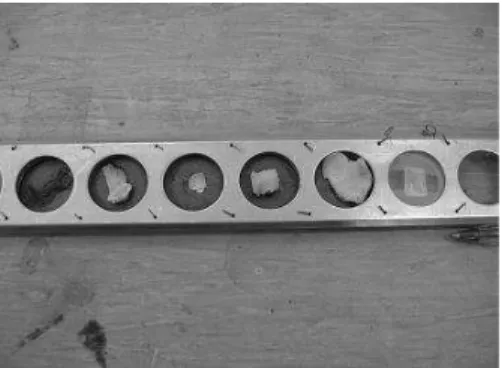
Regular PIXE analysis were performed at the Laboratory for Material Analysis by Ion Beams at University of S˜ao Paulo (LAMFI-USP), using a 2.4 MeV proton beam. The pieces irradiated were a bone from one leg, three from the different points of vertebral column (see figure 5) and two from the tail. The samples were fixed in carbon targets and mounted in a multiposition target holder at the center of the PIXE vacuum
FIG. 5: One of the bones irradiated from the spinal column.
FIG. 6: Bones ready for irradiation in the multiposition target holder.
FIG. 7: Multiposition target holder in the center of the PIXE cham-ber.
1390 Brazilian Journal of Physics, vol. 36, no. 4B, December, 2006
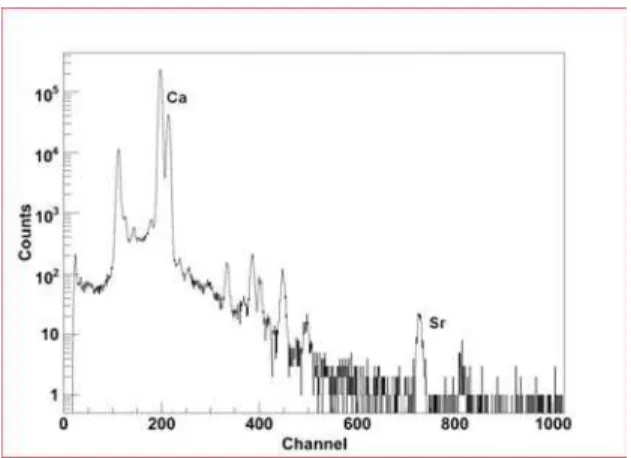
FIG. 9: Energy espectrum from one of the irradiations using ROOT code.
FIG. 10: Schematic draw of Sr/Ca quantities in crocodile bones.
chamber as it can be seen in Figs. 6 and 7.
Two Si(Li) detectors with resolutions around 150 eV for 6.4 KeV were used to collect the X-rays emitted by the samples. An external view of the experimental setup is shown in Fig. 8.
III. PRELIMINARY RESULTS
All energy spectra were analyzed using ROOT code [8]. In Fig. 9 a typical X-ray energy spectrum can be seen.
The quantities of strontium and calcium were obtained inte-grating the respective peak areas and normalizing them by the number of incident particles (charge), thin film PIXE yields [9] and correction factors for thick target [10]. Uncertainties for Sr and Ca were evaluated using statistical considerations.
The results of preliminary irradiations can be seen in Fig. 10. It’s not difficult to see that there is a tendency of a lower Sr/Ca ratio closer to the heart region and a higher Sr/Ca ratio in the extremities, as we expected.
Acknowledgments
We would like to thank Dr. Manfredo H. Tabaknics for ideas and discussions. We also would like to thank FAPESP and CNPq for financial support.
[1] R. W. Buddemeier, R. C. Redale, and J. E. Houce, Science204, 404 (1979);
[2] J. Warren Beck et al., Science257, 644 (1992); [3] “Human Temperature”
http://www.icb.ufmg.br/∼neurofib/Engenharia/ Temperatura/processos%20biologicos.htm (2005); [4] “Animal Temperature”
http://www.saudeanimal.com.br/artigo97 print.htm (2005);
[5] M. Sponheimer et al., Journal of Human Evolutions48, 147 (2005);
[6] J. H. Burton and L. E. Wright, American Journal of Physical Anthropology96, 273 (1995);
[7] Reese E. Barrick and William J. Showers, Science 265, 222 (1994);
[8] Root code source: http://root.cern.ch/ (2005);
[9] M. H. Tabacniks, CLCPIXE.xls (2005). Private communication (2005).