Quasiparticle-Rotor Model Description of Carbon Isotopes
T. Tarutina1, A.R. Samana2, F. Krmpoti´c1,3,4, and M.S. Hussein1
1Departamento de F´ısica Matem´atica, Instituto de F´ısica da Universidade de S˜ao Paulo,
Caixa Postal 66318, CEP 05315-970, S˜ao Paulo, SP, Brazil
2Centro Brasileiro de Pesquisas F´ısicas, CEP 22290-180, Rio de Janeiro, Brazil
3Instituto de F´ısica La Plata, CONICET, 1900 La Plata, Argentina and
4Facultad de Ciencias Astron´omicas y Geof´ısicas, Universidad Nacional de La Plata, 1900 La Plata, Argentina
Received on 18 March, 2006
In this work we perform quasiparticle-rotor coupling model calculations within the usual BCS and the pro-jected BCS for the carbon isotopes15C,17C and19C using13C as the building block. Owing to the pairing correlation, we find that13C as well as the cores of the other isotopes, namely14C,16C and18C acquire strong and varied deformations. The deformation parameter is large and negative for12C, very small (or zero) for
14C and large and positive for16C and18C. This finding casts a doubt about the purity of the supposed simple
one-neutron halo nature of19C.
Keywords: 13C,15C,17C,19C nuclei; Energy spectra; Particle projected BCS model; Core excitation; Quasiparticle-rotor model
I. INTRODUCTION
Many experimental and theoretical investigations for over two decades were concentrated upon study of light nuclei near neutron drip line (see references in recent reviews [1, 2]). Pair-ing correlations play an important role in the structure of these nuclei, because of the proximity of the Fermi surface to the single-particle continuum. This gives rise to many interesting phenomena and creates a challenge for conventional nuclear structure models. The experimental evidence for theN=8 shell melting [3] and the appearance of the 1s1/2intruder state in11Be are famous indications of the complicated structure of light nuclei. In Refs.[4, 5] it was shown that the increase in pairing correlations and the shallow single-particle potentials for nuclei close to the driplines may result in a more uniformly spaced spectrum of single particle states.
To mention a few recent works on this subject, a series of interesting articles appeared in the literature which study the pair correlation in spherical and deformed nuclei near the drip line using a simplified HFB model in coordinate repre-sentation with the correct asymptotic boundary conditions. In Ref.[6] the effects of continuum coupling have been studied, it was shown that for small binding energies, the occupation probability decreases considerably for neutrons with low or-bital momentum. In Ref.[7] the weakly bound neutrons ins1/2 state have been studied. The effective pair gap was found to be much reduced compared with that of neutrons with larger orbital momentum. In the presence of pair correlations, the large rms radius was obtained for neutrons close to the Fermi level, thus favouring the halo formation.
Nowadays it is generally accepted that nucleus tends to form a halo when the valence particles are loosely bound and the relative angular momentum is small. In this case, the last nucleons and the core are to a large extent separable and there-fore these nuclei can be approximated as an inert core plus the halo formed by the valence particles. This supports the use of the cluster models for such systems. But for real nuclei, the admixtures between the core and valence particles have to
be taken into account. One of the simple models that include core degrees of freedom is acore + particle cluster model for one-neutron halo systems including core excitation via de-formation assuming a rotational model for the core structure [8, 9]. Although this model allowed successful description of the 1s1/2intruder state in11Be, it has a serious drawback as it does not treat Pauli Principle correctly.
In this work we incorporate the residual interaction be-tween nucleons moving in an overall deformed potential and perform a Bogoljubov-Valatin canonical transformations from particles to quasiparticles, thus modifying the band-head ener-gies and the non-diagonal particle core matrix elements. The resulting model is known as the quasiparticle-rotor coupling model (QRCM). The inclusion of pairing effects allows a cor-rect treatment of Pauli Principle. This model is then applied to the series of odd-mass carbon isotopes.
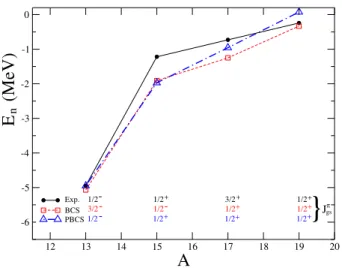
Heavy carbon isotopes have recently been studied exten-sively, and17C and especially19C are suggested to be candi-dates to possess neutron halo. To calculate the quasiparticle energies for13C and heavy carbon isotopes the BCS calcula-tion with particle projeccalcula-tion procedure was used (PBCS). It is known that in BCS formalism the number of particles is not conserved, which becomes a serious drawback for the case of light nuclei. It was shown in Refs.[12, 15], that the projection procedure is very important in such nuclei. The Fig. 1 shows the BCS and PBCS calculations confronted with experimental data, using the results obtained in [12], where we evaluate the ground states energies for the remaining odd-mass carbon iso-topes, by only modifying the numbers of neutrons:N=8,10 and 12 for15C,17C and19C, respectively. One immediately sees that the pairing interactions account for the main nuclear structure features in these nuclei.
II. THE QRCM MODEL
in-12 13 14 15 16 17 18 19 20
A
-6 -5 -4 -3 -2 -1 0
E (MeV)
Exp. BCS
PBCS1/2 1/2 1/2 1/2
3/2 1/2 1/2 1/2 1/2 1/2 3/2 1/2- + + +
--
-n
+
+ +
+ +
}
Jπgs
FIG. 1: Comparison between the experimental and the calculated ground state energies in BCS and PBCS in odd mass carbon isotopes. The experimental data were taken from Ref. [10] for13C,15C, and Ref. [11] for17C and19C.
teraction between nucleons is neglected (see, for example, Refs.[9, 13, 14]). The core is assumed to be an axially sym-metric rigid rotor. The Hamiltonian of the core-neutron sys-tem can be written as
Hp−rot=Hsp+Hrot+Hint, (1) whereHsp=T+U0 is single-particle (shell-model) Hamil-tonian, that is the sum of central Woods-Saxon potential and standard spin orbit interaction, whose eigenvaluesejare spec-ified by the particle angular momentumj. We consider here the quadrupole deformation only, specified by the deformation parameterβ. In this case, the core-neutron coupling hamil-tonian
Hint=−βk(r)Y20(θ′,0); k(r)≡r dU0(r)
dr , (2)
wherek(r)is the radial part of the interaction.
The total angular momentum isI=j+R (in this work we consider onlyI=0,2) and the coupling betweenjandR is evidenced in the weak-coupling representation of the total wave function, which reads
|jR;IM=
∑
MR,m
(jmRMR|IM)|jm|RMR, (3)
where|RMRis the rotor wave function. The matrix elements of the Hamiltonian (1) are:
j′R′;IM|Hp−rot|jR;IM=
2R(R+1)
2
J
+ejδRR′δj j′
−β(−)j′+R+I√2R+1(R020|R′0) I R′ j′
2 j R
j′||kY2||j.(4)
The resulting eigenfunctions are of the form:
|In=
∑
jRCIjR|jR;I, (5) with energies
E
In, and where theCIjR are constants that re-sult from the solution of the coupled channel system of equa-tions obtained by substituting the total wave function into the Sch¨oedinger equation and projecting out the basis wave func-tions.
We now incorporate the residual interaction,Vres, between nucleons moving in an overall deformed potential. The total Hamiltonian becomesHqp−rot =Hp−rot+Vres. After carry-ing out a Bogoljubov-Valatin canonical transformation from particle to quasiparticle operators, one gets that the matrix elements ofHqp−rot for odd-mass systems continue being of the form (4), except for (i) the band-head energies for a par-ticle state are modified asej→Ej in BCS, andej→εKj in PBCS, whereEj is the quasiparticle BCS energy, andεKj = RK
0(j)+RK11(j j)
IK(j) −
RK
0
IK, where quantitiesRK andIK, forK=Z,N,
are defined in Ref.[15]; and (ii) the non-diagonal matrix ele-ments are renormalised by the following overlap factors
F
j′j = uj′uj−vj′vj(BCS) or= uj′ujI
K(j′j)−v
j′vjIK−2(j′j)
[IK(j′)IK(j)]1/2 (PBCS), (6)
whereuj andvjare the occupational numbers for the state j.
IK(j′j),IK−2(j′j))andIK(j)are the PBCS number projection integrals (see Refs.[12, 16]).
The energies to be confronted with the experimental data are
BCS PBCS State
ε(+)I
n λ+εIn ε
N
In particle
ε(In−) λ−εIn −ε
N−2
In hole
whereλis the BCS chemical potential. Of course, in the re-sulting quasiparticle-rotor coupling model (QRCM) the state
en-ergiesε±j are quite different from the single-particle energies ej. Second, the factors
F
j j′ correctly take into account the Pauli principle. In addition, the particle-like states do not cou-ple to the hole-like states. As a brief test, in Fig. 2 we show a comparison of the energy levels for13C and11Be in the Pure Rotor Model with those in the QRCM: Rotor+BCS and Ro-tor+PBCS as a function of the parameter of deformationβfor the single particles taken from the Vinh-Mau’s work [17] for 13C and11Be. From a careful scrutinising of the energy levels in Fig. 2, one can easily convince oneself that, none of our particle-rotor coupling calculations is able to reproduce the experimentally observed spin sequence 1/2+−1/2−−5/2+ in11Be, for such a value ofβneither positive nor negative. The constant of pairing for 13C is vs =37.80 in both BCS and PBCS, while that in11Be they arevs=21.02 in BCS and
vs=24.25 in PBCS.
III. RESULTS AND CONCLUSIONS
In our procedure we use the nucleus13C as a building block of the calculation, assuming core12C deformationβ=−0.6. In our calculations we adjust the single particle state energies ej(for 1p3/2, 1p1/2, 1d5/2and 2s1/2) so that the resulting qua-siparticle energies including the core excitation give correct binding energies of four bound states in13C. The same set of single particle energies are then used in PBCS calculation to obtain quasiparticle energies of15C,17C and19C, occupation numbers for the states in these nuclei and the reduction fac-tors of the matrix elements. Subsequently, the quasiparticle energies and reduction factors then enter the coupled channel system to include core excitation and give the binding ener-gies of15C,17C and19C. For15C,17C and19C we adjust the deformation parameterβto obtain a correct one-neutron sep-aration energy in each of the isotopes. Using this deformation parameter we calculate the energy of the first excited state. For simplicity, in the present calculation we use fixed values for averaged radial matrix elements between different states, that is,j′|k(r)|j=25, 30 and 35 MeV. These values provide a reasonable estimation of non-diagonal part of the interaction and correctly reproduce the spin-orbit splitting between initial single-particle 1p3/2and 1p1/2states. The energies obtained within the Rotor+PBCS model on different carbon isotopes fork(r)=25 MeV (all energies are in MeVs) are presented in the Table I.
The results for the odd-mass carbon isotopes can be sum-marised as:
15C: In our calculation we obtain a zero deformation for the core 14C in case of k(r)=25 MeV and a binding en-ergy of 1.25 MeV. The calculation with larger average matrix element 30 and 35 MeV, gives an oblate shape with defor-mation parameter equal to -0.23 and -0.32 respectively. (In this calculation we introduced a lower 2+rotational energy in 14Cε
2+ =3 MeV). This confirms the idea that the core nu-cleus14C is nearly spherical and supports the possibility of halo formation for15C. Finally, our calculation also predicts a
first excited state 52+with the binding energy -936 keV, -991 keV and -867 keV fork(r)equal to 25 MeV, 30 MeV and 35 MeV, respectively. The binding of the first excited state is overestimated in our model.
17C: Small separation energy of17C 0.728 MeV suggests a possible halo structure of this isotope. There is an uncertainty about ground state spin assignment for this nucleus. In our model we obtain12+ground state for17C, although the exper-imental value is32+[11]. A simple explanation for this experi-mental result could be found in the so calledJ=j−1 anomaly discussed by Bohr and Mottelson [18]. Core-particle calcula-tions without pairing similar to those in Ref.[13] used defor-mation parameterβ=0.55. We obtain theβequal to 0.505, 0.583 and 0.609 for average radial matrix elementk(r)equal to 25, 30 and 35 MeV, respectively. We see that the deforma-tion changes slowly with the value of the matrix element and is rather large. The first excited state of17C in our model is 5
2
+
state. The binding energy of this state is as follows: -0.616 fork(r)=25 MeV, -0.527 MeV fork(r)=30 MeV and -0.430 fork(r)=35 MeV. These energies are close to the experimental separation energy of -0.433 MeV.
19C: Ground state with spin-parity 1 2
+
and small one-neutron separation energy favours the formation of the halo in 19C. In our analysis we adjust the deformation parame-ter in order to obtain the adopted separation energy of 0.58 MeV. Core-particle calculations without pairing used defor-mation parameterβ=0.5. Fork(r)=25,30 and 35 MeV we need, respectively,β=1.27,1.51 and 1.82. That is, we obtain very a large prolate deformation for the core18C. The first excited state we obtain to be 52+ state with the binding energy -0.21MeV (k(r)=25 MeV).
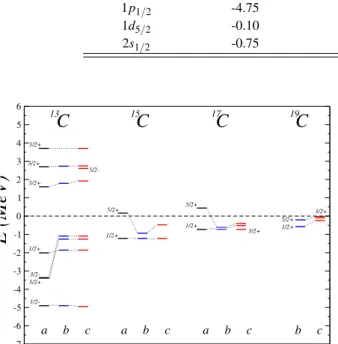
The Fig. 3 summarises the above results and compares them with the results of other models and experimental data.
Finally, in Fig. 4 we show the dependence of the deforma-tion parameter on the number of neutrons in the coreN for three values ofk(r). It is seen that in each case, the defor-mation changes from negative values (for cores12C and14C) to large positive values (for cores16C and18C). The depen-dence is nearly linear and crosses the zero deformation in the region of the core14C.
-15 -10 -5 0 5 -15 -10 -5 0
-1 -0.8 -0.6 -0.4 -0.2 0 0.2 0.4 0.6 0.8 1 β -15 -10 -5 0 Rotor Rotor+BCS 1/2 1/2 3/2 3/2 5/2 1/2 5/2 1/2
C
13 3/2 3/2 Rotor+PBCS 1/2 5/2 3/2 3/2E(MeV)
1/2 1/2 5/2 5/2 5/2 3/2 -1 1 1 1 -1 1 + + + + + -+ + -2 1 1 1 1 1 1 2 -1 1 1 1 1 1 + + --20 -15 -10 -5 0 5 10 -20 -15 -10 -5 0 5 10-1 -0.8 -0.6 -0.4 -0.2 0 0.2 0.4 0.6 0.8 1 β -20 -15 -10 -5 0 5 10 Rotor Rotor+BCS 1/2 1/2 5/2 1+ 5/2 1/2 1/2 3/2 Rotor+PBCS 1/2 5/2 3/2
E(MeV)
1/2 5/2 1/2 5/2 11Be
+ 3/2 3/2 1/2 3/2 3/2 + 2 1 2 3 2 1 -1+ + 1 -1/2 -2 3/2 1 2 -1 3/21 + + + -2 3 2 2 1 1 1 1FIG. 2: (Color online) Energies of the lowest states in13C and11Be as functions of deformation parameterβcalculated in the Pure Rotor model (middle panels), Rotor+BCS model(upper panels) and Rotor+PBCS(lower panels).
TABLE I: Energies obtained within the Rotor+PBCS model on different carbon isotopes fork(r)=25 MeV. All energies are in MeVs.
State 13C 15C 17C 19C
1p3/2 0.63 6.95 9.66 11.86
1p1/2 -4.75 1.92 4.38 6.32
1d5/2 -0.10 -0.94 -0.30 0.32
2s1/2 -0.75 -1.25 -0.36 0.45
-7 -6 -5 -4 -3 -2 -1 0 1 2 3 4 5 6
E (MeV)
3/2+ 1/2+a b c 5/2+
3/2+
5/2-a b c b c 5/2+ 1/2-5/2+ 3/2-1/2+ 3/2+
a b c
C C C C
13 15 17 19
5/2+
1/2+
5/2+ 1/2+ 3/2+
FIG. 3: Comparison between the calculated (a) core-particle, (b) QRCM, and (c) experimental level scheme for odd mass carbon.
5 2
+
first excited state. For15C we obtain zero or small oblate deformation. For17C large prolate deformation is given. Fi-nally19C has a very large prolate deformation, indicating that the nature of this nucleus is more complicated than the simple one-neutron halo picture of this nucleus would suggest.
The further analysis of this model and the details of its application to describe the low-lying spectra of light nuclei model will be presented in our next work [19].
12 14 16 18
N
−1 0 1 2β
<k(r)> = 25 MeV <k(r)> = 30 MeV <k(r)> = 35 MeV
FIG. 4: The adjusted value of deformation parameterβof cores12C,
Acknowledgments
F.K. acknowledges the support of the CONICET, Ar-gentina. A.R.S. appreciates support received from Conselho
Nacional de Ciˆencia e Tecnologia (CNPq) and Fundac¸˜ao de Amparo `a Pesquisa do Estado do Rio de Janeiro (FAPERJ). T.T. and M.S.H. would like to thank Fundac¸˜ao de Amparo `a Pesquisa do Estado de S˜ao Paulo (FAPESP) and CNPq.
[1] B. Jonson, Phys. Rep.389, 1 (2004).
[2] A.S. Jensen, K.Riisager, D.V. Fedorov, and E. Garrido, Rev. Mod. Phys.76, 215 (2004).
[3] H. Iwasakiet al., Eur. Phys. J. A13, 55 (2000).
[4] J. Dobaczewski, I. Hamamoto, W. Nazarewicz, and J.A. Sheikh, Phys. Rev. Lett.72, 981 (1994).
[5] J. Dobaczewski, W. Nazarewicz, T.R. Werner, J.F. Berger, C.R. Chinn, and J. Decharg´e, Phys. Rev. C53, 2809 (1996). [6] I. Hamamoto and B.R. Mottelson, Phys. Rev.C 68, 034312
(2003).
[7] I. Hamamoto and B.R. Mottelson, Phys. Rev.C 69, 064302 (2004).
[8] F.M. Nunes,Core Excitation in Few Body Systems: Applica-tion to halo nuclei, (PhD thesis, University of Surrey, 1995, unpublished).
[9] F.M. Nunes, I.J. Thompson, and R.C. Johnson, Nucl. Phys. A596, 171 (1996).
[10] F. Ajzenberg-Selove, Nucl. Phys. A433, 1 (1985) ; TUNL Nuclear Data Evaluation Project, available WWW: http:// www.tunl.duke.edu/nucldata/
[11] Z. Elekes, Z. Dombradi, R. Kanungo, H. Baba, Z. Fulop, J. Gibelin, A. Horvath, E. Ideguchi, Y. Ichikawa, N. Iwasa, H.
Iwasaki, S. Kanno, S. Kawai, Y. Kondo, T. Motobayashi, M. Notani, T. Ohnishi, A. Ozawa, H. Sakurai, S. Shimoura, E. Takeshita, S. Takeuchi, I. Tanihata, Y. Togano, C. Wu, Y. Yam-aguchi, Y. Yanagisawa, A. Yoshida, and K.Yoshida, Phys. Lett. B614, 174 (2005).
[12] F. Krmpoti´c, A. Mariano, A., and A. Samana, Phys. Lett. B541, 298 (2002).
[13] D. Ridikas, M. H. Smedberg, J. S Vaagen, and M. V. Zhukov, Nucl. Phys. A628, 363 (1998).
[14] T. Tarutina, I.J. Thompson, and J.A. Tostevin, Nucl. Phys. A
733, 53 (2004).
[15] F. Krmpoti´c, A. Mariano, A., and A. Samana, Pys. Rev. C71, 044319 (2005).
[16] F. Krmpoti´c, A. Mariano, T.T.S. Kuo, and K. Nakayama, Phys. Lett. B319, 393 (1993).
[17] N. Vinh Mau, Nuc. Phys. A582, 33 (1995).
[18] A. Bohr and B.R. Mottelson,Nuclear Structure, vol.II, (W.A. Benjamin, Inc. 1975).