1354 Brazilian Journal of Physics, vol. 36, no. 4B, December, 2006
Low-Energy Levels Calculation for
193Ir
Guilherme Soares Zahn, Cibele Bugno Zamboni,
Instituto de Pesquisas Energ´eticas e Nucleares, Caixa Postal 11049, 05422-970, S ˜ao Paulo, SP, Brazil Frederico Antonio Genezini,
Centro Regional de Ciˆencias Nucleares - CRCN-CNEN/PE Joel Mesa-Hormaza, and Manoel Tiago Freitas da Cruz
Instituto de F´ısica da Universidade de S˜ao Paulo, Caixa Postal 66318, 05315-970, S ˜ao Paulo, SP, Brazil Received on 18 March, 2006
In this work, a model based on single particle plus pairing residual interaction was used to study the low-lying excited states of the193Ir nucleus. In this model, the deformation parameters in equilibrium were obtained by minimizing the total energy calculated by the Strutinsky prescription; the macroscopic contribution to the po-tential was taken from the Liquid Droplet Model, with the shell and paring corrections used as as microscopic contributions. The nuclear shape was described using the Cassinian ovoids as base figures; the single particle energy spectra and wave functions for protons and neutrons were calculated in a deformed Woods-Saxon po-tential, where the parameters for neutrons were obtained from the literature and the parameters for protons were adjusted in order to describe the main sequence of angular momentum and parity of the bandheads, as well as the proton binding energy of193Ir. The residual pairing interaction was calculated using the BCS prescription with Lipkin-Nogami approximation. The results obtained for the first three bandheads (the 3/2+ground state, the 1/2+ excited state at E≈73keV and the the 11/2− isomeric state at E≈80keV) showed a very good agreement, but the model so far greatly overestimated the energy of the next bandhead, a 7/2−at E≈299keV.
Keywords: Ir-193; Beta decay; Spectroscopy
I. INTRODUCTION
This work is a theoretical support for the experimental analysis of the excited states in193Ir populated by theβ−
de-cay of193Os [1].
The low-lying states in193Ir have been thoroughly studied and, although this nucleus is usually described as triaxially-deformed [2–5], it has also been recently described as a pro-late rotor [6]. Most of these theoretical studies describe rather well the binding energies of the 3/2+ ground state and the 1/2+excited state at 73keV, but fail to describe the negative-parity bandheads; in this regard, the best effort to this date seems to be the one by Drissi [7], where a variation of the Interaction Boson-Fermion Model(IBFM) describes to some degree the 11/2− isomeric state at 80keV and has the next bandhead, a 7/2−state, quite shifted from its original 299keV excitation energy, but still below 1MeV.
In this work, the low-lying states of193Ir were evaluated us-ing a sus-ingle-particle model in an axially-deformed potential, with pairing interaction corrections applied. The deforma-tion parameters in equilibrium were obtained by minimizing the total energy calculated by the macroscopic-microscopic method [8]. The single particle energy spectra and wave func-tions for protons and neutrons were calculated in a deformed Woods-Saxon potential [9], with the potential parameters for neutrons obtained from the literature [10] and the parameters for protons adjusted in order to describe the main sequence of angular momentum and parity of the bandheads, as well as the proton binding energy. The residual pairing interaction was calculated using the BCS prescription with the Lipkin-Nogami approximation [11].
II. THE NUCLEAR MODEL
A. Nuclear Deformation
The nuclear deformation was calculated using the macroscopic-microscopic method. Within this method, the to-tal energy is given by
Etot(ε,αˆ) =Emacr(ε,αˆ) +Emicr(ε,αˆ) (1)
whereεand ˆαare the deformation parameters.
The macroscopic term is given by the liquid drop model. The microscopic portion can be divided into two components: the contribution associated with the shell correction energy and the pairing contribution. In order to obtain the equilibrium deformation the total energy is minimized with respect to the deformation parameters. The Cassini ovaloid shape parame-trization was used, taking into consideration the terms associ-ated with the quadrupole(ε)and hexadecapole(α4)moments.
B. Single Particle Energies
The single particle states were calculated using the Woods-Saxon (W-S) potential. To determine the W-S potential twelve constants should be given, six for neutrons and six for protons: V0 depth of the central potential;
aso diffuseness parameter of the spin-orbit part;
Guilherme Soares Zahn et al. 1355
FIG. 1: Dependence of the total energy with the deformation para-meters.
r0−so radius parameter of the spin-orbit potential;
a diffuseness nuclear parameter; λ strength of spin-orbit interaction.
Several parameter sets have been proposed for the Woods-Saxon potential, usually determined by a global fit to various ground state nuclear properties ofβ-stable nuclei in a mass number range.
The Woods-Saxon potential consists of the central part Vcent, the spin-orbit partVsoand the Coulomb potentialVCoul
for protons:
VW S(r,z,ε,αˆ) =
Vcent(r,z,ε,αˆ) +Vso(r,z,ε,αˆ) +VCoul(r,z,ε,αˆ) (2)
where(r,z)are cylindrical coordinates.
The central part is defined in order to describe the density distribution function
Vcent(r,z,ε,αˆ) =
V0
1+edist(rα,z,ε,αˆ)
(3) wheredistis equal to the distance of a given point to the nu-clear surface.
The depth of the central potential is parameterized by:
V0=V0[1±0.063(N−Z)/(N+Z)] (4)
with positive signal for protons and negative for neutrons. The spin-orbit term is defined by
Vso(r,z,ε,αˆ) =λ
h 2Mc
2
∇V(r,z,ε,αˆ)·(σ×p) (5)
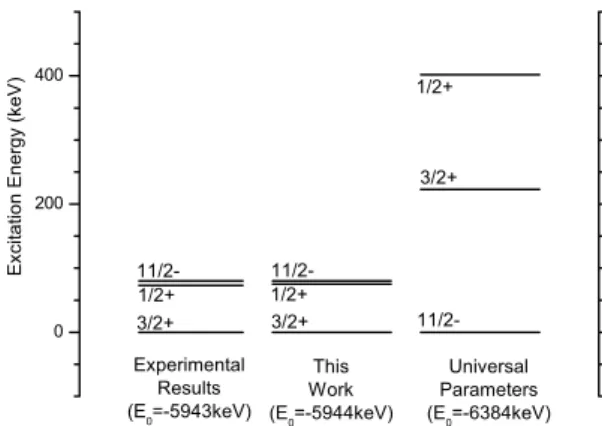
FIG. 2: Comparison of the experimental bandheads of193Ir to the calculations performed using the present set of parameters and to the calculations using the Universal Parameters from Cwiok [12].
whereMis the nucleonic mass, the vector operatorσstands for the Pauli matrices andpis the linear operator.
The Coulomb potential is assumed to be that corresponding to the nuclear charge(Z−1)e, uniformly distributed inside the nucleus. For the Hamiltonian diagonalization, the eigen-functions of an harmonic oscillator with axial symmetry in the cylindrical coordinates were used as a base.
The pairing energy was evaluated as in the commonly used prescription of the BCS approach. The hamiltonian operator in the BCS model contains two parts: the first corresponding to the single particle states and the second corresponding to the pairing interaction. If the particle term is diagonal, the BCS operator can be written in the formalism of the second quantization as
ˆ
H=Hˆsp+Hˆpair=
∑
εΩi
α†iαi+α†i¯α¯i
−
∑
Gjiα†jα† ¯
jα¯iαi (6)
Finally, the system of equations of this model is
EΩν=
nu
∑
i
εΩi+ nu
∑
i
1− εΩi−λν (εΩi−λν)2+∆2ν
−∆
2
ν
G (7)
where:
1356 Brazilian Journal of Physics, vol. 36, no. 4B, December, 2006
V0 r0 a r0−so aso λ (MeV) (fm) (fm) (fm) (fm) Universal
Parameters 49.6 1.275 0.70 1.32 0.70 36.0 [12]
Present 54.612 1.18992 0.70 1.27498 0.932 36.899 Work
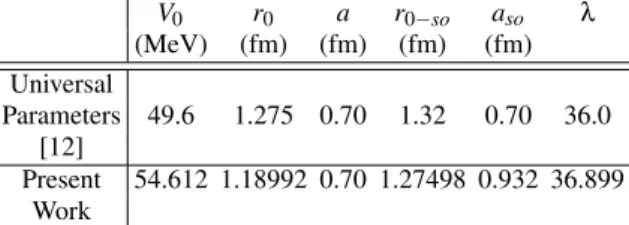
TABLE I: Parameters of the Woods-Saxon potential
III. RESULTS
The values of the deformation parameters that minimize the total energy areε=0.1102 andα4=−0.0404; the
represen-tation of the total energy dependence with these parameters is shown in Fig. 1.
The parameters of the W-S potential for neutrons were ob-tained from ref. [10], and the parameters for protons were adjusted in order to describe the main sequence of angular momentum and parity of the three lowest-lying single parti-cle states, as well as their binding energy; from these states it was then possible to calculate the quasi-particle states using
the LINDEN code [11]. The values obtained were compared to the parameters suggested by Cwioket al. [12], called Uni-versal Parameters(see Table I. In Figure 2, the present single particle states calculation is compared to the experimental re-sults from [1] and to the rere-sults obtained using theUniversal Parameters.
IV. CONCLUSIONS
Our calculations reproduced very well the ground state and the two lowest-lying states in193Ir, while theUniversal Para-meterscouldn’t even reproduce the ground state. The 11/2− state at 80keV, which has presented some problems in other theoretical explanations of this nucleus, in particular, was per-fectly reproduced, showing that it can indeed be explained in terms of an axially-symmetric potential.
The next step in this work should be to try to reproduce the next two bandheads in 193Ir, a 7/2− state at 299keV and a
3/2+state at 460keV, both of which were not included in the present analysis and presented serious trouble in other calcu-lations found in the literature [2–7].
[1] G. S. Zahn et al., Bras. Journ. Phys.35(3B), 1 (2005). [2] E. Bezakova et al., Nucl. Phys. A669, 241 (2000). [3] F. K. McGowan et al., Phys. Rev. C35(3), 968 (1987). [4] A. E. Stuchbery, Nucl. Phys. A700, 83 (2002). [5] A. E. Stuchbery, J. Phys. G25, 611 (1999).
[6] B. Roussire et al., Phys. Atom. Nucl.64(6), 1048 (2001). [7] S. E. Drissi, Nucl. Phys. A621, 655 (1997).
[8] F. Garcia et al., Comput. Phys. Commun.120, 57 (1999). [9] F. Garcia et al., Eur. Phys.J. A6, 49 (1999).
[10] Z. Lojewski et al, Phys. Rev. C51, 601 (1995).