THIS REPORT WAS PREPARED BY FABIAN BLOCHER, A MASTERS IN FINANCE STUDENT OF THE NOVA SCHOOL OF BUSINESS AND
ECONOMICS, EXCLUSIVELY FOR ACADEMIC PURPOSES.THIS REPORT WAS SUPERVISED BY SARA ALVES WHO REVIEWED THE
M
ASTERS IN
F
INANCE
E
QUITY
R
ESEARCH
The Airline industry struggles with declining ticket prices and strong competition. In 2015 passengers yields fell from 11.8 to 9.7 (in U.S. dollar cents) which could partly been offset by increasing passenger demand and a low oil price. However those effects were not enough to achieve a positive net profit in 2015. Moreover, within the first months in 2016, the stock of Avianca recovered 21.5% as the Colombian pesos appreciated slightly against the U.S. dollar and the oil price still remains on a very low level. Avianca presented Hernan Rincon as their new CEO and surprised with strong growth rates in passengers carried for the first months in 2016 (9.1% Y-o-Y.).
If the latest recovery can be continued depends on the development of the oil price, as well as if Brazil, the biggest economy in South America can turn upward and strengthen the demand for passenger transportation.
We see the fair value for Avianca at $6.10, which indicates an upside potential of 18.5% to the current stock price of $5.15. We believe the recent share price gives investors an opportunity to buy stocks of Avianca at a discount price to the real value of its current operations.
Company description
Avianca is a Colombian Airline that offers scheduled air passenger transportation services. The portfolio of Avianca ranges from domestic flights in South America to International flights to North-, and Central America as well as to Europe. Furthermore Avianca offers cargo transportation which accounts for roughly 14% of total revenues. The company was founded in 1919 and is headquartered in Panama City, Republic of Panama.
A
VIANCA
H
OLDINGS
S.A.
C
OMPANY
R
EPORT
T
RANSPORTATION
22
M
AY2016
S
TUDENT
:
F
ABIAN
B
LOCHER
[email protected]
Avianca on its way to old strength?
But shrinking yields in a difficult environment lesson
the arising euphoria
Recommendation: BUY
Price Target FY16: $6.10
Price (as of 22-May-16) $5.15
Reuters: AVH, Bloomberg: AVH:US
52-week range ($) 3.40-13.15
Market Cap ($m) 641.79
Outstanding Shares (m) 124.62
Source: Bloomberg
COLCAP vs. Avianca
Source: Bloomberg
(Values in $ millions) 2015 2016E 2017F
Revenues 4361.3 4497.3 4791.3
EBITDAR 767 775 885
Net Profit -139.5 50,3 112.0
EPS -0,14 0.40 0.90
P/E - 12.8 5.73
ROE -10.2% 3.6% 7.6%
ROIC 4.0% 4.0% 5.0%
EBIT Margin 5.0% 4.7% 6.1%
Net Profit Margin -3.1% 1.9% 4.0%
Debt/EBITDAR 6.8 7.0 6.52
Net (debt) 3168 3197 3452
AVIANCA HOLDINGS COMPANY REPORT
Table of Contents
EXECUTIVE SUMMARY ... 3
INVESTMENT SUMMARY ... 3
COMPANY OVERVIEW ... 3
SHAREHOLDER STRUCTURE ... 5
REGIONAL ANALYSIS ... 5
DOMESTIC MARKETS ... 5
Colombia ... 5
Ecuador ... 8
Peru ... 9
INTERNATIONAL MARKETS ... 10
Caribbean and Central America ... 10
Intra Home Markets ... 12
Europe ... 13
North America ... 14
South America ... 15
KEY DRIVERS ...16
AVAILABLE SEAT KILOMETERS (ASK) ... 16
LOAD FACTOR ... 17
REVENUE AVAILABLE SEAT KILOMETER (RASK) ... 17
COMMODITY AND UTILITY PRICES ... 18
VALUATION ...19
VALUATION METHODOLOGY ... 19
DISCOUNTED CASH FLOW (DCF) AND WACC ... 22
ADJUSTED PRESENT VALUE (APV) ... 23
SCENARIO ANALYSIS ... 24
MULTIPLES ... 26
FINANCIAL ANALYSIS ...27
PROFITABILITY RATIOS ... 27
COVERAGE RATIOS ... 27
LEVERAGE RATIOS ... 28
COMPANY RATINGS ... 28
INVESTMENT RISKS ...29
APPENDIX ...31
FINANCIAL STATEMENTS ...35
AVIANCA HOLDINGS COMPANY REPORT
Executive summary
Investment Summary
The aviation industry is a huge market worldwide and about 1% of world GDP is spent on air transportation. In the last 20 years, costs for air transportation could be halved.1 However because the airline industry is highly competitive, most of the cost reduction only favoured customers with lower fares. Although worldwide passenger transportation demand is increasing and low oil prices strongly benefited airlines in the previous years, it but could not prevent airline stocks to have a negative return (YTD: -8.53%).2
The stock of Avianca underperformed the industry (YTD: -45.9%), which is mainly because of the difficult economic environment in South America as well as the depreciation of the Colombian Peso. In 2015 Avianca reported a negative net income of U.S. dollar 139.5 million.3
Shrinking ticket prices are a huge threat for the profitability of the airline industry and low cost carriers, as well as open skie agreements4 intensify the competition. If Avianca can return to black figures in 2016 and afterwards will depend if the company can increase its operations and cut its costs at a higher speed than the decrease in ticket prices.
Company Overview
Avianca belongs to the leading airlines in Latin America and shipped more than
26 million passengers in 2015. It operates a route network from its hubs in Bogota, San Salvador and Lima. Avianca offers flights to more than 100 destinations through domestic and international operations. Moreover, the airline offers cargo services through its flights, which are carried out through the bellies of aircrafts as well as through cargo planes. The company is headquartered in Bogota and is incorporated in Panama City. Its passenger operations are divided in 8 geographical segments, which are Colombia (domestic), Ecuador (domestic), Peru (domestic), Central America, Intra Home Markets, Europe, North America and South America. As it can be seen in figure 4, more than 50% of total passengers arise through domestic operations in Colombia. Followed by international flights to North America (14.05) and Central America (7.1%). Figure 2 shows the origin of Aviancas revenue, divided passenger and non passenger revenues. The share of non passenger revenues increased slightly in the past
1 Source: IATA Economic Performance of the Airline Industry 2015 – End Year Report. 2
Source: CSI Market; http://csimarket.com/Industry/Industry_Performance.php?ind=1102.
3 Which was mainly because of losses in foreign exchange of $177.5 million (see chapter investment risk). 4
Agreements between countries and continents that reduce market entry barriers for foregin airlines in a country.
Figure 2: Number of Passenger 2012-2015
Source: Avianca Annual Reports
Annual Report 2015
Avianca Guidance 2016
Analyst Estimate 2016 PAX growth 7,9% 3.0% - 5.0% 3,8% ASK growth 8,4% 3.0% - 5.0% 3,1% Load Factor 79,7% 78%-80% 79,0% EBIT 5,7% 5.5% - 7.5% 4,7%
Figure 1: Avianca Guideline vs Forecast
AVIANCA HOLDINGS COMPANY REPORT
few years (2011: 16.1% vs 2015: 20.7%). It is expected that this trend is going to continue, which is mainly driven due to shrinking yields in the passenger segments and increasing capacity in the cargo fleet.
Figure 4: Distribution of Passenger among Regions and Revenues in US$
Source: Analysts Valuation Model based on Annual Report Avianca 2011-2015.
Avianca generates a relatively high percentage of non-passenger revenues, which makes the company less vulnerable to downturns in one segment. In order to strenghten its position in the cargo segment, Avianca acquired a minority position of AeroUnion, a small mexican based company of cargo shippment in October 2014.
An other significant driver of revenue is the frequent flyer program Life Miles. In July 2015, Avianca announced to sell a 30% minority stake in LifeMiles B.V to Advent International for $347.5 million. The transaction had a positive impact on liquidity and leverage and reduced the debt to EBITDAR by ~0.6x. Advent International has a long lasting experience in South America and is considered as the biggest private equity firm on the continent. We expect the corporation to be bear fruits and give impulses to Life Miles, which recently stagnated in revenue growth.
Lately, Avianca named former Microsoft Latin America president Hernan Rincón
as their new CEO, replacing Alvaro Jaramillo Buitrago who served as an interims CEO after Fabio Villegas Ramírez stepped down in 2015. Hernan Rincón has served as CEO for Microsoft Latin America since July 2012, and was responsible for the long term business strategy of 46 countries. In most of which Avianca also operates. Due to its strong experience in Latin America, we expect Rincón to navigate Avianca well through its difficult business environment in the future. In 2010 Avianca completed a merger with Salvador based airline TACA. The holding since then benefits from its increased network, stronger brand and synergies. Experts describe the merger to be very successfull, which led to increased profits and an enlarged customer base. This merger drove the decision by LAN and TAN to create LATAM Airlines Group two years later, which is now
AVIANCA HOLDINGS COMPANY REPORT
the leading airline in South America and Aviancas strongest competitor in many regions.5
Shareholder Structure
Synergy Aerospace Corp. is the majority shareholder of Avianca. It holds 51.53% of its total outstanding shares.6 Synergy is an oil and aviation empire and is owned by Germán Efromovich a Brazilian entrepreneur. Synergy started acquiring shares in 2005, when Avianca was in bankruptcy proceedings. Furthermore Synergy acquires aircrafts in order to lease them to Avianca and TACA.7 Another significant shareholder is Kingsland Holdings, which holds about 14.46% of total outstanding shares. Due to a joint action agreement, Kingsland and Synergy hold a veto power over significant strategic and operating transactions.8 Kingsland is owned by the Salvadorian Roberto Kriete who is at the same time board member of the Mexican low-cost carrier Volaris. The airline focuses on central and north america. This is as well an important region for Avianca, as its revenue in north and central america combined make out of 30.3% of total revenues. Hence, Avianca and Volaris stand in direct competition in some routes. Because of the veto power that Kingsland hold, it is therefore not assured that actions will always be favorable for Avianca shareholders. Avianca Holding has 660.800.003 common shares and 340.507.917 preferred shares. Since 2011, the number of preffered shares has been increased continuously, whereas the amount of common shares has been decreased slightly. In average 161.804 shares of Avianca are traded daily, which ensures a high liquidity, and relatively low trading costs.
Regional Analysis
Domestic Markets
Colombia
Colombia is third largest economy in South America and its economy depends heavily on exports of petroleum, coffee and cut flowers. The drop in global economy prices has impacted the economy significantly. Its economy, the Colombian Peso depreciated by 56% against the U.S. dollar since 2014. In March 2016, the inflation hitted 7.6%, which is the highest rate since October
5 As measured by total passengers carried in 2015. 6
It holds approximately 78.1% of its common shares. Source: (Avianca Annual Report 2014).
7 In the Airline Industry it is very common to lease aircrafts, rather than buying them, which is also the reason that
EBITDAR is a better measure of profit than EBITDA.
8 Those transactions include: Mergers and consolidations, investments >$30 million, the business plan and annual
budget, capex > $120 million and issuance of voting stock. Source: Avianca Annual Report 2014.
12m. Ending 2014 2015 2016E
GDP growth 4,6% 3,1% 3,0% Inflation 2,9% 5,0% 7,6% Interest Rate 4,5% 5,8% 6,7%
Figure 5: Shareholder Structure
Figure 6: Key Macro Data Colombia
AVIANCA HOLDINGS COMPANY REPORT
2008. Though, the worldbank forecasts gdp to grow by 3.0 and 3.3% for 2016 and 2017 respectively.9
Looking at the number of carried passengers, Colombia is the biggest market for Avianca. In 2015, Avianca transported 14,0 million passengers through domestic flights in Colombia, which accounted for 52% of all carried passengers. $948 million in revenue (27.4% of total revenue) has been achieved through passenger operations in Colombia. However, this is less than in 2014 ($1.078 million), which is mainly because Avianca collects its ticket fares in Colombia in the local currency and the Colombian Peso depreciated strongly against the U.S. dollar. The devaluation of the currency can be observed by declining RASK (Revenue Available Seat Kilometer) from $0.21 (2012) to $0.15 (2015). However, the RASK is still on a relatively high level ($0.15), which reflects that the Colombian domestic market is a very profitable and important segment for Avianca.
Figure 8: Key Data by Avianca for the Colombian Market from 2012 - 2016
12 Months Ending FY 2012 FY 2013 FY 2014 FY 2015 FY 2016E
Number of Passengers (in k.) 11.340 12.396 13.603 14.025 14.782 RPK (in mil. USD) 4.546 5.022 5.664 6.288 6.561 ASK (in mil. km) 5.675 6.472 7.309 7.879 8.305
RASK (in USD) 0,21 0,20 0,19 0,15 0,15
Total Revenue (in mil. USD) 959 1.008 1.078 948 1.010
Source: Analysts Valuation Model based on Annual Reports by Avianca
As it can be seen in the table, Avianca is the biggest player in Colombia. Within the last years, it could stabilize a market share at about 58%. The biggest competitor of Avianca in Colombia is LATAM, which until 2012 operated as LAN. LATAM is a merger of the airlines LAN (Chile) and TAM (Peru) and the biggest airline in South America with a fleet consisting of 310 aircrafts (Avianca: 194 aircrafts). In Colombia, they have a market share of 18%. However, in the last years the holding could not extend its market position in Colombia. A relatively new competitor in the Colombian market is Viva Colombia, which started its operations in 2012 and already has about 12% market share. Viva Colombia is a low cost carrier, founded by Viva Aerobux (Mexico), Bolivar Group (Colombia) and Ryanair. They follow a Ryanair-like model, which means that if luggage is needed or a seat wants to be reserved, it has to be paid separetely. For people who do not need a a lot of luggage the offer therefore can be advantegous, as pure fares are lower. In a survey by Deloitte, 58% of the people stated that they do not see a significant difference in the service quality and would select the cheapest available option.10 Because of this mentality, low cost carriers gained substantial market shares in the last years. Copa Airlines (Panama) on the other
9 Source: World Bank; http://www.worldbank.org/en/publication/global-economic-prospects/data. 10
Source: Deloitte Report – Rising above the Clouds 2013.
Figure 7: Exchange Rate USD/COP
AVIANCA HOLDINGS COMPANY REPORT
hand lost significant market shares in the Colombian market. They used to hold about 15.2% in 2010, but meanwhile only play a minor role in Colombia (1.4%). However this is also a result of the group strategy to focus more on the international market. Copa Airlines claimed, that there is an irrational degree of competition in domestic markets.11
Figure 9: Market Share for Colombia (domestic) between 2010 and 2015.
Source: Own illustration based on Annual Report Avianca 2012-2015 and Centre for Aviation
There are also a few bus companies, that offer trips between the bigger cities, such as from Medellin, to Bogota and Cali. Because the ticket prices for flights became much cheaper in the previous years, bus companies lost competitivenes. Furthermore, the road network in big parts of Colombia is not on a very good standard, which makes travelling by bus less comfortable. Therefore we see the threat through substituaries to be relatively low and believe that the airline industry can gain further market shares in the transportation industry in Colombia.
In Colombia it will be a challenge for Avianca to hold its market share, as Viva Colombia is strongly increasing its capacities. Colombia has an expanding middle class that Avianca estimated will represent 51% of the country’s population in 2020, up from 31% in 2000.12 Based on the analysis, we assume that Avianca will struggle to keep their market share at 58%, but they will still profit significantly from the increasing demand of air transportation in Colombia.
11
Source: Centre for Aviation: http://centreforaviation.com/analysis/colombias-aviation-market-poised-for-more-rapid-growth-in-2013-led-by-vivacolombia-avianca--lan-101354.
12
AVIANCA HOLDINGS COMPANY REPORT
Ecuador
In Ecuador, 58% of exports arise from crude oil and related products to oil. Conclusively, Ecuador has taken a hard hit by the oil price collapse and the GDP growth stagnated in 2015.13 Ecuador uses the U.S. dollar as functional currency, hence its currency does not devalue if the economy is in a recession. Therefore the country can not boost economic activity by printing money. Based on the economic situation, the World Bank estimates that the GDP of Ecuador will fall by 2.0% in 2016.
Domestic transportation in Ecuador is a relatively small market of Avianca as it accounts for only 3.3% of total carried passengers. As it can be seen in the table below, Avianca could not increase the number passengers carried since 2012 and was conclusively forced to reduce its capacities (ASK). Furthermore, the revenue per available seat kilometer is very low in Ecuador, which is very untypical for a domstic market. However it indicates a high competition and very low ticket prices.
Figure 11: Key Data by Avianca for the Ecuadorian Market from 2012 - 2016
12 Months Ending FY 2012 FY 2013 FY 2014 FY 2015 FY 2016E
Number of Passengers (in k.) 978 729 857 852 825
RPK (in mil. USD) 505 447 436 484 464
ASK (in mil. km) 630 576 563 607 587
RASK (in USD) 0,13 0,11 0,13 0,11 0,11
Total Revenue (in mil. USD) 67 50 58 51 50
Source: Analysts Valuation Model based on Annual Reports by Avianca
In Ecuador, Avianca operates as AeroGal, which was acquired by Avianca in 2012. The main competitors in Ecuador are LATAM and Tame Airlines. Tame Airlines is a Ecuadorian state airline and operates 19 routes to 15 destinations. It dominates the Ecuadorian domstic market and has about 54.9% market share. Because of low air fares, Avianca shifted capacity away from the domestic market in Ecuador. Conclusively the market share of Avianca decreased from 29.9% in 2012 to 18.6% in 2015.
Except of to the galapagos islands (13% of ASK in Ecuador), there is a high competition between airlines and bus companies. The most frequent route is from the capital Quito, to Ecuadors biggest city, Guayaquil. It accounts for 56% of ASK in Ecuador and can easily be reached within 8 hours by bus. Very low ticket prices are hard to competet with for airlines, as bus companies offer fares of about $0,015/km. Avianca on the other hand offers its service for about $0.105/km (RASK, see figure 11). Because of the clearly cheaper ticket prices,
13
Source: Trading Economics; http://www.tradingeconomics.com/ecuador/exports.
Figure 10: Market Share Ecuador
AVIANCA HOLDINGS COMPANY REPORT
the short distances and the low purchasing power in Ecuador, we assume that the airline industry will lose further market shares in Ecuador.14
Based on a difficult economic environment, very low ticket prices, the dominant market power of the state airline Tame as well as the strong competition
through bus companies, we believe that Avianca will reduce its domestic operations in Ecuador furtherly.
Peru
Peru is the seventh largest economy in South America with a strong service sector that stems about 60% of total GDP. The country will elect a new president on 5th June and it is expected that it will be Keiko Fujimori that has a reputation of being very market-friendly.15 The World Bank expects the GDP of Peru to grow strongly between 3.3% in 2016 and 4.6% in 2018.16 The outlook for Peru is therefore much brighter than for its neighbor countries, which is also because of being less dependent on the oil price.
Within the last years, Avianca could clearly increase its influence in the domestic Peruvian airline market. Since 2012, the capacity rose by 29.3%. Conclusively, Avianca increased its route network and passengers. On the other hand, Avianca could not enlarge its revenue, which can be blamed on increasing competition and therefore shrinking ticket prices. Figure 12 gives an overview about key data in the Peruvian market from 2012 to 2016.
Figure 13: Key Data by Avianca for the Peruvian Market from 2012 - 2016
12 Months Ending FY 2012 FY 2013 FY 2014 FY 2015 FY 2016E
Number of Passengers (in k.) 976 1.225 1.209 1.242 1.324 RPK (in mil. USD) 630 785 734 815 860 ASK (in mil. km) 787 1.012 947 1.021 1.088
RASK (in USD) 0,12 0,12 0,12 0,09 0,09
Total Revenue (in mil. USD) 75 93 85 75 81
Source: Analysts Valuation Model based on Annual Reports by Avianca
Based on the economic development in Peru, the market can be seen as one of the most promising in South America. Avianca has identified the possibilities and steadily increased its capacity by 29.7% in the last 4 years, becoming the 3rd largest airline in Peru after LAN and Peruvian. Peruvian is the 2nd biggest player, that launched its operations in 2009 and focuses primarily on domestic operations. LAN is a part of LATAM and market leader in Peru. They dominate 62% of the domestic market and have one of their main hubs in the Peruvian capital Lima.17 Star Peru completes the market, which however could not
14 Source: Ecuador Living: http://www.ecuadorliving.com/2014/05/24/ecuador-purchasing-power-concerns.html. 15
Source: Focus Economics; http://www.focus-economics.com/countries/peru.
16 Source: World Bank; http://www.worldbank.org/en/publication/global-economic-prospects/data. 17
Further main hubs are Santiago, Sao Paulo and Bogota.
Figure 12: Market Share Peru
AVIANCA HOLDINGS COMPANY REPORT
increase its number of passengers in 2015 (-0.4%). Similar to Avianca, which ultimately could not significantely increase its number of passengers further and stagnated at about 1.2 million. This might be because of the very strong competition for market shares within LAN, Peruvian and Avianca.
Recently it could be observed that the strong competition resulted in lower ticket prices, which pressured the yield and operating margin of Avianca (RASK 2012 – 2015: -22.5%). However, we expect that Avianca is going to maintain its market share and will face the competition, as the market outlook in Peru is very
promising.
International Markets
Caribbean and Central America
The Caribbean and Central American market is defined by operations between Belize, Cuba, Domenican Republic, Panama, Costa Rica, Guatemala, Honduras and Nicaragua. In Q4 of 2015, the economy in Central America and the Caribbean expanded by solely 2.8%, which is the smallest rate in the last 4 years. Especially the service sector in Panama underperformed compared to previous years. The region grew by 3.2% in 2015 and for 2016, a GDP growth rate of 3.1% is expected. However, for the future, experts believe that the region will grow faster than Latin America, which is also based on benefits from the recovery in the United States.18
In 2015, Avianca achieved 6.5% of total revenues through operations in Central America. Its carried passengers accounted for 2.358 million, which is about 8.8% of all passengers. It can therefore be considered as one of Aviancas most important markets. Total revenues fell from $270 million in 2012 to $225 million in 2015, which is mainly a result of declining ticket prices in the region. An other cause for concern is the extremly low load factor in 2015, that only accounted for 70.5% and is therefore clearly the lowest among the different geographic segments by Avianca. Avianca increased the seating capacity significantly from 2013 to 2015 (24.3%) but could merely increase the number of passengers (6.6%) in the same period. Hence, we assume that Avianca will shift excess capacities from Central America in order to achieve a load factor between 78% and 80%, which will ensure profitable operations.19
18 Source: Focus Economics; http://www.focus-economics.com/regions/central-america. 19
Break Even Load Factor of Avianca accounts for 75.1% in 2015, see Chapter “Load Factor”.
AVIANCA HOLDINGS COMPANY REPORT
Figure 15: Key Data by Avianca for the Caribbean Market from 2012 - 2016
12 Months Ending FY 2012 FY 2013 FY 2014 FY 2015 FY 2016E
Number of Passengers (in k.) 2.205 2.211 2.300 2.358 2.510 RPK (in mil. USD) 1.776 1.843 2.016 2.027 2.417 ASK (in mil. km) 2.322 2.313 2.542 2.875 3.059
RASK (in USD) 0,15 0,15 0,14 0,11 0,11
Total Revenue (in mil. USD) 270 282 282 225 274
Source: Analysts Valuation Model based on Annual Reports by Avianca
As it can be seen in figure 16, the airline industry in Central America suffered significantely during the financial crisis, but could recover relatively quickly since then. In average it grew annually by 0.4% from 2005 to 2014.20 The aviation industry in Central America & the Caribbean is less clearly than in the domestic segments. Unlikely to in Colombia, Peru or Ecuador, the market is not dominated by a few players that hold the majority of the market share, but the 7 biggest airlines in the region only hold about 50% of the capacity. Almost 42% of the market is dominated by airlines that individually hold less than 3%. United Airlines and JetBlue Airways showed strong growth rates between 2010 and 2014 by 548% and 82.9% respectively. Combined with American Airlines, the group can be identified as Aviancas core competitors in Central America. It can be observed that US airlines are aiming to increase their influence in Central America, whereas non-US airlines are also expanding into the US.21 US airlines see potential in the growing middle class, which enables more and more people to travel for exploration and to visit friends. Because many countries are on islands, there is a relatively low competition by substitute transportation, such as buses. Increasing demand for passenger transportation can therefore almost solely be overtaken by airlines.
Figure 17: Airline Industry Market Shares in Central America
Source: Routes Online22
20 Measured in ASK (Available Seat Kilometers). 21
See Chapter North America.
22 Source: Routes Online
http://www.routesonline.com/news/29/breaking-news/246845/data-what-are-the-fastest-growing-airlines-in-the-caribbean/.
Figure 16: ASK growth Central America
AVIANCA HOLDINGS COMPANY REPORT
Based on this facts, we see the Caribbean and Central America to be a key market, where Avianca could potentially increase its market position significantely and profit from the growing economy in the region. On the other hand it is also a region that has been targeted by US carriers that belong to the biggest airlines in the world and have very strong financials.
Intra Home Markets
The home markets of Avianca exists of operations between Colombia, Ecuador, Peru, Salvador, Costa Rica, Guatemala. As it can be seen in the table, Avianca could continuously increase the capacity (ASK) in the segment by average 7.8% annually.
Figure 18: Key Data by Avianca for Intra Home Markets from 2012 - 2016
12 Months Ending FY 2012 FY 2013 FY 2014 FY 2015 FY 2016E
Number of Passengers (in k.) 1.786 1.971 2.070 2.118 2.210 RPK (in mil. USD) 3.037 3.241 3.435 3.650 3.912 ASK (in mil. km) 3.792 4.176 4.432 4.747 4.952
RASK (in USD) 0,11 0,12 0,11 0,09 0,09
Total Revenue (in mil. USD) 323 375 390 328 359
Source: Analysts Valuation Model based on Annual Reports by Avianca.
The Avianca Group currently has a 24% share of international flights from/to
Ecuador and is just 3% behind the LATAM Airlines Group (27%). TAME, which is the leader for domestic operations in Ecuador, is a relatively small player regarding international flights (7%). Moreover, significant positions are hold by Americal Airlines (12%) and Copa Airlines (16%). Avianca is slightly weaker in international passenger markets serving Peru. There they hold 13% and are therefore far behind LAN Peru (32%), but ahead of Copa Airlines (5%) and American Airlines (4%).23 24 Avianca recently announced to install a new route from San Andres (Colombia) to San Jose (Costa Rica) in order to strenghten its market position. In 2015, the market grew by 10.2% vs 2.7% by Avianca. Therefore, Avianca clearly underperformed the growth rate in the market, which account for 9.8 million passengers per year. Within its Home Segments, Avianca should pay attention to the low cost carrier Viva Colombia, that increased its international capacity to 300.000 seats in 2015 (Avianca: 4.7 million). Viva Colombia serves routes from Bogota to Lima, Quito and Panama City, which directly compete with Aviancas service. Their operations are so far not very profitable, as they only reached a load factor of 66% (Avianca: 79.5%), but the company still has some time to reach maturity and already demonstrated its
23 Source: Centre For Aviation;
http://centreforaviation.com/analysis/avianca-market-share-in-ecuador-slips-as-domestic-operation-is-reduced-while-lan-and-tame-expand-128486.
24 Source: Centre For Aviation:
AVIANCA HOLDINGS COMPANY REPORT
ability in the Colombian domestic market to gain a high market share in a very short time.
Europe
Within Europe, especially the development of Spain and United Kingdom is relevant for Avianca, as the fleet approaches the cities Madrid, Barcelona and London. Europe faces a lot of challenges, such as the refugees that are streaming into the continent, the economic slowdown of its important trading partner China and a possible exit of the EU- member state Great Britain.
However, Europe is a very promising market for Avianca as they could boost the capacity from 4.134 ASKs to 6.746 in the last 4 years. Therefore carried passenger and revenues rose by 27.3% and 53.1% respectively.
Figure 19: Key Data by Avianca for the European Market from 2012 - 2016
12 Months Ending FY 2012 FY 2013 FY 2014 FY 2015 FY 2016E
Number of Passengers (in k.) 454 525 560 578 599 RPK (in mil. USD) 3.282 3.855 4.037 5.943 5.517 ASK (in mil. km) 4.134 4.753 5.169 6.746 6.983
RASK (in USD) 0,09 0,09 0,09 0,07 0,08
Total Revenue (in mil. USD) 288 336 379 441 419
Source: Analysts Valuation Model based on Annual Reports by Avianca
Recently in December 2015, members of the Schengen community eliminated the Visa requirements for Peruvian and Colombian citizen. This measure will allow more people to travel to Europe and will stimulate passenger traffic. However, leading European airlines, such as Air Europa, Tap, British Airways
and Iberia already reacted and reduced ticket prices in order to overtake market shares. Though, Avianca responded by increasing the weekly frequencies from 3 to 5 in the route Cali-Madrid and from 4 to 7 in the route Bogota-London.25 Particularly Iberia is considered as a direct and important competitor for Avianca, as the Spanish airline, similar to Avianca has daily flights from Bogota to Madrid and from Lima to Madrid.
We assume that Avianca will increase its capacities further to the European market in order to not miss the increasing passenger demand between the continents. Due to the increased capacity we expect the Load Factor to adjust from 88.0% in 2015 to 79% in 2016 and onwards. Furthermore, because of the lower ticket prices, we see the RASK on a low level between $0.07 – 0.08$ in the long run.
25
AVIANCA HOLDINGS COMPANY REPORT
North America
The North American market is defined as United States, Canada and Mexico. The economy of the United States is the biggest in the world and is expected to grow by 2.5% in 2016 and 2.4% in 2017.26 In December 2015, The FED increased the interest rate the first time after 10 years, but recently announced that it will be very careful by increasing the interest rate further.27
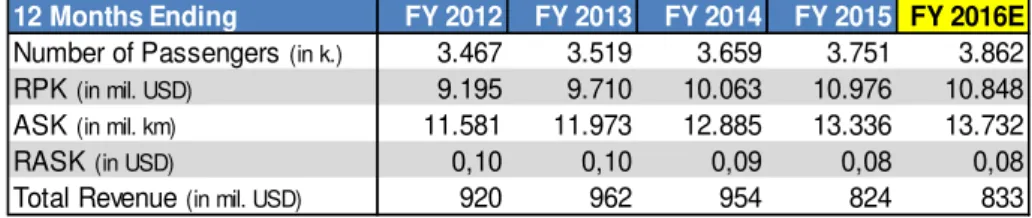
The North American market is crucial for Avianca, as it covers a population of nearly 530 million people. Almost one quarter of passenger revenues arise from international operations to North America (23.5%). Avianca maintains huge capacities from and to North America and is the largest foreign carrier in Miami, which from South America is seen as the most important destination in the United States (Avianca: 42 departures per week).
Figure 21: Key Data by Avianca for North America from 2012 - 2016
12 Months Ending FY 2012 FY 2013 FY 2014 FY 2015 FY 2016E
Number of Passengers (in k.) 3.467 3.519 3.659 3.751 3.862 RPK (in mil. USD) 9.195 9.710 10.063 10.976 10.848 ASK (in mil. km) 11.581 11.973 12.885 13.336 13.732
RASK (in USD) 0,10 0,10 0,09 0,08 0,08
Total Revenue (in mil. USD) 920 962 954 824 833
Source: Analysts Valuation Model based on Annual Reports by Avianca
In 2015, Avianca launched new routes from Bogota to Los Angeles and from Lima to Cancun. Moreover, Avianca announced that it will extend its operations to New York, starting from April 2016. Those measures go in line with the corporations strategy to continuously expand its capacity and market share in the region.28 However, at the same time the routes are highly competitive and more airlines are trying to achieve higher market shares. First in line is Viva Colombia, that recently launched new routes from Bogota and Medellin to Miami. Although the market share of the low cost airline is still very low, it may increase its operations further, if the current routes prove to be prosperous. Besides the already strong competition with American Airlines, United Airlines and Delta, there is Jet Blue (currently 3.9% market share) that is planning a new international push into Central America, launched new operations between Bogota and Fort Lauderdale and could increase its seats by 19.4% in 2015.29
26
Source: World Bank; http://www.worldbank.org/en/publication/global-economic-prospects/data.
27 Source: ABC; http://www.abc.net.au/news/2016-03-17/us-federal-reserve-scales-back-its-rate-rises/7253820 28
It will be operating 3 times a week, starting from April 2016. Source: http://airlineroute.net/2016/02/17/av-bogjfk-s16/.
29 Source: Airline Leader;
http://www.airlineleader.com/categories/regions/latin-america-remains-a-bright-spot-for-us-airlines-216113.
12m. Ending 2014 2015 2016E
GDP growth 1,5% 2,4% 2,5% Inflation 1,6% 0,1% 1,0% Interest Rate 0,25% 0,5% 0,5%
Figure 20: Key Macro Data USA
Figure 22: Market Share North America
AVIANCA HOLDINGS COMPANY REPORT
South America
In 2015 the region suffered a strong economic downturn. Brazil and Venezuela accounted for the lion share of the recession where its political leaders, Dilma Rousseff and Nicolas Maduro are claimed to be responsible. High inflation, increasing unemployment rate and shrinking GDP hit Brazil, which is the biggest economy in South America. Brazil as a part of the BRICS countries used to be named as one of the most promising economies in the world.30
Within the South American market, Brazil is the most important country for Avianca, as operations to Brazil account for almost 50% of the capacity. Besides of Ecuador, South America is the only geographical segment of Avianca that could not increase the number of passengers since 2012 (-9.2%). Moreover, Avianca lowered its exposure to the oil rich country Venezuela where it cancelled the route to Valencia and reduced its operations to the capital Caracas to 4 flights per day.31 This decision was also based on the fact that the inflation in Venezuela is among the highest in the world.32 This lead to strong losses in 2015, as Avianca had to depreciate a cash position that was hold in Venezuelan Bolivars (See Chapter Investment Risks).
Figure 23: Key Data by Avianca for South American from 2012 - 2016
12 Months Ending FY 2012 FY 2013 FY 2014 FY 2015 FY 2016E
Number of Passengers (in k.) 2.095 2.181 1.900 1.902 1.907 RPK (in mil. USD) 5.884 6.114 5.626 6.266 6.060 ASK (in mil. km) 7.411 7.539 7.204 7.651 7.671
RASK (in USD) 0,11 0,12 0,11 0,09 0,09
Total Revenue (in mil. USD) 643 761 641 566 559
Source: Analysts Valuation Model based on Annual Reports by Avianca
The market in South America, is mainly dominated by four players, which besides of Avianca are TAM, Gol and Azul. The Paraguayan airline Tam and the Brazilian Gol combined control about 72% of the market capacity. Avianca is a relatively small player, but could increase its market share slightly in 2015, achieving 9.4% vs 8.4% in 2014. Moreover, there is some hope, that the Olympic Games in Rio de Janeiro could boost the transportation demand in South America in 2016, but it prooved to be very limited during the world cup 2014 in Brazil.33
30
Source: Focus Economics; http://www.focus-economics.com/regions/latin-america.
31 Source: Avianca Annual Report 2015. 32
Source: Financial Times; http://www.ft.com/fastft/2016/01/22/imf-sees-venezuela-inflation-at-720-this-year/?ft_site=falcon&desktop=true, Inflation in 2016 is expected to account for 720% according to the IMF.
33
AVIANCA HOLDINGS COMPANY REPORT
Figure 24: Airline Industry Market Share 2014 vs. 2015 in Brazil
Source: Airline Leader34
We assume that Avianca will be able to maintain its capacities and number of passengers in 2016. South America is a market with a lot of potential for the airline industry, that has not been exploited fully in the last 3-4 years. There is hope that the new Brazilian president Michel Temer could bring the Brazilian economy back on a grow path and that an increasing oil price could furthermore strenghten the economy of the upper South American countries (Venezuela, Ecuador, Colombia). Avianca gains 15.8% of its revenues in this region and we believe that this segment has the biggest potential for a positive surprise.
Key Drivers
Available Seat Kilometers (ASK)
ASK is a measure of the flight capacity by an airline. It is the product of the number of seats available by the number of kilometers flown. In the previous years, the global airline demand grew constantly. Its revenues increased from US$369 billion in 2004 to $746 billion in 2014.35 The diagram shows the yearly passenger growth rates of Avianca and of the global market between 2005 and 2015. Except during the economic crisis from 2008 to 2009, the growth was consistently above 5%. On the one hand, this trend was driven by globalisation and higher demand by business travellers. On the other hand, less visa restrictions and lower ticket prices enabled the growing middle class to travel for leisure and exploring.
Figure 26: Growth of Global Airline Industry vs. Growth of Avianca
Source: Avianca Annual Report & IATA
34 Source: Airline Leader; http://www.airlineleader.com/categories/regions/brazil-its-raining-on-their-parade-270310?nc=1 35
Source: PWC; http://www.strategyand.pwc.com/perspectives/2015-aviation-trends.
Figure 25: ASK among Regions
AVIANCA HOLDINGS COMPANY REPORT
The pie chart adjoining illustrates the distribution of ASK (Available Seat kilometres) among regional segments in 2015. As it can be seen in figure 25, Avianca has its biggest capacities in North America (29.7%), followed by Colombia (17.6%) and South America (17.0%).
Load Factor
The load Factor indicates how many available seats in an airplane are occupied by paying passengers. It assesses how efficiently an airline fills its seats and generates revenue. In 2015, Avianca achieved a load factor of 79.9%. An important factor within the load factor concept is the break-even load factor. It is a percentage of seats that an airline has to sell at a given yield to cover its costs. In 2015 the break-even load factor of Avianca accounted for 75.1%, which indicates that a positive EBIT can be achieved if at least 75.1% of the seating capacity is utilized by paying passengers.36 Aviancas load factor spread in 2015 conclusively accounted for 4.8%. The higher the load factor spread the greater the EBIT. The average break-even load factor in the Latin American airline industry was 60.9% in 2015.37 . If demand is low in one region, airlines tend to shift the offer to other routes in order to have an adequate load factor that can cover costs.
The average load factor for international operations by Avianca accounted for 79.5% in 2015. This is slightly below the industry average (80.6%)38 but higher than the average value of its peers in South America (74.8%). As it can be seen in figure 27, domestic load factors tend to be higher than international load factors. Regarding the domestic load factor, Avianca underperforms its peers slightly 80.2% vs 81.0%. Avianca states to achieve a load factor in the long run between 78%-80%, which is line to our expectation of 79%.39
Revenue Available Seat Kilometer (RASK)
Revenue Available Seat Kilometer describes how much revenue can be achieved per kilometer per seat. It is determined by dividing total revenues by total available seat kilometers. The value is basically determined by how much customers pay for their tickets. It is a ratio that is widely used in the airline industry in order to compare different airlines by its profitability. LATAM, which is the biggest player in South America, reported RASK of 8.69 cents in 2015, vs. in average 10.89 cents by Avianca. As it can be seen in figure 29, RASK
36
This Factor includes solely passenger transportation and excludes revenues and costs through cargo and other segments.
37
Source: IATA; Economic Performance of the Industry end year 2015.
38 Source: International Air Transport Association; http://www.iata.org/pressroom/pr/Pages/2015-12-10-01.aspx. 39
Source: Avianca Annual Report 2015. Load Factor Domestic International
Avianca 80,2% 79,5%
LATAM 81,7% 83,3%
Viva Colombia 86,0% 66,0% Copa Airlines 75,2% 75,2%
Figure 27: Load Factor- Avianca & Peers
Source: Avianca Annual Report/Bloomberg
Figure 28: RASK – Avianca vs. Peers
AVIANCA HOLDINGS COMPANY REPORT
decreased among the regions, which was mainly because of a depreciation of the Colombian Peso against the U.S. dollar. Furthermore, increased competition that lead to shrinking ticket prices have been claimed to be a cause for the lower RASK. The diagrams also highlights that revenues per kilometer fluctuate over different segments. Domestic flights in Colombia, Ecuador and Peru tend to have higher revenues per kilometer than international flights to Europe or North America. The reasons are on the one hand a different extent of competition and on the other hand lower CASK (costs available seat kilometers) for longer flights due to economies of scale.
In the last years a trend in the airline industry has been observed which is a higher awareness and sensitivity to ticket prices and lower focus on extra services, such as extra luggage in the plane. This is especially notifiable in emerging markets where Avianca operates. That is also a reason for the success story of low cost carriers in the last years, which already control about 25% of the worldwide market. Especially in domestic flights, such as in Colombia, Ecuador or Peru, low cost carriers identified the customers wish to save money and do not include check-in baggage in the ticket price which therefore makes them optically cheaper.
Commodity and Utility Prices
Avianca is exposed to the volatility of commodities, such as to crude oil or jet fuel. It is an important factor for Aviancas profitability, as in 2015 aircraft fuel accounted for 25.2% of total costs. However because of declining oil prices, this share is currently relatively low and used to be at 33% in 2012. Absolute numbers in 2015 state that CASK (Total Costs Available Seat Kilometers) accounted for $9.53 vs. CASK ex. fuel of $7.13. The reasons for the decrease of the oil price are multifarious. On the one hand, demand from China is not as strong as it used to be. On the other hand, the supply remains on a very high level, as the OPEC is not finding an agreement to decrease the oil price. OPEC members, such as Saudi Arabia, Iran or Ecuador are afraid, if they lower the oil supply, non-OPEC members, such as the 2nd biggest oil producer Russia will take over market shares. Vagit Alekperov, a top Russian oil executive recently announced that there is very little chance of Russia ever agreeing to restrain output.40 Another factor that will drive the oil supply is the sanctions on Iran which have been lifted on January 16th. As Iran has around 158 billion barrels of oil reserves the market is expected to be flooded by cheap oil. Based on the political and economic environment, we expect the oil price to remain at a low level.41
40 Source: CNN; http://money.cnn.com/2016/04/20/news/economy/russia-oil-opec-lukoil-alekperov/. 41
Source: Vox; http://www.vox.com/2015/7/14/8962651/oil-prices-iran-nuclear-deal
Figure 29: Avianca RASK among Regions
Figure 30: RASK 2012- 2016
Source: Avianca Annual Report Source: Avianca Annual Report
Figure 31: CASK/CASK ex fuel
AVIANCA HOLDINGS COMPANY REPORT
In order to reduce its exposure to jet fuel price risk, Avianca enters into
derivative financial instruments using heating oil and jet fuel. Avianca decided to hedge 100% of the expected fuel consumption from September to December 2015. A fixed price of U.S. dollar 42 for WTI has been achieved. Backwards looking, we can state that it was a wise decision, as the oil price averaged between 45 and 50 U.S. dollars.42 Furthermore the oil price is strongly volatile to extreme events. Therefore, using financial instruments will make the operating result more foreseeable and less risky.
Figure 32: Distribution of Operating Costs in 2015
Source: Analysts Valuation Model, based on Avianca Annual Report 2015.
From 2017 to 2019, Avianca is planning to put 33 new airplanes of the type A320neo into operation. They promise to consume 15% less fuel than the existing A320 family. Hence, we expect Avianca to increase its fuel efficiency by 0.4% y-o-y for the whole fleet.43 Based on this assumption we assume, that consumption of gallons per ASK can be reduced from 9.63 in 2015 to 9.43 gallons per ASK in 2020 (see figure 33).
In 2015, Avianca successfully reduced the number of fleet families from 9 in 2010 to 4. This measure will reduce crew and staff training costs as well as lower expenses for maintenance.44
Valuation
Valuation Methodology
In order to evaluate a fair price for Avianca, an Adjusted Present Value Analysis (APV) and a Discounted Cash Flow (DCF) analysis have been performed. Furthermore, the results reliability has been verified by comparing with multiples
of a selected peer group.
APV is not as commonly used as DCF, but it is advantageous over DCF if a company operates in an emerging market, as it is the case for Avianca. On the
42
Avianca used a Call- Option and hedging expenses between U.S. dollar 5 million and 7 million accrued. See Appendix.
43 0.4% is the average increase of efficiency from 2011 to 2015. 44
Source: Avianca Annual Report 2015
Figure 33: Fuel Consumption/Efficiency
AVIANCA HOLDINGS COMPANY REPORT
one hand, no fixed debt ratio is needed, as the firm is valued without consideration to its leverage, also tax shields are calculated by discounting actual period by period tax savings. Moreover, it is not necessary to assume a constant corporate tax rate.45 Furthermore it is easier to track down where the value comes from and it is more flexible by adding other effects, such as costs of distress.46
Firstly we broke down the company in the eight different geographic segments of passenger transportation as well as forecasting separately cargo transportation and other non-passenger revenues. We believe that due to different operating margins in the segments, as well as different economic expectations, a more realistic value can be achieved by separating the segments. All forecasts are strongly based on existing macroeconomic expectations. Besides, the valuation has entirely been performed in US$, as it is the functional and reporting currency of Avianca.
Total Revenues
Initially we look at passengerrevenues: the revenue depends on the number of passengers and how much a passenger pays for its flight. In order to estimate the passenger growth we looked at the growth rate of GDP. The real GDP growth rate is adjusted for inflation and takes into account the growth of population in a country. As it can be seen in figure 34, there is a high correlation between the
GDP growth rate and the growth in number of passengers. For Europe and North America, we therefore assume that the growth in passengers will be equal to the growth in GDP. However, this assumption does not hold for the developing markets in which Avianca operates. As it can be seen in figure 35, the airline industry grew much faster than the GDP. Based on an analysis of the correlation in the last 10 years, we observed that the airline industry grew in average 1.7 times faster than GDP. Therefore we assume that passenger demand in developing countries will keep increasing 1.7 times faster than the GDP growth rate (this factor has been tested for sensitivity – see chapter scenario analysis). Based on the regional analysis in the previous chapter and the competition that Avianca faces, we made different scenarios, according to which we believe if Avianca can decrease, increase or sustain its market share in the respective region (for Details see Appendix 7). Based on this forecast, we expect that passenger demand will growth by 3.8% in 2016, which is within the guideline of Avianca (3%-5%).
45 Source: Jaime Sabal, WACC or APV- The Case of Emerging Markets. 46
Source: Finance Theory II (2003), Dirk Jenter.
Figure 34: Correlation Demand & GDP - Developed Market
Figure 35: Correlation Demand & GDP - Developing Market
Source: IATA & Avianca Annual Report
AVIANCA HOLDINGS COMPANY REPORT
As already mentioned in chapter “Load Factor”, we assume the load factor to
remain stable at 79% (Avianca guideline 78%-80%), which indicates that ASK
and number of passenger’s grow at the same pace. We believe this assumption to be realistic, as Avianca has the possibility to adjust its capacities according to passenger demand. To obtain the total revenue per segment, it is necessary to forecast RASK. As already explained previously, RASK determines how many revenue per available seat kilometer can be achieved. We cautiously believe that Avianca cannot increase ticket prices stronger than by the inflation rate.47
Moreover we analysed non passenger revenues, which mainly arise from cargo revenues and the frequent flyer program Life Miles. In order to forecast cargo revenues, we assumed the cargo load factor to remain stable at 60%, this is in line to a varying load factor between 63.9% in 2011 and 59.1% in 2015. According to a press release of Avianca, the company will continuously improve its cargo segment by adding the A330F aircraft to its fleet. It is able to carry 40% more cargo capacity than previous cargo fleets.48 Based on forecasts of Boeing, the cargo segment in South America is expected to increase between 4.8% (Latin America-Europe) and 5.2% (Latin America-North America) y-o-y (measured in ATK- Available ton kilometer).49 Because of the modernization in the fleet of Avianca, as well as the fact of having a cargo network hub in Bogota, we conservatively believe that Avianca will be able to increase its cargo
capacity by 4.5% annually in the next years.50 The largest competitors with respect to international cargo operations are LATAM and Centurion Air Cargo. Within the peer group of Avianca, the average load factor accounted for 42.4% in 2015, which is a sight for big excess capacities in South America. We assume that Avianca will not be able to increase cargo prices stronger than by the inflation rate. The share of domestic cargo revenue to international cargo revenue is assumed to remain stable at 0.54. Chart displays the evolution of revenues from 2012 to 2017F.
Operating Expenses
Accordingly we had to forecast the costs, which we broke down in 11 different cost categories.
We expect further operating expenses, such as for flight operations, ground operations, air traffic and aircraft rentals to growth at the same pace like ASK. Therefore we calculated the average share that these costs had in relation to
47 Inflation of U.S. dollar has been taken, under the assumption that a higher inflation in other currencies would cancel out
with depreciation in the exchange rate.
48 Cargo operations are carried out by Tampa Cargo S.A.S which is a 100% Subsidiary of Avianca based in the US. 49
Source: World Air Cargo Forecast; Boeing; Forecast 2013-2033 in Latin America-Europe
50 Source: Export.gov; http://www.export.gov/industry/aerospace/aerospaceresourceguide/colombia088797.asp. The
airport El Dorado in Bogota is the busiest airport for cargo transportation in South America.
Figure 36: Cargo Revenues
AVIANCA HOLDINGS COMPANY REPORT
ASK. Next we used a moving average of 4 years to forecast the costs. Sales and Marketing however is expected to growth with revenue, Avianca pays a commission of about 13.0% to intermediates for the sale of their tickets.51 Also we expect the salaries of Aviancas employees to grow by a moderate pace of 3.75% annually. Besides, we assume the number of employees that will be needed for operations to grow slightly between 2.47% and 2.54% per year in the long run.
According to a press release on 3rd of May, Avianca will reduce its CAPEX by about 50%. This reduction will start in 2016 and shall last at least for 3 years. In order to make this reduction possible, we assume that Avianca will hold a stable ratio of 105.5% (Property, Land and Equipment vs Total Revenues) in the following years.52
Moreover, depreciation is expected to be 4.5% per year of depreciable assets, which is in line to historical observations. Costs for maintenance and repairs depend on the number of aircrafts, which we forecasted accordingly to the order book of Avianca.
As already explained previously, a very important cost factor is jet fuel prices. It makes out for about 25.2% of total costs. The price depends heavily on where the fuel is being bought, which makes it very difficult to forecast. Prices range from $2.07 in Bogota to $1.29 per gallon in Sao Paolo.53 We expect Avianca to achieve an average purchasing price of $1.52 per gallon throughout the year. Moreover, we base this assumption on the fact that the average jet fuel price in 2016 is on a similar level as it was in 2015. The development of the jet fuel price can be seen in figure 37.
Based on revenues and costs, the income statement, cash flow statement and balance sheet have been forecasted. Forecasted operating cash flows, cash flows to the firm, as well as the capital structure are significant for the following valuation.
Discounted Cash Flow (DCF) and WACC
In order to obtain a value through DCF, it is necessary to identify an appropriate discount rate. Therefore we used the weighted average costs of capital (WACC).54
WACC
51
Average marketing costs divided by total revenues of the previous 5 years.
52 105.5% is based on the value for December 2015. 53
Source: Aeroportos; http://aeroportos.weebly.com/fuel-prices.html#.VyQSpkZuORg.
54
Formula:
Figure 37: Jet Fuel Price 2015 - 2016
AVIANCA HOLDINGS COMPANY REPORT
WACC exists of the costs for debt and for equity. Firstly we estimated the costs for equity which we determined with the CAPM. Initially we had to estimate a risk free rate, which brings up the problem of the absence of long-term default free bonds in Colombia. However, based on the facts that it is a valuation of an ADR, the U.S. dollar is the functional currency of Avianca and we forecasted cash flows with inflation of the U.S. dollar it is justified to use the risk free rate for the USA. Therefore we followed the rule that the inflation rate in cash flows and in the discount rate has to be the same.
Avianca operates in a region with high growth that is accompanied with significant macroeconomic risk. As we did not include the risk in the risk free rate, we had to include it separately in a country risk premium. As it can be seen in figure 38 we multiplied the different country risks with its market shares in Aviancas operations.55 Therefore we come up with a country risk premium of 3.23%. Furthermore we added the mature equity market risk that accounts for 6.25% in a mature market such as the airline industry. Additionally we obtained a
Beta by running a regression of daily market returns of Avianca (AVH) against the S&P500 for the last 2 years. According to the Beta, Avianca is slightly more volatile than the market (1.06). Therefore we obtain cost of equity of 11.8%.56 Additionally, cost for debt had to be calculated, which we obtained by the sum of the spread (4.5%) and the risk free rate (1.7%). The size of the spread is due to the Rating of Avianca (B). Conclusively we obtain costs of capital of 6.6% for 2016. As we did not assume the debt/equity ratio to stay stable over time, we furthermore forecasted the WACC y-o-y. The US inflation rate is expected to account for 1.7% in the long run. However, based on a conservative and careful approach we assumed the infinite growth rate to be at 1.2% after the forecasting period of 10 years.57 Furthermore the value of the corporation has been tested for its sensitivity to changing assumptions of the infinite growth rate (see chapter scenario analysis).
Adjusted Present Value (APV)
Moreover we evaluated the operations of Avianca with APV, which has already mentioned can be advantageous to DCF in emerging markets. APV is a method to value a company as if it were all-equity financed without consideration of its leverage.
55 Based on Revenue; the Country Risk Premium is based on relative equity volatility by provided by Stern.nyu and is
based on the default spread for the countries.
56 57
Further details regarding the valuation, see chapter Scenario Analysis.
CAPM
Rf 1,7%
Beta 1,06
Country Risk 3,2%
Mature Market Risk 6,3%
Equity Risk 9,5%
Cost of Equity 11,8%
WACC 2016
Cost of Debt 6,2%
Share Debt 79,3%
Cost of Equity 11,8%
Share Equity 20,7%
Tax Rate 0,25
WACC 6,6%
Cost of Debt
Spread 4,5%
Risk free Rate 1,7%
Rating S&P B
pre tax cost of Debt 6,2%
Figure 38: Country Risk Premium
AVIANCA HOLDINGS COMPANY REPORT
Firstly we unlevered the Beta (1.06) with the market debt/equity ratio of 3.6. Conclusively the unlevered beta accounts for 0.29. The CAPM results in 4.43% which serves as discount rate for cash flows to the firm.58 Discounting those cash flows resulted in a value of unlevered firm in the amount of $3046.2 million. Furthermore we added the tax shields which Avianca is assumed to gain throughout the years. They have been calculated by multiplying the tax rate with the costs of debt and the appropriate interest bearing debt of each year. Additionally those tax shields have been discounted by the cost of debt.
Moreover it is necessary to subtract costs for bankruptcy from the value of the levered firm. We estimate that in case of bankruptcy, 50% of the value can be recovered. According to S&P, 26.4% of firms with a B- Rating have been defaulted in a time horizon of 5 years. Based on these assumptions we obtain costs for bankruptcy of $402.1 million.
Scenario Analysis
In order to test for the sensitivity of the stock price, a sensitivity analysis has been performed. Three key factors have been identified that have a strong influence on the value of Avianca Holdings. Firstly to mention, there is the (1) infinite growth rate, which determines how Avianca is going to growth after the forecasted period. For the normal case we assumed a conservative value of 1.2%, which is below the target inflation rate of the U.S. dollar. As it can be seen in the table, it still has a strong influence on the stock price although we took already minimized the effect by taking a forecast period of 10 years.
Worst Case Bad Case Normal Case Good Case Best Case
Infinite Growth Rate 0,80% 1,00% 1,2% 1,40% 1,60%
Stock Price in US$ 4,17 5,24 6,44 7,80 9,35
Source: Analysts Valuation Model based on Valuation by APV.
Another important factor is the (2) Load Factor of Avianca, which is based on customer demand and is crucial for the profitability of the company. The higher the load factor the greater the profit. As it can be seen in the following table, the
company’s value is highly sensitive to the load factor. This is because, higher utilization can almost be considered as pure profit, as the marginal costs for an additional passenger in the airline industry are very low.
Worst Case Normal Case Best Case Load Factor 78,5% 79,0% 79,5% Stock Price in US$ 3,71 6,44 9,17
Source: Analysts Valuation Model based on Valuation by APV.
58
In contrast to DCF, where we used operating free cash flows, we used free cash flows to the firm for the evaluation of APV. The difference is the non-operating free cash flow that adjusts the operating free cash flow by financing activities.
Levered Beta 1,06 Market Debt / Equity 3,6 Risk free rate 1,7% Risk Premium 9,5% Unlevered Beta 0,29
Unlevered costs of Equity 4,43%
Rating Rate
AAA 0,0%
AA 0,3%
A+ 0,4%
A 1,4%
BBB 2,3%
BB 12,2%
B+ 19,3%
B 26,4%
CCC 46,6%
CC 65,0%
C 80,0%
D 100,0%
AVIANCA HOLDINGS COMPANY REPORT
Moreover, the (3) oil price has been tested regarding its influence on the stock price of Avianca. Fuel expenses account for 25.2% of Aviancas total costs. Its development is therefore fundamental for the value determination of the company. As it can be seen in the table, an increase between 2-4% has a significant impact on the value of the corporation.
Worst Case Bad Case Normal Case Good Case Best Case
Oil Price In US$/Gallon 1,56 1,54 1,52 1,5 1,48
Stock Price in US$ 3,37 4,90 6,44 7,98 9,51
Source: Analysts Valuation Model based on Valuation by APV.
Furthermore we tested for sensitivity of the exchange rate (Colombian Peso vs. U.S. dollar). However, due to the fact that Avianca currently has a similar ratio of expenses denotiated in U.S. dollar (68.0%) and revenues denotiated in U.S. dollar (64.2%), the total effect on the profit of Avianca is relatively low (Colombian Peso/US Dollar 2500 effect on EBIT $-41.8). Avianca prices fares in other currencies according to the exchange rate to the U.S. dollar, which lowers their exposure to currency risk. Indeed it can harm the competitiveness, as flights of Avianca becomes more expensive if the Colombian Peso depreciates (see appendix 9 and 10 for more details).
Currency Risk Analysis
Stronger Peso Current Exchange
Rate Weaker Peso
U.S. Dollar / Colombian Peso 2500 3050 3600
effect on EBIT -550,0 0 550,0
AVIANCA HOLDINGS COMPANY REPORT
Figure 39: Scenario Analysis
Assumptions Bad Case Normal Case Good Case Bad Case Normal CaseGood Case
Infinite Growth 1,1% 1,2% 1,3% 1,1% 1,2% 1,3%
Oil Price 1,54 1,52 1,48 1,54 1,52 1,48
Passenger Growth 2,5% 3,8% 5,1% 2,5% 3,8% 5,1%
Load Factor 78,5% 79,0% 79,5% 78,5% 79,0% 79,5%
Scenario Analysis
Weights 15% 75% 10% 15% 75% 10%
Stock Price 3,82 6,44 10,14 2,08 5,89 10,47
Target Stock Price 6,42 5,78
Target Stock Price
Current Share Price Return
Recommendation
Average of APV/DCF
APV DCF
BUY 18,4%
5,15 6,10
Source: Analysts Valuation Model.
Multiples
In order to verify the results, a multiple analysis has been performed. The current P/E-Ratio and EV/EBITDAR account for 12.8 and 4.7 respectively. Therefore, Avianca is slightly undervalued to its global peers, which have a P/E-Ratio of 12.8 and EV/EBITDAR of 5.4 (see appendix for whole table). Based on our forecast and target price for Avianca, a P/E-Ratio of 14.1 and EV/EBITDAR of 5.2 is implied. Avianca would therefore be slightly more expensive than its global peers regarding P/E and slightly undervalued regarding EV/EBITDAR. Comparing the target ratios to its direct competitors in South America Avianca is still underprized. Bearing in mind that Avianca has a lower exposure to the struggling market Brazil than its local peers and considering the fact that Avianca operates in a market that is growing faster than of its peers in Europe and North America, we believe that our target price of $6.10 is justified.
Figure 40: Multiple Analysis by Region Figure 41: P/E and EV/EBITDAR
Airline P/E
Ratio
EV/ EBITDAR
EBITDAR Margin
Avianca (Actual) 12,8 4,7 27,0
Avianca (Target) 15,1 5,1 17,2
LATAM Airlines 20,3 6,2 31,0
Copa Holdings 12,8 6,3 25,8
Peer Group in:
South America 16,5 6,2 28,4
North America 9,0 4,0 32,1
Europe 8,1 5,3 25,2
Asia 12,2 5,2 34,7
Global Average 12,8 5,4 29,3